North: Poems of Home

Maurice Kenny, North: Poems of home (Blue Cloud Quarterly 1977)

This book found me by serendipity. A BookMoocher  said she’d be willing to send me the book I wanted if I mooched at least one more at the same time (same postage for her, twice the BookMooch points). I chose this pretty much at random from her list of moochable titles.

Maurice Kenny is a Native American poet who has twice been nominated for the Pulitzer Prize. The blurb on this little book explains that the poems deal largely with ‘his childhood in the Mohawk Nation and his friendships there’. But the book lacks the personal touch that this description led me to expect, especially in the many incantatory list poems. I went looking on the web, and the very first Maurice Kenny poem I stumbled across, ‘Going Home‘, published a decade or so after this book, was of a completely different order. It’s as if in this book, he is in some way claiming, or proclaiming, his heritage:

north
north by the star
we go home, we go …
to the pheasant, woodchuck, muskrat
the last deer standing the summer
of flies on the blood of the wolf
howled in the north
(from ‘Home’)

And having claimed the heritage, he could look more closely at his relationship to it in the 1988 poem, which concludes:

home from Brooklyn to the reservation
that was not home
to songs I could not sing
to dances I could not dance
from Brooklyn bars and ghetto rats
to steaming horses stomping frozen earth
barns and privies lost in blizzards
home to a Nation, Mohawk
to faces I did not know
and hands which did not recognize me
to names and doors
my father shut

I don’t think I would have felt the pathos of that exclusion as fully if I hadn’t read these earlier, rhetorical poems.

Beyond Apollo

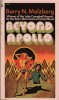
Barry N Malzberg, Beyond Apollo (1972, Pocket Books 1974)

In the real world, the Apollo moon program lasted from 1962 to 1972. Beyond Apollo, first published in 1972, tells what happened next: a failed attempt to land men on Mars in 1976, and then the Venus project in 1981. The immediate aftermath of the latter is the book’s present moment.  Malzberg’s future is our past. If he had been aiming for accurate prediction, he failed miserably. But this isn’t that kind of book.

James Tiptree Jr said of Barry Malzberg: ‘Everybody and everything hurts, for no known reason.’ She could have been giving us an abstract of this book. The main character, Harry Evans, has returned to earth after failing to land on Venus. His fellow-traveller, the Captain, died out there. Evans is probably deranged by whatever happened out there, although possibly his derangement out there led to whatever happened. He gives his debriefers – and us – about ten different versions of events, none of them cheery. Some are obvious fantasy, some probably lies, none is obviously true. He remembers (or fantasises) a lot of unpleasant sex with his wife, and possibly with the Captain. Actually, I probably approached this books thinking I should have read it when I was 14 – science fiction’s ideal reader is supposed to be a 14 year old boy, right? Well, no! I would strongly discourage any 14 year old boy, and a fortiori any 14 year old girl, from reading this. I read the horrible marital rape scenes as somehow parallelling the  mechanistic, soulless nature of the Venus project (Venus//sex, OK?), but they sure weren’t fun to read.

This is probably a very good book. Though there are aliens (possibly invented by Evans, possibly real, who is to know?), the book is not the romp with sexy aliens promised by the lurid cover. Nor is it an easy read. Everybody hurts, including the reader.

Bran Nue Dae

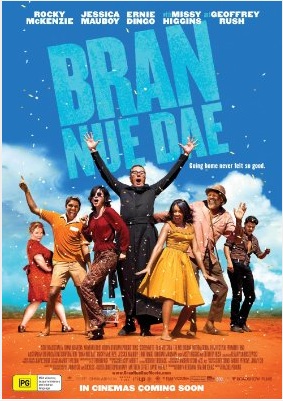
I usually restrict my blogging about movies to little notices in the feed on my right-hand column, but I’m making an exception for Bran Nue Dae because every review I’ve read has been tepid to ice-cold.

I want to shout from the rooftops: BRAN NUE DAE is FABULOUS.

It’s not a ‘well-made film’ – though it’s very well made. It’s funny, occasionally soppy, often sly and certainly capable of making a middle class white viewer like me interestingly uncomfortable. I mean, what is this movie doing when it has me wanting to sing along with:

There’s nothing I would rather be
than to be an Aborigine
and watch you take my precious land awa-ay.
For nothing gives me greater joy
than to watch you fill each girl and boy
with superficial existential shit.

It’s like David Gumpilil in his one man stage show tricking us into laughing at his humiliating arrest for public urination. The politics are clear, the dire consequences of dispossession are never denied, but we’re not being lectured at. We’re invited in, discomfort and all.

Mind you, I don’t know how it got its PG rating: in the first few minutes there’s a song about condom use that has very explicit lyrics, and Deborah Mailman’s, um, sexually active character is a pretty adult concept, I would have thought.

All the performances are terrific. I loved the choreography (and choreographer David Page’s brief appearance on a group shot at the end). I loved the look of it. I laughed out loud many times. Rachel Perkins has pulled it off.

The Bone Man of Kokoda

Charles Happell, The Bone Man of Kokoda (Pan Macmillan Australia 2008)

I’m not one of those people who are fascinated by World War Two. When war comics were all the rage in my primary school, I was off in a corner reading Donald Duck, Superman, Captain Marvel and a sophisticated detective whose name I don’t remember. But lately I’ve been getting myself an education on the subject. My sister-in-law gave me this book on the strength of recent blog entries, and I approached it with a double sense of obligation: it was a Christmas present, and it promised yet another perspective on a subject that had lain unconsidered in my mind most of my life. Obligation rarely leads to enthusiasm, and I started the book with a heavy heart.

It turns out to be a fabulous book, another of those micro-histories described by Judith Keene as making up history – where hers swam against the main current by being traitors, the hero of this one does so by extraordinary loyalty. It’s a man who, having made a solemn promise in his early 20s, dropped everything in his  60th year, not to go into comfortable retirement but to devote the next 26 years to keeping the promise. When his wife and sons objected, he gave them everything – the house, his thriving business, even his antique samurai sword – set out on his mission, never to speak to them again. His daughter, who understood something of what drove him, remained in touch and now looks after him in his old age.

What drove Kokichi Nishimura was the horrendous experience of being part of the Japanese invasion of New Guinea, seeing all his comrades killed in the jungle, mainly on the Kokoda Trail, and returning as part of a defeated force, despised in some quarters for not having suicided according to the code of bushido, and suspect in others because of the well-publicised atrocities committed by the Japanese forces. What do you do with the rest of your life after that? How do you live when you have fought in the battle of Brigade Hill at the age of 22, in kill-or-be-killed hand-to-hand combat:

Nishimura’s wounded arm was useless, but he drew his sword with his left hand and thrust it at the Australian’s chest; it hit a rib and stopped. The Australian grabbed the sword’s blade with his bare hands and kicked Nishimura in the stomach. The Japanese fell on his back and the sword went flying.
Noticing his enemy’s face up close, Nishimura was struck by how young the Australian was … For a moment, he thought: Why am I fighting this boy whom I don’t even know? But in the next instant he realised he would be killed himself if he didn’t get to his feet and tackle the Australian.
Nichimura launched himself again at the bigger man. Somehow, in the ensuing struggle, he regained his sword from the ground and this time drove it into the Australian’s stomach. The soldier pierced the air with a wail that sounded like an air-raid siren as he fell down, and slipped into unconsciousness. It was a chilling scream that Nishimura never forgot.

Some survivors committed ritual suicide. Many, possibly the mainstream, embraced the new pacifist Japan and tried to forget the war. Some foment rightwing nationalist politics. Nishimura’s path is strikingly individual. He promised his dead companions that he would return to honour their remains, and since 1966 his life has revolved around an uncompromising quest to keep his word, to bring families of the slain, if not the remains of their bodies for burial, then emotionally significant mementoes – a lunchbox, a flag, in one case a rusty pump. As a corollary, he invested his time and resources into projects to help the locals in the places where he conducted his search – building a school, bulldozing roads, helping people get training and set up enterprises.

He’s a fascinating man, a lesson in integrity. And the book is all the more fascinating because written by an Australian. Maybe the ghosts of the Pacific War are on the way to being laid to rest.

—-

Fortuitous’ watch:

My current favourite mystery word makes two appearances in this book.

On page 86, Nishimura sustains nasty damage to his right leg when his ship is sunk by a US torpedo:

In a way his injury proved fortuitous. It meant he could again rest up in hospital and eat regular meals.

And on page 151:

He had relied heavily, too, on the fortuitous windfall he received from the sale of his parcel of land in Kochi.

In the first quote, ‘fortuitous’ clearly means ‘lucky’. It could be replaced by ‘fortunate’ with no change to the meaning. Or perhaps it has a slightly greater emphasis on the arbitrariness of the good fortune. Whichever, it’s used in a way the dictionaries recognise, though some still frown on it.

In the second, the word could almost have its pure, pedant-approved meaning, ‘happening by chance’, though paired with ‘windfall’ it is completely redundant if that’s what it means. It only adds meaning to its sentence if we understand it to mean ‘especially fortunate’.

Puppies

Puppies (Snapshot series, Hinkler Books 2008)

I couldn’t find a photo of this little book’s cover online, so you’ll have to take my word for it that it’s very cute. The publisher’s site gives its ‘interest age’ as 6–12 years. I can report that the interest extends well beyond that, though I suppose a notice saying ‘Interest Age: 6–12 years and the demented’ wouldn’t sell many books.

But this book has featured in many pleasant interchanges with Mollie in the nursing home. Yesterday morning, it was sitting in the middle of her table. She gestured towards it with fluttering fingers. Though it was pretty much the same gesture that she’d used towards the piece of buttered raisin bread the nurse had given her with a piece of kitchen tongs, and which she had no intention of putting anywhere near her mouth, I interpreted her to mean that she wanted to look at the book. I placed it right in front of her, closed. With some difficulty, she opened it, and said, in he fluttering voice, ‘That’s funny.’ I was sitting on her left, and had to stand and peer over the half-open cover to see the page she’d opened to. It was the end papers, plain green except where someone had printed her name in block letters. She touched her first name with an index finger and said, half questioning, half marvelling, ‘Mollie.’ And if that lovely moment wasn’t enough, when we reached page five or so, where there is a lot of text, she touched the last word on the page, and read it too, only sightly more tentatively, ‘Puppies.’

It may not have intellectual heft of her reading of twenty years ago, but it looks to me as if there’s still pleasure to be had in reading at her intellectual limit.

Pudding Lane

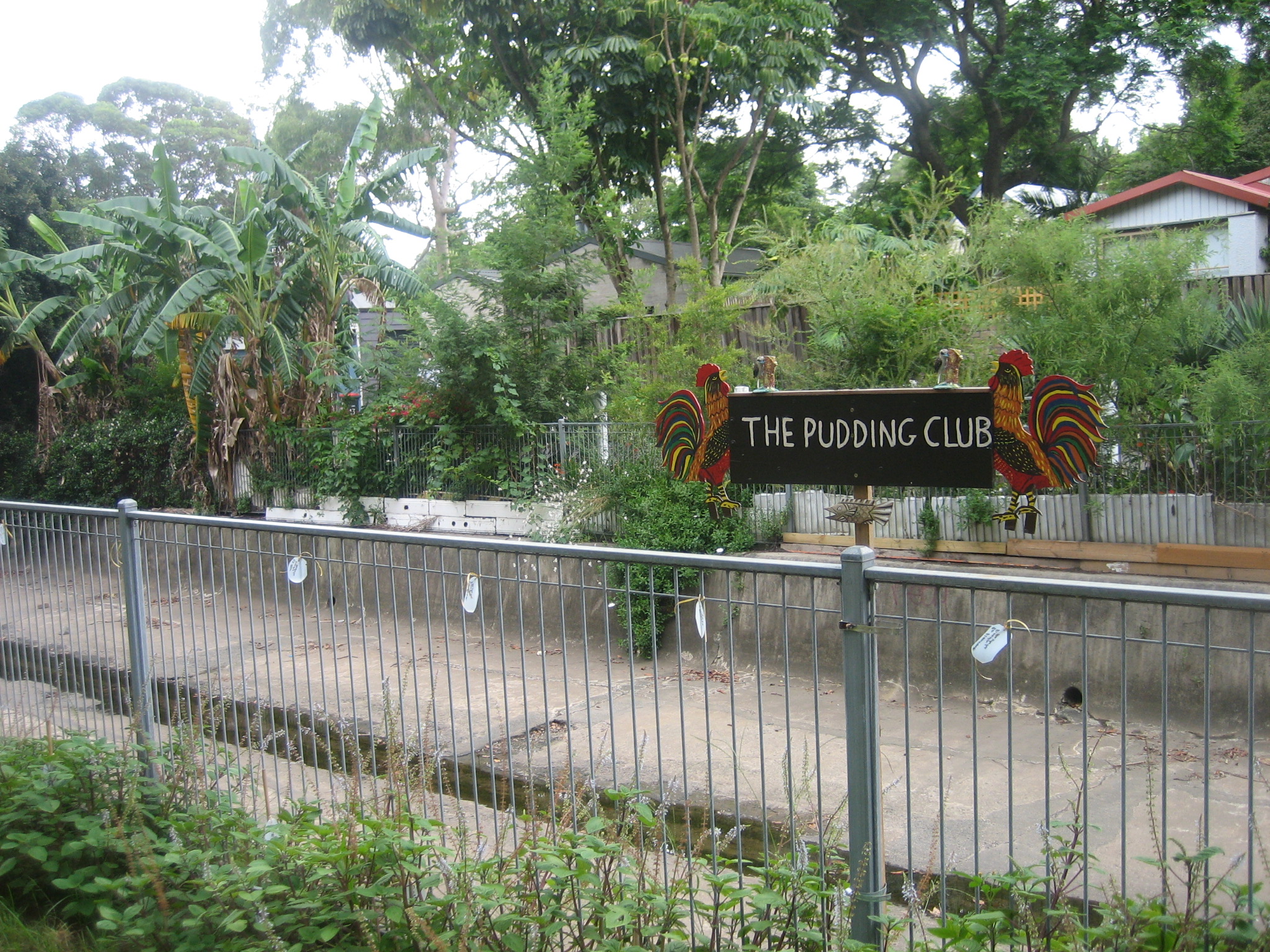
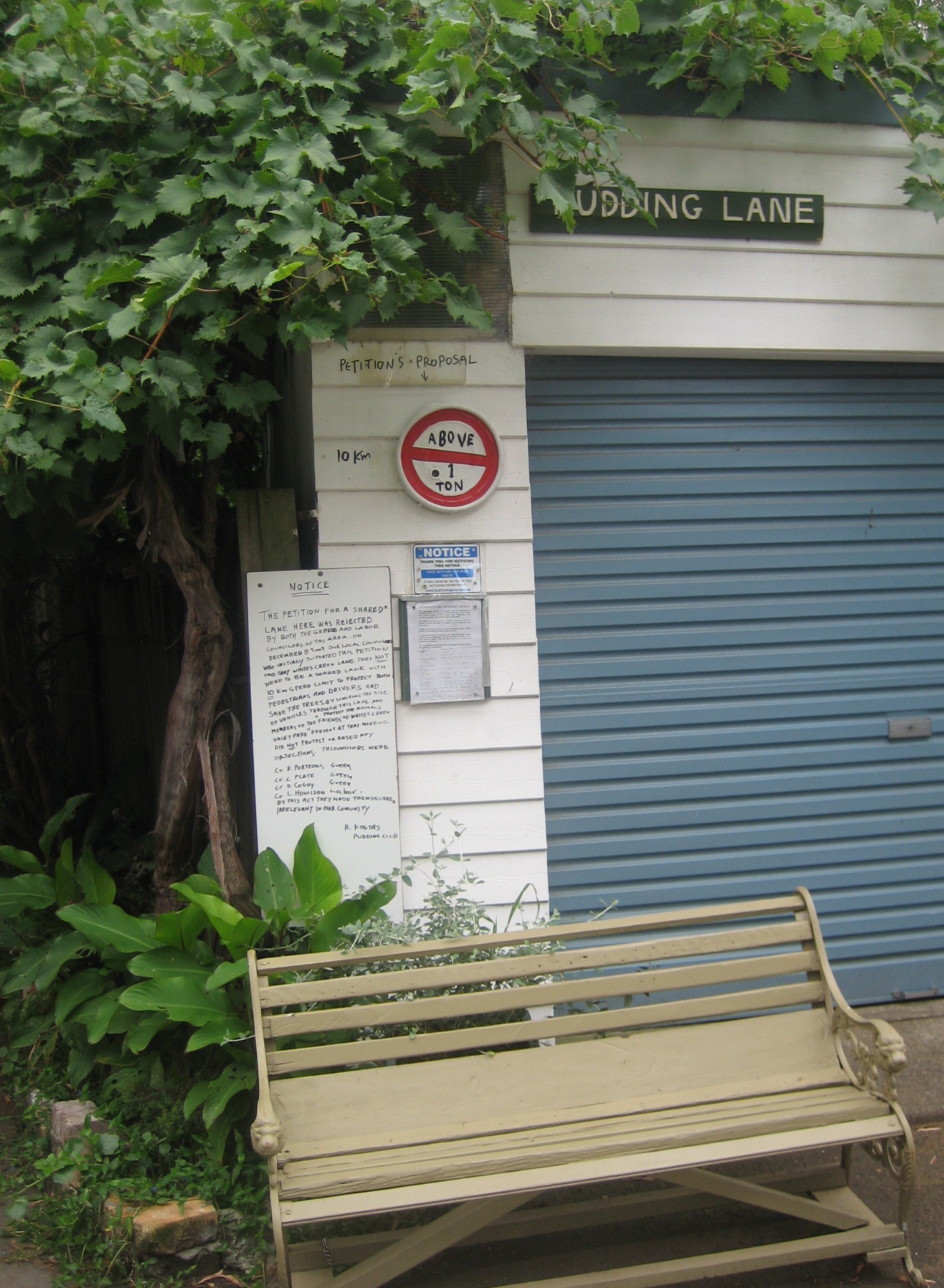
Kostas is one of the stars of Gillian Leahy’s exquisite little documentary Our Park. In the film, though not in the clips at the link, we see a little of his project of establishing a community garden along Whites Creek Lane. At one point, he says that his many plantings will stop dogs from slipping under the fence and into the canal – and is immediately given the lie by a shot of a dog doing exactly that. The laughter is good natured, but Kostas’ project comes off looking less than practical.

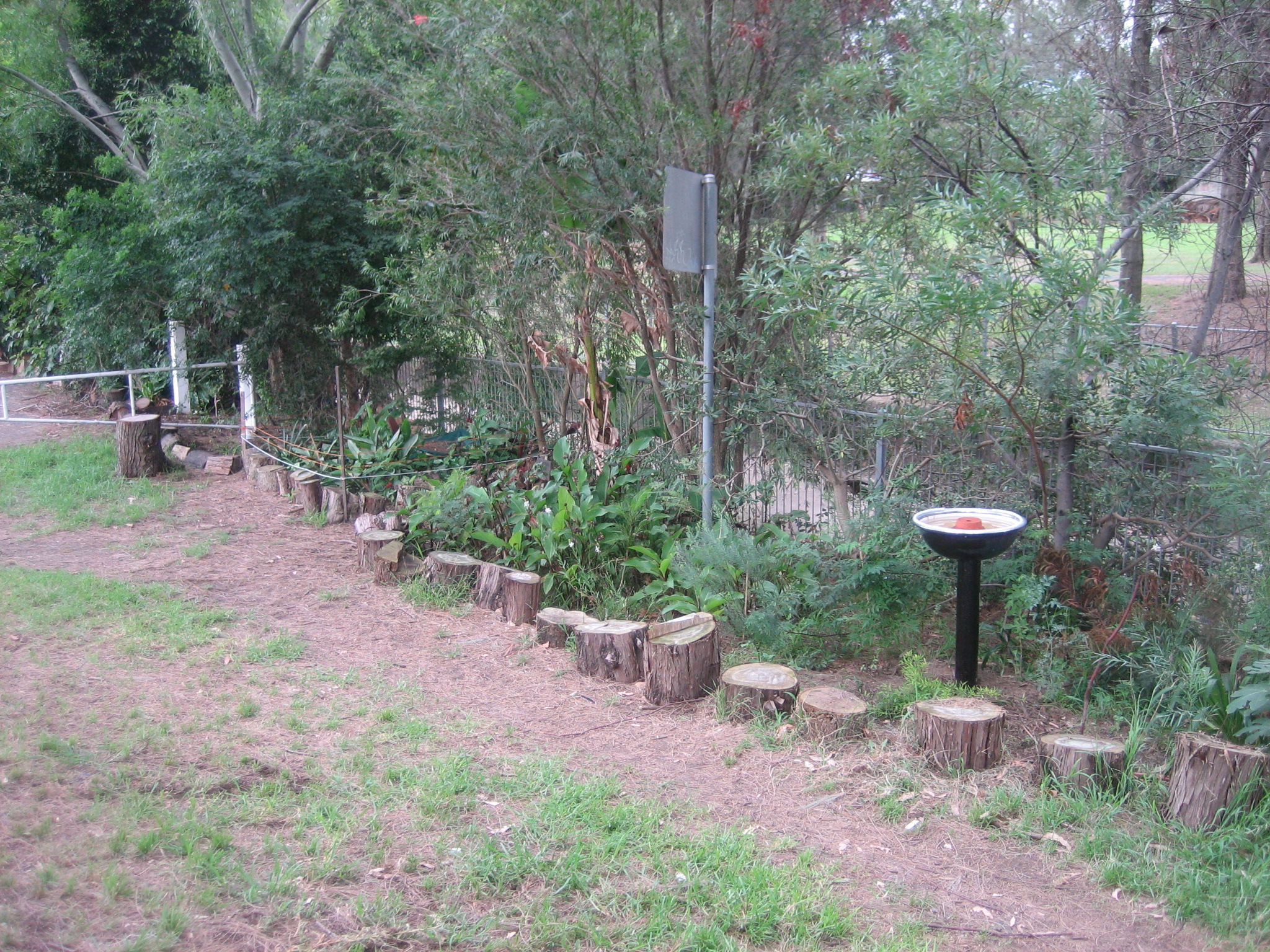
Eleven years later, the lane is transformed into a leafy garden, and Kostas presides over the Pudding Club, whose primary school student members spend a couple of hours each weekend watering, weeding, composting … and eating cakes cooked by Kostas. There are pomegranates, olives, stone fruit, birdbaths and dog watering holes. The plantings and edgings continue into the park to the north of the lane, and there are seedling gum trees planted across the canal. A recent application to have the lane declared a shared zone with a 10 km/h speed limit was rejected by Leichhardt Council, but by sheer hard work and personal charm Kostas has created something special.

A Life Like Other People’s

Alan Bennett, A Life Like Other People’s (Profile 2009)

Probably inspired by the success of Alan Bennett’s little hardcover, The Uncommon Reader, the publishers have given us this physically similar book. But where the earlier was a whimsical piece in which the Queen discovers reading for pleasure, with mildly catastrophic results, this is perfectly serious memoir. Originally published as part of the 650 page volume Untold Stories, it explores the themes of family secrets, depression, dementia and suicide in the lives of Bennett’s grandparents, parents and aunties. It’s a testament to his skill, and to the depth of his affection for his family, that for all its grim subject matter the book is a joy to read. The prose is unfailingly urbane, and he manages to convey multiple perspectives with apparent ease: for example, when one of his aunties (a term whose class connotations he carefully spells out) decides to take apart his mother’s stove to give it a thorough cleaning, we are amused at the spectacle of Bennett’s father flying into a rage (a very uncommon event) at this dire insult to his wife, and at the same time we realise that it was a dire insult.

Perhaps partly because I’ve tried something similar in the predecessor of this blog, I was taken by his attempt to convey the conversation of a demented aunty. His description is quite long, but this little bit may give you an idea, both of its truthfulness and of its elegance:

Embarking on one story, she switches almost instantly to another, and while her sentences still retain grammatical form they have no sequence or sense. Words pour out of her as they always have and with the same vivacity and hunger for your attention. But to listen to they are utterly bewildering, following the sense like trying to track a particular ripple in a pelting torrent of talk.

As I was reading, I found myself thinking of AD Hope’s lines about Yeats (see, the poems you study in your youth hang around in your brain forever): ‘To have found at last that noble, candid speech / In which all things worth saying may be said’. It’s not exactly the same thing, but it seemed that Bennett could write about a huge range of  human experience without his prose ever stumbling. We know, for instance, the kind of emotional tumult involved in the experience referred to in this sentence: ‘While sexual intercourse did not quite begin in 1974 it was certainly the year when sex was available pretty much for the asking … or maybe I had just learned the right way to ask.’ What did Freud say about jokes? Not that this is unconscious – on the contrary. And it’s not that he’s hiding anything. It’s just that the prose is not about self-revelation, but about elegant, usually witty communication. I wasn’t sure this was entirely a good thing, whether a little raw emotion mightn’t have made a more interesting book. But he was ahead of me. Towards the end of the book, when Bennett’s mother, after decades in and out of psychiatric institutions, ECT, is in advanced dementia in a nursing home, he winces at the way the employees address her, calling her loudly by a diminutive that was never hers, kissing her lavishly, who was always physically reserved. He observes with irritation that his mother seems to enjoy it, and goes on:

But then taste has always been my handicap, and so here when in this sponged and squeegeed bedroom with an audience of indifferent old women I do not care to unbend, call my mother ‘chick’, fetch my face close to hers and tell her or shout at her how much I love her and how we all love her and what a treasure she is.
Instead, smiling sadly, I lightly stroke her limp hand, so ungarish my display of affection I might be the curate, not the son.
The nurses (or whatever) have more sense. They know they are in a ‘Carry On’ film. I am playing it like it’s ‘Brief Encounter’.

There are photos of the Bennett parents scattered throughout. Almost as much as the prose, they convey the deep current of love that flows through the book.

Did I mention that it’s very funny?

Fourmillante Sydney …

… Sydney of dreams …

Last night we spent a couple of hours in the city for the first night of the Festival of Sydney. We saw:

  • thousands of people in a good mood, many sporting little electric fans that somehow lit up with an ad telling us to switch to a sponsoring bank
  • the fig trees in Hyde Park sporting ornate trunk wraps
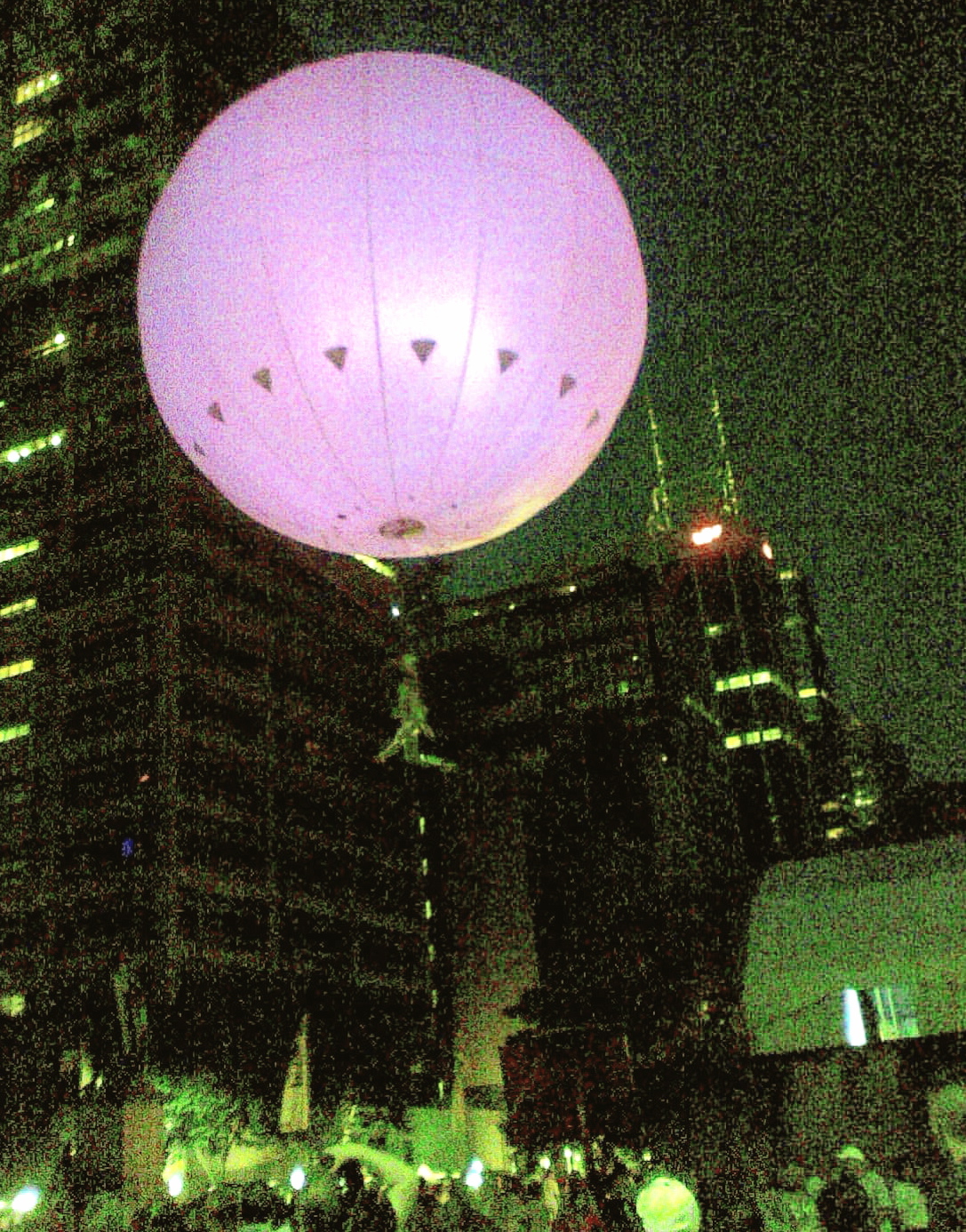
  • a spangled woman floating beneath a giant balloon outside the Barracks Museum, who dived in slow motion to touch fingers with a little girl sitting on her father’s shoulders

  • kaleidoscopic images lighting up the wall of the law courts building
  • a hundred saxophone players belting out a tune from the upper and lower verandahs of the Mint Museum
  • twenty bagpipers playing ‘Amazing Grace’ from the front of Parliament Building
  • Black Arm Band singing ‘Treaty’ in the Domain, and even though we were half a kilometre away from the stage they really did the business (Al Green, the main act, didn’t reach as far back as us in quite the same way)
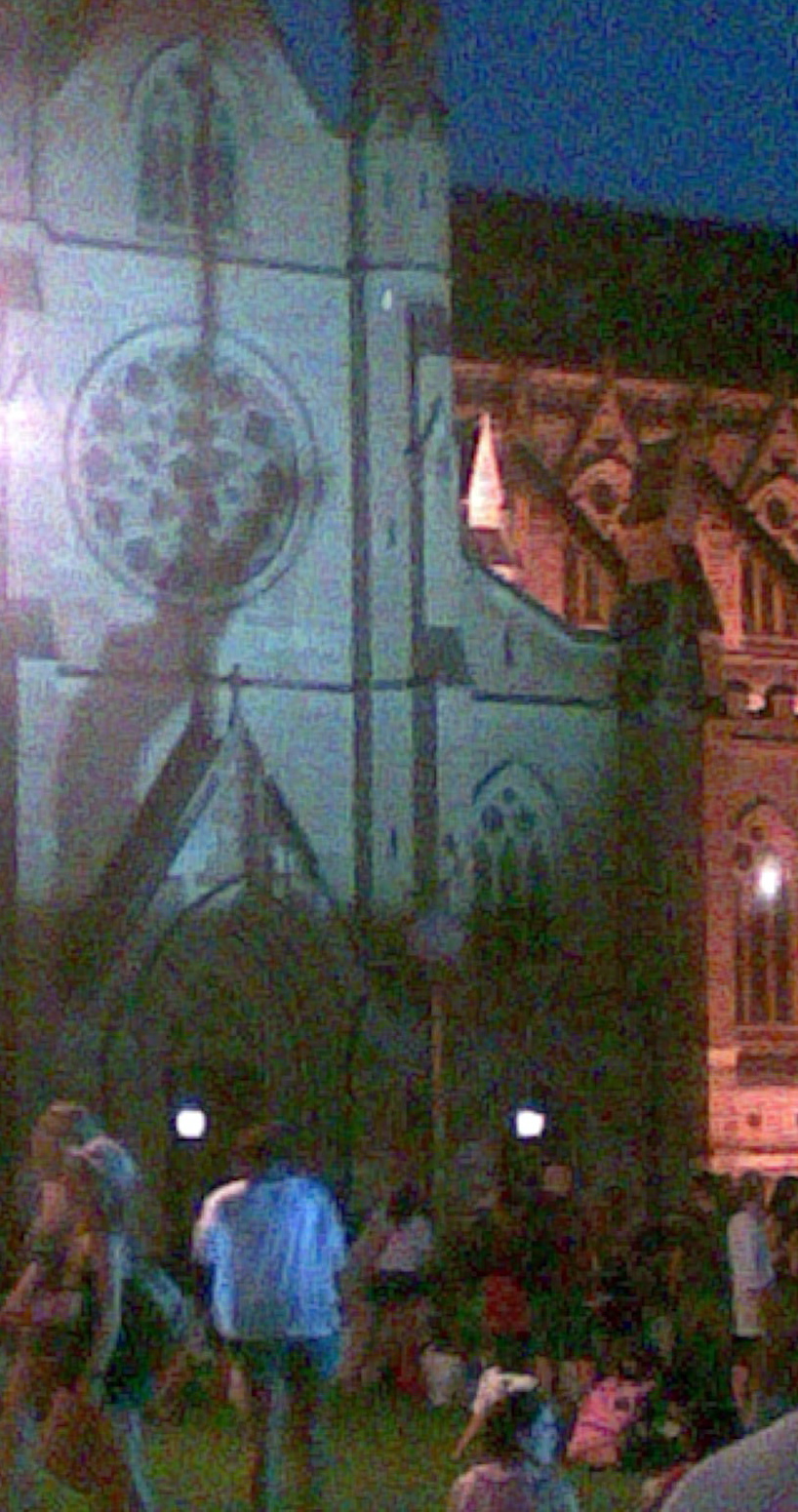
  • aerialists throwing weird shadows onto the western façade of St Mary’s Cathedral

  • A fabulous band called (I’ve just looked them up on the Festival web site) Big Bad Voodoo Daddy doing ‘Minnie the Moocher’ in Martin Place, which was packed even tighter than the Domain

I don’t have high expectations of these kinds of giant parties, particularly since being vomited on by a stranger at Darling Harbour one New Year’s Eve 25 years or so ago. Last night was like a good dream, or a dozen of them at once.

Treason on the Airwaves

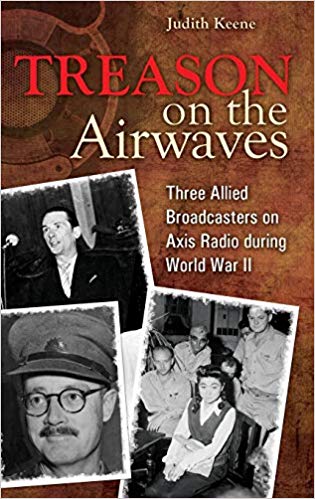
Judith Keene, Treason on the Airwaves: Three Allied broadcasters on Axis radio during World War II (Praeger 2009)

An Englishman, an Australian and an American walk into a courtroom … It could be the start of a joke, but in this case it’s a fascinating study of three very different people who were charged with treason for their activities as radio broadcasters for the Axis powers, and the three very different ways their nations dealt with them. The subjects are John Amery, whose broadcasts for the Nazis included nasty anti-Jewish rants, Charles Cousens, who broadcast for the Japanese and expected (in vain) his Australian listeners to discern deeply embedded messages that would help in the war effort, and Iva Toguri, one of the 50 000 (yes, so many!) nisei trapped in Japan in 1941, who broadcast as Orphan Ann but was tried as Tokyo Rose.

Judith Keene says in her introduction that ‘the big patterns of history are made up of a great many micro-histories, individual stories, writ small and smaller’. The stories of individuals accused of treason must be one set of micro-histories that tests the big patterns: much as we might want the famous footage of the man dancing in Martin Place to represent the whole meaning of the Victory in the Pacific for Australians, there was a lot more going on than that. Along with the sheer joy that the War was over, in Australia as in Britain and the USA there was also quite a bit of racism-inflected vindictiveness around, for which these treason trials provided a conduit.

All three stories are fascinating, but Iva Toguri’s fills me with almost evangelical zeal. She was born in the USA, and was a cheerful, outgoing child and adolescence. Like many nisei, she identified as American, and her parents organised to send her to stay with relatives in Japan so she could learn Japanese language and culture properly. After the attack on Pearl Harbor, she refused to renounce her US citizenship and, cut off from her parents as a source of funds, found what work she could in a Tokyo where her US status was certainly not an advantage. As a typist in Radio Tokyo, where her fluency in English was valued, she took pity on the wretched US and Australian POWs, slipping them food and blankets at some risk to herself, and because she had a rich deep voice was soon invited across to be an announcer on Zero Hour, a program beamed out to Allied troops in the Pacific, consisting mainly of popular US music. Cutting a long story short, at the end of the war, while thousands of nisei who had renounced their US citizenship were readmitted to the US without question, at the prompting of the 1946 equivalents of today’s shock jocks, she was arrested, tried for treason in a process that was later shown to be unambiguously corrupt, imprisoned for decades, further harassed and humiliated on her release and then pardoned. Someone ought to make a movie about her. (And having written that last sentence I went googling and found that there is a movie in the works, to be directed by Frank ‘Shawshank Redemption‘ Darabont from a screenplay by Christopher Hampton.)

Judith is a friend of mine, so I might not have mentioned this next thing if Richard Walsh hadn’t done so at the launch in April: the book is dreadfully edited, to the point that the regular bloopers become a significant distraction. In the very first paragraph of the introduction, a punctuation error renders the second sentence close to nonsensical. ‘Grey’s Elergy‘ (two spelling errors) and ‘the dye was conclusively caste’ (two spelling errors and a redundancy) are not atypical. I’m very glad that Praeger Press of Connecticut published the book, but anyone who commits their manuscript to them should be warned that the detail of your text is not in safe hands. Anyone who wants to know what a line editor does will find this book instructive: the things that make it hard to read are the things an editor would have fixed. However, I recommend that you treat the frequent blemishes as you would mosquitoes on a bushwalk: irritating, but not enough to make you turn back.

Eliasson’s Lights at the MCA

We visited the MCA again yesterday, this time to see the Olafur Eliasson exhibition. The most interesting things there – apart from the room where we were invited to build things in white Lego and to admire the extraordinary creations of those who had come before us – were his pieces made with light. I was probably a bit spoiled for them by having seen James Turrell’s work in Naoshima (blogged about here and here), where the thoughtfully reverential treatment allows the work to become almost numinous. In the MCA, for example, the 360º Room for All Colours, in which a circular wall becomes something like a domestic-sized Aurora Borealis (Eliasson is from Iceland) might have had that effect, but the chatter from the Lego room, the attendant’s helpful explanation of technical matters, and the intrusive detail of the floor and the room beyond the ‘room’ (unlike the polished blankness of the floor in the photo on the MCA site) allowed in too much mundanity, and the room felt to me like a clever novelty. ‘Take your time’ was the title of the exhibition, but there was little in the presentation to enforce that injunction.

Except in the piece entitled ‘Beauty’. In a black-lined room a fine spray of water fell from the ceiling, in light from a single directed bulb. In a very slight breeze, perhaps caused by our movements, the water fell in gentle arcs, catching and refracting the light like a shimmering, almost mother-of-pearl curtain. As I was standing in the dark at the back of the room, three women walked in. Something about their manner emboldened me, and I said, ‘Walk into it.’ And they did. It looked great – the curtain completely vanished for a moment, then reformed. Then I discovered for myself that when you walked into the mist, a circular rainbow formed around you.

There were other lovely things in the exhibition, but I wanted to make sure I told you about that.