Eliasson’s Lights at the MCA

We visited the MCA again yesterday, this time to see the Olafur Eliasson exhibition. The most interesting things there – apart from the room where we were invited to build things in white Lego and to admire the extraordinary creations of those who had come before us – were his pieces made with light. I was probably a bit spoiled for them by having seen James Turrell’s work in Naoshima (blogged about here and here), where the thoughtfully reverential treatment allows the work to become almost numinous. In the MCA, for example, the 360º Room for All Colours, in which a circular wall becomes something like a domestic-sized Aurora Borealis (Eliasson is from Iceland) might have had that effect, but the chatter from the Lego room, the attendant’s helpful explanation of technical matters, and the intrusive detail of the floor and the room beyond the ‘room’ (unlike the polished blankness of the floor in the photo on the MCA site) allowed in too much mundanity, and the room felt to me like a clever novelty. ‘Take your time’ was the title of the exhibition, but there was little in the presentation to enforce that injunction.

Except in the piece entitled ‘Beauty’. In a black-lined room a fine spray of water fell from the ceiling, in light from a single directed bulb. In a very slight breeze, perhaps caused by our movements, the water fell in gentle arcs, catching and refracting the light like a shimmering, almost mother-of-pearl curtain. As I was standing in the dark at the back of the room, three women walked in. Something about their manner emboldened me, and I said, ‘Walk into it.’ And they did. It looked great – the curtain completely vanished for a moment, then reformed. Then I discovered for myself that when you walked into the mist, a circular rainbow formed around you.

There were other lovely things in the exhibition, but I wanted to make sure I told you about that.

December niece news

Since I seem to be posting regular notes about nieces, perhaps I should explain: I’ve got eight of them, and five of the eight have lived, or at least stayed for a while, with us over the years. Every one of them is a source of great joy. A number of them are meeting with a degree of success as writers and artists, and I’m shamelessly putting my blog to work as part of their publicity machines. (We have seven nephews, sources of no less joy, who have so far been more or less avoiding the need for publicity.)

Paula Shaw, whose memoir Seven Seasons at Aurukun received quite a bit of attention earlier in the year, and not just from me, popped up again in Inga Clendinnen’s article in the December Australian Literary Review. Although the article itself has attracted aspersions from Guy Rundle in Crikey, the reference to Seven Seasons as ‘a brave and honest book’ stands uncontested. Thanks to my avuncular Google Alert, I also came across a number of reviews by teachers – on the publisher’s web site, and a review by an Aboriginal reader who has the most negative response I’ve seen so far, identifying a ‘heart of darkness vibe’, but says all the same that it would be a ‘good read for anybody interested in contemporary life in an Aboriginal community in Australia’.

Meanwhile, Paula’s sister Edwina Shaw has been gracing the pages of the Griffith Review for a couple of years now – and grace is the right word for it, even though her stories deal with dark themes set in Joh-era Brisbane. She has a story in the current issue, along with Frank Moorhouse, Louis Nowra and other luminaries. She also has a story, about different youth altogether, in the current (Winter) edition of the Asia Literary Review, sharing the contents list with among others Henning Mankell.

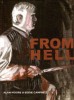
From Hell

Alan Moore & Eddie Campbell, From Hell (Top Shelf Publications 2000)

Each of my sons gave me a big comic for Christmas. I’ve already posted a note about R Crumb’s Genesis. From Hell, in which Alan Moore and Eddie Campbell tackle Jack the Ripper, makes an interesting companion read. Both books have ample sex, violence and uncanniness. Both deal in multiple versions of the same events. Both feature self portraits by the illustrator that are charmingly at odds with the rest of the book (Crumb on the dust jacket flap in his ‘lounge pants’; Campbell in an Appendix as a gangly stay-at-home dad). And both have notes up the back that exert a fascination of their own.

I’m not particularly fascinated by Jack the Ripper. In my teens I read what must be one of the few books on the subject not mentioned in the appendices of this one, The Identity of Jack the Ripper by Donald McCormick (what’s the good of keeping these records if you can’t trot them out occasionally), in which Jack was revealed to be the Prince of Wales, and that was enough for me. Alan Moore, by contrast, has immersed himself in Ripperology and hammered it into a vast, complex web of story, incorporating court records, newspaper accounts, speculation, rumour, architectural history, literary history, Masonic ritual, unexpected historical connections and just plain invention, with appearances by Queen Victoria, William Blake, William Morris, Aleister Crowley, Hitler’s parents – the list goes on. I can’t say it was a pleasant read, but it’s a very impressive one. Likewise Eddie Campbell’s art (in this book) is rarely pleasant, but it’s darkly powerful. There’s a lot of hatching, and it’s often hard to tell exactly what is being shown – which at he more grisly moments is a great blessing!

I started out reading the main narrative in tandem with the notes that constitute the first appendix, but gave up about a third of the way in, because the plethora of information about sources was slowing the story down terribly. However, it’s good to know how little of the narrative is pure invention on Moore and Campbell’s part, and I’m reasonably sure that without the notes some bits of the story would have remained completely mysterious to me. And there’s one fabulous twist in the tail that would certainly have bypassed me if the last couple of notes (I skipped to the end) hadn’t first told me that the ‘scene on page 23’ was cryptic, second told me to work it out for myself, and third given me a big hint that transformed the meaning of one of the many subplots into something almost redemptive.

In the first few pages, a convenient warning to parents to put the book on a high shelf, there’s a sex scene that exemplifies Eddie Campbell’s genius by managing to be very explicit (by which I mean anatomically specific), not at all soft-focus prurient, and also joyful. This scene is what sets the whole ghastly plot into action, which according to one school of Biblical interpretation brings me back to the similarities to Genesis.

In short, I don’t know who I’d recommend this book to, but it’s very good.

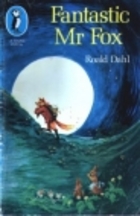
Fantastic and not so fantastic Mr Fox

Roald Dahl, illustrated by Jill Bennett, Fantastic Mr Fox (1970, Puffin 1974)

I came out of  Wes Anderson’s Fantastic Mr Fox wondering if I oughtn’t reconsider my devotion to the cinema. The film is brilliant, witty, beautifully performed all round, and – for me – a totally pointless experience. Was this like the moment when a 12 month old child decides that the breast is history? (That moment in the life of one of our sons, incidentally, happened in the cinema: he wouldn’t accept his mother’s breast and insisted on crying loudly. The movie was The Turning Point. True.) Then I remembered my last five outings to the pictures, and I’m looking forward to the next sip of mother’s milk. I did, however, feel the need to read Roald Dahl’s book on which the film was based.

Though in my days as a young parent I was a Dahl fan, I hadn’t read Fantastic Mr Fox, but we have a copy stashed away. I dug it out. Sure enough, it seems to me that Wes Anderson kept the story outline, elaborated it with myriad Hollywood tropes, and missed the point. Specifically, the movie completely missed that Dahl’s story is deeply and deliciously ironic. It takes place in rural England, and depends on the reader knowing that farmers are generally decent people who work hard to provide food for our tables: farms are benign places, and foxes are pests who savagely murder poultry that’s meant for us to eat. With that basic assumption in mind, underlined in this Puffin edition by Jill Bennett’s drawings of a classic idyllic countryside, Dahl opens his narrative with pen portraits of three physically grotesque, gluttonous and generally vile farmers, and a fox whose nightly depredations are portrayed as the behaviour of a responsible, loving husband and father. He draws on the folk tradition of the fox as clever, and uses the sneaking sympathy for foxes that is all through children’s literature as a lever to turn the moral order on its head. The book is subversive, shocking in a delicious way and, as the farmers become more murderous and the fox cleverer in outwitting them, it’s also jolly good fun. It’s like a vulpine Peter Rabbit.

Maybe in these days of vast chicken factories it just doesn’t make sense to demonise small farmers, even as ironically. or maybe that irritating commonplace that Americans don’t do irony (that link is to a particularly irritating example) has some truth to it after all, given that I would have thought Wes Anderson was one of the best counter-examples. Whatever the explanation, the farmers in the movie are not only grotesque, gluttonous and generally vile, they are immediately recognisable as representing rapacious industrial capitalism: their ‘farms’ look like combination gasworks and concentration camps. These are awfully familiar villains. Dahl’s fox talks and wears clothes, but his behaviour is fox-like – he lives in a hole, has four barely differentiated cubs – so that there’s an appeal to the (young and other) reader’s knowledge about actual foxes and their actual status as pests. Anderson’s fox lives in a tree with all mod cons, writes a newspaper column, has to deal with a ‘different’ adolescent son. He’s as much as fox as Mickey is a mouse.

All this doesn’t necessarily matter in itself. If Fox and his underground friends are trapped in a sewer with archways and electric light rather than a deep hole they’ve dug themselves, and find their salvation in a vast supermarket filled with frozen and canned food rather than among the living or freshly killed poultry on the farms themselves, it’s just a different story, isn’t it? Well, yes. Different, and duller. Much of the original text survives, but in my opinion it loses everything, its ironic lifeblood drained out and replaced by clever-dick formaldehyde.

If you’re planning to go to this movie, and especially if you’re planning to take a young person to see it, I urge you to read the book, or read the book to the young person, first.

2009

By way of quick and dirty retrospective, here are the first sentences from my blog (or really blogs, as I changed platforms and name in May) for each month of the year. It’s a meme, picked up from The Couch Trip.

1 January:
I just found out from the nice people at Wikipedia that the Catholic Church no longer celebrates 1 January as the Feast of the Circumcision of Our Lord, and hasn’t done since 1960.

1 February:
Penny said I had to blog this, even though I was so bowled over by it that I lost track of how I came upon it, so can’t give proper credit. [It’s a lovely bit of Obamiana.]

3 March:
Yesterday was a big one for the Shaw family. [My niece Paula’s book launch.]

1 April:
Last October I posted a little entry about Nicolas José’s address at the NSW Premier’s History Awards, in which he spoke of the Macquarie PEN Anthology of Australian Literature, due for publication in August this year, and mentioned Taam Sze Puy’s bilingual memoir, My Life and Work, published in Innisfail in 1925.

4 May:
A couple of nights ago I had a hugely reassuring phone call from one of the editors of a literary magazine that has accepted a couple of my poems.

1 June:
L K Holt’s man wolf man won the Kenneth Slessor Award this year.

1 July:
I’ve been slack in my self-imposed duty to be a blog of record – that is, to keep you informed about what I get up to by way of going out to stuff in the evenings, often stuff you won’t hear about from the newspapers.

4 August:
Last night my men’s group book group met to talk about Anna Karenina (Anna Karenin, as she’s called in the secondhand copy I bought on Monday), and an excellent evening it was.

3 September:
I haven’t exactly managed a daily post as we walked through the Loire Valley: points d’internet aren’t exactly common and those I have found, when they functioned at all, have had keyboards that drive me crazy.

2 October:
I was on a bus in Connecticut in August when Penny texted me from the airport in Sydney to tell me Yasmin Ahmad had died.

1 November:
This afternoon we visited the White Rabbit Gallery in Chippendale, and then went on to Object Gallery to see their part of the exhibition Menagerie.

1 December:
I don’t suppose many people would see an item about youth suicide in Queensland as a good news story, but this story in today’s Sydney Morning Herald marks my niece Kym’s first byline in a major newspaper.

So this year, I’ve been published, and so have my nieces. I’ve travelled, with Penny and without her. People have died. I joined an all-male book group. I’ve tried to blog about all my reading, gallery-going, lecture-attending, and my reading has been, um eclectic –100 books by my count, including comics like Watchmen and revisited children’s books. Obama and Rudd have continued to inspire and disappoint. The past has continued to surprise.

I’m setting this to upload at a minute after midnight. I intend to be sound asleep in a single bed by then, with Penny, sick and infectious with the flu, sleeping in our bed a room away.

Happy 2010!

I hope he’s now working on Exodus

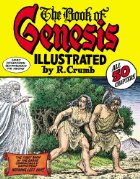
R Crumb, The Book of Genesis Illustrated (Jonathan Cape 2009)

On the dust-jacket flap (yes, I read it in hardback, it was a Christmas present) we’re told that Crumb originally intended to do a ‘take-off of Adam and Eve’, but found himself so fascinated by the thing itself that the project transformed into this – a comic version of the whole book of Genesis, ‘NOTHING LEFT OUT!’ Being a bit slow on the uptake, I was still expecting that somehow this would be a crude and raunchy telling, a version for the irreligious.

Nup! It’s a straight graphic-novelisation. Admittedly, Crumb doesn’t shy away from the text’s abundant sex, violence and general skullduggery, but he doesn’t linger on it or portray it in lascivious detail. In fact, he has a couple of pages of lucid notes up the back proposing explanations for some of the more puzzlingly lurid behaviour of Abraham and Isaac, some of them drawing on feminist biblical scholarship (yes, that’s right, the creator of Fritz the Cat reads and refers his readers to feminist biblical scholarship).

My elder son, who is shamefully ill-informed about the foundational Judaeo-Christian texts, read the first few pages, and for the first time was full of questions about matters Biblical. I imagine some religious people might find the book a bit confronting, but if they were honest they would probably admit to finding it confronting even without Crumb’s contribution.

Arty sunny afternoon

Confounding the predictions, yesterday gave us deep blue skies all day. Two loads of washing dried on the line, the goldfish glowed in the murk of our little pond, and P and I took the light rail to Pyrmont and walked to the MCA.

There was a charge for Danish–Icelandic artist Olafur Eliasson on the third floor, and a friend had been pretty lukewarm about him, so we decided to save our money (unusual for this time of year, I know) and visit it some other day. But the first, second and fourth floors fabulous enough.

The first and second are exhibiting a recent gift from Ann Lewis, an art collector so famous that even I had heard of her. It was wonderful to see shimmering works by Utopian ladies Emily Kame Kngwarreye and Gloria Petyarre, among other Aboriginal artists, displayed in the company of US big names Rauschenberg and Klippel  – Gloria Petyarre’s canvas filled with shimmering silver leaves is the single image that most grabbed me. There’s a little room of lovely photographs by Jon Lewis. Any relation? Well, yes, if the handwritten ‘For Annie (Grannie)’ written in the bottom border of one image means what it appears to.

Half of the fourth floor is given over to Forbidden, ‘the first in-depth solo exhibition’ of Fiona Foley’s work . Now, I am often impressed, bemused, amused or depressed by contemporary art, but I don’t often have a strong head-and-heart response. I did have to this exhibition. For example, the word Dispersal in big, chunky shiny aluminium letters, of which the initial D bristles with .303 bullets is a lot more than a clever reminder of the hideous use of that word in our colonial history. It stands next to a spiral of flour about three metres across, that needs constant attention from an attendant to maintain its crisp shape; the flour turns out to be part of an installation ‘Land Deal’, in which other objects representing those John Batman used to ‘buy’ the land where Melbourne was built hang on the wall. Nearby hangs a row of blankets, each inscribed with a single word, that conjure the experiences of Aboriginal women under colonialism. Elsewhere Foley places herself in photographs with titles like ‘Native Blood’ and ‘Modern Nomad’, that refer strongly to nineteenth century anthropological images. Evidently, earlier exhibitions have had titles like ‘Lick my black art’. Ok, lick it and weep.

The rest of the floor showcases new acquisitions. There’s a cute hologram that was popular with the very young (and others, including me), which could have been titled ‘Ghost Train’, but instead is called ‘You’re not thinking fourth dimensionally’. Danie Mellor made the cut with a sculpture that includes a shiny, mosaic kangaroo and a lifelike sulphur-crested cockatoo. I loved a video piece by Grant Stevens, in which an account of a dream is projected onto a wall in a way that controls the speed at which the viewer reads (or fails to read, because the pace picks up enormously in the middle).

Then we walked back to Pyrmont along the Hungry Mile, trying to figure out Paul Keating’s proposal for Barangaroo, and home to find the washing dry on the line.

SOS from three worlds

Murray Leinster, SOS from Three Worlds: Super-Medic for Interstellar Catastrophes (Ace Books 1966)

This book contains three stories in which interstellar medic Calhoun and his cute furry alien sidekick Murgatroyd visit farflung planets and foil evil or foolish plots involving major medical crises. They are straightforward space adventures with a touch of comedy and just enough space-tech stuff to reassure. The story is the thing. I suspect they’re the kind of stories that were killed by television, supplanted in the lives of young readers by the likes of Star Trek and Doctor Who. I mourn their passing.

According to the blurb, Murray Leinster (real name Will F Jenkins) had been writing science fiction since the early 1920s, and his work had appeared in many magazines, ‘both slick and pulp’. There are signs that he wrote quickly and was paid per word, but he wrote well, with a spring in the step. This little bit of technical writing from the first paragraph of the first story (variations on which recur regularly) is an accurate indication of the narrative’s cheerful engagement with technical matters:

The Med Ship did something equivalent to making  a hole, crawling into it, and then pulling it in after itself. In fact, it went into overdrive.

On the basis of the cover and the blurb, I was expecting a museum piece, but actually the book is great fun. My sorrow at its being out of print since 1966 was mollified when I discovered that Leinster wrote a total of eight Super-Medic stories, and in 2001 all eight were collected into an omnibus, Med Ship, edited by Eric Flint. There are lots of bits of Calhoun and Murgatroyd online if you want a taste.

Obligatory seasonal post

I jumped the gun with my Tim Minchin post, and now I’m left feeling that if I don’t say something here about the last couple of days my silence will be eloquent with a meaning I have no intention of conveying. So here you go, my seasonal post.

A number of people whom I respect and like have taken up anti-Christmas positions. It’s not just that they hate Christmas. They believe that the only people who should celebrate it are practising Christians, that the rest of us are just being suckered in by capitalism to perform environmentally, socially, politically and/or spiritually repugnant acts, that we’re also playing into a sidelining, or worse, of people who come from non-Christian religious and cultural traditions.

I respectfully take a different view. (So do my Jewish next door neighbours, but that’s another story.) It’s not just that Christmas is (in this hemisphere) a summer solstice festival, or – like the current incarnation of Australia Day – that any public holiday is cause for celebration. Christmas, in my atheistic mind, is specifically about something real and humanly central.

When walking the dog on Friday morning, I tried to think why it mattered to me. I decided, with striking lack of originality, that at the heart of Christmas is an image of a newborn child, the idea that the birth of a child is a cosmic event. That’s something that has meaning for me. I remember in the middle of all the intense emotion around my own first son’s birth having a sense of having engaged with a deep mystery, and the phrase in my head that expressed it, ‘Unto us a child is born.’ That is to say, all the singing and talking and reading about the Manger etc in my childhood had been laying down templates, had been a kind of preparation for parenthood.

If your birthday is the day when you are celebrated just for having been born, Christmas is the day when we, or at least I, do that for all of us. It’s a time for celebrating the fact that we were all babies once, for acknowledging our shared humanity (‘goodwill to all’), our connection with each other – friends and family, mainly, but also strangers walking their dogs and, for people more civic minded than I am, the homeless and potential recipients of  Oxfam goats.

That’s it. Happy Christmas!

My ruminations did move on, to wondering if this emphasis on the child is particular to the Christian tradition. It occurred to me that Eid l-’Aḍḥā, described by one of the participants in Bankstown Pressure Cooks as being about ‘the sacrifice of the sheep’, is connected. There’s no cute baby, but the event being celebrated is the angel’s intervention in Ibrahim/Abraham’s sacrifice of  his son (Isaac in the Hebrew Bible, Ishmael in the Holy Koran), and directing him to sacrifice a sheep instead. I think of this story as a record of the moment in the history of the Semitic peoples when human sacrifice came to an end. Obviously I don’t have any of the insider’s grasp of the emotional meaning of the Eid, but it seems a fair enough speculation that it too is about a joyful honouring of the human.

Belatedly, Happy Eid!

Any thoughts on other traditions, anyone?

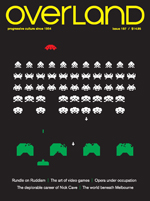
Recent journals (2) – Overland 197

Jeff Sparrow (ed), Overland issue 197 (OL Society December 2009)

overland 197I initially intended to write a single post about the three journals that arrived in my letterbox this month, but after rabbiting on about Heat at such length I decided I’d better split them up.

In a world where passionate anti-Communist Robert Manne  has been described as a preeminent lefty, there’s clearly a crying need for Overland, whose Communist Party origins flutter from its masthead in the slogan, ‘Progressive Culture since 1954’ (and smirk on the back cover in a quote from The Australian describing it as ‘loopy-Left’). Even before the recent online Subscriberthon I’d been thinking of subscribing – I loved (and blogged about) the biography of Guido Baracchi, Communism: a Love Story, written by current editor, Jeff Sparrow, and I have been a freeloader (ie, online reader) for some time.

After the mainly elevated austerity of Heat, Overland‘s direct speech is refreshing. You won’t find essays here that begin as dauntingly as ‘It was while reading Jean-Paul Sartre’s monumental study of Flaubert, The Family Idiot, that I fell into an “epileptiform” state’ or ‘I have long associated landscape with passion and solace, and with the urge to record it’. Instead, we get ‘Last Sunday I went to church to be with my father, to say goodbye,’ or ‘Sometimes in life you get lucky.’ Not that the Overland pieces lack heft. The former introduces ‘My Father’s Body‘, Francesca Rendle-Short’s moving and, for my money, profound essay on her relationship with her father who has Alzheimer’s. The latter leads in to Fiona Capp’s ‘The Lost Garden‘, an extract from her My Blood’s Country, which promises to demonstrate Judith Wright’s continuing relevance (‘These hills and valleys were – not mine, but me …’).

There is some engaging fiction, some punchy argument (a trenchant go at Nick Cave, who is a closed book to me so I don’t mind one way or the other), short reviews, engaging essays (Sophie Cunningham, just popping over from Meanjin, visits the drains of Melbourne; Thomas Rye visits an island in Arnhem Land), a swathe of poems. There’s nothing I recognise as loopy-Left, though there are two very interesting articles – one on Ruddism and the other on education as export and its relationship to border control –  written in learned-Left language that makes for hard going (‘The CFMEU and other Left trade unionists wish to increase control of the borders of their labour markets at the point of intersection with the borders of the nation, and definitions of “Australians”‘).

The whole content is available online. I’ve linked to the articles I particularly liked.
—–
I’ve been lamenting the frequent copy-edit and/or proofing mistakes in Heat for a while. I kept my carping eye peeled for Overland as well. Interestingly enough, although Overland doesn’t include a credit for a copy editor (as Heat does), it doesn’t have anything like the same incidence of irritating and sometimes perplexing mis-edits and typos. There is a spot where lay and laid are used in place of lie and lay , but as this happens consistently over a number of paragraphs I’m willing to put it down to a difference of opinion (in which, of course, they are completely wrong!) rather than sloppiness or ignorance.