Wa modern

As the Japan Foundation web site says:

Wa Modern is a blend of cherished traditional Japanese crafts (floral arrangement, ceramics and calligraphy) presented as one. For a limited time only from 9–16 October, floral artist Setsuko Yanagisawa, ceramist Malcolm Greenwood and calligraphy artist Ren Yano come together in their first mixed media collaboration at the Japan Foundation Gallery.

We trotted off to Chifley Square this afternoon. Really, it’s a brilliant exhibition, and exactly as advertised the three crafts speak to each other and with each other in wonderful harmony. The flower arrangements are based in ikebana and use Australian plants. The pottery could have been created for these arrangements. The calligraphy, to my completely uneducated eye, seemed to have taken liberties with tradition, to be looser, more relaxed, more – possibly – Australianish.

As we were leaving the young woman at the front desk asked if I’d taken any photos, and when I said I hadn’t told me I should come back with a camera. So I whipped out my phone for a couple of parting snaps.

Some dramatic waratahs:

Waratahs

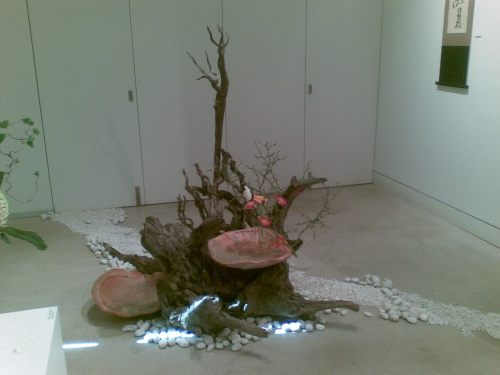
A big arrangement. You can’t really see it in the photo, but those poppies appear to be standing in a shallow pool of water on the shell-like pottery dish, defying gravity. Looking closer, one sees that the poppy stems are actually supported by being pierced by thorns on the branch that lies across the dish

alcove

The exhibition is open all week. I recommend it.

Small talk

I’ve mentioned before here that I like to read while walking around my suburb – actually, while walking round whatever suburb, or urbs, I happen to be in. One of the incidental pleasures of this practice is the micro-conversations it engenders.

The most common opening gambit is, ‘Must be a good book.’ Sometimes there’s an edge of reprimand in this, as in, ‘It would have to be a bloody good book to make me – or any normal person – read it like that.’ Other times, it’s quite benign: if Bob Thiele and George Weiss were right that friends shaking hands saying, ‘How do you do,’ are really saying ‘I love you,’ then people making this comment are really saying, ‘I notice you’re doing something unusual/making the environment slightly more interesting.’

The other common remark, though it trails a long way behind the first, is, ‘Careful you don’t walk into a post/tree/branch.’

I try to respond with something friendly and amusing, an equivalent of ‘Thank you for commenting’. My fallback is something like, ‘Have to get the reading done some time.’

A very few people scope out the book as we approach each other and make a book-specific comment: ‘Is that any good? I’ve had it beside my bed for a while.’  ‘Has he done that well?’ ‘You must be an academic, reading Heat.’

Yesterday, a friend coming up Booth Street laughed when she saw me, and said, by way of explaining her laughter: ‘You look so ancient. So untechnological.’ I had no comeback.

Opening

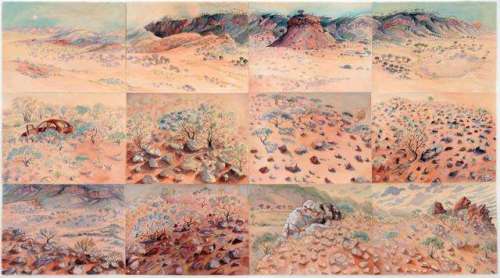
We own a painting by Sydney artist Carol Ruff – a landscape, featuring a single almost symmetrical, almost bare hill. It’s hard to say why, but I just love it. I can sit and look at it for a long time and not be bored. Some time ago we were invited to an opening of Desert Air, an exhibition of Carol’s work alongside that of her partner Greg Weight, but when we got there the crowd spilling out onto the footpath outside the gallery was so thick we turned around and went straight home. Tonight another dual exhibition was opening, Love Creek Bitter Springs, made up like the other of work created during trips to the MacDonnell Ranges in the Northern Territory. Learning from past experience, we turned up at the Australian Galleries in Paddington an hour early and left before the first glass of anything was poured.

It’s a fabulous exhibition. Both Penny and I fell in love with one landscape in particular, much bigger and more elaborate than our little hill, but with the same mesmeric power:

img3505

There is much else that’s stunningly beautiful. I want to mention a set of photographs, described in the gallery’s list as created jointly by Carol and Greg, but most of them featuring Carol, indoors and out, in the same country that features in the paintings and photographs elsewhere in the exhibition, presumably with Greg behind the camera. The list introduces the set with a quote from Barry Lopez: ‘In the end, there’s little difference between growing into the love of a place and growing into the love of a person.’ Somehow this sharply personal note brought home to me the obvious fact that the whole exhibition is a work of love.

Posthumous Tiptree Jr

James Tiptree Jr, Meet Me at Infinity (Tor Books, 2000)

I got hold of this book as part of my Science Fiction/Fantasy self-education project. In years long gone, I’d read two Tiptree novels and a collection of short stories, so already had a healthy respect for her. (Yes,  James Tiptree Jr was a woman. However, in this book she’s identified primarily by her male pseudonym rather than as Alice Bradley Sheldon or Raccoona Sheldon. And that’s as it should be: she kept writing as James for roughly ten years after she was outed, and the pieces by Raccoona collected here are pretty forgettable. There are precedents: I’ll bet you struggle, as I do, to remember the real life name of Henry Handel Richardson or George Eliot.) This is a posthumous gathering of previously uncollected stories and essays, so might have turned out to be a grab bag of offcuts of interest only to completologists. I’m glad to report that it’s not so, not by a long shot.

In the fiction section, roughly the first half of the book, most of the pieces do turn out to be of mainly completological* interest. But two of the stories, specifically ‘Trey of Hearts’ and ‘The Color of Neanderthal Eyes’, are vivid reminders of Tiptree’s ability to portray intimate sensuality (including, as in the first of these stories, graphically described sexual encounters) between beings from different planets. If only I’d read the former story before my Book Group’s evening on erotica!

At the start of the non-fiction section, in which Tiptree is maintaining, sometimes strenuously, her male persona, I was reminded of Jennifer Maiden’s reference (in her poem in the current Heat) to

Wilde’s old aphorism that a man
is least himself in first person: give
him a mask and he’ll tell the truth.

These pieces were mostly written for fanzines – some of which were produced by the book’s editor, Jeffrey D Smith, whose notes explain for us visitors from the mainstream the nature of fandom and fanzines. The pieces are appropriately informal, ‘Uncle Tip’ telling traveller’s tales, dispensing advice to his younger co-fans and generally shooting the breeze in playfully overwrought language. You get the impression the writer was having so much fun creating, or being inhabited by, this male character that she allowed herself to say all sorts of things about creativity, science fiction, ageing, the environment (including, more than 20 years ago, a lament about carbon dioxide and climate change) and anything else that crossed her mind, things she might not have said in her own person. Some of it is embarrassing, as when ‘Tip’ writes with self-deprecating comedy of his lustful admiration for a young Mayan woman. But there’s a lot that’s eminently quotable. Like this, on the Doomsday theme in science fiction, in 1973:

Ever since things got serious, ever since we realised that we really are in danger of killing ourselves, of bombing or poisoning or gutting or choking the planet to death or – perhaps worst of all – of killing our own humanity by fascist tyranny or simple over-breeding, science fiction has been the only place we could talk about it. The mainstream took one look at it in Orwell’s 1984 and promptly caponised itself. It’s too terrible. Don’t look. Tell me Jesus saves.

Or this, which must surely be quoted in any discussion of women in science fiction (the emphasis is in the original):

I know now why women have always attracted me, you see: They are the real aliens we’ve always looked for.

A year or so later, edging closer to emergence from behind the male mask, she wrote, ‘I have changed my mind, by the way: Of course it is not women who are aliens. Men are.’ In that same piece, a compilation of contributions to a symposium on women in science fiction, ‘he’ responded sweetly when invited by the famously pugnacious Joanna Russ to bow out of the discussion on the grounds of his gender.

The book gets really interesting with his/her unmasking, in a number of ways. First, the real Alice Sheldon steps out onto the stage, and although she talks in a number of pieces of how disappointed her readers must be when the writer they’d suspected of having lived a daring life (a spy, or something worse?) turns out to be a nice elderly lady (‘At least I hope I’m nice’), she did have a very interesting life – starting with accompanying her parents on major journeys of exploration as a very young child. Second, her writing changes, becomes more straightforward, less florid, if perhaps also slightly less adventurous. And third, she reports on what she has learned about gender in science fiction, about sexism in general, from her masquerade and unmasking: all too often what can be heard with respect if said by a man, if said by a woman is understood to be whining. As ‘Tip’ she could suggest to a male anthologist (pen-)friend that he ought to include some women in his collection; the same suggestion from Alice would probably be heard as pure self-interested.  And so on. Without the male persona, she writes passionately about the situation of women, and about the importance of male allies in the struggle against sexism. But always with style, oddness, modesty, spark and a weird kind of grace.

* I didn’t make that word up. I just googled it, and got one hit.

Artsy weekend

It’s a long weekend in New South Wales, the Rugby League Grand Final, and a busy, artsy time for our household.

After the Orange Grove Market on Saturday morning, we went to the Australian Centre for Photography in Paddington where there’s an excellent exhibition of students’ work as well as The Lake, in which ‘ten artists explore the exquisite strangeness of the Australian landscape through photography, video and interactive work’, and where I got unreasonable pleasure from making waves swell and crash in one of the interactive video pieces, as well as very reasonable pleasure from the many spectacularly beautiful photos, both digitally manipulated and not obviously so.

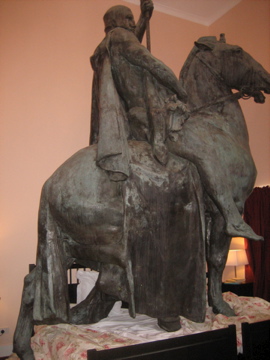
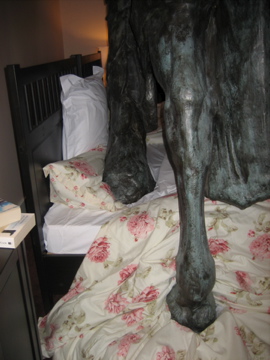
Then on to the Roslyn Oxley Gallery where we were puzzled by half a dozen large, rough drawings on butcher’s paper by Tatzu Nishi of equestrian statues that appeared to have been  wholly or partly transported into domestic settings. If these huge drawings, with much Japanese notation on them, weren’t enigmatic enough, there was the added mystery that much of the wall space in that room were bare. Deciding that both the sketches and the blank walls would remain among art’s little mysteries, we stopped on our way back to the car to look at a slide show of the artist’s installations, in which he builds domestic spaces around public objects – the spire of a European church, a street light, a large graffitied sphere in a park somewhere … The mystery of the half bare room was part way to being cleared up.

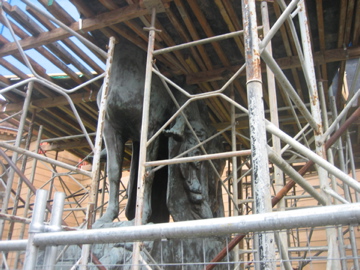
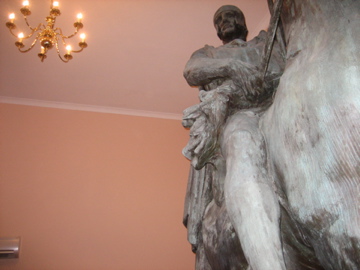
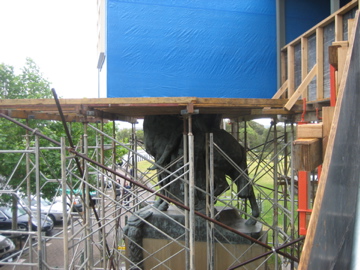
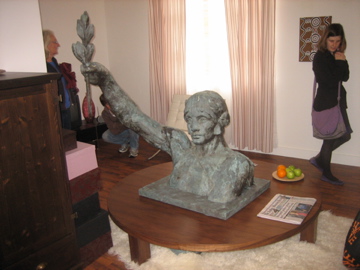
The mystery was cleared up completely the next afternoon when we visited the Art Gallery of New South Wales to see something that had been mentioned in the small print of a Roslyn Oxley hand-out, the John Kaldor exhibition (a revelation in its own right, but I’ll skip over that). As a Tatzu Nishi project, the equestrian statues that flank the main entrance of the gallery are enclosed in bright blue cladding, with ramps leading to doors that give us access into the blue rectabgular shapes. And inside, we see what those blank walls in Paddington are waiting for. No doubt the photos that appear there over the next couple of days will be better – and much bigger – than these, but here’s a look. Go and see the installation yourself if you can – no photo can convey the exhilaration of walking into those rooms, especially the bedroom. (The John Kaldor site has a slide show of the construction.)

The Spoils of War as seen from the ground:
IMG_3827 IMG_3825

and from inside the blue cladding (the fruit on the table is real):
IMG_3828

The Offerings of Peace in the elevated bedroom:
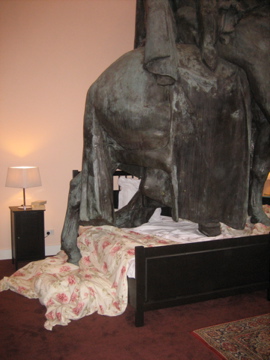
IMG_3829 IMG_3830 IMG_3832 IMG_3831

But back to Saturday. After dinner we were off to the Opera House to hear Christopher Hitchens at the Festival of Dangerous Ideas. (Just so you know, I think such a festival is a pretty lame idea. What’s the point of giving a huge platform to people who want to argue against legislation protecting workers from exploitation?  Is any useful purpose served by Germaine Greer once again expressing her contempt for Steve Irwin? Indeed, once you’ve read the title of Christopher Hitchens’s address, do you need to pay good money to hear it?)
achitchBut we’d seen Christopher on Q&A on Thursday night, and he was impressive: abrasive and pugnacious but brilliant and, actually, civil. So we decided to make him our Saturday night’s entertainment. We managed to get late-bookers’ seats in the choir behind the stage. Here’s a phone shot taken 10 minutes before the show started from our pozzie in the middle of the front back row. In those ten minutes, the whole hall, including most of the choir, filled. It seems that many people in Sydney are hungry for atheism, or maybe just like a good smackdown, whoever is being smacked.
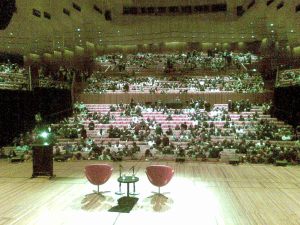
empty

After the preliminaries – a fabulous Welcome to Country, a speech from the Opera House’s CEO (who hinted that he was heading off to the Sleaze Ball after the talk), an excellent two-minute speech on the right to die from Sarah Taylor (who had won a soapbox-rant competition in the forecourt that afternoon), an introduction by ABC journalist Tony Jones (who called Hitchens, insultingly I thought,  a contrarian) – he gave a forty minute talk, then conversed with Tony Jones for another half hour or so. The audience applauded frequently, which was only right and proper, but at times created an uneasy sense that he was preaching to the choir. Sadly, I mean that only metaphorically – the acoustics in the actual physical choir were terrible, so we missed an awful lot of what was said in the Hitchens’ upper-class mumble. When he started quoting from the Monty Python Philosophy Song what should have been a delight was just an irritation.

I won’t try to summarise his talk – it will be all over the internet soon, on ABC Fora or Slow TV or who knows where else. I loved it that he started out with a personal connection to Australia: he read a lot of Neville Shute as a teenager, and gave us the evangelicals’ banner ‘There is still time, Brother’ flapping in the breeze after the end of the human race in On the Beach as an epigraph for his talk. I loved his response to Cardinal George Pell’s then-yet-to-be-given address, ‘Without God we are nothing‘: ‘Don’t you take that tone with me.’ I wonder how the scattering of women in hijabs and other people of faith in the audience responded: presumably they abstained from applauding at least the cheaper shots (calling Moses a schizophrenic comes to mind). I had a sense, though, that for all his seriousness and erudition, Hitchens somehow was missing the point of religion. When Tony Jones asked him if he would consider the pervasive religious practice of Bali as poisonous, I think he said (remember, my hearing was impaired) that that wasn’t really religion because it wasn’t poisonous. And he replied similarly to a question about a Salvation Army Officer who has devoted his life to demonstrably effective good works. I’m in the atheist camp myself, but came away unconvinced that religion is the enemy of all that is good. I did, however, come away thinking, and that can’t be bad.
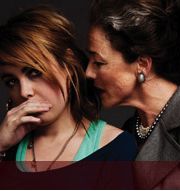
gethAfter our visit to the AGNSW yesterday afternoon we went to David Hare’s Gethsemane at Belvoir Street. The play started out with what might have been a quote from Christopher Hitchens, a statement that some people put their faith in a book, some in one book some in another, but the book gives them certainly, and a further statement that the play we were about to see was full of people with a book. The second act started with a similar Hitchy address to the audience about how religious people are incomprehensible. Those two moments, however, had no discernible connection to the rest of the play. There were two very watchable performances, from Hugh Keays-Byrne as a political fixer and Emily Barclay as a troubled teenager. Sadly, whether it was the performances, the direction or the writing, I found the play as a whole pretty much an incoherent mess. And what’s more the Gethsemane reference was irritatingly illiterate: the whole point of the Agony in the Garden, according to these characters, was that Jesus doubted his mission. I would have thought he was doing something a little less cerebral, like experiencing wretched miserable terror and unhappiness about it, without a shadow of doubt. ‘Father if it be thy will, let this chalice pass from me’ is surely a far cry from ‘I don’t want to be a teacher any more because there’s too much paperwork and not enough actual teaching.’ According to Time Out (as quoted on the Belvoir web page), the play provides ‘an insight into why we are in such a mess today’. Not to me, it doesn’t.

Yasmin Ahmad

I was on a bus in Connecticut in August when Penny texted me from the airport in Sydney to tell me Yasmin Ahmad had died. Actually, Penny’s text asked if the filmmaker whose blog I followed was named Yasmin, and if so, she had died of a heart attack. I’ve never seen any of her films, unless you count a single extraordinary community service announcement:

But the blog – and its comments section – opened a window for me onto a lively, intelligent, warm, exuberant and sometimes embattled creative milieu in Kuala Lumpur.

The Trash and Treasure segment on today’s Movie Time on Radio National was about Yasmin’s film Gubra. And Peter Mares referred us to links on the Movie Time web site. Naturally, I followed them up, including one to a beautiful Tribute to Yasmin page, on which we get to see her on the set of a short film, Chocolate. Sadly I couldn’t find a version of Chocolate with English subtitles, and the film remains a mystery to me, but The Making of is lovely:

I don’t know if any of her films have been screened here. I hope we do get to see them.

Heat 20: Plain Vanilla Futures

Ivor Indyk (editor), Heat #20: Plain Vanilla Futures (Giramondo Publishing Company August 2009)

heat

John Freeman, of Granta magazine, had an excellent piece in The Australian in July (pretty much the same article as published in the Independent a month earlier, with a little Australian – and Australian – content inserted). The primary function of literary journals, he said:

is to […] promote gross miscegenation, messiness, conflict and disorder; to subvert the market; and to place writers in unexpected places, where they can create an unlikely community of readers. …

It is presumptuous of any literary journal to claim that it has discovered any writers – novelists and poets are hardly nickel deposits, after all – yet a good journal can make it far easier for readers to discover a new writer’s work. It can take a piece of writing, regardless of where it comes from and what unusual shape its story takes, and ask readers to smash into it. For these reasons the ideal reader of a literary journal is one who yearns for the lash of the new, the way a boxer needs to be hit.

I can’t say that I yearn to be lashed by anything, really, but Heat does offer the kind of discomfort John Freeman describes, and I suppose I read it as a kind of homage to the gods of literature. Every issue contains things by writers who are completely new to me. Admittedly some of them are also, to me, almost completely unreadable; but others are sublime. In this issue Jennifer Maiden’s ‘Diary Poem: Uses of Privacy’ is in the sublime category, though I’m not new to her poetry. And there are a number of pieces that range from completely engrossing to callow, self-indulgent or academic-exercise-ish. I enjoyed and was instructed by Elizabeth Bryer’s ‘Peru’s Heartbeat’, an essay on a Peruvian drum. I was glad to learn about Aileen Palmer, daughter of Vance and Netty, and Rosa Cappiello who wrote novels in Italian during her years as an immigrant in Sydney (though I’m deterred from reading the latter’s Oh Lucky Country by the fact that her translator’s article here includes more than one sentence as awkward as this: ‘The Italian original is written in a language that is precise and explicit and yet metaphorically complex, and which sometimes reflects the influence of Neapolitan syntax and lexemes, popular Italian and some elements of the Australian variety of Italian.’)

It’s two translations from the Chinese, though, that got me closest to a lashing and mashing experience, both of them being unsettlingly odd: ‘An Inexperienced World‘ by Sheng Keyi, in which an older woman/writer lusts after a younger man she meets on a train; and ‘1989: My Confession‘ by Ah Jian, which seems to be excerpts from a longer, gossipy account of events among Beijing intellectuals in and around Tian’anmen Square in that year.

Part of each issue these days seems to be devoted the literary equivalent of “The Making Of” pieces: this time Evelyn Juers writes fascinatingly about her recent Giramondo title House of Exile: The life and times of Heinrich Mann and Nelly Kroeger-Mann, blending diverse elements including subtle self-disclosure, intriguing historical snippets, and tourist impressionism.

I share Pavlov Cat’s view that Ivor Indyk is a living national treasure, but the copy-editing of Heat often gives me pause. This issue is no exception: a supercede and at least one faux-gentility (‘a literary prize that enabled my partner and I to…’) have snuck past the editorial defences. Everyone makes mistakes. But there is one genuine puzzlement. In Ah Jian’s piece we read that the writer’s friend Zhao Yueshen wrote ‘about the ancient Greek [sic] poet Virgil’s Georgics‘. That ‘[sic]’ is not mine. It’s in the magazine. So someone – most likely the (uncredited) translator – made a note of Ah Jian’s slip (Virgil was actually Roman), and someone – most likely an editor or a series of editors and proofreaders –  decided to leave it there so the readers would see it as well. It looks as if the editors, being primarily academics, treated the text as if it were something they were quoting in a scholarly paper, distancing themselves from the error but taking care to quote it accurately. But such meticulous respect for the text ends up looking like derision of the author. For the record, I want editors, quietly and without fuss, to correct my stupid mistakes.

Café affects house prices

There was a house auction in our block today In his opening spiel, the auctioneer said that Annandale was the best place in Sydney to buy, the reasons being the wide tre-lined streets, the proximity to public transport and  … the café on the corner.

26092009

The thong-wearing (that’s footwear) woman who won the bid at $1.3 million after a heart-stopping $1000 at a time bidding war may or may not have been swayed by Revolver’s existence.

Added on 1 November: At an auction yesterday, much closer to the corner, the auctioneer made much more out of Revolver’s proximity. The fabulous Annandale lifestyle now consists, it seems, of waking up and strolling across the street for a double shot latte. And the house went for a mere $1.6 million.

Dust in my feed

We woke to a weird light in Sydney this morning. As I emptied out kitchen compost into the backyard bin I looked back into the kitchen and it looked astonishingly white and crisp in a tawny world. The car looks as if it’s been on a trip to Bourke. I didn’t take a photo myself, but I’ve just found these in my RSS feed:

7.08 am: Welcome to planet Vulcan (Have phaser will travel)

7.14 am: Obligatory Sydney dust storm photo (Hoyden about town)

8.02 am: Life on Mars (The witty knitter)

8.20 am: Sydney at dawn (Larvatus Prodeo)

Added later: Someone in San Francisco has got a Flickr gallery up already.

Dangerous Days

Ernest Brough, Dangerous Days: A digger’s great escape (Harper Collins 2009)

dangerousWhen I was ten or eleven years old, although I wasn’t at all attracted to the war comics that many of my school companions devoured, I did read, and enjoy, Eric Williams’ The Wooden Horse, a POW escape story. It came with parental recommendation (my mother was amused by the POWs’ christening a cow Venus di Milko, or was that a different book?), and seemed to me to be a tale from the distant past. In fact, it was published in 1949, and the events it narrated had happened barely fifteen years before I read it. Ernest Brough’s story, written when he was in his 80s and when the events he recalls were more than sixty years in the past, nonetheless has some of the same qualities that caught this little boy’s imagination way back then.

The book is Ernest Brough’s story of his war experience. He was one of the Rats of Tobruk, and his account of how the war was conducted there almost makes one long for the good old days when the Geneva Conventions were respected. Taken prisoner, he was kept in camps run first by the Italians and then by the Germans, then escaped with two companions. The story of the trio’s privations and difficulties as they made their way from the prison camp in southern Austria, through Slovenia, Croatia and into Bosnia, a good part of the way in the care of Tito’s Partisans, is the book’s compelling read – the larrikin camaraderie of the Australians and New Zealanders in training, in combat and in the POW camp is transmuted into an almost mystical solidarity.

Perhaps more than The Wooden Horse, in fact, the book reminds me of Bert Facey’s A Fortunate Life. It’s a tale of survival, told without bitterness but pervaded by a sense of good fortune. And as I like my morals to be explicit, I was grateful for the final chapter, ‘Take it from an Old Bloke’, where he spells out his views on war, peace and life, including this:

War’s a damnable thing. Don’t let anyone ever tell you otherwise. The damage runs deep. All those nights for decades afterwards I would lie in bed thinking, I’ve got to get under the wire tonight. or gotta make it to the riverbank. … Most soldiers will bring the war home with them in some form. Some will never forget it; some will die from it, from suicide or alcoholism, years after the guns have packed up and gone home. You see, it’s just not natural for human beings to go out and kill other humans. And that’s what war’s all about.