Revolver unveiled

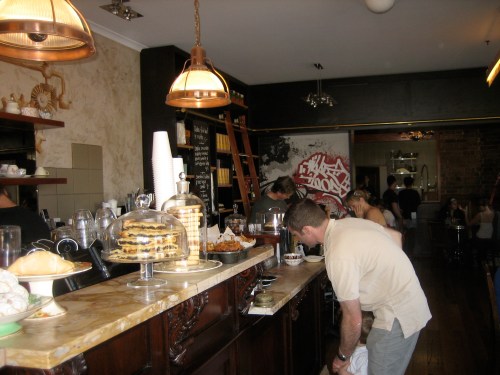
The corner shop is no longer in the making. Whenever I’ve walked down the street in the days since I’ve been home there have been people inside, sitting at the bench by the window and at the table outside in the sun. Clearly Rod’s understanding of his potential market was sound. I caused a terrible racket by walking past with Nessie on the lead; she remained virtuously silent (I don’t mention the aggressively stiff tail) and let the two little dogs parked at the door go spare with rage that she should exist. This morning for the first time I actually went inside, noting as I did that people were arriving by car to have their breakfast coffee  Naturally, I took a camera.

IMG_3818

IMG_3819

IMG_3820

IMG_3821

Perdido Street Station

China Mieville, Perdido Street Station (Pan Macmillan 2000)

perdidoKim Stanley Robinson (you know who he is, right?) is quoted in a recent Guardian, in the context of a spray about the insularity of the Booker Prize judges, that ‘the best British literature of our time’ is science fiction. I can’t say I share his disparagement of historical novels, still enjoying the afterglow of Wolf Hall as I am, but he has a point. Certainly I feel more nourished by Perdido Street Station, a full-on chaotic, phantasmagorical, dystopian, steampunk boy’s-own-adventure-with-interspecies-sex-and-reanimated-cadavers than by any number of sensitive and self-important explorations of guilt, memory and adultery.

It’s very long, and there was a bit towards the end where I wished he would just get on with it, but it sustained me very well through a very long plane trip and subsequent jet lag. I do feel when I read a genre work like this that I’m something of an outsider and can’t tell what’s original to it and what is a common trope. (I recognise echoes of Terry Pratchett and Neil Gaiman, for instance, but have no idea whether they are actual references or simply drawing on the same meme pool.) But when it’s done as well as this, that becomes an academic question.

If you’re looking for a long, light, engaging read, I doubt you could find better.

Ma rentrée

Having witnessed the cultural phenomenon of la rentrée in France, in which the populace returns en masse from their vacances, shops open, streets and markets come alive, Paris is reinhabited by  fabulously arrogant Parisien(ne)s, and posters and TV commercials abound recommending ways to make the great return douce or moins chère, having felt just a little of the excitement of all that, I’m facing my own pale shadow, my re-entry. But before girding my loins, here’s a blog post of snippets.

• In Manhattan you can buy eyelash extensions.

• There’s a hamburger place opposite the Port Authority Terminal in New York that boasts that it’s the only one with its name, that it was founded in 2008, and it has served fewer than a billion burgers (so far).

• In Lyon, I was approached in the street by an unkempt man speaking in rapid (and therefore incomprehensible to me) French, holding up a euro coin in one hand and extending his other palm empty to the passers-by. I dipped into my pocket and gave him a couple of coins – it could have been anything from 50 centimes to 2 euro – and walked on. He called after me: ‘Monsieur! C’est pour manger ou pour boire?’ It sounded like a serious question: he was asking me to tell him whether the money was for food or drink. I called back, ‘Pour manger!’ ‘Pas d’alcool?’ he called back, like a little boy making sure his papa was really forbidding something he knew he shouldn’t have. ‘Pas d’alcool, oui,’ I said, then added by way of mitigating this sternness something that probably translates as ‘Me no myself drink any alcohol.’

• I know everyone goes on about the different light in Europe, but when I walked the dog this morning I kept wondering why everything looked so clear, the greens so brilliant and the sky such a sharp blue. Then I realised I was back in Sydney, in spring and this light that the first settlers thought so harsh and unforgiving is for me the light of home.

• A visit to Paris at the end of summer makes it much clearer what all the fuss is about than a visit in March, when all the trees are like dark, mutilated skeletons.

• The Eiffel Tower sparkles all over at 10 o’clock at night.

• M Eiffel built a kilometre long bridge to carry a canal over the Loire at Briare, and it’s a very pretty thing.

• It’s illegal to sell cheese made with unpasteurised milk in Australia, which means we miss out on some fabulous, richly stinky delights.

• In certain lights, the power lines to the southeast of Saint-Gervais (Gard) appear to be supported by an army of Hello Kitty silhouettes coming over the hills.

• One of the main delights of travel for me is being in an environment where the language is different from at home. I get far too much pleasure from deciphering untranslatable puns in shop names, like the bookshops Mona Lisait, or the restaurant (or resto) in Rue Mouffetard that’s called the Mouffe’tôt Mouffe’tard. This delight is just as strong in places where the language is English. In Brooklyn, for instance, a car full of young dreadlocked men drew alongside my taxi with its radio turned up loud, and instead of the undifferentiated bass beat I expected I was treated to a crystal-clear rendition of ‘No Woman No Cry’, and the next day, a car pulled into the street where I was staying and the whole small block was filed with Aretha Franklin. I know that’s not strictly language, but it’s communication.

• The prayer ‘Give us this day our daily bread’ must feel completely different in a place where the custom is to go out each morning and buy just enough fresh bread for that day, from where you buy a sliced loaf on the weekend and eat slightly mouldy toast on Friday.

Jet lag has been intense this time, but I’m feeling almost human this morning after two nights’ sleep. Normal broadcasting may resume shortly.

Really merde

Dave Eggers, Zeitoun (McSweeneys, Hamish Hamilton 2009)

zeitounReading this in the wake of Ronald Wright’s What Is America?, I can’t help but see it as a case study in the dimension of the US that is missing from the land-of-freedom myth. It’s a post-Katrina story: Abdulrahman Zeitoun is a painter, contractor and landlord who had been living and working in New Orleans for 15 years when Katrina struck. His wife and children left before the storm, but he stayed behind to look after their properties, and then stayed on, paddling around in his canoe, helping people to safety, feeding dogs that otherwise would have starved, generally serving God’s purpose (he was and is a devout Muslim). Things go terribly wrong when he encounters the military, and the story takes on the quality of a nightmare.

Dave Eggers displays extraordinary authorial restraint: his narrative is based primarily on the stories as told by Zeitoun and his wife Kathy, and everything is told here from their points of view. There are writerly flourishes in some of the descriptive passages, and it may well be that some of the embedded commentary about George W Bush and FEMA originates with Eggers, but the whole reads as an impressively humble work, the author at the service of his material, at the service of his subjects. All his royalties go to the Zeitoun Foundation, which exists to fund organisations that help people caught up in similar difficulties to the Zeitouns.

The day I finished it, I saw Inglourious Basterds in New York City. The audience laughed cheerfully as the Brad Pitt character did something completely brutal — I couldn’t help but feel that, though he may complicate it with possible alternative readings, Tarantino romanticises, glamorises and eventually in effect endorses exactly the kind of US savagery that laid waste Native American civilisations, the Philippines, Iraq, and led to Guantanamo Bay and Camp Greyhound  in New Orleans.

NY Post geography

On page 14 of today’s New York Post, Jane Campion is quoted: ‘I have a two-room hut in a remote part of New Zealand, the south island, an hour’s drive outside Queensland.’ She clearly drives a very fast amphibian vehicle.
Right! No more painful pseudo tweets from my phone. I get my fixed computer back any hour now.

4.30 am NYC

Because of frequent flier stuff I’m flying home from Paris via New York, while Penny is doing the sensible thing, flying via Hong Kong and getting home 36 hours before me. At least that was the plan. She’s just texted that her Air France plane was leaking oil and has been diverted to Manila. I’m wide awake in the city that never sleeps posting to my clog from my not-an-iPhone. 24 channels, nothing worth watching except a senate enquiry into contractors (ie for profit armies) and moron Girls Gone Wild

Merde

Stephen Clarke, A Year in the Merde (2004, Black Swan Books 2005)

A year in the merde

My travelling companion read three of Stephen Clarke’s Merde books in quick succession between Paris Gare de Lyon and La Grande Motte on the Mediterranean. Not only did she laugh frequently, but she would read bits out prefaced with phrases such as, ‘Ah, this is what was going on the other day.’

We were in France at the start of September and the phrase la rentrée is everywhere. We’d gathered that it signified the equivalent of our Back to School, with added intensity gained from the fact that an awful lot of enterprises shut down for les vacances d’été and open their doors again at this time. But this book explained it from the point of view of someone working in Paris, and certainly enriched our grasp of its meaning – a time for resolutions and new beginnings, etc.

Then there was the mysterious siren we heard exactly at midday in a small village during our walk on the Loire. Completely mystifying until – in Merde actually – we learned that at midday on a certain day every month all the airraid sirens of France have a practice run and are completely ignored by everyone except ignorant tourists. (We can vouch for the ignoring bit.)

I was confirmed in my impression that one asks for un carafe d’eau rather than simply de l’eau at a café unless one wants to pay for mineral water.

Apart from these useful snippets of information, and interesting bits of language artfully disguised as comedy, the book is a well-executed romp. I don’t plan to read the others, but if you’re travelling to France you could do a lot worse by way of preparatory or companionable reading.

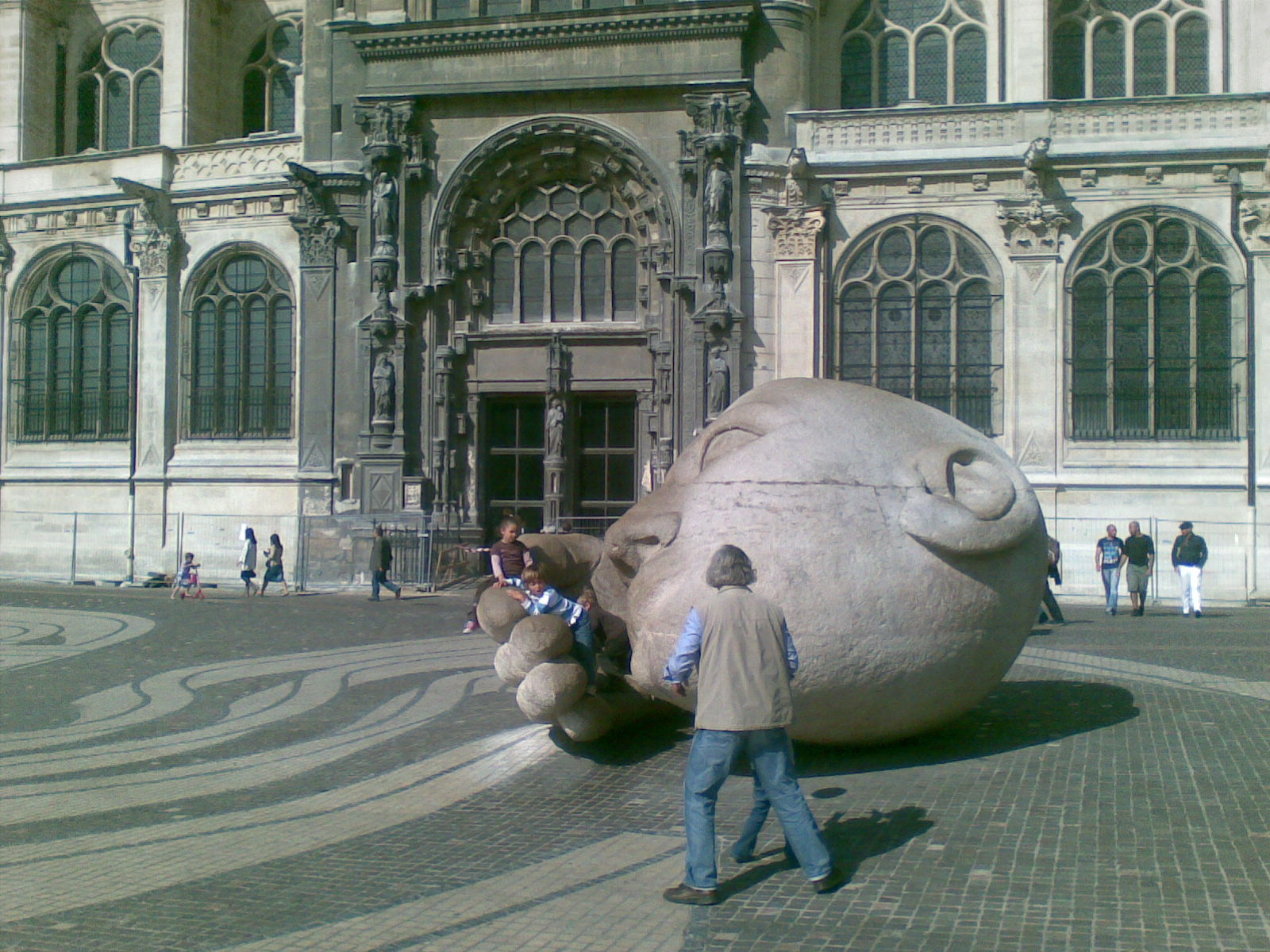
Near les Halles

12092009004

Landscape of Farewell

Alex Miller, Landscape of Farewell (Allen & Unwin 2007)

It pains me to say it, but the best thing about this book as far as I am concerned is that it’s short. I read it in a day.

In the first couple of pages, it seemed to hit wrong note after wrong note. Just two examples, tiny in themselves, but part of a cumulative effect that left me simply not believing in the characters: an elderly German professor, meditating on the notion of honour, remembers that somewhere in the bible, probably in the New Testament, we are told to honour our father and our mother; a young Australian History professor asks that same man what his father did in the war, and when he reacts with shock says it was just a piece of Australian humour. Just what planet do you have to be an academic on not to know the Ten Commandments, or that Germans of a certain age might not like to be asked by complete strangers about their family’s relationship to Nazism.

In spite of encountering some fine prose and being invited to confront difficult realities, I never recovered from the blow my trust received in those first pages. The book’s centrepiece is a powerful account of a meticulously planned massacre of white settlers in North Queensland by Aboriginal men in reprisal for the unwitting violation of a sacred site. Everything else seems to be there to justify this piece of writing. It didn’t work for this little white duck. I was left with an uneasy feeling that some kind of equivalence was being proposed between the Aboriginal action and unnamed actions taken by German operatives during the Second World War. I’m sorry, but my response, in a word, is ‘Ewww!’

My Book Group is to discuss this book at our next meeting. Since the meeting is on the evening of the day I get home from a month in France, I may not make it. If I do, I’ll let you know what other people thought.

What Is America?

Ronald Wright, What Is America?: a short history of the new world order (Text Publishing 2008)

20130730-230738.jpgThis is a book that promises great things and, in the first half at least, delivers. Here, from page 13, is what I read as the promise:

Seen from inside by free citizens, the young United States was indeed a thriving democracy in a land of plenty; seen from below by slaves, it was a cruel tyranny; and seen from outside by free Indians, it was a ruthlessly expanding empire. All these stories are true, but if we know only one without the others, what we know is not history but myth. And such myths are dangerous.

Only one of the three stories features strongly here, the story of ruthless empire. And at times it’s very hard to read, not because it’s poorly written – on the contrary, the writing is clear, passionate, engaging – but because the story is so hideous. The murderous double talk of George Walker Bush, Dick Cheney and their comrades in arms (and even at times, I say this in sorrow, of Barack Obama when he talks of Afghanistan) has a long pedigree. We have been lied to about who lived in North America before the first Puritans arrived there – systematically lied to, and evidence contradicting the lies has been systematically destroyed.

We white Australians have finally recognised that though Aboriginal Australians may not have done much of what our predecessors recognised as farming the land, they still lived here and had natural rights that were trampled. North America in the fifteenth century was dotted with farms, towns, and an established civilisation. Smallpox and to a lesser extent technological superiority enabled the invaders to take over a land that had been prepared for them, and they did it with a nauseating confidence that this is what God intended, then lied about who had lived there before them.

It felt to me that the book kind of lost its way towards the end, turning into an all too familiar analysis of the crimes and sins of successive US administrations from Nixon to Bush the younger. The end comes much sooner than you expect, as more than a third of the book is taken up by notes and a bibliography. I wonder if Ronald Wright had to finish it quickly, hearing a probable Obama win at the polls coming ever nearer.  Whatever its shortcomings, it’s a richly informative background to the Bush era, and to the challenges faced by Obama.

Ronald Wright is Canadian. Though he quotes a number of Australians, he doesn’t draw a parallel with the Australian history of dispossession and genocide, but it’s hard not to observe the difference that a couple of centuries made: as far as I’m aware no one seriously tried to claim that the Australian atrocities were done at the direct instruction of God. And it seems that the practice currently prevalent in Australia of acknowledging the traditional owners of the land, however token it may be, is a long way from making an appearance in the US.

(I bought this book almost a year ago, at a talk given by Roland wright in the Sydney Ideas series.)