Books I read in July [2007]

[I originally posted this in my old blog on 31 July 2007, but didn’t retrieve it when I moved to the WordPress platform. I’m republishing it now because I’m about to blog about Alexis Wright’s Praiseworthy, and what I wrote about Carpentaria here is true of Praiseworthy as well. Retrieving the post is also a tiny way of having the blog mark Robert Adamson’s death on 16 December last year.]

Robert Adamson, The Goldfinches of Baghdad (Flood Editions 2006)
Alexis Wright, Carpentaria (Giramondo 2006)
Marjane Satrapi, Chicken with Plums (Jonathan Cape 2006)
J K Rowling, Harry Potter and the Deathly Hallows (Bloomsbury 2007) (begun)
Harold Bloom’s Best Poems (continuing)

goldfinches

The Goldfinches of Baghdad includes an elegy for Arkie Whitely, thereby providing a smooth segue from the last book I read in June, Another Country, which is dedicated to her. Bob Adamson’s book is published by a US company. Couldn’t he find an Australian publisher? Or does this give him a crack at a larger readership? Or is it just an an example of globalisation with no subtext at all?

The book is in three sections, of which I expect to reread the first two many times. Maybe it was just a trick of the light, or the music that happened to be playing as I read, but these poems, almost all of them featuring birds, the Hawkesbury River and/or fishing by night, just picked me up and took me with them: the word that comes to my mind for the interplay of real birds, the real river and what the poet’s mind makes of them is ‘charming’, as in having magical force. Without a hint of appropriation of Aboriginal stories or images, it seems to me, Adamson manages to create a sense of sacred involvement with his country.

After been immersed, as it were, in whitefella Robert Adamson’s Hawkesbury, it felt quite natural to move on to Carpentaria, which starts with a river. This is from page 2:

Imagine the serpent’s breathing rhythms as the tide flows inland, edging towards the spring waters nestled deep in the gorges of an ancient limestone plateau covered with rattling grasses dried yellow from the prevailing winds. Then with the outward breath, the tide turns and the serpent flows back to its own circulating mass of shallow waters in the giant water basin in the crook of the mainland whose sides separate it from the open sea. To catch this breath in the river you need the patience of one who can spend days doing nothing.

The book is like nothing else I’ve ever read. I suspect that my decades of working as an editor, mainly of things written for children, have set me up for a quite distinctive relationship to it. It matters to me that words are used with their correct meanings (I hate ‘discomfit’ being used to mean ‘make uncomfortable’, for instance), that punctuation and spelling are correct (though I yearn for spelling reform and love George Bernard Shaw’s spelling of ‘fish’ as ‘ghoti’ and, truly, am not a rule-bound comma-curmudgeon), and that writing makes syntactical sense (I cringe when ‘none’ is used with a plural verb, but I acknowledge that no meaning is lost and don’t see it as absolutely incorrect). Mixed metaphors, stock phrases, tautologies, inconsistencies, all are guaranteed to turn me off or – if I’m so empowered – to make me reach for the blue pencil. I think of these attitudes as constituting a passion for the language, and of myself in my small way as a defender of its integrity. Well, Carpentaria is like a grenade lobbed into the middle of that way of reading.

It’s a wonderful book, richly poetic (I defy anyone to read it quickly), passionate, and funny. There are extraordinary, surreal set pieces, a stunningly original cast of characters and a plot full of surprising turns. But the most striking thing about it is the language. Alexis Wright has said that she based the narrator’s voice on a conversation she overheard between two old Aboriginal men in the street in Alice Springs. I don’t doubt it. But this isn’t Aboriginal English, or a literary equivalent of it, as the language of Beasts of No Nation suggests an African English. It’s pretty standard English, but as used by someone coming at it from outside: it contains every one of the things that make my editor’s heart shrink and fingers twitch, with the possible exception of the greengrocer’s comma: a dog lies with its belly belly-up; something has ‘flown the coup’. I had been shocked to read Ivor Indyk, redoubtable editor-in-chief of Giramondo, quoted in the newspaper as saying that the manuscript when he first saw it was ‘woolly’. But I now think he was misquoted, or at least misunderstood. He was most likely referring to the peculiar challenge this book must have posed to any copy editor: what in almost any other manuscript would have been errors to be corrected, in this one are integral elements. Here’s a passage, chosen at random:

Initially, on that eventual morning, on the eleventh hour of the eleventh day of the month of November, when Gordie did not play the remembrance bugle, everyone thought: Alright! Something is astray. Something smells mightily funny to me. Although, at first, everyone had thought very little about it. Perhaps Gordie was sick with the summer flu. Nothing to be done about that. Life went on as usual. Desperance was a normal town where even the bugle player had as much right as everyone else to get sick with influenza and stay home in bed. Normal people knew how to tell the time without depending on a clock, or a signal, and had enough decency, unlike the rest of the country, to stand for a minute’s silence in respect of the fallen on the eleventh hour, even without the bugle of the returned, to remind them.

There are some changes that a competent copy editor would make almost automatically to this: change ‘mightily’ to ‘mighty’, delete the comma between ‘returned’ and ‘to remind them’ (this kind of mis-comma-ing is rampant in the book, often rendering the sense very difficult to determine), change ‘on the eleventh hour’ to ‘at the eleventh hour’. One who had slavishly subjected his or her will to the style manual would ruthlessly make other changes: fix the fragments ‘Although … about it’ and ‘Nothing to be done about that’, amend ‘Alright’ to ‘All right’. Someone with an eye for redundancy and consistency would suggest fixes for the contradiction between what ‘everyone thought’ initially and what ‘everyone had thought’ at first; would query the assertion that ‘normal people’ were ‘unlike the rest of the country’; would circle ‘flu’ and ‘influenza’ and the repeated ‘on the eleventh hour’. This tidying up would make the passage read more smoothly, and make its meaning easier to access, but what it would lose is exactly the thing that is so distinctive about the prose: its outsider quality. The narrator loves language. The words come tumbling out, alliterative, onomatopoeic, idiosyncratic … and in some sense out of control.

In one of her many appearances at the Sydney Writers Festival this year, Inga Clendinnen said that whereas essayists invite the reader to come on a companionable walk with them, writers of fiction are always playing Catch Me If You Can. That may be true of some, even most, novelists: they build worlds which they invite us to enter. Reading Carpentaria, one feels that the author is running as hard as anyone else trying to catch up with her own creation. I mean no disrespect when I say that the book is less a raid on, than a prolonged campaign by, the inarticulate. The language is out of control and refuses to be tied down to the rules of ordinary discourse. It might seem that I’m talking about a trivial aspect of the book, and perhaps I am. But I found it profoundly challenging; it invaded my dreams. And the constantly unnerving play with language is a key part of that challenge.

[Added 7 August 2005:
Ivor Indyk was quoted in Thorpe’s Weekly Book Newsletter as saying of Carpentaria:

It was quite an intellectual challenge for me as an editor: there are ungrammatical moments that you wouldn’t want to cut out, even though your training tells you to ‘fix’ them.

Which says elegantly a lot of what I was trying to say.]

0224080458

Marjane Satrapi’s stark black and white comic strips provided a brief holiday from Alexis Wright’s tumultuous ride. The plot of Chicken with Plums has been unkindly summarised on LibraryThing: ‘a man without his musical instrument is depressed.’ Which is like ‘old man gets dementia’ as a summary for King Lear. It’s a fine romantic tale about true love lost twice over. I’m glad to see that Satrapi can move on from her powerful autobiographical Persepolis, and tell this touching, complex tale so elegantly. (All the same, I’m eager for the English version of Persepolis, tome trois, in which Marjane goes to Austria.)

bloom

I continue to make my meditative way through the Harold Bloom anthology, and I’m mostly enjoying it and getting an education. For someone who has a reputation as being a great upholder of the canon of great writers, he’s remarkably idiosyncratic in his selection of ‘the best poems in the English language’, and in his annotations on the selection. I think I already mentioned that he disparages Edgar Alan Poe, but includes a poem or two because he’s so popular. Well, when he gets on to Ezra Pound, our Harold makes no bones about despising the Fascist anti-Semitic montageur, and he takes eight pages ripping into him, followed by one poem, a translation from mediaeval French, included because Pound is an excellent translator. At least that’s why Harold says he included it; it’s pretty darned obvious that the poem’s there because without it he wouldn’t have been able to include his extended anti-Pound bile. Of course the publisher probably came up with the book’s title: Shorter English and United States Poems I Feel Like Anthologising, with Some Notes on Poets I Hate would have been more accurate, but isn’t as catchy.

0747591059

Given Professor Bloom’s feet of clay, I don’t feel any need at all to defend myself against his judgement on the Harry Potter books: ‘Can more than 35 million book buyers, and their offspring, be wrong? Yes, they have been, and will continue to be for as long as they persevere with Potter.’ I did, however, have to overcome other sources of reluctance – I’ve not been totally grabbed by what I’ve read of the saga previously; I had an unpleasant exchange of emails with JKR’s agent nearly a decade ago; and I’m moderately disgusted by the way the press piles onto the Potter bandwagon, heaping lazy and ignorant generalised scorn on the extraordinary wealth of other works written for children. But I joined the 35+ million, and bought the children’s edition at the recommended retail price, of which Gleebooks assures me a certain amount will go to the Fred Hollows Indigenous Literacy Program. I wanted to read for myself HOW IT ENDS. I’m half way through it as I upload this, and so far, I have to say, it’s also like no other book I’ve read – in this case because of the constant sense that I’m not just reading a book but taking part in a major cultural event, being just one of millions of people absorbing these very words at roughly this very time. Having found out ten minutes ago what the Deathly Hallows are, I still want to know what happens next.

Journal Catch-up 19

I’m almost caught up on my journal-reading. This isn’t a result of my diligence, but of the difficulties besetting literary journals just now. Heat has been appearing like clockwork, but the Summer 2022 edition of Overland arrived in my mailbox in mid Autumn 2023, and Southerly and the Australian Poetry Journal and Anthology – to which I subscribe – haven’t published hard-copy issues for two years.

Here are two almost-current issues, blogged with attention to page 76 as per my arbitrary blog policy.


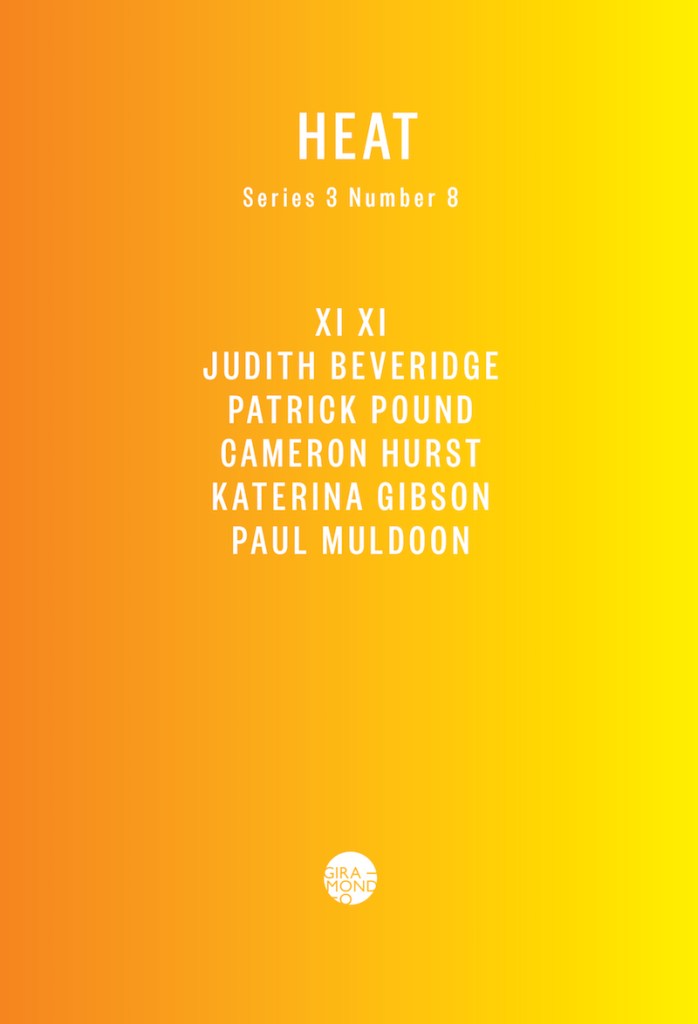
Alexandra Christie (editor), Heat Series 3 Nº 7 (Giramondo 2023)

From the Heat website:

The first issue of HEAT was published in July 1996, in the wake of the Demidenko Affair, in which an Australian author of English background posed as Ukrainian in order to gain credibility for her Holocaust-inspired novel. The anger provoked by this hoax accounts in large part for the magazine’s name, and a commitment to the publication of genuinely diverse writing.

The third series is different from the first two in many ways, but it continues to make a rich contribution to Australian literary culture through its commitment to writing from non-British backgrounds. This issue includes translations from Chinese, Spanish, French and Ukrainian, as well as work by two non-Anglo Australians – П.O. and Eda Gunaydin. Five poems by Melbourne poet Gareth Morgan may make him an exception, though a man in one of his poems says, ‘He must be fresh off the boat,’ which seems to imply a non-Anglo appearance.

I most enjoyed Eda Gunaydin’s ‘Fuck Up’, a comic tale of two young Anglo men who set up a Go Fund Me for an imaginary anti-Islamophobia conference, whose scheme goes awry when they find themselves actually trying to organise the conference. Two stories by Zhu Yue (translated from Chinese by Jianan Qian and Alyssia Asquith) reminded me of Jorge Luis Borges; Andriy Lyubka ‘Roasted Uganda’ (translated by Yulia Lyubka and Kate Tsurkan), a letter from the war in Ukraine, is available to read on the Heat website.

Noémie Lefebvre’s ‘Les non-dupes errent and other ghosts’ (translated by Sophie Lewis), which begins on page 76, overcame my codgerly resistance to stories that invoke French Theorists: the narrator is stuck in the middle of writing a tragedy, pondering the futility of literature given the state of the world and remembering her mother’s anorexia as she prepares to eat some toast – as one does – when Lacan (no first name) turns up and they have a weirdly obscure, but funny and resonant conversation.


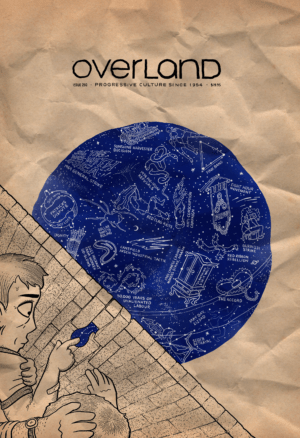
Evelyn Araluen and Jonathan Dunk (editors), Overland 249 (Summer 2022)
(Some of the content – less than in the past – is online at the revamped Overland website, and I’ve included links)

Apart from its usual excellent content this issue of Overland brought tears to my eyes with a letter to ‘the Overland family’ from the editors committing themselves to the MEAA’s Freelance Charter, which among other things means not passing on the effects of funding challenges to their contributors. I’m an MEAA member, book editors’ section. They’ve just guaranteed that I’ll keep subscribing for the foreseeable.

The issue kicks off with an excoriation of Heather Rose’s Bruny, which almost makes me want to read the novel to see if Elias Grieg, the excoriator, might have failed to notice that the narrative was deeply ironic. But I can resist. There are also interesting articles on forced adoption (by EJ Clarence), brain tumour as experienced by an environmental activist (Bonnie Etherington), and language liberation (Natalia Figueroa Barroso).

Of the generous array of poems, I most enjoyed Ouyang Yu’s uncharacteristically upbeat ‘To Richard Ouyang’, a meditation on the naming of his bicultural son.

There are five short stories, including one (by Avi Leibovitch) that features a talking cat, another (by Tim Loveday) that features small dogs in a bushfire (and mentions in passing a horrific practice in commercial dog-breeding), a family drama (by Rob Johnson) told from a child’s point of view (‘it was like a movie and I wasn’t part of it’). I enjoyed all of them. Fortuitously the one beginning on page 76, ‘Black Spring’ by Hossein Asgari, is perhaps the most interesting.

The protagonist of ‘Black Spring’ is a university teacher who has moved back in with his parents during the pandemic. It begins:

He pushes his chair back and stretches his limbs, turning himself into a multiplication sign before taking his glasses off and rubbing his eyes. He knows how they must look: red, irritated, thirsty for a few artificial tears. Has he just snapped at a student? In an online class which was recorded? God damn it! He slams his laptop shut, opens his desk drawer, picks up his eyedrops, and walks to the window. His father still squats where he’s been for the last hour, under the shade of the fig tree, a garden trowel in his hand.

The family relationships reveal themselves – the father is in early stages of dementia, the mother has health issues, the pandemic brings its own problems, it’s not easy working from home when it’s also your parents’ home, and so on. It reads as a Melbourne story, like most of Overland‘s contents, with mild hints of non-Anglo culture in the father’s habit of sucking on sugar cubes, or the mother’s offer of a choice between dates and dark chocolate with a cup of tea. Then there’s a deft reveal, first with the mention of an Imam influencing the water supply, and then with a place name, that the story is unfolding in Iran. No big deal is made of the reveal, and the story continues – a sweet, understated piece of anti-Othering.


Heat 8 has already landed (and been reviewed by Lisa at ANZ LitLovers LitBlog). The good things just keep coming.

Middlemarch: Final progress report

George Eliot, Middlemarch: A study of provincial life (George Eliot, 1871–1872; Könemann 1997), chapter 73 to end

I had lunch last week with a friend from university days, who remembered me going on about Middlemarch back then. Apparently I was very keen on Casaubon’s doomed project, the Key to All Mythologies. My friend assured me that my keenness was ironic, but maybe in his heart of hearts the young me feared he had a lot in common with Casaubon.

As I read the book this time, two things stood out for me that I’m pretty sure I took for granted in 1968 (yes, it’s been that long!).

First, the main characters are very young, and the narrator speaks with the gravity of experience. In 1968 I read a contemporary review that, from memory, began by saying that reading George Eliot’s prose was like lifting the heavy lid of a sarcophagus. I was at a loss to understand what the reviewer meant, but this time around the narrator’s world-weariness is clear as a bell, along with her deep affection for, and possibly even envy of, the young characters.

Second, there’s a serious concern with money. Dorothea can be virtuous because she inherited a small fortune from her mother, and she inherits a further substantial fortune when Casaubon dies. Part of her virtue for most of the novel consists of a commitment to use her wealth well: she sets out to be a decent landlord, but never considers that her wealth is created by the labour of the people she means to be kind to. (Marx was still working on Das Kapital when Middlemarch was published, but George Eliot had almost certainly read Les misérables.) Lydgate comes from gentry, but is determined to make his own way as a doctor and scientist. Rosamond is all about wanting affluence without worrying where it comes from. Fred gets into serious trouble by gambling, and finds his way to responsible work.

These two strands come together brilliantly in the climactic scene at the end of Chapter 83. Dorothea and Will have just declared their love for each other, all doubts as to the other’s integrity dissolved, and they have faced the apparent impossibility of marriage because of the terms of Casaubon’s will:

‘Oh, I cannot bear it – my heart will break,’ said Dorothea, starting from her seat, the flood of her young passion bearing down all the obstructions which had kept her silent – the great tears rising and falling in an instant: ‘I don’t mind about poverty – I hate my wealth.’

(Page 923)

It’s been stated explicitly much earlier that Dorothea could renounce what she has inherited from Casaubon, but only now does she see that as a real option. ‘I hate my wealth’ – the wealth is a kind of prison from which she can escape.

But the word ‘young’ is crucial here. The narrator and the reader know not to take her outburst literally. Will takes her in his arms and, looking into his eyes, she says ‘in a sobbing childlike way’:

‘We could live quite well on my own fortune – it is too much – seven hundred a-year – I want so little – no new clothes – and I will learn what everything costs.’

(Page 924)

So, she doesn’t really hate her wealth as such, only the part of it that constrains her. She’s hardly opting for poverty. The narrator sees that, and so do we, but we can still appreciate the moral leap she is making. And that wonderful final clause, so clearly the cry of a young person – ‘I will learn what everything costs’ – sends echoes back through the whole book. Fred has had to learn the cost of his gambling; Lydgate the cost of marrying unwisely; Rosamond, however briefly, the cost of dalliance. Even some of the older generations learn what things cost – notably Mr Bulstrode whose sins find him out.

I’l miss the world of Middlemarch. I’ll wait a couple of weeks before I plunge into my next slow-read project, in no hurry to have George Eliot’s voice fade from the front of my mind. I’ll give her the last word, from the beginning of the ‘Finale’:

Marriage, which has been the bourne of so many narratives, is still a great beginning, as it was to Adam and Eve, who kept their honeymoon in Eden, but had their first little one among the thorns and thistles of the wilderness. It is still the beginning of the home epic – the gradual conquest or irremediable loss of that complete union which makes the advancing years a climax, and age the harvest of sweet memories in common.

(Page 945)

That’s from Mary Ann Evans, towards the end of a book dedicated ‘To my dear husband’, to whom – scandalously – she was happily not married.

The Book Group and Percival Everett’s Trees

Percival Everett, The Trees: A novel (Graywolf Press 2021)

Before the meeting: This is another excellent book I wouldn’t have read but for my wonderful book group.

The book moves disconcertingly from genre to genre. After a bit of hayseed comedy, it develops into one of those murder mysteries where wisecracking out-of-town detectives arrive to help resentful local cops with an apparently insoluble case. Then there’s some social satire as the detectives, who are both African-American, make fun of the racism endemic in the small town. It’s all good TV detective show fun with an anti-racist bent.

Then the corpses multiply, each murder scene featuring a dead and mutilated White person paired with a long-dead Black person whose clenched fist holds the other’s severed testicles. It could be a highly implausible serial-killer yarn, or a revenge ghost story about racist violence in the USA (against Chinese people as well as African Americans, as the narrative makes unnervingly clear). A magic realist parable, perhaps, in which the murder scenes eerily evoke, and partly reverse, iconic images of lynchings? Or a tale of witchcraft? Certainly one key character identifies as a witch, but then she is also an amateur archivist who has accumulated records of thousands of lynchings from 1913 to the present. Or maybe, as the plot widens, it’s a zombie apocalypse, one whose allegorical meaning lies right on the surface. And Donald Trump makes an appearance. In the end, it’s a genre mash-up that manages – perilously – to stay coherent.

It’s all – to quote Quentin Tarantino from another context – ‘so much fun’. But it doesn’t lose sight of the monstrous historical reality. For example, one chapter consists of a ten-page list of names, in the manner of a spread in Claudia Rankine’s brilliant book, Citizen (my blog post here), and reminding me of Nana Kwama Adjei-Brenyah’s short story ‘The Finkelstein 5’, in which Black vigilantes kill random white people while shouting the names of Black people who have been murdered (my blog post about Friday Black, the book the story appears in, here).

A book that plays around like this with form and genre, that preaches a little, chills a lot and leaves a lot of questions unanswered, has to work brilliantly at the scene level and even the sentence level. This one does. I could give lots of examples, but take the moment at about the one-quarter mark, when the detectives, Ed and Jim, visit the juke joint on the edge of town.

The narrator doesn’t say so, but everyone in the joint is Black. Apart from one character who passes for White and another who is revealed to be Black late in the book, this is Ed and Jim’s first encounter with the town’s Black people. (In classic movie structure the one-quarter mark is the second turning point, often involving a change of location.) When they walk in, everything stops:

Jim and Ed stared back at the staring faces.
‘Yes, we’re cops,’ Jim said loudly. ‘And we don’t like it either. Everybody carry on. Have fun. Break the law, if you like.’
A couple of people laughed, then others. There was the sound of someone breaking a rack at the pool table in back. The dancing and chatting started up again.

(Page 75)

Maybe you have to enjoy writers like Elmore Leonard to be tickled by moments like this. I do and I am. You almost don’t notice that what is being described is a tacit alliance, or at least deep mutual understanding, among the Black characters, whether they’re cops, people relaxing at a bar, or possibly murderers.

What happens as Ed and Jim question the bartenders continues on that note. The bartenders express no sorrow for the racist White men who have been killed, but it’s different with the photograph of the Black corpse whose face has been beaten in. This corpse has appeared at the first murder scene, disappeared, turned up at the second murder scene, and disappeared again. Soon after this scene he will be identified [rest of this sentence whited out, but you can select it with your cursor if you don’t mind spoilers], mistakenly but with great thematic impact, with Emmett Till, whose murder sparked outrage in 1955. At this stage, most of the townspeople, Black and White, believe that this ancient corpse is somehow the murderer.

Jim pulled the picture from his pocket. ‘This is kind of hard to look at, but tell me if you recognise this man.’
The man cringed at the sight. ‘Ain’t nobody gonna recognise him. What the fuck happened?’
Jim shrugged. ‘If this man is alive, we want to find him before that cracker sheriff and his deputies do.’
‘How can that man be alive?’ the bartender asked.
Jim shrugged again.
‘Franklin, come here and look at this.’
The other bartender came over. Jim held up the photo for him to see. ‘Lord, have mercy. What’s that?’
‘That’s a human being,’ Ed said. ‘Somebody did that to another human being. Do you recognise him?’
The second man shook his head. ‘He must be dead. Is he dead?’
‘On and off,’ Jim said.
The man offered a puzzled look.
‘We don’t know,’ Ed said.

(Page 76)

‘Somebody did that to another human being’ lands like a well placed rock in the middle of the hard-boiled humour. It’s a sentence that is to gather force like a snowball in an avalanche. An awful lot of the writing in this book is as impeccable as that.

Why The Trees? Trees don’t feature in the book much at all. But a character sings the Billie Holiday classic (written by Abel Meeropol / Lewis Allan):

Southern trees bear strange fruit
Blood on the leaves and blood at the root
Black bodies swinging in the southern breeze
Strange fruit hanging from the poplar trees

Pastoral scene of the gallant south
The bulging eyes and the twisted mouth
Scent of magnolias, sweet and fresh
Then the sudden smell of burning flesh

Here is fruit for the crows to pluck
For the rain to gather, for the wind to suck
For the sun to rot, for the trees to drop
Here is a strange and bitter crop

Nearer to the meeting (spoiler): On Friday 28 April news broke that Carolyn Bryant Donham, the woman whose accusation led to a notorious racist murder, had died. Percival Everett got there just before Real Life: in the novel Carolyn Bryant, aka Granny C, is the third person to die in the presence of the small Black corpse. It’s unlikely that the Real Life Carolyn Bryant even heard of this book, but the timing!

After the meeting: Tragically I came down with a heavy cold (not Covid) on the morning of the meeting, and spared them all the risk of infection. It’s now a couple of days later and the customary brief account of the evening hasn’t materialised, so all I can say in this section of my blog post is: a) one chap beforehand said he could barely read for tears of laughter, until the book went dark and the laughter dried up; b) on the night itself, the conversation turned – as it does – to identity politics, including pronouns (several of us have gender non-conforming family members or friends); and c) they all had a good time while I stayed home nursing a stuffy nose.

Philip K Dick, Flow My Tears, the Policeman Said

Philip K Dick, Flow My Tears, the Policeman Said (1974, Gollancz SF Masterworks edition 2001)

I have a shelf full of science fiction and fantasy books that I acquired through BookMooch after finding a list of titles recommended as essential reading in the genre. Every now and then I actually read one of those books.

Flow My Tears, the Policeman Said was on that shelf.

I had previously read just one Philip K Dick novel, Do Androids Dream of Electric Sheep? (my blog post here), which was the basis of the movie Blade Runner; and I’d seen at least two other brilliant movies based on his work: Total Recall and Minority Report. So I was expecting a dystopian future, a surveillance state, psychological dislocation and the kind of philosophical rumination that can be hard to tell apart from quasi-psychotic, drug-induced meandering. My expectations were filled to overflowing. The book is like a weird waking dream, put together without much care for logical coherence, and at the same time it feels somehow deeply personal. It’s also masterly story-telling.

Jason Taverner is the phenomenally successful host of a weekly TV show. He’s a six, a genetically engineered superior human, handsome, charismatic and super-smart. Without warning he finds himself in a seedy hotel room, stripped of his identity – all records of him have disappeared from the data banks, there’s no trace of his TV show, and none of his associates recognise him or have any memory of him. Somehow he has to somehow acquire forged ID papers to avoid being picked up by the pols or nats and sent to an FLC (forced labour camp).

The story progresses through a series of encounters with women: his long-term partner in the TV show who is also a six; a woman he has seduced and dumped who unleashes an alien creature on him that (we believe) precipitates his crisis; a disturbed teenaged girl who forges his documents and tries to blackmail him into having sex with her; a spectacular, drugged out dominating woman who lures him into her mansion with disastrous results; a quiet ceramicist who is impressed to be meeting a celebrity. There’s a lot of drugs, a weird death, plenty of sexual titillation (see below), and a final bonkers explanation of what has been happening that an early reviewer described as ‘a major flaw in an otherwise superb novel’, but which I loved. Take your pick.

The book was published in 1974 and set in 1988, so the book’s near future is our fairly remote past, and readers in 2023 have the extra pleasure of clocking how wrong Dick’s predictions were. People fly around the city in self-flying quibbles and flipflaps but have to find a public phone to make a call. They read the news on foldable newspapers. The 70s protest movements have led to the Second Civil War in the USA; the surviving students now live underground beneath the ruins of universities and risk being captured and sent to forced labour camps if caught outside looking for food. The USA is a police state, and everyone is apparently on drugs of one kind or another.

Also dated is a creepy sexual element that seems to function mainly to assert Dick’s status as a pulp writer. Police surprise a middle-aged man in bed with a boy who has a blank expression, and though they are disgusted by the evidence of child sexual assault it is revealed to us that the age of consent has been lowered to 13. There are regular references to pornography and phone network orgies (as close as the book comes to predicting the internet). Two of the main characters are brother and sister who live in an incestuous love-hate relationship and have a son who is away in boarding school. And so on.

While the sexy stuff might assert the book’s pulp status, there’s also a strand of references to ‘high culture’. The book’s title, as the main example, comes from the 16th century lute song ‘Flow My Tears’:

Each chapter begins with a couple of lines from the song, so that it becomes in effect a sound track, a melancholy, orderly counterpoint to the characters’ panic and disorder. Sadly I didn’t look it up until I started writing this blog post, so it didn’t work that way for me.

Taverner’s progress is marked by his encounters with women. Meanwhile he is pursued by men, chief among them Police General Felix Buckman, who listens to classical music, and whose tears flow when he decides to seal Taverner’s fate. He has one of the weirdest scenes in the book, when he stops his quibble at a refuelling station and, out of the blue, has an intimate (but not sexual) moment with a Black stranger, which Dick later said was a mystical reference to a scene from the Christian Bible (Acts 4:27–38) – which he hadn’t read.

Having said that the book seems not to care for logical coherence, I should give you an example of the writing, which is always measured, even flat. Here is the moment, about a third of the way into the book, when Buckman makes his first appearance. His personality is revealed to us deftly – his easy authority, his cultural sophistication, his kindness. At the same time, details of the book’s world are filled in effortlessly, including the presumably intentionally comic bodily reference in ‘sphincter’ and the unintentionally jarring distinction between an ‘officer’ and a ‘female officer’:

Early in the grey of evening, before the cement sidewalks bloomed with nighttime activity, Police General Felix Buckman landed his opulent official quibble on the roof of the Los Angeles Police Academy building. He sat for a time, reading page-one articles on the sole evening newspaper, then, folding the paper up carefully, he placed it on the back seat of the quibble, opened the locked door, and stepped out.
No activity below him. One shift had begun to trail off; the next had not quite begun to arrive.
He liked this time: the great building, in these moments, seemed to belong to him. ‘And leaves the world to darkness and to me,’ he thought, recalling a line from Thomas Gray’s ‘Elegy’. A longcherished favourite of his, in fact from boyhood.
With his rank key he opened the building’s express descent sphincter, dropped rapidly by chute to his own level, fourteen. Where he had worked most of his adult life.
Desks without people, rows of them. Except that at the far end of the major room one officer still sat painstakingly writing a report. And, at the coffee machine, a female officer drinking from a Dixie cup.
‘Good evening,’ Buckman said to her. He did not know her, but it did not matter: she – and everyone else in the building – knew him.
‘Good evening, Mr. Buckman.’ She drew herself upright, as if at attention.
‘Be tired,’ Buckman said.
‘Pardon, sir?’
‘Go home.’

(Page 77)

Magdalena Ball’s Bobish

Magdalena Ball, Bobish (Puncher & Wattmann 2023)

If you are poetry-shy or poetry-curious, Bobish maybe just the book you’re looking for. ‘Bobish’ is a version of the Yiddish word for grandmother – Bobish is a life story in verse of Magdalena Ball’s great-grandmother. It’s made up of short, self-contained poems that form a straightforward narrative thread.

The heroine, whose name became Rebecca Lieberman, left Russia in 1907, leaving her parents, her family and the world she knew. with many other Ashkenazi Jews from from the Pale of Settlement she ended up in New York City, where she worked for a time in the garment industry – including being home sick from the Triangle Shirtwaist factory on the day in 1911 when 140 workers – mostly young women – were killed in a fire. The book follows her life through a violent marriage, the two world wars, motherhood, old age, and the legacy she has left her descendants.

Everyone should have a great-granddaughter who will honour their life in this way: seeking the facts and filling the gaps with humility, empathy and grace.

I can’t think of a better way to tell you about this book than to show you a single poem. Here’s ‘Potatoes’ from pages 75–76. It’s in ‘Fish Smoker’, the third of the book’s six sections, in which Rebecca meets a fish smoker who ‘smelled of home / whispering the mother-tongue in her ear’, and marries him. ‘Potatoes’ conveys the corrosive effects of poverty and terrible working conditions. It doesn’t aim for high drama, and there’s none of the playfulness that shines in other poems, but perhaps it will give you an idea of how the verse form can evoke a scene, suggest emotion, invite the reader’s heart into the story.

Potatoes
Some days it was only barley broth. Some days 
a few bits of squashed herring
brought home from the bottom
of the barrel, his legs purple
from standing in ice water all day.

She arrived at the apartment before him, her hands 
shaking as she cut up what food she could find, 
cabbage mostly, purchased cheap from
the vegetable peddler, fit only for stewing.

If there was bread, it was so hard 
she needed a hammer to break it.

Dizzy, hair spilling from her combs 
she would tuck it behind the ears 
ignoring the migraine that began in the morning 
at the sewing machine, all day at the machine 
with no breaks, fingers throbbing.

It was not the life she'd dreamt of, curled 
under a thin blanket during the Russian winter.
The streets here were not paved with gold, after all.

Tomorrow there might be windows that opened 
hot running water, a proper flushing toilet, 
potatoes. These were her new dreams.

She tried, without success, to sweep away 
the grime that encrusted the floor 
to wash the smells of rotting cabbage 
and smoked fish from her clothing.

The scent followed her to work, where her 
sewing machine kept going until the bell rang 
and she never drank water because the door 
to the toilet was broken and the toilet was so dirty 
she feared becoming ill by using it.

She bent over, her young back hunched as she
leaned into the machine trying to forget the pain 
that followed her like a faithful dog 
the rest of her life, and she got used to it.

She never told him about the way her body 
continuously hurt, carried her pain silently 
into the shared space 
no one wanted to call home.

The last poem in the book, ‘What Remains’, begins with a question and answer:

How far back can you go?
You can never go back.

This answer is obviously true if we’re talking about time, and in reference to the migrant experience, as in this poem, it’s heartbreakingly true. I was going to say that in this book Magdalena Ball has done a mammoth job of going back in imagination to Rebecca’s life. Then I realised that ‘What Remains’ has a different way of seeing what has happened in the book. It hasn’t so much gone back in time as captured what remains. Here are its final lines, the final lines of the book:

Magic is a gift not held 
solely in fading photographs.

It lingers, like your voice 
humming a Yiddish song 
winding through the double 
helix of your children, filling the air 
everywhere.

I’m grateful to the author for my copy of Bobish.

Another Day in the Colony with Chelsea Watego

Chelsea Watego, Another Day in the Colony (University of Queensland Press 2021)

Not every book is as explicit as this one about its intended readership. The Introduction gives fair notice:

This is not a book for colonisers, or those aspiring to share the same status as them. This is a book that is written specifically for Blackfullas, and when I say Blackfullas I mean of the capital B kind.
When I speak of the uppercase Blacks, I speak of those who simultaneously recognise and refuse the racialised location we’ve been prescribed, as well as those who have been haunted by it.

(Page 9)

‘Colonisers’ is the term Chelsea Watego prefers over, say, ‘non-Indigenous people’ or ‘settlers’ because, she argues, those terms gloss over the continuing violence of colonisation. As a reader of Anglo-Celtic heritage, I’m glad to report that the Introduction continues:

Of course, the colonisers may find something of use here.

In 2020, the first year of Covid-19 and the year of a re-energised global Black Lives Matter movement, as well as the 250th anniversary of Cook’s arrival in Australia, Chelsea Watego took leave from work, including her Twitter account and the Wild Black Women radio show. In the Introduction, she tells us that her ‘body was tired and, in this moment, appeared to insist that [she] tell a story’. The stories that she told make up this book:

  1. ‘don’t feed the natives’ – among other things, a personal account of growing up and taking on a career in Indigenous health, which Watego has come to understands as aiming ‘to strategise a Black living which presumes a Black future, of a forevermore kind … that is set on our terms, on our land’
  2. ‘animals, cannibals and criminals’ – about which more later
  3. ‘the unpublishable story’ – an article, discussed in the previous essay, that was rejected by the journal that had commissioned it
  4. ‘on racial violence, victims and victors’ – an argument for the importance of naming racism, accepting that it is embedded in the institutions of the colony, rather than talking of culture and diversity, and relying on the courts to put things right
  5. ‘ambiguously Indigenous’ – a critique of the ’emerging tribe’ of people who discover Aboriginal heritage and identity after growing up white, and assume positions of authority in Indigenous affairs. She describes this grouping as a modern equivalent of the nineteenth century Native Police
  6. ‘fuck hope’ – an argument against a version of hope that minimises current mistreatment and suffering by focusing on an imagined time when things will be better
  7. ‘a final word … on joy’ – which could be an extended paraphrase of Alice Walker’s revelation at the end of Possessing the Secret of Joy, ‘The secret of joy is resistance.’

That list can only give a faint idea of the confronting riches of the book. I’d be lying if I said I didn’t get defensive at times, identifying with the writers, editors and reviewers Watego finds wanting, or that as a man I didn’t feel a guilty relief when she focused on white women as key culprits, or that at times I didn’t respond with something like, ‘Steady on now, that’s a bit intemperate.’ Et cetera. I’m pretty sure any non-Indigenous/coloniser reader will have similar responses, which might be some consolation to the people whose names are named. We’re in this together.

The second essay, ”animals, cannibals and criminals’, lays out the way Australian fictional and non-fictional (‘faction’) writing has depicted Aboriginal people as either belonging in the past with quaint customs and stories, or as problems to be solved by white managerialism. These representations aren’t safely in the past.

The essay discusses Sarah Maddison’s book The Colonial Fantasy (‘which it could be argued is one of the more sympathetic works to the plight of Indigenous people in our time’), and Randolph Stow’s To the Islands (or at least Stow’s preface to the 2002 revised edition, which deterred her from reading much further).

The Black story must be a site for which the coloniser can express sympathy, and not in a solidarity kind of way, but a condescending sorrow for our supposed plight. Our stories should not be repositories for which faux coloniser sympathy may find a home, yet too often they are.

(Page 67)

The essay moves on to stories of how Watego’s own writing has run foul of gatekeepers. She entered academia with the aim of correcting the prevailing account of First Nations people by presenting a solid evidence base. She found it wasn’t a matter of evidence, but of a deeply embedded attitude in the minds of the colonisers.

Editors have asked her to include on-the-other-hand paragraphs that undercut the thrust of her writing; have quibbled with her use of language like ‘white’ to describe a racial category; articles have either gone unpublished or are still awaiting publication years after being accepted.

The chapter ends with the story of an article she wrote for a special edition of the Australian Feminist Law Journal, but which didn’t make it into the journal. As with all such stories, the reader is left wondering what version of events the unnamed meddlers and censors would tell. We don’t get that, but we get something even better: the following chapter, ‘the unpublishable story’, gives us the article to read and judge for ourselves.

There can be little doubt that the article would make painful reading for Cathy McLennan, whose memoir Saltwater (link is to my blogpost) is unsparingly criticised, but it’s not the first time the book has been given the treatment (see ‘Crocodile Tears‘ by Russell Marks in Overland Summer 2019), and it’s hard not to see the force of Watego’s argument that the editors who spiked the story were mistaken to override the judgment of the two First Nations editors of the special issue as well as two anonymous peer-reviewers.

Back to the story of the article being spiked:

After much back and forth, the managing editor and editor-in-chief advised that this work was not publishable in any form because it apparently posed a threat of defamation because the white woman author of the book I was critiquing wouldn’t like my review … Her real concern was that there was an imputation that the author of the book was racist.

(Page 76)

This sounds like arse-covering to me, and I expect academics of all kinds run into it all the time. The book being criticised was, after all, written by a lawyer.

Watego’s next sentence is the killer:

Now I didn’t say the author was racist, but I did have about 180 footnotes, three-quarters of which were direct quotes from the text that cited animalistic references to the Aboriginal characters.

On first reading, I took this to be a bit of smart-aleckery: ‘I didn’t say she was a racist, I just gave 180 examples of her racism.’ But it’s more interesting than that. However emphatic she is about the harmful nature the book, she really isn’t imputing malice to the writer. Her argument is that we colonisers are so imbued with the notion of our own superiority – so enmeshed in a racist and colonising system of thought and practice – that no matter how good our intentions or sincere our anti-racist attitudes, we fuck up.

And this is at the heart of the storytelling war, and the dangers confronting the sovereign storyteller in the colony. We simply are not permitted to speak freely and truthfully about the violence we are subject to.

The book as a whole is a living contradiction of that last sentence. Thank you Chelsea Watego and University of Queensland Press for this abrasive, uncompromising, sometimes hilarious piece of free and truthful telling.

Middlemarch: Progress report 6

George Eliot, Middlemarch: A study of provincial life (George Eliot, 1871–1872; Könemann 1997), chapter 59 to chapter 72 and the beginning of BookVIII

A friend who recently read Middlemarch for a book group said she more or less hated it. I suppose I might too, if I was reading it with a deadline, but at five pages a day there is so much to enjoy.

A lot has happened this month. Fred and Mr Farebrother’s rivalry for Mary Garth’s affections is out in the open. The Will Ladislaw’s origin story has been revealed, to us and to him; he has felt obliged to leave town and exit the narrative, but not without declaring his love to Dorothea, leaving her sorrowful but happy. The agent of Will’s revelation has precipitated a crisis in the life of Mr Bulstrode the sanctimonious banker, which allows George Eliot to lay out in excruciating detail the way people can lie to themselves. The marriage of Lydgate and Rosamond has continued to deteriorate; financial disaster has been averted, perhaps too late to save the marriage and with terrible strings attached to the means of his rescue. There’s been a death, a murder even.

The rumour mill has been in hyperdrive, and while the pub gossips’ dialogue is richly comic, I wouldn’t be surprised if it was that class-based comedy, and the unremitting focus on the land-owning and professional classes, that my friend found off-putting. I tend to think of it as a kind of science fiction: from one point of view the world of the book is far removed from the actual world – there are no people of colour, the working class and poor people are fairly uniformly dim, etcetera – but from another point of view it’s as realistic as, say, Succession.

I love the moments when Eliot takes the gloves off, like this, which leaves us in no doubt how she feels about the beautiful but completely unempathetic Rosamond:

In fact there was but one person in Rosamond’s world whom she did not regard as blameworthy, and that was the graceful creature with blond plaits and with little hands crossed before her, who had never expressed herself unbecomingly, and had always acted for the best – the best naturally being what she best liked.

(Page 756-757)

This morning’s reading was the first, short chapter of Book VIII, and the end is almost in sight. Things are looking grim for all the characters, and the many narrative strands are starting to come together. Lydgate has made himself the target of serious suspicion by helping the loathsome Bulstrode in his hour of need, and incidentally confirming for the reader that he is a deeply honourable man. Dorothea, hearing the news, is determined to clear his name, and in this chapter all her friends advise caution. Here’s a paragraph:

Dorothea’s tone and manner were not more energetic than they had been when she was at the head of her uncle’s table nearly three years before, and her experience since had given her more right to express a decided opinion. But Sir James Chettam was no longer the diffident and acquiescent suitor: he was the anxious brother-in-law, with a devout admiration for his sister, but with a constant alarm lest she should fall under some new illusion almost as bad as marrying Casaubon. He smiled much less; when he said ‘Exactly’ it was more often an introduction to a dissentient opinion than in those submissive bachelor days; and Dorothea found to her surprise that she had to resolve not to be afraid of him – all the more because he was really her best friend. He disagreed with her now.

(Page 836)

I just love the music of that. There are two long sentences reminding us of the story so far, especially of Chettam’s relationship to Dorothea, then a third that deftly evokes their current relationship, with the lovely observation of the turn of speech that allows ‘Exactly’ to mean its opposite. And the paragraph ends by bringing us back abruptly to the present moment with a sentence of five words.

At the very end of today’s reading, there’s a rare moment when Dorothea laughs, and almost as are a moment when she is bested in conversation. She’s talking to Celia, who like the book’s villain Rosamond is committed to conventional femininity, but unlike her is generous and kind. Celia urges Dorothea to take Chettam’s advice and hold back from interfering in Lydgate’s affairs:

‘Why can’t you think it your duty to submit a little to what James wishes?’ said Celia, with a sense of stringency in her argument. ‘Because he only wishes what is for your own good. And, of course, men know best about everything, except what women know better.’
Dorothea laughed and forgot her tears.
‘Well, I mean about babies and those things,’ explained Celia. ‘I should not give up to James when I knew he was wrong, as you used to do to Mr Casaubon.’

(Page 838-839)

Touché, little sister!

At my current rate, my next Middlemarch progress report will be my last.

Annie Ernaux’s Years

Annie Ernaux, The Years (Fitzcarraldo Editions 2022, from Les Années 2008, translated by Alison L Straya 2017)

Annie Ernaux won the Nobel Prize in Literature last year, which probably accounts for my long wait for this book at the library. It was worth the wait.

It’s a memoir, covering roughly the first 60 years of the author’s life, from listening to adults telling heroic stories of the Resistance in the late 1940s to presiding over family gatherings at the turn of the century full of lively exchanges in which ‘there was no patience for stories’.

It’s not like any other memoir I’ve read. Ernaux describes how she imagined it, referring to her past self as ‘she’:

This will not be a work of remembrance in the usual sense, aimed at putting a life into story, creating an explanation of self. She will go within herself only to retrieve the world, the memory and imagination of its bygone days, grasp the changes in ideas, beliefs and sensibility, the transformation of people and the subject that she has seen … To hunt down sensations that are already there, as yet unnamed, such as the one that is making her write.

(Pages 222–223)

Earlier (on page 162), she says she wants to assemble the multiple images of herself that she holds in memory, and thread them together with the story of her existence – ‘an existence that is singular but also merged with the movements of a generation’.

So it’s the story of the changing attitudes and sensibilities of a generation (the broader ‘they’ and the more specific ‘we’), and of an individual member of that generation (‘she’), embedded in an impressionistic account of France’s political, social and cultural history over half a century.

Algeria gains independence but anti-Algerian racism persists. 1968 happens, and leaves a deep mark on Ernaux’s generation, including those like her who weren’t actually throwing cobblestones. Catholicism vanishes ‘unceremoniously’ and consumer capitalism invades all aspects of life. There’s AIDS, wars and climate change.

The early sexual experiences of Ernaux’s later memoir A Girl’s Story (the link takes you to my blog post) take up a couple of paragraphs. ‘She’ marries, divorces, becomes a grandmother, teaches, retires, ruminates on the approach of death, and writes.

As I read this book, I often just let a series of specifically French references wash over me – resigned to never knowing everything. An Australian The Years might mention Gough Whitlam pouring sand into Vincent Lingiari’s hands, Jack Thompson’s nude centrefold for the first edition of Cleo, or Auntie Jack threatening to rip your bloody arms off: immediately recognisable to some readers, mystifying to others, and opening a whole new vista to the latter if they go exploring.

My practice of looking at a single page is a good fit for this book – the writing is so compressed that practically every page cries out for detailed explication.

Page 76 focuses on the general scene, talking about ‘we’ and ‘they’, as opposed to the passages that begin with a photograph of ‘a woman’ – always Ernaux – and talk about ‘she’. (It’s a book where you watch the pronouns.)

It’s 1962, near the end of the Algerian liberation struggle. Page 75 has described an incident in October 1961, when Algerian demonstrators were attacked by police, and a hundred of them thrown into the Seine, largely ignored by the press. Page 76 begins:

Try as we might, we would see no resemblance between October’s heinous attack on Algerians by Gaullist police and the attack on anti-OAS militants the following February. The nine dead crushed against the railings of the Charonne Métro station bore no comparison with the uncounted dead of the Seine.

As with many passages, I’m happy to guess at the general drift, but since I’m blogging about it, I’ll delve a little.

The OAS (Organisation Armée Secrète / Secret Armed Organisation) was a violent rightwing organisation opposed to Algerian independence. A demonstration against them was organised in February 1962 by leftist groups including the Communist party. The nine victims of police violence at the Charonne Métro station received a lot of publicity and the event came to be seen as a defining moment in the struggle. Ernaux reflects that ‘we’ – her generation, and I would add most people since – give value to the things the press highlights and have trouble giving full value to the sometimes much greater things it ignores. The narrative doesn’t pause to sermonise on the underlying racism.

Nobody asked whether the Évian Accords were a victory or a defeat. They brought relief and the beginning of forgetting. We did not concern ourselves with what would happen next for the Pieds-Noir and the Harkis in Algeria, or the Algerians in France. We hoped to go to Spain the following summer – a real bargain, according to everyone who’d been there.

You probably guess, correctly, that the Évian Accords were the treaties that brought an end to the Algerian war (Wikipedia entry here). The Pieds-Noir were the Algeria-born whites who opposed independence; the Harkis were Algerians who supported French forces (shades of the people abandoned when the USA and Australia quit Afghanistan). ‘We’ don’t include those people, and though our sympathies are with the freedom fighters we’re more interested in our next holiday abroad (again, a familiar syndrome).

The next paragraph shifts smoothly from ‘we’ to ‘people’ and then ‘they’. Though it’s not a hard border, Ernaux is no longer talking specifically about her own cohort, but about French people generally. It’s a characteristically brilliant summary of the mood of a time, beginning:

People were accustomed to violence and separation in the world. East/West. Krushchev the muzhik/ Kennedy the leading man, Peppone/ Don Camillo, JEC/UEC, L’Humanité/L’Aurore, Franco/Tito, Cathos/Commies.

Peppone and Don Camillo are a Communist mayor and a priest who clash in a series of popular books (Wikipedia entry here). JEC is Jeunesse étudiante chrétienne / Christian Student Youth); the UEC is Union des étudiants communistes / Union of Communist Students). L’Humanité was the Communist newspaper; L’Aurore was a centrist mainstream newspaper. All these dualities can be reduced to the almost affectionate diminutives ‘Cathos/Commies’.

The paragraph continues, now definitely in ‘they’ territory, a clear distance between Ernaux’s student grouping and the attitudes described:

Under cover from the Cold War, they felt calm. Outside of union speeches with their codified violence, they did not complain, having made up their minds to be kept by the state, listen to Jean Nochet moralise on the radio each night, and not see the strikes amount to anything. When they voted yes in the October referendum, it was less from a desire to elect the president of the Republic through universal suffrage than from a secret wish to keep de Gaulle president for life, if not until the end of time.

I suppose every French person would know that Jean Nochet was a vehemently anti-Communist broadcaster and that the referendum of 1962 meant that the French presidential election moved from a US style electoral college to direct popular vote. The motive attributed to the electorate reflects De Gaulle’s changing status in Ernaux’s mind over the years.

And then, a characteristic change of focal length, this time from national politics to Ernaux’s own group, with just a whiff of a suggestion that the students at that time didn’t pay much attention to politics (which was to change six years and a few pages later):

Meanwhile, we studied for our BAs while listening to the transistor. We went to see Cleo from 3 to 7, Last Year at Marienbad, Bergman, Buñuel and Italian films.

As I write this blog post, I recognise a way the book touched me personally. My oldest brother was pretty much the same age as Ernaux. Like her he moved from home in a small town to go to university in a large centre. This list of movies reminds me of the enthusiasms he brought home on uni holidays. He certainly talked about Last Year at Marienbad. I don’t remember if Agnès Varda featured. It was probably in 1962 when he took me on an excursion from boarding school to see my first subtitled movie, Bergman’s The Seventh Seal.

Though the book might not be for everyone, it’s a richly instructive evocation of an era, and at the same time I’m pretty sure most readers would find something in it that speaks directly to their own experience.

My kind of activism

Like most of us, I fail daily to do enough about the climate emergency. My little effort revolves around Move Beyond Coal. This is an Australia-wide network of local community groups who are currently targeting the National Australia Bank which, in spite of talking a good talk about climate responsibility and taking some excellent initiatives, continues to fund fossil fuel extraction corporations. Notably, it funds Whitehaven Coal, with a massive new funding to them in the pipeline, which, if it goes ahead, would lead to major climate vandalism for short term profit.

Move Beyond Coal is currently in the middle of an Australia-wide Ten Days of Action, in which small groups turn up at local branches of the NAB aiming to draw attention to the bank’s contribution of the climate emergency. We hope to lead NAB to change course. Failing that, we will at least have kept the conversation alive, poked some holes in the prevailing silence.

On Thursday this week, our local group staged an action at the Newtown branch of NAB. Outside the branch, a number of people handed out leaflets in front of a beautiful hand-painted banner, one member wearing an excellent giant NAB logo she’d made from felt. Inside, we sat in the comfortable chairs provided, and read – to each other – from Greta Thunberg (who writes brilliantly), Saul Griffith (whose The Big Switch and The Wires that Bind are on my TBR list), Antonio Guterres (‘Our world needs climate action on all fronts – everything, everywhere, all at once’), and other relevant sources. One person said it reminded her o the teach-ins from the 70s (and yes, we were mostly from silver-haired generations).

The few customers who came in paid us at best cursory attention.

The manager didn’t want us inside, and when we politely disobeyed, he sent for the police. After some polite back and forth, we agreed to leave. Our disruption had lasted about 40 minutes. You can see more, with pics and a video, on facebook at this link. Here’s part of our reading group:

Three women on a couch, a man on a high stool, part of a fourth person in the right foreground. All are listening as the woman in the middle readds
Photo (probably) by Mary Regan

And here we all are after we readers walked out chanting, ‘Hey hey, ho ho, Whitehaven Coal has got to go!’:

Fourteen people lined up outside the Newtown branch of NAB, with a prominent banner reading 'No More Money for Coal'
Photo by Josh Creaser

Added later: There’s a fabulous reel on Instagram with suitably dramatic music at this link.