Ronnie Scott’s Shirley: page 76

Ronnie Scott, Shirley (Hamish Hamilton 2023)

Ronnie Scott has played an important role in Australian culture over some decades, not least as founder of the literary magazine The Lifted Brow. So it’s only fair that his novels (Shirley is his second) should be reviewed with respect. It’s not that I don’t respect the book, but I’m definitely not part of its intended readership, so I don’t know that anything I have to say will be of much use.

You can read thoughtful and mostly laudatory reviews in the Sydney Morning Herald (Giselle Au-Nhien Nguyen), the Guardian (Bec Kavanaugh), the Newtown Review of Books (Jessica Stewart) and Australian Book Review (Morgan Nunan), to give just a sample.

It’s a novel set firmly in Melbourne, Collingwood to be precise, mostly among people involved in the food industry, with unconventional familial and sexual relationships, as the bushfires of 2019–2020 are coming to an end and Covid-19 is taking hold. The unnamed female narrator (who is not the Shirley of the title – that’s a house) tells the story after Melbourne’s many Covid lockdowns. By about page 20 when the narrator does something of a sexual nature that seems to defy the laws of physics, I was reading without much pleasure. A passing, and to me incomprehensible, mention of people licking themselves, a few pages later left me pretty thoroughly alienated,. Nevertheless, I persisted. There’s a twist at the end that reveals a shape in what until then had seemed to be fairly pointless meanderings. For my taste that was far too little far too late, but my taste is evidently an outlier – see list of laudatory reviews above.

Currently when blogging about books I have a policy of taking a closer look at page 76, chosen for the arbitrary reason that it’s my age. On page 76 of Shirley, the narrator has answered a knock on her apartment door and opened it to her affluent downstairs neighbour Frankie, a ‘famous condiment maven’. After a little chat, she yields to unspoken pressure and invites her in. Then, on this page, the narrator resumes the scrambled tofu she was cooking when Frankie interrupted her, while Frankie asks about it: ‘Wait, what have you put in that? Why does it look so much like curds?’

It was just the Safeway brand of melty ‘mozzarella’, and I’d stolen Meera Sodha’s method of pouring a base of neutral oil, frying off some spices, mixing in the ingredients that had to be actually cooked, and then crushing some silken tofu in my hands – splatting it, really – along with the ‘final’ ingredients that just had to be wilted and warmed; when I’d read that recipe, in East, I’d scrambled tofu before, but somehow I hadn’t realised that the tofu didn’t need to be cooked, that it could be honoured as a soft, pillowy additive.

Today was a bit different, as Frankie had interrupted me just after I’d crushed in the tofu, but I supposed it was fine, as I’d decided on impulse to cook a hash brown in the same pan, and parts of it had broken up as I’d initially over-microwaved it from frozen. Coming back to the pan, I noticed these parts were blackening and sticking, and I chipped them off and incorporated them with a wooden spoon.

There’s quite a bit of vegan cooking in Shirley, mostly with meticulous acknowledgement of the source of the recipes. Meera Sodha’s East, acknowledged here, is subtitled ‘120 Vegetarian and Vegan Recipes from Bangalore to Beijing’.

There’s a school of thought that any passage of a novel needs to do one or preferably all of three things: move the plot forward, deepen our understanding of character, and develop theme or themes.

On first reading, nothing much happens on this page, but revisited when you’ve read the whole book, it astonishingly can be seen to do all three things.

In terms of plot, Frankie’s visit occurs almost exactly at the novel’s one-quarter mark. In conventional movie structure, this would be time for the second turning point, sometimes known as the Change of Plans. Indeed, Frankie’s moving into the narrator’s intimate space marks a major shift: Frankie is actively cultivating the narrator, for reasons that will be revealed much later. No doubt more sensitive readers pick up a weird vibe here that only gets weirder as the pages turn. (I was cleverly seduced into thinking it was all just part of a general weirdness.)

The narrator has already been established as a vegan foodie. This passage reinforces that aspect of her character, shows it in action. We learn more about Frankie too: this is the first time we see her outside of an environment where she is ‘the boss’. Here and on the next couple of pages, we see her as, well, a bit of a manipulator: praising, professing interest in what is after all pretty mundane, offering to help …

As far as thematic development goes, a key strand of the book is the narrator’s relationship with her mother, and her attention to the physical detail of food is in contrast to her celebrity-cook mother’s approach, which is mostly showbiz. Interestingly enough, the narrator silently judges Frankie a couple of pages later as ‘an entrepreneur by temperament but a cook only through opportunity and trade’. That is to say, bit the narrator’s mother and Frankie lack her authenticity around food.

The narrator’s veganism, made concrete here, has an important thematic value. I took it, disparagingly, to be part of the book’s inner-city cool vibe. But it’s more than that. It contrasts to a frequently mentioned photo, unexplained until the last pages, of the narrator’s mother holding a knife and spattered with blood. It’s a key piece of character rooted in plot.

So a lot is happening under the bland surface of page 76. For my taste, here and in the rest of the book, it’s all too far below the surface. Maybe on second reading I’d be alert to the subterranean shifts elements. But I don’t want to reread it. Its cultural terms of reference are largely alien to me. I know anything about vegan cookbooks. I don’t know any of the songs the characters listen to. I barely know West Brunswick from Fitzroy. I’ve never heard of Zachary Quinto. Celebrity cooks aren’t part of my internal pantheon, even ironically. Perhaps most importantly, it’s been a long time since I was dealing with the hopes, despairs and confusions of my 20s.

Your mileage may vary.
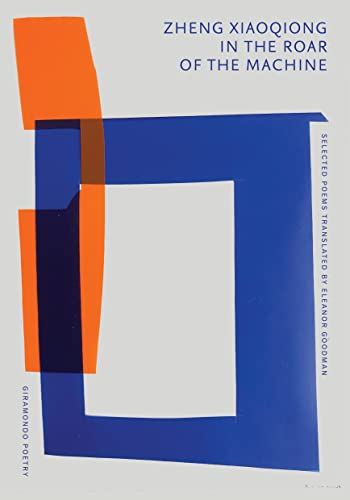
Zheng Xiaoqiong’s In the Roar of the Machine: page 76

Zheng Xiaoqiong, In the Roar of the Machine, translated by Eleanor Goodman (Giramondo 2022)

True to the promise implied in its name, the Giramondo Publishing Company invites its readers to travel widely. In the Roar of the Machine takes us into the world of migrant workers in China – that is, the mostly rural poor who have moved to large industrial centres to live and work creating what has been called an enormous floating workforce that, to quote Eleanor Goodman’s introduction, ‘comprises one of the largest human migrations in recorded history’.

Zheng Xiaoqiong, born in 1980 in Sichuan province in western China, moved when she was about twenty to an industrial city in Guangdong province on the south-east coast where she has been a factory worker ever since. Partly for her own mental health, partly to bear witness, she wrote poetry about her experiences, and soon gained a degree of fame – though in China as in most of the world, fame for a poet is a relatively modest affair. She has published a number of books of poetry and essays, and won prestigious literary prizes.

Eleanor Goodman is a poet in her own right and has translated a lot of contemporary Chinese poetry. including Iron Moon: An Anthology of Chinese Workers Poetry (2017), which has been described as ‘a fervent testimony to the horrific, hidden histories of the 21st century’s working-class’. That description could equally apply to In the Roar of the Machines. (You can read a fascinating interview with Eleanor Goodman on the Poetry International website, at this link.)

Two things I think I know about classic Chinese poetry: it often works through a series of images, and it often deals with exile. Both those things are true of this book. In many of the poems, the alienating effect of factory work is conveyed in an accumulation of images. In these lines, chosen more or less at random, from ‘Industrial Zone’, the harsh lights of the factory are contrasted with the moonlight of the mid-autumn festival, and the phrase ‘disk of emptiness’ carries a huge weight of nostalgia for home, family, community:

The fluorescent lights are lit, the buildings are lit, the machines are lit 
exhaustion is lit, the blueprints are lit ...
this is a night on an endless work week, this is the night of the mid-autumn festival
the moon lights up a disk of emptiness

I often struggle with poems in translation from Chinese. Almost every poem in this book grabbed me and held me hard.

There are four sections, each comprising poems from one of Zheng’s books: ‘Huangmaling’ (2006), ‘Poems Scattered on Machines’ (2009), ‘Woman worker’ (2012) and ‘Rose Courtyard’ (2016). A ‘Finale’ contains a single longer poem, ‘In the Hardware Factory’.

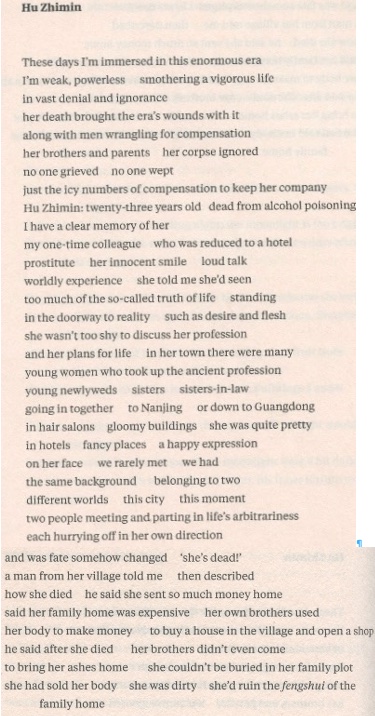
The third section, ‘Woman Worker’, is a collection of passionately feminist poems. The poem on page 76 is ‘Hu Zhimin’ (胡志敏), one of its portraits of individual women. (Right click on the image to embiggen.)

It might be worth noting that the poem becomes a lot easier to follow once you realise that, instead of conventional punctuation marks, it signals breaks in meaning or pauses for breath by longer spaces between words and by line breaks.

Hu Zhimin
These days I'm immersed in this enormous era
I'm weak, powerless __ smothering a vigorous life 
in vast denial and ignorance

This sets the tone, leading us to expect a story that will expand on what it is about the ‘enormous era’ that makes the poet weak and powerless. We’re invited to expect her ‘vast denial and ignorance’ to be contradicted in what follows.

It’s nerdy of me, but because every translation is at best an attempt (or so my high-school Latin teacher used to say), I like to compare different translations. I found Zhou Xiaojing’s version of this poem on the Poetry International website (link here). I won’t do an extended comparison of the two – except to say that I think Goodman’s generally has a better feel for what works in English – but here’s Zhou’s version of the opening lines:

These years I am immersed in an immense era
feeling weak and frail     allowing youthful life to be
covered by gloomy negations and ignorance

I prefer Goodman’s first line and a half, as Zhou’s ‘immersed’ / ‘immense’ echo falls pretty flat. But I stumbled over Goodman’s ‘vigorous’ – how can a life be both vigorous and smothered? – and I had trouble with the literal meaning that the poet was smothering her own life. Zhou’s ‘youthful’ resolves my momentary confusion, and the poet is no longer actively stifling herself but allowing herself to be covered/smothered by external forces. Of course, ‘vast denial’ beats ‘gloomy negations’ hands down, though they do mean different things, and ‘gloomy negations’ may be more accurate.

I’m guessing that anyone who understands Chinese would know from the poem’s title that it is about a particular woman. She now makes her entrance:

her death brought the era's wounds with it 
along with men wrangling for compensation 
her brothers and parents _ her corpse ignored 
no one grieved _ no one wept
just the icy numbers of compensation to keep her company
Hu Zhimin: twenty-three years old _ dead from alcohol poisoning

That’s the skeleton of the story, arriving at last at the woman’s name. But what are these ‘icy numbers of compensation’ that displace grieving and weeping? Having raised that question, the poem holds off answering it until the final lines. For now, it continues its broad movement from the general to the specific:

I have a clear memory of her
my one-time colleague _ who was reduced to a hotel
prostitute _ her innocent smile _ loud talk
worldly experience _ she told me she'd seen
too much of the so-called truth of life _ standing
in the doorway to reality _ such as desire and flesh
she wasn't too shy to discuss her profession
and her plans for life _ in her town there were many
young women who took up the ancient profession
young newlyweds _ sisters _ sisters-in-law
going in together _ to Nanjing _ or down to Guangdong
in hair salons _ gloomy buildings _ she was quite pretty
in hotels _ fancy places _ a happy expression
on her face

So much is conveyed in by piling on these images. This is personal: Hu Zhimin had worked in the factory with Zheng. We have glimpses of her at work as a sex worker: ‘innocent smile’, ‘quite pretty’, ‘a happy expression on her face’. There’s a hint of shame in ‘she was reduced’, but at the same time, Hu Zhimin didn’t try to hide what she was doing and the poem opens out to show us the ‘many young women’ have taken the same course. Their reasons for doing so aren’t named, and I suppose the poem allows the reading that these women took up sex work as an embrace of ‘desire and flesh’ or as a way of earning an income like any other, but I think it’s implied that harsh economic reality was their motivation, and there was an element of degradation in the work.

Then, back to the personal connection:

on her face _ we rarely met _ we had
the same background _ belonging to two
different worlds _ this city _ this moment
two people meeting and parting in life's arbitrariness
each hurrying off in her own direction

Both women came from small towns and migrated to ‘this city’ at ‘this moment’, but one of them left factory work for sex work, the other found a way to poetry. It’s a ‘there but for fortune’ moment.

I found the next words problematic:

and was fate somehow changed

Zhou Xiaojing’s translation came in handy for me:

not knowing what fate would bring

In Goodman’s translation, the line could be a question – did some mysterious force change their respective fates – but it’s hard to tell what’s actually being said. Zhou’s version is clearer: we are still with the two young women at the moment of parting ways, each ‘hurrying off in her own direction’ (or in Zhou, ‘each going her own way in a hurry’), and these words throw forward to the announcement at the end of the line, ‘she’s dead!’ Maybe Goodman’s opaqueness is more accurate than Zhou’s clarity, but I’m happy with the clearer version.

and was fate somehow changed _ 'she's dead!'
a man from her village told me _ then described
how she died _ he said she sent so much money home
said her family home was expensive _ her own brothers used 
her body to make money _ to buy a house in the village and open a shop 
he said after she died _ her brothers didn't even come
to bring her ashes home _ she couldn't be buried in her family plot 
she had sold her body _ she was dirty _ she'd ruin the fengshui of the family home 

That’s the real tragedy. There’s no need to repeat that she died young of alcohol poisoning. Now we learn that her sex work was a means to create prosperity for her family back in the village. Though here it names only her brothers, we remember that the opening lines names the parents as well. They ‘used / her body to make money.’ But now that same body is treated as unclean, and left without the proper treatment of the dead.

We’re left with the image of a family home carefully ordered to be in harmony with the universe, but we know that this order has been achieved by the cruel exploitation of a family member that led to her early death. We’re thrown back to the opening line, ‘These days I’m immersed in this enormous era’. Hu Zhimin’s story sends ripples outward: the family home’s fengshui is corrupted by their callousness, the prosperity of China as a whole is built on suffering like hers, and – wider still – capitalism as a system destroys lives.

All that, and yet there’s an immediacy to the poem – we feel the pain of the poet’s loss and her indignation on her friend’s behalf.

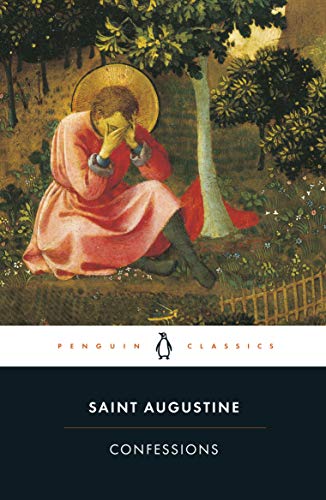
Beginning the Confessions of Saint Augustine

I’ve become attached to the practice of reading a few pages of a classic text first thing in the morning. À la recherche du temps perdu kept me busy for nearly two years. The Iliad and The Prelude followed. Then Middlemarch, which I finished a couple of weeks ago. Now that I’ve stopped missing Dorothea, Will, Celia, Lydgate and even Rosamond, it’s time to move on to my next morning project.

Over the protests of the Emerging Artist, who has barely tolerated my occasional morning chat about Middlemarch (I say occasional; she says far too frequent), I’ve decided to tackle St Augustine’s Confessions next. I hereby resolve to keep any enthusiasms to myself, or at least not inflict them on my nearest and dearest.

This is a book that has been around in my life for a very long time, but it hasn’t occurred to me until now to actually read it. Good Counsel College in Innisfail – which I attended aged 9 to 13 – had the Latin motto, Tolle lege, which translates as ‘Take up and read’. Regardless of what personal meaning it might have had to students – it has pretty much become my life’s motto – we were told that the phrase came from a moment in the life of Saint Augustine: when he was living a dissolute life in the fleshpots of Egypt he heard an angelic voice telling him to pick up and read a book he saw lying on a window ledge. The book was a Christian Bible, and the text that he read in obedience to the voice turned his life around. I guess I’m about to find out if that story comes from the Confessions, and if it does, how much of my childhood recollection is true to what the man himself wrote.

I’ve garnered other bits of information about Augustine and this book over the years. That’s one of the things that makes a book a classic: you don’t have to have read it to know a thing or two about it.

I feel as if I’ve always known that Augustine lived a debauched pagan life while his Christian mother wept and prayed for his conversion. His prayer is famous: ‘Lord, make me virtuous, but not yet.’

At one stage of my life his injunction, ‘Ama et fac quod vis’ (‘Love and do what you will’) was a welcome antidote to the rule-bound Catholicism of my childhood.

Augustine invented the concept of original sin, the blight of many young Catholic lives – though James Carroll, in Constantine’s Sword, an excellent book about anti-semitiism in the Catholic Church, argues that for Augustine the concept was about embracing human imperfection rather than condemning us as innately evil.

I’e bought a copy of the Penguin Classics edition, translated in 1961 by the wonderfully-named R S Pine-Coffin, and I’ve found a Latin text on line in case I decide to be linguistically adventurous. I’ll report back in a month …

Benjamin Gilmour’s Paramédico: page 76

Here’s another post where I talk about a book with a focus on page 76 – chosen because it happens to be my age., but also because I remember someone saying that flicking to a page in the 70s (they may have suggested page 73) was a good way of checking out a book before buying

Benjamin Gilmour, Paramédico: Around the World by Ambulance (Pier 9, 2011)

If you were to judge Paramédico by its bullet-punctured, blood-spattered cover with its photo of an ambulance nosing through an impossibly dense crowd, you wouldn’t be wildly off the mark. To write the book, Benjamin Gilmour spent a number of years’ annual holidays from the NSW ambulance service working in ambulance services all over the world. Gunshot wounds and huge, virtually impenetrable crowds do feature.

But the cover gives no clue to much of the book. Gilmour abandons his holiday plans in Thailand to help treat survivors of a tsunami. He attends elderly people dying in the back streets of Venice. He wakes in fright in outback Australia. In the longest chapter, he explores two different ambulance systems that serve the urban poor of Pakistan. Everywhere he gives vivid accounts of injuries and illnesses the ambulance workers encounter, of the workings of the different systems: some have doctors in the ambulance, for instance, while in others the vehicle exists entirely as a transportation service for the dead as well as the living. It’s a kind of travelogue with a paramedical theme.

The main thing not hinted at by the cover – and as far as I recall not part of Gilmour’s 2012 documentary of the same name – is the book’s intensely personal nature. As paramedic and occasional interviewer of key people, Gilmour is always at the centre of the action. There’s a sense of jeopardy, not just in the proximity to gun violence or the hair-raising races through the streets of London and South African townships with sirens blaring, but in the ways the ambulance staff of various countries let off steam. The book’s comedy brings home the reality that ambulance workers put their bodies on the line: they do it not only in their work, but also in their play. Gilmour has fun mocking his own modesty when expected to sauna naked in Iceland, and plays up his terror of a Mexican initiation ceremony that involves having alcohol poured on his chest and set alight.

On page 76 he’s in Macedonia at the midsummer feast of Saint Nicholas. Even though his crew of four are on duty, they celebrate the feast in the traditional way, visiting a series of friends through the night, joining briefly in a feast at each stop. The page begins soon after they arrive at their first destination, the home of Igor, an ambulance worker on his night off:

Igor puts a strong hand on my shoulder, bangs a small glass down in front of me and fills it from a bottle of crystal-clear rakija inside of which is a miniature wooden ladder, as if inviting me to climb in.
‘Drink! Drink! Drink!’ Igor shouts at me.
Everyone is looking my way, at the foreign guest about to taste their rakija. It is customary in the Balkans to sample a family’s home brew after entering a house and, if one values one’s life, declaring it the best brandy one has ever tasted. Any reservations I have about drinking on shift are subdued by the fact that Sammy [the driver] and nurse Snezhana Spazovska also have a fully laden glass of rakija in their hands, while Dr Aquarius is savouring a mixture of red wine and Coca-Cola known as bamboos.

He drinks, and offers appropriate words of appreciation. The party breaks into approving applause, someone plays the accordion, and then:

Everyone is in fine spirits.
We have been at Igor’s for fifteen minutes when Dr Aquarius – now finishing off her second glass of bamboos – says we should keep rolling. This is not so we can return to our area for work but instead to visit the next home for another round of everything we have just ingested. We get up, offer our thanks and leave.

You get the picture. The visiting and partying continue, Gilmour suffers, and the reader is amused by his bruising journey on a loose stretcher in the back of the speeding ambulance. Then, in one of the moments that makes the book truly memorable, the crew that we just saw carousing is called to the home of a Roma woman who has died. When they arrive on the scene, the dead woman’s sister begins to sing:

Everyone listens intently. Everything is surreal. Quiet grief pours out of each person here. So moving is the sister’s song, my heart is hurting for the woman I never knew. On a card table nearby, tears belonging to Dr Aquarius fall onto the death certificate. She tries her best to dab it dry with her sleeve. In this moment the dead lady is everything and Saint Nicholas is nothing. Nurse Snezhana Spazovska, Dr Aquarius, Sammy the driver; it’s the longest I’ve seen them stay on scene. Never could I imagine that these hardened Macedonian medics on hearing this seemingly endless song would become so sad and – God forbid – weep. Nor could I imagine the gypsies of Shutka would appreciate our presence like they do now, our willingness to stay and listen, to give the most valuable gift a medic can give a patient – the gift of genuine feeling.

(Page 81)

Benjamin Gilmour spoke at the recent Sydney Writers’ Festival. As I mentioned in my blog post about his Curiosity Lecture, I was instrumental in publishing some of his poems when he was a teenager. Since then he has made at least two movies besides Paramédico: Son of a Lion (2007) and Jirga (2018), the latter dealing with a former Australian soldier returning to Afghanistan to submit to the judgment of a tribal court, a jirga. (Here’s a link to the Guardian review, which also describes the conditions in which the film was made, significantly more hair-raising than the adventures in Paramédico).

It’s quite a body of work, one that has involved going to places where most writers and filmmakers fear to tread. Let this be a lesson: if a teenager presents you with a handful of poems with titles like ‘An ode to a snake charmer (from his snake)’, encourage them. You don’t know what might they might do next.

Alexis Wright’s Praiseworthy

This post continues my experiment of taking page 76 – because it happens to be my age – and writing whatever comes to mind. For a book as vast and challenging as Praiseworthy the approach would be inadequate for a thorough review of the book but it’s appropriate for a modest blog post.

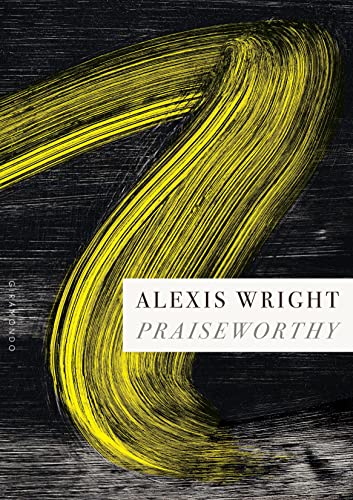
Alexis Wright, Praiseworthy (Giramondo 2023)

Page 76 of Praiseworthy is almost exactly a tenth of the way into the book. If this was a movie, it would be the moment for the first turning point, the ‘opportunity’. And maybe it is.

Tommyhawk has just been introduced. He is a pudgy eight year old, the youngest member of the family at the centre of the story. His father, Cause Man Steel (also known as Planet and Widespread), has a vision of ensuring that Aboriginal communities and culture thrive in the climate catastrophe by creating a global transportation conglomerate using feral donkeys (the book gets pretty surreal). His mother, Dance (called ‘moth-er’ for the first time on this page), has a mystical connection with moths and butterflies, and is often surrounded by millions of them. His older brother, Aboriginal Sovereignty, is to take on a weird allegorical significance as the tale unfolds.

Depending on your point of view, Tommyhawk is the book’s villain or its tragic hero. The real villains are the colonisers, who are described on the very first page as ‘land-thief criminals’ and referred to frequently as ‘the national Australian government for Aboriginal people’, but who are almost completely offstage. (All but two ‘onstage’ characters are Aboriginal.) Assimilation is the great moral evil in this book. Other characters, including the albino Major Mayor of the community of Praiseworthy, have assimilationist goals, but for Tommyhawk, as we begin to understand on page 76, it’s personal.

Tommyhawk has done well at school and has been given a bunch of electronic devices, which he uses to listen to mainstream media, and becomes entranced by the version of Aboriginal people he hears, especially a much repeated assertion that Aboriginal men are paedophiles.

On this page:

Tommyhawk became convinced that these good white righteous people were speaking to him in particular, and not to other Aboriginal children, because he was special, and this made him most at risk. He believed they were speaking directly to him, and what they were saying ran through his mind in sleepless nights this way and that while he tossed and turned in the heat until he became wholeheartedly convinced that he had not been placed on this Earth to be stuck with dangerous people. Even!

Even like his parents. They were a danger to him. That Cause Man Steel person could kill him. And Dance, the moth-er, she only noticed him, took pity when she had mistaken him for a butterfly, or as a cocooned baby being cared for by butterflies flying among the reeds, pandanus fronds, mangrove leaves, drifting in from the sea, like the story of Moses. Hatred was not a word strong enough for how he felt about his parents.

The radio voices are Tommyhawk’s equivalent of Macbeth’s witches. Where Macbeth is tempted to kill the king, Tommyhawk is called away from his Aboriginal family and culture. He decides, soon after this page, that he wants to be adopted by the Minister for Aboriginal Affairs (whom he sees as an apparition in the sky) and be taken to live in the palace of Parliament House in Canberra. It’s absurd, comic and tragic all at once. I won’t spoil it by saying if he succeeds.

I can imagine a Reader’s Digest Condensed version of Praiseworthy that was about a third as long. Such a version would capture the whole plot and and lose almost everything that makes the book interesting. The same can be said of this page. If you read it simply for what moves the story forward, what follows the paragraphs I just quoted adds almost nothing.

But you don’t read this book just for the story. Alexis Wright appeared at the recent Sydney Writers’ Festival in conversation with Ivor Indyk, her publisher. For me, the most revelatory moment of the session was when she talked about the relationship between her writing and music. While writing, she listens mostly to classical Indian music and yidaki. Both those musics have a kind of pulse to them, and she tries to create something similar in her prose. It’s the pulse of country, she said: ‘We say that we’re of one heartbeat with the country.’

The second half of page 76 is far from the most ecstatic passage in Praiseworthy. It doesn’t defy punctuation conventions or twist language in a way that so discombobulates people like me who can’t lay their internal proofreader aside (see my blog posts on Carpentaria and The Swan Book), but it’s a good example of the way Alexis Wright’s prose circles around itself in long, looping sentences, repeating motifs (‘the Australian government for Aboriginal people’), using words that aren’t technically accurate but create the right effect (‘smithereens’), tossing in an awkward cliché (‘plain as day’), making an acute observation (‘passionately, or indifferently’), all in a seemingly unstoppable flow. It’s prose that needs to be heard.

Try reading this aloud, exclamations and all. What I hope you’ll hear is the rhythm of the prose, its weirdness, and – now that Wright has given me the word – its pulse.

So! Very well then! Tommyhawk’s endless deciphering of the barrage of voices on the radio went on through the night and continued as relentlessly as the haze-loving mosquitoes buzzing around him, but neither the activity of squashing blood-bloated mosquitoes to smithereens, or growing his monstrous brain from listening to what was being said on the radio passionately, or indifferently, about the Aboriginal world, was without success. All was gained, and while Tommyhawk had initially wondered why these people were talking the way they did about Aboriginal people like himself, he finally broke the code. He knew the plan as plain as day, that his national Australian government for Aboriginal people was actually speaking directly to him through the voices of random bigots on talkback radio, or in the news, or whatever running commentary he was listening to where anyone was having a good go, giving it all about what they thought of Aboriginal people. This was how he always found the message that the government was trying to get to him. Mostly it was about how the government was trying to tell him, You must escape your black parents

Added on 16 June: Mykaela Saunders has a brilliant long review of Praiseworthy, ‘Think of the Children!’, in the Sydney Review of Books, which you can read at this link.

Jeannie Baker’s Desert Jungle

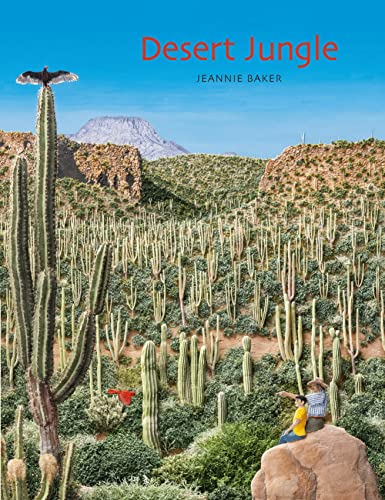
Jeannie Baker, Desert Jungle (Walker Books Australia 2023)

There are no books quite like Jeannie Baker’s. For four decades she has been creating picture books that are immediately recognisable as hers. Where the Forest Meets the Sea (1988) was the first one I encountered. In it, a small boy wanders through the Daintree rainforest in North Queensland. The forest is recreated in collaged materials, most of them gathered in the real-life rainforest, to stunning effect. The book is meant for young readers, but readers of all ages are intrigued and delighted by the extraordinarily detailed work that has gone into the images.

Since then, every couple of years, a new book using similar collage techniques has appeared. All of them reflect a deep concern and love for the natural environment. Window (1991) traces the changes to a rural environment brought about by urban sprawl as seen through a child’s window. The Story of Rosy Dock (1995) features a beautiful but destructive invasive weed. Circle (2016) is about migratory birds.

Jeannie Baker has made short films of Where the Forest Meets the Sea and The Story of Rosy Dock – both of which are available from the National Film and Sound Archive. And there have been many exhibitions of her original artwork.

Which brings me to Desert Jungle. I read the book at the Penrith Regional Art Gallery, at an exhibition of the collages for this book. The gallery website describes the work (and the book) in these terms:

In this new story, Jeannie explores the Valley of the Cirios in Mexico, through the perspective of a young child and his grandfather. In parts of the Valley, towering stands of Cardon Cactus – some of the largest cacti on Earth – and Elephant Trees, mix with Cirios and other unique desert plants as a ‘forest’, almost a desert jungle. These cacti and other plants form both subject and material for Jeannie, who incorporates clippings from plants in her intricate and stunning works

https://www.penrithregionalgallery.com.au/events/jeannie-baker-desert-jungle/

The collages are in effect dioramas, displayed behind perspex that is curved to accommodate their depth. Part of the fascination is to read the labels, to see that most of the images are made from parts of the plants they represent. Even, in an image of the young boy sitting with his grandfather, the hairs on the old man’s arm are actual human hair meticulously glued in place.

In the context of these wonders, the book’s story is almost of secondary interest. When the boy visits his grandfather, he doesn’t like to go out into the surrounding desert because he’s afraid of coyotes, so he stays by the house and plays on his tablet. A coyote steals his precious technology and when he wanders out to search for it, he finds the desert isn’t so scary after all. He even encounters the coyote and nothing bad happens. It’s an understated little drama about facing one’s fears, and at the same time has something to say about the importance of engaging with the natural world.

I haven’t read it with a small child yet. I’ll be interested to see how it goes.

SWF 2023: My sixth day

Another early start with 10–11 am: Barrie Cassidy & Friends: State of the Nation

Veteran journalist Barrie Cassidy has been a regular at the Sydney Writers’ Festival, but this is the first time I’ve been to one of his sessions. He was on stage with what the festival program calls ‘his hand-picked squad of the country’s sharpest pundits’: Amy Remeikis, Niki Savva and Laura Tingle. They’re all regulars on current affairs TV, but I don’t think I’d seen any of them in person before.

The subject was politics, that is to say mainly electoral politics and the state of the major parties. The most telling comment was towards the end when Barrie Cassidy said, ‘When there’s consensus between the major parties, the media doesn’t chase it up.’ This means that the press doesn’t do a lot of interrogating of the AUKUS deal – is it actually in Australia’s interest or is it a matter of us serving the interests of the UK and the US? Similarly, coverage of climate issues through a party-political lens can often miss the point.

Nikki Savva’s subject seems to be the Liberal party. She sees the current dominance of Labor in Federal parliament and in all mainland states is largely due to the decline of the Liberals as a fighting machine and also as representative of a population. They are ceasing to be an effective opposition, or even an opposition at all. Peter Dutton’s survival strategy depends on three things: the failure of teh referendum on the Voice; an economic crash; and the rise of intolerance. Hard to cheer for him, then, and she says many dyed in the wool Liberals can no longer bring themselves to vote for what the party has become since Howard.

Amy Remeikis, introduced by Barrie Cassidy as political correspondent for The Australian much to the amusement of the Guardian readers in the audience, thought Labor’s ascendancy had something to do with changing demographics. Millennials now outnumber boomers, and in addition to the tendency of people to be more progressive when young, there’s the fact that life is particularly tough for the young these days.

Laura Tingle added that politics tends to go in cycles. This is Labor’s time for dominance, it was at rock bottom in 2014.

All agreed that there is a growing disconnect between the political class – politicians, political journalists, people who turn up for panels like this one – and the rest of the community. People are doing it hard, inequality is bigger than it’s ever been, our sense of common life is being eroded (not as badly in the USA, yet). Things are better than they were before last year’s election. The people in charge now are there with good motives, but business as usual could lead to disaster. We need grown-up conversations about tax and climate policy, and we’ve got a way to go for that.

A non-party-political subject that got some airplay was the recent resignation of Stan Grant after he was subjected to vicious and sometimes racist attack for giving a Wiradjuri perspective on the British Crown. Laura Tingle, as recently elected member of the ABC’s Board, said she had been out of action for a couple of weeks because of a bereavement, but deeply regretted Stan’s lack of support from management and the Board.

I haven’t ever watched Insiders, which used to be Barrie Cassidy’s Sunday morning show on the ABC. I imagine this was a slightly generalised version of that. One of the questions at the end referred to the fact that over a number of years not one non-white panellist had appeared on that show (the questioner didn’t need to point out that all the panellists today were white). Barrie did the only thing he could do and said it had been a mistake.


11 am: Osman Faruqi on Australia’s War Against Hip Hop

I listened to this Curiosity Lecture almost by accident. I know almost nothing about hip hop, and I guess I skip over headlines saying that it has been banned in venues including Sydney’s Royal Easter Show.

Osman Faruqi’s exasperated plea could have been meant specifically for me: ‘For once, listen to some art that doesn’t come from Bondi or Balmain.’ (Though, to be honest, I don’t know when I last listened to music from either Bondi or Balmain.)

He told us that NSW Police have taken steps to ban particular hip hop performers saying, nonsensically, that their music is used to ‘procure’ members for criminal bikie gangs etc. This censorship, he said, is ‘the greatest example of artistic suppression in Australia’s history’. If Nick Cave, who is white and part of the music establishment, sings about murdering every woman he sees, no one bans his song as inciting murder. When Bill Henson’s photographs are taken down, there’s an outcry. But if a brown rapper uses violent imagery they are banned from performing and police have their videos removed from YouTube, and there is resounding silence from the art world, including from successful white rappers.

Showing my age: in the 1970s the campaign against censorship focused on erotic material, because the banning of material deemed pornographic (the famous example if Lady Chatterley’s Lover, but Norman Mailer’s Why Are We in Vietnam was also banned). You don’t have to love pornography or be a fan of drill-rap to be uneasy about what’s happening now


12–12.30 pm: Beginnings: Remembering Robert Adamson and Frank Moorhouse

There were a number of ‘Beginnings’ sessions. It’s a nice idea: people read the beginnings of their favourite books, or perhaps their own books, on the assumption that writers put a lot of attention to their opening paragraphs.

This short session used the format to honour Frank Moorhouse and Robert Adamson, who both died in the last 12 months. I wonder if it would be an idea to plan a couple of elegiac sessions along these lines for every Writers’ Festival. Spaces could be left blank for people who die too late to be included in advance publicity. John Tranter, who died on 21 April this year, might then have been honoured.

As it was, Annabel Crabb and Mark Mordue read to us.

Annabel read the opening pages of the first two ‘Edith’ books, the first line of the third, and then the final pages, Edith’s death scene, from Cold Light, the third book. It was shockingly good.

Mark Mordue opened with a letter found in Adamson’s papers in which Frank Moorhouse responded warmly to one of Adamson’s poems. He spoke briefly about Adamson’s life, including his time in prison, his drug addiction and the role of his wife Juno Gemes. He finished with a poem that Adamson wrote for her, ‘The Kingfisher’s Soul’, which Adamson himself read at at least one previous Sydney Writers’ Festival. It ends:

_________________________ the future awaits you.
I stepped into the day, by following your gaze.

I want to make a final small observation about acknowledgements of country.

My initial prompt for this was an acknowledgement that was gobsmackingly perfunctory: the presenter didn’t look at us, but read hurriedly from a clipboard, stumbling slightly over the words. Disrespect may not have been intended, but it was certainly there.

I started to notice how other presenters made their acknowledgements personal. For example:

  • Michael Williams spoke briefly of how the land was unceded and so the issue of sovereignty was unresolved
  • Omar Sakr noted that some people object to the acknowledgements and responded that words – words like ‘genocide’ and ‘sovereignty’ – matter, that words give rise to actions
  • Sisonke Msimang made acknowledgement first in her own mother tongue and then in English
  • Felicity Plunkett quoted two lines about the power of country from First Nations poet Ellen van Neerven
  • Barrie Cassidy drew our attention to the coming referendum on a First Nations Voice to Parliament.

I was born on Mamu land in what is now North Queensland, and my father remembered as a child hearing ceremony down at the river behind our place. I’m writing this on Gadigal-Wangal land. Both places make my heart sing.

And the Festival is over, bar the podcasting.

SWF 2023: My fifth day

12–1 pm: Crime and Justice

This session demonstrated the strengths of a two-person panel. It was progressing quite nicely, as Sarah Krasnostein (my blog post about her Quarterly Essay Not Waving, Drowning here) introduced the talent, Helen Garner (my relevant blog post here) and Hedley Thomas (creator of the podcast Teacher’s Pet), and asked about their writing process.

When Helen Garner is embarking on a long project, she buys a spiral bound A4 notebook and keeps a kind of diary of everything related to the project: not transcripts of interviews, but odd details, what she did, and thought, and felt. When it came time to marshal the material she had accumulated for Joe Cinque’s Consolations she was at a loss where to start, looked to the notebooks for inspiration and discovered that they contained the skeleton of the book.

Hedley Thomas was in the middle of answering a similar procedural question, when Garner was visibly excited by something he said. With a quick look at Sarah Krasnostein, half asking permission and half apologising, she interrupted to take the conversation off in a whole new direction: the way footballers tend to have a degree of immunity from police investigation because of their almost hallowed status in Australian society. From then on we were treated to a lively conversation between two people who had deep appreciation for each other’s work and were swapping stories and genuine compliments.

Sarah Krasnosteiin made a couple of attempts to restore order, but I think she could tell things were going swimmingly. This session is sure to appear on the SWF podcast during the year.


5–6 pm Alexis Wright: Praiseworthy

Alexis Wright’s third massive novel, Praiseworthy, was published just a couple of months ago. Ivor Indyk, director of Giramondo Publishing, stepped in at short notice to discuss it with her, replacing Sisonke Msimang, who had been called home to Western Australia unexpectedly. So, in this session, an author discussed her novel with her publisher and editor – that is to say, with a reader who had some influence on how the book turned out.

I was one of the few people in the room to have read the book. I was keen to lap up any guidance from either Ivor or Alexis on how to make sense of the experience. I’m glad to report that I got plenty.

For a start, it was reassuring that Alexis mentioned some of the more bizarre plot developments with a wicked smile, and the audience laughed quite a lot as the two of them named odd characters and moments. Ivor said towards the end of the conversation that the comedy of her work was often overshadowed by its epic qualities. For me, the issue was more how seriously to take the epic qualities when, as summarised by their author in this conversation, they had such absurd qualities.

Asked about the original idea for the book, Alexis Wright said she didn’t remember – she’d have to look up her notebooks. Perhaps it had to do asking what Aboriginal people are to in the new era of global warming and climate change. She started writing it when she was working on her multivocal biography of Tracker Tilmouth in 2017 (my blog post here), and the visionary at the heart of the novel ‘Cause Man Steel, Widespread or Planet, whatever you want to call him’) is in part based on Tracker. Widespread’s plan for a global transport conglomerate using Australia’s five million feral donkeys, though, is all hers: it’s absurd to the point of surrealism, but there’s something true in the way it leads to a cycle of vision and disappointment.

The book is in part a celebration of Aboriginal people’s will to survive, manifested in many ways, tainted by 240 years of living in the coloniser’s world. The enemy in this book is the project of assimilation.

Perhaps most interesting to me was the exchange about music. Referring to the Ice Queens – grotesque, larger-than-life women who appear toward the end of the book – Ivor wondered about the influence of opera. Alexis agreed that she loved opera, but seemed nonplussed at Ivor’s suggestion that these characters are operatic. The music she listens to most while writing is classical Indian music and yidaki (didgeridoo). She tries to capture the tone and rhythm of that music – the pulse, the heartbeat: ‘We say that we’re of one heartbeat with the country.’

‘You hear what you’re writing,’ Wright said. ‘Then it gets recorded and you want it to be the voice you heard, but it can’t be that voice.’

There was a lot more. Ivor touched on the way Wright defies conventions, at times inventing words that look like mistakes, but which are anything but.

I’ll be attempting my own blog post about Praiseworthy in the next couple of days. Wish me luck!


We made a quick dash to a smaller venue for 6–7 pm State of the Art

Kate Evans of ABC’s The Bookshelf presided over another panel. This time it was Eleanor Catton, Richard Flanagan, Tracey Lien and Colson Whitehead invited to discuss the state of the novel and the future of fiction.

I haven’t read anything books by any of these authors, apart from one novel that I hated, which I’m told is completely unrepresentative of their work. I enjoyed the ebb and flow of conversation, but didn’t have anything to ground myself in.

Kate Evans asked if ChatGPT and other AI content producers spelled the end of novelists. Tracey Lien, the youngest on the panel and the only one without a string of awards to her name (and not at all intimidated by that, she said smiling bravely), said she used ChatGPT as a research assistant, but it couldn’t do the writing. On the one hand, it doesn’t have a brain, but produces word after word by complex algorithms, and the act of reading is a back-and-forth between minds. On the other hand, ChatGPT lies.

Richard Flanagan, whose scowl occasionally gave to an appreciative grimace at another panellist’s point well made, said he didn’t care about AI. He’d just keep writing.

The subject of decent recompense for the work of writing, and of all creative work generally, provoked more interest. Digital publishing changes the landscape significantly. They all agreed they weren’t in it for the money, but money would be nice. Eleanor Catton said that working as a scriptwriter was hugely more remunerative. Responding to a question at the end about how to become a writer and also earn a living, Flanagan said he had decided to be a writer when he was very young and in order to achieve it he lived in poverty for years. There was no other way. Colson Whitehead said something similar: after a significant number of successful novels he was at least temporarily able to live on his earnings as a writer. He implied that this is precarious.

Whitehead, Flanagan and Catton spoke interestingly about not repeating themselves, each new novel being a whole new challenge.


SWF 2023: My fourth day

Friday was my day for poetry, starting early:

10–11am In Conversation: Anthony Joseph

Anthony Joseph comes from Trinidad and is currently based in the UK. He was in conversation with Felicity Plunkett, one of the few Australian poets to appear on the program. Though his most recent book of poetry, Sonnets for Albert, won the 2022 T S Eliot Prize for Poetry, Felicity Plunkett assumed, correctly in my case, that the audience was unfamiliar with it, and filled us in: it’s a book, mainly in sonnets, about the poet’s father.

The conversation covered two main subjects, both engrossing: the story of Joseph’s father and his use of the sonnet form.

A young friend of mine once said of her father, with obvious affection, ‘He was a terrible dad.’ Joseph could go further: ‘He was my father, but he wasn’t a dad.’ He married very young, and left the marriage after just enough time for two sons to be born, then in the rest of his life had ten more children by a number of women. Joseph’s brother remained bitter about being abandoned until, at the very end, he was at his dying father’s bedside. Joseph himself lived with his paternal grandmother as a small boy and her affection for her son rubbed off on him. The poems, as I understand it, explore this emotional complexity. I’ve bought a copy of the book.

The sonnet – which Felicity Plunkett described as being an inheritance just as much as family experience is – is more than a poem. In the English-speaking world, it’s a feeling, a thing you recognise in many places: in the shape of a pop song, even in the shape of the human body. It’s a way of thinking. For Caribbean/Black poets, it’s interesting to find ways of using the form and making it fit their experience. When he was writing the book, Joseph started out adhering strictly to the rules, but then began taking all sorts of liberties. His father’s voice said to him: ‘You can’t put me in this box.’

He quoted two Caribbean poets. Kamau Braithwaite: ‘The hurricane does not roar in pentameter.’ Derek Walcott: ‘The English language is nobody’s special property. It is the property of the imagination.’

Speaking of himself, he said that luckily he has access not only to standard English but to Trinidadian Creole, which (I’m almost certainly getting this wrong) uses English words with African-derived grammar. To illustrate, he read us sonnets from the book in standard English and in Trinidadian.

There were some good questions. I loved his description of his process for writing a poem: ‘You write it. You leave it. You come back and edit it, and hope the original resonance is still there.


After grabbing a late breakfast, it was off to join a much larger audience for:

12-1 pm Eleanor Catton: Birnam Wood

Eleanor Catton was in conversation with Beejay Silcox who I know mainly as a critic in the Australian Book Review. Everyone keeps saying that Eleanor Catton’s new book, Birnam Wood, is her second, the first being the award-winning The Luminaries. Catton was careful to let us know it was actually her third, and that she didn’t disown her first, The Rehearsal, about a theatrical production in a girls’ school.

She talked about her venture in screen writing – for the 2020 movie Emma. (full stop is part of the title), directed by Autumn de Wilde. She learned a lot from her immersion in Jane Austen’s novel, and from the way film requires character to be revealed through action. She learned the dictum that every story had to have a beginning, a middle and an end was important for drawing attention to the transitions between those elements, the turning points of structure.

She and Beejay Silcox agreed that Emma is one of the great monsters of English literature, but she said that the genius of Jane Austen is to beguile the reader into committing the same mistake as Emma makes, in thinking ourselves morally superior to her, and then turning it back on us. (I do love a bit of Jane-Austen-ophilia.)

As for Birnam Wood, it sounds interesting, a satire that sets out to unsettle readers of all political stripes. I’ll wait for recommendations or otherwise from the Emerging Artist and others. Maybe I’m unsettled enough already.


Then scurry scurry scurry (I’m sure in the olden days when everything was better there was a bigger time gap between sessions) to:

1–2 pm ABC RN: The Bookshelf

The Bookshelf is an ABC Radio National program where hosts Kate Evans and Cassie McCullagh chat with guest writers about their books and the books they cherish. Each episode of the program adds a number of books to an imagined bookshelf. Their guests on stage for this session were Shehan Karunatilaka (I was glad to see more of him after Wednesday evening), Jason Reynolds (interested to hear him more discursive than on Thursday evening) and speculative fiction writer Grace Chan (yay for genre!).

One of the pleasures of this panel was the way it embodied Anthony Joseph’s quote from Derek Walcott: ‘The English language is nobody’s special property. It is the property of the imagination.’ An African-American YA writer, a Malaysian-born spec-fic writer, a Sri Lankan novelist, all own the language and its literatures. I did make notes of the books they mentioned, but I’ll just mention a couple of moments that gave me joy.

I loved it when someone mentioned a book I love. Jason Reynolds mentioned Sharon Creech’s Love That Dog, a tiny book about a boy who writes poetry that I had forgotten until he reminded me of it. Grace Chan recommended Spirits Abroad by Zen Cho, saying that it had magic, and boarding school etc, and then referred, not to the obvious inspiration but to the late, great, beloved of me, Diana Wynne Jones. Shehan Karunatilaka was cajoled into confessing his love for the Choose Your Own Adventure books – it’s not that I loved them so much as that they were a feature of my early parenthood, and somehow it was a thrill to realise these formidable people were young enough to be my children.

Drums got a mention. Jason Reynolds quoted James Brown (I don’t remember the context): ‘Every instrument is a drum.’ Shehan Karunatilaka said he loved to play the drums: ‘I bang the drum, read some Yeats, and I’m ready to go.’

The most interesting moment was when one of the facilitators suggested that these writers of non-Anglo background were redefining the canon. ‘No,’ said Jason Reynolds. ‘We have different canons to start with.’ He listed a number of great African American writers, not as favourite authors of his, but as the eminences who defined the literary landscape. He suggested that each of the others on the panel had a similar lineage behind them. We’ve come a very long way since my days studying Eng Lit under the shadow of F R Leavis (even though that shadow was fading in my time), when there was The Great Tradition – a very short list of The Writers Who Matter. I for one am very happy for that distance.


7.30–8.30 pm The Rhythm of the Word

The thing I love most about the Sydney Writers’ Festival is being read to. The Big Read, when half a dozen writers would read to a packed Town Hall is now apparently a thing of the past, but moments like Sebastian Barry bursting into song at the beginning of his reading are still with me years after the event.

So I was happy to venture back out from my warm home for this poetry reading. Poetry readings at the SWF used to have a home-town feel, and when the festival was beside the Harbour poetry had a base in small, often crowded, sometimes glare-filled room at the end of the wharf. The Carriageworks doesn’t allow for such nooks and crannies, and poetry events have somehow become rarer.

Not that there was anything unattractive about this event.

Western Sydney poet Omar Sakr was the host. He used his platform as MC to slip in a poem of his own (the only poem I heard at the festival by a Australian living east of the WA border!). It was ‘Diary of a non-essential worker’ a Covid poem, and I wrote down two lines that struck me. I can’t read my own writing, but I think the lines are:

Everything is a miracle when you're alive
I'm learning that reluctantly

Madison Godfrey did a reprise of ‘When I grow up I want to be the merch girl’, which they read on the opening night. Their other poems were ‘Harry Styles was [illegible] on a beach and the horizon was aligned with his thighs’, ‘Utopia translates as no place’ (a heartbreak poem), and ‘Impulse’ (named for a brand of deodorant).

Joshua Whitehead, Canadian First Nations scholar and poet (a different person from novelist Colson Whitehead who is also a guest at the festival) did a stunning performance of a medley of poems from his two books, including Making Love with the Land (2022). If you heard his astonishingly rapidfire stuttering delivery on a recording you could easily assume his effects were achieved by electronic feedback but he did it all.

Nguyễn Phan Quế Mai read three poems, first in Vietnamese and then in English. At the end, she gave us a short lesson in the importance of diacritical marks in Vietnamese (‘those funny little marks above the letters’). She had us all pronounce Quế , and explained it means ‘cinnamon’. Then she taught us Que (which is how her English-language publishers) wanted to print it). It sounds quite different and means ‘snake’. Point made.

Anthony Joseph read two poems, quite different from the sonnets of this morning’s session. They were ‘On the Move’ and ‘The Ark’ He introduced the latter saying it was an elegy for a London hip hop performer whose name I didn’t write down. It’s a list poem, or a litany: name after name of African-heritage writer or singer or performer with the recurring phrase ‘is on the Ark’. The cumulative effect is powerful – for me, partly by making me aware of how few of the names I recognised (making me think back to Jason Lester’s observation this morning about different canons), and partly by invoking the force of those I do recognise (from Langston Hughes to Maya Angelou). At the end his friend’s name was added to the list, and Omar Sakr came onstage wiping his cheeks and saying his face had melted.


After the reading I looked around and saw just one face I recognised. We had a chat, and were soon commiserating over the absence of Sydney’s usual poetry audience from the event, and the near absence of Sydney or even eastern Australian poets from the Festival program. We happened to walk past Ann Mossop, Artistic Director, and buttonholed her briefly on the subject. She said that it’s hard to find an audience for poetry. I wonder what would happen if the Festival commissioned someone like Magdalena Ball of Compulsive Reader or Toby Fitch, poetry editor of Overland and organiser of Avant Gaga, a monthly poetry reading in Glebe, to curate a poetry stream in a tiny room somewhere at Carriageworks. If such a curator needs t be someone who’s not white, what about Eileen Chong, or Sara Mansour of the Bankstown Poetry Slam? Just wonderin’.

SWF 2023: My third day

I’m not exactly live blogging the Sydney Writers’ Festival. It’s now Sunday and my festival is over, but the blog is still at Thursday.

On Thursday, we arrived an hour or so before any of our booked events and caught up with friends over lunch, then we were off.


2 pm: Climate Hope

This was billed as: ‘a trio of environmental experts examine promising developments, signs of hope and viable solutions for a greener, more sustainable future.’ It delivered on that promise.

Simon Holmes à Court, founder of Climate 200 (tagline ‘climate proofing politics’), was the chair. Other panellists were a scientist, an engineer and a community activist: Joëlle Gergis (Humanity’s Moment: A Climate Scientist’s Case for Hope), Saul Griffith (The Big Switch and the Quarterly Essay The Wires that Bind), and Claire O’Rourke (Together We Can: Everyday Australian’s doing amazing things to give our planet a future).

There was an awful lot to digest, or even grasp as it flew by. I hope it will turn up as a podcast – I recommend it.

Here are some of my takeaways:

Jöelle Gergis described how, after helping to write the IPCC report on the state of the climate, she was filled with despair. Technological solutions are pretty much all there, but there is little political will to implement them. This is no longer a scientific problem; it’s a social, cultural and political one. She found hope in looking to history. Many times in the past when there has been a major crisis, people have come together and created solutions. She gave a number of examples, but what I remember is Saul Griffith’s amplification of her point by mentioning Dunkirk: the Allied forces had been roundly defeated, and then Winston Churchill, who can be criticised on many fronts, inspired what could have seemed an irrational hope with his rhetoric (‘We will fight them with teaspoons’ – not an actual quote as far as I know), and the people famously rallied.

The motto ‘Reduce, Re-use, Recycle’ doesn’t point to the way out of the climate emergency. It puts the onus for action at the individual level, when what is needed is systemic change (though individual initiatives are important to achieve that). It can be paraphrased as, ‘If we just sacrifice a little, the world will be a little bit less fucked.’ (Numerous apologies for swearing were made to Saul Griffith’s mother who was in the audience, though if she’s anything like women I know who are mothers of people Saul Griffith’s age, she swears quite a bit herself.) in reality, if we do this right, we can get a good outcome and not sacrifice any of our standard of living.

Claire O’Rourke is already active in the social movement space. She gave example after example of ordinary people who have taken action and organised to bring about change at local and regional levels.

There were some great quotes:

Claudia Rankine (link to my blog post about her Citizen): ‘Every state of emergency is also a state of emergence.’

Bill McKibben (link to my 2007 blog post discussing his Deep Economy): ‘Winning slowly is losing.’

Rebecca Solnit (link to my blog post about her Hope in the Dark): ‘People today will determine the future of humanity.’

Saul Griffith recommended that each of us makes six big decisions about our lives in the next year in order to bring about systemic change: decisions about home heating, cooking, cars, nutrition and so on. Just a handful of major decisions, he means, not the hundreds of decisions involved in ‘lifestyle changes’.

Claire O’Rourke mentioned systems theory, said change happens most effectively through networks and recommended the All We Can Save Project.

Jöelle Gergis had the last word: The missing piece is a social movement.


I rushed off to arrive late and sit at the edge of the space set aside for ‘curiosity Lectures’ and ‘Beginnings’, the latter being sessions where people read the beginnings of books to the audience:

3 pm: Benjamin Gilmour on Taking Tea with the Taliban.

Among other things, Benjamin Gilmour is notable for the extraordinary film Jirga (2019), which he wrote, directed and shot in a tribal area of Afghanistan. He recently revisited Afghanistan for a new film documentary project, which if I heard correctly is to be called Taking Tea with the Taliban. In this Curiosity Lecture he told about interviews with members of the Taliban government and his time with villagers who told him of terrible brutality at the hands of Australian soldiers.

It was disturbing stuff. He relayed the Taliban’s protestations that the way they are portrayed in the western press is self-serving propaganda, that their treatment of women is misrepresented, and that it’s hypocritical for the west to condemn the Taliban for mistreatment of women when USA and Australian forces have destroyed so many Afghan lives, of women and children as well as men.

I couldn’t help thinking of those Australians who visited Stalin’s Russia and came back with glowing reports of happy workers at times when, it was later revealed, the gulags were filling up. All the same, he made a strong argument for governments to engage with the Taliban. ‘I did,’ he finished his talk, ‘and I’m just some guy.’

Benjamin Gilmour has a special place in my heart: we published a number of his poems in The School Magazine in the 1990s, when I was editor and he was a teenager. I introduced myself and we had a photo taken together. I’d share it here but I made the mistake of lowering my mask instead of taking it off altogether, and I look mildly deranged.


Then straight on to 4 pm: George Monbiot: Regenesis

A giant George Monbiot on video chatted with Rebecca Huntley. This was a brilliant talk. Monbiot’s ability to marshal facts and present a clear argument is breathtaking.

His central message was that the global food supply system is at risk of catastrophic failure. Not only that, but farming is contributing hugely to global warming. Second only to the urgent need to keep fossil fuels in the ground is the need to stop farming animals. It’s as if the scientists who have been researching this area have been shouting and waving their arms about, but have been doing it from behind plate glass, inaudible to the rest of us.

Although world hunger fell steadily from about 1960, in 2014 it began to rise again, and has been rising steadily ever since – even before the shocks to the food supply system that were Covid-19 and Russia’s invasion of Ukraine. This is because the food distribution system now works in such a way that even small shocks to the system can cause disproportionate price hikes in vulnerable communities.

He gave us a brief introduction to systems theory. Complex systems, such as the climate or the global food supply system, take a lot of understanding (and after this talk, I’m keen to learn more). There are six elements required for a complex system to be resilient:

  • diversity
  • asynchronicity
  • redundancy
  • modularity
  • circuit breakers (in this case regulatory constraints)
  • back-up systems

I imagine his book Regenesis spells out how the food system scores on these elements. From the talk I understood that concentration of the control of food in about four massive corporations makes for low resilience. Industrial farming likewise. Redundancy is so limited that if the Ever Given had been stuck in the Suez Canal a year earlier, when Covid was at a different stage, the result would have been disastrous.

It’s not a question of tightening our belts. He sees hope in technology, in what he calls a technoethical shift: when something becomes amendable it becomes intolerable. That is to say, if a food can be developed that has the nutritional value of meat and it’s flavour, texture and general appeal, we will be able to face the reality of what our meat-eating has been doing to our relationships with other animals and to the planet.

The technology that he favours is ‘precision fermentation’, in which single cell organisms are used for food: we already do it with yeast, and many other species are being explored. A naturally occurring pink microbe has been discovered in Europe that when grown in a culture looks, feels and tastes like sausage. He himself was the first person to eat a pancake grown from microbes – ‘One small flip for a man’ – and it tasted like a pancake. He surmises that this will lead to a culinary revolution as radical as the one produced by the development of agriculture. And food produced in this way uses a tiny fraction of the earth’s resources.


We went home for a vegan dinner, then caught public transport into town for our one event not at the Carriagework:

8 pm: Storytelling Gala: Letters to the Future

Not to cast shade on any of the readers or organisers but this ‘gala’ was a bit of a dud. A stellar line-up of writers got to read to a packed Sydney Town Hall. They had evidently been given the title ‘Letter to the Future’. Most of them gave us a piece that began, ‘Dear Future’, and too many wrote what could be summarised as: ‘Dear Future, we have fucked up the world. I expect Earth is posthuman/a disaster where you are. Please forgive [or forget] us.’ After hearing someone say in the 2 o’clock session that people find it easier to imagine a disastrous future than one where the problems have been solved, it was dispiriting to hear so many people take the easier path as if they were doing something serious.

There were exceptions.

Anthony Joseph (about whom more tomorrow) read two poems in a form known as the Golden Shovel, where the last words of the lines spell out a quotation. His first one took Kierkegaard’s ‘Life can only be understood backwards; but it must be lived forwards’: I was too busy trying to spot the line breaks to follow the poem, but it sounded great.

Shehan Karunatilaka spoke elegantly about the impossibility of the task and told a fable about a child refusing a hug to her father, thereby setting of a chain of events leading to disaster.

Nguyễn Phan Quế Mai wrote an imaginary letter from her ten-year-old self, bookended by fabulous a cappella song.

Jason Reynolds also read a letter from his past self: I found it hard to follow, but his performance was fabulously musical.

Nardi Simpson rejected the idea of the future, saying that as a First Nations person she has responsibilities to Now. It was striking how she echoed Alexis Wright’s talk on the opening night.

Tabitha Carvan got the only laughs of the evening with a comic bit about a leadership course where on the first meeting the participants wrote a letter to their future selves.


It was a day full of excellent things, and things that will bear thinking about and acting on for some time.