Another Day in the Colony with Chelsea Watego

Chelsea Watego, Another Day in the Colony (University of Queensland Press 2021)
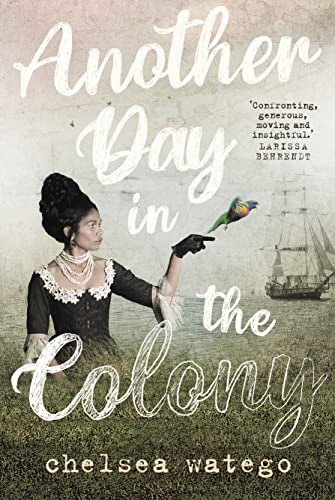
Not every book is as explicit as this one about its intended readership. The Introduction gives fair notice:

This is not a book for colonisers, or those aspiring to share the same status as them. This is a book that is written specifically for Blackfullas, and when I say Blackfullas I mean of the capital B kind.
When I speak of the uppercase Blacks, I speak of those who simultaneously recognise and refuse the racialised location we’ve been prescribed, as well as those who have been haunted by it.

(Page 9)

‘Colonisers’ is the term Chelsea Watego prefers over, say, ‘non-Indigenous people’ or ‘settlers’ because, she argues, those terms gloss over the continuing violence of colonisation. As a reader of Anglo-Celtic heritage, I’m glad to report that the Introduction continues:

Of course, the colonisers may find something of use here.

In 2020, the first year of Covid-19 and the year of a re-energised global Black Lives Matter movement, as well as the 250th anniversary of Cook’s arrival in Australia, Chelsea Watego took leave from work, including her Twitter account and the Wild Black Women radio show. In the Introduction, she tells us that her ‘body was tired and, in this moment, appeared to insist that [she] tell a story’. The stories that she told make up this book:

  1. ‘don’t feed the natives’ – among other things, a personal account of growing up and taking on a career in Indigenous health, which Watego has come to understands as aiming ‘to strategise a Black living which presumes a Black future, of a forevermore kind … that is set on our terms, on our land’
  2. ‘animals, cannibals and criminals’ – about which more later
  3. ‘the unpublishable story’ – an article, discussed in the previous essay, that was rejected by the journal that had commissioned it
  4. ‘on racial violence, victims and victors’ – an argument for the importance of naming racism, accepting that it is embedded in the institutions of the colony, rather than talking of culture and diversity, and relying on the courts to put things right
  5. ‘ambiguously Indigenous’ – a critique of the ’emerging tribe’ of people who discover Aboriginal heritage and identity after growing up white, and assume positions of authority in Indigenous affairs. She describes this grouping as a modern equivalent of the nineteenth century Native Police
  6. ‘fuck hope’ – an argument against a version of hope that minimises current mistreatment and suffering by focusing on an imagined time when things will be better
  7. ‘a final word … on joy’ – which could be an extended paraphrase of Alice Walker’s revelation at the end of Possessing the Secret of Joy, ‘The secret of joy is resistance.’

That list can only give a faint idea of the confronting riches of the book. I’d be lying if I said I didn’t get defensive at times, identifying with the writers, editors and reviewers Watego finds wanting, or that as a man I didn’t feel a guilty relief when she focused on white women as key culprits, or that at times I didn’t respond with something like, ‘Steady on now, that’s a bit intemperate.’ Et cetera. I’m pretty sure any non-Indigenous/coloniser reader will have similar responses, which might be some consolation to the people whose names are named. We’re in this together.

The second essay, ”animals, cannibals and criminals’, lays out the way Australian fictional and non-fictional (‘faction’) writing has depicted Aboriginal people as either belonging in the past with quaint customs and stories, or as problems to be solved by white managerialism. These representations aren’t safely in the past.

The essay discusses Sarah Maddison’s book The Colonial Fantasy (‘which it could be argued is one of the more sympathetic works to the plight of Indigenous people in our time’), and Randolph Stow’s To the Islands (or at least Stow’s preface to the 2002 revised edition, which deterred her from reading much further).

The Black story must be a site for which the coloniser can express sympathy, and not in a solidarity kind of way, but a condescending sorrow for our supposed plight. Our stories should not be repositories for which faux coloniser sympathy may find a home, yet too often they are.

(Page 67)

The essay moves on to stories of how Watego’s own writing has run foul of gatekeepers. She entered academia with the aim of correcting the prevailing account of First Nations people by presenting a solid evidence base. She found it wasn’t a matter of evidence, but of a deeply embedded attitude in the minds of the colonisers.

Editors have asked her to include on-the-other-hand paragraphs that undercut the thrust of her writing; have quibbled with her use of language like ‘white’ to describe a racial category; articles have either gone unpublished or are still awaiting publication years after being accepted.

The chapter ends with the story of an article she wrote for a special edition of the Australian Feminist Law Journal, but which didn’t make it into the journal. As with all such stories, the reader is left wondering what version of events the unnamed meddlers and censors would tell. We don’t get that, but we get something even better: the following chapter, ‘the unpublishable story’, gives us the article to read and judge for ourselves.

There can be little doubt that the article would make painful reading for Cathy McLennan, whose memoir Saltwater (link is to my blogpost) is unsparingly criticised, but it’s not the first time the book has been given the treatment (see ‘Crocodile Tears‘ by Russell Marks in Overland Summer 2019), and it’s hard not to see the force of Watego’s argument that the editors who spiked the story were mistaken to override the judgment of the two First Nations editors of the special issue as well as two anonymous peer-reviewers.

Back to the story of the article being spiked:

After much back and forth, the managing editor and editor-in-chief advised that this work was not publishable in any form because it apparently posed a threat of defamation because the white woman author of the book I was critiquing wouldn’t like my review … Her real concern was that there was an imputation that the author of the book was racist.

(Page 76)

This sounds like arse-covering to me, and I expect academics of all kinds run into it all the time. The book being criticised was, after all, written by a lawyer.

Watego’s next sentence is the killer:

Now I didn’t say the author was racist, but I did have about 180 footnotes, three-quarters of which were direct quotes from the text that cited animalistic references to the Aboriginal characters.

On first reading, I took this to be a bit of smart-aleckery: ‘I didn’t say she was a racist, I just gave 180 examples of her racism.’ But it’s more interesting than that. However emphatic she is about the harmful nature the book, she really isn’t imputing malice to the writer. Her argument is that we colonisers are so imbued with the notion of our own superiority – so enmeshed in a racist and colonising system of thought and practice – that no matter how good our intentions or sincere our anti-racist attitudes, we fuck up.

And this is at the heart of the storytelling war, and the dangers confronting the sovereign storyteller in the colony. We simply are not permitted to speak freely and truthfully about the violence we are subject to.

The book as a whole is a living contradiction of that last sentence. Thank you Chelsea Watego and University of Queensland Press for this abrasive, uncompromising, sometimes hilarious piece of free and truthful telling.
Middlemarch: Progress report 6

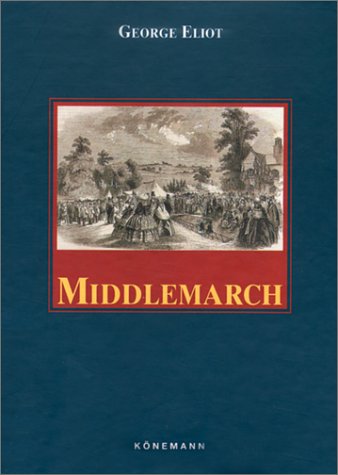
George Eliot, Middlemarch: A study of provincial life (George Eliot, 1871–1872; Könemann 1997), chapter 59 to chapter 72 and the beginning of BookVIII

A friend who recently read Middlemarch for a book group said she more or less hated it. I suppose I might too, if I was reading it with a deadline, but at five pages a day there is so much to enjoy.

A lot has happened this month. Fred and Mr Farebrother’s rivalry for Mary Garth’s affections is out in the open. The Will Ladislaw’s origin story has been revealed, to us and to him; he has felt obliged to leave town and exit the narrative, but not without declaring his love to Dorothea, leaving her sorrowful but happy. The agent of Will’s revelation has precipitated a crisis in the life of Mr Bulstrode the sanctimonious banker, which allows George Eliot to lay out in excruciating detail the way people can lie to themselves. The marriage of Lydgate and Rosamond has continued to deteriorate; financial disaster has been averted, perhaps too late to save the marriage and with terrible strings attached to the means of his rescue. There’s been a death, a murder even.

The rumour mill has been in hyperdrive, and while the pub gossips’ dialogue is richly comic, I wouldn’t be surprised if it was that class-based comedy, and the unremitting focus on the land-owning and professional classes, that my friend found off-putting. I tend to think of it as a kind of science fiction: from one point of view the world of the book is far removed from the actual world – there are no people of colour, the working class and poor people are fairly uniformly dim, etcetera – but from another point of view it’s as realistic as, say, Succession.

I love the moments when Eliot takes the gloves off, like this, which leaves us in no doubt how she feels about the beautiful but completely unempathetic Rosamond:

In fact there was but one person in Rosamond’s world whom she did not regard as blameworthy, and that was the graceful creature with blond plaits and with little hands crossed before her, who had never expressed herself unbecomingly, and had always acted for the best – the best naturally being what she best liked.

(Page 756-757)

This morning’s reading was the first, short chapter of Book VIII, and the end is almost in sight. Things are looking grim for all the characters, and the many narrative strands are starting to come together. Lydgate has made himself the target of serious suspicion by helping the loathsome Bulstrode in his hour of need, and incidentally confirming for the reader that he is a deeply honourable man. Dorothea, hearing the news, is determined to clear his name, and in this chapter all her friends advise caution. Here’s a paragraph:

Dorothea’s tone and manner were not more energetic than they had been when she was at the head of her uncle’s table nearly three years before, and her experience since had given her more right to express a decided opinion. But Sir James Chettam was no longer the diffident and acquiescent suitor: he was the anxious brother-in-law, with a devout admiration for his sister, but with a constant alarm lest she should fall under some new illusion almost as bad as marrying Casaubon. He smiled much less; when he said ‘Exactly’ it was more often an introduction to a dissentient opinion than in those submissive bachelor days; and Dorothea found to her surprise that she had to resolve not to be afraid of him – all the more because he was really her best friend. He disagreed with her now.

(Page 836)

I just love the music of that. There are two long sentences reminding us of the story so far, especially of Chettam’s relationship to Dorothea, then a third that deftly evokes their current relationship, with the lovely observation of the turn of speech that allows ‘Exactly’ to mean its opposite. And the paragraph ends by bringing us back abruptly to the present moment with a sentence of five words.

At the very end of today’s reading, there’s a rare moment when Dorothea laughs, and almost as are a moment when she is bested in conversation. She’s talking to Celia, who like the book’s villain Rosamond is committed to conventional femininity, but unlike her is generous and kind. Celia urges Dorothea to take Chettam’s advice and hold back from interfering in Lydgate’s affairs:

‘Why can’t you think it your duty to submit a little to what James wishes?’ said Celia, with a sense of stringency in her argument. ‘Because he only wishes what is for your own good. And, of course, men know best about everything, except what women know better.’
Dorothea laughed and forgot her tears.
‘Well, I mean about babies and those things,’ explained Celia. ‘I should not give up to James when I knew he was wrong, as you used to do to Mr Casaubon.’

(Page 838-839)

Touché, little sister!

At my current rate, my next Middlemarch progress report will be my last.

Annie Ernaux’s Years

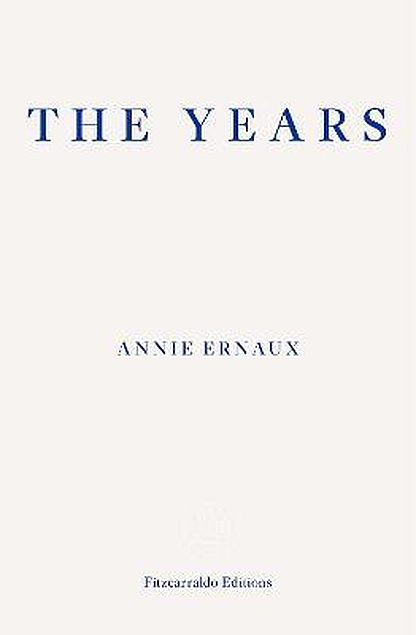
Annie Ernaux, The Years (Fitzcarraldo Editions 2022, from Les Années 2008, translated by Alison L Straya 2017)

Annie Ernaux won the Nobel Prize in Literature last year, which probably accounts for my long wait for this book at the library. It was worth the wait.

It’s a memoir, covering roughly the first 60 years of the author’s life, from listening to adults telling heroic stories of the Resistance in the late 1940s to presiding over family gatherings at the turn of the century full of lively exchanges in which ‘there was no patience for stories’.

It’s not like any other memoir I’ve read. Ernaux describes how she imagined it, referring to her past self as ‘she’:

This will not be a work of remembrance in the usual sense, aimed at putting a life into story, creating an explanation of self. She will go within herself only to retrieve the world, the memory and imagination of its bygone days, grasp the changes in ideas, beliefs and sensibility, the transformation of people and the subject that she has seen … To hunt down sensations that are already there, as yet unnamed, such as the one that is making her write.

(Pages 222–223)

Earlier (on page 162), she says she wants to assemble the multiple images of herself that she holds in memory, and thread them together with the story of her existence – ‘an existence that is singular but also merged with the movements of a generation’.

So it’s the story of the changing attitudes and sensibilities of a generation (the broader ‘they’ and the more specific ‘we’), and of an individual member of that generation (‘she’), embedded in an impressionistic account of France’s political, social and cultural history over half a century.

Algeria gains independence but anti-Algerian racism persists. 1968 happens, and leaves a deep mark on Ernaux’s generation, including those like her who weren’t actually throwing cobblestones. Catholicism vanishes ‘unceremoniously’ and consumer capitalism invades all aspects of life. There’s AIDS, wars and climate change.

The early sexual experiences of Ernaux’s later memoir A Girl’s Story (the link takes you to my blog post) take up a couple of paragraphs. ‘She’ marries, divorces, becomes a grandmother, teaches, retires, ruminates on the approach of death, and writes.

As I read this book, I often just let a series of specifically French references wash over me – resigned to never knowing everything. An Australian The Years might mention Gough Whitlam pouring sand into Vincent Lingiari’s hands, Jack Thompson’s nude centrefold for the first edition of Cleo, or Auntie Jack threatening to rip your bloody arms off: immediately recognisable to some readers, mystifying to others, and opening a whole new vista to the latter if they go exploring.

My practice of looking at a single page is a good fit for this book – the writing is so compressed that practically every page cries out for detailed explication.

Page 76 focuses on the general scene, talking about ‘we’ and ‘they’, as opposed to the passages that begin with a photograph of ‘a woman’ – always Ernaux – and talk about ‘she’. (It’s a book where you watch the pronouns.)

It’s 1962, near the end of the Algerian liberation struggle. Page 75 has described an incident in October 1961, when Algerian demonstrators were attacked by police, and a hundred of them thrown into the Seine, largely ignored by the press. Page 76 begins:

Try as we might, we would see no resemblance between October’s heinous attack on Algerians by Gaullist police and the attack on anti-OAS militants the following February. The nine dead crushed against the railings of the Charonne Métro station bore no comparison with the uncounted dead of the Seine.

As with many passages, I’m happy to guess at the general drift, but since I’m blogging about it, I’ll delve a little.

The OAS (Organisation Armée Secrète / Secret Armed Organisation) was a violent rightwing organisation opposed to Algerian independence. A demonstration against them was organised in February 1962 by leftist groups including the Communist party. The nine victims of police violence at the Charonne Métro station received a lot of publicity and the event came to be seen as a defining moment in the struggle. Ernaux reflects that ‘we’ – her generation, and I would add most people since – give value to the things the press highlights and have trouble giving full value to the sometimes much greater things it ignores. The narrative doesn’t pause to sermonise on the underlying racism.

Nobody asked whether the Évian Accords were a victory or a defeat. They brought relief and the beginning of forgetting. We did not concern ourselves with what would happen next for the Pieds-Noir and the Harkis in Algeria, or the Algerians in France. We hoped to go to Spain the following summer – a real bargain, according to everyone who’d been there.

You probably guess, correctly, that the Évian Accords were the treaties that brought an end to the Algerian war (Wikipedia entry here). The Pieds-Noir were the Algeria-born whites who opposed independence; the Harkis were Algerians who supported French forces (shades of the people abandoned when the USA and Australia quit Afghanistan). ‘We’ don’t include those people, and though our sympathies are with the freedom fighters we’re more interested in our next holiday abroad (again, a familiar syndrome).

The next paragraph shifts smoothly from ‘we’ to ‘people’ and then ‘they’. Though it’s not a hard border, Ernaux is no longer talking specifically about her own cohort, but about French people generally. It’s a characteristically brilliant summary of the mood of a time, beginning:

People were accustomed to violence and separation in the world. East/West. Krushchev the muzhik/ Kennedy the leading man, Peppone/ Don Camillo, JEC/UEC, L’Humanité/L’Aurore, Franco/Tito, Cathos/Commies.

Peppone and Don Camillo are a Communist mayor and a priest who clash in a series of popular books (Wikipedia entry here). JEC is Jeunesse étudiante chrétienne / Christian Student Youth); the UEC is Union des étudiants communistes / Union of Communist Students). L’Humanité was the Communist newspaper; L’Aurore was a centrist mainstream newspaper. All these dualities can be reduced to the almost affectionate diminutives ‘Cathos/Commies’.

The paragraph continues, now definitely in ‘they’ territory, a clear distance between Ernaux’s student grouping and the attitudes described:

Under cover from the Cold War, they felt calm. Outside of union speeches with their codified violence, they did not complain, having made up their minds to be kept by the state, listen to Jean Nochet moralise on the radio each night, and not see the strikes amount to anything. When they voted yes in the October referendum, it was less from a desire to elect the president of the Republic through universal suffrage than from a secret wish to keep de Gaulle president for life, if not until the end of time.

I suppose every French person would know that Jean Nochet was a vehemently anti-Communist broadcaster and that the referendum of 1962 meant that the French presidential election moved from a US style electoral college to direct popular vote. The motive attributed to the electorate reflects De Gaulle’s changing status in Ernaux’s mind over the years.

And then, a characteristic change of focal length, this time from national politics to Ernaux’s own group, with just a whiff of a suggestion that the students at that time didn’t pay much attention to politics (which was to change six years and a few pages later):

Meanwhile, we studied for our BAs while listening to the transistor. We went to see Cleo from 3 to 7, Last Year at Marienbad, Bergman, Buñuel and Italian films.

As I write this blog post, I recognise a way the book touched me personally. My oldest brother was pretty much the same age as Ernaux. Like her he moved from home in a small town to go to university in a large centre. This list of movies reminds me of the enthusiasms he brought home on uni holidays. He certainly talked about Last Year at Marienbad. I don’t remember if Agnès Varda featured. It was probably in 1962 when he took me on an excursion from boarding school to see my first subtitled movie, Bergman’s The Seventh Seal.

Though the book might not be for everyone, it’s a richly instructive evocation of an era, and at the same time I’m pretty sure most readers would find something in it that speaks directly to their own experience.

My kind of activism

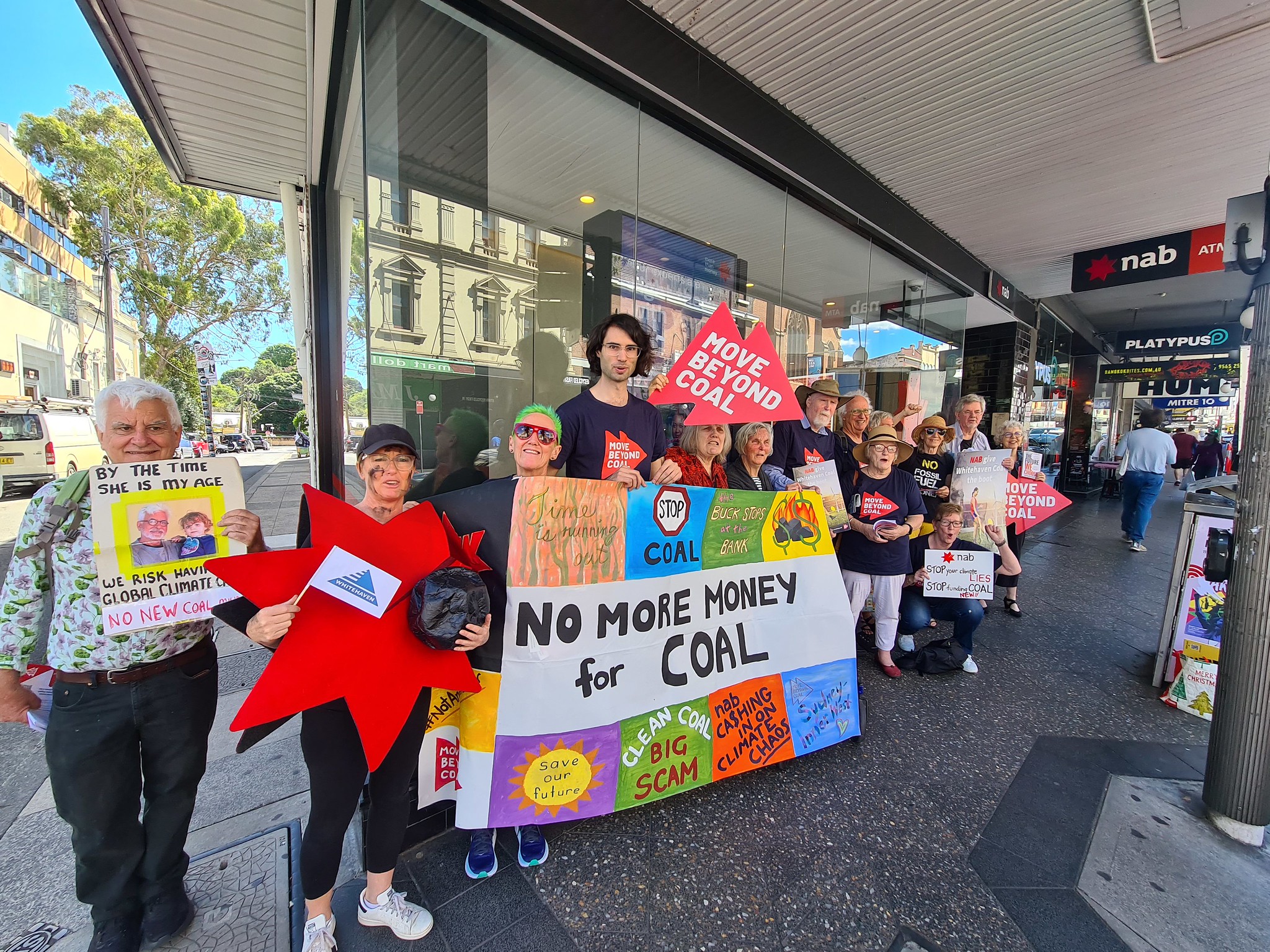
Like most of us, I fail daily to do enough about the climate emergency. My little effort revolves around Move Beyond Coal. This is an Australia-wide network of local community groups who are currently targeting the National Australia Bank which, in spite of talking a good talk about climate responsibility and taking some excellent initiatives, continues to fund fossil fuel extraction corporations. Notably, it funds Whitehaven Coal, with a massive new funding to them in the pipeline, which, if it goes ahead, would lead to major climate vandalism for short term profit.

Move Beyond Coal is currently in the middle of an Australia-wide Ten Days of Action, in which small groups turn up at local branches of the NAB aiming to draw attention to the bank’s contribution of the climate emergency. We hope to lead NAB to change course. Failing that, we will at least have kept the conversation alive, poked some holes in the prevailing silence.

On Thursday this week, our local group staged an action at the Newtown branch of NAB. Outside the branch, a number of people handed out leaflets in front of a beautiful hand-painted banner, one member wearing an excellent giant NAB logo she’d made from felt. Inside, we sat in the comfortable chairs provided, and read – to each other – from Greta Thunberg (who writes brilliantly), Saul Griffith (whose The Big Switch and The Wires that Bind are on my TBR list), Antonio Guterres (‘Our world needs climate action on all fronts – everything, everywhere, all at once’), and other relevant sources. One person said it reminded her o the teach-ins from the 70s (and yes, we were mostly from silver-haired generations).

The few customers who came in paid us at best cursory attention.

The manager didn’t want us inside, and when we politely disobeyed, he sent for the police. After some polite back and forth, we agreed to leave. Our disruption had lasted about 40 minutes. You can see more, with pics and a video, on facebook at this link. Here’s part of our reading group:

Three women on a couch, a man on a high stool, part of a fourth person in the right foreground. All are listening as the woman in the middle readds
Photo (probably) by Mary Regan

And here we all are after we readers walked out chanting, ‘Hey hey, ho ho, Whitehaven Coal has got to go!’:

Fourteen people lined up outside the Newtown branch of NAB, with a prominent banner reading 'No More Money for Coal'
Photo by Josh Creaser

Added later: There’s a fabulous reel on Instagram with suitably dramatic music at this link.

Journal Catch-up 18

I’m not across the detail of the Australian government’s National Cultural Policy – ‘Revive: a place for every story and a story for every place’ (here’s a link) – but I hope it means our literary journals are in a less desperately mendicant state. Certainly, I’m grateful that they continue to exist and even proliferate, even though my reading is limited. Just two on this blog post, both from last year, and both blogged with attention to page 76 as per my arbitrary blog policy.


Alexandra Christie (editor), Heat Series 3 Nº 6 (Giramondo 2022)

There are two wonderful homegrown pieces in this Heat: Fiona Wright’s essay about ageing, ‘To Begin / It Broke’; and Oscar Schwartz’s ‘Father Figures’, a collection of ultra-short prose pieces written as the birth of his first child approached. You can read the latter on the Heat website at this link.

There are translations – four poems translated from Chinese and an essay from Norwegian – and six pages devoted to images of witty ceramic pieces by Kenny Pittock with the self-explanatory titlePost-It Notes Found While Working in a Supermarket’.

Page 76 is near the beginning of the longest and most ambitious piece, ‘Dear Editor’ by Amitava Kumar. Kumar was born in India and now lives in Poughkeepsie, New York. The story starts with a writer flying to Mumbai from New York composing an op-ed in his head about the plane’s broken toilets and the smell of shit. He keeps it up:

My ability to exaggerate does on occasion get the better of me but, believe me, I’m not being fanciful when I say that even the blue carpet in the aisles exuded a faecal odour – no, a heavier element, a moist miasma, that entered the nose and seemed to paralyse the senses. This preceding sentence was going into the op-ed.

My resistance was immediate and intense. Why is an Australian literary journal giving over more than a third of its pages to an Indian-born USian complaining about his country of origin? There are quite a few more sentences for the op-ed, but just as I was about to skip to the end of the story, the scene changes to a hotel in Mumbai where the daughter of an old friend is to be married.

It took a few pages, but the narrator has a fleeting sense of himself as an obnoxious expat and starts a conversation wth a fellow guest, an older woman. The imagined op-ed takes on a more serious tenor, and eventually disappears altogether as the narrator is absorbed by the woman’s story. I have no idea how much of this story is fiction, how much journalistic truth, but the ‘mix of arrogance and condescension’, as he later describes it, turns out to have been a slipway into an account of the coming of Hindu-style fascism to a small village. My resistance was completely dissolved, and I’ve added Amitava Kumar to the list of writers I wish had been invited to the Sydney Writers’ Festival in May.


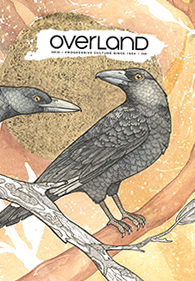
Evelyn Araluen and Jonathan Dunk (editors), Overland 248 (Spring 2022)
(Some of the content – less than in the past – is online at the revamped Overland website, and I’ve included links)

Many of the articles in this Overland have a literary academic feel: Thomas Moran writes about M Barnard Eldershaw’s Tomorrow and Tomorrow and Tomorrow; Michael Griffith compares and contrasts T S Eliot and Catholic German sometime Nazi Party member Carl Schmitt; Abigail Fisher discusses Bella Li’s Theory of Colours. All three are in accessible English, but aim for a readership who is more specialist than usual for Overland articles and, I confess, more specialist than I am.

The poetry, on the other hand, is more accessible than usual. I especially like Isobel Prior’s ‘The Medical Man’, a narrative about a hospital tragedy somewhat in the manner of the late, great Bruce Dawe; and Paul Magee’s ‘Flag mask’, a reminder of what the Australian Parliament was like before May 2022.

Of the five short stories, two play masterfully and unsettlingly with the notion of consent: ‘Espalier‘ by Kerry Greer and ‘What it means to say yes‘ by Megan McGrath.

Page 76 falls in the middle of the other short story that spoke strongly to me, ‘In the garden‘ by Jayda Franks. A character introduced as ‘a young man’ visits another character referred to mainly as ‘the woman’ in an aged care facility. As they chat and play with dirt in the garden, we realise that they have a history but there is a reason beyond her dementia for her not remembering him. It’s a simple, poignant tale whose twist is an emotional twist of the knife rather than a surprise. Here’s a little from the dialogue in the garden to give you a sense of the way the narrative captures the way conversation with someone with demential can go, while suggesting that something else is going on:

‘I don’t remember you,’ she says. She is much more lucid now. Her eyes are sharp and clear and they fix on his own.
‘I know.’
‘I’m sorry.’
‘Please don’t be. I don’t blame you at all.’
She watches him crack his fingers and her brow furrows. ‘The counsellor here says we should ask visitors to tell us about themselves. Even if it doesn’t help us remember. Would you like to do that?’
He smiles sadly. ‘I am afraid I am a very different person to the one you remember.’
She turns to the spider lilies and he watches the conversation leach away from her. She beams at their slender petals and her whole face crinkles up like a young bud in bloom. When she looks back at him, she falters and his heart contracts.
‘Hello.’
‘Hello.’


I subscribe to two other journals, but they seem to be on hiatus. May they be revived by Revive before my next Journal Catch-up blog post.

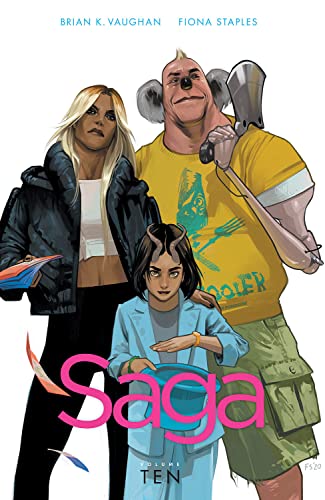
Staples and Vaughan’s Saga 10

Fiona Staples and Brian K. Vaughan, Saga, Volume10 (Image 2022)

It would be overstating it to say I was devastated when Saga went on hiatus ‘for a year’ after volume 9 in 2018 and then stayed out for three years. But delighted is not too strong a word for my reaction when the Comics experts at Kinokuniya told me the hiatus had ended and monthly comics Nº 55–60 had been collected to make Volume 10.

I won’t try to summarise the Story So Far. This Romeo and Juliet space opera has been going for nearly ten years and you’re welcome to read my previous blog posts. (This link should give you a list.)

Sadly, it looks as if the story has run out of puff a bit. A Terrible Thing happened at the end of Volume 9, and though the characters have had three years to adjust, it feels as if they all have that much less spark. The villains have less venom. The good guys have less vitality. The gratuitous naked breasts are more perfunctory. Hazel, the child at the centre of it all, is three years older, and less interesting because of it. One major plot point just … happens, though maybe I missed some subtle foreshadowing.

There’s another Terrible Thing on the last pages of this volume, which gives me hope for a revitalised Volume 11.

My general policy, when blogging about books, to pay attention to a single page (usually page 76, chosen arbitrarily because that’s my age) probably makes even more sense when the book is a comic, given my lack of visual vocabulary. As far as I can tell, the pages aren’t numbered in this book, so here’s what might be page 76 to give you some inkling of the book’s style. Our young heroine Hazel and the remains of her family have been captured by space pirates, and are about to forced back into their former outlaw ways. The junior members of the pirate crew have just given a concert for Hazel and her adopted brother-from-another-species. Hazel is the small person in blue with cute horns:

This page doesn’t illustrate is the way Saga’s text and image often play off against each other in tantalising counterpoint. But it might give you some idea of Fiona Staples’s gloriously playful artwork, and Brian K Vaughan’s gift for dialogue.

It’s a classic Saga moment of light relief, when Hazel has more or less ordinary child-to-adult interactions and the other main players, for good, evil or ambivalence, are offscreen. The pirate band members are each of a different species: the first speaker is from one of the story’s main species, the ones with TV sets for heads, the others are less significant. The frog-like creature is representative of a whole strand of illustration that owes something to children’s comics: not quite as cute as some of the animals that befriend Hazel, but getting there. Hazel’s enthusiasm for the guitar reminds us that she is growing up, and introduces a minor plot strand.

To be continued when Volume 11 arrives.

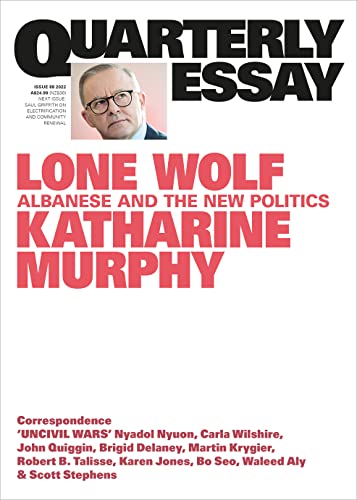
Katharine Murphy’s Lone Wolf

Katharine Murphy, Lone Wolf: Albanese and the New Politics (Quarterly Essay 88, 2022)
– plus correspondence in Quarterly Essay 89

Katharine Murphy is Guardian Australia’s political editor. I always find her political commentary enlightening, and it’s a pleasure to read this Quarterly Essay, where she does a terrific job of making sense of what happened at the May 2022 federal election, which ended a decade of Liberal–National Coalition government, ousted Scott Morrison from the prime ministership, replaced him with Anthony Albanese and an Australian Labor Party majority, and increased the cross benches significantly.

A good half of the essay is devoted to the Albanese story, in particular the way he developed from the ‘lone wolf’ who once said he was in the parliament to ‘fight Tories’, to the man who, having decided he wanted to win the prime ministership, became a great unifier and team leader. Albanese’s starring offscreen role as ALP heavyweight in Robin Anderson and Bob Connolly’s excellent 1996 doco, Rats in the Ranks, gets a passing mention, but the Albanese who emerges into the spotlight in this essay is not so much a heavyweight as a lightfooted dancer, always with a plan.

The essay also, as announced in the second part of its subtitle, describes how Climate 2000 provided resource to a number of independent candidates (the so-called Teals), and how their electoral success, along with that of the Greens, has changed the nature of Australian parliamentary politics.

Page 76* is part of a short section subtitled ‘Big Tents and Unifying Theories’. The section begins by explaining that Australia’s major political parties are ‘big-tent actors’. The ALP and LNP Coalition each embrace a wide range of perspectives but, unlike the major political parties in the USA, have tight party discipline: they ‘model the reality that deliberation and compromise can lead to progress’. The section goes on to ask how these parties will respond to ‘political disrupters’ like the Teals and the Greens, as well as Pauline Hanson and Clive Palmer’s parties, that tend of offer uncompromising positions (as I was drafting this I saw a Greens poster for the NSW election: ‘All Pokies out of Pubs and Clubs’). The section warns against making firm predictions on the basis of Grand Unifying Theories; it hopes that Peter Dutton’s opposition will aim to (re-)build a diverse electoral community rather than allow its extremist rump to call the shots; and it ends with a line from elected independent Zoë Daniels, not necessarily quoting Bob Dylan on purpose: ‘Something is happening here.’

Katharine Murphy has a terrific ability to explain complex issues in memorable language, and she doesn’t indulge in pseudo-objective ‘balance’. Here are some bits from this page:

Democratic parliaments are not iTunes or Spotify. Citizens can’t curate their own playlists. Parliaments cannot possibly reflect the will of every individual citizen. They model the art of the possible.

In the positive, disrupters mirror the gnawing hunger among engaged people for a more perfect democracy as a bulwark in uncertain and dangerous times. In the negative, the mirroring engages with voter grievance or alienation.

Not every minority parliament will function as cooperatively and productively as the Gillard parliament, because not everybody enters politics to get things done.

There is a school of thought that Coalition governments – particularly Abbott’s and Morrison’s – existed largely to stop Labor doing things rather than to do anything much themselves.


As usual with the Quarterly Essay, the correspondence in the following edition casts further light on the argument, some disagreements, some amplifications. The first response is from Christopher Pyne, whom Katharine Murphy describes as ‘another wily factional veteran’ and Albanese’s friend and rival. He is sceptical about any ‘new politics’ – and sees politics as still, and always, about winning and losing. Michael Cooney, among other things a speech writer for Julia Gillard, has interesting things to say, but I am gratified that he also notes Katharine Murphy’s gift with a telling phrase – he says she ‘saw the election in haiku’.

Perhaps the most interesting piece of correspondence is from Simon Jackman, one of the principal investigators of the Australian Election Study. This study has surveyed a representative cross section of the electorate after every federal election since 1987 and, Jackman writes, is ‘an authoritative source for assessing what is “new” about the new politics’. Mostly he cites data that validates Katharine Murphy’s analysis. The data especially puts a rocket under the notion that Scott Morrison’s unpopularity played a role, showing him to be the least popular PM or Opposition leader ever seen in AES data. The information about ‘new voters’ is also interesting: ‘Only about 1 in 4 voters under the age of forty report voting for the Coalition in 2022.’ [Someone on the NSW election commentary last night said 1 in 5 millennials do so – presumably a version of the same research finding.]

Katharine Murphy’s response to correspondents is gracious and generous. It ends with a postscript correcting a minor factual error. That postscript leaves the final word to Dr David Champion, the rheumatologist who attended Albanese’s mother: ‘Young Anthony was an inspiringly good son from my perspective.’

The essay isn’t hagiography, but you do come away from it with a deep respect for Anthony Albanese, and a sense that Katharine Murphy likes him.


* Currently when blogging about books I have a policy of taking a closer look at page 76, chosen for the arbitrary reason that it’s my age.

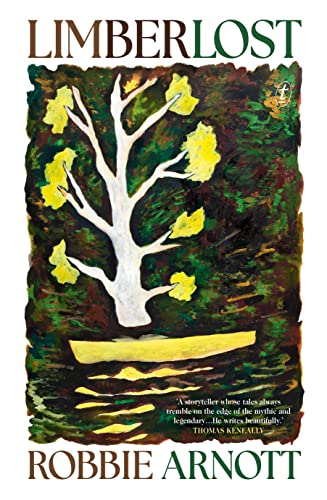
Robbie Arnott, Limberlost and the Book Group

Robbie Arnott, Limberlost (Text Publishing 2023)

Before the meeting: To fully appreciate this book, you may need to have read Gene Stratton-Porter’s 1909 classic of USA children’s literature, A Girl of the Limberlost. I haven’t read it, but Sue at Whispering Gums has, and loved it. You can read her review of Limberlost at this link.

The novel’s main character is Ned, a young teenager living on an orchard in Tasmania towards the end of World War Two. His two older brothers are away at the war, leaving Ned and his older sister to help their gruff, widowed father on the struggling farm. Ned has a secret goal of buying a boat – he’ll raise the money over summer by shooting rabbits and selling their pelts. Rabbit fur is prized as material for making slouch hats for soldiers, and Ned hopes his father will believe his killing project is inspired by patriotism rather than self-interest.

The story unfolds as you’d expect, reaching forward to Ned’s later life as father of two adult daughters and back to an incident involving a whale. There’s more I could say about the book as a whole – the Tasmanian bush, Ned’s father, the boat, the whale and a wounded quoll – but this is a ‘Page 76’ blog.

Page 76 comes almost exactly at the novel’s one-third point. The local vet has given Ned’s project a boost by asking as payment for services rendered that he clear rabbits from her garden and the forest behind her place. (US readers note: in Australia a vet is a veterinarian surgeon, not a former soldier.)

Before rereading the page closely for this blog post, I would have said that it deals with the practicalities of trapping and shooting rabbits – a necessary bit of telling before we move on to the important bits of the story (the boat, the quoll, the father, the girl next door, etcetera). But slowing down to read it, I realise that it’s full of the stuff that makes the book engrossing.

Bending my rules a little, here’s part of the description of the vet’s patch of forest on page 75:

A place of dark-eyed wallabies and fat-faced possums and flickering wrens and eagle-sized ravens and swarms of rabbits beyond counting, beyond thought. A place so thoroughly non-paddock and non-river and non-orchard that, when he picked his way through its structures, Ned began to unmoor from the leafy dirt and drift away from the version of the world he knew. A wave of prickles needled through him. He felt a shifting beneath his flesh: all his pain and shame and anger and sorrow would peel off his nerves, steam from his bones and fry off his skin.

Only after bringing the place to our attention as so full of life and a kind of enchantment, the narrative moves on to Ned’s activities. The first full sentence on page 76 pulls us up short:

By the time the sun had fully risen, his hands were full of death.

What follows a brutal edge to it. First the traps:

Each morning he’d find at least two of their corpses in the teeth of his traps, sometimes three. He’d skin them at the edge of the garden and hurl the bodies far into the trees.

Then the shooting:

After he’d stashed the skins in his bag he’d move through the forest, towards the small clearings that lay within its interior. Here other rabbits inched over the grass, grazing at pace, their cheeks swelling in the low light. Ned stepped quietly, made sure he was obscured by the darkness of the ferns, waited. He’d raise the rifle and pick out the fattest animal, the cleanest fur. Missing was difficult, although occasionally he managed it.

It’s not that Ned has any particular feeling about the killing. Earlier, we’ve seen him working out the best way to place the traps, and he’s fascinated by skinning techniques. Here his focus is on moving quietly, picking the best victim. But Robbie Arnott’s prose insinuates a different perspective: the dead rabbits are ‘corpses’ and ‘bodies’; the living animals graze ‘at pace’. The comment that ‘missing was difficult’ comes from Ned’s pragmatic perspective, but it conjures up an image of innocent, vulnerable creatures. I’m reminded of the hunting scene in Renoir’s La règle du jeu, where the humans are cheerful and relaxed, but the camera shows rabbits first fleeing for their lives then dying in close-up, tails and ears twitching. The counterpoint there between the characters’ perspective and that of Renoir’s camera is similar to the tension between Ned’s view and Arnott’s prose.

The narrative doesn’t pass judgment. It leaves that to Ned’s daughters much later. This page offer a final harsh image (‘In the trees, ravens picked apart his kills.’), and something that has underlain much of the story so far comes into full view. As Ned makes his way back, ‘his bag heavy with pelts’, he feels ‘the unmooring, the needling, the shifting’ named on the previous page:

The burning away of his emotions, until he saw only the forest around him, and felt only the weight of his bag and gun, and the warmth of the morning.

Then this (moving on to page 78 – Maggie, Toby and Bill are his siblings):

Outside of those mornings in the forest he was exposed to an uncontrollable stinging in the folds of his mind … To counter this, he avoided thinking about anything that brought on the sting. The war. The school year that awaited him. The mare. The quoll. Maggie, ice hammered from metal ships, northern seas of endless chop. The rush of Toby’s smile, and how soon they might see each other. His father. How his father, after he’d read Toby’s letter, had asked Ned if anything had come from Bill. The blank fissure in the old man’s face when Ned had shaken his head.

The saga of the rabbits and the boat is something that Ned has dreamed up to distract himself from deeper issues: the questions of his relationship to the land that the captured quoll embodies, the ordinary angst of being a teenager, and over it all the cloud of war. Arnott doesn’t hit us over the head with this, but it’s always bubbling under the surface.

After the meeting:

As always it was a fun evening with far too much to eat. A couple of chps brought Tasmanian-themed food and drink. I had offered to host at short notice when our designated host came down with Covid (not as bad as the first time, he said, but still rotten). As a result I inherited substantial leftovers. We spent some time, quite unrelated to the book, as a bunch of old codgers trying to help each other understand the young people these days. We had minimal success, perhaps because the younger and wiser group members (overlapping categories) were detained elsewhere by work, family commitments and the aforementioned Covid.

The book struck a deep chord for a number of people. Two had read it twice. One said he resonated strongly because like Ned he had two older brothers and has two adult daughters, and Ned’s experience chimed with his own. The other had read Robbie Arnott’s first novel, Flames, then returned to Limberlost, enjoying the way it revisited similar concerns in a very different mode. One man’s partner had loved A Girl of the Limberlost with a passion, but otherwise we’d all read this book without illumination from that one.

I confessed to blogging about page 76. Someone promptly read a beautiful passage from page 77-78, in which Ned is haunted by images of violence among birds, in ancient and modern warfare, and in the sight of the girl next door carrying a rifle.

Some insights were shared about the quoll that Ned accidentally traps and then keeps until it has recovered from its wounds: it mirrors back to Ned the wildness and rage he can’t admit to feeling; it’s a beautiful thing that transcends humdrum daily life; it becomes an intimate shared experience between Ned and the girl next door; it provides one of a number of occasions when Ned’s father surprises him by being sympathetic.

There was a lot more. I came away from the meeting with a much deeper understanding of the book, and of the traditional rural masculinity it depicts.

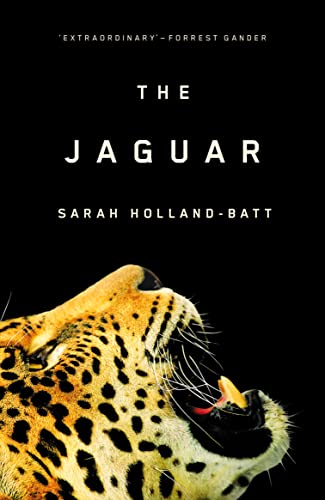
Sarah Holland-Batt’s Jaguar

Sarah Holland-Batt, The Jaguar (UQP 2022)

If you come across The Jaguar in a bookshop and want to dip, I recommend any of the first half dozen poems. Possibly the most direct is ‘The Gift’ on page 4, which you can also read online at The New Yorker in February 2021, or the Australian Book Review in June 2021.

The book is shortlisted for the Kenneth Slessor Prize in the NSW Premier’s Literary Awards. I’ll be surprised if it doesn’t win. It begins and ends with stunning poems bearing witness to the final illness and death of the poet’s father. They are almost unbearably good in their own right, but carry even more force when one is aware of Holland-Batt’s passionate and eloquent campaigning for improvement in the aged care sector (as in this article in the Guardian).

Here’s part of the Kenneth Slessor Prize judges’ citation:

The Jaguar is a tremendous collection of poems, deeply compelling in their subject matter and exemplary in their attention to language and craft. … This is muscular, tenacious writing of great intensity that bears unflinching witness to the decline and death of a loved one, that embraces the necessary suffering that is part of loving and of being human. The Jaguar is poetry of the highest order — poetry that changes us in the reading of it, that reminds us of the inevitable.

From State Library of NSW website.

My current blogging practice is to focus on page 76 of the book I’m discussing. In The Jaguar, that page comes part way through the third of the book’s four sections. Not all the poems in this section relate to the poet’s father. There are a couple of break-up poems, some despatches from the high life on the Riviera and the USA. ‘Tiepolo’s Cleopatra’ might well be a response to John Forbes’s ‘On Tiepolo’s Banquet of Cleopatra’ (which you can read at this link) – both attend to a painting that reeks of decadent luxury. The poem on page 76, ‘The Worst of It’, appears between two poems about past romantic relationships – ‘Night Flight’ (‘our bodies puzzled together in that room’) and ‘Mansions’ (‘When I think of you I think of mansions’):

The Worst of It
As I combed it, 
he sat cross-legged 
in front of me, 
bent over 
like a penitent, 
his head heavy 
as intimacy.
An easy gesture, 
like wind riffling 
blue dunegrass 
in tidal weather.
Salt and pepper 
at the temples, 
or more accurately 
silver, perilous 
and stellar.
A wave in it, 
long from lack 
of cutting.
How can I go back 
to knowing nothing, 
knowing this?

There are three pronouns: I, he and it. We know who I is; we know what it is; he is unidentified. I read him to be the poet’s father, but he could be a lover or even someone in a patient–nurse relationship with her. It’s part of the poem’s power that his identity isn’t explicit. Readers are free to invent their own specifics.

The short lines aren’t typical of Holland-Batt’s poetry, but they work beautifully, inviting the reader to focus on each element, each connotation, as they are revealed line by line. There’s a lot of unobtrusive echoing of sound – not exactly rhyme – that binds the lines: ‘combed ‘cross-legged’; ‘front’, ‘bent, ‘penitent’; ‘heavy’, intimacy’; ‘silver’, ‘perilous’, ‘stellar’; and so on all the way to the repeated words in the final couplet.

The line-by-line movement is especially clear in the first seven lines, where a physical scene unfurls: first the action of combing, then the man’s basic position, then his spacial relationship to the speaker, then his bowed attitude, then a traditional meaning of that attitude, then a close focus on the head, then the poem’s key word, ‘intimacy’. I love the way the music of these lines builds to that word as a resonant conclusion. Heaviness isn’t an obvious quality of intimacy: we’re not dealing with, say, the intimacy of fresh love, but something more sombre.

In a kind of undulating movement away from that heaviness, the next four lines quietly surprise by comparing the combing action / gesture to wind blowing though blue dunegrass (of which you can see some images here in case, like me, you’re botanically ignorant). Though it doesn’t say so explicitly, this suggests that the two people in the poem have spent time together at sandy beaches, so the intimacy hasn’t always been heavy.

The next eight lines focus on the hair and, again one line at a time, what it tells us about the man.

  • ‘Salt and pepper’: he’s ageing
  • ‘at the temples’: but not what you’d call old or elderly
  • ‘or more accurately’: wait on, the poet is about to rethink her use of a stock phrase
  • ‘silver, perilous’: the light and the dark; on the one hand precious, and on the other in danger, perhaps because ageing brings one closer to death, or perhaps something more specific
  • ‘and stellar’: a nice alternative to ‘salt and pepper’ to describe ageing hair – flecks of shining white against a dark background
  • ‘A wave in it’ – ‘stellar’ felt like the end of the description, but the poem decides to linger a little on the hair itself, noticing other qualities
  • ‘long from lack’ – here’s a place where the line break does a lot of work: by leaving the word ‘lack’ suspended for a moment, it reinforces the earlier suggestions that the man is somehow in trouble: penitent, imperilled
  • ‘of cutting’ – on the one hand this clarifies that the lack is as mundane as not having gone to a barber, but it also suggests a degree of neglect.

In the final three lines, something of the emotional meaning of the moment is revealed. Or more accurately is invoked. This moment of combing the man’s hair comes after a discovery that has transformed the relationship. Given the wider context of the book, I read it as the moment when the father has told the daughter of his illness and the grim prognosis, but in itself it’s not tied to that. The tenderness of the first fifteen lines has been laced with a hint of sorrow or threat. These last lines bring those elements to the surface: something has happened which cannot be reversed.

So, this isn’t one of the book’s poems that takes its readers by storm. But quietly, artfully distracting from its artfulness, it delivers a moment, the kind of moment that could happen at the midpoint of a movie: the moment when we know where things are headed. A moment when we hold our breath and understand the shape of things.

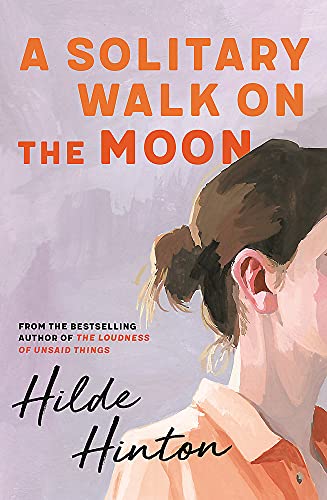
Hilde Hinton’s Solitary Walk on the Moon

Last November I decided to experiment with blogging about books by taking a single page and writing whatever comes to mind about it. I picked page 75, my age at the time. Sadly, though I did focus on page 75 (or 47 or even 7 in shorter books), I didn’t really keep to the plan but felt obliged to go on about the books in general as well. Now that I’m 76, I’m renewing the experiment.

Hilde Hinton, A Solitary Walk on the Moon (Hachette Australia 2022)

You could describe A Solitary Walk on the Moon as a quirky comedy, but that suggests a particular kind of US movie – and Evelyn, the book’s laundromat-manager protagonist, is more John Wayne than Miranda July, or perhaps Miranda July in a John Wayne role. Like the hero of a classical Western movie, she’s a loner who brings her peculiar set of skills to the aid of the community who come to love her, but among whom she feels she has no abiding place.

Page 76, a little past the one-quarter mark, is relatively uneventful, but in it the characters develop, the plot moves forward and key images recur, all without breaking a sweat.

Evelyn is in the process of building what will turn out to be a patchwork family. Having overheard two young women, laundromat customers, talking about a friend who has disappeared, she has insinuated herself into their confidence, and enlisted the help of a befuddled old man, also a customer, who she has learned is a retired policeman. At the start of this page, she introduces the man to the young women with characteristic awkwardness and a touch of bravado that doesn’t quite work:

‘This is,’ Evelyn said, suddenly realising that she didn’t know his name, ‘our retired policeman.’ Her ta-da finish went unacknowledged.

We understand the lack of acknowledgement to be partly because the young women don’t quite trust Evelyn, and partly because the retired policeman is grubby and vague-looking. By this stage readers have come to understand that though Evelyn is deeply strange – perhaps non-neurotypical, perhaps from a non-mainstream culture, or perhaps dealing with childhood trauma – she is smart and well-intentioned. But we also understand other people’s hesitance around her.

The ex-policeman introduces himself as Phillip, and they head off to the police station. In a characteristic narrative move, they stop on the way for Phillip to play the love-me, love-me-not ritual with a daisy. He presents Evelyn with the stem, ‘topped by a clearly embarrassed pistil and a sad, solitary petal which flapped about in the evening breeze’. This moment reminds us that Phillip is probably in early stages of dementia, but it’s also a feature of the novel’s style: at any moment there’s likely to be a mild departure from a straightforward narrative. All the characters, it seems, are at least slightly odd, or at least wonderfully naive.

They arrive at the police station:

‘Don’t ring the bell,’ he said authoritatively when Evelyn went to ding the bell.
‘How will they know we’re here?’ she asked. The old man pointed at the mirror behind the counter and sat down on one of the plastic moulded chairs. They were all bolted together, and Evelyn wondered why. No one in their right mind would steal one. Phillip crossed his legs and clasped his hands behind his head. The two girls sat either side of him. Evelyn was not in the mood for sitting and wandered around the waiting room looking at the faded posters that looked like they’d been there for years. There was a chart of missing persons, and Evelyn vaguely remembered the tall cross-eyed man who had gone missing while bushwalking a few years back. They had never found him, as far as she knew.

This isn’t one of Evelyn’s most eccentric moments, but you can see her restless mind at work, wondering about the chairs, noticing the details of a missing man. We half expect her to go in search of him (she doesn’t). Hilde Hinton draws us into Evelyn’s world, so that we too come to notice the odd things that stand out for her, and find ourselves seeing the world with fresh eyes – not those of a child, but fresh all the same.

You can see the author’s mind playfully at work here too: is Phillip’s counter-intuitive advice about ringing the bell sensible, or are we being played with? Either way, it’s characteristic of this book that a man who when we first saw him was unable to find his own way home has practical wisdom to offer when he’s on his own turf.

There’s a faint hint here of Evelyn’s past. It’s the missing persons chart that she notices. The novel is full of such people: the young women’s missing friend, the mother of a little boy who calls on Evelyn as the only friendly adult in his life, potentially Evelyn herself. We gradually discover that she has had a number of previous lives. We learn almost no specifics, just enough of her childhood to know she was ill treated. We learn that she has walked out of her life a number of times and started over each time, so an undertow of suspense builds: this time, as she almost inadvertently builds a patchwork family around her, will she stay or will she go?

The search for this missing friend turns out to be a minor episode (they don’t actually find her, but the search is resolved). In terms of the longer arc, what is happening here is that Phillip is being drawn back into meaningful participation in society. He will go on to help solve the mystery and become part of Evelyn’s knocked-together community.

There are other great characters: Don, the man from the paint shop who is delighted by Evelyn; and the little boy and his drug-addicted mother. As the back-cover blurb says, Evelyn is going to make a difference in their lives, whether they like it or not. She’s a terrific character and this is an immensely enjoyable book. I’m grateful to the Struggling Artist, who picked it up more or less at random from the Marrickville Library shelves.