Journal Blitz 6

I subscribe to a number of literary journals as a way of supporting Australian cultural workers – specifically writers. I generally read the journals I subscribe to, plus occasional others: the prospect of this reading tends to loom as an obligation as the pile of unread journals grows, but the reading itself dependably turns out to be a joyful and invigorating experience. Then I blog, in the hope of communicating some of that pleasure, and possibly encouraging some of my readers to back these crucial enterprises. So here goes, with three journals that were published, um, some time ago …


Jacinda Woodhead (editor), Overland 236 (Spring 2019)
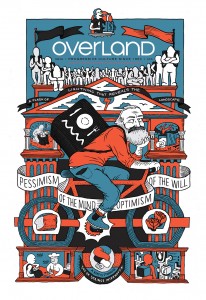
I mistakenly wrote that Overland 235 was the last issue of the journal edited by Jacinda Woodhead. This one is actually her second last, and the new editors have brought out their third issue as I’m writing.

Overland 236 kicks off with two excellent articles. (Links are to the full items on the Overland web site.) In ‘After hours‘ Leigh Hopkinson, herself a former stripper, writes about the death of a stripper in a Melbourne club (Overland tend to be Melbourne-centred), and uses the case as a springboard to describe the terrible, and worsening, conditions of women who work in the adult entertainment industry. In ‘The great acceleration‘ Jeff Sparrow traces the history by which cars came to be established as the dominant, ‘natural’ mode of transport in the USA. Did you know, for instance, that before the automobile industry made a concerted effort to introduce the concept of a jaywalker, the term jaydriver was in common use, meaning someone who drove a car in the city with cloddish disregard of the danger for pedestrians, especially children?

There are more articles later, of which two stand out for me. But then, face to face by Joanna Horton is a wonderful account of the joys – and difficulties – of door-knocking for the Greens. Tina Ngata’s Toppling Cook puts a strong case, from an Aotearoa/New Zealand perspective, against celebrating the 250th anniversary of James Cook’s voyages of exploration.

Guest artist Sam Wallman has three spreads of sequential art (what some might call comics) that are brilliantly accessible lessons in recent English history, specifically the Sun boycott in the Liverpool region, the Annual Durham Miners’ Gala and the Grenfell Tower fire.

There are 13 pages of interesting and challenging poetry. My North Queensland heart leads me to single out ‘Toad‘ by Damen O’Brien, which begins:

Toad in the garden, which is the same as
a snake in Eden or a crack in a mirror.

and includes the gorgeously evocative line:

Inexhaustible armies of malevolence

Of the especially rich batch of short stories, the ones that most struck me are Jack Vening’s ‘Don’t tell me‘, a runner-up in the Victoria University Short Story Prize, and Allanah Hunt’s ‘Running to home‘, winner of the Nakata Brophy Prize for Young Indigenous Writers. No spoilers from me on either of them.


Elizabeth McMahon (editor), Southerly Vol 78 No 3 2018: Violence (2019)
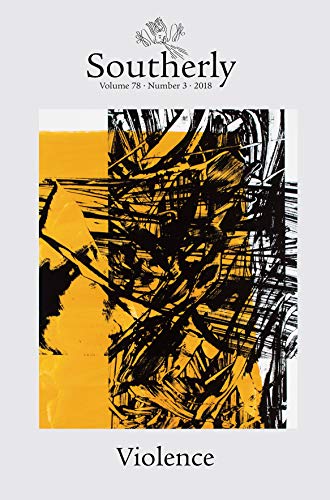
Southerly, after 80 years of publication Australia’s second-oldest literary journal*, is in trouble. In March this year the editors published a plea for help on Facebook, and in October the website went down with a promise of reappearing soon – we’re still waiting. The editors, who aren’t paid for their work, have set up a crowdfunding platform at https://gum.co/wYZRP in the hope of prolonging the journal’s life. As a reader I’m still back in 2019, and though the editors were already desperately chasing funds then, the journal itself came out, behind schedule but in rude good health. There has been at least one issue since.

Like the Overland, this Southerly starts very strongly, with three poems: jenni nixon’s ‘knock on the door at 6am’ is an impressionistic narrative that earns the right to its epigraph from Gandhi, ‘poverty is the worst form of violence’; Brenda Saunders’ ‘Boab tree, Derby’ comes at the famous ‘Prison Tree’ in a number of choral voices (click here if you want to know about the tree); Andy Jackson’s ‘To name what we feel’ enacts the ambivalence of working on a phone-in service for violent men.

And it goes on from there, compellingly. There’s memoir (including Brenda Downing’s writerly ‘Letter to the Editor’ in which she arrives at a huge ethical dilemma when she tracks down the man who sexual abused her when she was very young), essay (including David Brooks’ ‘A Roo Battue’, on the continuing mass slaughter of kangaroos, which raises the spectre of extinction for some species), short stories (including Winnie Dunn’s brilliant ‘Wanting to be White’, a drama set in a Western Sydney Starbucks). I usually skip the scholarly articles, but Fiona Morrison’s ‘The Antiphonal Time of Violence in Leah Purcell’s The Drover’s Wife‘ was a way to revisit the pleasures of a great night in the theatre. Likewise I tend to skip or skim the reviews, but Rachael Versace’s review of David Malouf’s An Open Book, by quoting generously and incisively, opened the door to revisiting the pleasures of that book.

There is one moment of eerie prescience in this Southerly. Josephine Clarke’s ‘transnational’ laments the way technology, while enabling connection over great distances, still leaves us bodily unconnected. Covid–19 wasn’t even a blip on the horizon when it was published, yet there’s this:

what if I take ill? who will come back /
come home / come through 

and hold my hand      my real hand
where the creases run labyrinthine across my palm

– my palm where your newborn head once rested
and was safe   

*The oldest is a children’s literary journal, The School Magazine, published since 1915 by the NSW Department of Education.


Andy Jackson and Jennifer Harrison (editors), Australian Poetry Journal Volume 9, Number 2: DIS– (2019)
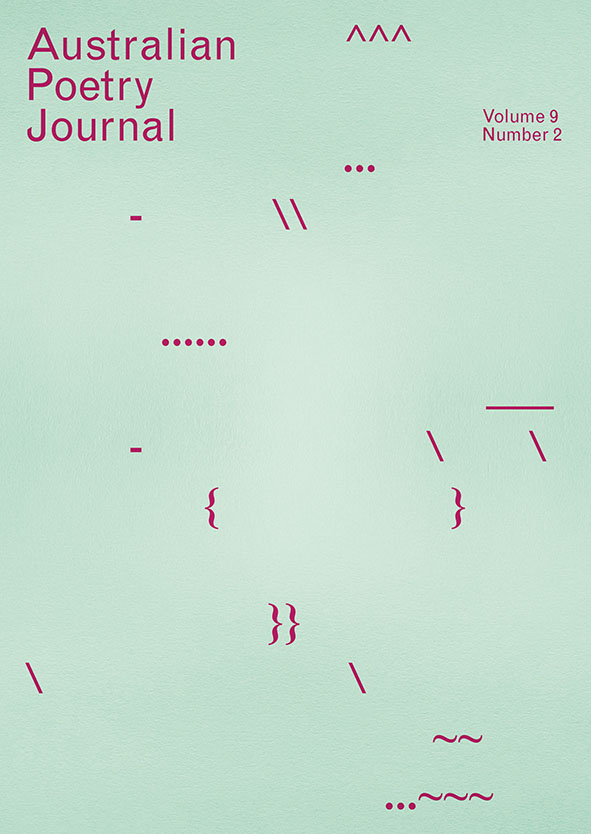
Andy Jackson and Jennifer Harrison, guest editors of this issue of Australian Poetry Journal, are both poets and advocates for writers with self-identified disability/ies. They have collected more than 60 poems related to disability, aiming, as Andy’s foreword puts it:

… for a diversity of voices, in many senses of that word – bodily experience, cultural background, age, gender, philosophy, aesthetic. We also strongly prioritised poems of lived experience, including the voices of carers, friends, lovers – poems of solidarity and care that recognise that distancing ourselves from disability is impossible.

By arranging the poems, mostly, in reverse alphabetical order of poem title, the editors have added an extra stroke of disorder: each poem stands on its own, spatially disconnected from others on the same subject or by the same author, defying easy categorisation. The effect is indeed a marvellous ‘diversity of voices’, all dealing one way or another with disability. As Jennifer Harrison says in her Foreword:

What poetry gives us is birdsong alongside activism, the outside word alongside the internal world of emotions, hope shadowing despair … Poetry has a unique ability to see behind doors previously closed …

In this journal, many poets opens doors to whole worlds of difference.

A number of them are poets whose work I already know. Fiona Wright, who has written a lot about her own struggles, speaks to someone who may be a version of her younger self in ‘poem for jessie’ (‘I want you to remember / how to want’). David Brooks makes translation look easy with a version of Baudelaire’s ‘The Albatross’, which in this context becomes a powerful metaphor for physical disability. Samuel Wagan Watson’s ‘DISlocation’ captures a raw moment of betrayal (‘I may have challenges but my sensory perception is still sharp’).

Mal McKimmie’s ‘Thirteen Ways of Looking at Blackbirds’ is wonderful. It begins:

There are no 'blackbirds with disabilities' –
_____________all blackbirds can fly.
There are only 'blackbirds with disabilities' – 
_____________all blackbirds will one day fall from the sky.

E A Gleeson, whose bio tells us that she ‘cares for her sister who lives with significant physical and intellectual challenges’ gives us a graphic childhood vignette in ‘The First Seizure’. Oliver Mills, in ‘De-Coding’, speaks clearly and succinctly, and wittily, about the difficulty of being understood when you have cerebral palsy, as he does: :

When I'm out of breath
Or having a lazy laugh
I make the sound of a creaking door

I could go on quoting. There’s plenty here for anyone interested in poetry. There are drawings, as well as poems, by people with mental illness diagnoses and people with learning difficulties. Just reading the poets’ bios is a revelation of the myriad ways the body and mind can differ from the typical. Even if you’re (temporarily) non-disabled and not interested in poetry, these pages may expand your world immensely. They have mine.

As a bonus, up the back, half a dozen pages are given over to Rachael Mead, winner of the 2019 Australian Poetry/Nature, Art & Habitat Residency. She lived in a village in the Taleggio Valley in northern Italy in June 2019, and three of the poems she write during her stay there are reproduced here. What with one thing and another, it’s glorious to read her poem, ‘Pacing myself’, about waking in that beautiful place, so far beyond the reach of most of us just now.


Speaking of journals, there’s some good news on the horizon concerning Heat, which ceased publication in 2011, after 39 issues in two series over 15 years. According to the Giramondo web site, ‘The third series of Heat, in a new design and format, will be published from 2022.’

The Book Group and John Irving’s Prayer for Owen Meany

John Irving, A Prayer for Owen Meany (Bloomsbury 1989)

Before the meeting: This is an odd book. It tells the life story of Owen Meany, a young man who is tiny in stature and huge in voice like the hero of Gunther Grass’s The Tin Drum (which I haven’t read, though I’ve seen the movie). From an early age Owen has a profound belief that he is an instrument of God, and he has a vision of his own death, including the exact date and some of the circumstances. His story is told by his best friend Johnny Wheelwright, who doesn’t have a lot to distinguish him from any other child of an old New England family, except that his mother never revealed the identity of his father and she herself was killed in a bizarre Little League accident when he was eleven.

I loved the first hundred pages or so, which introduce us to the characters who inhabit the small New Hampshire town of Gravesend, and tell the story of Owen and Johnny’s childhood friendship, their shared quest to find the identity of Johnny’s father, their adolescent adventures. I was happily back to my enjoyment of The World According to Garp (1978) and The Hotel New Hampshire (1981), both of which I read when they were newly published. John Irving has an eye for the detail that brings a scene to life, and manages to keep his story slightly off-kilter without every completely descending into quirkiness. His characters are vividly realised in a few strokes, with an almost Dickensian oddness. My love waned in a very long sequence involving the staging of two theatrical pieces concurrently, a Christmas pageant and a production of A Christmas Carol. In both of them Owen is improbably compelling, at least in rehearsals, as the Christ Child and the Ghost of Christmas Yet to Come. Both predictably descend into chaos. These chapters rattle along, full of amusing and touching incidents and character development, but I was straining at the bit, wanting the story to move forward.

Then at almost exactly the midpoint of the novel, in the narrator’s present time, I was rapped over the knuckles in a moment that’s close to being explicitly meta. John (as he is now known) laments that his girl students don’t read Hardy’s novels with an eye to foreshadowing. ‘I hope you realise,’ John Irving was saying at barely one remove, ‘that all that stuff about Owen as Christ, Owen as a ghost predicting the future, Owen and a number of armless figures, Owen practising a special basketball move, all that was giving you very specific hints about where this narrative is going.’ Well, I took the hint, and from that point on I read everything as foreshadowing.

When all that carefully constructed foreshadowing came together in the final pages of the book, it was most satisfactory – or just a bit too neatly tied together, depending on your point of view. I was left uneasily cold by the religiosity of the story, which to be fair was signalled on the very first page when John-the-narrator tells us that Owen was the reason he believes in God. Owen becomes a Christ figure, but without arms, and John lives out his day as a vaguely religious, celibate man whose only purpose, apart from teaching English literature to teenage Canadian girls, is to bear witness to Owen’s story. Religion is his analgesic. ‘Don’t underestimate the church’ – he says at one point – ‘its healing power, and the comforting way it can set you apart.’ (Page 415) It’s a religious faith that depends on miracles for its existence (the kind of miracles that exist only in the pages of carefully contrived novels), and leads to a lack of engagement with the world, or with anything but the memory of his Christ-like friend. It leaves a sour taste in this reader’s mouth.

But, speaking of foreshadowing, John’s present time coincides with the Contra scandal under Reagan, and though he has been living in Canada for decades he is addicted to the US news. So much of John’s (and presumably Irving’s) commentary on Reagan’s US feels eerily prophetic of Trump and Trumpism. I recognise John’s newspaper addiction as an old-media version of my (our?) Twitter addiction. It’s not that things were the same back then, but by contrasting the Kennedy era of Johnny and Owen’s adolescence with the Reagan era of John’s middle age, the passions that burned over the US invasion of Vietnam with the apathy that greeted the Contra scandal, the novel captures a change in the US’s political culture, a change that has since deepened to an extent that would have looked wildly fantastical in the 1980s.

After the meeting: Last night was our last meeting for 2020 and our second since we all started to relax a little about Covid–19. All but two of us made it – one of the absentees had to attend a family do, and the other had been tested for the Covids with his young daughter and was staying home as a good citizen (he WhatsApped us this morning to say the result was, as expected, negative). We had what we’ve been calling a Gentlemen’s Picnic: everyone brought food. We ate well, including salmon with anchovy butter pats, barbecued sausages, charcoal chicken, several salads and three different desserts. Covid deprived us of meatballs slow cooked with figs. Our host had Gospel music playing as we arrived, which he said was the nearest he could come to the religiosity of the book, and at the end of the evening he treated us to a couple of short films he had made – potentially setting a dangerous precedent as I’m sure may of us have substantial slide shows we’d love to share.

It’s not that we didn’t talk about other things: family news, good TV and movies (a Michael Jordan film is apparently excellent, and I’m not the only one who loved Corpus Christi), a bit of reminiscence about the 18 years of book group and rumination on how it has changed this year (because of Covid and zoom? because of the level of trust that has enabled discussion to become more robust? because the person who noticed the change has been a more frequent attender this year?), Trump deprivation syndrome, and show-biz anecdotes all got an airing. But the book generated a lot of discussion.

I wasn’t an outlier, as it turned out. Someone described the book, memorably, as a shaggy dog story. A man who said he hadn’t finished it was having trouble following comments about how all the threads came together in the last scene: it turned out he’d read all but the last 10 pages or so, which just goes to show how skilfully John Irving postpones his revelations until the last possible moment. Someone said – articulating my sentiments exactly – that in the first couple of pages he breathed a sigh of relief: after reading a number of books for the group that, whatever their other virtues, were pretty rockily written, with this he knew he was in the hands of an accomplished storyteller.

Someone felt that this was a book written by someone who had a big back catalogue, who now could relax and just spin a yarn without being too serious about it, venting about current politics as the spirit moved him. Not everyone agreed. Some, me included, felt we were expected to take the religious theme seriously but found it pretty hard to do so. One said most of the religious stuff was largely incomprehensible to him. I asked if the recurring image of armlessness was purely decorative or had some thematic significance. One of our architects took offence, demanding, ‘What’s wrong with decoration?’ and describing the way those recurring images created a patterning that was pleasing in itself and helped the reader track the story. Our Book Chooser, who first read the book 30+ years ago, loved it then and loved it again this time, thought the armlessness represented Owen’s helplessness in the light of fate. This led someone to comment that though Johnny keeps his arms, he is ineffectual, spiritually armless. None of us could remember what we were told about the armless image drawn by the 17th century sagamore Watahantowet when he signed away the land to the invaders, but felt that might offer some help. I just looked it up:

Some said it was how it made the Sagamore feel to give up all that land – to have his arms cut off – and others pointed it out the earlier ‘marks’ made by Watahantowet revealed that the figure, although armless, held a feather in his mouth; this was said to indicate the sagamore’s frustration at being unable to write. But in several other versions of the totem ascribed to Watahantowet, the figure has a tomahawk in his mouth …

There’s more. The upshot is that the armlessness could signify many contradictory things. It’s a good example of how so much of the early pages of the book are full of foreshadowing, and of how hard it is to pin down the book’s actual position. Is John Wheelwright a dependable narrator? Does Johnny have a feather between his teeth, while Owen had a tomahawk? The questions aren’t resolved, and we don’t even know if they are meant to be taken seriously. We admired the first sentence of the book as an example of foreshadowing; evidently John Irving himself admired it too.

A number of chaps had done some supplementary reading. One of them had read that John Irving starts with a clear image of how a book is going to end and then makes sure everything leads to that point. This rings very true.

In order to give the appearance of completeness, I’ll finish with a quote from the one chap who hadn’t read the book at all, except for the author’s introduction in his copy. He said he concluded on the basis of that introduction that John Irving was a wanker. Not everyone agreed.

SWF 2020, 11th and final post

I’ve been blogging about the online 2020 Sydney Writers’ Festival (I almost forgot the apostrophe) most of the year. The Festival is still going on, and its website is listing events to mid-January next year. I’ll keep listening, but I won’t blog any more. Here are links to the Festival podcasts currently on my phone, in case you’d like to check them out.

Drawn from Life: Alice Oseman in Conversation 21 October: YA phenomenon and graphic novelist Alice Oseman chats with media phenomenon Jes Layton.

Secrets and Lies: Donor-Conceived Rights 21 October: Dani Shapiro, USA-based author talks to Australian author Bri Lee about issues raised in her memoir, Inheritance, including those related to children conceived by sperm donation.

Griffith Review 68: Getting On 28 October: Tony Birch, Andrew Stafford and Jane R. Goodall talk with Griffith Review editor, Ashley Hay, about getting older.

Trent Dalton: All Our Shimmering Skies 4 November: Trent Dalton in conversation with Annabel Crabb bout his second novel

Guardian Australia Book Club with Helen Garner 6 November: No elaboration needed from me. The interviewer is Michael Williams, now artistic director of the SWF.

Behrouz Boochani and Tara June Winch in Conversation 11 November: Again, no elaboration needed from me about either of the participants. I will mention that Tara June Winch acquitted herself admirably in Hard Quiz recently.

Tony Birch: The White Girl 18 November: Tony Birch is here again to talk with Evelyn Araluen about his novel The White Girl.

Julia Phillips: Disappearing Earth 3 December: The author of the excellent Disappearing Earth talks to Tam Zimet, until recently associate director of the SWF.

It’s nice to finish with one of the rare books that I’ve read that also features in this year’s Festival

November verse 20: Approximately fourteen ways to start a stanza

I’ve well surpassed my quota of 14 stanzas for this November but, though I’m being called to attend to pressing matters involving the vacuum cleaner, storage shelves and other important things, I’m squeezing in one more to make it a round twenty:

November verse 20: Approximately
fourteen ways to start a stanza
Take a phrase that makes you cranky,
melts your heart, or stirs your mirth,
from politician being wanky
or tweeter somewhere else on earth.
Steal the first words of a novel.
Quote a tiny friend's sweet waffle.
Parody a famous line
from Hamlet or source less divine.
See dead words that serve transactions –
shake them, turn them upside down.
Lay bare your heart and find a noun
or verb that lurks there. Let distractions
be your helpers. Take a thought
and tie it in an eight-word knot. 

That’s it for 2020. Normal transmission will resume tomorrow.

November verses 18 & 19: 29/11

November verse 18 &19: 29 and 30/11
Using the rhyme words from Vikram Seth's
The Golden Gate, stanza 11.29 and 11.30

As 2020 nears completion,
gurgling swiftly down time's drain,
and leaves behind its vast accretion
of damaged lives, despair, rage, pain,
let's build our souls some insulation,
not give way to desperation,
put our faith in humankind
and the power of the mind.
May politicians' treachery
be no more wrapped in pious sighs
(no way to hide their lyin' eyes),
buffoonery and lechery
in office meet with decent scorn
and find they are no longer borne.

Greenhouse gas accumulation
challenges the world's combined
resourcefulness. The fermentation
of bullshit would leave us resigned
to dying off without compunction,
but we can overcome disjunction.
The clock is nearing 12 at night
but tunnel's end shows flicking light:
I'll join a crowd, not be a stranger,
join hands, write letters, march, and then
do it again, again, again.
It's hard to face how real the danger,
feel climate grief, but then the lust
for life kicks in. In science I trust.

November verse 17: Homonyms

November verse 17: Homonyms

A crash and panic in Vienna.
Eyemouth, many fishers died.
Women beaten at a demo.
Perfect storm Lake Erie-side.
King Zog vanquished by Il Duce.
Allied planes shot down in Norway.
Flood, tornado, bombs and fire,
scandals, massacres – all dire,
all sharing in this nomenclature.
Why choose this term to sell us stuff?
Why don't we shout, Enough's enough!
Why take it on as second nature?
What next, merchant brotherhood?
Yes, why not call this Friday good?

When I started writing this, I had the Black Friday bushfires in Victoria in mind. But a quick look at Wikipedia made me realise that Black Fridays are legion. Here’s the link if you want to know more.

Also: if anyone knows the James McAuley poem whose last line is echoed by by my last line here, please tell me its title and where I can find it. [Added later: It wasn’t James McAuley at all, but TS Eliot, the last line of Part 4 of East Coker in Four Quartets: ‘Again, in spite of that, we call this Friday good.’]

November verse 16: A walk to the shops

In a creative writing class I took part in years ago, we did an exercise of walking around the block then coming back and writing down everything we saw. It would be impossible to do that in 14 lines for my five minute walk to the shops, but here’s a partial account.

November verse 16: A walk to the shops
Dotty silver snail trails, roses,
skittish skinks and lorikeets,
gardeners, leaf blowers, hoses,
cafe tables on the street,
three crossword collaborators
(quick, not cryptic), Uber waiter,
handless Lady of La Vang,
cloth monkey left to hang,
stroller, skateboard, backward trolley,
taxi revving at the rank,
homeless regular, eyes blank,
child who's spilled a bag of lollies.
In my ears Waleed and Scott
untie existential knots.

Maybe line 7 needs explanation. Here she is, in someone’s beautifully tended front garden:

November verse 15: An initial response to a work by Danie Mellor

November verse 15: An initial response to
Danie Mellor's A time of the world's making
Born on stolen Mamu Country
where the Johnstone River flows
(Robert Johnstone brought the guns, ey?),
where the cash crop sugar grows,
I loved that place, its rich volcanic
soil, the heat, and the titanic
rainfall – the rainforest too.
The place was old, and I was new.
I didn't hear its age-old stories.
Now tiny men, ropes, floating shell,
and women with their pile of skulls –
in crayon-blue, no dark green glory –
all alive, a dream unfurled:
is now a time to make the world?

Danie Mellor’s stunning work, A time of the world’s making, 2019, features in Real Worlds: Dobell Australian Drawing Biennial 2020 at the Art Gallery of New South Wales (next door to the huge Arthur Streeton exhibition on the same floor, and a floor below the Archibald).

Here’s a video walk-through of the Dobell with curator Ann Ryan. She talks about Danie Mellor’s two ‘landspaces’ from 11:16 to 12:58:

November verse 14: On waking from a dream of a friend

November verse 14:
On waking from a dream of a friend
who has been dead for many years

You left a note and neatly folded
clothes beside the famous cliff;
left the life and loves you'd shouldered;
vanished. But you left a whiff
of disbelief, and time's a traitor:
someone found you decades later,
now not Damien but Bob,
in Tassie with a uni job.
No note this time, a rope your chosen
tool: your mother mourned you twice.
This time there was no artifice.
Yet last night to my dream, unfrozen,
fugitive from death you came,
with warnings not to say your name.


November verse 13: Maggie Thatcher’s Curtsey

November verse 13: 
Maggie Thatcher's curtsey
Insiders know to give a little
bob (or bow if you're a man). It's just
that she's the queen, no need for fiddle-
faddle-flum – no need to bust
a gut. But this is some production:
a creaking almost-genuflexion,
shuttered eyes and head bent low,
lips pursed as if to kiss a toe.
Such obeissance for the monarch
speaks centuries of grocers' love
for rulers blessed by God above,
but also sounds a note sardonic: 
This curtsey, queen of all we see, 
is all you'll ever get from me.

This is of course prompted by the fourth season of The Crown, in which Gillian Anderson gives us a scarily believable, and loathsome, Margaret Thatcher. If you enjoyed that show, and maybe even more so if you didn’t, you might enjoy this brilliant set of impressions from British comedian Kieran Hodgson: