I’ve occasionally blogged about poetic gems that turn up on discarded mattresses around Marrickville (here’s a link). I’m not the only one – here’s a link to a post by someone called Therese Trouserzoff.
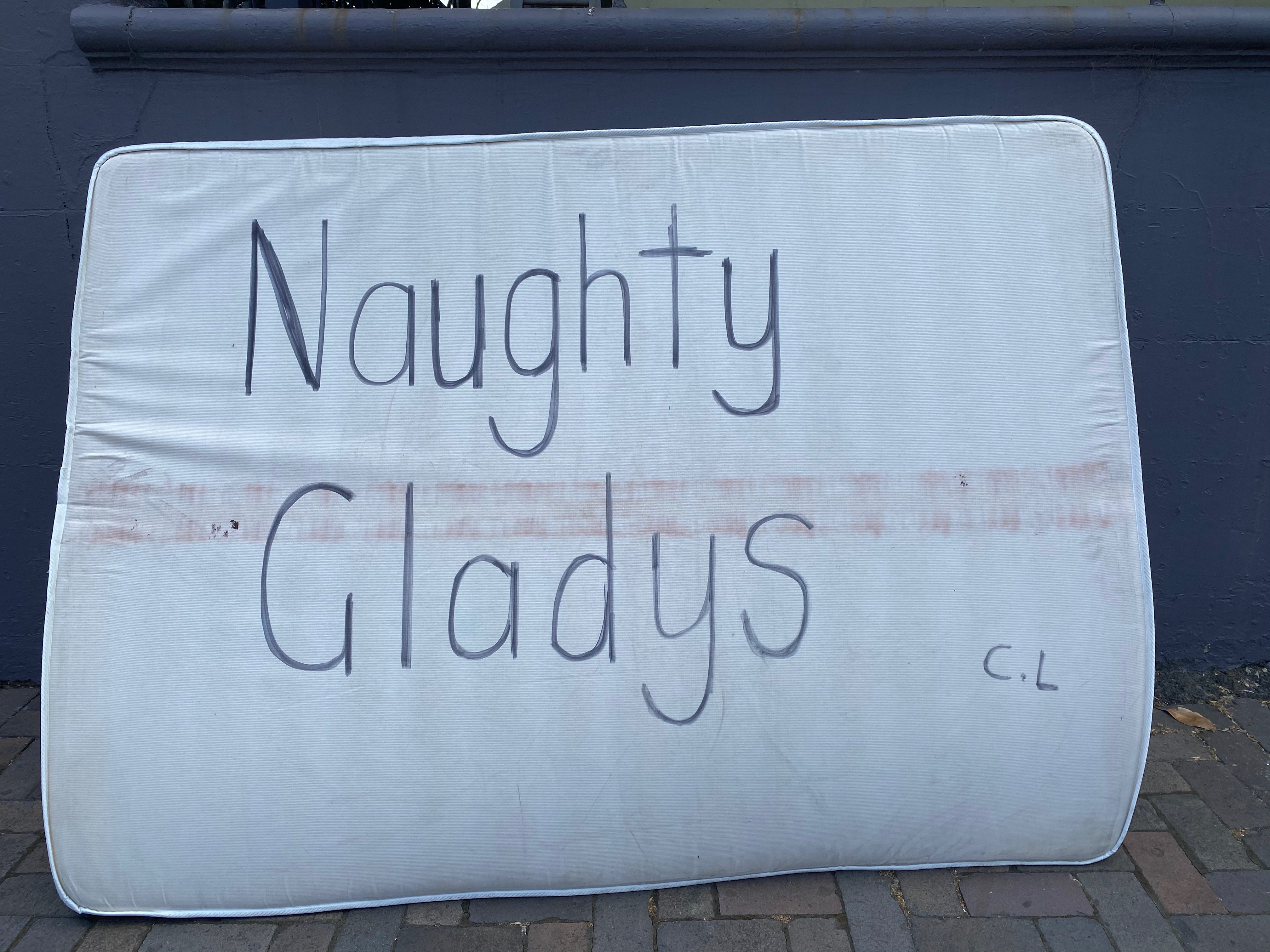
I can report a new sighting on the Enmore edge of Marrickville, this one signed like two of my previous specimens: ‘C.L’. The poet has moved from lyric celebration of life and art to political satire:
The poem is referring to New South Wales Liberal Party Premier Gladys Berejiklian’s revelations at the Independent Commission Against Corruption that she had been in ‘a close personal relationship’ with a corrupt politician, and had remained close to him after she sacked him from her cabinet. Here’s a link in case you live somewhere completely different.
You might see it as adding to the chorus of prurient outrage, an innerspring vox-pop rubbing salt into the wounds of Gladys’s humiliation. This is the inner west, where Liberal Party supporters aren’t exactly thick on the ground, so you could read it as endorsing the ALP’s opportunistic calls for Gladys’s immediate resignation. But remember, this two-word poem is published on a discarded mattress, as far from a high horse as you can get. In my reading, it offers a finger-wagging sympathy: not, ‘Poor Gladys, you were deceived by a rotter,’ or, ‘Evil Gladys, you turned a blind eye on corruption,’ but, ‘Naughty Gladys, fancy a serious girl like you getting up to something like that!’
We’ll see how it plays out at ICAC over the next couple of days or more. It may be the end of the Berejiklian premiership. And that may be a just and appropriate outcome. But C.L has captured a moment in the saga, and drawn readers’ attention to something so easily lost in this age of political polarisation: our shared human fallibility.
Does anyone know more about C.L? Is there a gallery of their work somewhere? I’d love to know.
There hadn’t been any community transmission of Covid-19 in New South Wales for a number of days. The Premier was warning against complacency. In our part of the inner west there were still plenty of masks in evidence, and at the supermarket we politely gave each other wide berths. But the virus is still out there. Here’s a timeline of what happened next in my family (no trigger warning needed):
Sunday 4 October: The Emerging Artist and I had yum cha with four other people. Two people turned up in masks. We all used the hand sanitiser on arrival. When we were seated, in a small private room because that’s what was available, the person in our group who is statistically most likely to have serious illness if she’s infected asked for sanitiser and wiped down the table and her chair. There was some mild eye-rolling. We had a pleasant lunch.
Monday 5 October: With a great sense of liberation and celebration, the Emerging Artist and I had dinner at friends’ house. We ate roast chicken, just four of us, and spent a very pleasant evening catching up on each other’s lives, and laughing a lot.
Tuesday 6 October: One of the people from Sunday’s yum cha – call him Alfredo – spent a couple of hours at his work in close contact with a student, helping her to use some complex equipment. He gave her his mobile number so she could phone for help the next day when she was to use the equipment. Unknown to him (and possibly her), the student’s mother was being tested for Covid while they were meeting.
Wednesday 6 October: The student learned in the morning that her mother had tested positive. She got tested and that night at nine o’clock got word that she too was positive. She immediately phoned Alfredo to let him know. He was the only person she had had contact with at his workplace.
Thursday 7 October: Alfredo drew up a list of everyone he had spent time with at work on Tuesday and since, and told them the story. They got themselves tested and did the self-isolation thing. He also called us early in the morning to let us know.
The Emerging Artist and I were tested late morning – no waiting, friendly people doing the job, and a horrible sensation in the nose. We were grandparenting that day, and as Alfredo had visited our granddaughter and her family on Sunday before the yum cha, we had her tested too – and her parents did it separately. We assumed that Alfredo’s exposure happened after we’d seen him, but no one was absolutely sure who was infected when. All the others from yum cha were also tested, and went into isolation pending results.
On Thursday night, the contact tracers phoned to tell Alfredo that he was regarded as a ‘close contact’, and that he should be tested. He told them he was ahead of them. They said that, as a close contact, even if his test came back negative he was to self-isolate for another ten days and then be tested again. That is to say, it took the contact tracers well over 24 hours to contact him, which I would have thought was time for him to do plenty of spreading if he was infected. They didn’t ever contact us.
Friday 8 October: A little after 6 in the morning, the Emerging Artist and I received text messages saying no trace of Covid was found in our samples or our granddaughter’s. Alfredo, the granddaughter’s parents, and the other Yum Cha-ers got text messages on Friday evening saying they too were negative. Alfredo is still in strict isolation, but the rest of us are back to Sydney-Covid-normal.
It’s sobering to realise that if the timing of those events had been just a little different, this could have been a story to make us roll our eyes in a whole other direction.
Johka Alharthi, Celestial Bodies, translated by Marilyn Booth (published in Arabic as Sayyidat al qamar 2010, translation Allen and Unwin 2019)
This book is quite a ride. The first novel by an Omani woman to be translated into English, it’s Jokha Alharti’s second novel. According to the Translator’s Introduction, it’s one of ‘ a wave of historical novels that constitutes a major subgenre of fiction in the Arab world’, and ‘has been praised by critics across the Arab world for its fineness of portraiture, its historical depth and subtlety, and its innovative literary structure’.
It tells the story of a couple of intertwined Omani families in the village of al-Awafi over four generations, but its ‘innovative literary structure’, which is at first bamboozling and never becomes straightforward, means that the story isn’t told in anything remotely like a straight chronology. With some exceptions, alternate chapters are narrated by Abdallah, son of the merchant Sulayman: he drifts in and out of sleep and entertains trance-like memories while travelling on a plane, he ruminates on his complex, pain-filled relationship with his late father, on the state of his marriage and on his children’s life paths. Each of the other chapters focus on a different character: Abdallah’s wife, his daughter, his sisters-in-law, his father-in-law, the slave woman who raised him. With each of these characters, the novel moves off into different directions and to different times. Time collapses and the overwhelming sense is that everything is happening in an imagined present.
Yet the period covered by the narration sees huge social and political change. A recurring image of flimsy buildings being replaced by cement ones becomes emblematic of the changes. Slavery was legal in Oman until 1970, but one of the main characters is irritated or worse when her husband and then her son insist that she and they are no longer slaves – that’s how she thinks of herself and she has made it work for her, including establishing a sexual partnership with her ‘owner’. The situation of women in general is in a state of flux: three sisters negotiate different outcomes in relation to the outgoing custom of arranged marriages; each of them faces down the patriarchy in her own way, though patriarchy stays intact.
The modernity of lab coats, plane trips and celebrity culture jostles with elaborate cursing rituals, offerings to placate djinns, and (no spoiler really) what turns out to be a covert honour killing. Classic Arabic literature has a strong presence – my impression is it wouldn’t be realistic if the characters didn’t recite poetry every now and then, and indeed they do. There’s more than one unsolved murder, although – after some teasing – the reader is left in little doubt about the perpetrators. There are some deeply satisfying twists for better and worse in the many complex marriages and relationships. Especially towards the end, tragedies that have been passed over or heard about at third hand are seen in close-up.
Marilyn Booth’s English is elegant and accessible, and leaves enough Arabic words in place that the reader is always aware that this is a place and a culture he (in my case) knows next to nothing about. There’s a map of the characters at the front, which I needed to consult often.
Celestial Bodies won the 2019 Man Booker International Prize (you can read how the judges described it at that link), which is how it came to be on offer at our Book-swapping Club. I’m glad to have read it.
From a septuagenarian’s memoir to queer teenage romance, the war on drugs and soundscape ecology, here are the next five sessions from the 2020 Sydney Writers’ Festival that Covid sent into virtuality.Once again, I haven’t read any of the books discussed.
Vicki Laveau-Harvie’s The Erratics won the Stella Prize last year. It’s edging onto my TBR shelf, and I’ve heard and read quite a lot about it, so I almost didn’t listen to this podcast: hearing too much about a book before you read it can completely undermine the experience of reading it for oneself.
But once I’d started listening I was hooked. Ange Lavoipierre (so many excellent interviewers at this Festival that I’ve never heard of) elicited wonderful reflections, on the difference between memoir and autobiography, the astonishing way something that’s peculiarly personal can resonate with many people’s experience, the way writing a memory down is like taking a snapshot which replaces the fluid thing that was there before, and much more.
The conversation made me want to read the book rather than making me feel, as this kind of conversation sometimes does, that I don’t need to.
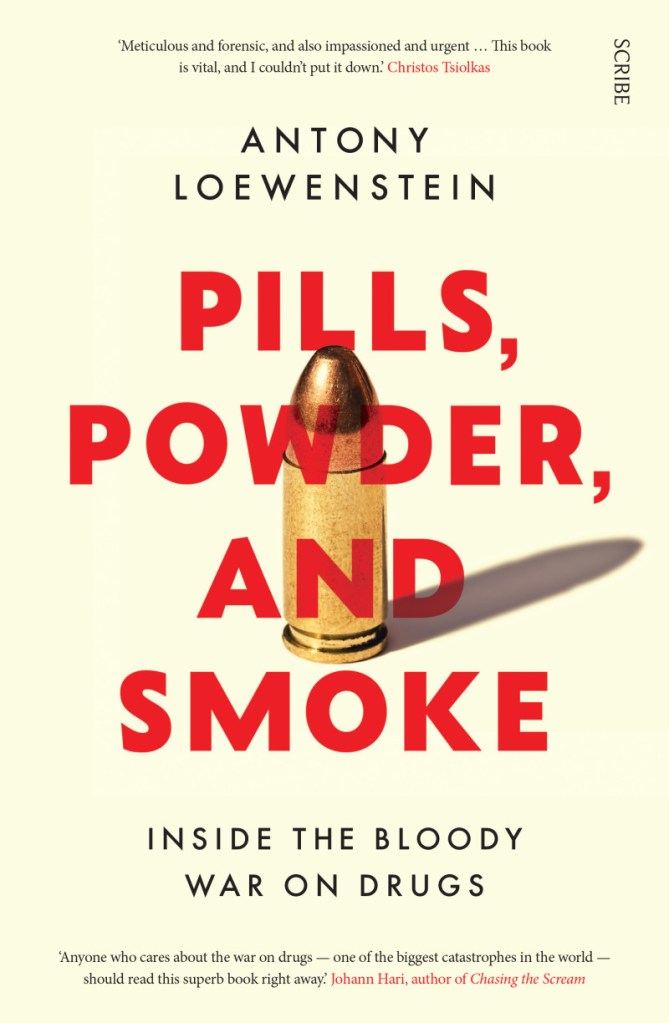
Antony Loewenstein is back, this time talking about his own book about the war on drugs, Pills, Powder, and Smoke, with George Dertadian. Dertadian introduces himself as an academic who researches aspects of illegal / recreational drug use, who only put Loewenstein’s book down because he had to. So it’s a high-level journalist talking to a scholar, a good combo.
The war on drugs is like the war on terror: neither can ever be won, and both – if I remember correctly – generally make worse the thing they seek to remedy. The war on drugs can become a war on drug users, as experience in the Philippines under Duterte shows. Shockingly but not surprisingly, Loewenstein says, Duterte’s program of extrajudicial killings is generally popular. But the Philippines is an extreme example of what is happening elsewhere:
American administrations have not killed millions of Black people to fight a drug war, not within the US at least. What they’ve done is, they’ve got the world’s largest prison population, which I might add was mostly expanded under Democratic administrations, not Republicans, and Joe Biden, potentially the next US president was the key architect of the War on Drugs rhetoric.
There’s a fascinating discussion of ethical drug use, challenging the mindset, ‘My enjoyment is not connected to other people’s suffering,’ with information about the cost of the drug trade for lower level people in the supply chain in the drugs’ countries of origin. And equally fascinating, though brief, discussion of the safe injecting rooms in Sydney and Melbourne.
My favourite quote: ‘With some notable exceptions politicians on this subject are gutless pricks. I think that’s the correct academic term.’
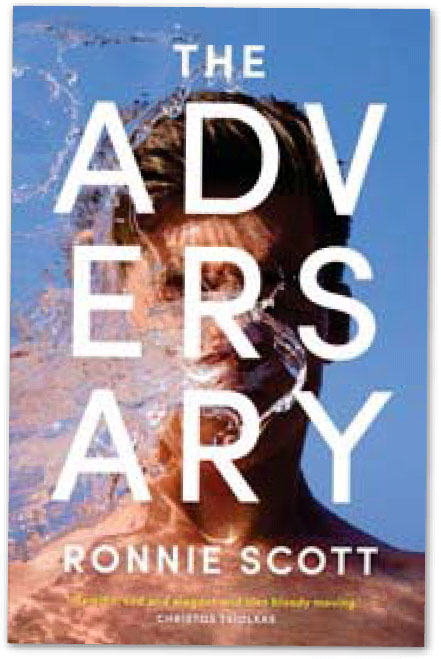
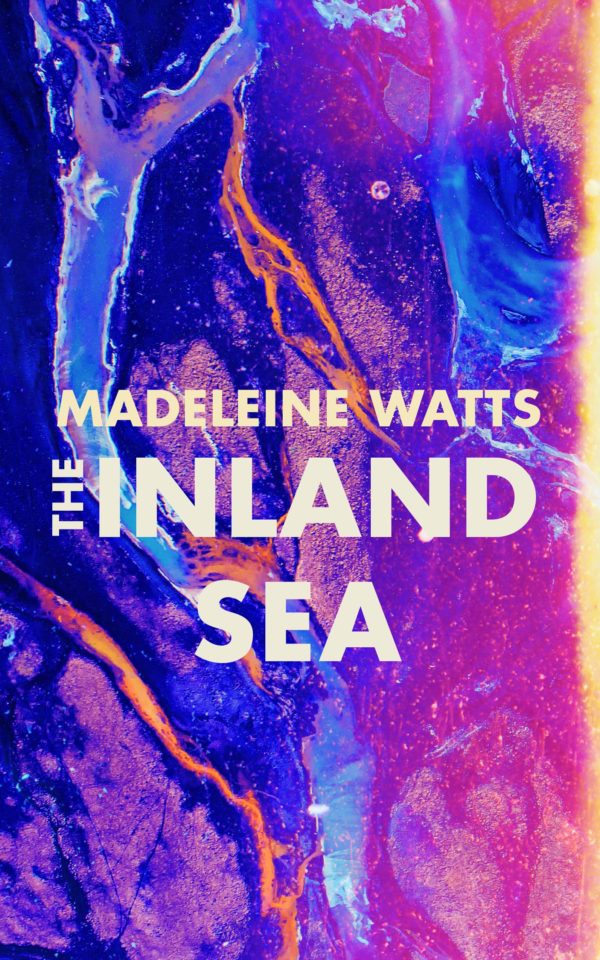
Ronnie Scott and Madeleine Watts, authors of the coming-of-age novels The Adversary (set in Melbourne) and The Inland Sea (set in Sydney) respectively, talk with Rebecca Harkins-Cross, Melbourne-based critic and writer.
They each read from their books, always a good thing in these conversations, and both books sound interesting. The conversation mostly avoids the trap of detailed discussion of the books and instead ranges over the questions of research and the relationship of these books to others. Patrick White, Christina Stead, Sumner Locke Elliott and explorer John Oxley are all mentioned. I learned a little about ‘post-AIDS-crisis’ culture among Gay men, and enjoyed hearing a Sydney-Melbourne conversation that didn’t indulge any of the inane rivalry tropes.
Josephine Rowe, described on the SWF website as one of Australia’s short-fiction greats, discusses her recent collection, Here Until August, with novelist Stephanie Bishop. Listening to this podcast was like eavesdropping on two smart, likeable strangers taking in spoilerish detail about a book I hadn’t read, a pleasant but pointless activity, until …
…. speaking of the importance of place in her fiction, JR went off piste for a moment to speak about the fascinating work of Bernie Krause, a soundscape ecologist who has been recording the sounds made by particular locations over five decades:
[He has] built up this incredible archive of 1300 biomes, their sonic signatures, and how they change over time … He talks a lot about the ways in which animals communicate and the bandwidths that they use. There’s the geophony, which is the sound of the natural, non-animal, non-sentient world. Then there’s the biophony, which is all non-human creatures, sound-making organisms. And there’s the anthrophony, which is us: our noise interacting or coming in and taking up certain registers means that creatures can’t communicate with each other in the same way and they’re being edged out. So you might be looking at the same patch of forest and it might look completely the same, but when you listen to the sound signature of it you hear how much is missing.
… Of these 1300 environment that he has recorded over the past 50 years, two thirds of them are either unrecognisable or in some cases completely silent, and that’s such a terrifying idea.
The conversation then turns to craft – how writing a novel differed from writing short stories (not necessarily harder!), how building with bricks differs from building with stone … And the session finishes with a reading from one of the stories in Here Until August, which made me want to go out and by the book.
The non-digital SWF was to have an All Day YA event. This panel was to be part of it, featuring YA writers Erin Gough (Amelia Westlake), Sophie Gonzales (Only Mostly Devastated) and Anna Whateley (Peta Lyre’s Rating Normal), all of whom have written queer romance.
Again, I felt I was eavesdropping on smart, likeable people talking about books I haven’t read, and in this case am unlikely too, because my niblings are either out of the YA age group or aren’t much interested in romance, queer or otherwise, and by the time my grandies have reached YA reader age the field will have moved on.
There wasn’t really any YA as such when I was of that age. I searched out the little book where I listed all the books I read 1961 to 1975. Not including the books set for school, the list for 1961, the year I turned 14, which I understand to be peak YA, comprises:
20 books by Agatha Christie
5 by Edgar Wallace
4 by Erle Stanley Gardner
4 racist yarns by Sax Rohmer
2 by Ngaio Marsh
a guilty 2 by Carter Brown
only 1 by Georgette Heyer, alas
1 by Arthur Conan Doyle
2 detective stories by people I’ve never heard of otherwise
3 historical novels – Ben Hur, The Robe and I Will Repay by Baroness Orczy
1 science fiction: H G Wells, The Invisible Man
Cheaper by the Dozen by the Gilbreths
Patrick Dennis, Around he World with Aunty Mame
Willie Fennel, Dexter’s Court, which I noted was funny by don’t remember
Much Ado About Nothing (I don’t know why)
I guess if there’d been YA queer romance, or any YA books at all, I would have been spared that immersion in churned-out detective fiction.
The last line of Andrew Huntley’s ‘An Essay on Criticism’ comes to mind as I gather my thoughts about The Beating Heart’: ‘Poem can be way to make a friend.’ (You can read Andrew’s poem in full at this link.)
Anne Casey’s introduction to this slim volume speaks of the poet’s ‘keen powers of observation’, of ‘an elegant interplay of evocative forays between [the poet’s] internal and external worlds’, of conjured enchantment. All this is true, but my overwhelming response to these poems wasn’t to be enchanted or impressed, but something much closer to home: it was the pleasure of meeting someone new. There’s art here, and technique, but it’s art that conceals art and feels like a natural voice speaking directly, warmly and openly.
The back cover tells us:
Born and raised in Rome, Denise O’Hagan lived in London before emigrating to Sydney, where she lives with her husband and sons. She has a background in commercial book publishing, [and] works as an editor with independent authors.
Many of the poems put flesh on the bones on that biographical note. To an extent, in fact, the book could be subtitled ‘Scenes from an Autobiography’: family holiday visit to Switzerland in ‘And the nuns wore lipstick’; a child’s perspective on the Brigate Rosse‘s kidnapping and murder of Aldo Moro in Rome in 1978 in ‘Fifty-five days’; Proustian, unbidden memories in ‘A stain in the shape of Italy’:
That these milestones of our lives
(Laboriously recounted, photographed,
Or documented in countless other forms)
Are glued together by such details
We scarcely realise until later
When they emerge with doubled force
From the backrooms of our memory
There’s adolescent anguish (‘Mary, Mary, quite contrary’), young adulthood in London (‘Bedsitter’, ‘Lost in Transition’ – the titles tell you a lot), a wonderful series of poems about early motherhood and her son’s hospitalisation for a rare condition, the death of parents, and then – a progression I recognise from my own experience – the discovery of a grandparent’s story. ‘The quiet assimilators’ canvasses the ambivalence of an assimilated immigrant. There’s even a poem about being an editor, which I love:
For we editors are tailors
(Seamstresses of old
Working in the back rooms of history
Heads bowed, diligently, invisibly),
We cut and paste and nip and tuck,
Sewing it all together
Until the point is clear
There’s much more than these autobiographical glimpses, but they lay a solid ground so the reader can recognise the voice in the other poems.
Rather than discuss one of the poems in detail, which is my usual practice, I’ve been prompted to write one of my own in response. I started with the quote from Andrew Huntley above and then went where the lines took me. I can justify the opening words of Dante’s Inferno because Denise quotes them in an epigraph to one of her poems, but the rest – sadly – couldn’t be further from Denise O’Hagan’s loose, informal, uncontrived openness.
Responding to Denise O'Hagan's The Beating Heart
'A poem can be way to making
friend,' my friend wrote years ago,
not something only for painstaking
exegesis, judgement – no,
instead an open invitation:
read, let's have a conversation –
silences, yours and mine,
word by word, line by line,
meet, we listen to each other.
When lost nel mezzo del cammindi nostra vita, each has seen
a thing or two. Dear sister, brother,
semblable or not, you write, I read,
together smile, together bleed.
The Beating Heart is the 15th book I’ve read for the 2020 Australian Women Writers Challenge. I received a complimentary copy from the author.
I hadn’t read the Psalms, or any book from the Bible, since my seven years in a Catholic religious order in the 60s and early 70s. I used to love belting them out in the chapel several times a day, especially the complaining bits, the bloodthirsty bits and the bits that celebrate the natural world. They were choral spoken-word poetry of my late teenage years, a place where I could put words to feelings I hardly knew I had.
When this book turned up on offer at our Book-swapping Club, I liked the idea of revisiting that experience.
Alas, Robert Alter didn’t do his translating with me in mind. His version is concerned with precision of meaning, and not at all interested in rendering the poetry, the music of the language. These Psalms were barely recognisable.
A recent YouTube experience illustrates what I mean about Alter’s translation. Sister Nicole Trahan, talking on camera about racism in the US Catholic Church (link here), starts brilliantly with Psalm 55 verses 13–15:
If an enemy had reviled me,
    that I could bear.
If my foe had viewed me with contempt,
    from that I could hide.
But it was you, my other self,
    my comrade and friend,
you whose company I enjoyed
    at whose side I walked in the house of God.
Here’s how Robert Alter translates those verses:
No enemy insults me, that I might bear it,
            no foe boasts against me, that I might hide from him.
But you, a man to my measure,
            my companion and my familiar,
with whom together we shared good counsel
            in the house of our God in elation we walked.
They both are clearly translating the same text, yet the meaning of Sister Nicole’s version is clear, it has a musical flow and it packs an emotional punch, while Alter’s version is dry and needs a footnote to clarify its meaning:*
Were it a known enemy showing hostility, the speaker would have found a way to bear the insult, but it is his intimate friend who has turned against him.
I eventually realised that Alter is not even trying to render the Psalms into memorable (or prayable) English. This is a book for the scholars and exegetes, not for poetry readers or, I imagine, the devout. Neither a scholar nor an exegete, I gave up on it.
But my appetite for revisiting the Psalms had been whetted. I dug out my tattered, dusty copy of the Jerusalem Bible (1966), which employed a ‘team of collaborators in translation and literary revision’ that included J R R Tolkien, James McAuley and Robert Speight. From here on my quotes are from that version unless I say otherwise.
The first thing I want to say is that pundits who cherry-pick the Holy Qur’an for quotes advocating violence should read the Psalms and chill.
Again and again, especially in the early Psalms, the speaker calls on God to destroy his enemies, as if his God is not much more than a secret super-weapon. I guess that’s where a bit of historical imagination comes in handy: you can read this book as a record of the developing notion of what ‘God’ is. Early on, it’s as if every tribe has its own god or gods, and Yahweh is the one belonging to the Hebrews. Gradually, the emphasis changes from, ‘God, smite my enemies,’ to ‘God defend me,’ and ‘God, let my enemies come to see your greatness.’ Morality comes into it: “God, I will obey your law,’ ‘I beg your forgiveness for my wrongdoing.’ They never give up bathing a just person’s feet in the blood of the unjust (58:11), or celebrating the way God heaps up corpses (110:5) but there’s an increasingly clear assertion of an incllusive monotheism: other gods are just lumps of wood or metal, but Yahweh is the creator of the universe. There’s history, wisdom, complaint, repentance, celebration: it’s a rich collection.
The Psalms are full of quotations: ‘The Lord is my shepherd,’ ‘Out of the depths I cry to you O Lord,’ ‘A mighty fortress is my God.’ So there’s a lot that’s reassuringly familiar in them. But reading all 150 from start to finish, whether in Alter’s dryness version, the Jerusalem Bible’s lyricism, or the King James sonority, confronted me not only with their violent us-and-them-ism, but also with the absence of any sense of God in my own mind.
I’ve got a lot of sympathy for people of faith, and when I participate in religious observances I usually find a pragmatic way of paying more than lip service. I can be grateful for my blessings, repent my failings, commit to the things that matter, wonder at the splendours of the universe, acknowledge precarity and interdependence, make acts of faith, hope and love. I can rejoice in the story of the escape from Egypt, love the story of heroic, imperfect, pious King David and lament the destruction of the temple. I can do all that without a need for a supreme being. I can take part in a Mass or a Seder or a sundown prayer without feeling any need to assert my non-belief. But reading the Psalms, I find it hard to get past my outsider status.
My custom with books of poetry is to talk about one poem in some detail. I’m picking number 137, because Boney M:
The song, which I can listen to on hard rotation, was written by T. McNaughton, George Reyam, Frank Farian and Brent Dowe, and draws on Psalm 137 verses 1–4 and Psalm 19 verse 14. It absolutely captures the power of the first four verses of this Psalm. Spoiler alert: the Psalm has 9 verses and takes some dark turns after verse 4.
PSALM 137 **
Ballad of the exiles

Beside the streams of Babylon
we sat and wept
at the memory of Zion,
leaving our harps
hanging on the poplars there.

For we had been asked
to sing to our captors,
to entertain those who had carried us off:
‘Sing,’ they said,
‘some hymns of Zion.’

How could we sing
one of Yahweh’s hymns
in a pagan country?
The heading, ‘Ballad of the exiles’ is a little gloss by the translators. In the first half of the 6th century BCE a large number of people were taken captive from Judaea and taken to Babylon, for an exile that lasted half a century. This was a key event in the history of the Jewish people, and played an important part in the development of Judaism. This Psalm is framed as a song from that time. Its pining for home has struck a chord in the hearts of exiled people for millennia. It makes one think of African-heritage people enslaved in the USA being expected to entertain their oppressors. Or, since I’ve recently read Grace Karsken’s The Colony, ceremony and payback conducted by Eora people in what is now Sydney’s Hyde Park being treated as entertainment by the early colonisers. And it’s open to rich metaphorical reading about commodification of culture: how can I make authentic art for a marketplace?
Jerusalem, if I forget you,
may my right hand wither!

May I never speak again,
if I forget you!
If I do not count Jerusalem
the greatest of my joys!
Moving beyond the verses used in the Rastafarian song, these lines are framed as a kind of self-curse, but behind the curse there’s a feeling that if the speaker were to lose all connection to their home, their spiritual and cultural base, they would lose their ability to function in some crucial way. This is something like what many First Nations people say about the importance of country: on country you can feel a wholeness, a peace, a strength that you can’t feel anywhere else. So far, this is a powerfully resonant song/poem about the pain of exile
Yahweh, remember
what the Sons of Edom did
on the day of Jerusalem,
how they said,
‘Down with her!
Raze her to the ground!’
Then, a sudden change of tone. The captors have asked for an entertaining bit of exotica. Here is the song of Zion that the singer can actually sing. As I write this it occurs to me that to imagine it being sung in response to the captors’ command, but in a language the captors don’t understand, so there’s an element of subversive joy in this as well as heartfelt cry to Yahweh. The singer recalls the harm that has been done to their people, and then ups the ante:
Destructive Daughter of Babel,
a blessing on the man who treats you
as you have treated us,
a blessing on him who takes and dashes
your babies against the rock!
This is directly addressed to the captors. This may once have been meant literally, and if so it’s just monstrous: other people’s violence is wicked, but baby-murder is fine if I or my allies do it. And when I started writing about this Psalm that’s how I read it. But you know, now I think it’s funny: ‘You want me to sing you one of my cute songs. OK, here’s one about the temple and a little baby.’ Then a cheerful tune is struck up. Maybe the Babylonians recognise the word for blessing that occurs twice towards the end. At the last line the performers and Hebrew listeners smile broadly, and their Babylonian listeners follow their cue and also smile broadly.
There’s no way the end of this poem can be read as a pious, morally improving text. Alter’s note says it’s morally unjustifiable, but we should take the terrible circumstances into account. Maybe, though, if you assume that the Psalmist had a sense of humour, the moral unjustifiability is the whole point: this is deliberately outrageous, wicked humour. In the unlikely, er, inconceivable, event that I had to give a sermon based on it, I’d talk about how when we say we want to hear the voices of oppressed people, we need to be prepared to hear things we really don’t like.
I’m not saying that all the psalms can be read as edgy comedy. Sadly, far from it. But I happen to have lit on one that makes me, and possibly you, remember that these songs/poems/hymn were written by people with complex minds – some for liturgical purposes, some to teach history and morality, some to allow the expression of emotion, some as theatre.
* Not to flog a dead horse, but here are a couple of other translations of those same verses from the Bibles on my bookshelves, each with its own clarity, grace and power. First the King James Version: For it was not an enemy that reproached me; then I could have borne it: neither was it he that hated me that did magnify himself against me; then I would have hid myself from him: But it was thou, a man mine equal, and mine acquaintance. We took sweet counsel together, and walked unto the house of God in company.
The Jerusalem Bible: Were it an enemy who insulted me, I could put up with that; had a rival got the better of me, I could hide from him. But you, a man of my own rank, a colleague and a friend, to whom sweet conversation bound me in the house of God!
** If you’re really interested in comparative translations, here are two other translations. First the King James Version: By the rivers of Babylon, there we sat down, yea, we wept, when we remembered Zion. We hanged our harps upon the willows in the midst thereof. For there they that carried us away captive required of us a song; and they that wasted us required of us mirth, saying, Sing us one of the songs of Zion. How shall we sing the LORD’S song in a strange land? If I forget thee, O Jerusalem, let my right hand forget her cunning. If I do not remember thee, let my tongue cleave to the roof of my mouth; if I prefer not Jerusalem above my chief joy. Remember, O LORD, the children of Edom in the day of Jerusalem; who said, Rase it, rase it, even to the foundation thereof. O daughter of Babylon, who art to be destroyed; happy shall he be, that rewardeth thee as thou hast served us Happy shall he be, that taketh and dasheth thy little ones against the stones.
Robert Alter: By Babylon’s streams there we sat, oh we wept, when we recalled Zion. On the poplars there we hung up our lyres. For there our captors had asked of us words of song, and our plunderers – rejoicing: ‘Sing us from Zion’s songs.’ How can we sing a song of the LORD on foreign soil? Should I forget you, O Jerusalem, may my right hand wither. May my tongue cleave to my palate if I do not recall you, if I do not set Jerusalem above my chief joy. Recall, O LORD, the Edomites, on the day of Jerusalem, saying: ‘Raze it, raze it, to its foundation!’ Daughter of Babylon the Despoiler happy who pays you back in kind, for what you did to us. Happy who seizes and smashes your infants against the rock.
Usually the Sydney Writers’ Festival lasts for two weeks. Usually I blog about the dozen or so sessions I attend live, and don’t feel the need to tell you about any podcasts. This year I seem to have made a decision to listen to them all and blog about every one. Here are sessions 35 to 40: journalism, memoir, First Nations voices, the world of high tech, terrorism, violence against women.
I know Trent Dalton’s writing from his novel Boy Swallows Universe, which I loved (blog post at this link). It turns out he has also been writing ‘long form journalism’ for The Australian for years. For even more years, Jane Cadzow has been doing likewise for Good Weekend, the magazine published on Saturdays with The Sydney Morning Herald and The Age. Katrina Strickland is editor of Good Weekend.
This is an inside look at feature-article writing in Australia. There are lots of anecdotes about the biz, insights into the process (taping allows a journalist to take notes about things other than what is being said), and how ‘long form’ is seen by the ‘hard news’ journalists. As audience, I felt that I was listening in on a chat among people who knew each other well and moved in the same journalistic circles, rather than people who were discovering things along with us. The emphasis seemed to be on profiles of celebrities and others rather than stories from war zones or issues-based articles. But it’s a fun listen.
My last batch of SWF sessions featured two white liberal male authors in conversation. This session features two white left-wing males. Jeff Sparrow, former editor of Overland, has written Fascists Among Us: Online Hate and the Christchurch Massacre. Here he talks to Antony Loewenstein, whose My Israel Question is terrific – and he’s written a lot since.
Starting with the Christchurch massacre, the conversation range widely over contemporary politics and media. The perpetrator (Sparrow doesn’t use his name and the discussion of his reasons is interesting) was not a ‘mentally-disturbed individual’ but a convinced Fascist, whose main inspiration was Oswald Mosley. Donald Trump is not a Fascist, but has created a sea in which Fascists can swim. Social media platforms have some responsibility for enabling Fascists to flourish. Here’s Jeff Sparrow:
Genuine Fascists were some of the early adopters of the internet, precisely because they realised the internet allowed them to mobilise and organise in a way that they couldn’t do in real life. The far right in Australia tended to be recruiting people from the outsides of big cities or small countries towns. How do you organise those people in the real world? It’s very difficult. Australis is a big country. How do you bring them all together? If you have a website, it’s much easier, and the most recent attempts to organise Fascist movements in Australia were for that very reason closely associated with platforms like Facebook, because here is a mainstream form of the internet, everyone uses it, everyone in a country town can get on Facebook, there’s this one group you can set up. It’s very well suited to the structure of Fascist organisations because it’s participatory but not democratic. You can set up a Facebook, everyone can be involved but there’s a leader at the top who runs everything. In a sense it replicates the structure of a traditional Fascist organisations. That’s one of the reasons the far right has done much better on line than the left has.
And later:
We need to try to find some way to take the anti-Fascist principles that have worked in the real world into the online space. That’s easier said than done, and I don’t have a particular answer as to how that might occur, but it’s going to be a real issue from here on in, because the internet is gong to be central to whatever far right groupings emerge.
In normal times, Sparrow says towards the end of the conversation, the perpetrator’s eco-Fascist notion of mass murder as a solution to the climate emergency would be absolutely unattractive to absolutely anyone. In the context where the world seems to be breaking down, that may be changing. He concludes on what Loewenstein calls the ‘mildly optimistic note’ that it’s not enough to fight back against Fascism: we have to offer some genuine hope for a better world.
As in the session on long-form journalism, here three journalists who work in similar fields compare notes and discover how much they have in common. But this trio are Indigenous, and until recently it was rare for Indigenous journalists to be have major platforms. The participants are Warlpiri woman and co-host of NITV’s The Point Rachael Hocking; Anishinaabe and Polish Canadian journalist Tanya Talaga; and Kamilaroi/Dunghutti founder of the Tiddas4Tiddas podcast Marlee Silva.
Like the earlier session featuring Tanya Talaga, this one discusses strikingly similar experiences of First Nations peoples in Australia and Canada.
This is another podcast in the Stories Worth Telling series created by the Judith Neilson Institute for Journalism and Ideas and Sydney Writers’ Festival.
Uncanny Valley is US journalist Anna Wiener’s first book, a memoir of her time working in the high-tech industry. Here she talks about it with Rae Johnston, NITV’s Science and Technology Editor. The conversation covers many familiar topics: the rise of surveillance, the exploitation of workers in the tech industry and by companies like Uber, the steady thrum of sexism in Silicon Valley.
There’s an interesting discussion of Wiener’s decision to name no companies and very few people in the book – for instance, there’s a company she calls ‘the social media platform that everyone hates’ and there’s no prize for guessing what that is. Another highlight was the explanation of ‘Down for the Cause’, unofficial motto of a start-up that calls on employees’ devotion above and beyond their official duty, and well beyond what they are paid for. But though both speakers mention several times that the book is very personal, the conversation generally stays at an abstract, journalistic level. Here’s Anna Wiener:
I just wanted to write about the way that it feels to look for meaning in work, to think you’ve found it and then to be totally disillusioned not just by your personal experiences but by the narrative and fantasies of an entire industry … I didn’t write the book as an instrument of social change. That was never my intention. I really wrote it hoping that people might see themselves in it in some way, people might see the world a little differently. I wanted to articulate the experience of being a fairly low level employee at tech companies in the 2010s in part because I just felt that was not a perspective that I was reading much about.
I would have liked to hear her read from the book, to hear something specific about those personal experiences and those fantasies. But the conversation was a good reminder that those unnamed/nicknamed companies aren’t necessarily our friends.
A small note about entertaining differences in pronunciation: Anna Wiener spoke of the importance of higher keys and buyer says, and it took me a moment in each case to realise she meant organisations with rising levels of power and prejudices.
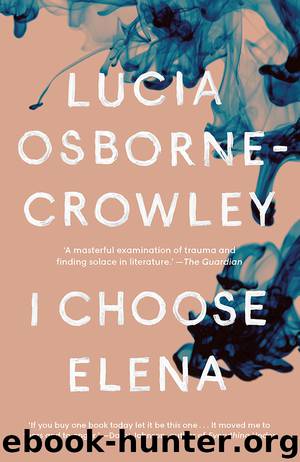
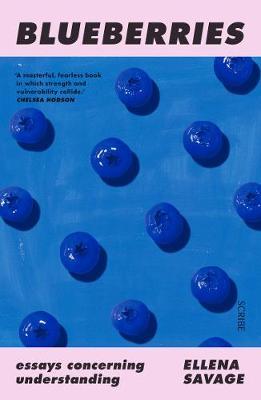
Lucia Osborne-Crowley’s I Choose Elena and Ellena Savage’s Blueberries are both debut books, the former a memoir and the latter a collection of essays. They both deal with personal experience of sexual assault, and its long, hideous tail.
Maeve Marsden, theatre person and curator of the ‘national storytelling project’ Queerstories, does a lovely job of facilitating the conversation – I particularly appreciated her for having both writers read from their books at the beginning, so we got to hear their deeply considered and carefully deployed words before hearing the back and forth of conversation. In that conversation one of the writers mentioned her PhD a couple of times and spoke in academically-inflected language a little too much for easy communication, but that’s a minor grumble from a relatively uneducated listener-in, who nonetheless benefited from the conversation.
The next batch of podcasts promises to include some story-telling. And maybe there’ll be some poetry …
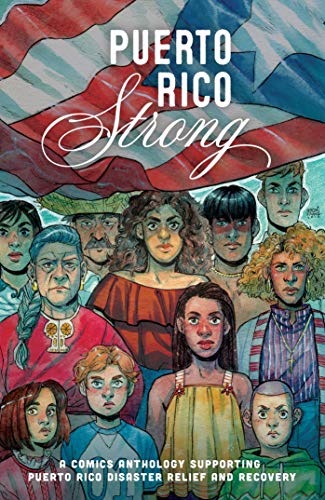
Marco Lopez, Desiree Rodriguez, Hazel Newlevant, Derek Ruiz and Neil Schwartz (editors), Puerto Rico Strong(2018)
This is a comics anthology supporting Puerto Rico disaster relief and recovery in the wake of Hurricane María in September 2017.
I confess that before reading this book my main source of information about Puerto Rico and its relationship to the USA was West Side Story. The book has given me a lightning introduction to 500 years of the island’s history, from the original Taino inhabitants, through brutal Spanish colonisation to the current US imperial presence. Puerto Ricans were made US citizens – who don’t have the vote – in 1917, and a couple of weeks later the men were called up to fight for the US in World War One. As many as 1500 Puerto Rican women were involved in trials of the contraceptive pill in the 1950s, without real informed consent. And so on.
Among the 40 short pieces, as well as the history lessons, there are childhood stories, fantasies of dystopian futures and mythic pasts, explorations of the complex identities involved in being Puerto Rican, tales of friendship and creative enterprise, all in a dazzling range of art styles. Most of the writers and artists are Puertoriqueños. Donald Trump’s insulting paper-towel-throwing stunt and subsequent blocking of aid after the hurricane is mentioned, but his presence is restricted to less than a handful of pages. Attention goes instead an exhilarating assertion of pride in Boricuan identity and the proud history of resistance. (Borikén was the name of the island before the Spanish colonisers renamed it.)
I’m in awe of the work of the editors bringing this vast array of writers and artists together in a work that has many overlaps but never feels muddlingly repetitive. My copy was a gift for my birthday in March. I waited too long to read it.
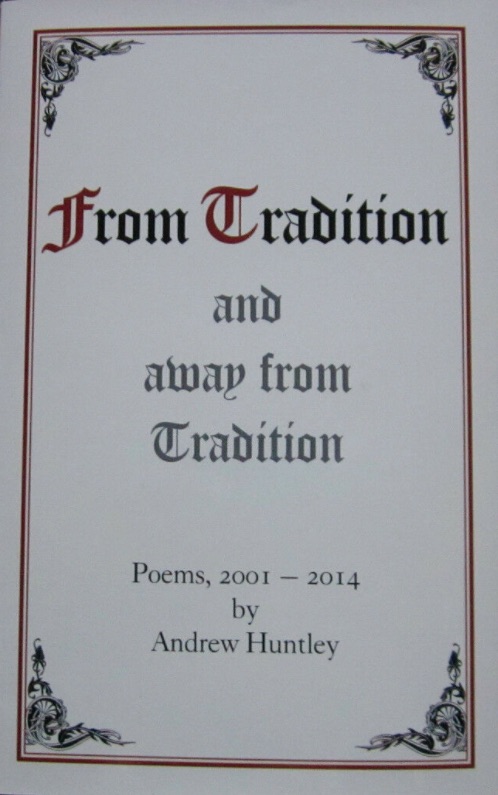
Andrew Huntley died in June this year. In lieu of attending his funeral I broke my personal ban on Amazon and bought a copy of From Tradition, which he self-published in 2014. I’m sorry it was too late for my purchase to boost his finances or his morale.
We were friends in the early 1970s when we were both in our 20s. He was witty, warm and exuberant, a recent convert to Catholicism of the pre-Vatican-Two variety, and a keen astrologer. We liked each other. And I loved his poetry.
Lyrical Ballast was one of three slender, stapled books of poetry published by the Sydney University Arts Society in 1970. (The other two were Martin Johnston’s shadowmass and Terry Larsen’s Tar Flowers.) It’s largely nonsense poetry, and though it mostly hasn’t aged well its general benign silliness is charming, and disarming.
Two poems in this collection still give me pleasure. ‘A Paean: Australia’s Praise in Honour of the Makers of Sweat Poesy’ offers a deeply ironic picture of an Australia where poets have ultra-celebrity status that still rings true:
'Sing Huzzah for the poet!'
Cries each Australian Son,
As a poet passes down the street
'Huzzah!' cries everyone.
‘An Essay on Criticism’ (which I’ve uploaded elsewhere in this blog – link here) was Andrew’s contribution to the website commemorating the 30th anniversary of Martin Johnston’s death (link here). It’s a tragicomic love story and a celebration of non-academic approaches to poetry, which begins:
Maisie were a critical
Severe she wore her bun
She lecturing on literature was grim.
Arnold he be engineer
He's reading just for fun –
Maisie meaning all the world to him.
And it ends:
A poem can be way to make a friend.
Between Lyrical Ballast and From Tradition, Andrew published three other books: Lalai – Dreamtime, the script for Mike Edols’s 1972 short film of that name, a poetic rendering of a story ‘recounted by Sam Woolagoodjah, Elder of the Worora people, north-west Australia’ (the description is form the AustLit website); Minor Pageant (Island Press 1977); and The Stone Serpent Dreaming (Hale and Iremonger 1983). And he had a number of poems published over the years, mainly in politically conservative journals such as Quadrant and in conservative Catholic publications.
From Tradition is a beautifully produced hardback, containing 33 short poems, mostly sonnets that adhere rigorously to the demanding Petrarchan rhyme scheme (in case you’re interested, that’s abba abab cde cde), and one longer poem in blank verse. Almost every short poem asserts a traditional-to-reactionary Catholic position – on sex, feminism, grief, the afterlife, writing back to Yeats, Pound, Emily Brontë, Phillip Adams. The long poem, ‘The Plough & the Cross’, is a narrative telling of the poet’s conversion to Catholicism. The exuberant silliness of Andrew’s early poetry has evaporated, and the tone is generally combative – the speaker in most of the poems is fighting against modernity and holding fast to his commitment to the One True Church, and to God the Creator and, especially, Judge.
While I admire Andrew’s technical skill and his erudition, and respect his embattled integrity, I found the book uncongenial. I think that’s how he meant someone like me to find it.
Every now and then, the poetry allows a glimpse of a suffering human being under the carapace of Faith. Here’s an example:
Chasing Tolkien'And Rose drew him in, and set him
in his chair, and put little Elanor upon his lap.
He drew a deep breath. "Well, I'm back," he said.'
The Return of the King, J R R Tolkien
My time seemed flowing there – re-burgeoning –
I never knew how strongly years might stay:
Once more the final pages, – I could say
With Samwise, well, I'm back. Yet in my spring
There was no loving Rosie – none to bring
Her promise that all years would glide away,
Bearing a couple on their wedding day
That death alone could part .... come anything!
My Middle-earth, little but breaking's been,
And scattered flowerings of sadness sown;
With autumn silent now in loneliness:
Where haven has withdrawn from every scene,
And (on and on) mere roads to madness shown –
And time is past; and only God may bless.
As an evocation of misery finding comfort or hope in God, it’s a long way from George Herbert of Gerard Manly Hopkins, but it does pull at the heart.
This is my thirteenth blog post about À la recherche du temps perdu: 1723 pages read and 677 to go! I’m bearing up much better than my copy of the book, as seen on the left. I mostly read my three pages in bed in the morning, so the damage has been caused by ordinary wear and tear, not by any gross mistreatment.
A lot happens in this month’s reading. Here are some highlights, not necessarily in order. The violinist Morel continues to be an opportunistic scoundrel. Marcel (as the narrator has now been named, twice) listens to the sounds of the street in the early morning (those are lovely pages). He contemplates sending a dairymaid on an errand but changes his mind. He watches Albertine as she sleeps, and creepily drapes her unconscious arm around his neck. He watches her wake up. He takes us through his own process of waking up from a dream. He ruminates on the relationship between love, obsession (not his word) and jealousy. He talks Albertine out of going somewhere where he fears she might meet other Lesbians, and then realises that he has let her go to a performance by a notorious Lesbian. He plays the piano. He opens Albertine’s chemise and looks at her naked body:
Les deux petits seins haut remontés étaient si ronds qu’ils avaient moins l’air de faire partie intégrante de son corps que d’y avoir mûri comme deux fruits ; et son ventre (dissimulant la place qui chez l’homme s’enlaidit comme du crampon resté fiché dans une statue descellée) se refermait, à la jonction des cuisses, par deux valves d’une courbe aussi assoupie, aussi reposante, aussi claustrale que celle de l’horizon quand le soleil a disparu.
(Page 1661)
This is about as erotic as La recherche gets. But wait, I asked, wasn’t Proust Gay, or at least bisexual? What weirdness is this about men’s bodies? I looked up Scott Moncrieff’s translation. And there it is:
Her two little upstanding breasts were so round that they seemed not so much to be an integral part of her body as to have ripened there like two pieces of fruit; and her belly (concealing the place where a man’s is marred as though by an iron clamp left sticking in a statue that has been taken down from its niche) was closed, at the junction of her thighs, by two valves of a curve as hushed, as reposeful, as cloistral as that of the horizon after the sun has set.
This translation even softens the meaning a bit – I would have thought s’enlaidit was ‘becomes ugly’ rather than ‘is marred’.
Increasingly I understand why, at the end of fifteen years, when Clive James had finished reading this work in French, he needed to read an English translation so he’d know what he’d read.












 Me fail? I fly!