November Verse 2 & Judith Brett’s Coal Curse

November verse 2: 
First a paddock, now a quarry.
Ride on sheepback, ride in coal-cart
all the way to– Well I'm sorry,
who knows where? It takes a cold heart
not to quake when science gives notice
not to quail when Trump is POTUS,
not to dump Adani's deal,
not to see shit just got real.
Impervious to rhyme and reason,
evidence and sound advice,
our governments have, for a price –
praise be, and Kyrie eleison –
bent the knee to fossil fuels
like autogenocidal tools.

Which is a response to:


Judith Brett, The Coal Curse: Resources, climate and Australia’s future (Quarterly Essay Nº 78, 2020) – and correspondence in Quarterly Essay 79
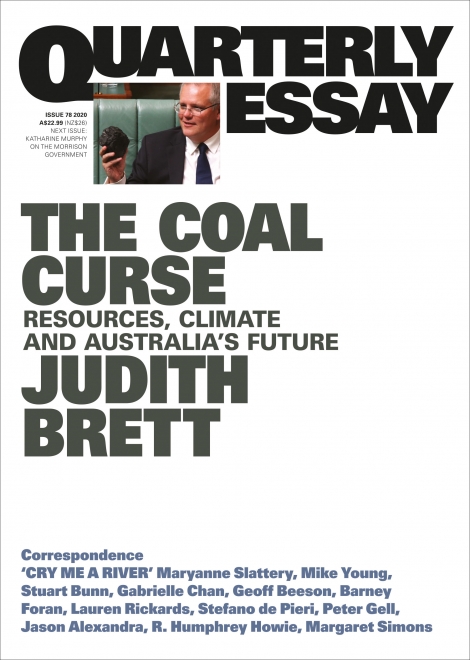
Judith Brett’s The Coal Curse is in part an update of Guy Pearse’s Quarterly Essay Nº 33, Quarry Vision (here’s a link to my recently-retrieved blog post about that). Much has changed in the decade between the two essays: the climate emergency has become more obviously pressing, community and business support for renewable energy has increased hugely, there’s much more scepticism about the future role of coal and gas in Australia’s economy in business circles (except, of course in the coal and gas industry). Dispiritingly, little has changed in the federal government’s hand in glove relationship with the fossil fuel industry, and the issue has become even more politicised, more enmeshed in culture wars.

This essay, Judith Brett writes in the introductory section, ‘is about the history of Australia as a commodity-exporting nation and its political consequences’:

Economic history is unfashionable nowadays. Economists focus on the modelling and management of the present and historians are more interested in stories and experience, and in uncovering diversity and neglected voices. Economic history is dry and hard to narrativise. But how a country makes its living can explain a lot.

(Page 8)

I didn’t find this essay dry at all. Judith Brett writes with wonderful clarity. Every now and then she throws in a wry aside, an amusing factoid or a startling anecdote, but you’re never at risk of getting lost in a welter of detail or a barrage of polemic.

Here’s her argument in brief:

  1. Australia is a trading nation. We have a small population, so exporting enables our companies to grow by reaching larger markets.
  2. There has always been a divide between the export of commodities – wool until the 1950s, minerals since then – and manufactured goods. The first makes a lot more profit but employs many fewer people.
  3. Because minerals export, especially coal and gas recently, is so profitable, it draws resources away from other exports and manufacturing.
  4. With the minerals boom, our manufacturing sector has pretty much collapsed.
  5. World markets for coal are decreasing dramatically as the rest of the world addresses climate change. Australian governments have been successfully captured by the fossil fuels lobby, and have not responded to the challenges of reality, as opposed to many in business and overwhelming public opinion.
  6. Paraphrasing wildly now, if something doesn’t change dramatically soon, we’d better kiss our backsides goodbye.

Actually, Brett isn’t as pessimistic as that. But when she quotes an LNP Senator from Queensland saying what an honour it has been ‘to represent the Australian mining sector’ (page 62), she leaves the reader in no doubt that some politicians forget that they are, as she puts it, ‘our risk managers of last resort’.


As we expect in the Quarterly Essay, the correspondence on The Coal Curse in QE 79 is civil, nuanced and challenging. Andy Lloyd, who worked for Rio Tinto for 23 years, offers the equivalent of a ‘not all men’ argument, which blurs some of the edges of Judith Brett’s argument but makes no substantial difference. The other correspondents tend to emphasise the hopeful elements of the essay, pointing to promising activist strategies, actual developments in the business sector that indicate fossil fuels are heading for oblivion and the Australian government are likely to be left floundering behind the main game.

Stephen Bell, professor of political economy at the University of Queensland, articulates a key question that always lurks behind discussions of this sort:

Who reads this kind of history? Mostly, people already agree that coal is causing environmental devastation and the coal lobby is far too powerful. And almost certainly not those who have drunk the Coal-Aid, unless their aim is to lampoon it and its author, as the Murdoch stable is wont to do. This is the crisis of Australia’s intellectual life: the apparent impossibility of generating a constructive rational dialogue about anything in general, and about coal in particular.

(QE 79 page 128)

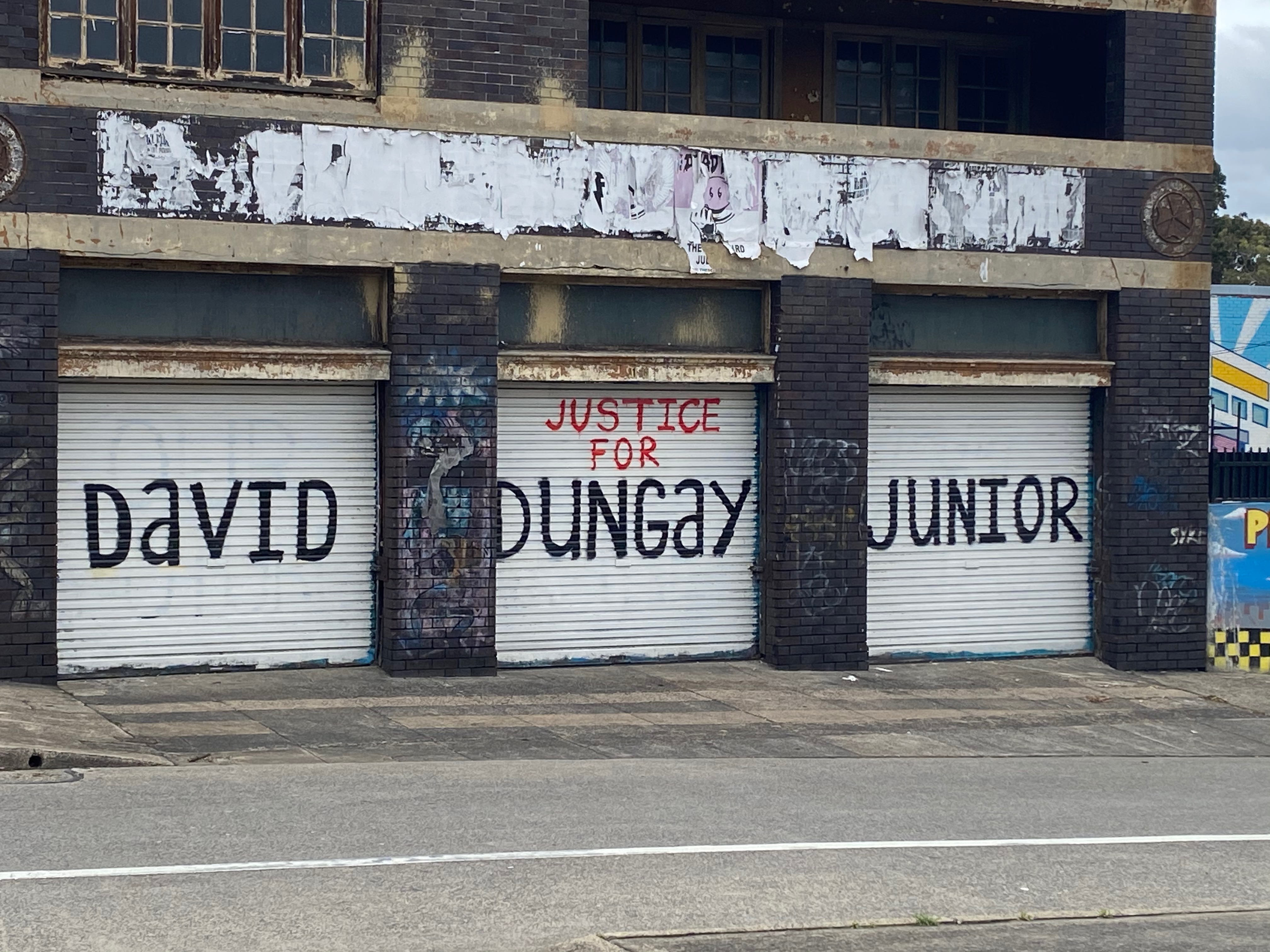
Martin Luther King Junior said, ‘The arc of the moral universe is long, but it bends toward justice.’ We’d better hope the arc isn’t too long.


The Coal Curse is the 19th book I’ve read for the 2020 Australian Women Writers Challenge.
November verse 1

Since 2010, inspired by National Novel Writing Month (NaNoWriMo), I’ve had a project of writing fourteen 14-line stanzas each November. Mistakenly believing my favourite stanza form was a sonnet, I called this project LoSoRhyMo – Local Sonnet Rhyming Month. It turns out that my form isn’t a sonnet but an Onegin stanza, but I’m keeping the label anyhow.

If you want to read past Novembers’ verses you can click on the LoSoRhyMo tag at the bottom of this blog post. Or you could go to my Publications page and buy one of the four little books made up from these and others of my adventures in verse.

Here goes for November 2020, a fresh start:

Verse 1: Unprecedented again

You can only be unprecedented once 
(Michelle Goldman, Asthma Australia, 
on ABC News, 31 October 2020)

A cataclysmic bushfire season
should be no surprise next time.
We've raked the ashes, learned the lessons,
know just how to lift our game.
Unprecedented 2020 –
fire, flood, plague and Rio Tinto –
warns us that we won't be spared
in days to come. Best be prepared!
Yet here's our precedented morning –
juice and coffee, jam and toast  
the fifteen-thousandth time at least.
Each microsecond freshly dawning,
despite our habit-blinkered view,
is absolutely, freshly new.

Elza De Locre rediscovered

Elza De Locre, How May I Endure: Selected Poems, edited by John Arnold (Fanfrolico Two 2019)

This elegantly produced, limited-edition poetry book is a work of cultural retrieval and a labour of love.

Elza De Locre was the intimate partner of Jack Lindsay in the 1930s, when Lindsay was running the Fanfrolico Press in London along with P R Stephenson.

Whereas Jack’s father, Norman Lindsay, is still a household name in Australia, thanks mostly perhaps to The Magic Pudding, Jack himself, P R Stephenson and Fanfrolico Press, let alone Jack’s work as a Marxist literary critic after he broke from his father, would elicit blank stares in a pub trivia quiz. Even more so Jack’s tragic lover Elza, who even in her lifetime was better known for her bewitching beauty (she was the subject of Edith Young’s 1931 novel, Lisa) than for her poetry.

John Arnold is a distinguished Australian Literature scholar – he co-edited the four-volume Bibliography of Australian Literature (2001–2008), which has been described as ‘an essential reference work for the reading, study and collecting of Australian literature’. Among his more personal scholarly publications is The Fanfrolico Press: Satyrs, Fauns and Fine Books (2008). Now retired from his position of Head the National Centre for Australian Studies at Monash University, he has compiled this selection of Elza De Locre’s poems, and published it over his own imprint, Fanfrolico Two.

His introduction begins:

Elza De Locre is a now a forgotten minor figure of 1920s literary and artistic London. Her life started badly in 1897 and ended even more so in 1952. It was one of mystery, oppression and fighting mental demons, relieved only with occasional periods of freedom and beauty. Her story deserves to be told and this selection of her poetry has been compiled as a tribute to her.

The introduction gives a fascinating glimpse of the writerly life in 1920s bohemian England. Drawing on many sources, especially Jack Lindsay’s memoir Fanfrolico and After, it pieces together an outline of Elza’s life. Born illegitimate as Elsie May Hall in Bristol, by the time she met Jack Lindsay in 1926, she had lived through very hard times, married, had a daughter, found work where she could, including sex work, and gone by a number of names – Arnold lists nine. With Jack she found a turbulent but committed relationship, which didn’t stop her from becoming increasingly mentally troubled through the 1930s. In late 1941 when Jack was called up to the army, she couldn’t manage on her own and voluntarily went into a ‘mental home’. She then lived in a series of hospitals until her death eleven years later – Jack paid her expenses, but his own financial resources were limited.

Elza’s two books of poetry, a short story and ‘Time Please!, a light-hearted novel’ (co-authored with Jack) were published in the early years of her relationship with Jack.

Arnold quotes Jack as saying of her poems that many were ‘direct transcriptions of dreams, written down in the early morning’, and that their world ‘is one of elemental change and dissolution, with her lonely spirit pursued and tormented, finding release only in momentary identifications with the bright life of nature’. Ominously, Arnold says that some of the poems are ‘of genuine quality’,

So I approached the poems themselves as to a museum exhibit: of historical interest at best. And then was shocked by the intensity and rawness of many of them. I was expecting fairies and satyrs and classical references, and I got those, but I wasn’t expecting:

And always I would lose my way 
And stumble over rotting minds, 
Tree-roots in the darkness, thorns anywhere
And mangroves thrusting their fingers
Into my wounds

There are poems about life and death, about erotic annihilation, poems of ecstasy and terror and despair. There are some amazing poems about, of all things, the moon:

Her naked body lying on the waters
Shakes my five senses.

Jack Lindsay’s description of these poems as transcriptions of dreams rings completely true, and she had extraordinary and often terrible dream.

Here’s the shortest poem in the book:

THE LAST REFUGE
Twice in this life have I been dead;
But the mortal gods have bewitched me.
I have crawled back like a wretched slave.
Pelted with clods back to my body.
The third time I think I'll get away.

See what I mean? That looks very simple on first blush, but something in it niggles at you. The first line is startling enough, but enigmatic. Maybe it’s literal: two heart failures. Maybe it’s semi-literal: two suicide attempts. Maybe it’s completely metaphorical: two moments of existential nothingness. Maybe the speaker isn’t human, but a mythological character. The poem works for any one of these readings, for a kind of mental miasma containing all of them, or a reading that leaves the question hanging.

Then ‘the mortal gods’ can carry at least two meanings: the gods of death (we can assume the poet is influenced by the Lindsays’ brand of neo-paganism), or mere humans who take on themselves the godlike ability to bring someone back from the dead. Whether it’s human intervention or dumb luck, the effect is bewitchment – not so much a miraculous (Christian) resurrection as some kind of (pagan) magic.

She has crawled back ‘like a slave’. She has been deprived of agency and comes back from the dead against her own will.

The blunt physicality of ‘Pelted with clods back to my body’ is what makes the poem leap from the page; but that last word comes as a surprise. The being that is being pelted is not physical at all. It’s the soul – or disembodied mind, or whatever – being driven back to its bodily existence.

The last line here is a powerful, matter-of-fact embodiment of suicidal ideation. I’m not a fan of suicide poems, and I won’t be turning to this one in moments of depression. But this is a living voice speaking to us very directly, brought back from literary oblivion.


How May I Endure was printed in a limited edition. I am grateful to John Arnold and Fanfrolico Two (scholartis @ gmail.com) for my copy, which is number 61 of the 150 numbered paperback copies. There may be some copies left for sale.

Beautiful graffiti

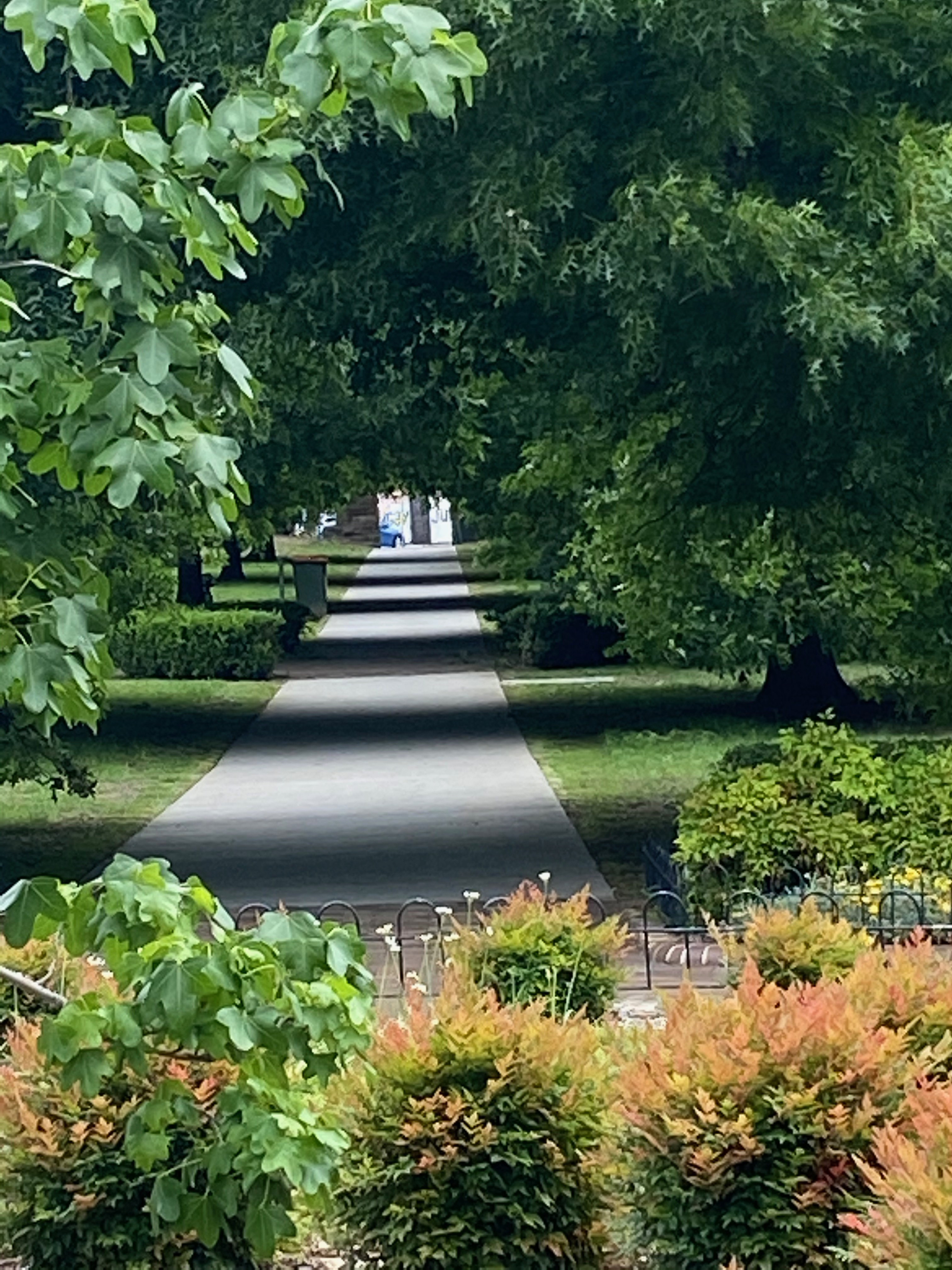
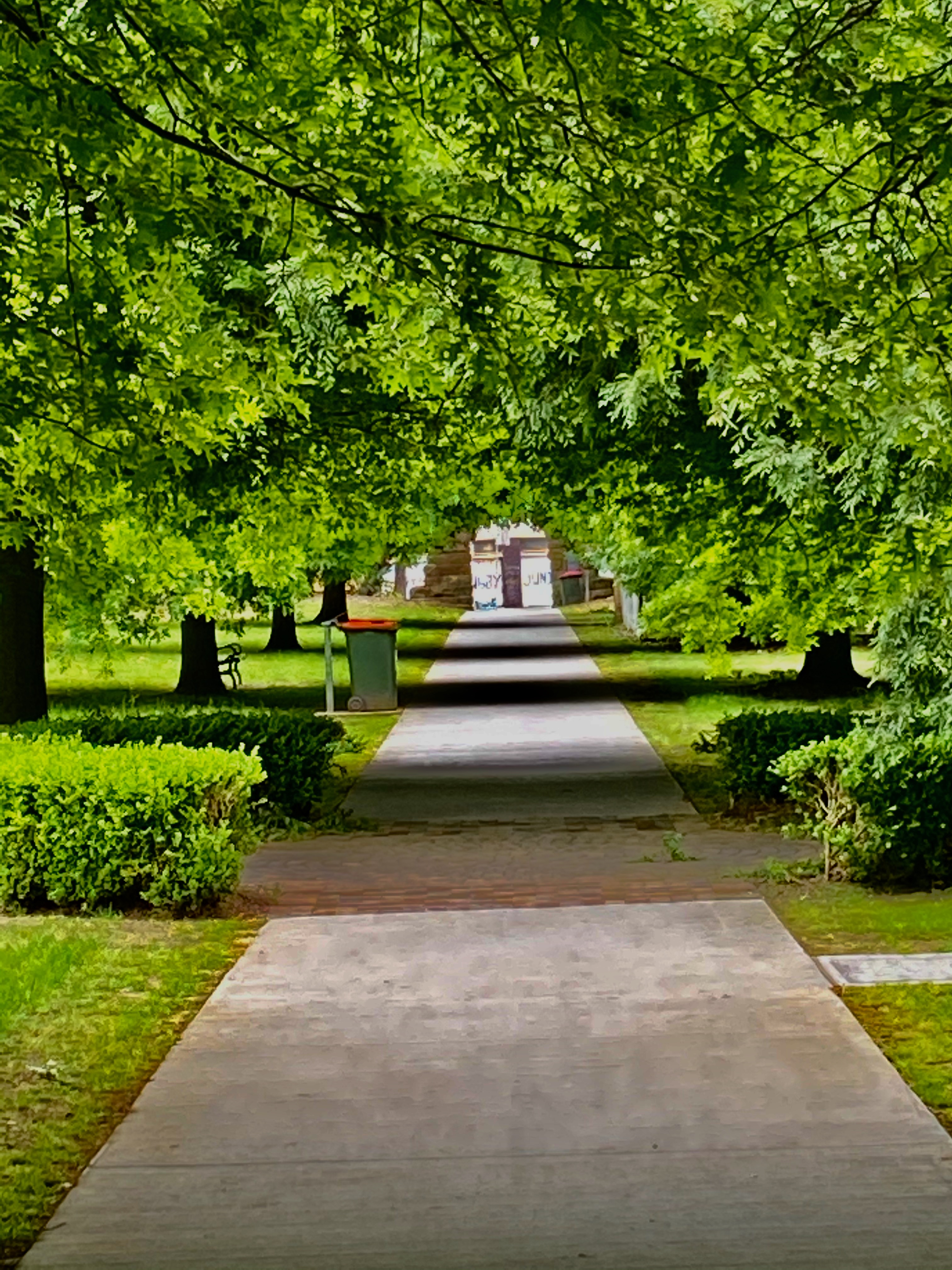
I live very close to Enmore Park, a geometrically laid out green space that’s beautiful at this time of year. Here’s a little walk I took, along one of the diagonals, though a sandstone arch that’s a monument to colonial selfhood to the corner of the colonial-named Edinburgh Road and Victoria Road, and a reminder that colonisation is still alive and well and harsh.

SWF 2020, Post 10: All fiction

The next five podcasts from the 2020 Sydney Writers’ Festival are all about fiction. My guess is I would have attended one out of five in a non-virtual festival, but my completist compulsion kicked in. The one I would have attended, the 50th session, is about the first book in the festival that I’ve actually read!

In the intro to the fifth session in this blog post, Michael Williams introduces himself without fanfare as the new Artistic Director of the Sydney Writers’ Festival. I for one welcome our new Melbourne overlord.

Alex Dyson: When It Drops 16 September

This conversation about Alex Dyson’s When It Drops is part of the festival’s YA podcast series. Will Kostakis, YA author himself, does a brilliant job, and Dyson’s experience as a morning radio presenter ensures that teh entertainment quotient is high. We don’t get to the content of the book until the 20 minute mark: before that there’s a lot of very funny chat about the difference between doing a radio show and writing a novel, about the horror of discovering a typo in a freshly published book, about tiny bits of celebrity gossip, about awkward love poetry written by both these men when they were teenagers.

Even then, the conversation doesn’t get stuck in laborious detail about the book’s characters and plot. We learn snippets of Alex Dyson’s life story, and then there’s non-spoilerish discussion of how those snippets relate to the book. At the end, it turns out that Alex Dyson ran for federal parliament last year, and he has some very smart things to say about that.


Nicole Dennis-Benn: Patsy 23 September

Jamaican-born Nicole Dennis-Benn now calls Brooklyn home. Her novel Patsy tells the story of a Jamaican woman who leaves her husband and five-year-old daughter for a new life where she can choose how to live, in the USA. In this conversation with Australian journalist and filmmaker Santilla Chingaipe, she lays out some of the issues the novel is responding to. At its heart there’s the question: ‘What do we lose or gain when we choose ourselves as women – especially as women – in society.’

It’s great to hear a clear voice speak about Jamaican society, including aspects of class, colonialism, the importance accorded skin colour, sexism; and about Jamaican Americans in relation to African Americans and others.

My two favourite moments in the conversation are being read to from the novel (always a pleasure, and in this case reassuringly concrete in the context of a conversation bristling with terms like ‘intergenerational trauma’), and Nicole Dennis-Benn’s response to the question, ‘How did Patsy find you?’ The novel started life as a series of letters from the character Patsy to her mother back in Jamaica. Then after a whole year, another voice turned up, a girl navigating a life in Jamaica without her mother:

I realised Patsy’s saying all these things to her mother in these letters, but she’s leaving out a lot of things. She’s leaving out how she’s really doing in America – you know, she was in that one room already in that first draft. But in addition to that, Patsy wasn’t telling me – the author – something: that she left a whole five-year-old daughter behind. … I kind of refused to believe that Patsy would actually do that, because I wanted to like Patsy, I judged Patsy initially when I found that out. But I continued the Dear Mama letters and then, draft two, I trashed that. I was like, ‘You know, Patsy, you gotta tell me the truth.’ And that’s what happened. She ended up revealing a lot more.


Heather Rose: Bruny 30 September

Heather Rose’s novel Bruny, the subject of this conversation, has disappointed friends of mine who loved her earlier novel, The Museum of Modern Love. Worse, one of the more forthright members of my Book Group virtually recoiled in horror when someone mentioned it. So I was tempted to bypass this session. I resisted the temptation.

It’s a conversation between Heather Rose and Suzanne Leal, lawyer, novelist and literary award judge. Perhaps there’s a bit too much information about the novel for anyone intending to read it, but this session managed to shift me from ‘almost certainly not’ to ‘maybe, or I might wait for the movie’. It’s a novel set in the near future when an erratic right-wing president of the USA is midway through a second term and the Chinese Communist Party is becoming more aggressively involved in Australian public life.

There’s some wonderful talk about Heather Rose’s creative process. The main character of Bruny, whom she imagines as played by Charlize Theron, feels to her like an imaginary friend who says and does things she would never dare do herself.A Vietnamese character in a previous book just wouldn’t speak to her until she had read a huge amount about the Vietnam War – and when that character does speak in the novel about her backstory, no reader could guess that the couple of sentences she speaks required so much arduous research.


Favel Parrett: There Was Still Love 7 October

I’ve read Favel Parrett’s earlier books, Past the Shallows (2011) and When the Night Comes (2014). A Czech friend said every Australian should read the subject of this conversation between the author and radio presenter Elizabeth McCarthy, There was Still Love. It’s on my TBR shelf. But I wasn’t keen on the podcast because I’ve heard Favel talk about the book at length on at least one other program, and – quite apart from actual spoilers – too much talk in advance can spoil the reading experience

In the event the conversation wasn’t spoilerish in any sense. They talked about the seeds of the book in Favel’s relationship with her Czech grandparents; her research, especially in her discovery of a cousin who had lived in Prague under Communism – which is the book’s setting, but also in her reading the history of Czechoslovakia and the Czech Republic under first the Nazis and then the Communists; the process of writing – this is her third novel, and the first that she has played close to her chest until she was confident she had reworked it enough that it didn’t need much rewriting; the book’s reception, including the top editor of Hachette who called to say she loved the manuscript, which Favel half expected no one would publish, and the Czech cousin who first wrote angrily that she had got a detail about food terribly wrong, and then wrote to say that he had cried for days. I’m looking forward to the book.


Mirandi Riwoe: Stone Sky Gold Mountain 14 October

I’ve read Mirandi Riwoe’s Stone Sky Gold Mountain, loved it and blogged about it in June (here’s a link).

Here Mirandi Riwoe is in conversation with Rashida Murphy, who introduces herself as a first-generation immigrant woman from India, who is also a writer of novels, short stories, essay and poetry.

Ms Murphy starts out with outrage. Evidently it’s a word that Riwoe used when talking about her novella The Fish Girl, which is a retelling of a Somerset Maugham from the point of view of an Asian woman who appears in the original without a name or much sense of her as a full human being. The novella sounds very interesting, independent of its relationship to Maugham. (I confess to not having read any Maugham stories, but to have been put off by the way he exoticises the tropics in a quote I’ve read somewhere.) Then the conversation moves to the question of some white people’s anger that this year’s Booker Prize didn’t go to Hilary Mantel. Riwoe politely and tactfully resists giving airtime to that point of view: she says that Mantel herself, while understandably disappointed, was gracious about the matter and we all got to know about a swath of writers not from the white mainstream.

The discussion of Stone Sky Gold Mountain is interesting, with an animating tension between the participants, Murphy again seeming to want Riwoe to rebut some (white?) critics while Riwoe seems happy not to define her work in opposition to someone else’s view. She talks interestingly about the book’s ghost elements, about how her research into the North Queensland goldfields transformed the book that she had thought she was writing from a cross-cultural love story into something much more interesting, about books she loved as a younger person. She mentions that Rashida has reviewed Stone Sky Gold Mountain, describing as ‘unflinching’ her accounts of violence against Chinese on the goldfields, and violence against the First Nations people, in which Chinese miners were complicit. She laughs, and says that she flinched a lot.

I was already a fan of Mirandi Riwoe as a writer. I’m relieved to say that she’s an excellent conversationalist as well.

Jenny Blackford’s Girl in the Mirror

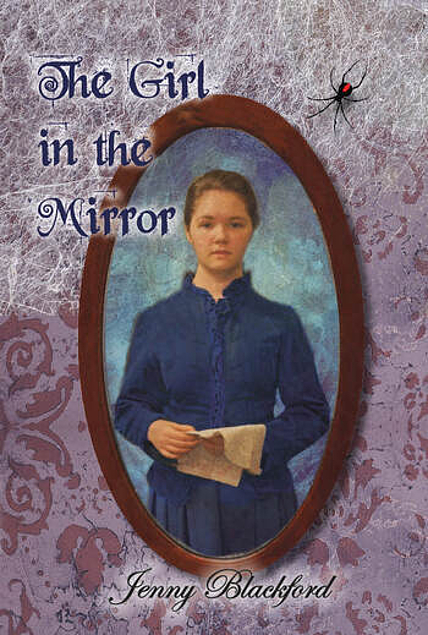
Jenny Blackford, The Girl in the Mirror (illustrated by Fiona McDonald, Eagle Books 2019)

In what seems another lifetime, I was professionally immersed for something like 15 years in literature for children of primary school age – the brilliant range of writing arrayed between little children’s picture books and beginners’ chapter books at one end and YA fiction at the other. I haven’t read a lot of it since. The Girl in the Mirror reminds me of what I’m missing.

It’s a time-slip/ghost story: Maddy moves to a new home with her family. As a new girl she has to deal with school-yard politics, and find a way of making herself at home in the new house with its unruly back yard. Her parents, like so many parents in books for this age group – perhaps like so many parents in real life – are oblivious to her struggles, they can’t hear the clattering footsteps of the little-boy ghost on the stairs, and she knows it would be pointless to tell them about Charlotte, the girl from a century earlier, whom she sees in the old-fashioned mirror in her bedroom.

It turns out that Charlotte has problems with a nasty aunt, and that nastiness somehow spills over into the present, threatening the very survival of Maddy’s baby brother. The two girls help each other with their problems, and the ghost of Charlotte’s little brother, already a ghost in her time having died of whooping cough, intervenes cheerfully in Maddy’s life.

With a wonderful lightness of touch, Maddy and Charlotte show each other things about their respective ages: whalebone corsets and skits that end above the knee; the symptoms of whooping cough and the wonders of the Internet.

All that, plus a garden full of poisonous plants, and ominous redback spiders. Which leads me to Fiona McDonald’s illustrations: apart from two full-page ink drawings, most pages have a single tiny redback spider next to the page number. Then at two points in the narrative the illustrations mirror the action, and those spiders multiply and spread up the margins in a delightfully creepy way..


The Girl in the Mirror is the 18th book I’ve read for the 2020 Australian Women Writers Challenge. My copy of the book is a gift from the author, Full disclosure, in 2009, soon after my tenure as editor came to an end, The School Magazine published a short story, ‘Bertie’, which Jenny Blackford has expanded to become this novel.
Bonny Cassidy’s Chatelaine

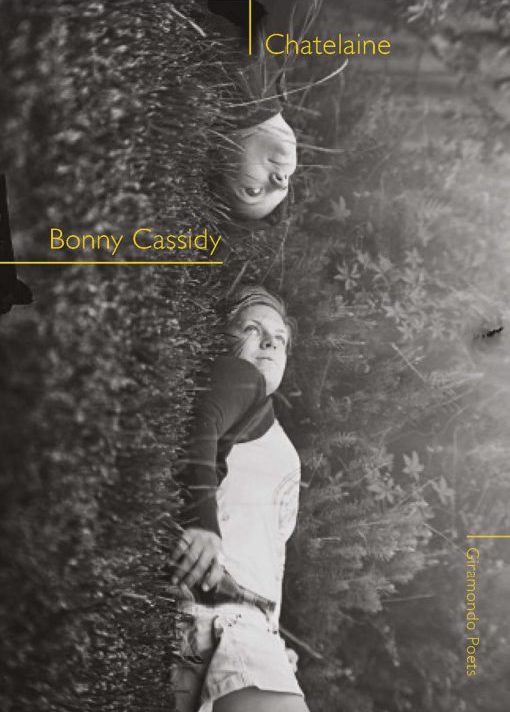
Bonny Cassidy, Chatelaine (Giramondo 2017)


Note: This blog post is not a review of Chatelaine, a book of poems by Bonny Cassidy, a well-regarded poet who leads the Creative Writing Program at RMIT. I’ve written it because of a self-imposed requirement to blog about every book I read. I don’t mean my ruminations to disparage the poetry, and certainly don’t want to discourage anyone else from reading it and enjoying it.


I once did a short course in signed English. Soon after I graduated, a visitor to my workplace showed us a hand-written note, ‘I’m deaf. May I use your photocopier.’ I greeted her confidently with the sign for hello – and was then at a complete loss as she started to chat with great animation while photocopying. I appreciated the eloquence of her signing and her facial expressiveness, and tried to look intelligent, even laughing at an anecdote about – possibly – a mouse. But my pulse raced, I broke out in a sweat, and I failed to understand anything she said, apart from hello and thank you.

My experience reading the poems in Chatelaine was something like that. The analogy isn’t quite accurate, though. If my Auslan had been up to it the deaf woman and I could have had a conversation, whereas I’m pretty sure that these poems are doing something other than invite the reader to a conversation. Here’s a for-instance:

Sink
this warning 
to our gully 
where the emus ram 
walls of uncoupled think. 
Under the easy homes and dread 
stem, drag the noisy secret 
the marble halls.

This reminds me of Noam Chomsky’s famous example of a sentence that is grammatically correct but semantically nonsense, ‘Colourless green ideas sleep furiously’, except that it doesn’t cohere grammatically either.

I needed help. The author’s note that came with my complimentary copy shed some light on what the poems are not doing:

The deceptive narrative of lyric poetry, for me, is reminiscent of mythic narratives of Australian settlement and also myths of femininity. I think this meeting point has something to say about what we believe to be credible, the blur between myth and events

That’s enticing. I like the idea of poetry that does away with deceptive and oppressive narratives. Or at least I thought I did.

The back cover blurb says of the book:

Its voices stalk across time and space inhabiting the genres of riddle, fragment, confession, lyric and ekphrasis, and returning to images of metamorphosis and position.

Again, that sounds exciting, but it didn’t help me read a single poem. Even a couple of poems that the Acknowledgements identify as ekphrastic (that is, responses to other works of art) remain stubbornly enigmatic – and perhaps would have even if the artworks they refer to had been identified.

I found a review by Anne Buchanan-Stewart in Plumwood Mountain (link here). It begins:

Bonny Cassidy’s Chatelaine is visceral, layered and driven by word constructs in an innovative lexicon of erotic topoi, ready to be open to contemporary interpretative potential – previously unworked.

I found myself echoing Prufrock: ‘I have heard the academic poets singing, each to each. I do not think that they will sing to me.’ But I did try to read the whole article. It included this:

– We usually want to understand, interpret, ascribe meaning to a poem and we usually want the words to tell us something, but perhaps it could be different.

– How?

– There is another way to get to the ‘it’ of the poem – through an encounter.  An encounter with the language ‘it’ self and its materiality. We can consciously put aside our search for meaning.

But if language doesn’t have meaning, I almost wept, is it still language? I went back to the book and read on, not trying to ‘understand, interpret, ascribe meaning’ but to ‘encounter’ the poems.

To cut a very long story short, I failed. I really did spend time with these poems. I had glimmerings of something, but I failed to encounter anything in them.

Not every book is meant for every reader. This one, beautifully designed by Harry Williamson for Giramondo, isn’t for me. There’s a sweet quote from ‘Ask’ by the Smiths as an epigraph, which I take as a reproach:

Nature is a language, can't you read?

Julie Janson’s Benevolence at the Book Group

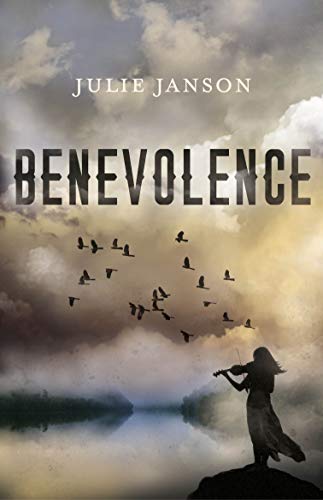
Julie Janson, Benevolence (Magabala Books 2020)

Before the Meeting: Generally, if I read a book about a marginalised group I try to read one by someone from that group soon after. Even though both Truganini (the Book Group’s last title) and The Colony (which I read just before Truganini) are committed to telling colonial history with First Nations perspectives to the fore, they are both written by white/settler women. So I was happy when this book by Julie Janson, a Burruberongal woman of the Darug Nation, was chosen for the Book Group.

Julie Janson has described the novel as ‘a First Nations response to The Secret River by Kate Grenville’:

[The Secret River] is a wonderful book, but I was challenged by the ending where all the Burruberongal Darug people died in a massacre except for one old man. I asked myself the question: if all the Darug died, who were we?

I had researched my (Aboriginal) family history along the Hawkesbury River, and the Darug interpretation of those early days of colonial invasion is entirely different.

(Link to Booktopia interview here)

Benevolence (the title is deeply ironic) tells the story of Muraging, a Burruberongal woman whose parents give her up to a missionary-run school in 1816 when she is very young, in the hope that she will gain resources there to survive in the colonised world. Renamed Mary, she learns to read, write and play the violin, and resists attempts to make her give up on her culture, language and people. She runs away with a handsome young Aboriginal man, and what follows is a picaresque account of her travels, moving back and forth between the two cultures – now living with a group of women who have lost their men to the frontier wars, now a servant to a clergyman with whom she has a consensual sexual relationship that eventually goes very sour, now wandering with her small daughter, a servant again, a disregarded listener to callous conversations about massacre and rape, a speaker of truth to power. She finds occasional kindness and mostly avoids threats of violence and sexual assault. She spends time in prison, is often hungry, loses her daughter, has a second child after having sex with a French man in return for a bag of flour. She never gives up the search for her family and a place where she can live among her people.

It’s a story of navigating the harsh conditions of colonisation. The Aboriginal people and communities that Mary encounters are not pathetic victims, and aren’t romanticised as automatically safe and nurturing, but at the end of the novel, she finds a home in a community of survivors – precarious, under threat, but solid.

Each chapter has a year in its heading title, and most begin with a brief note on what is happening in the colony: in 1826 Darling becomes Governor of the colony; in 1832 Kings School opens in Parramatta; in 1835 Governor Bourke proclaims terra nullius; also in 1835 King William IV recognises the continued rights to land for Aboriginal people in South Australia. These landmarks serve to anchor the narrative in settler history, but most bear little direct relation to Mary’s struggles.

There are many painful scenes with settlers: the unashamedly white supremacist Reverend Masters, the weak Reverend Smythe (her first child’s father), Smythe’s insufferably prim and nasty wife Susan, a military man who forces her to guide him on a punitive expedition that culminates in massacre, and others. These characters are pretty much universally portrayed as weirdly irrational, inconsistent, bullying or pusillanimous, so that their scenes – dinner parties, domestic rows, meetings with Aboriginal warriors – read like hellish phantasmagoria. I haven’t seen any of Julie Janson’s plays, but many of the scenes involving settler characters read like scripts for rough-theatre, agitprop pieces.

To give you a taste, here’s part of the scene where Susan Smythe has caught her husband Henry having sex with Mary, after Susan has set fire to their cornfield and blamed Mary, after Mary has saved Susan’s life, after Henry has told Mary many times that she must leave. Mary is listening from behind a screen:

‘Get rid of her!’ Susan is speaking with a clear high voice. Henry twitches and ruffles his black hair with nervous fingers. He sits by his writing desk and taps his quill. He laughs like men do when confronted by a wronged woman.

‘Must we discuss this now? I am penning a sonnet and working on my native language book,’ says Henry. He dips the quill in ink and examines the tip.

“Sonnet? Are you insane? I shall call the doctor to bleed and purge these dark humours,’ rages Susan.

‘We must buy more quills – make a list … She is just a black servant. Don’t be silly, Susan dearest,’ says Henry.

‘You must choose between rich cream cake and soda bread,’ says Susan.

Mary leans forward to hear his answer. She holds her breath.

‘Don’t be ridiculous, dearest. It was a mistake such as many better man than me have also on occasion made. You must forgive me. I command you to find forgiveness. I am only human,’ says Henry.

‘I have heard about such servants! The other colonial wives have spoken of these creatures!’ says Susan. ‘You are shaming me and have no respect for the sacred promise of our marriage. You are a colonial joke. Everyone is laughing at you – behind your back – at your lack of Christian fidelity or conscience as you preach your pious sermons on the Sabbath. Look at you now, damaged by a violent savage and yet you dare to defy me and you let her stay.’

(Pages 178–179)

Clearly both these people are unhinged. Yet they have life-and-death power over Mary and her daughter.

It’s exhilarating to have stories of early settlement told from a strong, unapologetic Aboriginal point of view that makes no attempt to humanise the invaders.

This is an unsettling book, not only because of its content. Very unsettling for me as a white, middle-class man who has worked for decades as a copy-editor, is a kind of knockabout quality to the text, something that I took at first to be poor proofreading but which is so pervasive that it has become a feature rather than a bug. In these sad times when publishing companies don’t generally have in-house copy editors, it’s a rare book that has no typos, but this is at a whole other level.

There are moments, like this from page 110, that are impossible to visualise:

Mary sips the tea and smiles with her hands pressed between her thighs.

There are malapropisms – some Aboriginal people are to be punished for their ‘trepidations against settler families’. A tribe in the north-east of Sydney is called the ‘Awakabal’, twice, which is surely a misspelling of ‘Awabakal’. A character is described as Bungaree’s grand-daughter and on the same page as the sister of Bungaree’s son.

I don’t think these errors are deliberate, but whether they survive to the published text through lack of resource or failure of editorial attention they amount to a kind of nose-thumbing. I think of that Audre Lorde quote: ‘The master’s tools will never dismantle the master’s house.’ Benevolence uses the colonisers’ tool, the novel, to respond to a ‘wonderful book’ that has erased a people’s survival. There’s a kind of rough justice in that tool being treated with disrespect.


After the meeting: We met in person for the first time in months. At least seven of us were there in person – even making a little physical contact. An eighth had been about to leave his home when a friend and recent contact called to say she was feeling sick, so he did the ‘abundance of caution’ thing and joined us on a screen for as much as he could stand.

It was good to eat together. It was so good to be in a room with other bodies, where cross-currents of conversation were allowed to flow (though that was hard on the virtual participant). Somehow, I think, being physically together made it easier to talk about this book – about the roughness of much of the writing, and the shameful sense most of us shared of having light shone on our ignorance about the realities of colonisation.

Others were – of course – less disturbed than I had been by the typos etcetera. I had hoped someone might have seen Julie Janson’s plays at Belvoir Street, but no one had. Someone mentioned Kim Scott’s books, That Deadman Dance and Taboo (links to my blog posts) as covering similar territory, brilliantly. A couple of guy had gone in search of historical information, and reminded the rest of us that Samuel Marsden, presumably the inspiration of the novel’s Reverend Masters, was on record as perpetrating hideous atrocities. We generally acknowledged the heartbreaking difficulty of the task Julie Janson had taken on: to draw on scholarly historical works and stories passed down by generations of survivors, to imagine herself into the life of one person in those terrible times. The general sense was that, for all its flaws, we were glad to have read the book. The Chooser, who was absent because of a non-Covid infection, was thanked in his absence.

And of course, we shared our responses to whatever the President of the United States had done (it was last night and he’s said so much since then!), to the Premier of New South Wales’s self-inflicted damage, to some recondite celebrity gossip (did you know about Bug Beats, a children’s show on Netflix, that has permission to use a whole slew of Beatles songs), to the adventures of some of our offspring, etc. We took a moment to honour the achievement of Victorians in bringing the infection numbers down. The potatoes that our host had put in the oven some time before we all arrived were ready to eat soon after we all left. He sent us a photo on WhatsApp.


Benevolence is the 17th book I’ve read for the 2020 Australian Women Writers Challenge.
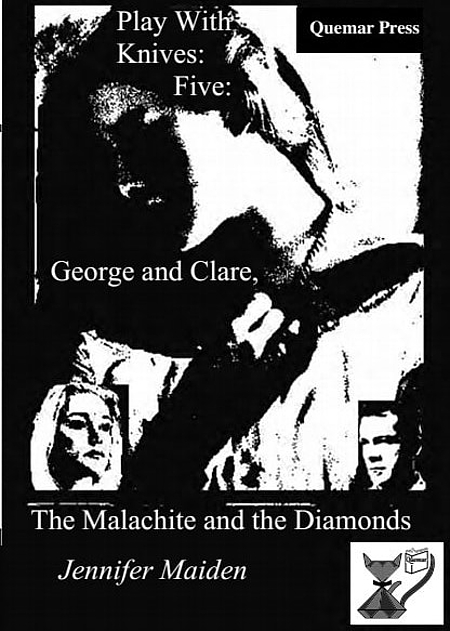
Jennifer Maiden, George and Clare, the Malachite and the DIamonds

Jennifer Maiden, Play With Knives Five: George and Clare, the Malachite and the Diamonds: a novel in prose and verse (Quemar Press 2018)

George Jeffreys and Clare Collins first met in the 1980s when he was a probation officer in Western Sydney and she was a young woman nearing the end of her prison sentence for murdering three smaller children when she was nine years old. They have since featured in four novels before this one, and in more than 30 poems, going on to become lovers, work together for an NGO called Prisoners of Conscience, and most recently have a baby together.*

In this book they set off to Russia to bring home the daughter of a friend who is in thrall to a murderous international operative. The young woman is an arms dealer in her own right, and it’s not at all clear that she wants to be rescued, although she knows her life is in danger.

The book has all the ingredients of a thriller: exotic locations, hacking, deep-state conspiracy, silicon-impregnated diamonds, helicopter rides, glamorous women, worldweary men, and an urgent sense of jeopardy both for the characters and for the whole world of the novel, which is recognisably ours, as conflict rages in Syria, Julian Assange is not yet extracted from the Ecuadorian embassy, and there are wars and the prospect of war from Russia, the Ukraine, the USA, China … There’s quite a bit of sexual tension and actual sex, lots of violence, and a satisfying twist at the end, with bonus explosion.

But if you picked the novel up expecting a straightforward political thriller, you’d be disconcerted. For a start, every second chapter is in verse – verse whose long lines and conversational rhythms may at first be mistaken for prose with unexpected turns of phrase and odd line breaks, but whose precision and visual qualities are anything but prosaic.

Then there are the characters. In their previous adventures, George and Clare have accumulated relationships. We rarely see them without their months-old baby Corbyn, and many of their scenes, even the most violent, are shared with some or all of their entourage: eight-year-old Florence whom they rescued from death in Paris, Florence’s mother Sophie, George’s hacker grandson Idris, a young Russian cop named Kirill and a Saudi agent, Samir. They frequently converse with Clare’s and Quentin’s mothers back in Mt Druitt, as well as a Darug woman, Ruth, behind whom lurks the shady but benign Lithgow Coven. A dog and a cat that were rescued from far-flung places in earlier books still need to be catered for. The memory of the children Clare killed is never far from her mind. Unsurprisingly, every now and then there is a roll call: ‘Present were Clare, Corbyn and I, Idris, Sophie, Florence and Ninel’ (page 30), ‘In a cafe near 1st Tverskaya-Yamskaya Street, I was sitting with Idris, Sophie, Florence, Ninel, Kirill and a Saudi agent called Samir’ (page 106). This is not a tale of a solitary individual hero; none of the characters needs to be told that humans are social animals.

Nor is the book populated by strong, silent types. There’s constant chatter – political gossip, poetry recitals, reminiscences about adventures in previous books, snippets of interesting history, commentary on world affairs, cultural analysis, meditation on moral and ethical issues. Thrillers are often impregnated with right-wing ideology. Not the George and Clare books. I confess that reading the book three years after publication, I’m mystified by many of its contemporary references – but maybe I would have been at the time. George and Clare are extraordinarily well informed, and have inside knowledge of many points of global conflict, thanks in part to their membership of Prisoners of Conscience, and in part to their creator’s extraordinary insight into international politics.

I often feel the impulse to read the start of a novel when I’ve reached the last page. Here’s the start of George and Clare, the Malachite and the Diamonds:

Clare was standing at the window in the saffron orchid, orange orchard light of the Mt Druitt December. She was in a smock-like translucent azure kaftan, and still a bit rounded by her recent pregnancy. She looked as innocent and preoccupied as a Vermeer wife, and was holding a letter to Silkie Roberts from Silkie’s daughter Quentin. This included a new photo of Schmidt and Quentin. Clare showed it to me. Schmidt was thinner since the recent stabbing-attack on him and was grasping Quentin’s shoulder with sharp, skinny, greedy fingers.

Does that make you want to read on? It did me. And it was a fun read.


* You can read my summary of George and Clare’s appearances up to 2016 here.


George and Clare, the Malachite and the Diamonds is the 16th book I’ve read for the 2020 Australian Women Writers Challenge.

Proust Progress Report 14: de Charlus on the brink

Marcel Proust, À la recherche du temps perdu (text established under the direction of Jean-Yves Tadié ©1987–1992): Book 5, La Prisonnière pages 1724–1816

Proust is everywhere. I stumbled across him twice this month – as well as in the three pages I read each morning.

Early in the month, the Emerging Artist and I went to an actual movie theatre to see the delightfully silly multilingual whodunnit The Translators / Les traducteurs. A slim hardback with À la recherche du temps perdu blazoned on its cover plays a key role and (spoiler alert) doesn’t emerge unscathed.

More recently, I attended a zoom event commemorating the thirtieth anniversary of poet Martin Johnston’s untimely death, the launch of a new edition of his poetry, Beautiful Objects. Lex Marinos spoke movingly about his friendship with Martin, and many poets read from Martin’s poetry. A recording has been uploaded (here’s a link). Proust popped up when Kate Lilley read ‘Room 23’, which includes these lines:

Proust, I suppose, once and for all defined
the intermittencies of heart and mind
whereby the gone becomes the never wanted.

It’s a view that the poem goes on to reject, but clearly Martin, whom I revere, felt he had to argue with Proust to write decent poetry about missing his beloved. (Maybe his summary of what Proust defined is correct. I know ‘gone’ is different from ‘absent’, but so far Marcel the narrator broods obsessively about his beloved when she is absent: sometimes it seems, he only wants her when she is gone. But intermittencies is a great word for the way Marcel the narrator’s intense, sustained focus switches constantly and without warning.)

Here’s a tiny bit I loved in this month’s reading:

Celui qui veut entretenir en soi le désir de continuer à vivre et la croyance en quelque chose de plus délicieux que les choses habituelles doit se promener.

(page 1730)

In English:

Anyone who wants to sustain in themselves the desire to go on living and a belief in something more delightful than habitual things, must go for a walk.

Given that Marcel the narrator devotes much time and attention to convoluted overthinking, this dollop of wisdom shines from the page. But, as so often in Proust, that sentence takes an unexpected turn. It goes on: car les rues, les avenues, sont pleines de Déesses / ‘for the streets, the avenues are full of goddesses.’ So perhaps, one thinks, his recommendation wasn’t exercise, fresh air and attention to the environment as a counter to morbid introspection, so much as surveying the field as a counter to morbid jealousy.

So, this month’s action: Marcel is still keeping Albertine his beloved under surveillance. He gets her to agree not to go to a performance at Mme Verdurin’s because he suspects that her Lesbian friends will be there and who knows what she’ll get up to with them? He goes to the performance himself and we are immersed in the complexities of the evening: sexual politics, class politics (the aristocracy are extraordinarily rude to their bourgeois hostess), the music itself (described brilliantly, at great length), the paradox that such sublime music is brought into being by people generally judged to be morally repugnant, and so on.

After the performance, a terrible thing happens. It hasn’t quite played out at the moment where I stopped reading this morning, so I’m living in suspense. M de Charlus, who invited his prestigious but rude friends to Mme Verdurin’s for the recital, spends some time chatting with her about how successful the evening had been, completely unaware that she has taken serious offence. From her point of view he has claimed for himself the prestige that by rights belongs to her as the hostess, and treated her as a lowly functionary. As soon as he moves away, she instructs Brichot, one of her ‘little clan’, to take de Charlus outside so her husband can have a word to the baron’s beautiful young violinist protégé Charlie Morel, to warn him of ‘the abyss that he is heading for’: that is, to unleash the full force of bourgeois anti-homosexual righteousness on the relationship.

Characteristically, the narrator accompanies de Charlus and Brichot and the next few pages are taken up with their conversation, about the rooms they enter, about Marcel’s preoccupation with the notorious Lesbians, about de Charlus’ huge enthusiasm for Charlie’s performance on the violin – and the reader is filled with dread about the vicious devastation being wrought on him back in the main room. I may be slow on the uptake, but it’s only now that I realise just how much Charlie is the emotional centre of the baron’s world, and what a devastating blow in store. Having up to this point seen de Charlus as creepy, conceited, arrogant, manipulative, and even grotesque, I now do a complete about turn. I’m putty in Proust’s hands.