Tag Archives: πO

Journal Catch-up 23

Two more journals in my endless attempt to keep up to date!


Evelyn Araluen and Jonathan Dunk (editors), Overland 252 (Spring 2023)
(Some of the content is online at the Overland website – I’ve included links)
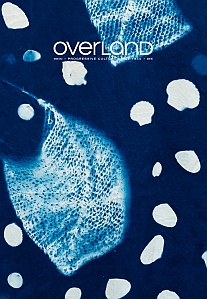
This Overland‘s editorial describes itself as a ‘second run’. The first run had reflected on the Voice referendum, but as publication came closer – in October last year – ‘the temptation to linger on the politics of symbolic recognition and constitutional reform seems a luxury in the face of escalating violence against Palestinians in Gaza and the West Bank’. With feet and throats sore from a solidarity march, the editors draw attention to an essay by Palestinian-Australian writer and historian Micaela Sahhar, ‘which reminds [them] of Overland‘s historic role in indexing Palestine’s survival and resistance’.

Quite apart from its serendipitous relevance, the essay, ‘An idiosyncratic archive: Overland 169 & the Wolstonecroft years‘, is a joy to read, as Sahhar revisits two copies of Overland she acquired in 2002 and 2004. She compares her reading of them then and now, talks of her relationships to people who appeared in them, and generally takes us on a journey into her mind. I love this passage – and so, I assume, do the editors:

As a journal at odds with the mainstream, Overland offered a younger version of me an intellectual place where radical thinking could reside, and a dawning awareness of a community I could take a place in. In this sense, Overland was the tangible expression of a counter to the indifference and invisibility of a young Palestinian woman, the significance of whose identity was rewritten just as she came of age at the time of a catastrophic intellectual nadir represented in 9/11; and a place of refusal against socio-political disengagement and apathy which have been the horsemen of these neo-liberal times.

The other stand-out essay is ‘The Disappearance of a.k.a. Victor Mature‘ by Vivian Blaxell, which ranges far and wide, high and low, into memoir and poetry appreciation, circling the subject of beauty. It’s a great read, from which I can’t resist quoting what may be the silliest paragraph, but one that made me laugh:

Australian English is wanton with beautiful. Beauty pops up in not the usual beautiful places there, thereby revealing the radical contingency of beauty itself, probably unintentionally: beautiful, Australians might say of a pork sausage, which seems a surprise at first until you realise that beauty does not exist before we say it exists, for beauty relies entirely on disclosure for its existence. That lucky sausage.

Other essays are a discussion by Peter D Mathews of Sophie Cunningham’s 2004 novel Geography and an idiosyncratic but fascinating essay by πO on concrete poetry in Australia and related matters.

There are five pieces of fiction and nine poems.

Of the poetry, ‘Balloch’ by Eileen Chong stands out for me. An apparently simple poem about a visit to a Scottish loch, it leaves an uncanny aftertaste that only gets richer with further readings.

The fiction covers a wide range, from a celebration of Rotuman culture (I had to look it up) by Dorell Ben to a fantasy of a catastrophic world post climate emergency by Jodie How, with a little social realism by Chloe Hillary and other pieces in between.


Alexandra Christie (editor), Heat Series 3 Nº 12 (Giramondo 2023)

This may be my last issue of Heat before my subscription expires. Despite having a selection of poems from Nam Le’s 36 Ways of Writing a Vietnamese Poem, a book I’m looking forward to, the journal is a bit of a fizzer for me, though the dominating US presence I’ve complained of in earlier issues is absent, and only one member of Heat‘s editorial advisory board gets a guernsey.

  • You can read Paddy O’Reilly’s ‘Redundant‘ on the Heat website. It’s an experimental prose piece in which the experiment seems to consist of not finishing sentences. See what you think.
  • Jordi Infeld’s ‘Poet’s Pocket’ would and indeed does pass for a short essay on sewing and related matters – just a footnote identifying one of its otherwise unremarkable phrases as a quote from Gertrude Stein’s Tender Buttons suggests deeper undercurrents.
  • ‘The Phoenix Apartment’ by Bella Li feels to me like notes towards a larger project.

Items from beyond the Anglosphere are ‘We Shall Be Monsters’, a meditation on Mary Shelley’s Frankenstein by Argentinian writer Esther Cross, translated by Alice Whitmore, and six terrific short poems by Iranian Maryam Nazarian, translated by Malaysia-based Arash Kohshsafa. Here’s the first and shortest of the poems, which does wonderful things with an echo of William Carlos Williams’s poem about the plums:

One
I've set the breakfast, the kisses, and the keys on the table.
Please, forgive me
if I find freedom more pleasant than your love.

The most interesting piece is Stephanie Radok’s ‘Inventory 2020’, an impressionistic chronicle of a working artist’s life, made up of mostly very short entries. It reminded me of the late Antigone Kefala’s journals in the way it combined observations of the passing moment with considered reflections and descriptions of the artist’s process. As 2020 was a year when the even tenor of our lives was disrupted by Covid, a narrative emerges. Here’s the entry for 23 February, on page 77*:

23. What you thought was passing/casual was your life. And a particular red purple near a blue hillside that seemed to reflect you.

As for Nam Le’s poems, they seem to be part of a larger whole. I’ll wait for the book.


* My blogging practice for some time has been to focus arbitrarily on the page of a book or journal that coincides with my age.

Australian Poetry Journal 5.2 and 6.1

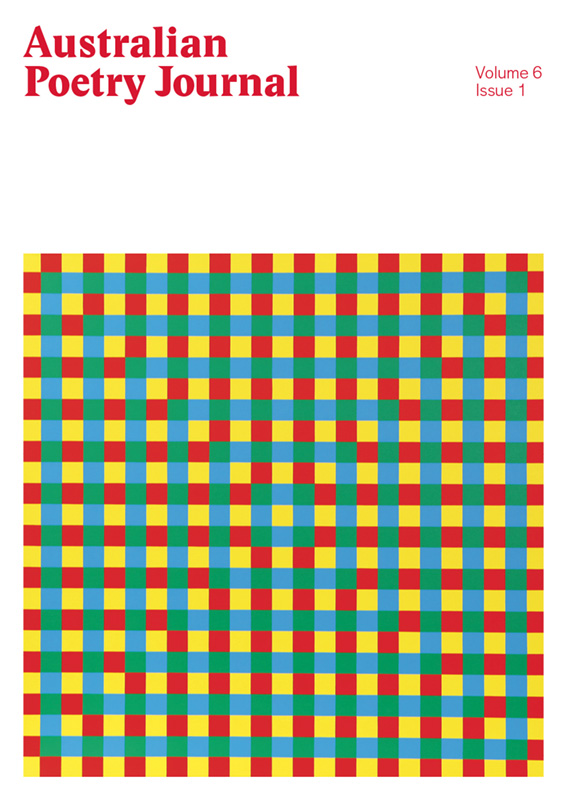
Michael Sharkey (editor),  Australian Poetry Journal, Volume 5, Issue 2 (2015)
———,  Australian Poetry Journal, Volume 6, Issue 1 (2016)

Australian Poetry Journal is the nearest thing we have to a community newsletter for Australian poets and poetry-readers. It is delivered twice a year to paid-up  members of Australian Poetry Ltd. My copy tends to wait until I’ve got a book on the go that’s too bulky to read while walking. Thanks to a couple of hefty books, I’ve recently caught up on two issues, as well as last year’s anthology (also covered by the cost of membership). In case you’re interested, the joys of these journals aren’t restricted to members: anyone can buy copies, and the entire contents of issue 5:2 are up online. I’ve included links.

APJ-5-2.jpg

 Issue 5:2 leads with a wonderful profile (here) by Dan Disney, Un Gyung Yi and Daye Jeon of some contemporary Korean poets, including octogenarian Ko Un, whom Allen Ginsberg called ‘a demon-driven Bodhisattva’. In other articles, Nicolette Stasko farewells JS Harry, who died last year, quoting generously from her work (here); there’s a knowledgable article about Stuart Cooke (here) and a number of reviews, including a piece on US poet and activist Denise Levertov by Felicity Plunkett (here); Adrian Caesar tells the story of David Musgrave’s Puncher & Wattmann (here).

I can’t resist mentioning that Adrian Caesar, who is enthusiastic about most of P&W’s publications, has misgivings about some of the criticism they publish. After quoting a paragraph of dense academic writing from a recent book, he lets fly:

In its determined promulgation of specialised language, its astonishing lack of wit or irony … and its pervading sense of high-minded seriousness, it made me wonder if the writers were not like adherents of some gnostic sect seeking to articulate their search for the numinous through their ‘belief’ in literary theory.

Shades of the Dunciad Minor.

Then there are the poems, roughly 50 of them. I turned down the corners of too many pages to talk about all the poems I responded to, so I’ll just list some of the raisins from the pudding.

Susan Hawthorne interrogates a photograph of her grandmother in ‘unknowing‘. Jennifer Compton’s ‘Two Women‘ explores the difficulty of the ‘inconstant narrative of bewilderment’ created by, well, is it dementia or just habitual white-lying? Ivy Alvarez, in ‘N‘ riffs on ‘n’ words chosen as if at random from the dictionary:

noctambulist:
_______I once walked out a sleeping house
_______to see the moon
_______trees tethered their shadows
_______and I was the only one that moved

Kit Kelen’s ‘In my incunabula‘ reminisces about technologies past, beginning:

TV was eternity.
There was always the promise of snow

Tom Morton’s ‘November‘ is a very Sydney poem, sweet to read on a cold July day:

The days get longer, a sudden heatwave
And the outrageous heavy sweetness
Of the jacarandas on the river path
Jiggles the deadlocks on
Whole rooms of me
I've not been in, this long winter

Jordie Albiston rings in the 2015 New Year in ‘strontium‘. Vanessa Proctor celebrates  a plant in ‘Bathroom Orchid‘. Ron Heard tackles birdsong in ‘currawongs‘. John Stokes offers an oblique love lyric in ‘She feels him at a seaside motel‘ (‘The curves of his buttock / and the moon / are the same’). There’s Andy Kissane, Eileen Chong, Ron Pretty … Michael Sharkey has put together a feast that has something for everyone.

APJ-6-1.jpg

He does it again in issue 6:1, which has a focus on women poets and their concerns: a lively article by Carol Jenkins brings an epidemiological approach to gender and age distribution in Australian poetry anthologies; Heather Taylor Johnson profiles Susan Hawthorne, poet–founder of feminist Spinifex Press; Tegan Schetrumpf argues that writing groups offer an alternative to the patriarchal lone-genius-poet paradigm. Off-theme, but who would complain, is a fine tribute by Helen Nickas to Dmitris Tsaloumis, Greek Australian poet who died in February aged 94; and reviews of work by πO and Lesbia Harford, among others.

And there are another 50 or so poems. I got tears in my eyes (though I defy anyone to guess at which poem), I smiled, I gasped, I felt moments of my own experience vibrate into new life.

‘Old haunts’, a haibun by Sam Wagan Watson, evokes childhood terrors at the sounds of the night. J. Richard Quigley’s ‘Fondue’ utters the thought one dare not speak when offered that cheesy dish. Heather Taylor Johnson’s ‘They Say’ makes poetry that transcends its ‘kids say the darnedest things’ source material. Rod Usher has serious fun with Italian verbs in ‘The imperfect’. My own peculiar edginess about kitchen knives is echoed uncannily in Claire Rosslyn Wilson’s ‘Cooking for Two’, and the precise language of ‘Stories from the kampong’, Mindy Gill’s narrative about a chicken-coop-raiding python, captured my own childhood memory of a similar incident (a significant difference being that, though we talked about the possibility, we didn’t eat the snake or the chickens it had eaten). Rozanna Lilley’s ‘Early onset’ touches on the pain of having someone close affected by dementia.The first poem of Brendan Doyle’s that I read began, from memory, ‘Sittin on the gasbox, / waitin for me dad’; in ‘The Wooden Gate’ here, his father ‘dead these sixteen years’ pays a reproachful visit in a dream. ‘Hearts and Minds’ by Stephen Edgar, master of rhyme, bounces beautifully off an artwork currently being created by the Emerging Artist. Dick Alderson’s ‘nail holes’ reminds me of my youthful fascination with the way holes in an iron shed ‘throw circles / on the floor / like soft pennies’.

There’s history: Virginia Jealous visits Edward ‘Weary’ Dunlop’s war diaries in ‘Weary’s Birds’; and Judith Beveridge’s ‘Ode to Ambergris’ does what it says on the lid, with lovely light musicality. There are elegiac moments, as in Pam Schindler’s ‘Like someone who is leaving’. In the twelve delicate short lines of ‘Jumhoori’, Hessom Razavi describes a cat and laments the state of his native Iran.

Paradoxically, given that I get no sense at all that these poems are competing with each other, there is a prize for the best poem published in the journal each year.This issue includes 2015’s winner, Andy Kissane’s ‘Alone Again’, reprinted here with commentary from Andy.

I expect if you were asked to make a list of stand-out poems from these journals  your list would be different from mine, but I’m pretty confident you’d find something here to nourish you and give you pleasure.

Heat 22: The Persistent Rabbit

Ivor Indyk (Ed), Heat 22: The persistent rabbit (Giramondo May 2010)

This issue of Heat has much that is wonderful. The title, following tradition, is a phrase chosen apparently at random from the contents, in this case from πO’s exuberant nonsense poem ‘Rabbit Proof Fence’:

The average person blinksoooo22 rabbits a minute.
Burke & Wills went into the desertoooowith a dozen rabbits
Obsession isooooa persistent rabbit.
The causes of a rabbitooooaren't clear.

Perhaps Ivor Indyk, the editor, is quietly suggesting that the seemingly  miraculous persistence of Heat owes not a little to obsession.

I understand Heat to be about diversity, about presenting a version of literary Australia that is open to the whole planet. It often includes, for instance, travel writing, translated pieces, news from abroad, and fiction, essays or images that grow from places where cultures intersect. In this issue there are examples of each of these – respectively, Barbara Brooks’s self-styled fictional memoir ‘Lost in the House’ (which powerfully combines tales of travel, dementia, memory and intergenerational relationships); Stuart Cooke’s ‘Two Mapuche Poets’ (the Mapuche people are indigenous to parts of Chile and Argentina); Priya Basil’s ‘My Home is Our Castle’ (about a communal housing project that won a major architecture prize in Berlin last year); Michelle Moo’s colonial historical fiction, ‘New Gold Mountain’ (white women and Chinese men on the Australian goldfields); Barry Hill’s ‘Ezra Pound: The tragic orientalist’; and the centre section of art by Guan Wei, ‘Longevity for Beginners’. (The last three provide a nice example of the kind of counterpoint that Edward Said recommended.)

Apart from Barbara Brooks’s memoir three pieces stood out for me.

Brendan Ryan (whose book of poetry, Why I Am Not a Farmer, I am now actively seeking) has a gripping personal essay on the 1983 Ash Wednesday fires in western Victoria, which is enough by itself to justify the price of the journal. Sadly, not even part of it is up on the Heat website.

Lee Kofman’s essay, ‘Revisiting the Geography of My Body’, just as gripping and as intensely personal, includes incidental elements of a migration story, but is mainly about scars, particularly scars on a woman’s body, and their almost complete absence from literature and visual arts: wounds, scars as something to be healed, scars on men (she doesn’t have to mention Coriolanus), but scars as such, particularly on a woman’s body, reside ‘outside the linguistic and public realm’. By sheer chance, I happened to walk past this piece of graffiti in Newtown just as I finished reading the essay. I hope Ms Kofman would enjoy it:

I said I wouldn’t whinge any more about proofing errors in this Heat, but there is one good old-fashioned belly laugh in this essay. The pursuit of bodily perfection, it tells us, ‘can be traced back to Pluto’s ideal of human beauty as the “natural”, unmarked body’. Roman myth, presumably, rather than Disney.

Of the poetry, Kate Middleton’s poems on a Hansel and Gretel theme stand out for me. They are billed as excerpts from Where Dingoes Tread. I look forward to seeing the whole thing:

Remember when hunger
was simple?
ooooooooooooThere was nothing
and we ate nothing. Then plenty returned
and I turned
to austerity.