Tag Archives: Ali Cobby Eckermann

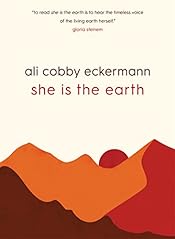
Ali Cobby Eckermann, She Is the Earth

Ali Cobby Eckermann, She Is the Earth: a verse novel (Magabala Books 2023)
Ali Cobby Eckermann is a Yankunytjatjara woman. Her mother and grandmother were taken from their families when very young as part of the government policy. She herself was also taken. Raised by a loving German-heritage family, she found her way back to her First Nations family as an adult, after years of searching.

I first met her poetry in Black Inc’s Best Australian Poems 2009, edited by the late Bob Adamson. In his introduction, Adamson said of her wonderful dramatic monologue ‘Intervention Pay Back’ that it made ‘a new shift in what a poem might say or be’. You can read it in the Cordite Review at this link. Two poems by her, also dramatic monologues, were included in the special Australian issue of the Chicago-based Poetry journal in May 2016. They can be read on the Poetry Foundation website: ‘Black Deaths in Custody’ here and ‘Thunder Raining Poison’ (on the effects of the Maralinga atomic tests on traditional APY lands ) here.

I haven’t read her memoir, Too Afraid to Cry (Ilura Press 2013), or her first verse novel, His Father’s Eyes (OUP 2011). But I can tell you that her second verse novel, Ruby Moonlight (Magabala Books 2012), which deals with the aftermath of massacre, is brilliant (my blog post here). Of her verse I have read the chapbook Kami (Vagabond Books 2010) and Inside My Mother (Giramondo 2015, my blog post here), which are both filled with the intensities of re-uniting with her Yankunytjatjara kin and culture, and the loss of her birth mother soon after finding her.

All of this work has enormous power, and has garnered many awards in Australia and elsewhere.

She Is the Earth, which arrived eight years after her previous book, is a different kind of writing.

It’s described on the title page as a verse novel. There are no characters apart from an unnamed narrator, and no clear events apart from her meandering through an Australian landscape. Any movement is internal. But the book is meant to be read as a single text rather than a collection of short, untitled poems.

At first, I thought it was an imagined story of pre-birth existence, in which the narrator moves towards being born, taking on substance in the world. But that didn’t seem to work and in the end, I gave up on trying to find a narrative, and just went with the flow.

The flow is far from terrible, and the language is never less than gripping, but I don’t know what to say about the book as a whole. I can refer you to better minds than mine.

Here is part of what the judges had to say when the book won the Indigenous Writers’ Prize at the 2024 NSW Premier’s Literary Awards (go to this link for their full comments):

Ali Cobby Eckermann writes in a poetics of self-emergence in which the spectral is made solid through an eloquent economy of language and lifeforms. Each word of this verse novel is deeply considered and rich with meaning, forming as a whole a narrative which is sometimes gentle and sometimes sharp, both beautiful and terrible, and always profound in its exploration of healing, hope and the earth. Each word reads as a gift to the reader.

I recommend Aidan Coleman’s review in The Conversation (at this link). He discusses the book as an example of minimalism, and says interesting things about its recurring images, and even about the developing narrative:

The speaker in these poems is both child and mother, pupil and teacher. References to children and motherhood abound. Initial images of disconnection, anxiety and trauma give way, in later sections, to wholeness and calm.

But the journey is not linear: hope is present from the earliest sections and trauma haunts the closing pages. Healing is presented as an ongoing process that is projected beyond the poem.

[Added later in response to Kim’s comment: Kim on reading Matters had a very different, and more attuned response than mine. You can read her blog post at this link.

Page 77* occurs toward the end – there are 90 pages in the book. Piggybacking on Aidan Coleman’s reading, I can see it as a moment of consolidation, of identity firming up in the landscape:
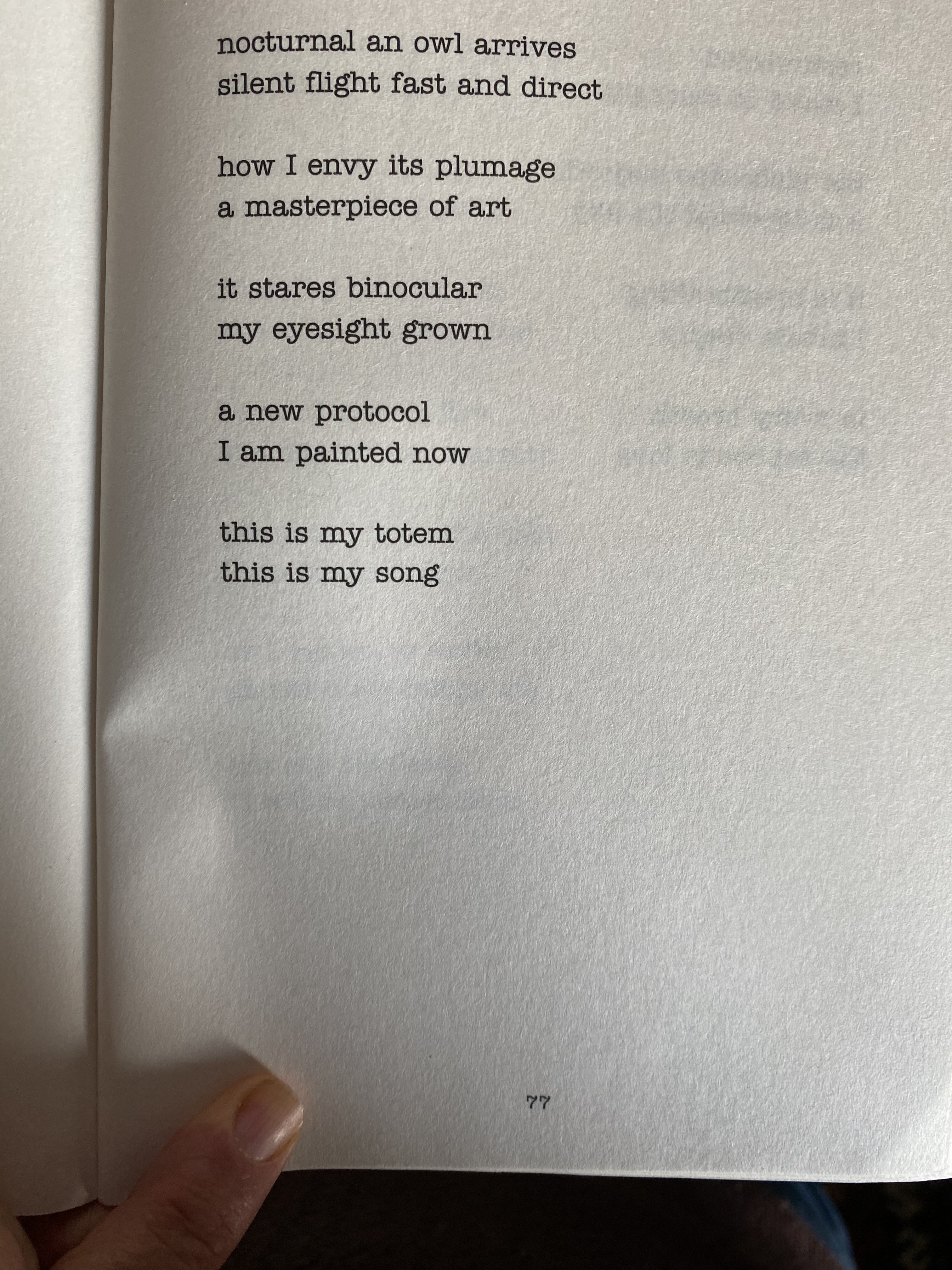
The pleasure of these lines doesn’t depend on their function in the broader narrative. The owl arrives; the narrator admires it; their eyes meet, and there is a moment of identification with the bird; the ‘masterpiece of art’ of the bird’s plumage somehow transfers so that the narrator is painted. The final couplet pulls all that together.

In the wider scheme, that last couplet resolves more than the preceding eight lines. Up to now, the narrator has been full of yearning and unease. Here she seems to find peace:

this is my totem 
this is my song

‘Totem’ takes the hint of identification in the comparison of eyes a step further. There’s something about finding a place of belonging, of deep affinity, of being at home in the world. Once that’s found, there’s the possibility of singing, of having one’s own song.

The first word on the next page is ‘resurrected’, and a couple of pages further on my favourite lines in the book:

I am a solo candle
inside a chandelier

this is the wisdom
I need to succeed.

I still can’t say I understand what’s going on at any given moment in this book. But maybe that’s OK.


I wrote this blog post in Gadigal Wangal country, where it is my great joy to live. I acknowledge Elders past, present and emerging for their continuing custodianship of this land.


* My blogging practice, especially with books of poetry, is to focus on the page that coincides with my age, currently 77.
Sydney Writers’ Festival 2024: My day one

The Sydney Writers’ Festival is always one of my annual highlights. I’m off to a very quiet start this year, just one session today in the smallish Gallery Room at the State Library. And then nothing until Friday.

12.30: And the Award Goes To …

The Festival website invites us to:

be among the first to hear from some of the winners of the 2024 NSW Premier’s Literary Awards, in a discussion covering the impact that awards can have on a writer’s career.

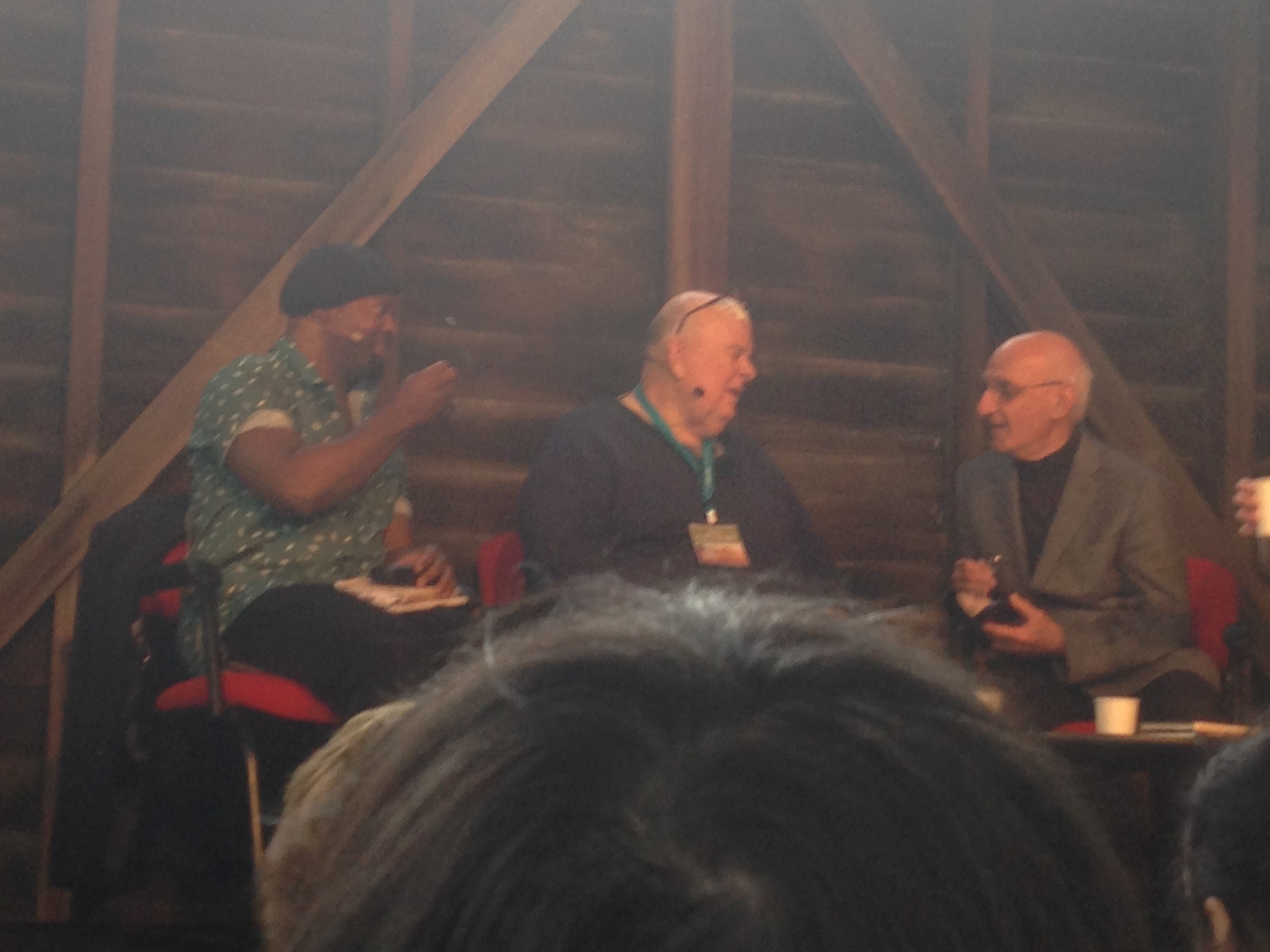
We did get to hear from three of the winners: Ali Cobby Eckermann (She Is the Earth), Helena Fox (The Quiet and the Loud) and Christine Keneally (Ghosts of the Orphanage). But the conversation wasn’t about the awards’ impacts. From my point of view, it was a lot more interesting than that. What follows is the best I can glean from my mostly illegible notes aided by my unreliable memory.

Bernadette Brennan, senior judge of the awards, kicked off the conversation by saying that though the three award-winning books were in different genres – a verse novel, a thoroughly researched piece of non-fiction, and a novel – they all dealt with intergenerational trauma with an emphasis on the vulnerability of children, and they all found ways of pointing to healing. That set the agenda for what followed.

Ali Cobby Eckermann spoke first, and did her best to follow the brief of the program notes. Her first verse novel, Ruby Moonlight, was written in the context of the Howard government’s Intervention in he Northern Territory. The awards it received enabled her to leave her home with her Yankunytjatjara family, go south and buy a house which she set up as a writers’ retreat. When she unexpectedly received a Windham-Campbell Literature Prize (link is to the Wikipedia entry on that prize) her life was turned upside down again. When she came to write She Is the Earth, she was very alone. But she drew on her Yankunytjatjara grannies – though they had passed, she imagined them as creating a safe place for her to create.

Helena Fox spoke in fairly abstract terms of having endured trauma as a child and an adult, and said she saw herself as opening a space where her young readers could see that it is possible to speak of hard things. Among the loud things like abuse, you have a right to be alone, quiet, to ground yourself.

Christine Keneally’s book is about terrible things done to children, focusing on the testimony of survivors from an orphanage in Vermont. Its seed was planted when she ‘wandered into a room’ at a conference in Brisbane where people were talking about the extreme difficulty of finding any record of their early childhood. She discovered the unfolding story of abuse in orphanages in Australia. She reasoned that similar things must have happened in the USA. She discovered that indeed they had, but there the only redress survivors had was through litigation, which was often a damaging process in itself. As she found and interviewed survivors, she saw what a powerful antidote talking is. She realised the importance of bearing witness – and that is what the book seeks to do.

Some snippets from the conversation that followed:

Ali Cobby Eckermann:
‘It shits me that you have to forgive everyone to heal yourself.
‘Poetry can change the dialogue about trauma away from trauma itself to something like regeneration or repair. It can turn something painful into beauty.’

Helene Fox:
How can you heal if you can’t share?

Christine Keneally:
I spoke to people who had been married for 30 years but hadn’t told their spouses about their lives. Sometimes I was the first person they told their story to.

There was a time for questions, but no one raised their hand. I’d love to know what contact Christine Keneally has had with the Lost Generations people in Australia. If I wasn’t so shy and needing to get home, I would have stopped to ask if she knew about Bryan Hartas’s autobiography Hard As (link to my blog post) and the work people like my niece Edwina Shaw have been doing helping members of the Lost Generations to tell their stories.

On my way out I heard one of the few men in the audience mutter to another, ‘What a miserable lot!’ That’s not at all how I saw it, but I guess there weren’t a lot of laughs.

I bought a copy of She Is the Earth.

2024 NSW Premier’s Literary Awards night

The NSW Premier’s Literary Awards, as we are often reminded, are Australia’s richest and longest running state-based literary awards. This year, in a break with tradition, I didn’t do a blog post when the shortlist was announced. I was happy to read a consolidated list on Lisa Hill’s blog at this link.

At that time, had read two of the Christina Stead Prize contenders. I’d seen two of the plays shortlisted for the Nick Enright Prize. I did better on the Betty Roland Prize, having seen seen three of the movies. I had read none of the poetry, none of the children’s or young people’s books, none of the non-fiction. And it turns out I have read or seen none of the winners.

Last night, the awards ceremony was live streamed. I was busy with family, so tuned in late. It’s all on YouTube and you can even watch it here, The actual video begins at 8 minutes, 40 seconds with the Welcome to Country by Uncle Brendan Kerin from the Metropolitan Lands Council, who reminds us that we have a shared history, and manages to make comedy out of his experience as a member of the Stolen Generations. After introductory speeches from librarians and the Minister for Arts, the presentation of awards by the senior judge, Bernadette Brennan, begins at 40 minutes. The video is worth watching as – in the midst of much charming humility and gratitude – person after person refers to the unfolding disaster in Gaza, explicitly or implicitly responding to recent media attacks on the judging panel.

The winners (with links to the judges’ comments):

UTS Glenda Adam’s Award for New Writing (at 40 minutes)

Anam, André Dao

Multicultural NSW Award (at 43 minutes)

Stay for Dinner, Sandhya Parappukkaaran and Michelle Pereira

Indigenous Writers’ Prize (at 48 minutes)

She Is the Earth, Ali Cobby Eckermann

Nick Enright Prize for Playwriting (at 52 minutes)

Sex Magick, Nicholas Brown (Griffin Theatre Company & Currency Press)

Betty Roland Prize for Scriptwriting (at 56 minutes)

Safe Home, Episode 1, Anna Barnes

NSW Premier’s Translation Prize (at minutes)

Patricia Wrightson Prize for Children’s Literature (at 60 minutes)

Paradise Sands: A Story of Enchantment, Levi Pinfold

Ethel Turner Prize for Young People’s Literature (at 1 hour, 2 minutes)

The Quiet and the Loud, Helena Fox

Kenneth Slessor Prize for Poetry (at 1 hour, 6 minutes)

Riverbed Sky Songs, Tae Rose Wae

Douglas Stewart Prize for Non-fiction (at 1 hour, 10 minutes)

Ghosts of the Orphanage: A Story of Mysterious Deaths, A Conspiracy of Silence, and a Search for Justice, Christine Keneally

Christina Stead Prize for Fiction (at 1 hour, 13 minutes)

    The Sitter, Angela O’Keeffe

    The People’s Choice Award (at 1 hour, 16 minutes)

    The God of No Good, Sita Walker

    Book of the Year (at 1 hour, 20 minutes)

    She Is the Earth, Ali Cobby Eckermann

    The presentations ended, as they began, with eloquent words about the lasting impact of the Stolen Generations.

    There was no special award this year.

    Overland 227 & 228

    Jacinda Woodhead (editor), Overland 227 (Winter 2017)
    —-, Overland 228 (Spring 2017)

    overland227It’s not that I read Overland out of obligation, but I do feel guilty if I leave an issue sitting on my to-be-read pile for too long because – among other things – Overland offers left perspectives that aren’t all that easy to come by elsewhere in the Australian media. So here’s a slightly guilty blog post about the two most recent issues.

    The star of the winter issue (No 227) is Evelyn Araluen. The journal kicks off with her article ‘Resisting the Institution: On Colonial Appropriation, which takes recent activism around statues commemorating colonial ‘heroes’ as a starting point, and develops into a (for me at least) powerful introduction to the field of decolonial theory (as opposed to postcolonial theory):

    Decolonial theory provides the Indigenous subject with the tools to deconstruct and challenge colonial infiltrations into our worlds and minds, but decolonial practice within the academy is restrained to that which the institution regards as profitable. In other words, it is safely contained within the classroom, in the form of critical frameworks, unsettling questions or creative-thinking asseignments. Outside of the university, I have given late-night workshops on decolonial theory to anywhere between two and 200 people, often squished together in a leaky tent.

    Later in the journal her short story Muyum: A Transgression, winner of the Nakata Brophy Prize for Young Indigenous Writers, is equally powerful and challenging.

    There are the regular columnists, Giovanni Tiso (on owning and keeping books), Alison Croggon (on kindness as a political act), Tony Birch (on his family history, racism and the Australian constitution) and Mel Campbell (on where writers’ ideas come from –  ‘an idea is a promise, not a commodity’). There are solid articles on the gambling industry (by Dan Dixon), tiny presses that publish poetry in Australia (Kent MacCarter), GLBTQ+ politics in contemporary Singapore (Ng Yi-Sheng), Professor Richard Berry and scientific racism (Helen Macdonald), and how much social transformation we can really expect from technological advances under capitalism (Lizzie O’Shea). ‘Pregnant in Mexico’ by Tina Cartwright is a tiny memoir that feels as if it was carved, to good effect, from a longer piece.

    There are two short stories in addition to Evelyn Araluen’s prizewinner. ‘Broken zippers‘ by George Haddad, which could serve as a grim companion piece to SBS’s Struggle Street, stands out for me.

    There are fourteen pages of poetry. The two poems that spoke most strongly to me are ‘Crossing Galata, Istanbul‘ by John Upton, a tourist poem acutely aware of the limits of its touristic perspective (that’s a mangled quote from Adam Aitken), which captures the feel of Galata Bridge in Istanbul; and ‘The Apology Day breakfast‘ by Ali Cobby Eckermann, which is what it says on the lid, but with a deep, bitter-sweet twist.

    The winter issue features the weird photomedia work of guest artist Yee I-Lann.

    overland228Sadly, I hadn’t read all of the spring issue (No 228) before it mysteriously went missing on a trip to the supermarket. as a result my vote  for the outstanding items mightn’t be completely valid. But I recommend this edition for Eileen Chong’s poem ‘The Task’ and Olivier Jutel’s article ‘Paranoia and delusion‘.

    The Task‘ (do read it at the link; it’s short) is at first blush a straightforward childhood memory of eating crabs, but it drew me in on a number of levels. First, a splendid moral complexity: the crabs have eyes, so we – and the remembered child – know they’re sentient, so there’s no minimising of what’s involved when they are killed and pulled apart, but at the same time there’s frank enjoyment of eating them. Then the opening – ‘We fished with lines, not nets’ – suggests a whole other, metaphorical reading: so by the time we reach the final couplet there’s a strong sense that we’re not talking about crabs any more, at least not only crabs, but something about Chong’s creative process as well:

    I left the claws to the others,

    preferring only what I could mine
    through my own precise undoings

    Olivier Jutel’s article is a formidable intervention into the general conversation about Donald Trump.

    Domestically, he has mobilised, however chaotically, the most retrograde forces in American society, who experience through him a carnivalesque transgression in ‘Making America Great Again’ one tweet, post and triggered liberal at a time.

    He had me at ‘carnivalesque’. The article goes on to rip into the ‘liberal’ media’s obsession with the Russia connection, seeing in it a revival of Cold War emotions, and argues that the Democratic Party is completely at a loss for an adequate political response to the Trump phenomenon, falling back on, among other things, ‘the libidinal deadlock of politics as comedy’. I can’t claim to have followed the whole argument (Jutel is a PhD candidate who quotes Lacan), but if you feel the need of a gust of fresh air amidst the abundant Trump-based sarcasm and despair, this could be the article for you.

    Again the regular columnists are worth reading: On coal by Tony Birch (who quotes Murrawah Johnson, spokesperson for the Wangan and Jagalingou community, ‘We’ve seen the end of the world and we’ve decided not to accept it’); On experimentalism by Mel Campbell; On confusing reason and authority by Alison Croggon. Giovanni Tiso has a full-blown article, ‘Dynamite for the people‘, a lively piece on the European anarchists of the late 19th century, and how they differ from 21st century terrorists.

    There are, as always, solid articles: Jessica Whyte on the politics of human rights; Mark Riboldi on virtual reality in fact and fiction; Roqayah Chamseddine on conspiracy theorists, those that are nutty and those that turn out to be right. I lost my copy before I got to Michael Brull on Saudi Arabia and Qatar or Chris di Pasquale on religious freedom under the Soviets: they’re up on line or soon will be, but I have trouble with sustained reading from a screen, so I’m sadly giving them a miss.

    I did read the winners of the VU Short Story Prize: the winner, Breeding Season  by Amanda Niehaus, and first runner-up, Wharekaho Beach, 1944 by Allan Drew are both excellent. I missed the discussion between Jennifer Mills and Peter Carey about his short story ‘Crabs’, first published in Overland an amazing 45 years ago. It’s a nice idea for an institution like Overland to revisit past glories – I hope there are more interviews like this in the pipeline.


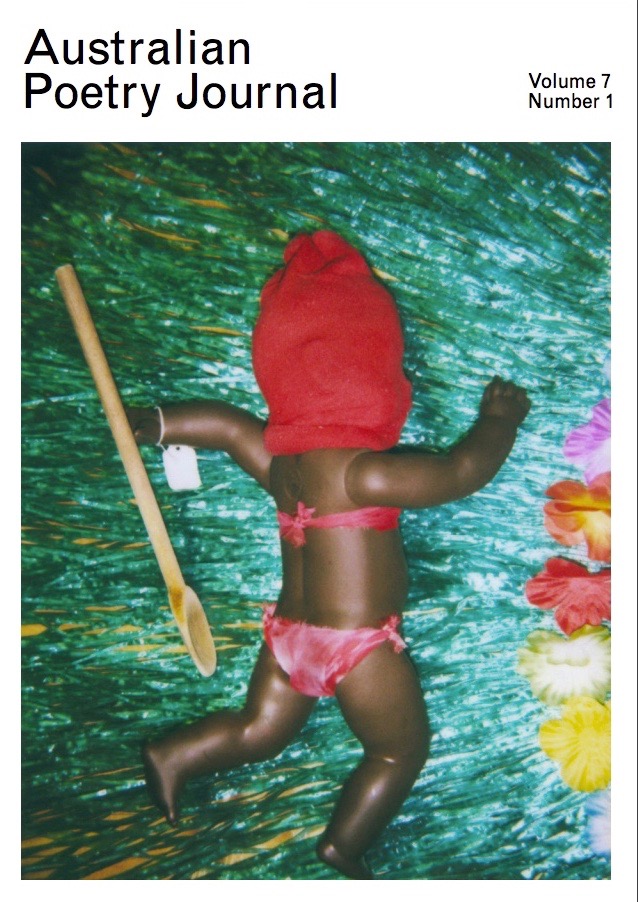
    Australian Poetry Journal 7:1, Skin

    Ali Cobby Eckermann and Ellen van Neerven (editors),  Australian Poetry Journal, Volume 7, Issue 1: Skin (2016)

    apj71The cover of this issue of Australian Poetry Journal features a brilliantly eye-grabbing Destiny Deacon photograph, Escape from the Whacking Spoon (2007). As the first issue covered by the new policy of having different guest editors for each issue, this one is edited by two leading Aboriginal poets, which ensures that it follows through on the cover’s promise.

    There are three sections:

    • Skin 1: 34 poems by 25 Indigenous writers
    • Skin 2: 16 poems by 13 non-Indigenous writers
    • Transforming My Country (edited by Toby Fitch): 12 poems responding to Dorothea Mackellar’s ‘My Country’,

    The selection is very rich, for many of the individual poems and for the extraordinarily valuable dialogue created by placing them between one set of covers. I dog-eared the pages with these poems from the first two sections in my copy (your mileage will very – I recommend you get hold of your own copy via Australian Poetry Pty Ltd’s web site):

    • Claire G Coleman, ‘Strawberry Juice’: starting from the image of spots of strawberry juice staining her writing paper, the poet plays with the notion that directions for colonial killings and records of them were written on paper. Ink stains, like blood stains, can’t be removed, and the lines that bring it home:
      _
      __Notice how paper covers rock
      __Covers
      __My country, my people are one
      __Notice how easily paper tears
      _
    • Aunty Kerry Reed-Gilbert, ‘Love comes in many colours’ The poet greets her granddaughter:
      _
      Her blonde hair cool against my black skin her whiteness grabs my heart a new day dawning for this land Australia as we dance to the sounds of the oldest culture in the world. Love comes in many colours.
      _
    • Kate Adler, ‘Sorry’. A non-Indigenous person at a Sorry Camp:
      _
       __Hard to witness wounds like these
      __but love is deeper than skin.

    The third section includes work by some heavy hitters of Australian poetry, including brilliant poems by the editors of this issue, Ali Cobby Eckermann and Ellen van Neerven. Eileen Chong (‘My music is wrong – nothing / has been written down right’) and Hani Abdile (‘Opal-hearted country / I’m now one of your unwanted beings / I’ve come to love you sunburnt’) write from immigrant and refugee perspectives. The poem is deconstructed, thesaurised and anagrammatised. Toby Fitch’s introduction describes Lisa Gorton’s conceptually and concretely thrilling poem as an ‘almost-epic’ that ‘explores in microscopic detail the history of the grounds of Royal Park, Melbourne’. I’ll end with some lines from each of the Indigenous takes on the Mackellar poem:

    Alison Whittaker (‘A love like Dorothea’s’):

    I’m sorry, sweet Mackellar, that it famished all your cows,
    y’paddock’s yellow-thirsty-sudden-green; no telling how.
    That the gold-hush-rainy-drum hard to your violence and your plow.

    Natalie Harkin (‘Heart’s Core Lament’, which is hard to represent accurately here, as it depends on justifying the text on the page, and includes quotes from colonisers’ texts in the margin, but here goes):

    harkins.jpeg

    Ellen van Neerven (‘My Country’):

    my country
    is between two rivers

    two ribs
    two hip bones

    Ali Cobby Eckermann (‘Transforming My Country’, which plays with Mackellar’s words to produce radically different meanings):

    Who pays back to Earth?

    Not she and soft-hearted love
    What a hush of her heart, and her
    I have her share, her jewel
    Though not her land
    Your love of my land is tragic

    ——-

    (I won’t repeat my own favourite anecdote about ‘My Country’ and Dame Mary Gilmore, If you’re interested you can read it here.)


    SWF 2017 Thursday

    It was T-shirt weather for my first day of this year’s Sydney Writers’ Festival at Walsh Bay. The crowds and queues were big enough to create a buzz without  inducing panic. Having collected my tickets for the next five days I started out with a free event in the early afternoon:

    1.30 And the Award Goes to…

    This is a regular event showcasing winners of the NSW Premier’s Literary Awards. Not all of them, of course: this year’s it was Heather Rose, who won the Christina Stead prize for her novel The Museum of Modern Love, and James Roy and Noël Zihabamwe, who won the Ethel Turner Prize for their A Thousand Hills. Suzanne Leal, the Senior Judge of the Awards, chaired.

    Heather Rose spoke of the advantages of obscurity: The Museum is her seventh novel, all the others having been published to little acclaim. Add that she lives in Tasmania, and she has been able to write as she wants, without having to meet someone else’s marketing or other agenda. She said she wrote this novel as a love letter to women in art, who do marvellous work and then are sidelined by art historians. Marina Abramovich, whose performance piece The Artist Is Present is central to the book, became famous when the novel was well under way, and her new celebrity meant significant changes in the book: if I heard properly, at that stage the character in the novel had to be Marina herself rather than a fictional Marina-like character.

    James Roy had a different take on obscurity. He opened with something he would have liked to say at the awards ceremony but realised it would have been graceless: even though he has been well supported and has won substantial prizes, he knew on Sunday night that if he won the award on Monday night, he would still have to turn up for his job in retail on Tuesday morning. (Suzanne Leal interjected that she had recently interviewed some women who had collaborated on a writing project because they wanted to earn a lot of money – cue disbelieving laughter.)

    Noël Zihabamwe’s own story is similar to that of the book’s hero – both lost their families in the Rwandan massacre of 1994. So for him the writing was an intense experience. He told us that one effect of having the book published was to feel that he was acknowledged: ‘I’m not nothing. I’m something.’ He read from the book, and the conversation addressed the big question, how to write about such a monstrous event and keep some sense of hope.

    All four people on the stage were warm, open, smart. James Roy did a nice favour to those of us who couldn’t be at the awards ceremony. He quoted a number of times from Joanna Murray-Smith’s address. An image that resonated with him and, he thought, with every writer, is that every work begins as a tiny burning wick, which if you persevere expands until it lights up all the corners of the room. I think it’s fair to say that the Sydney Dance 2 was lit up by these four luminaries.

    I sat next to a young man who arrived clutching a copy of Leah Purcell’s The Drover’s Wife (which won Book of the Year). I asked if he’d seen the play at Belvoir Street. No, but he had seen the archive video – evidently you can contact the Belvoir and arrange a time to see the archive version of any of their productions. How good is that bit of incidental learning?

    3 pm: Poetry and Performance
    Poetry has moved up the status chain at the Sydney Writers’ Festival. This event didn’t happen in the tiny sun-drenched mezzanine room at the end of the wharf that we have been accustomed to, but in the main theatre across the road with more than ten times the capacity. And it wasn’t free.

    But maybe of course it’s not poetry as such that’s moved up. Maybe today’s crowd was drawn by clickbait titles like Keats is Dead so Fuck me From Behind,  or fusses about menstrual images on Instagram, or the prestige of poet laureateship, or other forms of cool, rather than the art of purifying the language. Whatever, this was a terrific event. In order of appearance:

    • Miles Merrill, who has done more than anyone to foster spoke word in Australia, emceed, opening proceedings with some of his trademark mouth noises, which he told us was a work called ‘Some poems can’t be written down’
    • Carol Ann Duffy, proving that a UK poet laureate can be fun, read from a lectern at the side of the stage  from her collection The World’s Wife. The witty, acerbic narratives of ‘Mrs Tiresias’ and ‘Mrs Aesop’ were perfect for the occasion. ‘Mrs Tiresias’, a monologue by the wife of Tiresias, a man who was turned into a woman for seven years, lightly challenges some modern pieties about gender fluidity.
    • Hera Lindsay Bird (who wrote the aforementioned clickbait) walked to centre stage and read a number of poems, including one that revolved around her dislike for the character Monica in the TV sitcom Friends. So pop culture reference, frequent use of the work ‘fuck’, and a preoccupation with relationships: not my cup of tea.
    • Canadian Ivan Coyote started out by saying, ‘I’m not a poet, I’m a story teller,’ and read us a number of ‘Doritos’, which would certainly pass for poems. Most of them dealt with other people’s struggle with Coyote’s challenge to seeing people in terms of  gender binaries. I loved the moment when a small child, told by his mother to stop bothering (her) Coyote, looked long and steady ito COyote’s eyes and said,  ‘I don’t think he’s a lady. I think he’s a man, but with pretty eyes.’
    • Ali Cobby Eckermann took things to a different place: she began with an acknowledgement of country, reminded us that this is the 20th anniversary of the Bringing Them Home report, and said that more Aboriginal children have been removed from their parents in recent years than ever before in Australian history. Having grabbed our attention, she then held it with poems from a number of her books, including the marvellous Inside My Mother.
    • Rupi Kaur (who has been the subject of a big fuss on Instagram) read some poems and then performed a couple of spoken word pieces. I think I would have preferred to hear her (and Hera Lindsay Bird) at a spoken word event, where audience response is so much part of things. No clicking of foot-stamping or voting here, so lines like  ‘I want to apologise to all the women I have called pretty before I’ve called them intelligent or brave’ end up sounding a little glibly correct-line.

    Even if people came for the sexy controversy, they got poetry, and a fabulous variety of it.

    Then I got to sit in the sun and read, occasionally chatting to passing strangers (including one man who had been to school with Tom Keneally), and back to the big theatre a bit later for:

    6.30 pm The Politics of Fear
    David Marr and John Safran chatted with the Wheeler Centre’s Sophie Black about Pauline Hanson’s followers and Australia’s extreme right. Sophie introduced them by saying they would join the dots between those two groups, but not a lot of dot-joining happened, or really was needed.

    David Marr spoke to his recent Quarterly Essay The White Queen, and John Safran to his Depends What You Mean By Extremist: Going Rogue with Australian Deplorables. Both were interesting and insightful, and at times surprising. It was an excellent conversation, an I left it wondering if there isn’t something futile about too much close reading of the far right, with the end message that even though these people are a small minority they wield a lot of power because of the way our electoral system works. As David Marr said towards the end, the vast majority of Australians – including most Hanson followers – think same-sex marriage and euthanasia should be legalised and penalty rates should stay in place, but governments simply won’t or can’t follow the clear will of the people. It took one of the questioners at the end to ask what is to be done, and the answer wasn’t particularly satisfying.

    So we went home glad we’d been but a little disgruhntled through the final run-throughs of a number of Vivid installations (opening the next night).

    Poetry May 2016

    Robert Adamson (guest editor), Poetry, May 2016 (Poetry Foundation, Chicago)

    This special Australian Poets edition of Poetry magazine was launched at the Sydney Writers’ Festival this year by the regular editor Don Share. Guest editor Robert Adamson spoke and a number of the featured poets, including several who were coopted from the audience, read to us. Who could resist buying a copy?

    The magazine contains 28 poems by 20 poets, along with 18 beautiful photo portraits by Juno Gemes and two survey essays by Jaya Savige and Bronwyn Lea, plus a charming note on Robert Adamson by US poet Devan Johnston.

    Where the articles, particularly Bronwyn Lea’s ‘Australian Poetry Now‘, struggle with the impossible task of giving the readership, presumably mainly from the US, an overview of the state of Australian poetry, the selection does something different: it’s personal, making no claims to be representative or definitive. It includes a wonderful variety in forms and concerns: narrative, lyric, prose poems, formal experimentation. The landscape and geography are well represented. There are cultural references – both to settler and Aboriginal motifs – that will set non-Australians frantically googling, but at least as much Biblical and classical reference.

    It’s hard to generalise about a collection like this, and equally hard to single out individual poems. But here goes with a few:

    • Ali Cobby Eckermann has two strong, plain-speaking poems, ‘Black Deaths in Custody‘ and ‘Thunder raining poison‘, the latter an incantatory response to a work of art about the effects of atomic tests on traditional lands at Maralinga.
    • Samuel Wagan Watson’s prose poems ‘Booranga Wire Songs‘ and ‘A one ended boomerang‘ really sing.
    • The first poem in magazine, Bonny Cassidy’s ‘Axe Derby‘, which plays tantalisingly on the image of a woodchopping competition
    • Anthony Lawrence’s ‘My darling turns to poetry at night‘ is a richly complex villanelle, whose title doesn’t mean what you expect.
    • Jaya Savige has fun with mangoes and anagrams in ‘Magnifera‘.

    (The whole magazine has been up on the Poetry Foundation’s website, and you may still be able to read it all on screen. All the links are to that website.)

    SWF: My Day 3

    Circumstances made me miss Friday morning at the Sydney Writers’ Festival. The Emerging Artist, however, got two sessions under her belt.

    10:00–11:00 am: Sri Lanka: This Divided Island. She said this was marvellous. Samanth Subramanian, an Indian Tamil journalist, spoke with Michael Williams from Melbourne’s Wheeler Centre. Quite apart from its main thrust, an account of the recent three-decade war and its aftermath, the conversation helped her think about the ethics of her own current art project, which involves many people making small terracottta hearts.

    11:30 am – 12:30 pm: Jonathan Franzen: My Reading Life. The main things she reported was that he enjoyed the famous German sense of humour, and was influenced by a number of women writers.

    At 3 o’clock the Emerging Artist went to Migration: A World Without Borders? and pretty much fell in love with Aleksandar Hemon. She bought two of his books, even overcoming her vehement dislike of zombie stories to buy his novel, The Making of Zombie Wars.

    At 4:30 she went to hear Starlee Kine: From This American Life to Mystery Show and discovered a new podcast to subscribe to, dealing in ‘mysteries that can’t be solved by Google’.

    Meanwhile, apart from sitting and chatting over lunch, my Festival day began at 3 with The New Australian Poetry. Unlike previously, this year’s poetry events are in largish rooms and mostly aren’t free. This one was a book launch – of an issue of the US journal Poetry devoted to Australian poets.

    As we queued in the scorching afternoon sun (yes, scorching in mid- May), we were regaled by the booming opinions of a youngish man who had evidently been all over the world (perhaps his time in the US accounted for his LOUDNESS) and wanted the world to know that poetry is held in lower esteem in Australia than anywhere else.

    The room was filled to capacity. After brief remarks from Don Share, soft-spoken editor of Poetry, and Robert Adamson, guest editor of this issue, we were read to by Ali Cobby Eckermann, Lionel Fogarty, Lisa Gorton, Michael Farrell and Robbie Coburn. In response to an audience request, some of them read poems by other people that appear in the anthology. Then two poets – Susan Fealy and Petra White – were drafted from the audience. Taking a cue from David Malouf the previous day, I asked if any of them would read the same poem a second time – I named Lionel Fogarty and he obliged.

    There were two questions, both from the same person, one for each of the Indigenous poets. Don Share made that’s-a-wrap noises, and we were gathering up our stuff when Lionel Fogarty stepped up to his mic again and called on us to break out of our individualism and think in terms of community.

    Ali Cobby Eckermann took a turn at the mic and told us, shockingly, that when she was at an international gathering of poets recently some Syrians had asked her how come she writes war poetry. They recognised in her poetry about Aboriginal Australia striking similarities to their own war-torn lives, and she realised that, however deep and strong the denial, the Australian war of dispossession is still going on.

    Don Share rose beautifully to the occasion: ‘The difficulty we have in understanding a poem,’ he said, ‘is the same as the difficulty in hearing another person.’

    I went home to deal with various animals, then rejoined the EA in the evening for Magda Szubanski and George Megalogenis: Rated PG (Polish and Greek), an entertaining conversation between two children of immigrants.

    Ali Cobby Eckermann’s Inside My Mother

    Ali Cobby Eckermann, Inside My Mother (Giramondo 2015)

    1imm

    If you haven’t read anything by Ali Cobby Eckermann, you’re not keeping up. In the last five years or so, in three books of poetry, two verse novels and a memoir, she has made a huge contribution to our general understanding of what Australia is. She was taken from her Aboriginal family when she was a small child, and brought up by a white, German heritage family. Her writing is largely animated by the charge from her reunion as an adult with her mother and with  her Yankunytjatjara and Kokatha relatives and heritage.

    The memoir, Too Afraid to Cry, tells her story and is on my reading list. The poetry in Inside My Mother touches on it in many ways – on her relationship with her mother, and the pain of her death soon after renewing contact; and also on her rediscovery of Aboriginal culture, as in the first poem in the book:

    Bird Song
     our birds fly
     –––––on elongated wings
     ––––––––––they fly forever
     –––––––––––––––they are our Spirit
    
    –––––––––––––––our bird song
     ––––––––––is so ancient
     –––––we gifted it
     to the church

    This kind of assertion of the power of Aboriginal culture is hard to pull off without coming across as defensive or preachy, but Cobby Eckermann manages it here, and throughout the book, with grace and a faint satirical edge.

    The poetry here is wonderfully varied: love lyrics, fables, autobiographical narrative, polemic, surrealism and some silly humour.

    As I’ve been ruminating about this book over the last couple of weeks, my mind keeps returning to ‘Hindmarsh Island’, not because it stands out as excellent, but because it cries out to be read alongside Les Murray’s ‘Inspecting the Rivermouth’ in his most recent book, Waiting for the Past.

    Les Murray’s fine poem can be read online here. It celebrates the renewal of the mouth of the Murray River, in particular the prosperity and vitality that has come to Hindmarsh Island thanks to the bridge that has recently joined it to the mainland. It has Murray’s characteristic joy in linguistic display, the wonderful image of the bridge throwing houses onto the island, and the joyful underlying pun on ‘Murray mouth’.

    Then along comes Ali Cobby Eckermann’s ‘Hindmarsh Island’:

    hindmarsh Island 

    Cars drive over the babies!

    And we realise that for all his emphasis on the importance of the past, Les Murray as a non-Indigenous poet can glide over some elements of our history. The Signal Point café is part of the thriving scene celebrated in ‘Inspecting the Rivermouth’, but from an Aboriginal perspective, we don’t have the luxury of forgetting that the bridge was built over the prolonged protests of a group of women who asserted that it meant the destruction of a significant cultural site. It’s possible that Cobby Eckermann had read the Murray poem (which was first published in Quadrant in September 2010), but I doubt if it’s a deliberate response: this is just a different take on the same phenomenon, one that demonstrates how important Aboriginal voices are if our national conversation is to have integrity.

    Ali Cobby Eckermann’s previous books of poetry are Kami (a Vagabond Press Rare Objects chapbook, 2010) and little bit long time (Australian Poetry Centre’s New Poets Series, also 2010) and love dreaming and other poems (Vagabond 2012). Her two verse novels are His Father’s Eyes (OUP 2011) and Ruby Moonlight (Magabala Books 2012). Her memoir, Too Afraid to Cry, was published by Ilura Press in 2013.

    aww-badge-2015

    Inside My Mother is the eleventh book I’ve read for the 2015 Australian Women Writers Challenge.

    Sydney Writers’ Festival 2015: My Day 2

    My Friday at the Festival was a long day. Also wet. Anticipating queues, I arrived early for my first event, and turned out to be one of three people sheltering under the long marquee for a good half hour. Sadly, attendance was pretty sparse for an excellent session:

    10 am: Australia in Verse
    As is often the case, this event’s title was irrelevant. With poetry events at the SWF, it’s the who that counts rather than the what.

    Sam Wagan Watson and Ali Cobby Eckerman were in conversation with Ivor Indyk. Jennifer Maiden’s name was in the program but back trouble kept her away, that and her wish that the two Indigenous poets should have the floor. I was sorry not to see her, but it was wonderful that we got so much of the two who were there.

    The poets spoke about their backgrounds. Sam’s south-east Queensland childhood was full of story-tellers, writers and artists, solidly Aboriginal though not in denial about European heritage as well. He described himself as a child of popular culture. Ali’s mother was taken from her family when very young; Ali herself was taken; and she relinquished her own baby son. Their paths to becoming poets were vastly different, as is their poetry.

    Both read a number of poems, and spoke about what their poetry meant to them. Ivor Indyk was wonderful in the chair. When Sam said something about his early poems being well received, Ivor said that was because they were good: ‘And I’ll say what was good about them in a minute.’

    There was a lot of laughter, and some tears.

    And on to:

    11.30: Writers on Writers: Rilke
    I know very little about Rilke. I read his Letters to a Young Poet when I was a young non-poet, and I love this passage from Etty Hillesum‘s diaries, written on her way to Auschwitz, which makes me want to know more:

    I always return to Rilke.
    It is strange to think that someone so frail did most of his writing within protective castle walls, would perhaps have been broken by the circumstances in which we now live. […] In peaceful times and under favourable circumstances, sensitive artists may search for the purest and most fitting expression of their deepest insights so that, during more turbulent and debilitating times, others can turn to them for support and a ready response to their bewildered questions, a response they are unable to formulate for themselves, since all their energies are taken up in looking after the bare necessities.

    So I was interested.

    There was a lot to absorb. All four panelists knew an awful lot about Rilke, which they were enthusiastic to share: much more than could possibly fit into an hour. Luke Fischer, enthusiastic young scholar–poet, fell over his own words as he gave us three trains of thought at once. Lesley Chamberlain, a learned Englishwoman in jeans, made sure we knew how to pronounce Brancusi properly. Peter Morgan, from Sydney University’s German department, was in the chair and had interesting things to say about translating Rilke. Elder poet Robert Gray seemed to rise every now and then from the depths of abstract thought to make a brief contribution. It was fascinating theatre, and pretty good as an impressionistic introduction to a poet who, they said, sits at the beginning of modernism.

    Not that it was like a fish and chip shop, but I had three takeaways:

    • Rilke is the one who ended a short poem describing an ancient sculpture with a phrase that seemed to come from nowhere and go everywhere, ‘You must change your life.’
    • He regarded his letters as part of his literary output. (This was a relief, because if the Letters to a Young Poet were dashed off there’s no hope for the rest of us.)
    • Something that came up in response to a question at the very end, that seems relevant to to Etty Hillesum quote is Rilke’s concept of the reversal. As far as I could understand, the idea is that if you set out to experience any pain and painful emotion fully rather than numbing them out or seeking distraction from them, then at some point a reversal happens, and the pain is in some way transcended.

    Time for lunch, in what was now a beautiful sunny day by the Harbour, and then:

    1.30: The World in Three Poets

    3 poets

    This was a wonderful session. Kate Fagan (not pictured), herself no mean poet, did an amazing job of introducing poets Ben Okri, David Malouf and Les Murray. That is, she said just a few extraordinarily well crafted words about each of them, leaving most of the hour for them to read to us, followed by a short question time. It was an almost overwhelming combination of talents.

    The woman sitting next to me said she was there mainly for Ben Okri – she’d read some of his novels (‘if you can call them novels’) and hoped that hearing him read in person would help to understand them. As if he’d heard her, his final reading was from his current novel, which he introduced by saying that his novels had often been described as poetic. My transitory companion was pleased.

    Les Murray read nothing from his most recent book, which of course was because he had a whole session on that book – Waiting for the Past – the next day. What he did read was marvellous. And when David Malouf read, Les was a picture of concentration – as if he was in training for an Olympic event in Listening to Poetry.

    David began with his ‘Seven Last Word of the Emperor Hadrian’. Heard in the context of the previous day’s session on the classics, this revealed itself more clearly: the speaker, anticipating death, bids a tender farewell to his soul, the reverse of what we would expect in the Judaeo-Christian mindset, and there is something deeply moving about that.

    All three of these extraordinary poets shone in the question time.

    3  pm: Australia’s Oldest Stories: Indigenous Storytelling with Glen Miller
    It’s 51 years since Jacaranda Press published a children’s book, The Legends of Moonie Jarl by Moonie Jarl (Wilf Reeves) and Wandi (Olga Miller), which has been described as the first book written by Aboriginal people. The Indigenous Literacy Foundation have re-published it this year. Glen Miller, nephew and son respectively of the authors, talked to Lydia Miller about his own very interesting life – as very young worker in the coal mines, public servant, cultural tourism entrepreneur, and now as elder and activist in the Maryborough Aboriginal community – and about the origins of the book as he remembered them. He was very good value, but I can’t have been the only person in the audience who was hanging out to be read to. Eventually, he did read us one story – almost apologetically, as if an audience full of adults wouldn’t want to be read a children’s story. There were no complaints.

    It being Friday, I was joined by the Art Student for:

    4.30: The Big Read
    The Big Read is where a big theatre full of people, mainly adults, sits back to be read to. This event used to be for ninety minutes, but it’s sadly been cut back to just an hour, and that hour has to accommodate the presentation of the Sydney Morning Herald Best Young Australian Novelist Awards.

    This year the awards presentation featured some unscheduled theatre. The set-up has always been a little awkward, as one by one the young novelists stand silently off to the side of the stage while their novels are described, and then again while the others have their turns. This year, the first recipient, Michael Mohammed Ahmad, clearly feeling the awkwardness acutely, sat down in a spare chair while his book (The Tribe) was being described. When he was shepherded away from that chair after receiving his award, he looked around and saw that there wasn’t a chair (Beatles reference intended), so sat on the floor. His successors – Maxine Beneba Clarke, Ellen van Neerven and Omar Musa (Alice Pung, the fifth recipient, was in Melbourne with a small baby) – each made the decision to join him. Linda Morris from the SMH said it was like a sit-in. Perhaps next year there will be chairs, and the young novelists may even have a moment each at the microphone.

    On to the show itself: Camilla Nelson read from Alice Pung’s book; Kate Grenville read from One Life, a kind of biography of her mother; Steven Carroll read an extended passage about a guitar from his novel, Forever Young; Damian Barr gave us a snippet of Glaswegian childhood from his memoir Maggie and Me. Annette Shun Wah was as always a warm and charming host.

    It’s probably telling that when we went to Gleebooks on our way to dinner to buy Damian Barr’s book it was sold out. After a dinner up the hill at the Hero of Waterloo, we uncharacteristically returned to the Festival for an evening session:

    8.00 Drafts Unleashed + Slam
    MCd by Miles Merrill, mover and shaker on the Australian spoken word scene, this featured an open mic plus a number of featured guests, all of whom were invited to read something completely new. Benjamin Law read us the opening scene of the TV series currently in production based on his memoir The Family Law. He did the voices and the accents, and it was a wondrous thing to see this slight, mild man transformed before our eyes into a big, loud, wildly inappropriate woman. The rest was fun too, but we were weary and left before the show was over, walking back to Circular Quay through the spectacle and crush of the Vivid festival.