Tag Archives: Alison Bechdel

Alison Bechdel’s Spent

Alison Bechdel, Spent: A Comic Novel (Jonathan Cape 2025)
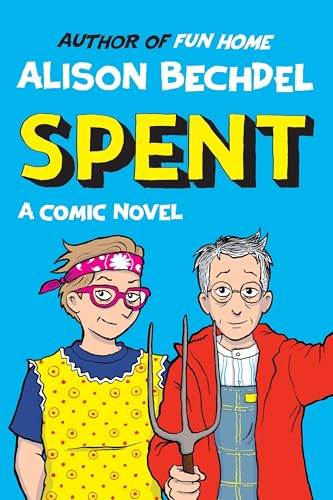
This is the fourth ‘graphic novel’ by Alison Bechdel. I use quote marks because they aren’t all novels. The first, Fun Home (2006), the only other one I’ve read, includes fictional elements, but is actually a memoir about her relationship with her father. I believe her second and third, Are You My Mother? (2012) and The Secret to Superhuman Strength (2021) are also predominantly memoirs. 

Even though this book describes itself as ‘a comic novel’, it too feels as if it’s taken from Bechdel’s actual life. The main character, ‘Alison Bechdel’, is a cartoonist whose graphic memoir about her father (here called Death and Taxidermy), became a best seller. The project she is currently working on has striking similarities to book we are reading. In the acknowledgements, the author thanks her ‘stellar agent, Heloise C. Bland Sydelle Kramer’ – the struck-through name belongs to the book’s fictional agent. And so on.

We’re not meant to read the book as describing the actual lives and loves of Bechdel and her ‘annoying, tenderhearted, and utterly luminous friends’. I don’t know if Bechdel has a goat farm IRL, or if her empty-nest neighbours are experimenting with polyamory (‘Indeed, they give “sandwich generation” a whole new meaning’). But the concerns and preoccupations of the characters are definitely taken from life.

This is a book about the members of a haven for leftist LGBTQI+ people in the era of Trump, MAGA, the climate emergency and rampant late-stage capitalism. They write letters, organise, lobby, have ‘Black Lives Matter’ placards on their lawns, argue about gender politics, suffer at the way television adaptation mangles and betrays Alison’s first book. And they are funny.

An early caption (page 14) sums up the mood: ‘How she rues the decades she spent fretting that the country was on the verge of fascism. Now it really is, and she’s worn out.’

Hence one meaning for the book’s title: spent, worn out, depleted. The title also refers to the way Alison and friends are incorporated into consumerism – the ‘S’ in ‘spent’ could have been a dollar sign, as in fictional Alison’s project, $um. The characters are constantly receiving packages from Amazon, and Alison agonises over whether to accept an offer from Megalopub (aka the Murdoch empire?) for her work in progress.

Page 78* gives you an idea of the art, and the general playfulness. A couple of pages earlier Alison and Holly have been startled out of their sauna by a goat thumping about on its roof – and have stood naked in the snow, rude bits discreetly hidden. A couple of pages later their neighbours are playing at the local pickleball palace and have a zing moment when hands touch that is the beginning of the polyamory thread. Page 78 is a quiet page: no nakedness, and just a couple of flirty double entendres.

Holly, in the blue cap, has been chopping wood while Alison films her for Holly’s Instagram account, which is about to go viral. ‘It’s the new vet,’ says Alison. ‘Whoa! What a beauty!’ says Holly. We turn the page and see that Holly is looking at the vet’s truck, not the vet herself.
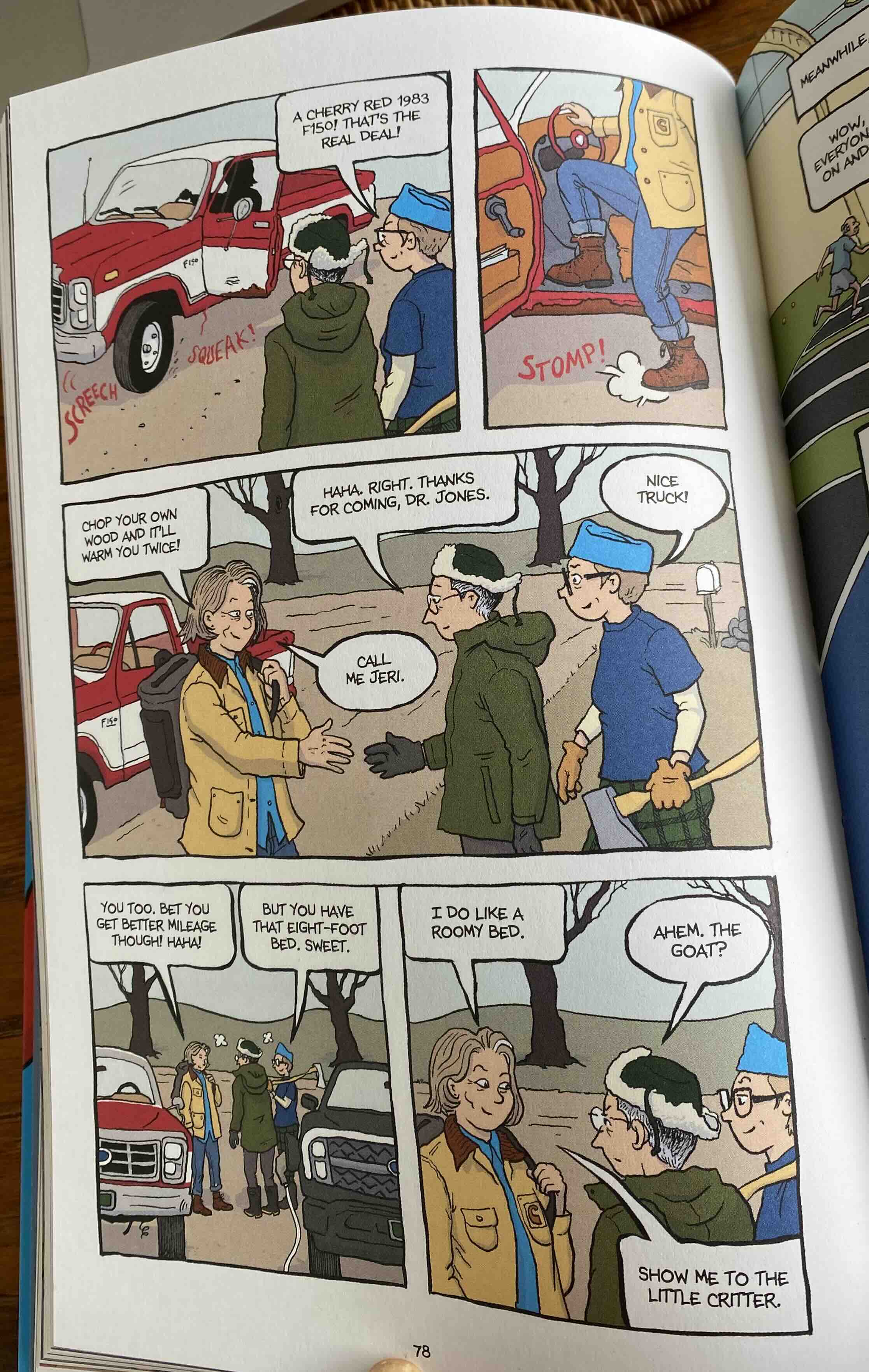
But the original ambiguity continues. The flirty stuff between Holly and the vet will persist, making Alison a little nervous.

I notice two things about the page.

First, same-sex attraction is the norm in the world of this book, no big deal. One character is a trans man, but no one even mentions it – somewhere along the line he is shirtless and discreet scars from top surgery are revealed. The one cis-het man in the friendship group has fantasies of being a Lesbian. Even the women of the younger generation who identify as asexual are asexual with other women. Heterosexuality is, um, rampant among the miniature goats, which leads to some good-humoured comedy.

Second, there’s a tiny detail in the bottom left frame. No verbal cues given (unless that’s what the vet means about mileage), the car on the right is being charged. Of course, you think, these right-on environmentalist vegans would have an EV. It’s one of the pleasures of the book that such tiny moments abound. A random flick through the pages gives someone commenting at the communal non-Jewish shabbat, ‘I don’t think I’ve ever seen a man light the candles before.’ Or there’s the young gender-non-conforming character Badger wearing a T-shirt that proclaims, ‘Neurodivergent AF’. Monitor screens and floating strips of text regularly bring news from Mar-a-Lago and the disasters of the wider world.

Of my recent reading, the book this most chimes with is Susan Hampton’s memoir, Anything Can Happen. They are both excellent books. This one doesn’t have the Sydney Gay and Lesbian Mardi Gras, but it’s funnier.


I wrote this blog post on the land of Gadigal and Wangal, where the wind is cool and rain is pending. I acknowledge their Elders past and present and welcome any First Nations readers of the blog.


That’s my age. When blogging about a book, I focus on page 78 to see what it shows about the book as a whole.

2025 End of Year List 4: Books

The Emerging Artist now keeps a record of the books she reads so she can easily whip up a list for the blog at this time of year. First her data:

  • 62 novels,  9 non fiction, 3 art books 
  • 29 novels by women
  • 20 novels by non English speakers
  • 2 First Nations authors

Best novels
I’ve tried not just to mention books reviewed by Jonathan. That meant excluding two favourites: Time of the Child by Niall Williams and The Granddaughter by Bernhard Schlink. My best five are:

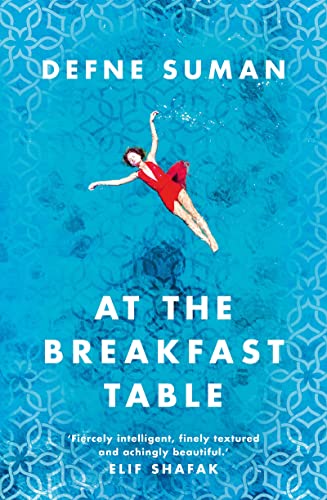
At the Breakfast Table by Defne Suman. Set in Istanbul, it weaves the story of four generations of a family, focused around one weekend, but giving glimpses into the recent history and politics of Turkiye through the lives of each character. The role of women, class and art are in the process. It was one of my random picks from the library, and I now have another of hers on order. 

Glorious Exploits by Ferdia Lennon. What a terrific read, full of humour, violence, Irish sensibilities set in ancient Syracuse. The love of Euripides’ plays drives our two main characters to stage a production performed by prisoners. We saw Ferdia at the Sydney Writers’ Festival where he was equally entertaining. 

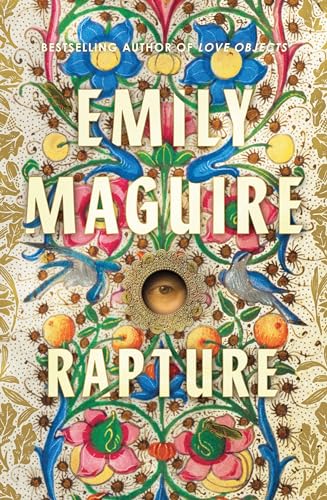
Rapture by Emily Maguire. I had put off reading this but eventually, somewhat reluctantly, picked it up. It was gripping, conjuring up mediaeval Europe and a woman struggling to have independence from the constraints imposed at the time.

Brotherless Night by V. V. Ganeshanathan. Another random pick from the library, this is set in Sri Lanka as the civil war builds over a few decades. Its main character, a young female medical student, tries to sidestep the conflict as her brothers are increasingly caught up in it. A powerful read.

33 Place Brugmann by Alice Austen. During the Second World War, an apartment block in Belgium holds the range of residents that reflect the broader society – those enthusiastic about Nazism and willing to inform, those willing to put their lives in danger to hide Jews and those who become the target of hatred. 

Best non fiction
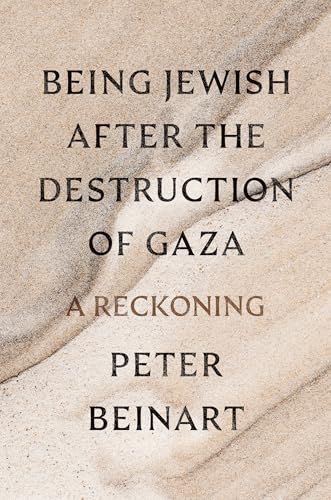
What does Israel Fear from Palestine by Raja Shehadeh and Being Jewish after the Destruction of Gaza: A Reckoning by Peter Beinart are two excellent books about the current genocide.

From me

I can never pick a favourite or best book. Some highlights of 2024 were:

A comic: Fun Home by Alison Bechdel, an LGBTQI autobiographical work that has become a classic. A friend was shocked that I hadn’t read it already (she didn’t care that I haven’t read Pride and Prejudice).

A novel: Time of the Child by Niall Williams, one of three novels so far set in the small fictional Irish town of Faha. Its picture of the role of Catholicism in the life of the village struck a deep chord for me as a child of a Catholic family in North Queensland.

Another novel: First Name, Second Name by Steve MinOn features a Jiāngshī (a kind of Chinese vampire). This struck a personal note for me as the Jiāngshī’s journey ends at the Taoist Temple in Innisfail – and a childhood friend of mine told me that the MinOns lived down the street from him when he was a child.

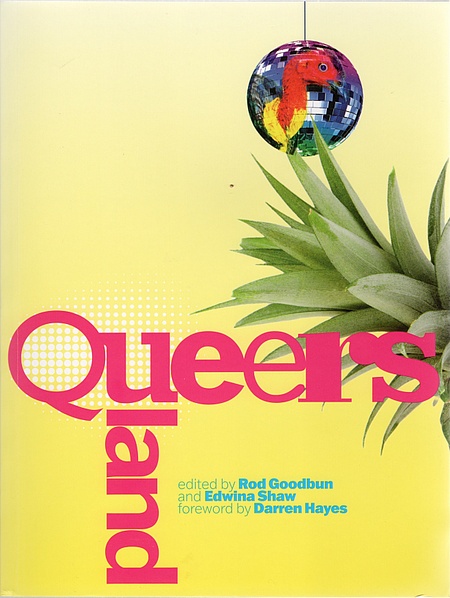
A collection of essays: Queersland is full of stories about being LGBTQI+ in the state of Queensland, especially in the Jo Bjelke-Petersen era, co-edited by Rod Goodbun and my niece Edwina Shaw. I love it because it is so necessary and for obvious nepotistic reasons.

Poetry: Rather than sngle out an individual book I’ll mention the Flying Islands Poets series edited by Kit Kelen. I read 12 books in the series this year, and my life is much richer for it.

I should mention Virginia Woolf. I was inspired by a podcast about the centenary of the publication of Mrs Dalloway to plunge into that book. I’m very glad I did, though plunge is probably exactly the wrong word for my three-pages-a-day approach.

To get all nerdy, I read:

  • 77 books altogether (counting journals and a couple of books in manuscript, but only some children’s books)
  • 32 works of fiction
  • 19 books of poetry
  • 5 comics
  • 11 books in translation – 4 from French (including Camus’ L’étranger, which I read in French), 2 from German, and 1 each from Chinese, Icelandic, Korean and Hungarian
  • 9 books for the Book Group, whose members are all men
  • 11 books for the Book Club, where I’m the only man
  • counting editors and comics artists, 39 books by women and 41 by men
  • 3 books by First Nations writers, and
  • 14 books by other writers who don’t belong to the White global minority.

And the TBR shelf is just as crowded as it was 12 months ago.

Happy New Year to all. May 2026 turn out to be unexpectedly joyful. May we all keep our hearts open and our minds engaged, and may we all talk to peope we disagree with.


I wrote this blog post on Wadawurrung land, overlooking the Painkalac River. I acknowledge their Elders past and present and welcome any First Nations readers of the blog.

Alison Bechdel’s Fun Home

Alison Bechdel, Fun Home: A Family Tragicomic (©2006, Vintage 2022)

A Lesbian friend of mine was surprised, even shocked, when I told her I hadn’t read Alison Bechdel’s Fun Home. I got the impression that she revised her opinion of my literacy on the spot.

Well, now I’ve read it and can hold my head high again.

Alison Bechdel is probably best known for the Bechdel test, which serves as a rough guide to a movie’s level of misogyny or otherwise: does it have more than one named female character? do they have a conversation about something other than a man? According to Wikipedia, Bechdel modestly attributes the invention of the test to a friend and ultimately to Virginia Woolf. But it still bears her name.

She is also celebrated as a creator of comics, in particular her long-running series Dykes to Watch Out for. The strip ran for 25 years, from 1983 to 2008, with a brief revival on Trump’s first election. Fun Home, published in 2006, brought her a wider readership. The book was a New York Times bestseller. It has been adapted into an audio-book and an award-winning stage musical, with a movie reportedly on the way. It has been included on college reading lists and Wikipedia currently lists eight attempts at having it banned in the USA. When I bought my copy the shop assistant enthused that she had studied it at university, but then read it again later for pleasure.

It’s a memoir. At first, it seems like a familiar tale of living with a tyrannical father who is emotionally distant and given to violent rages. But it develops into something much more complex and interesting. Towards the end of the first chapter, Alison and her brother are at Sunday Mass with their parents, and a caption reads: ‘He appeared to be an ideal husband and father.’ This is an ordinary observation about middle class families putting on a front for public display, but then there’s a second caption: ‘But would an ideal husband and father have sex with teenage boys?’ And that question hangs there unexplained for many pages, as the narrative takes us back to the family’s early life, the father’s part-time work as a mortician (which is where the book’s title comes from – it was the Bechdel children’s nickname for the undertaker’s business), and Alison’s own portrait of the artist as a young woman.

So the narrative moves back and forth, entwining the narrator’s own story as a nerdy young person with OCD who comes out as a Lesbian, with the unfolding story of her father’s sexuality, and the way it all plays out in the family. Key moments are hinted at, passed over as offstage events, and then revisited in detail much later, so that there’s a constant sense of something not yet revealed.

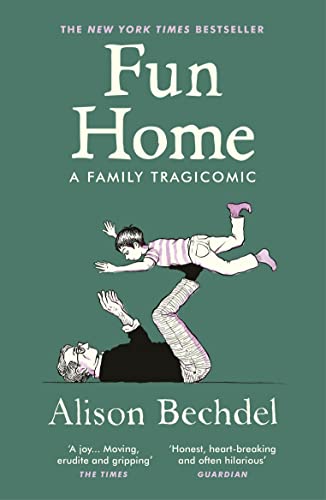
It’s a bookish family, and a bookish book, shot though with literary references. The story of Daedalus and Icarus forms a major thread, beginning with a father-and-daughter game of ‘airplane’ as seen on the cover – ‘In the circus acrobatics where one person lies on the floor balancing another are called ‘Icarian games’.– and leading in the final pages to a revisionist interpretation of the myth, applied to this story. Camus gets a look-in, and so do Proust, Oscar Wilde, F. Scott Fitzgerald, Wallace Stevens, J. D. Salinger, A Chorus Line, Henry James, Shakespeare of course, and more – none of them incidental to the plot.

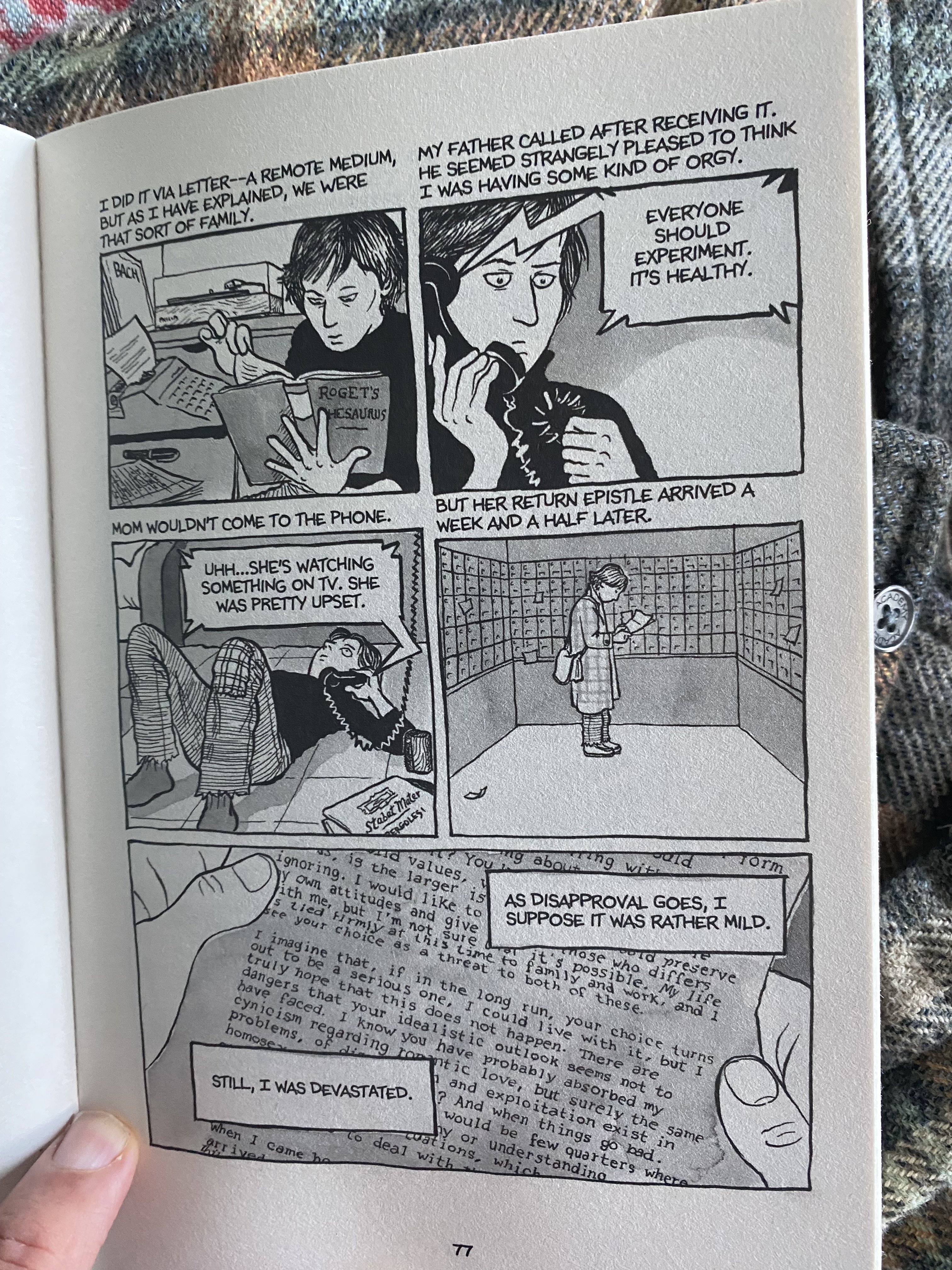
Page 77* may give you an idea of the art and the narrative style. Alison is nineteen, at college, and has just realised she is a Lesbian. The realisation has come about ‘in a manner consistent with [her] bookish upbringing. A revelation not of the flesh, but of the mind.’ There are a couple of pages that could be used as a reading list for a young person making a similar realisation; she attends a meeting of a Gay Union ‘in petrified silence’, and in the resulting exhilaration decides to come out to her parents:

If you enlarge this image you see how beautifully words and images are integrated. The captions offer a commentary on the action: ‘We were that sort of family,’ ‘He seemed strangely pleased,’ ‘I was devastated’. The page is a good example of Bechdel’s skill with dialogue: the father’s words on the phone convey his awkwardness quite independently of the caption’s commentary. The images are more than illustration – the technical term for this kind of story telling is ‘sequential art’, a different beast from ‘illustrated story’. We see how 19-year-old Alison lives: her clothes, the music she listens to, that she has to go to a post office box to receive mail, that her coming-out letter is typed, and composed with the assistance of a thesaurus. As often in this book, the images themselves include text: not just the names of books and records, but a glimpse of the mother’s letter, implying a documentary dimension to the narrative.

On the next page, there’s a fine example of the way the story is given to us bit by bit, layer by layer. We see Alison’s diary entry about her mother’s letter, which quotes part of the letter we are not shown here, hinting at the revelations yet to come about the father’s sexuality.

Like Art Spigelman’s Maus, Joe Sacco’s Palestine or Marjane Satrapi’s Persepolis, this is a comic that people who don’t read comics would do well to spend a little time with. It might not make comic-readers out of them, but it may give them the same kind of pleasure as a good movie or novel.


I wrote this blog post on land of the Gadigal and Wangal clans of the Eora Nation, where a flock of corellas, which I think are visiting from inland country, have been making a lot of noise. I pay my respects to Elders past and present, and to any First Nations readers of this blog.


My blogging practice is focus arbitrarily on the page of a book that coincides with my age, currently page 77.