Tag Archives: art

Philippe Jaccottet’s Pilgrim’s Bowl

Philippe Jaccottet. The Pilgrim’s Bowl (2001, translated by John Taylor 2015, Seagull Books 2022)
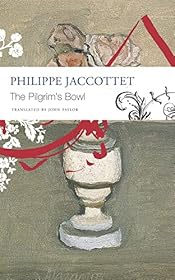
This is a short book by a poet who is completely new to me about an artist whose work I have never seen. It was a Christmas present, a book I wouldn’t have dreamed of buying for myself. I enjoyed it a lot.

Philipe Jaccottet (1925–2021) was a Swiss poet who wrote in French, one of only fifteen writers to be included in the canon-defining Bibliothèque de la Pléiade while still alive. His English-language Wikipedia page is extremely sparse, but French-language Wikipedia is a different thing altogether. His expansive page there includes this (as rendered by Google Translate):

Jaccottet writes that the poet is no longer ‘the Sun […] nor a son of the Sun; nor even a Torchbearer or a Lighthouse’ (he therefore rejects the image of the ‘poet-prophet’): the task of this ‘anonymous one […] dressed like any other anxious man’ is to try to ‘paint’ the world ‘so wonderfully’ that his work would be able to distract Man from his fear of death.

In The Pilgrim’s Bowl, Jaccottet turns his attention to the work of Italian painter and printmaker, Giorgio Morandi.
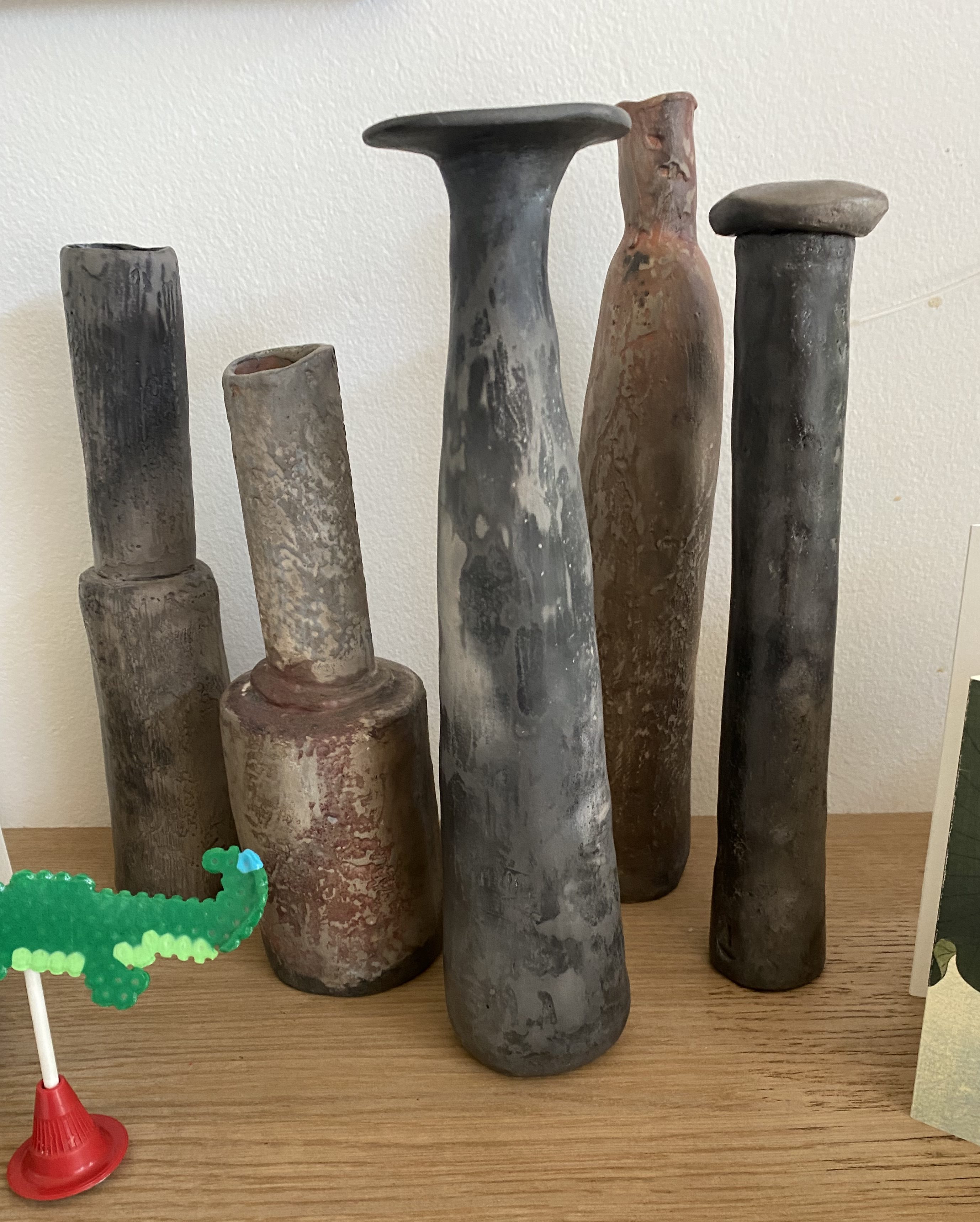
Though I’ve never seen an original work by Morandi (1890–1964, Wikipedia page here), I know a little more about him than about Jaccottet. The Emerging Artist did a beautiful drawing when at Art School that was copied, she told me, from one of his paintings, and the great cartoonist Jenny Coopes, taking up ceramics late in life, created a set of Morandesque objects which we now own. (For the benefit of readers who don’t know Morandi’s work: this photo does not capture anything of its austere, dreamlike simplicity.)

After reading this 66-page book with its dozen images, I feel that I know – and like, and admire – both these people much better. Jaccottet does not present as an art critic. He is not out to describe Morandi’s paintings, but to explore what he calls the enigma of the powerful emotion they create in him. This is from page 3:

It is not surprising to be stirred by the view of a mountain, the ocean, a sunset, a big city; or by the imminence of a war, the nearness of a face, the death of a close friend. And therefore, consequently, by their representation in a painting, poem or narrative. But with this artist: those inevitable three or four bottles, vases, boxes and bowls – what apparent insignificance, what ludicrousness or nearly so (and all the more so when the world seems about to collapse or explode)! And how can you dare claim that such a painting speaks a more convincing language to you than most contemporary works of art?

He approaches the enigma from different angles, ‘as naively as possible’. Which means he goes down tangent after tangent, and somehow enriches our sense of Morandi’s work.

Noting that Pascal and Leopardi were Morandi’s favourite authors, he spends fascinating pages discussing them. He riffs on snippets of Morandi’s biography. He catches fleeting associations – remembering that Morandi would let dust settle on his paintings, he thinks of the ‘sandman’ and then of the Sleeping Beauty, which gives him a way of talking about ‘the unchanging light bathing Morandi’s paintings’:

It never sparkles or glares, never flashes or breaks through clouds, even if it is clear as the dawn, with subtle rose and grey hues, this light is always strangely tranquil.

There is much more about that light.

He quotes from Dante and Plato. Acknowledging that he may be a little over the top, he compares Morandi’s still lifes with Vermeer’s paintings of young women and even with classic Madonnas.

Page 47* is the first half of the book’s most tangential tangent. Page 46 ends with this beautifully distilled paragraph:

The more Morandi’s art progresses in terms of deprivation and concentration, the more the objects in his still lifes take on, against a background of dust, ash or sand, the appearance and the dignity of monuments.

Then, abruptly, a parenthesis takes up the next two pages, beginning:

One night not long ago, I remembered a stopover in Ouazazarte, Morocco – rose-coloured sands and yellow sands, windy gusts blowing distant sand up into flags, and those fortress-like buildings shimmering in the excessive light without being mirages, yet barely distinct from the ground on which they had been built – why was this brief glimpse-like vision one morning so poignant?

I don’t know how to summarise this work. You have to be there. Let me just say that when I do get to see a painting by Morandi, I will come to it with eyes, heart and mind prepared.


I wrote this blog post on Wadawurrung land, overlooking the Painkalac River. I acknowledge their Elders past and present.


My blogging practice is to focus on the page of a book that coincides with my age, currently. As The Pilgrim’s Bowl has fewer than 77 pages, I’m focusing instead on my birth year, ’47.
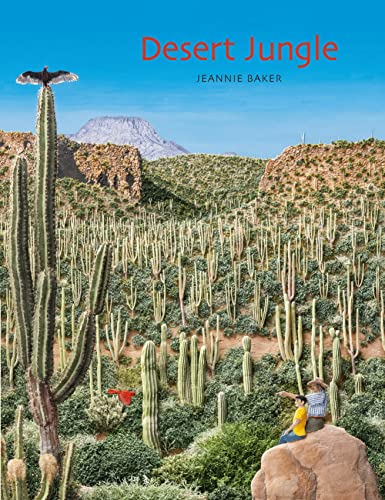
Jeannie Baker’s Desert Jungle

Jeannie Baker, Desert Jungle (Walker Books Australia 2023)

There are no books quite like Jeannie Baker’s. For four decades she has been creating picture books that are immediately recognisable as hers. Where the Forest Meets the Sea (1988) was the first one I encountered. In it, a small boy wanders through the Daintree rainforest in North Queensland. The forest is recreated in collaged materials, most of them gathered in the real-life rainforest, to stunning effect. The book is meant for young readers, but readers of all ages are intrigued and delighted by the extraordinarily detailed work that has gone into the images.

Since then, every couple of years, a new book using similar collage techniques has appeared. All of them reflect a deep concern and love for the natural environment. Window (1991) traces the changes to a rural environment brought about by urban sprawl as seen through a child’s window. The Story of Rosy Dock (1995) features a beautiful but destructive invasive weed. Circle (2016) is about migratory birds.

Jeannie Baker has made short films of Where the Forest Meets the Sea and The Story of Rosy Dock – both of which are available from the National Film and Sound Archive. And there have been many exhibitions of her original artwork.

Which brings me to Desert Jungle. I read the book at the Penrith Regional Art Gallery, at an exhibition of the collages for this book. The gallery website describes the work (and the book) in these terms:

In this new story, Jeannie explores the Valley of the Cirios in Mexico, through the perspective of a young child and his grandfather. In parts of the Valley, towering stands of Cardon Cactus – some of the largest cacti on Earth – and Elephant Trees, mix with Cirios and other unique desert plants as a ‘forest’, almost a desert jungle. These cacti and other plants form both subject and material for Jeannie, who incorporates clippings from plants in her intricate and stunning works

https://www.penrithregionalgallery.com.au/events/jeannie-baker-desert-jungle/

The collages are in effect dioramas, displayed behind perspex that is curved to accommodate their depth. Part of the fascination is to read the labels, to see that most of the images are made from parts of the plants they represent. Even, in an image of the young boy sitting with his grandfather, the hairs on the old man’s arm are actual human hair meticulously glued in place.

In the context of these wonders, the book’s story is almost of secondary interest. When the boy visits his grandfather, he doesn’t like to go out into the surrounding desert because he’s afraid of coyotes, so he stays by the house and plays on his tablet. A coyote steals his precious technology and when he wanders out to search for it, he finds the desert isn’t so scary after all. He even encounters the coyote and nothing bad happens. It’s an understated little drama about facing one’s fears, and at the same time has something to say about the importance of engaging with the natural world.

I haven’t read it with a small child yet. I’ll be interested to see how it goes.

500 people: Weeks 41 to 43

See this post for a brief description of my 500 People challenge.

I had a terrific conversation in the sauna this week ranging over the relative merits of cows and goats, Buddhism and Christianity, the gym we were in and the one at Annette Kellerman, and other matters. When I was about to head for the showers I told the other chap my name, and he said, ‘I know, we’ve met before.’ So I couldn’t include the conversation as part of the Challenge – though it does confirm that at least some of these encounters have follow-ups. He may have been Number 7 in Week 14.

1. Sunday 21 November. Usually when I visit an art gallery I wouldn’t dream of initiating a conversation with an artist. Today in Articulate, a small gallery on Parramatta Road, with my 500 People challenge in mind, I did just that. The artist seemed delighted to engage. The works on exhibition were collaborative drawings, and her description of the collaborative process was fascinating. At one stage, saying, ‘I can do this because I’m the artist,’ she lifted a corner of a large hanging to show me and my two companions who had joined us the reverse side of the richly textured paper.

2. Monday, I went out early to buy some celery. At the checkout, a young woman asked from behind her mask, ‘Do you make celery juice?’ When I said I did, she told me about her own celery-and-lemon-juice routine, and how it had improved her health and ‘even’ her skin (her skin looked fine to me). I said I had mine mixed with carrot, beetroot, apple and ginger juice. And we were away – luckily there was no one else in the queue. Her most memorable line was, ‘I used to have mine with carrot juice but I stopped because it was like soup.’

3. Tuesday. There’s a Matisse exhibition on at the Art Gallery of NSW. I had a free ticket thanks to a son’s excellent gift of Gallery membership. I was intrigued by the 1944 painting Still life with magnolia, displayed alongside six preparatory sketches. I turned to a woman who was also looking at it and remarked how interesting it was to see the painting along with the sketches. Luckily she was no more of a connoisseur than I am, and pretty much finished my sentence for me. We chatted a little and then went our separate ways.

4. Sunday 28 November. I called to make an appointment to see a podiatrist (don’t ask!). Miraculously an appointment was possible the next day. As the receptionist was taking down my details, she asked how to spell my name. I told her, and thanked her for asking. She said she knew what it was like as her name is Isabel. I told her that both my mother and my quasi mother-in-law had that as a second name, spelled Isabel and Isobel respectively. (I discovered the next day when I asked after her that she goes by Izzy.)

5. Monday. At the podiatrist’s, I decided to have an actual conversation while she was attending to my feet. It wasn’t hard as she seems to have worked out that life goes better if you connect with people. In response to my asking how she got into podiatry, she told a sweet story. We talked about other things as well … Then, as I was going down the stairs, I heard her greet the next client: ‘I always look forward to your visits.’ ‘Me too,’ he answered.

6. Monday. I had a brief interaction with that man (‘the next client’) before going to the stairs. I saw that he was intensely focused on the Target Word in the Sydney Morning Herald. I contemplated telling him the day’s nine-letter word, but realised that would have been purely mischievous. I did, however, say truthfully, ‘This is the first time I’ve seen someone else doing that.’ He laughed, and told me he usually does the Quick Crossword, but he’d finished it and had time to fill.

7. Wednesday 8 December. I include this as representative of maybe a score of tiny, courteous-to-warm interactions that I haven’t noted. This morning in the pool, the slow lane was uncomfortably crowded. At one stage, I paused at the end of a lap to make way for the woman a couple of body-lengths behind me, who was swimming faster than me and would have had to pass me if I’d kept going. She took a moment to acknowledge the courtesy with a nod and a smile and a ‘Thanks’, and I reciprocated.

8. Thursday afternoon, driving down Addison Road in Marrickville, we passed an ambulance and police car dealing with someone who looked as if they’d been hit crossing the street. The traffic going in the opposite direction to us was banked up for blocks. When we came to our next set of lights, I gestured to the driver of the car closest to me and when she wound down her window I told her what the hold-up was. She thanked me. I know this is almost nothing as far as human contact goes, but the next time we stopped, I made the same gesture to a driver who was about the same distance from me. I could tell that this one saw me, but they (I genuinely don’t remember their gender) studiously refused the overture.

9 & 10. Saturday 11 December. We went on a long walk – from Cowan Station to Brooklyn on the Hawkesbury/Dyarubbin. We passed very few people, but had a pleasant chat at one encounter. We had been walking up a stretch that was classified as hard, and feeling it, when we met a family – a woman, a man and a teenaged girl – coming down. We exchanged politenesses. Then, inspired by Joe Keohane’s book The Power of Strangers (blog post to come soon), I admired their walking sticks, and asked if they were Nordic style. They weren’t, but both parents were happy to talk about the sticks, which led to an exchange of stories about walking various parts of the Camino/Caminho/Camiño di Compostella, past and possibly future.

Running total is now 262, but bloody Joe Keohane (see above) has ade me realise that I’ve set my bar pretty low in this challenge – most if not all the encounters I have listed are opportunistic, in the sense that these are people I meet anyhow, and many of them aren’t much more than hit-and-runs. I’ll (try to) do better.

The Book Group and The GrandMasters #Sh*tf*ckery

The Book Group had our end of year meeting last night. I wasn’t going to blog about it as there was no book to discuss, but things happened to change my mind.

We had our now-traditional ‘gentlemen’s picnic’ – which is to say, everyone brought food. We had dumplings, barbecued prawns, delicious roast potatoes with rosemary and garlic, Portuguese chicken, plus a bowl of peas so we’d have some greens, followed by a fruit platter, pastéis de nata and mince pies, all accompanied by excellent conversation and much laughter.

Then down to work. Instead of a book, in what may become a tradition, we each brought a poem and read it aloud. The poems ranged from Les Murray’s ‘An Absolutely Ordinary Rainbow‘, read to us beautifully by a man to whom Les Murray had read it as a student audience of one, to a completely foul Rodney Rude limerick. Between those extremes were Janet Frame, David Malouf, Barbara Vernon (the fabulous opening stage direction to her 1957 play The Multicoloured Umbrella), Raymond Carver, Adrian Wiggins, anonymous children’s versifiers, and Naomi Shihab Nye. Readings were punctuated by wonderful anecdotes about complex intimacies, the sound of rain on an iron roof, 9th century Japanese poetics, student life in times past, father–son connections and more.

Finally, the Kris Kringle. We each brought a book from our shelves, suitably wrapped and given out at random. Once the books were unwrapped we all looked happy with what we’d got, though the one who’d scored three folded pieces of waxed cloth looked a little mystified and his happy appearance may have been a little strained. (He found out later in the evening that the giver had brought the wrong one of two identically wrapped parcels from home, and will get the book to him soon.) I’m delighted by my book, and because it’s a very quick read, I get to do this blog post:

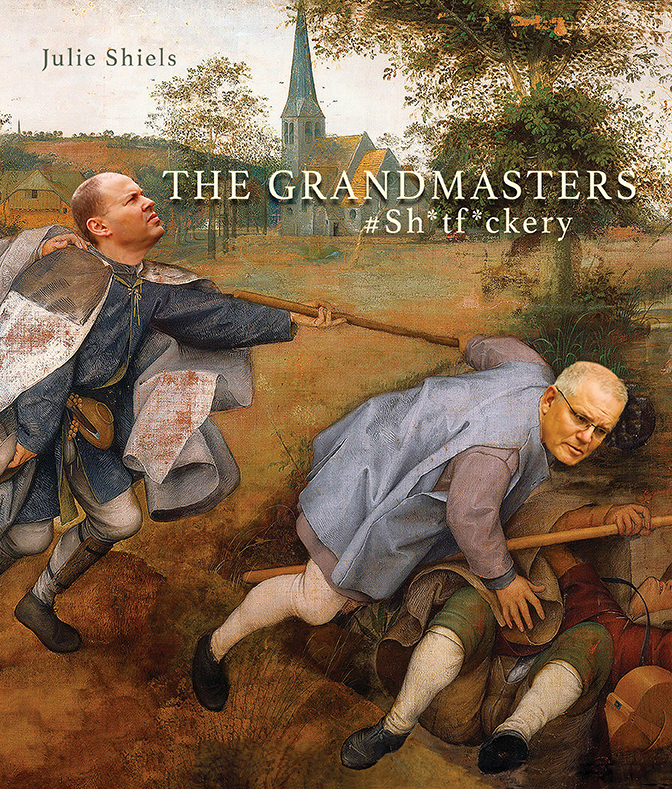
Julie Shiels, The GrandMasters #Sh*tf*ckery (M.33 2021)

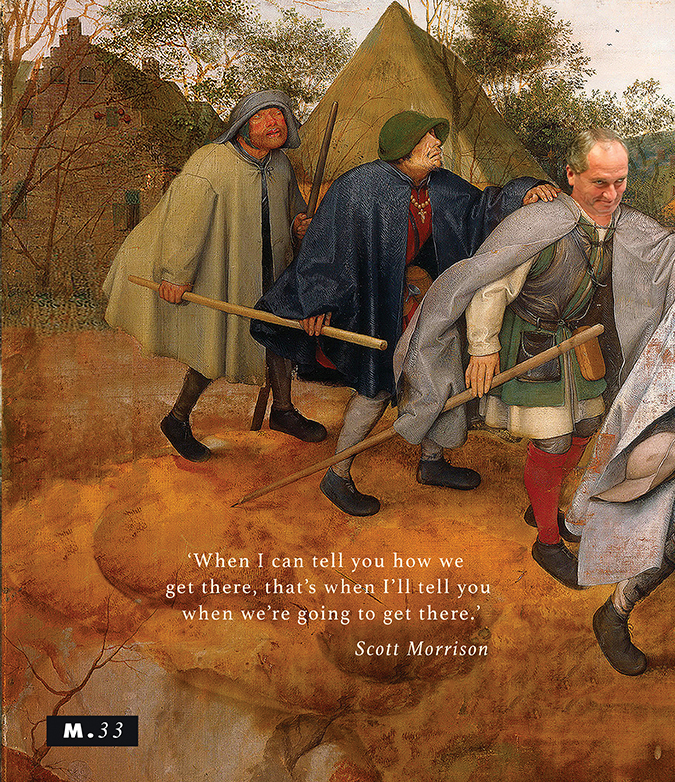
Julie Shiels is a Melbourne artist who created a series of digital collages, starting during the Great Covid–19 Lockdown of 2020. She took a number of paintings by old masters, gave some of their personages the faces of contemporary Australian political leaders, and added pointed captions. For example, the dustjacket (left) has The Parable of the Blind Leading the Blind by Pieter Bruegel the Elder featuring Scott Morrison, Josh Frydenberg and Barnaby Joyce. The satirical point would be clear enough, but then there’s the caption, a quote from the Prime Minister: ‘When I can tell you how we get there, that’s when I’ll tell you when we’re going to get there.’

The book simmers with rage, as it covers Robodebt, the federal government’s handling of the vaccine rollout, the scandal around Christian Porter, the Britney Higgins matter, climate change, Peter Dutton deciding to smile, Karen Andrews describing herself as compassionate, the abandonment of Australia’s Afghan friends, and so on.

I laughed out loud at the title page, which has a smirking Morrison standing by the woman’s corpse in Jerome Preudhomme’s The Death of Lucretia, while Michaelia Cash and Marise Payne play other roles – the caption: ‘Blokes don’t get it right all the time.’ Other pages – including but not limited to variations on the rape of Lucretia – are too horrible to be funny, but horrible in a bracing way. Some images land only in the general vicinity of their targets, and some – such as Scott Morrison as Aeneas carrying his ailing father in Pompeo Bartoni’s Aeneas Fleeing from Troy, saying ‘We are all Melburnians now’, or Dan Tehan as Rubens’ Saturn Devouring His Son – hit the bullseye.

This is an art book. The quality of the reproductions is excellent. The face-changes are mostly convincing, and where they’re not the effect is comic rather than shambolic (Julie Shiels must have trawled through millions of photographs to get the heads at just the right angle, the faces with just the right expression).

I recommend it as a gift for a politics-junkie friend who is into art. According to the M.33 website, only 300 copies were published, so you may need to be quick if you want one. The collages, being digital creations in the first place, can be see on Julie Shiels’s website at this link.


The GrandMasters #Sh*tf*ckery is the 15th book I’ve read for the Australian Women Writers Challenge 2021.

500 people: Week Twelve

I started the week at the Sydney Writers’ Festival, which you’d think would be a great place for talking to new people. But, though I caught up with a number of people I hadn’t seen for a long while, and was pretty awkward with a couple of writers whom I admire, even love, I didn’t do a lot of talking to strangers as such. See this post for a brief description of my 500 People challenge.

  1. Sunday 2 May, at an afternoon session, I fell into conversation with the woman sitting beside me. (I’m not counting the man in a wheelchair a couple of seats further away who unleashed on the subject of accessibility.) We’d seen Mehreen Faruqi in different sessions, and it was fun sharing our slightly different perspectives on her.
  2. Monday early morning at the pharmacy check-out, I got into one of those slightly awkward dances about where the queue actually went. I said to the woman at the till, ‘In Spain, instead of having queues you just ask when you arrive, “Who’s last?”‘ She said, ‘Yes, it’s the same in Cuba. You arrive and say, “Qui es ultima?” Then everyone can sit, or move around , or chat with people who arrived much earlier.’ The man I’d had the little dance with chimed in: ‘That’s what we do in my barbershop around the corner. When a customer arrives, they ask, “Who’s last?”‘
  3. Monday evening at the Griffin Theatre for Dogged (which I recommend), I was sitting next to a woman who seemed to be alone. Ever original, I asked, ‘Do you come to this theatre regularly?’ ‘No,’ she said, ‘I’m from Albury.’ and we had a very pleasant chat, reminiscing about theatre (we both used to come to that one when it was the Nimrod), grandchildren (she has more than me, and she comes to Sydney to visit them as well as go to the theatre), etc. Despite being masked, we may well recognise each other on future nights at the Griffin.
  4. & 5. Tuesday in the checkout at the supermarket, a small child (about a year old) was calling, ‘Baby,’ to the world in general. I asked where the baby was, and he pointed to the stroller with the woman ahead of him. Then he said, ‘Dog,’ and pointed over my shoulder to where there was indeed a cardboard cutout dog. I observed that there was a cat next to it, and he said, ‘Cat.’ Other words were exchanged, and his father joined the conversation less monosyllabically.
    6 & 7. Thursday morning at GymKidz, little girl came up to me and wordlessly showed me a sticker on her hand. when I admired it she peeled it off and offered it to me. I graciously accepted it, and asked if she’d like me to stick it back on her hand. She held the hand out to me, and I stuck it back on. Then I realised her father was the burly bald man with a pirate beard a couple of seats away who was wrestling an older child into his socks and shoes. I said something about the juggling act he was performing. ‘Yes,’ he said, ‘you learn how to stay cool under pressure and be in two places at once.’
    8 & 9. Thursday evening at the launch of Radicals, I mostly chatted with people I know. One conversation was joined by a Famous Person who, if we’ve met previously, certainly doesn’t remember me. ‘Hi E–,’ I said. ‘Who are you?’ she replied, and soon I was being eased out of the conversation she had just joined. Not rudely, but definitely. Later I had a chat with a man I’d not met before. It was an evening for reminiscence and ancient gossip, and that’s what we did. The bit I remember is that Geoffrey Roberson had told him he was radicalised by realising that the copies of a Shakespeare play given out at his school had had the rude bits cut out. I told him my story about the pious Brother who taught me Macbeth dictating the rude bits so we could write them back into our bowdlerised books: ‘Showed like a rebel’s whore, that’s W-H-O-R-E.’
    10 & 11. Saturday, at the Dobell Drawing Prize exhibition at the National Art School, I was entranced by a video component of Maryanne Coutts’s Dress Code, when two women who seemed to know a bit about art started chatting about the work. ‘It’s got a bit of everything in it,’ one of them said. I boldly offered, “I love the video.’ We watched companionably for a while. The other one said, ‘I like that outfit.’ (The video shows the artist emerging from a closet, walking about with large, Frankensteinish movements, then crawling back into the closet, her outfit changing every second or so.)

Running total is now 114.

I think of Mierle Laderman Ukeles

I’ve been thinking of Mierle Laderman Ukeles a lot in recent weeks. At the supermarket checkout, passing the post deliverer in the street, receiving a hand-delivered book from Gleebooks, putting the garbage out for collection, seeing a childcare centre that has stayed open, and especially when being tested for Covid–19 by a young man in a mask and a blue gown several sizes too big for him, I feel the urge to say, ‘Thank you for keeping us alive,’ and think of her.

Mierle Laderman Ukeles {Wikipedia entry here) has been the unsalaried artist in residence at the New York City Department of Sanitation since the late 1970s. I first heard of her when the Emerging Artist was doing her MFA and regaling me with stories of public art projects. One of them was Ukeles’ Touch Sanitation. In this performance art project, she spent eleven months in 1979–1980 visiting each of the New York Sanitation Department’s districts and shaking hands with every worker who would accept her handshake, roughly 8500 of them. She looked each worker in the eye and said, ‘Thank you for keeping New York City alive.’

The conversations didn’t stop there – she also listened to the workers, and documented their personal stories. There are some wonderful photos (for example, here, here, here and here).

Plenty of people have commented that in Covid-19 times the poorly paid, low-esteem jobs are being recognised as essential and offered more respect if not better remuneration. Artists help us make sense of our times. Mierle Laderman Ukeles did this major performance 40 years ago: it speaks directly to our circumstances now.

November verse 3: Woman with knife

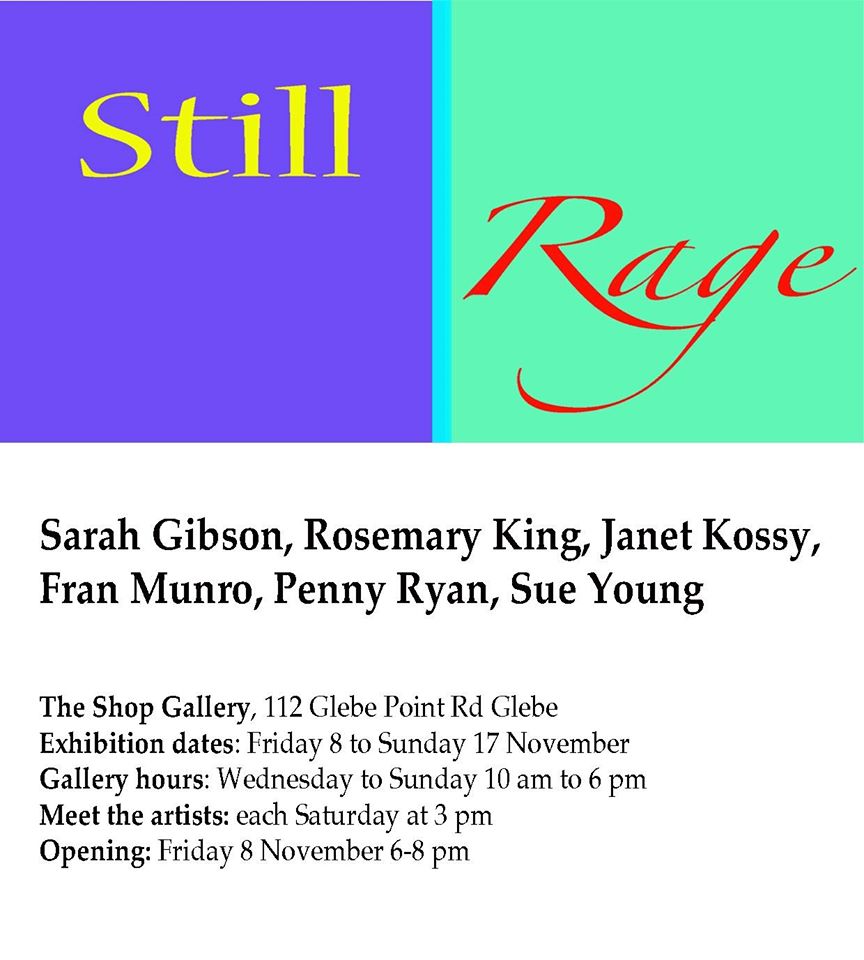
The Emerging Artist and five others have a terrific exhibition currently at The Shop Gallery in Glebe.

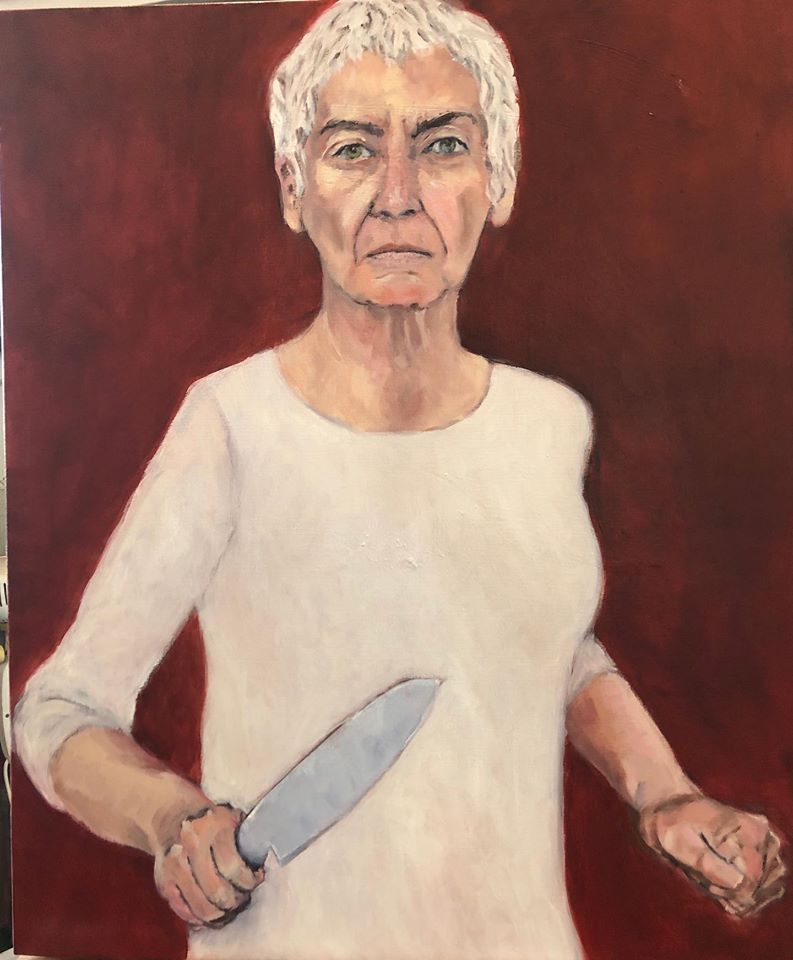
There are raging female monsters, exquisite still lives, images of brightly wrapped babies, orthodox Jews and patriots, a beatific Greta Thunberg, a powerful portrait of a Wiradjuri woman, ceramic cotton-reel pendants with unsettling inscriptions, and three images of a woman with a knife, including this one:

November verse 3: Woman with Knife – Red
She's got a knife and she will use it
if she must. Not so much rage
as weariness has made her lose it.
No choice but to turn the page
on compromise, compliance, meekness,
millennia of other-cheekness.
Her right hand's ready for the fight.
Her left holds hidden treasure tight.
No harpy, lamia, sphinx or gorgon,
no trained assassin, hired gun,
or martial artist out for fun:
a new sound blast, a whole new organ
shakes the floor. How good's that frown?
Good enough to bring you down.

Katharine Margot Toohey’s Vera Rudner

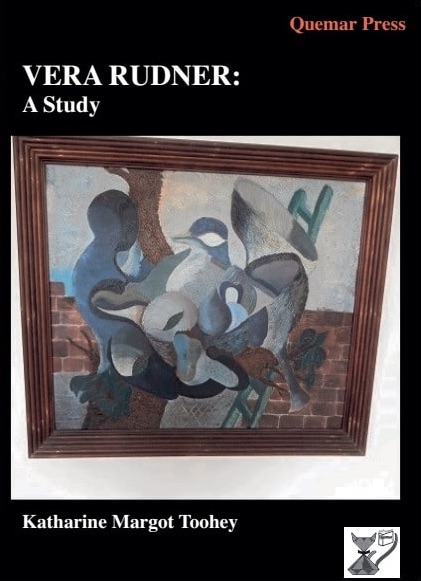
Katharine Margot Toohey, Vera Rudner: A Study (Quemar Press 2018)

A friend of mine (and no, this isn’t urban legend) recently attended a lecture on Australian modernist art at a mainstream tertiary institution in Sydney. The lecturer managed not to mention a single woman. When my friend protested, and rattled off a list of women who were crucial to the history, the lecturer was unapologetic.

Early this year at a prestigious Melbourne gallery, the same friend was lamenting the almost complete absence of women painters in a large exhibition of 20th century Australian art. Then we walked into one of the smaller rooms, and there they were, scores of them, crowded onto the walls four or five high without space for so much as a descriptive label: if you wanted to see who painted that sock knitter or that bridge in curve you had to consult an iPad chained to a seat in the middle of the room and scroll through the list. So the ladies had a room to themselves, all hugger mugger, and the real male artists, were shown as individuals.

It seems our institutions may have some trouble giving Australian women artists their due.

This tiny, almost zine-like book from Quemar Press is doing its bit to kick against the trend.

Vera Rudner, born in Berlin in 1922, fled the Nazis with her Jewish family and arrived in Australia in 1938. She studied painting at the aforementioned Sydney tertiary institution, among others, and painted a number of striking surrealist works before she stopped painting in 1948.

Two of her paintings are held in the National Gallery of Australia. Four are in the artist’s possession. One is known to have been destroyed – actually burned – because, according to the woman who inherited it, it ‘scared her grandchildren’. She hasn’t been completely ignored in the literature of Australian art, but she remained in relative – almost complete – obscurity until Jennifer Maiden’s poem ‘Sacrilege’ appeared in her collection, Appalachian Fall (Quemar 2017, link is to my blog post). It introduces Vera as a friend of some decades, and focuses on her painting for which the poem is named. It begins:

                I fear not doing her justice; however,
for a long time I've wanted to write a poem about Vera
Rudner.

That poem, and ‘Be Back in the Morning or Diary Poem: Uses of Toys’, named for another of Rudner’s paintings and published in Maiden’s brookings: the noun (Quemar 2019), are reprinted in this book, evocative amplifications of Katharine Margot Toohey’s prose.

The text of the book is in three parts. First is a brief biography presented as an extended captions to a series of photos – snaps of Rudner as a child movie actor (the movies were all destroyed by the Nazis), of a framed wedding photo; an exhibition catalogue; the cover of a book that mentions her work; and a recent shot of her with Jennifer Maiden. The second is a short general essay, and the third an explication of the six paintings that Katharine Margot Toohey has access to.

There are two colour photographs of each of the paintings, and a number of details in black and white. These are enough to whet the appetite to see the actual paintings, but because of the perennial problem of reproducing paintings as tiny illustrations and getting the colour right, it’s hard to feel they do much more than that. For example, the cover photograph of Suburbia (1945) has a predominantly blue-grey pallet; both internal reproductions are mainly warm yellows and oranges.

Some sections of the book are available online at Quemar’s website (click here), where the images seem much less problematic. If, like me, you’re vaguely aware of an ache in your brain where the history of women artists should be stored, I recommend you have a look.

Vera Rudner: A Study is the fourth book I’ve read for the 2019 Australian Women Writers Challenge. I’m grateful to Quemar Press for my copy.

Steve Shipps’ (Re)thinking ‘Art’

Steve Shipps, (Re)thinking ‘Art’: A guide for beginners (Blackwell 2008)

1405155639.jpgI read this book as an act of solidarity with The Emerging Artist. Thanks to a year-long series of lunchtime lecture–slideshows given by an art enthusiast in the French Department in my undergraduate years, I had a general idea of the history of Western art up to Picasso, so I could engage intelligently as she tackled assignments on Rembrandt or Watteau, but when she needed a sounding board on anything postmodern, I didn’t even know when to nod interestedly. She said she found Steve Shipps helpful.
The first sentence gave me hope: ‘This book grows out of bewilderment, skepticism and something like awe.’ Visits to contemporary art exhibitions have often enough evoked in me just that mix of emotions, plus occasionally the urge to deride. The book starts out with Doug Fishbone’s work 20,000 Bananas, which is what it says, a big pile of bananas dumped in the street, but could easily have started with Robert Gober’s  Drainsor Aleks Danko’s Trick Bricks or Sandra Nori’s amateur video of a Japanese anti-nuclear demo in the last Sydney Biennale.

Now that I’ve read the book, my bewilderment, scepticism and awe are pretty much still in place, but now they’re better informed.

It’s a short book, a guide for beginners as promised, that sheds light on a lot of contemporary discussions of art, not to mention art works themselves. There’s a terrific chapter titled ‘Pragmatics’ that describes a way to think about any given work of art – designed mainly for the student who has a paper to write, but with much broader application. But the book’s real interest is in its trickier and more provocative elements.

Shipp worked the book up from college lectures he has been giving since the 1980s, but he doesn’t patronise the teenaged student who is its imagined reader. In talking about de Saussure (Course in General Linguistics) and Danto (After the End of Art) and the Prague Linguistic Circle, he’s exemplary in his concern not to leave the reader behind, always carefully defining his terms and introducing his characters. It’s not ‘talk to me like I’m stupid’ or even ‘”art for dummies’ but it provides what the readers of such texts are looking for.

Apparently the idea of ‘art’ as we understand it today didn’t appear in the West until the Renaissance, and that the idea of art history didn’t appear until the late 18th century. ‘Art history’ traced the development of art – mainly painting and sculpture – from the Renaissance to the historian’s own time, and projected the new concept back onto works dating from cave paintings and the Venus of Willendorf. When the sculptures and plays of the ancient Greeks were created, Shipps maintains, they weren’t seen as ‘art’ in the way we have understood it for the last 600 years or so, but as what we would call craft. I have trouble getting my head around that, because surely Euripides and Praxiteles were famous for their works in their own time. But Shipps is adamant, and he backs his argument up with solid argument and lucid examples.

‘Art’ is not something that exists independently of what we call it, like a cow in a field, which is still there whether we see it as prospective food, a deity or an outsized pet. The term ‘art’ refers to disparate objects and activities, linking them in a category that exists only because of the term itself, and so it becomes hard to define. After much complex but always readable discussion, he says this on page 120:

what we seem to have come to, finally, is this: when we say ‘art’ what we mean is something  that invites – and justifies – a certain kind of attention. It seems to be that simple.

I love that, especially the word ‘justifies’. But, even given the interesting challenge of describing the kind of attention art invites, life isn’t that simple. The book goes on for another 40 pages, first arguing that we should describe as ‘art’ only those works that are created in a state of ‘flow’ and finally calling on us to stop thinking in terms of ‘art’ and ‘artists’ at all, and get on with doing for ourselves the things we have outsourced to them:

So much of the world has been described by now, and so many of those descrioptions made the more permanent for being ‘written down’ in whatever form, so much of our described experience has thus come to seem to be the way it ‘is’, that most of us are forced today to spend unprecedented amounts of time learning how things are ‘supposed to be’ and/or ‘supposed to be done’, and then doing them that way, so that our lives will proceed satisfactorily …
We are numbed by all the information through which we have to sort every day, so our experience of our experience, of ‘art’ or of anything else, becomes increasingly numbed as well … becomes, that is, increasingly anaesthetic …
We needn’t look far to see that there are things in our world today that could surely use some (re)thinking, and (re)describing. And I suspect that if we didn’t have ‘artists’ making ‘art’ to trust with doing that for us while the rest of us got on with our conventional, anaesthetic day-to-day lives, we all just might then tend to do more of it ourselves.

Bathurst Regional Art Gallery and Rhyme #5

On Saturday we drove to Bathurst to see an exhibition John McDonald had reviewed in the previous weekend’s Sydney Morning Herald. The exhibition’s full name is guwiinyguliya yirgabiyi ngay yuwin.gu gulbalangidyal ngunhi (they made a solitude and called it peace) by Jonathan Jones, in collaboration with the Bathurst Wiradyuri and Aboriginal Community Elders, commissioned  as part of the Bathurst Bicentenary.

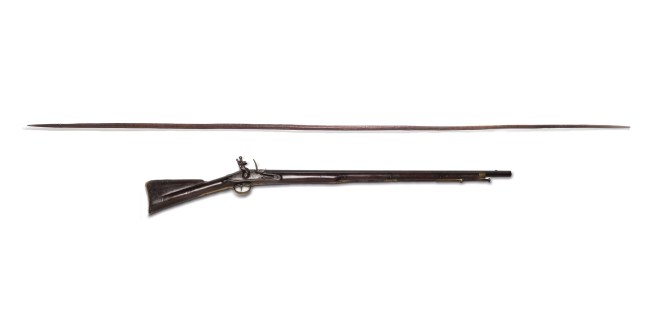
Musket_and_spearIt’s  not a vast exhibition, but its powerful. There are stunning video works – a giant screen on which the camera glides endlessly through beautiful bush, and a room with six portraits of Wiradyuri elders looking out at us from significant locations in the Bathurst area. The main room has a musket and a spear on the wall (though the image above, lifted from the BRAG website, is missing the musket’s lethal bayonet), and in front of them on the floor a circular arrangement of flint fragments and grevillea flowers: the catalogue explains that the stone is waste from a Wiradyuri and Aboriginal community stone-tool making workshop. In a second room an elegant shape on the floor, made up of mussel shells cast in bronze mixed with lead musket balls, points at a pile of dusty potatoes – again, the catalogue adds to what’s already a strong image by telling us that the Bathurst wars of the 1820s began when a Wiradyuri family was massacred over some potatoes. There’s a room with surveyors’ maps and traditional parrying shields around the wall, and another with the cadavers of six small trees painted gold. All of it is very beautiful, and all invites the viewer to find out more about the history of the Wiradyuri wars, and to meditate on that history.

If you’re interested you can download a PDF of the catalogue from the Bathurst Regional Art Gallery web site, but I recommend taking the trip to walk through the six small rooms of the exhibition in person. Apart from anything else, it’s a stunning example of work created by a very fine artist collaborating humbly with a community. In the catalogue, the Bathurst Wiradyuri and Aboriginal Community Elders say they have been working with Jonathan, ‘directing him, teaching him and supporting him’. The drive from Sydney isn’t so long. We stayed overnight because the weather was threatening, but we could have done it as a day trip.

There is one room we didn’t see. It features two possumskin cloaks, made by members of the local community and evoking a moment when Windradyne, the great warrior leader, presented a similar cloak to Governor Macquarie. It was our good fortune to visit the gallery while a weaving workshop was happening in that room, so we stayed out. (We did see the gorgeous cloaks in a room that isn’t part of the exhibition but which, on Saturday, was temporarily home to them and an array of objects woven by local people.) This was good fortune for two reasons: first because during our visit the gallery was filled with the sounds of Aboriginal people enjoying each other’s company, in effect proclaiming their resilience; and second because two elders generously absented themselves from the workshop to chat to us whitefellas about the cloaks and the woven objects, about the Wiradyuri dictionary app, about the uses of some woven objects (‘Good for carrying babies, but not much good for water. That’s why we have bottles for beer.’).

And it’s November, so here’s an attempt to say in verse what I can’t figure out how to say in prose:

Rhyme #5: An exhibition in Bathurst, November 2015
Steel v hardwood, stone and blossom,
mussel shells v musket balls,
prim English maps, cloaks of possum.
Unsmiling elders on the walls
Look out from Country. Devastation
here finds mute  commemoration.
The Romans made their solitudes
and called them peace. Such platitudes
prevail now too, the past obscuring.
But lively voices here resound,
Wiradyuri are still around. 
They greet us, chat with us, ensuring
that we whitefellas will own
that solitude, but not alone.