Tag Archives: Chloe Hooper

Garner, Hooper & Krasnostein on tape

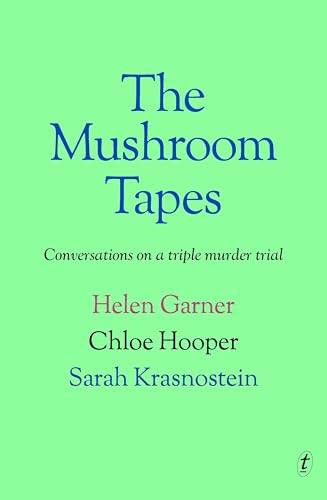
Helen Garner, Chloe Hooper & Sarah Krasnostein, The Mushroom Tapes: Conversations on a triple murder trial (Black Ink 2025)
A couple of years ago, in an attempt to limit the way this blog ate into my time, I decided that when I was writing about a book, I would focus arbitrarily on the page that corresponded to my age. No attempt at a proper review, no selection of the most quotable bits, just a look at one page.

It didn’t work out to be a time-saver. As often as not, the discussion of page 77, then page 78, became an added extra to a general discussion of the book.

I hereby resolve to stick rigorously to page 78 (and soon to page 79), and assume that my readers can go elsewhere for proper, thoughtful reviews.

The Mushroom Tapes is a good book to start my new policy. Few Australians won’t know about Erin Patterson’s trial last year for murder involving a Beef Wellington made with deadly mushrooms served up to her in-laws. If you really know nothing about it, here’s a Wikipedia link. Almost as few readers won’t know who Helen Garner, Chloe Hooper and Sarah Krasnostein are. (I’ve linked their names to lists of my blog posts where they appear.)

This book was originally conceived as a podcast in which three writers who have covered criminal trials chatted about this one. The podcast came to nothing, and they made a book from the tapes. I come close to being its ideal reader because I managed to pay very little attention to the trial as it was happening, so I didn’t come to it suffering from mushroom-overload.

Page 78 is one of the pages that records the writers/tapers’ conversation while driving around. It occurs in Part II, ‘The Church and the House’. They have visited the church where Erin Patterson and her in-laws worshipped, and then her house. Sarah Krasnostein, the only one among them who is an actual lawyer, has just given a little lecture about the pros and cons of a guilty plea. Helen, always the one to draw attention to details of the environment, has asked what some black cattle all spread out on a hill ‘in a lovely way’ are called. Chloe has a stab at an answer:
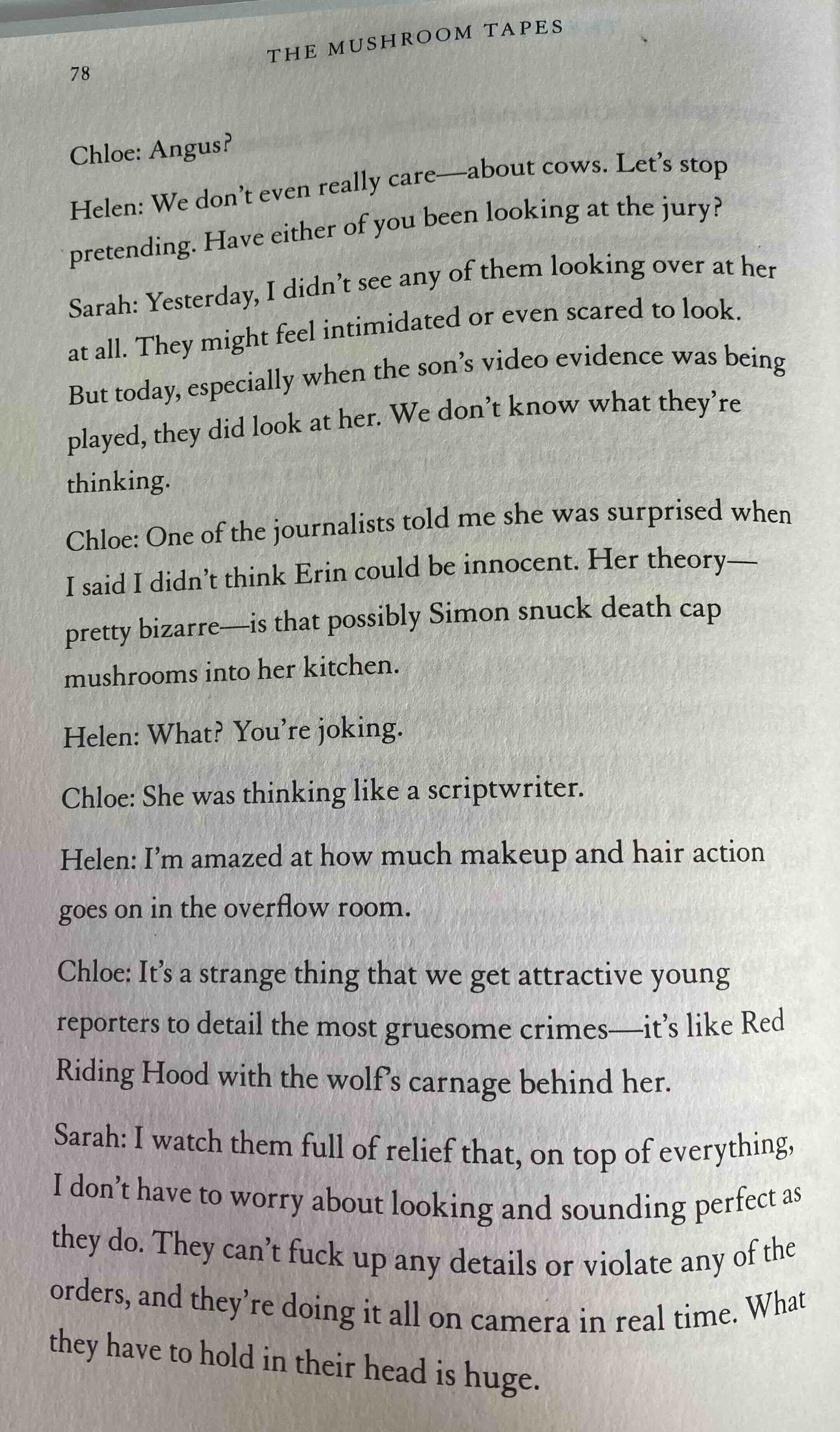
It turns out the page gives a good sense of the flavour of the conversations generally. There’s not a lot of rambling. Having raised the subject of the cows, Helen abruptly shuts it down: ‘We don’t even really care – about cows!’ And they’re away trading insights and observations – about the jury, and for most of this page about the journalists following the case.

Sarah’s comment on the jury is the kind of thing that all three of the women contribute. They don’t all manage to get into the courtroom at every session, so each of them has a brief to observe as fully and acutely as they can and report back. What emerges is a number of verbal sketches of Erin Patterson herself in the dock, and of other players – jury member, witnesses, lawyers, and perhaps especially Ian Wilkinson, the Pattersons’ pastor sitting in dignified silence in the back row. Sarah’s comment on this page, ‘We don’t know what they’re thinking,’ is again typical. Though they occasionally agonise over whether they are just a part of the media circus / witch hunt that surrounds the case, and though much of the book feels like chat among friends, at heart these are three serious observers. None of them wanted to take on the slog and heartache of writing a book about the case, but each of them takes her role as witness seriously. As this page exemplifies, all three bring feminist perspectives to the task: here they are talking about the lot of young female journalists, but elsewhere they also bring an unsettling degree of sympathy to a woman who would kill her in-laws.

People who still see Helen Garner as the ogre who was mean about younger women in The First Stone (some of the most vocal of whom haven’t actually read the book ‘on principle’) might find fuel for their fires here: her astonishment at a journalist’s ingenious theory of Erin Patterson’s innocence pretty much leaps off the page, and she expresses amazement at the ‘makeup and hair action’ among the young women journalists. (On page 79, she sticks to her guns: ‘Everybody should smile less, especially women, in public. Every advertisement or commercial is full of people smiling with unnatural vehemence, and it drives me insane.’) I read this grumpiness less as critical of the young woman than decrying the pressure on them to look the part.

Chloe, a couple of decades younger than curmudgeonly Helen, is more sympathetic. She sees the young woman’s theory as bizarre, but recognises the story-telling impulse: ‘She’s thinking like a script-writer.’ Mind you, her image of the attractive young reporters as being ‘like Red Riding Hood with the wolf’s carnage behind her’ shows that she also has a script-writer’s eye. (Which is the kind of thing that makes this book very readable.)

Sarah, who may be a decade or so younger than Chloe, has even less distance. I don’t want to say that she’s humourless, but she tends to be the one who supplies facts in the conversation: facts about the law, and also for instance about toxic mushrooms. Here she reminds the others, and us, of the exigencies of the young female journalists’ worklives. (I remember hearing somewhere that a female television journalist’s hair is an important tool of her trade.) On the top of the next page, it’s Chloe who amplifies the point: ‘Whereas the male crime-journalists look grizzled and broken.’

That’s it. So much more to say about the book. You can read about it all over the place.


I  wrote this blog post on the land of Gadigal and Wangal of the Eora nation. I acknowledge their Elders past and present, and welcome any First Nations readers.
Bookblog #63: Read-alouds

[This post originally appeared in my previous blog on 16 April 2009. I’m restoring it now because I’m writing about The Mushroom Tapes, of which Chloe Hooper is one of the authors.]

Chloe Hooper, The Tall Man: Death and Life on Palm Island (Hamish Hamilton 2008)
Donald Horne and Myfanwy Horne, Dying: a memoir (2007, Louis Braille Talking Books 2008)

Over the Easter break, Penny and I drove to Airey’s Inlet in Victoria to spend a very pleasant couple of days with her brother. The drive there and back, down on Thursday in ten hours and back on Tuesday in twelve, was remarkably hassle-free. As is our custom, I read a book aloud; in an extension of the custom, we also took a Talking Book, because on our last long car trip my voice needed enough resting to create long bookless stretches. As it turned out, the constant application of eucalyptus and honey lollies meant I had much greater stamina this time, and we read the whole of our read-aloud choice, and then listened to half of the talking book in our last couple of hours on the road.

Pasted Graphic

The Tall Man is beautifully written, complex, passionate and about an important topic – so it was a perfect read-aloud. I hadn’t read Chloe Hooper’s article of the same name in the Monthly a while back, and knew only the vague outline of the case: Aboriginal man dies in the cells of horrific injuries; the policeman who arrested him for swearing in the street was the only one alone with him between his arrest in good health and his death a couple of hours later; policeman almost wasn’t even brought to trial, and then was acquitted of any wrongdoing; Aboriginal people who rioted in protest treated to the full force of the law.

A young creative writing student from Melbourne told me that his teacher praised the book for its even-handedness; and I’ve seen it praised elsewhere for not taking sides. In my view such praise is misplaced. Chloe Hooper combines a journalist’s attention to evidence with a novelist’s eye for the telling detail. She is careful to give the process of law its full due and at no stage makes an explicit judgement. Given that Senior Sergeant Hurley, the tall and bulky policeman at the centre of things, wouldn’t talk to her, she does a very good job of conveying a sense of him as a human being – a generous, thoughtful man under incredible pressure of many kinds. But it’s very clear that her sympathies lie with the bereaved Doomadgee family, and it’s very easy for a reader to come to conclusions that are at odds with those of the jury in the final pages.

We stopped reading fairly often to reflect on how the book illuminated or was illuminated by our own recent experiences in Cairns, my niece Paula’s book, my own family’s comparatively tiny brush with the Queensland police force’s culture of violence (I’m talking 50 years ago, when my brother was punched by a policeman who’d arrested him for dangerous driving, and a police enquiry found that it hadn’t happened – that he already had a black eye when he got into the van), the  ‘You can’t handle the truth!’ speech by the Jack Nicholson character in A Few Good Men. We noticed the preponderance of Catholics in the story. We ruminated on the validity or otherwise of the north-south divide (northerners dealing with harsh realities, southerners sitting comfortably in judgement) as a way of understanding the world. Terrible subject, terrific book.


Pasted Graphic 1

I suppose the same could be said of Dying: terrible subject, terrific book. It’s also a great read-aloud. When Donald Horne knew he was dying of progressive lung disease he decided to keep a journal of his dying, as well as putting together a number of essays on things he wanted to say about cultural matters before he could no longer write. This book is the result, with the addition of an essay by his long-term companion, wife, editor, lover and friend, Myfanwy Horne narrating the time leading up to his death and shortly afterwards. Our journey ended halfway through Myfanwy’s account, so we didn’t hear any of the cultural essays. I intend to get hold of the book and read the rest, because what we did hear was miraculous. The only other of Donald Horne’s books that I’ve read is The Education of Young Donald (1967). I must read more. I hope it’s not too spoilerish to quote the last paragraphs of Donald Horne’s narrative:

When I have done as much as I am physically able on this project, I would like to be allowed to drift off into greater ease. I don’t mean physical ease – that I’m told will come. The kind of ease that I would like would be to drift off into long established habits of contemplation. For example, I can no longer look around the street and look at things, but I can still remember looking. I can’t go for walks, but I can still remember walking. I can’t go into art galleries, but I can still remember paintings. I am almost utterly unable to read seriously, but I can still contemplate the snatches of reading that drift around in my mind.

My final drifting away by a morphine dose, I would want to be among my memories, with Myfanwy, whom I love, holding my hand.

Fun Fearless Niece

My fabulous nieces turn up in the most unexpected places. One of them is in the shortlist for Cosmopolitan’s Fun Fearless Females 2009 awards. I’m not surprised to discover that I hadn’t heard of most of the other people on the short list. None of the bloggers, for example, have crossed my radar– I went for a look and understood why, but I won’t go on about that. My niece Paula is on the Authors shortlist – along with the formidable Chloe Hooper and a number of others who have been invisible to me until now, though I don’t expect my ignorance has caused them much heartache.

I cast my vote in a number of categories. Why don’t you go and cast yours? The good thing is you’re not restricted to the names they’ve listed. You can add your own. Perhaps there’ll be a write-in landslide for Lowitja O’Donoghue in the Inspirational Role Model category.

NSWPLA Dinner [2009]

[Retrieved from 18 May 2009]

Tonight writers, translators, illustrators, publishers, agents and fans put on their glad rags and turned up for a glittering evening in the Art Gallery. The occasion was the annual NSW Premier’s Literary Awards dinner. This year’s dinner cost $15 more than last year’s.

In previous years the dinner has been organised by staff of the Ministry of Arts. This year it was in the hands of the Department of Arts, Sport and Recreation. The transition was seamless, though there was a slightly awkward moment when the Department’s Director General, who was our MC, said we were doing very well for an arts event and only running half an hour late. There was no hiss of indrawn breath, but I did think it indicated she was much more familiar with sporting events than with arty ones, where my experience has been there is an obsession with punctuality. And at times, as she urged us to resume our seats after a break, her tone was reminiscent of what one would hear over the loudspeaker at, say, a netball tournament. But these were amusing foibles that in no way took away from the pleasure of the evening.

Nathan Rees, more famous for his stint as a garbo and for having inherited a train wreck of a government than for his Eng Lit Hons degree and likeability, gave the impression that he was much happier here than in the bearpit of politics. In his welcome (which followed Aunty Sylvia Scott’s Welcome to Country, in which she said, ‘Your books let me travel’), he spoke of his own passion for books, and told us that some left him cold, surely a mark of a genuine book lover. And he said, interestingly, ‘The examined life is only ever the turn of a page away.’

This was the thirtieth year of the awards, and there was slightly more reminiscence than usual. Neville Wran, the first Premier of the Literary Awards, was there and gave a brief talk on their genesis. Success has many parents, he reminded us, but failure is always an orphan. Of the many people who have claimed m/paternity of these awards, he assured us in his ruined voice, the one who could truly claim parenthood was his wife Jill, who insisted that Sydney should have a writers’ festival distinguished by literary awards. He mentioned the legendary Night of the Bread Rolls in 1985 when the guest speaker Morris West was pelted with bakery products. I’d heard that it was because he droned on. One of my dinner companions was there on that night, and he assured us that it was because the literary types were envious of Morris West’s best-seller status.

Marieke Hardy, of Reasons You Will Hate Me, gave the Address, with a tattoo on each shoulder and a large red flower behind one ear. She spoke of Twitter and quoted Stephen Fry to good effect. In the past, I’ve referred to these dinners as the Oscars of the introverted. Marieke went several steps better and, referring to booklovers out and proud, called it ‘our Mardi Gras’.

As in past years, it’s my pleasure to list the winners with random observations:

The UTS Prize for new writing: Nam Le, The Boat
There’s no short list for this prize, so the announcement was a bit of a surprise. It’s a wonderful book. The award was accepted by Nam Le’s publisher, who read out a short speech Nam had sent him from Italy.

The Gleebooks Prize for an outstanding book of critical writing: David Love, Unfinished Business: Paul Keating’s interrupted revolution
Nathan ‘s script described this as an accessible account of important economic matters. I’m afraid I didn’t understand a word of the brief acceptance speech after the initial ‘This is one for the true believers!’

The Community Relations Commission Award : Eric Richards, Destination Australia: migration to Australia since 1901
Eric Richards spoke of how Australia’s immigration program has been an outstanding success, yet has been and is still a cause of widespread anxiety. He was expecting the book to provoke ‘historical warfare’, but so far there has been none.

The Translation Prize and PEN Trophy: David Colmer
He seems to be a nice man – he translates from Dutch.

The Play Award: Daniel Keene, The Serpent’s Teeth
I saw the STC production of these plays, and was less than impressed by the production, though the plays as written seemed to be marvellous. I approve.

The Script Writing Award: Louis Nowra and Rachel Perkins and Beck Cole, First Australians
In announcing this prize the Premier said, quite rightly, that it was hard to go past this show, but then he went and spoiled the moment by feminising Mr Nowra’s first name. When Rachel Perkins took the mike she pointed out the error. Our Nathan looked suitably abashed, and Louis clearly couldn’t help himself: ‘How long do you plan to stay in government?’ he asked, trying to make it sound good-natured. Ow!

The Kenneth Slessor Prize for a book of poems or for a single poem of substantial length published in book form: LK Holt, Man Wolf Man
Possibly intimidated by the compere’s reminders of the importance of being brief, LK Holt simply thanked her publisher and took her prize. She did stand at the microphone long enough to enable those of us close enough to read the enigmatic tattoo on her left shoulder: ‘MCMLXN’.

The Ethel Turner Prize for a work written for young people of secondary school level: Michelle Cooper, A Brief History of Montmaray
At this stage I began to feel very under-read.

The Patricia Wrightson Prize for a work for children up to secondary school level: Ursula Dubosarsky & Tohby Riddle, The Word Spy
And then I started to feel like an insider again. Tohby and Ursula have both worked at The School Magazine. I read this book in its first incarnations as a series of columns in the magazine, and I was sitting at the same table as both of them – along with two other generations of Ursula’s family and Tohby’s wife Sally. This is the fifth gong Ursula has collected from NSW Premiers. Though it’s no longer a gong.: to mark the 30th anniversary, a new trophy has been created, by Dinosaur Designs: a hefty, transparent, book-shaped objet.

The Douglas Stewart Prize for a prose work other than a work of fiction: Chloe Hooper, The Tall Man: Death and Life on Palm Island
I’ve read this too, and think it deserves any prize anyone chooses to give it.

The Christina Stead Prize for a book of fiction: Joan London,The Good Parents
I haven’t read this, but it’s been very well reviewed in my house. Joan London gave a sweet speech, acknowledging , among other things, her debt to her children.

The People’s Choice Award: Steve Toltz, A Fraction of the Whole
I hadn’t voted, because I’d only read two of the books, and this wasn’t one of the ones I’d read. The same man who had accepted Nam Le’s award accepted this one, but Steve Toltz, who couldn’t be there, hadn’t tweeted him anything to say, so he just looked pleased.

Book of the Year: Nam Le, The Boat
Then the poor guy had to get up for the third time, and gave us the second half of Nam Le’s emailed acceptance speech, in which he thanked his readers, ‘both professional and normal’. As one who used to be a professional reader who is striving for normality, I loved this.

The Special Award: Katharine Brisbane
Katharine was my first employer, when she was Managing Editor at Currency Press, and I couldn’t be more pleased at her receiving this recognition. She adlibbed an elegant speech about the importance of recognising achievement in the arts. She has received a number of awards in her time, she said, but this is the first one to come with money attached. She closed by saying that she too had been there in 1985. ‘We pelted Morris West with bread rolls because he warned us that we had to be prepared for bad things. The Baader Meinhofs were in the news, and he was warning us against terrorism. We thought he was ridiculous, but he was right.’

And then it was all over bar the networking …

… and the journey home. As I was walking back towards the city from the Art Gallery, I drew alongside a rough looking man going in the same direction. He said hello and asked how the evening had gone. ‘We’re homeless, you see, we sleep just beside the porch there.’ We chatted for a couple of minutes. He told me who had won the People’s Choice at the Archibald. I tried to tell him about the Literary Awards, but I think he still thought I’d been at something to do with paintings. As we parted, he said, in an eerie echo of Nathan Rees’s comment about the examined life: ‘People don’t realise it, but you’re always just one step away from the gutter,’ and we wished each other good night and good luck.