Tag Archives: First Nations

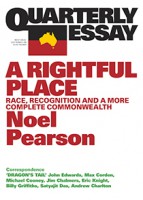
Russell McGregor’s Indifferent Inclusion

Russell McGregor, Indifferent Inclusion: Aboriginal people and the Australian nation (Aboriginal Studies Press 2011)

0855757795

On a recent edition of the ABC’s Q&A, Senator Nova Peris was discussing the proposed acknowledgement of Aboriginal and Torres Strait Islander peoples in the Australian Constitution. ‘As Aboriginal Australians,’ she said, ‘we are excluded. For such a long time we were regarded as flora and fauna. It’s about making a wrong right.’

Paradoxically, the 1967 removal of the Constitution’s two mentions of Aboriginal people (and, by implication, Torres Strait Islanders) was a significant step towards inclusion.

According to Russell McGregor, those two references resulted from indifference. He argues that the first, which prevented the federal government from making laws with respect to ‘the aboriginal race’, dates from the 1891 draft where it was inserted in order to protect the rights of Maori if, as then expected, New Zealand joined the new nation; when New Zealand withdrew, nobody cared enough to take the clause out. The other mention – ‘In reckoning the numbers of the people of the Commonwealth, or of a State or other part of the Commonwealth, aboriginal [sic] natives shall not be counted’ – rested on the assumption, he argues, that Aboriginal people counted for little. ‘Neither section,’ he continues, ‘formally excluded [Aboriginal and Torres Strait Islander peoples] from the legal rights and entitlements of Australian citizenship, but both implied that Aboriginal people were outside the community of the Australian nation.’

Indifferent Inclusion charts the decades of debate and changing attitudes among settler Australians, and activism and argument on the part of Indigenous Australians, that led up to the 1967 Referendum, in which an unprecedented 90 per cent of the electorate voted for change. It hardly needs saying that the Referendum was not the end of exclusion. Four years later, in what might have provided an epigraph for this book, a FCAATSI report described racism in Australia as mainly ‘cold, callous indifference to Aborigines, rather than intemperate hatred’. Punctuated by momentary expressions of good will such as the Walk Across the Bridge, the Sea of Hands and the Apology for the Stolen Generations, that indifference has persisted and non-Indigenous Australians have been largely silent in response to Aboriginal Deaths in Custody, the Northern Territory Intervention, and straws in the wind such as our Prime Minister’s recent description of the continent as ‘unsettled or, um, scarcely settled’ before 1788.

All the same, the story told here is one of progress. On one hand the voices of Aboriginal and Torres Strait Islander activists gain progressively more effective platforms, and the narrative introduces any number of passionate and eloquent individuals who ought to be household names: William Cooper, Jack Patten, Bill Ferguson, Stan Davey (author of a pamphlet on assimilation titled Genesis or Genocide?), Faith Bandler and more. On the other, settler Australia’s self image grows and develops, and with it the image it projects onto Indigenous Australians.

McGregor begins with the policy of ‘absorption’ which, though never official government policy, dominated the thinking of government departments charged with Aboriginal affairs in the 1930s, underpinned by what now looks like a bizarrely irrational emphasis on the importance of white skin to the Australian identity. This policy was a cold-blooded plan to control the relationships of people of part-Aboriginal heritage so that they had children only with white partners. This was called ‘breeding out the colour’: within a few generations, Australians would all have white complexions, and the treasured myth of ethnic homogeneity would prevail. ‘Full-blooded’ Aboriginal people would either die out or be kept cordoned off in the Western Desert, on tracts of lands to which the only non-Aboriginal people with access would be scientists. Most alarmingly, the dominant public opposition came from people who objected that the plan would corrupt the purity of the white race.

However, the self image of settler Australians did change, ‘blood’ (aka skin colour) giving way to ‘way of life’ as the main defining factor (as the White Australia Policy came to feel more anachronistic). In a number of ways, non-Indigenous people began to appreciate something of Indigenous culture: the Jindyworobaks had their doomed idea of finding a true Australian national identity by appropriating Aboriginal culture, but even kitsch tea-towels and wallpaper with ‘Aboriginal’ motifs reflected this growing appreciation. The voices of Aboriginal and Torres Strait Islander activists began to be more widely heard – the 1938 Day of Mourning was a landmark event; men served in World War 2 (though their enlisting had been resisted by conservatives who feared rightly that if they fought for Australia their claim to inclusion in the national community would be strengthened); Albert Namatjira and others demonstrated that artistic creativity wasn’t the sole preserve of non-Indigenous people; perhaps more influentially, Lionel Rose, Evonne Goolagong and others demonstrated that Aboriginal people could excel in sport.

‘Assimilation’ became the key policy word, which, although it has a bad odour these days, was supported in the 1940s and 50s by leading Aboriginal activists. According to McGregor, the assimilationist policies didn’t always, or even most of the time, entail the loss of Aboriginal identity and community: the distinction which came later, between assimilation and integration, was really an attempt to differentiate between two tendencies within the assimilationist movement. On the one side, for example, Paul Hasluck, who was Commonwealth Minister for Territories from 1951, proposed a version of assimilation in which

the Aboriginal cultural heritage would not disappear, but rather would dissipate into folkloric remnants, and Aboriginal identity would not be erased but privatised, contracting to little more than an individual’s sense of personal ancestry.

On the other side, anthropologist A P Elkin wrote:

The Aborigines are racially different from us, and recognizably so. In spite of the economic, religious, social and political assimilation at which we aim, they will be a distinct group, or series of groups, for generations to come. Indeed, they will develop pride in their own cultural background and distinctness while at the same time being loyal and useful citizens.

Elkin’s language was to change, but when he wrote this, he was using the language of assimilation. By 1961, most supporters of assimilation policies were towards Elkin’s end of the spectrum. It was generally understood that assimilation (or integration) did not mean the end to distinctive Aboriginal identity, culture and language. It was a question whether something was being done to Indigenous people, or with and by them.

I had vaguely supposed before this eminently readable book put me right that the 1967 Referendum gave Indigenous Australians the vote. But it turns out that the reading of the Constitution that led to their disenfranchisement had been successfully challenged before then. In spite of the rhetoric of the Yes campaign – ‘Right Wrongs, Vote YES for Aborigines on May 27’ – the Referendum didn’t change very much at all, and the federal government of the day under Harold Holt chose not to use their new powers, not to rock the boat. In the domain, its as if every change, seen to be huge as it approaches, turns out to be tiny.

These pages are full of odd and admirable characters, and any number of curious incidents. One truly odd moment was a piece of legislation ushered in by Paul Hasluck, the Northern Territory Welfare Ordinance 1953, subtitled An ordinance to provide for the care and assistance of certain persons. The striking thing about this legislation was that, while its concern was entirely with Aboriginal people, it never once used any version of the term ‘Aboriginal’, because Hasluck believed that no distinction should be made on the basis of race in legislation: it was easy enough to work out what distinct group was being declared wards of the state, of course, but somehow not using the name was meant to make it less discriminatory.

Many of the debates and attitudes covered here feel weirdly alien now but, as Nova Peris’s choice of language illustrates, the issue hasn’t gone away, and it’s sobering to reflect that what was once believed and spoken out loud is still lurking somewhere in our minds, unacknowledged even to ourselves. One one hand, The past is another country. They do things differently there. On the other: The past is never dead. It’s not even past.

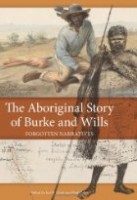
The Aboriginal Story of Burke and Wills from CSIRO

Ian D. Clark & Fred Cahir (editors), The Aboriginal Story of Burke and Wills: Forgotten Narratives (CSIRO Publishing 2013)

0643108084History, as Winston Churchill famously said, is written by the victors. As someone else has surely said, it’s also passed on by word of mouth among the conquered, and – if we’re lucky – revised by the descendants of both. Although only one of the essays in this collection is written by an Aboriginal author, the book is a happy example of that kind of revisionism.

Every schoolchild of my generation and earlier knew the Burke and Wills story: the successful crossing of Australia from south to north, the terrible coincidence of arriving at the Cooper’s Creek depot hours after their supply party had given up waiting for them, the Beckettishly symbolic ‘Dig Tree’, the wretched death of most of the party in the ‘wilderness’, the survival of King among an Aboriginal community, the retrieval of the bodies. As one of the essays in this book comments, the story is a key example of ‘the mythology of victimhood that, ironically, secures a settler claim to cultural legitimacy by marginalising the actual victims of colonisation – namely, Aboriginal people’ (Leigh Boucher, ‘Alfred Howitt and the Erasure of Aboriginal History’, p 255).

The myth-making impulse was so strong that no official account of the Victorian Exploring Expedition of 1860–61, to give it its full title, was attempted at the time, and it wasn’t until 2011, when CSIRO published Burke and Wills: The Scientific Legacy of the Victorian Exploring Expedition, that the expedition’s scientific achievements were explored in any systematic way.

The Aboriginal Story, edited by two Bathurst University academics, explores the other major area that has been largely neglected by the scores of journalists, novelists, filmmakers, painters, poets, sculptors and yarners who have dealt with the expedition, namely ‘the interaction between Indigenous people and the expeditioners and their potential and actual contribution to the expedition’ (p. v).

Not everything here is news. As a postgraduate student 40 years ago, I read the selections from Wills’s diary and letters published by his father, and was left in no doubt that Burke’s arrogant dismissal of Aboriginal hospitality and ABoriginal knowledge played a major part in his disastrous end. My abiding memory from that reading is the image of the bearded Irish policeman, close to death from starvation, knocking to the ground an armful of freshly caught fish being offered to him by a group of Aboriginal men.

That perception and that image occur in a number of the essays here, but there is much more. The book opens with an introduction by Aaron Paterson, a Yandruwandha man, descendant of the community in whose land Burke and Wills died, the people who cared for John King, the expedition’s only survivor. His lyrical description of his country demolishes in a couple of pages the whole edifice underpinning the tragic explorer myth: Burke and Wills weren’t crossing an implacable wilderness, but stumbling ineptly through other people’s home.

And it goes on from there. This is a collection of scholarly essays, each meant to stand alone if need be, with the result that there is a lot of repetition: the reader is introduced to characters such as the expedition artist Ludwig Becker many times over, and there is no single account of the expedition. I skipped a little, but only a little: most of it is fascinating reading – we learn about the languages of the people encountered by the expedition; there are Becker’s wonderful drawings of landscape and people, including the images on the cover; encounters with Aboriginal people quoted from the journals of members of the expedition and the follow-up expeditions; portraits of a number of the minor figures in the expeditions, including the Aboriginal men who worked as guides at various times; some scuttlebuck about Burke’s death and the daughter King may have fathered with an Aboriginal woman; an essay on Aboriginal people as messengers on the Australian frontier (a role which, unlike their role as trackers and as ‘native police’, has generally faded from the collective memory).

For me the most surprising essay was Peta Jeffries’ ‘The influence of Aboriginal country on artist and naturalist Ludwig Becker of the Victorian Exploring Expedition: Mootwingee, 1860–61’ (and yes, the essay titles generally aren’t too snappy), in which she explores one of Becker’s paintings, arguing that it prefigured an understanding of Aboriginal connection to country, that in it ‘the narrative of colonial occupation has subsided’. The most telling essay was the one by Leigh Boucher that I quoted from above, which demonstrates that Howitt’s early writing acknowledged the important role Aboriginal people played in the success of his expedition, but as time passed they disappeared from the story, their knowledge and help being replaced by Howitt’s own bushcraft. Genocide comes in many forms, and one of them is forgetting.

The ‘narrative of colonial occupation’ has dominated accounts of the Burke and Wills expedition and much else from Australian history until now. This book is a mostly very readable corrective. It’s worth noting that it doesn’t present a single ‘Aboriginal story’, as its title suggests, but many stories: there was a wide range of Aboriginal responses to the original expedition and to the follow-up expeditions, from active participation in a number of capacities, through benign oversight to outright hostility. As I read it, I could feel unexamined assumptions being dragged out from under rocks in my head, and the over-arching narrative of my early education being delivered another blow of the wrecker’s hammer.

Noel Beddoe’s Yalda Crossing

Noel Beddoe, The Yalda Crossing (UQP 2012)

0702249394 As Noel Beddoe says in an Author’s Note, this book is fiction, but adheres closely to the history of white settlement near what is now the township of Narrandera, including the Second Wiradjuri War and the massacre on Murdering Island. That’s the same massacre that lies in the background of our short film Ngurrumbang and Andy Kissane’s poem ‘The Station Owner’s Daughter, Narrandera’ that inspired us. It’s my great good fortune that the book wasn’t published until the screenplay was complete and pre-production was well under way – the first I heard of it was a comment from Jim Kable on my blog entry inviting people to donate via pozible. If I’d known of the book any sooner,  I would probably have been scared right off.

It’s a formidable achievement. Told from the point of view of Young James Beckett, as a teenager in the 1830s and as an old man in Sydney decades later, it is deeply embedded in its historical moments, and has a powerful sense of place. We care about the characters and come to appreciate their secrets and mysteries, not all of which are revealed, and some not until the last pages. The unfolding narrative gives us neither the ‘dun-dreary naturalism’ that Patrick White hated in Australian fiction, nor the black armband breastbeating that John w Howard claimed to discern and despise among Australian literati, nor again a ripping yarn of the frontier (though unless I’m very confused, Young James mentions reading some James Fenimore Cooper, whose novels must have been hot off the press). The tensions of the colonial society are there – English vs Irish, convicts vs free,  authority vs opportunism, women as a tiny, vulnerable minority – but they are embodied in recognisable individuals, facing particular dilemmas. I started this blog entry with the massacre, and most of the publicity for the book has centred around it, but the social, economic and moral world of the settlers is thoroughly fleshed out in its own right well before the prospect of massacre appears on the horizon.

Unlike other fictional treatments of atrocities against Aboriginal people, The Yalda Crossing lays the ground so that we understand how good people can deliberately commit abominable acts, not without reluctance, revulsion and remorse, but with a terrible sense of necessity. The good people who set the tone of the community aren’t drawn into the vortex of violence created by people less grammatically correct than they: when push comes to shove, they are the ones who orchestrate the terrible acts. Launching the book at the Sydney Institute last July, Linda Burney said that as a Wiradjuri woman, descendant of the victims, she had to skip the chapter where the massacre happens and come back to it later. Noel Beddoe, descendant of the perpetrators, doesn’t blink, and invites us, his semblables, to face our heritage with similarly unflinching gaze.

Linda Burney quoted a moment just before the massacre when a white man refuses to take part because he would lose his soul, which is more important to him than gaining the land. (Incidentally, it’s a gauge of the strength of Noel Beddoe’s writing that only when I typed it like that did I recognise the Biblical reference there.) For me, one of the devastatingly true things in the book is how that man, in spite of his genuine refusal to take part, is nonetheless in the end completely implicated.

Every bit as good, I think as Thea Astley’s A Kindness Cup or Kate Grenville’s The Secret River. (Links are to my blog entries, though the one on Kate Grenville’s book is very brief.)

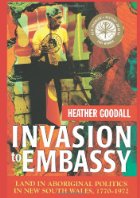
Heather Goodall’s Invasion to Embassy

Heather Goodall, Invasion to Embassy: Land in Aboriginal Politics in New South Wales, 1770–1972 (Allen & Unwin in association with Black Books 1996)

I recently heard a distinguished novelist claim that she grew up believing New South Wales was mostly settled peacefully and that damage to the original inhabitants was largely unintended, caused by infectious diseases and the like. Despite having been correctly described by a commenter on my auxiliary blog as not knowing shit about Aboriginal matters, I was slightly better informed than that in my childhood: I knew there was a lot of frontier violence. But I think I’m like most non-Indigenous Australians in having assumed, complacently enough, that Aboriginal people, at least in this state, were irrevocably dispossessed and driven from their land in the early years of settlement. In other words, all the really bad things were done long long ago, probably by people who were just acting according to the morality of their times. Um, well, mea culpa.

The dispossession of Aboriginal people in Australia has been a long, painful process. It has played out very differently in different states and territories and different regions within states, and been resisted at every phase by Aboriginal people and their allies, using means ranging from armed resistance to eloquent letters to the press. Invasion to Embassy tells the New South Wales history, and although the stories it tells are grim, often heartbreaking, I found it exhilarating: in these dying days of what W H Stanner called the ‘great Australian silence’ – the relegation of Aboriginal experience to footnotes in our history – books like this, where Aboriginal points of view are front and centre, are like doors opening onto the real world. I wish this one could be absorbed into the bloodstream of every non-Indigenous Australian.

Heather Goodall maintains that land has been a key issue in Aboriginal politics from the beginning. ‘There are strong grounds for arguing,’ she writes in the first chapter,

that for Aboriginal people in south-eastern Australia before the invasion, land was the physical and symbolic base for almost every aspect of life. Social relations were expressed, managed and negotiated through relations to land; political standing was legitimated and authority grounded in landholding. Knowledge was structured by its relation to place, and it was taught, held in memory and performed according to this organisational framework. New experiences were analysed by and incorporated into that oral tradition and so they too became organised within it by place.

In the first decades of the colony at Port Jackson and surrounds, then:

Land was seen by its Aboriginal owners as a central factor in their experience of colonialism. Their sense of invasion, of loss and deprivation of land was expressed clearly and unarguably. It was expressed to whites alongside Aboriginal pain at the deaths of their loved ones and offence at the transgression of their laws.

It’s a book that makes you want to read bits out loud to the nearest available listener, and maybe I should have done the blogging equivalent of that by uploading regular progress reports. But that’s an idea for another time, another book. Until you read the book, here’s a string of dot points, which might be familiar to you but were mostly news to me:

  • Before 1850, owners of the large pastoral properties described Aboriginal men as virtually useless as employees, but after that date, when almost all non-Indigenous workers headed for the Victorian goldfields, those same Aboriginal men, being now necessary, were suddenly transformed into brilliant horsemen, unsurpassed as shepherds and stockmen.
  • In the second half of the 19th century, reserves were established all over the state where Aboriginal people were promised security of tenure, and where many of them cleared land and worked small farms for decades, only to have their tenancies summarily revoked by the government, with no justification that would make sense in the absence of deeply racist, genocidal assumptions.
  • The legal doctrine that Australia was terra nullius, land owned by no one, when the first European settlers arrived, was not proclaimed in law until 1889. Goodall comments that such a judgement could not have been made in 1840 ‘when there was such wide acknowledgement of Aboriginal relations to land’.
  • 154 Aboriginal men from New South Wales volunteered and fought overseas in the First World War. Although there were no discriminatory regulations or laws, it turned out in practice that the Soldier Settler scheme was only for white soldiers – just one Aboriginal man was given any land under the scheme.
  • This kind of thing happened during the Depression (page 185):

By 1933 there was a large camp of Aboriginal people just outside Cumeragunja, refused the dole in Victoria because they were New South Wales residents, but refused the dole in New South Wales because they were ‘too black’, and told they must go to the [Aborigines Protection Board] station for relief. But at Cumeragunja they were met by a manager clinging to the old APB rules, who told them that they were ‘too white’ to receive Aboriginal rations because they were not ‘predominantly of Aboriginal blood’.

The story of the first half of the 20th century is gruelling. When government agencies wanted to move Aboriginal communities from their land, the threat to remove the children was often used to force compliance. Aboriginal children were excluded from public schools in many places because white parents complained and the government gave them what they wanted – and families were again forced to move to places where some form of education, sometimes of a quality that beggars belief, was available. The ‘Dog Act’ – the 1936 amended version of the Aborigines Protection Act – created conditions in which Aboriginal people felt the government could pen them up and shift them around like animals: the reserves, which had been refuges and places where some vestige of traditional connection to land could be maintained, became virtual prisons. Even as benign a project as the creation of National Parks was the occasion of further dispossession and removal – I was shocked to reflect that to speak of wilderness in Australia is to give voice to a genocidal worldview, that is, it denies the existence of the people who lived in that part of the world for millennia.

Here are some more dot points, people and events that in any sane world would be as much part of general Australian lore as Ned Kelly, Phar Lap and the Eureka Stockade:

  • Pemulwye and Windradyne,  the two most famous leaders of armed resistance to colonisation, around Port Jackson and Bathurst respectively
  • William Cooper – if you haven’t heard of him, and even if you have, read his Wikipedia entry. He was an extraordinary leader, who wrote to his local parliamentarian in his 20s, calling on the government to secure a ‘small portion of a vast territory which is ours by Divine Right’, and in his 70s organised the Day of Mourning on the sesquicentennial Australia Day. He is honoured in the Yad VaShem Holocaust Museum in Israel as the only person in the world to have organised a private protest in response to Kristallnacht. As Goodall says, he ‘had personally experienced the whole process of demanding land and winning it, farming it in relative independence, and then facing the bitter years of dispossession and violent repression on the station [of Cumeragunja]’
  • The Cumeragunja Walk-Off, in which 200 Aboriginal men, women and children crossed the Murray River into Victoria in protest against conditions at the New South Wales station. Among other things, this is the subject of Deborah Cheetham’s opera Pecan Summer
  • The Australian Aboriginal Progressive Association – the first Aboriginal political organisation to create formal links between different communities, whose chief spokesperson was Fred Maynard, a Hunter River Koori. It took shape in the early 1920s and found allies in the right-wing nationalists of the day.
  • The Australian Aboriginal League, formed in the 1930s with a close focus on Cumeragunja (can you tell the Cumeragunja story made a deep impression on me?), but also asserting broader Aboriginal unity: ‘We should nail our colours to the mast, … making our slogan “Full equality for the dark race with the white race, and no differentiation between the full-blood and those of mixed blood”‘
  • Political alliances between Aboriginal and other organisations – ranging from the Communist Party of Australia, which saw the unjust treatment of Aboriginal people as an extension of class struggle, to PR Stephenson’s right-wing nationalists, for whom Aboriginal issues were emblematic of White Australia’s need for independence from England and English cultural domination. When different Aboriginal groups accepted help from such disparate sources, it caused serious rifts.

I could go on. Read the book! You won’t regret it.

Invasion to Embassy was published in 1996, four years after the Mabo decision had laid to rest the legal fiction of terra nullius, and the same year as John w Howard said, disingenuously, ‘Injustices were done in Australia and no one should obscure or minimise them.’ The book would have to be an example of what Geoffrey Blainey and John Howard labelled black armband history. I’m sure Keith Windschuttle could find, perhaps has found, any number of errors. But those critics miss the point. Telling these stories doesn’t deny or diminish anyone else’s story. And it’s not about handwringing, collective guilt and shame – rage, perhaps, and a profound respect for those who held out for justice and dignity through it all.

awwbadge_2013

This is the third book I’ve read as part of the Australian Women Writers Challenge 2013.

Crossing Cultures with Owen and Wagner

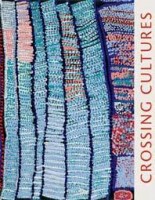
Stephen Gilchrist (editor), Crossing Cultures: The Owen and Wagner Collection of Contemporary Aboriginal Australian Art at the Hood Museum of Art (Hood Museum of Art, Dartmouth College 2012)

Until now I’ve assumed that exhibition catalogues were basically illustrated lists, of little or no interest to anyone who hasn’t been to the event they relate to. The Crossing Cultures catalogue has made me think again. My rethink was given a serendipitous boost by Mary Beard‘s contribution to TLS Books of the Year lists. She wrote:

Let me put in a plea (not for the first time) that we don’t forget the great contribution of exhibition catalogues, which often goes far beyond a simple record of the show concerned.

Like the esoteric-sounding catalogue she had in mind, Crossing Cultures ‘includes some wonderful essays and entries’. The bulk of the book is devoted to ten substantial essays, while the illustrated list – the ‘exhibition checklist’ – takes up less than a quarter of its pages. Since very few of my readers are likely to visit the exhibition (it’s in New Hampshire) or see the catalogue, I’ll give you a quick guided tour. The Art Student’s words when she first flipped through the book echo my own response and serve very well as a TLDR: At last, something that might help me understand some basics about Aboriginal art.

Will Owen kicks things off with an account of how he and Harvey Wagner created the collection of Aboriginal Art which they are now donating to the Hood Museum at Dartmouth College, and which constitutes the exhibition. People often bemoan the influence of collectors as a key part of the commodification of art and the art scene under capitalism. Will’s essay gives a different perspective. It describes how the urge to collect grew from being captivated by the art, and led him and Harvey to build relationships with dealers and artists, and to a deep engagement with ‘the complex social and cultural elements that informed [the art’s] creation’. Will’s blog demonstrates the intelligence, erudition, and passion he has brought to that engagement. (Will and I met online when I blogged about an exhibition of work from Aurukun, at which he and Harvey bought a sculpture over the internet. I think of him as a friend – and our copy of this catalogue is a generous gift.)

Then comes a trio of general articles:

Howard Morphy’s ‘Aboriginal Australian Art in America’ explores the role that US exhibitions and collectors have played in the process by which the non-Aboriginal art world has come to recognise ‘the value and aesthetic power’ of Aboriginal art, beginning with an image from the New York Times in 1941 that juxtaposed a bark painting from western Arnhem Land with paintings by Dali and Miro: decades before anyone would have thought of doing it in Australia, a US exhibition was suggesting an equivalence between Aboriginal and non-Aboriginal art. An observation that’s relevant to this exhibition:

The building of collections of Aboriginal art with a historical depth has … happened outside art museums, through the activities of private collectors and ethnographic museums.

In ‘In the Eye of the Storm: Issues Facing Contemporary Indigenous Art in Australia’s Remote Communities’ Brian Kennedy, former director of the NGA, summarises the social and political environment of Aboriginal art in recent decades – he doesn’t name John Howard or Mal Brough, but their dark presences are very much there. The general principle:

Each and every non-Indigenous person who hangs a work of Aboriginal or Torres Strait Islander art on the wall of his or her home or office thereby publicises Indigenous culture and sooner or later should contemplate the circumstances in which these works are made.

‘Painting the Law: Understanding the Law Stories in Aboriginal Art’ is an overview by N Bruce Duthu of the notion of the Dreaming and the importance of country in Aboriginal cultures. Duthu, a Professor of Native American Studies, quotes tellingly from a number of Aboriginal people, including this exchange between Aboriginal legal scholar Christine Black and David Mowaljarlai, senior law man from the Ngarinyin people of the Kimberley:

‘What about the areas where there are no Aboriginal people surviving, or at least living traditionally there any longer?’

‘You’re wrong there thinking like that. The land remained, you can’t get away from that. It acts for the people and their imprint is still there. If the land sinks into the ocean, the symbols will still be there. Only if the whole continent is blown to pieces and nothing is left of it, then it will be finished.’

Each of the remaining six essays focuses more narrowly

In ‘Daguerreotypes, Stereotypes, and Prototypes: Reframing Indigeneity’ Stephen Gilchrist, curator of the exhibition and editor of the catalogue, discusses photography. Six contemporary photographers are represented in the exhibition: Christian Thompson, Darren Siwes, Destiny Deacon, Bindi Cole, Ricky Maynard and Michael Riley. The essay takes us from a time when photography was a means for colonisers and anthropologists to define Indigeneity to the present when Aboriginal photographers

manage to push through the burdensome expectations of making racially explicit work and instead speak up against the persistent climate of ideological repression.

As the title suggests, Françoise Dussart’s ‘Mediating Art: Painters of Acrylics at Yuendumu (1983–2011)’ focuses on the work of Warlpiri artists in the Central Desert, particularly Yuendemu. After reprising the history of the beginnings of acrylic dot paintings at nearby Papunya, she draws of decades of conversations with Warlpiri artists, she explores the relationship between the acrylic art and the Dreaming stories it reflects, and pushes at the edge of how non-Indigenous people can read and understand the art:

Rooted in colonial and evolutionist views of exchange 
with indigenous peoples, practices of collecting have relied 
and continue to rely too often on sampling, on finding the
 ‘iconic’, on serial individualizing (concentrating on the career of a single artist), and on ‘preserving’. It may be time 
to instead embrace the truly panoramic representation of 
paintings from a specific time and place. Understanding 
the practices of indexicality articulated by Aboriginal painters will likewise force collectors and museums to think beyond sampling practices and the kinds of power relations
 that such practices generally structure.

Jennifer Deger’s ‘Art + Emergence’ focuses on northeast Arnhem Land. Her concern is to take her readers past looking at Yolngu barks and canvases as ‘elaborate messages in need of decoding’, to find ways to ‘sensually encounter’ the works – which means more than just finding them pretty. At the same time she writes very interestingly about the issue of who has the right to tell the stories that are contained in some paintings.

Sally Butler, Senior Lecturer in Art History at the University of Queensland, ranges from Cape York to Brisbane in ‘The “Presence” of Queensland Indigenous Art’. Queensland is huge, and the range surveyed in this essay is huge – from traditional Aurukun sculpture to the text-based protest art of Gordon Bennett and the extraordinary variety of Vernon Ah Kee’s work. Sally Butler, like most other contributors, quote artists of more traditional work in ways that indicate political / diplomatic intentions. An old man from Aurukun declared about Kugu Law Poles, ‘ I know your laws: now you can know mine.’

Among other things, Henry F Skerritt’s ‘Strange Relatives: Negotiating the Borderlines in East Kimberley Painting’ tells the story of Rover Thomas, and places his art in the context of Keith Windschuttle’s reactionary revisionism, which prompts me to reflect that if you were looking for a beautifully illustrated introduction to Aboriginal culture, history and politics, including the impact of dispossession, massacre and colonisation generally, as well as the integrity, courage and sheer brilliance of the ongoing struggles of Aboriginal people, you could do a lot worse than this book.

In the final essay, ‘Rethinking Western Desert Abstraction’, anthropologist and curator John Carty argues that in the process of claiming Aboriginal art as fine art rather than ethnographic artefact, ‘we have somehow neglected the basic disciplines of formal and art historical analysis’. Western Desert artists have moved on in their use of traditional forms, becoming increasingly abstracted, but art criticism has not kept pace – he traces the process in the works of ‘the incomparable Emily Kam Kngwarray’:

Her artistic trajectory resonated with the broader history of Western abstraction in ‘impossible’ ways, and yet it also expressed what some have come to interpret a a kind of Indigenous modernism. But the effusive proclamations of Kngwarray’s ‘genius’ have tended to obscure the fact that her dissolution of the structural and iconographic aspects of the aesthetic system was part of a broader creative process in much desert art of recent decades. Kngwarray has become the iconic embodiment of that process, yet singular as she was, her work encompassed developments in the abstractions of desert painting that both preceded and followed her own individual career.

He then gets down to cases, and has a fascinating discussion of concentricity, of dots and their relationship to meaning.

So, it’s not Contemporary Aboriginal Art for Dummies by any means. Each of the contributors speaks from deep knowledge, and many Aboriginal voices are quoted. But, speaking as a dummy, I find it hard to imagine how a single book could do a better job of informing me on the subject. Plus, of course, the images are plentiful, and brilliant.

Ross Gibson’s 26 Views and my 14 lines (Sonnet #9)

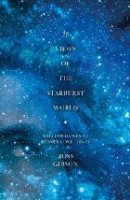
Ross Gibson, 26 Views of the Starburst World (UWAP 2012)

My formal education left me with a lingering sense that Australian history was boring: a drab procession of convicts, explorers, squatters, gold miners, politicians arguing about free trade and train gauges, soldiers, shearers, horsemen – and somewhere on the sidelines an undifferentiated, disappearing mass labelled ‘Aborigines’.

I began to see things differently in the theatre in the early 70s, with the irreverence and vigour of plays like The Legend of King O’Malley (Ellis and Boddy 1970), The Duke of Edinburgh Assassinated (Ellis and Hall 1972) and Flash Jim Vaux (Blair, Clark and Colman 1972), and exhumed splendours like Edward Geoghegan’s The Currency Lass (from the 1840s, published by Currency Press in 1976) and Katharine Susannah Prichard’s Brumby Innes (written 1927, first professional production at the Pram Factory in 1972). Skipping forward a couple of decades, Inga Clendinnen’s brilliant Dancing with Strangers (the link is to Will Owen’s review), by taking a probing scalpel to journal accounts of the first years of the settlement at Port Jackson, made me realise what an extraordinary moment that was, whose meaning is still a long way from being fully understood.

Ross Gibson’s 26 Views of the Starburst World is even more of a revelation, and has an even tighter focus than Dancing with Strangers. It looks at two notebooks, ninety pages in all, in which William Dawes recorded his notes on the ‘language of N. S. Wales, in the neighbourhood of Sydney (Native and English)’ in the late 18th century.

William Dawes was a marine lieutenant and astronomer who lived in Sydney from 1788 to 1791, years in which the world of the Eora changed catastrophically and in which that of the British invader–settlers likewise was transformed. These two notebooks were rediscovered in London in 1972. In compiling them, Dawes drew on his relationships with a small group of Eora, including most memorably a young woman named Patyegarang, who visited him at his tiny observatory on the edge of the settlement. They record snippets of conversation, and give sometimes enigmatic glimpses of tiny interactions.

Gibson describes the notebooks as ‘fragmented, unfinished, heuristic’, with ‘a prismatic quality’. And his book might be described in similar terms: it quotes, questions, analyses, peers closely at faint marks, speculates, extrapolates. It comes at the notebooks from, well, at least 26 angles: there’s biography, linguistics , psychology, anthropology, the history of colonisation, the history of science (1788 was a time of a high romantic approach to scientific enquiry in England), communication theory, the politics of Rugby League in 21st century Sydney. Apart from Dawes’ contemporaries Watkin Tench, David Collins and Arthur Phillip, it quotes Wordsworth, Emerson, Walden, Mallarmé, James Agee, Kenneth Slessor, the 2oth century haiku master Seichi, Robert Gray, Barry Hill – all of them pertinently … And sometimes it lets the notebooks speak for themselves. Gibson describes his approach as ’roundabout, relational, a tad restless and unruly’, and in a slightly less alliterative moment as ‘a little like history, a little like poetry, a little maddeningly like a séance’.

Possibly my favourite moment in the book is the facsimile of page 37 of Notebook A, on which there are just four words:

Yánga
________Present
––––________I
___________thou

Gibson gives us a caption – and bear in mind that everywhere else he refrains from speculation about any sexual dimension to the relationship between Dawes and Patyegarang:

‘Yanga’ – a verb that Dawes records but does not translate. Other colonial word lists, not compiled by Dawes, suggest ‘yanga’ means ‘to copulate’.

The School of Oriental and African Studies (London) has put the complete notebooks are online, with transcriptions of their contents, at http://www.williamdawes.org/.

But I’m falling behind on my quota of November sonnets, so here goes:

Sonnet 9: William Dawes and Patyegarang
He lived apart to study stars
and drew dark students to his table –
students and ambassadors
who drank his tea so he was able
to write their words down, turn their breath
to marks on paper. War and death
were soon to dominate this story
but then there was a kind of glory:
‘Paouwagadyımíŋa,’
she said, ‘You shade me from the sun.’
She said, ‘We’re angry, fear the gun –
Gulara, tyérun gu̇nın.’
The future loomed with genocide:
these marks show some opposed that tide.

Archie Roach’s Song to Sing, with added Jack Charles

.@LukeLPearson linked to this on Twitter. In the last couple of years Archie Roach has had a stroke and surgery for lung cancer. But cop this:

Ali Cobby Eckermann

Ali Cobby Eckermann, Kami (Rare Object No 54, Vagabond Press 2010)
——-, Ruby Moonlight: a novel of the impact of colonisation in mid-north South Australia around 1880 (Magabala Books 2012)

Like other Rare Objects chapbooks, Kami is beautifully crafted. A hundred copies were printed, signed by the author, with a small, square, torn-edge print of an Australian desert landscape glued to the cover. I mean no criticism when I say it reminds me of a tasteful bijou hotel, each guest/poem with a room/page to itself. Ali Cobby Eckermann is a Yankunytjatjara woman, and the guests, it turns out, aren’t as genteel as that analogy might suggest. They don’t trash the rooms or anything of that sort, but they raise their voices any way they want. There’s throwaway surrealist satire (‘Pauline Hanson’, about a giant carrot), poignant domestic vignettes that shed light on the stolen generations (‘Comical’ and ‘Sink’), astringent comment on the intersection of sexism and racism (‘Intervention Allies‘), a sweet-sad love song (‘Kami‘ – at the link it’s the first of five ‘Yankunytjatjara Love Poems’), C&W dramatic monologue (‘I Tell Ya True‘ – click to hear Joe Dolce sing his own musical version), and so on. It’s a wonderfully diverse set of poems.

If any one poem out has special resonance for me it’s ‘Wild Flowers‘. It reminds me of Douglas Stewart’s ‘Glencoe‘, one of the few poems I remember from school days. I’ve thought a lot about ‘Glencoe’ over the years: it’s fascinating that an Australian nationalistic poet wrote this lament for the victims of a massacre that took place centuries ago on the other side of the planet (‘Terrible things were done / long, long ago’), as if that’s as close as he could get to acknowledging the terrible reality of our own colonising history, but was impelled to make at least that much. Cobby Eckermann’s poem includes similar imagery of children’s bones, but she can name the event as very much of this place and not safely consigned to the past. An additional, idiosyncratic resonance – you’ll have to take my word for his – comes from the way the poem’s opening lines almost be describing a moment from our short movie, Scar:

Mallets pound fence posts
in tune with the rifles
to mask massacre sites

There’s a massacre in Ruby Moonlight too, though most of the book is about what happens next for the sole survivor. The book is a lot slimmer than you’d expect of a novel, just 80 pages all up, and you’ll look in vain for the lecture that subtitle (see above) might suggest. This is spare, restrained story-telling. If it wasn’t for the power generated by the flash of imagery, it would feel like notes for a novel rather than the thing itself. It’s a story of ill-starred love. A young Aboriginal woman survives the murder of her community and after wandering for some time with just nature and an ancestor spirit for company, she finds companionship and intimacy with an isolated Irish fur trapper. Their idyll, forbidden by both their cultures, can’t last. You might think you know this story before you open the book. You don’t.

In an interview with Michael Brennan on the Poetry International Website, Ali Cobby Eckermann has some very interesting things to say about her work, including this:

I want to use my poetry to educate Australians, to overcome their innate fear of Aboriginal people. Most Australians have never met an Aboriginal person outside school, sport or work. I want to highlight the benefits that Aboriginal people can provide through friendship and equality, and highlight the dangers of racism and judgmentalism. I have been happy with the heartfelt responses from festival audiences, and the new friendships shown to me and my family.

MB: Do you see your work in terms of literary traditions and/or broader cultural or political movements?

Ali Cobby Eckermann: I think it is impossible to be an Aboriginal writer, and be free from a political view. I always use cultural ethics in my writings. Some of my poetry has a unique style, due to my life between my adopted German Lutheran family and my traditional Yankunytjatjara family, who have also adopted the Lutheran religion. I hope my sense of truth becomes my literary tradition!

Lionel Fogarty’s 1995 selection

Lionel Fogarty, New and Selected Poems – Munaldjali, Mutuerjaraera (Hyland House 1995)

Lionel Fogarty is described on the Australian Poetry Library (APL) website as ‘a poet who has opened up the new space of black Australian post-surrealist writing and done much to reformulate our understanding of poetic discourse and its roles in both black and white communities’.

I bought this book years ago and it has been intimidating me from the to-be-read pile ever since. Now that I’ve finally read it I’m not so much intimidated as baffled, which, come to think of it, isn’t so unusual for me around poetry: I remember feeling that many of Frank O’Hara‘s poems might as well have been written in Icelandic for all I could make of them. But you know, even if straightforward poems aren’t all alike, every difficult poem is difficult in its own way. I experience Lionel Fogarty’s poetry as difficult in a number of interesting ways, some of them suggested by the APL quote above.

First, he writes in a version of Aboriginal English, and uses words from Aboriginal languages. The book’s glossary is some help with the vocabulary, but the syntax isn’t always easy to follow on the page, and Fogarty doesn’t go out of his way to ease the task for white readers. He writes in his introduction, ‘White man will never really fully interpret what a black man is thinking when he is writing.’ Fogarty writes as an Aboriginal man, heir to a genocidal history and survivor of continuing genocidal policies and practices; I am reading as a beneficiary of the same history and still with a world view largely conditioned by white privilege. That probably sounds dreadfully pious, but the fact is he can quite reasonably expect me to put in some work.

In a fascinating 1995 interview with Philip Mead published in the online poetry magazine Jacket, Fogarty responded to a question about his use of language:

I think what people should do is read my poetry, in an Aboriginal way, take the Aboriginal side of my language, and then reflect back on the English side. That’s the only way you’re going to get a balance of understanding. I think my most important thing, like I always say, is to revitalise or to get a full language into practice of the detribalised areas, of the urbanised, so-called, Aborigines. That’s my main thing.

I don’t know if it’s a separate thing, but there’s also what the APL calls his post-surrealism. I take this to refer to the hallucinatory element of some poems and something that’s happening in the language that isn’t just about Aboriginal English. From that same interview:

What I like to get into people’s minds, when they read my things, is that they get a picture, they get a painting from it and that’s the only way they can really understand all the mosaic, the patterns of the words I put down on paper. At the same time they can hear my voice coming through quite clearly, then they can really understand the poet.

I need to spend a lot more time with this poetry before I can do much more than struggle with it. But so as not to completely chicken out of saying something, here are the relatively unproblematic opening lines of ‘Farewell Reverberated Vault of Detentions’, a poem that imagines a day of freedom from oppression:

Today up home my people are
indeedly beautifully smiling
for the devil's sweeten words are
gone.
Today my people are quenching
the waters of rivers without grog
Today my people are eating delicious
rare food of long ago.

This isn’t difficult, if difficult means hard to understand. However, I do have difficulty with it. I don’t know if indeedly is Aboriginal English. In any other context I would have read it as a Ned Flandersism. Likewise, sweeten used as an adjective, quenching as something done to waters rather than by them, apparently erratic use of full stops and capitalisation: my copy-editor reflexes go wild. I don’t think that Fogarty has written these lines with an intention of discombobulating white pedants. This writing just doesn’t care about my concerns. It’s talking to someone else altogether, and if I want to keep up I have to let go. But then I’m at sea. I am as much at a loss to pick up on the nuances of this language as I am when I’m reading French or Italian – which is very at a loss.

It’s true, in the couple of videos I found of Fogarty reading, the poetry communicates much more effectively than when I read it for myself and hear it, inevitably, in my own white, middle-class, linear-syntax-conscious voice. This TEDxSydney 2010 video is fabulous, for example:

Ross Gibson’s Seven Versions

Ross Gibson, Seven Versions of an Australian Badland (UQP 2002)

I finished reading this book a while ago but it’s taken me until now to write about because I took it very personally.

It’s a meditation on the so-called horror stretch, country north of Rockhampton in central Queensland that has a reputation as the setting for terrible events. Starting with a number of roadside murders in the second half of last century that made headlines all over Australia, Gibson explores the cultural factors, the ‘structure of feeling’, underlying the general fascination with those crimes. A ‘badland’ such as this, he says, is a way of localising and mythologising issues that are unresolved in the society in general. This description may lead you to expect something that reads like a bad translation from the French, with lots of stuff being inscribed on the landscape, and references to impenetrable theory. But no, it’s an engaging read, and becomes positively compelling as it moves back in time to the terrible first contact between Aboriginal people and settlers, forward again to the ordeals of Melanesian indentured workers in the sugar paddocks, and forward yet again to the White Australia Policy’s denial of the extraordinary diversity of the region.

‘Sooner or later,’ Gibson writes, ‘any society that would like to know itself as “post-colonial” must confront an inevitable question: how to live with collective memories of theft and murder. Sooner or later, therefore, acknowledgement and grieving must commence before healing can ensue.’ This must also be true of the individuals who are part of that society, and my sense is that for all the impressive scholarship and historical research that went into it, this project is at heart personal, a way of making personal acknowledgement and beginning the necessary grieving. At least, coming though I do from Innisfail, hundreds of miles north of the horror strip (and yes, I knew of it by that name in my childhood), that’s how I read it.

Things may have changed, but when I was at school, history happened mostly in England (and elsewhere in Europe for Catholic Church history), and what we were taught of Australian history happened in Sydney or Melbourne, or occasionally the other capital cities. The only North Queensland figures I remember being mentioned – and that was at home rather than school – were the explorer Edmund Kennedy, speared by ‘natives’ in 1848, and his faithful Aboriginal companion Jackey Jackey (whose real name, Galmahra, was never alluded to). The specific history of the arrival of non-Aboriginal settlers in the north was never even hinted at. As in the ‘horror stretch’, I’ve learned, this history involved mass murder by Native Police under white officers. Ross Gibson brings that history home, and has a good deal to say about our collective silence about it. Even at the time of widespread killing of Aboriginal people in the mid 19th century, he says, the officers

jinked a two-step of violent action and circumspect remembrance. They wrapped their deeds in dissembling verbiage and eventually they became their own twisted idioms, developing a ‘pathological’ disconnection between doing and declaring, a disconnection which gave them no way to see the world clearly.

That ‘circumspect remembrance’ is something that has lived on in the north ever since, as ‘white people simultaneously knew and refused to know the violence behind their everyday lives’.

Now here’s why I took this all personally: in an entry in this blog a few years back I said I didn’t know much about first contact between the Mamu people and the first settlers of the Innisfail region, and I gave a link to Innisfail’s web site. When I clicked on that link I found this:

The first incursion came in 1872. Survivors of the shipwreck Maria arrived on the coast near the Johnstone River. Some of the Indigenous people helped; others they opposed. Sub-Inspector Robert Johnstone’s search party came to rescue survivors and punish Aboriginal people who had abused them, and ventured up river from what are now Flying Fish and Coquette Points. Johnstone wrote glowing reports of the area, and with vigilante Native Troopers attacked the Mamu people with rifle fire as he escorted the explorer Dalrymple, charting the watercourse and having it named after himself.

When European cedar cutters and Chinese gold seekers arrived later in the 1870s and early in the 1880s, the Mamu fought them and inflicted serious casualties. Again the Europeans sent in the Native Police. Superior firepower broke up the Indigenous communities and dispersed or integrated the remaining original landowners.

The evidence is that I had read that and could still say I didn’t know what happened, yet its meaning couldn’t be clearer. Words like ‘punish’ and ‘dispersed’ are transparent euphemisms: the high moral ground assumed by one and the almost kindly feel of the other could mislead only the ignorant or, it pains me to say, allow the wilfully obtuse to ward off the obvious. It’s impossible to stay obtuse after reading this book. And a further confession: I must have blithely assumed that if Native Troopers and Native Police were involved things couldn’t have been too bad. Gibson puts that assumption to rest with his account of the way armed young Aboriginal men, uprooted from their own communities and freed of cultural restraints, were directed to kill and maraud. He lays bare the mechanism by which Indigenous people, under tight white control, performed the genocidal work of dispossession, leaving the settlers – good Catholics in the case of the first farmers of the Innisfail Estate – to move in with an illusion of clean hands, deploring the violence of the unruly ones who had made their settlement possible.

Gibson’s discussion of the Melanesians who worked on the sugar farms is also compelling. I recommend the whole book.