Tag Archives: Francis Webb

Happy birthday, Francis Webb

Today would have been Francis Webb’s hundredth birthday.

Toby Davidson, the brilliantly enthusiastic Webb fan and scholar, is ensuring that the centenary year is well celebrated. He has already published an essay in the ABR (which sadly we can’t read without a subscription) and appeared on two podcasts.

Toby organises the annual Francis Webb poetry readings, and he promises that this year’s will be an All Star Event.

You can read some of my own effusions about this wonderful poet and events inspired by him: here, here, here, here, here and here.

Maybe the two excellent episodes of the ABC’s now defunct Poetica on the subject of Webb’s poetry and lertters will be resurrected. Their tombstones are here and here

UWAP has a page dedicated to the centenary, at this link. It includes a brief introduction by Toby Davidson and links to his essays and podcast appearances. Other links will be added as the year progresses

The 2024 Francis Webb reading

For some years now, Toby Davidson has been organising an annual reading from the works of Australian poet Francis Webb.

This year it’s on again:

Saturday 31 August
2.00–4.00pm
Chatswood Library
409 Victoria Ave
Chatswood

It’s a free event, but you can go to eventbrite to reserve a place.

Here’s what the Willoughby Council website has to say::

Come along to hear how this ‘poet’s poet’ astonished his own generation and many more since.
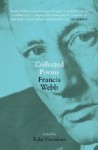
You’re invited to join MC Dr Toby Davidson, editor of Webb’s Collected Poems, for an afternoon celebrating the works of North Sydney poet Francis Webb (1925-1973) who spent some of his early years in Willoughby.

This annual gathering sees poets, scholars, community members and representatives from Webb’s former schools St Pius X College and CBHS Lewisham read and discuss their favourite poems by this local prodigy who combined his visionary talent with an eye for social justice. Gwen Harwood once wrote ‘I think Webb is unmatched … wonderful Webb!’

Come along to hear how this ‘poet’s poet’ astonished his own generation and many more since

I am one of the poets, scholars and community members. I’d love to see some of my regular – or even one-off – readers there!

The Annual Francis Webb reading

For some years now, Toby Davidson has been organising an annual reading from the works of Australian poet Francis Webb.

This year it’s on again:

Saturday August 26
2pm-4.30pm
Chatswood Library
409 Victoria Ave
Chatswood

It’s a free event, but you can go to eventbrite to reserve a seat

To quote from the blurb for the event:

Francis Webb was among the first Australian poets to be deeply influenced by post-war American poets like Robert Lowell and Sylvia Plath. He was also the first canonical Australian poet to write at length about the experience of mental illness and institutionalisation after he was diagnosed with schizophrenia in his 30s. A quintessential ‘poet’s poet’, Webb has deeply affected generations of poets and poetry-lovers while rarely being known to the wider public. Since 2012, this annual free event has celebrated Webb’s prodigious talent and keen sense of social justice. Webb’s personal book and art collection, held at the library, will also be on display.

The blurb goes on to say that student representatives from St Pius X College and CBC Lewisham will be reading and discussing Webb’s poems. What it doesn’t say is that there will be other guest speakers and readers – of whom I am one.

In my mid 20s I was completely enamoured of Webb’s poetry, and whenever I open Toby Davidson’s edition of his Collected Poems I fall in love all over again. I’ve mentioned him a number of times on this blog. I’m thrilled to be invited to read, and I’d love to see any of my readers there.

Added later: The reading was fun. About 20 people gathered in the ‘Creators’ room of Chatswood Library, and about seven of us read. Toby Davidson chaired the event with infectious enthusiasm. He paid special tribute to Bob Adamson, who died recently, and read one of Adamson’s eight poems that refer to Francis Webb. I met a man who was a psych nurse in Parramatta when Webb was a patient there, and who painted a portrait of him that was on display in the room where we met.

The 2019 Francis Webb Poetry Reading

For nine years now, Toby Davidson has been organising an annual celebration of Francis Webb’s poetry. Toby edited Webb’s Collected Poems (1911) – my blog post here. Though I’ve been enamoured of Webb’s poetry for 50 years now, this is the first time I’ve managed to attend the event (or the second, if the reading at the 2011 Sydney Writers’ Festival counts – my blog post here).

We met in a large room – the ‘Creator Room’ – at Chatswood Library, in the region where Webb spent his childhood. The library has inherited Webb’s collection of paintings – all or most of them bought with funds Webb received as a government grant, funds spent of art rather than, say, food – and his library of books. The paintings and some of his books were on display, along with other fascinating realia, including a photocopy of the handwritten draft of his final poem.

Toby Davidson was an unabashedly enthusiastic MC for an audience that was an interesting mixture of ancient fans (like me), current students (including some from Davidson’s classes) and satisfyingly motley others. The readers:

  • Robert Adamson, poet (blogged about by me here and here among other places): told us of his awe-struck meeting with Webb in Callan Park Psychiatric Hospital, and read three poems – ‘End of the Picnic’ (an imagining of the arrival of Cook’s ship in 1770 as a spiritual disaster), ‘Morgan’s Country’ and ‘Wild Honey’ (probably my favourite Webb poem, read in a way that had tears on my cheeks). A hard act to follow, but followed it was.
  • Michael Griffith (author of God’s Fool, his 1991 biography of Webb): quoted Shakespeare’s Sonnet 65 ‘How with this rage shall beauty hold a plea / Whose action is no stronger than a flower?’ as emblematic of key themes in Webb (and his own life), and read us two poems with props – the first part of ‘In Memoriam Antony Sandys, 1806–1883’ with the painting that the poem describes on an easel beside him; and ‘On first Hearing a Cuckoo’ preceded by part of Delius’ ‘On Hearing the First Cuckoo in Spring’.
  • Judith Crispin, poet and photographer, whose work, according to her web site, ‘includes themes of displacement and identity loss, a reflection of [her] own lost Aboriginal ancestry’: read the dingo’s second speech from ‘The Ghost of the Cock’, and commentred on the extraordinary way it embodied what webb could not have known, the polarity of moon and dingo in an Arnhem Land foundation story; and two other poems, ‘Episode’ and ‘Toward the Land of the Composer’.
  • Gareth Jenkins, poet, spoke among other things of the sonic, rhythmic quality of Webb’s work, his mastery of long lines, and read, beautifully, ‘The Yellowhammer’.
  • Richard Miller, self-described as a long-time Webb fan and former musician in, I think, the Sydney Symphony Orchestra, in a complete change of mood, delivered a brilliantly theatrical, over the top rendition of ‘Introduction in a Waxworks’ from ‘Leichhardt Pantomime’.
  • Two school students whose names I didn’t catch, one from each of the nearby schools that Webb attended: one read the eminently accessible ‘Australian Night’, which Toby Davidson told us Webb wrote between ages of 7 and 10; the other read ‘Compliments of the Audience’, a sardonic take on a poetry reading, thereby concluding the reading part os the afternoon.

Before we broke for an afternoon snack, we were treated to Oliver Miller’s short film Electric, based on Webb’s radio play of the same name about the first use of ECG on a human subject.

I had a great time. Some of the poems I could just about mouth the words as they were read. Others came from the bits of the work that I have pretty much skimmed. Every reader showed some new aspect of the poetry – and of themselves. Michael Griffiths told us that he had been discouraged from writing his PhD thesis on Webb because, the then Professor of Australian Literature at Sydney University said, ‘He’s mad’. And he’s been dismissed by more than one cultural arbiter. But it was a joy to be in a room full of people who are touched, challenged and invigorated by his poetry.

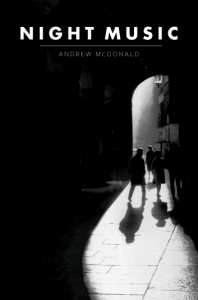
Andrew McDonald’s Night Music

Andrew McDonald, Night Music (Arcadia 2017)

nightmusic

As I was ruminating on Andrew McDonald’s Night Music, I kept thinking of Chaucer’s phrase ‘the life so short, the craft so long to learn’ the opening of The Parlement of Foules:

The lyf so short, the craft so long to lerne,
Th’assay so hard, so sharp the conquerynge,
The dredful joye, that alwey slit so yerne

Chaucer is talking about love, but I’m not alone in thinking they apply at least as well to art, specifically to poetry.

Andrew McDonald has quietly persisted with the craft for decades. Night Music is his third book in 40 years. His first, Absence in Strange Countries, was part of UQP’s Paperback Poets series in the 1970s, the series that launched David Malouf as a poet. His second, The One True History, appeared in 1984 (and can now be bought for more that £50 from Amazon). Though his poetic voice hasn’t been completely still since then – poems have appeared in journals and end-of-year anthologies – it’s been a long time between books.

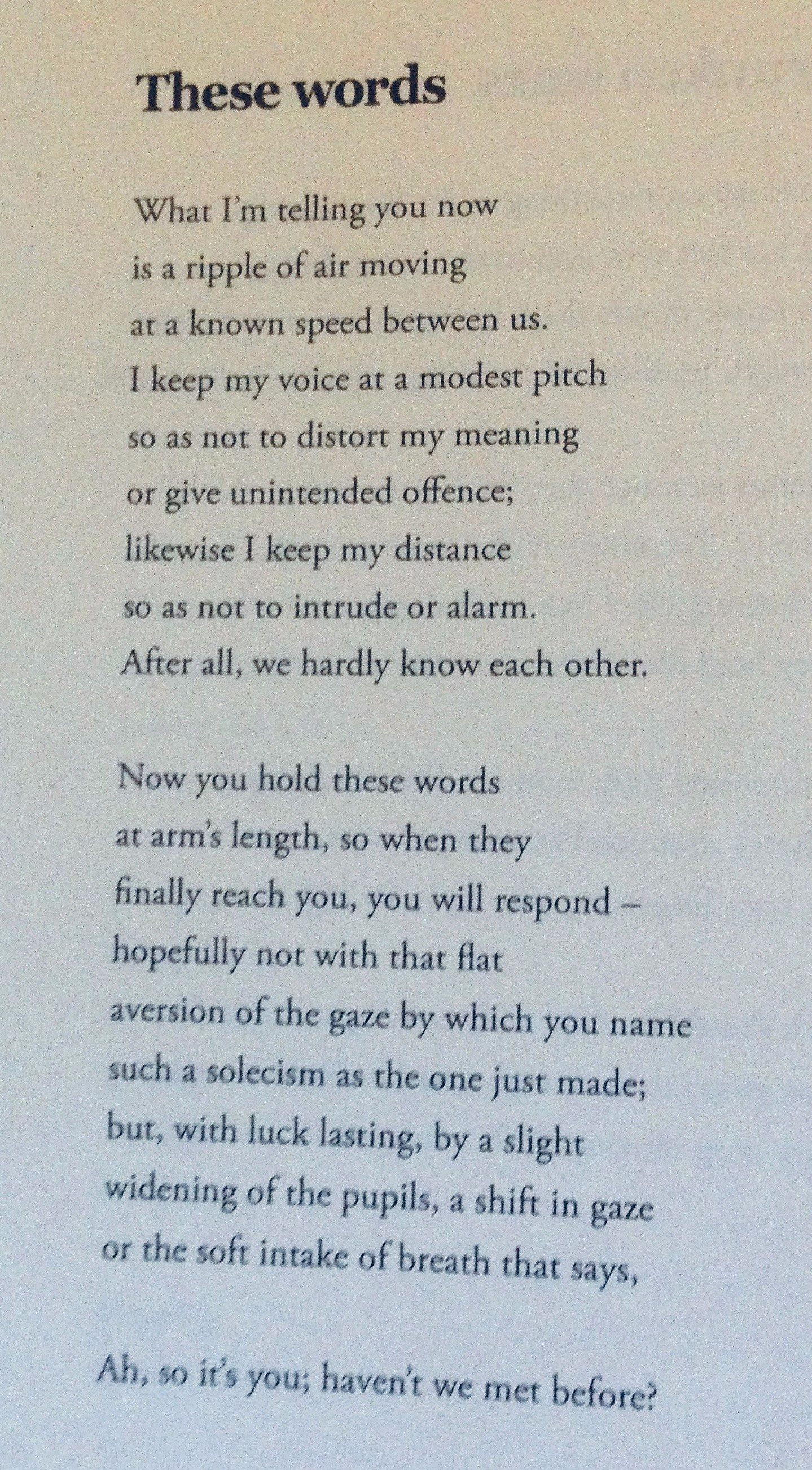
So it’s fitting that the opening poem ‘These words’, can be read as marking a kind of re-entry, moving from a tentative impersonality to a moment of relief and the possibility of a meeting of minds:

these-words.jpg

There’s a strong sense of place in what follows. The inner-western Sydney suburb of Leichhardt features in early poems, notably ‘Ode: Marketown’, which is dedicated to JF, il miglior guida and John-Forbes-ishly yokes images of tatty urban life to erudite allusions:

It’s shaping up as a day for reading cornflakes
packets in the supermarket considered as prolegomenon
to a proper reading of the Purgatorio.

Later, there are places visited – in rural New South Wales, North Queensland, Scotland,  Ireland, the Lake District (I think), an unnamed tropical beach. As an old Innisfail boy, I love ‘In the Rainforest’, one of the longest poems in the book, in which the Daintree National Park takes on metaphorical power:

The trees assemble themselves in their lack of rows or thought,
higgledy-piggledy, overgrown with creepers and vines and palms,
undergrown with mantras of the unnamed, the undiscovered, the unsuspected –
yet all this vast hubbub has, somewhere or other, to stop:
at the sea, at the incision of a road, at the counter-text
of pasture or cane or tea or some other human blankness,
so that the voice of the forest must finally cut short
its ancient murmurings and chatterings, its breath steam up
the pane of some other idea, until it simply ceases.

There are domestic moments. I’m a sucker for a poem about men and babies (see Francis Webb’s ‘Five Days Old‘ (at the link you need to scroll down a bit for the poem) or Galway Kinnell’s ‘After making love we hear footsteps‘). There are two here: ‘Night’, in which the speaker worries that his baby son will stop breathing:

I lean over him long, feeling the small warmth
that rises with his milky breath,
the smell if not the sound of life.

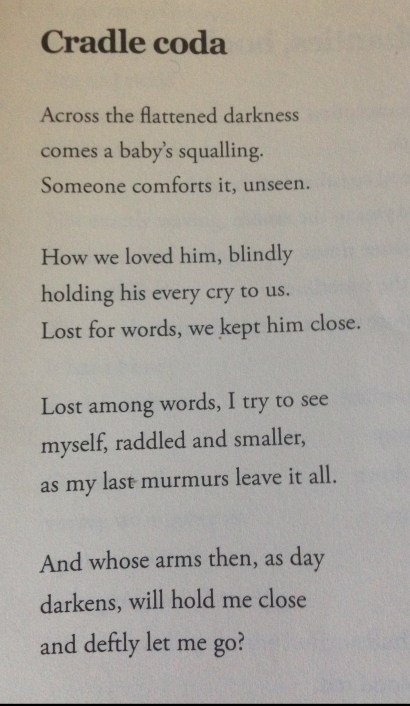
and ‘Cradle Coda’, which reads as written decades later. Here is the whole poem:

cradlecoda.jpg

It’s just a couple of weeks before my own first grandchild is due, so this poem strikes a chord. And I seem to have come back to Chaucer: ‘the lyf so short.’

There’s lots more than this in the book, much to enjoy. A fourth book is on the horizon. I’m glad.

My copy is a gift of the author, who has commented on this blog occasionally but whom I don’t think I’ve met in person.

Southerly 71/3

David Brooks and Elizabeth McMahon (editors), Southerly Vol 71 No 3 2011: A Nest of Bunyips

In 2001 the National Library of Australia published Bunyips: Australia’s Folklore of Fear by Robert Holden and Nicholas Holden. Robert said in his introduction that writing and editing the book had taken him ‘down many byways of history, literature, folklore, superstition and cultural studies’, and that he had gleaned insights from palaeontology, evolutionary thinking and anthropology.

The title of this issue of Southerly might lead you to expect something along the same lines. You would be misled. It does include a scattering of atmospheric drawings dating from between 1890 and 1912, citing the Holdens’ book as the immediate source, but they are the only bunyips on offer. As David Brooks says in his editorial, the issue is filled with things from the backlog ‘of pieces too good to reject but refusing any easy categorisation, and the bunyip motif derives from Michael Sharkey’s long poem, ‘Where the Bunyip Builds it Nest’, chosen more or less at random from the pile. (The poem isn’t actually about bunyips, but it is a bit of a monster: a long poem in five parts made up of lines taken from other poems from settlement until now in roughly chronological order, all carefully annotated.)

On reflection, Brooks says, bunyips – nocturnal, haunters of waterholes, ‘strange hybrids whose shrill quarrellings can sometimes be heard late into the night’ – sound like some poets. So the motif gained legitimacy: the issue contains work by 28 poets, essays on and by a half dozen more, and reviews of seven books of poetry. And the online supplement, the Long Paddock, has almost as much again, plus a substantial interview with Laurie Duggan.

The riches on offer include:

  • Jennifer Maiden’s ‘The Pearl Roundabout’, in which the re-awakened Elanor Roosevelt continues the conversations with Hillary Clinton begun in the book Pirate Rain
  • Margaret Bradstock’s pre-elegiac ‘Ask not’
  • Julie Maclean’s ‘cassowary’, a North Queensland poem that compresses an awful lot into a small space, about colonisation, tourism, art, and of course the gorgeous, dangerous cassowary
  • Peter Kirkpatrick’s delightfully old-fashioned, even archaic ‘The Angels in the House’, a meditation on inner city housing in heroic couplets
  • two poems by Craig Powell: a sonnet named from a line from Seamus Heaney, “and catch the heart off guard”, and a reinterpretation of an anecdote from Freud, ‘Fort Da’ (Craig Powell also reviews Toby Davidson’s edition of Collected Poems by Francis Webb, seizing the occasion to share some poignant memories of Webb).

Southerly is a refereed scholarly journal, and I tend to skip the scholarly articles, or at least the ones about writers I am unlikely to read, and those with Deleuze, Kristeva etc in the title. I did read Kevin Hart’s ‘Susannah Without the Cherub’, a fascinating discussion of A D Hope’s ‘The Double Looking Glass’. It may be, as Martin Johnston said, that A D Hope sent away for a Great Poet Kit, and then successfully used it to become a great poet. This essay bears out the second part of Martin’s quip.

It’s not all poetry. There are four short stories, all of which I enjoyed – Matthia Dempsey’s ‘One Week Gone’, about an old man a week after his wife’s death, is superb.

No bunyips, not really, but that’s not a terrible loss, given what’s there instead.

Robert Adamson on Francis Webb

Someone emailed me a link announcing that Robert Adamson, UTS Chair of Poetry, was giving a public lecture on Francis Webb on Thursday night. How could I not go? As far as I know, UTS – University of Technology Sydney, whose main tower is Sydney’s monument to stark practicality – doesn’t offer any poetry courses, and the prospect of Adamson, anything but stark or practical in his poetry or his person, lecturing on Webb, ditto with bells on, was irresistible.

It turned out to be a fairly intimate affair in a shiny new building across the street from the anti-poetic tower. I recognised a smattering of poets and other writers, scholars, editors and UTS lecturers. I sat at the front, and my neighbours turned out to include Juno Gemes, Adamson’s photographer wife who discreetly plied her trade, Toby Davidson, editor of the new, excellent Francis Webb: Collected Poems, and Michael Griffith, who wrote God’s Fool, the best and only booklength introduction to Webb’s life and work. I’m not suggesting it was a family affair. The room was full, but I don’t think many of us were there without a prior connection to Webb, Adamson or UTS’s Centre for New Writing.

Adamson, whose CAL-sponsored professorship is for three years, began with a disarming list of thankyous – including to poet Martin Harrison for explaining to him what a lecture was. I hope the lecture is somehow made available, as it was a very clear account of Webb’s life and work, informed by a deep engagement with the poetry and a brief but significant personal relationship with the man. He read a number of poems. I’d say he read them brilliantly but that would give the wrong impression: he read them slowly, almost stumblingly, as if he was discovering them as he read them, or even encountering the language itself for the first time, mispronouncing an occasional word (couch in couch grass to rhyme with crouch, impotent with the emphasis on the second syllable), so that the listener was drawn in as a collaborator rather than being cast as a recipient. I find it hard to imagine a better way of reading this poetry.

In the excellent Q&A, freed from his written text, Adamson loosened up and spoke more personally: of how Webb was crucial to his own development as a poet, of how James McCauley looked him in the eye and said, ‘You’re on the right track with Webb – follow him instead of these Americans, of how he and his friends turned up like rockstar fans at Angus & Robertson’s bookshop the day the first Collected Poems was published, only to be told, ‘We publish it, but that doesn’t mean we have to have in here for sale.’ He gave a very funny, and accurate, account of A. D. Hope’s article on Webb: ‘Hope was a vitalist, and suspicious of Webb’s religious dimension, but he discusses the poem Canobolas, saying, “Look, he sees the mountain as a naked woman, so he must be all right, he’s one of us.”‘

End of year lists 2011

Here are the Art Student’s best five movies for the year, in no particular order. That’s five out of roughly 43 movies we went to. (If you don’t know a movie the title links to  its IMDb page.)

Inside Job: A documentary about the Global Financial Crisis. The most memorable thing is that at the end Obama kept in something like 20 key positions the same people whose advice had led to the policies that brought about the collapse.

Of Gods and Men: The AS knew this was on my list and wouldn’t give me a comment.

Win Win: She liked this for its moral complexity and understatedness.

The Guard: This made her laugh. She liked being seduced by someone who did bad things.

Bill Cunningham New York: She was exhilarated by this and loved it as a model of a kind of integrity that may well be disappearing from the western world.

And mine:
Bill Cunningham New York: See the Art Student’s comment above

Of Gods and Men: Interestingly enough, this is also a study in integrity, and though it’s fiction, it ends with a profound letter written by the actual man it’s based on.

Source Code: An SF Groundhog Day that I found completely delightful.

If a Tree Falls: A Story of the Earth Liberation Front: There seems to be a theme emerging: what I loved about this was that its main character had done bad things with good intentions and took responsibility for his actions. It also cast yet more unflattering light on the US authorities’ response to ‘terrorism’.

Toomelah: I saw this at the Sydney Film Festival, introduced by Ivan Sen in the company of two young actors. Perhaps that’s why I saw it as an ultimately hopeful, though unsparing, look at life in a crushed, neglected and dysfunctional Aboriginal community.

About books, the Art Student claims not to be able to remember back past the last book she read, but she’s happy to have Edmund de Waal’s The Hare with Amber Eyes in her top five books for the year. This year, following the shocking VIDA statistics on gender bias in literary journals, I decided to keep track of whether books I read were by men or women, and a quick count shows, astonishingly that I read 25 books by men and 23 by women. Compulsive honesty has me acknowledge that many of the books by women were very short. the most dubious inclusion being a YouTube video of Harvard Professors reading Margaret Wise Brown’s Goodnight Moon.  My top five, a list that might look quite different if I did it on another day:

Christina Stead, The Man Who Loved Children. What a painful pleasure to re read this! I can’t think of a character I’ve hated more, while being fascinated, than Sam Pollitt.

Francis Webb, Collected Poems and a number of ancillary books.

Charles Dickens, Bleak House. I’m that much less likely to win a game of Humiliation now that I’ve read this. I completely understand why Claire Tomalin read this twice when researching her biography of Dickens – she wasn’t prompted by duty but by pleasure.

Kim Scott’s That Deadman Dance. Phew! We’re into the 21st century. After the necessarily careful correctness of, say, Kate Grenville’s novels about early contact in Sydney, this exuberant, multi-faceted, generous, funny, heartbreaking novel is like a blast of clean air.

Robert Whitaker’s Anatomy of an Epidemic: Magic Bullets, Psychiatric Drugs, and the Astonishing Rise of Mental Illness in America. Whenever I’m asked what my favourite book is I’m tempted to name the one I’m currently reading, but this really is a wonderful book, all the more shocking for the care with which it marshals its evidence and argument. I want to push it into the hands of everyone I know.

Please quarrel with these lists, add your recommendations, etc.

SWF: Busy Friday

I had tickets for a 10 o’clock session yesterday morning. One of the participants was prevented from being there by the Chinese government, and I was kept away by an act of vandalism (see previous post). There’s a photo of Liao Yiwu on a chair in the Gleebooks shop, but I got my whole body to Walsh Bay in time to spend a little money and queue successfully for

11.30 am: The Fascinator
Delia Falconer, Ashley Hay and Gail Jones have all recently written books set in Sydney. With Jill Eddington in the chair, the three of them – one a lifelong Sydneysider, one here since she was about 20, one a very recent arrival – chatted interestingly. Jill Eddington recommended reading all three in succession because the effect was like three movements in a piece of music. She imagined a movie that might be made of the three of them wandering the Harbour foreshores, going in and out of the Mitchell Library, walking in each other’s footsteps, almost meeting. The conversation that followed was a nice contradiction to the myth that writers are essentially in vicious competition with each other: Ashley Hay, for example, said that when her book was finally with the printer, reading Delia’s, which covered so much of the same territory but from a very different perspective, was like a special reward.

I tore myself away early, just as they were playing with possible readings if the session’s title: were we meant to think of the Harbour as a hat or an evil enchanter from a Margo Lanagan short story, or – the preferred option – both? I left reluctantly so as not to risk missing out on the Francis Webb session at 1 pm. This turned out to be a wise move, and brought a sweet bonus: I was hailed by a friend I hadn’t seen for 40 years, and while I kept one eye on the Webb queue we snatched a quarter of an hour to get reacquainted. When the growing queue vanished into the dark, we promised to follow up on Facebook, and I skedaddled to:

1 pm: The Lost Poetry of Francis Webb
This was in a much bigger venue than other poetry events, and we were told that it could have filled a space twice the size. It was one of a series of events around Australia to celebrate the recent publication of the UWA Collected Poems. The book’s editor, Toby Davidson, has organised and chaired the events, in which local poets read poems by Webb and speak briefly of their connections to him.

Toby D is a young man whose enthusiasm for his subject wouldn’t have shamed a revivalist preacher. He wants us all to read Webb, in solitude and aloud to our friends. He recommends the practice of carrying a book of his poems everywhere with us (which Bob Adamson told us later he actually does). He kicked things off by reading ‘Ball’s Head Again’. He didn’t read badly by any means, but he did demonstrate the difficulty of Webb’s verse and gave us a yardstick by which to judge the other readers.

By any measure they were all brilliant.

Judith Beveridge spoke of the texture of Webb’s language, its compression and richness, and read ‘Images in Winter’ and ‘For My Grandfather’.

Brook Emery quoted a speaker from an earlier session who referred to ‘songs that please the ear and songs that please the heart’ and said he would add ‘songs that please the mind’ – Webb’s poems, he said, are always reaching for meaning. He read ‘Night Swimming’, the first poem by Webb I ever read, when I was 24 or so, and ‘Nessun Dorma’.

Johanna Featherstone, easily the youngest of the poets, struck a blow against the view that Webb is a poet’s poet, read only by scholars and fellow poets. She takes poetry into correctional centres, where prisoners, possibly influenced by knowledge of his time in institutions, believe him. She read ‘The Runner’ and ‘Harry’.

Craig Powell, a psychiatrist in his day job, told a little story of his acquaintance with Webb when in a psych hospital in Melbourne. He read ‘Five Days Old’, prefacing it with the story of its creation: a psychiatrist in England took Webb on an outing, and asked him to hold his little baby for a moment. Powell almost spoiled the moment by asking with a snigger, ‘Who would hand their baby over to a certified chronic schizophrenic?’ But he gave us the poem with sound and heart and head. He also read ‘Hospital Night’.

Robert Adamson talked about the stigma of ‘mental illness’, quoting an eminent poet-critic-media-personality’s description of Webb as ‘the maddy’. When they met, Webb asked Adamson, ‘Are you a Communist?’ ‘Why?’ ‘The long hair.’ He read ‘Bushfire’, ‘Black Cockatoos’ and ‘End of the Picnic’. As a final comment he said that whereas a lot of discussion of Webb’s poetry focuses on his ‘mental illness’, the poetry itself is full of hope and lucidity.

The young Bulgarian woman sitting next to me said she’d loved the poetry, though there were many words she didn’t understand. Me too.

As I was on my way to the next session, I accosted Bob Adamson and said how much I’d loved his reading. He reached into his briefcase and gave me a book! So, dear reader, when someone does something that delights you, make a point of thanking them.

2.30 pm: The Merchants of Doubt
Naomi Oreskes’s eponymous book (can you say that?) is an exploration of the doubt-mongering techniques developed by the Marshall Institute in the US to defend vested interests against the implications of scientific research. They began with the connection between tobacco smoking and cancer, and progressed to a range of environmental issues, reaching some kind of peak with climate change They don’t have to lie (though they do anyway), but they do systematically create disinformation. She was in conversation with Robyn Williams, and they are clearly kindred spirits, science journalists passionately concerned about the current attacks on science.

I won’t try to summarise. Robyn recommended a BBC doco, Science Under Attack. In a neat echo of Adamson’s anecdote, he told of meeting one of the doubt-mongerers at a conference, and being asked of his journalist colleagues, ‘Are they all Communists?’

My main take-home point was that scientists (and, I would add, others) have a deeply held belief that the facts will speak for themselves. But this is manifestly not so on matters with big emotional charges on them.

Reading about Francis Webb

Bill Ashcroft, The Gimbals of Unease: The poetry of Francis Webb (Centre for Studies in Australian Literature 1996)
Michael Griffith, God’s Fool: The life and poetry of Francis Webb (Angus & Robertson 1991)
Poetry Australia September 1975: Francis Webb (1925–1973) Commemorative Issue
Peter and Leonie Meere, Francis Webb, Poet and Brother: Some of his letters and poetry (Old Sage Press 2001)

Having recently re-read Francis Webb’s collected poems, I didn’t want to just put the book back on the shelf. In order to be as booked-up as possible for the Sydney Writers’ Festival session on Webb next month, I got hold of three books about him, and dusted off my copy of the 1974 Poetry Australia commemorative issue. I can now assert that I have read every book published on the subject of Francis Webb.

Bill Ashcroft was writing an MA thesis on Webb in the Sydney University English Department in the early 1970s when I was a postgraduate student there. Michael Griffith was also in the Department then, and interested in Webb. Both of their books were published in the 1990s. Poetry as dense as Webb’s yields its riches slowly, so I was interested to read the results of such long gestations.
Bill Ashcroft’s emphasis is on explicating the poetry. He talks about Webb’s use of language, and about Webb as Catholic, as schizophrenic and as explorer. I believe Bill approaches Catholicism as an outsider, since he seems to miss references to Catholic liturgy and lore, but his analysis may be all the more useful for that, as he goes instead to major spiritual and intellectual traditions within Catholicism (namely the Thomist–Ignatian and the Augustinian) and locates tensions between them in the poetry.

His discussion of schizophrenia reads as if it was mostly thought through in the 1970s when R D Laing and the anti-psychiatry movement hadn’t lost the battle with Big Pharma for domination. In my opinion it’s all the better for that. He argues that Webb’s extraordinary use of metaphor is intimately connected to the condition for which he was repeatedly hospitalised, drugged and subjected to electroconvulsive therapy; that people diagnosed as schizophrenic often don’t distinguish, as others do, between metaphoric and literal ways of thinking, that this is generally a brilliant way of dealing with impossibly painful situations rather than the symptom of an illness. In the section on Webb as explorer, he argues that Webb’s poetry is groundbreaking post-colonial work, holding ‘a balance between the European spiritual roots and the post-colonial vision’.

According to the book’s back cover, Bill Ashcroft has been a trailblazer in post-colonial studies. As might be expected, then, his prose is heavy with theoretical ballast, and occasionally reaches dizzying heights of abstraction. I expect book would repay close, careful study, but at least for now I’m happy to have read it in a companionable way: I might not understand a lot of what this bloke says, but it’s good to have listened to him talk at length.

Michael Griffith co-edited Cap and Bells, a selection of Webb’s poems that came out the same year as God’s Fool, so he’s probably done as much as anyone to keep the poetry in print for the last 20 years. This book is an offshoot of Griffith’s PhD Thesis. ‘In reducing the work from its longer academic form,’ he writes in his introduction, ‘I have tried also to introduce some aspects of Webb’s humanity which had less place there.’ For this departure from academic rigour, I for one am grateful.

When I studied Eng Lit we did a lot of close reading, and the idea of approaching literary work by way of the author’s biography was sneered at. Bill Ashcroft deals with such potential sneers by talking about the poetry and the poet’s life as two intersecting texts that illuminate each other. Michael Griffith doesn’t see the need for such justification, and just gets on with the illuminating. He does do some explicating of the poetry, but I found much more value in his delving into Webb’s life story than in any tight focus on the text. He draws on Webb’s letters and other documents, including two ‘Hospital Confessions’ written as part of campaigns to have him released from institutions. He quotes correspondence with Norman Lindsay, Douglas Stewart and David Campbell among Webb’s elders, and Rosemary Dobson, Nan Macdonald, Vincent Buckley and others of his contemporaries. One day a collection of Webb’s letters may see the light, but in the meantime this book draws on those that have been preserved by colleagues and family to show us a working poet who, in spite of long periods of incarceration and serious difficulty in coping outside of institutions, was a cherished and active member of a creative community. In particular, it is fascinating to learn details of his early connection to Norman Lindsay, and to consider his poetry of the 1950s in the context of the resurgence of Christian, even Catholic, themes in Australian poetry and art at that time.
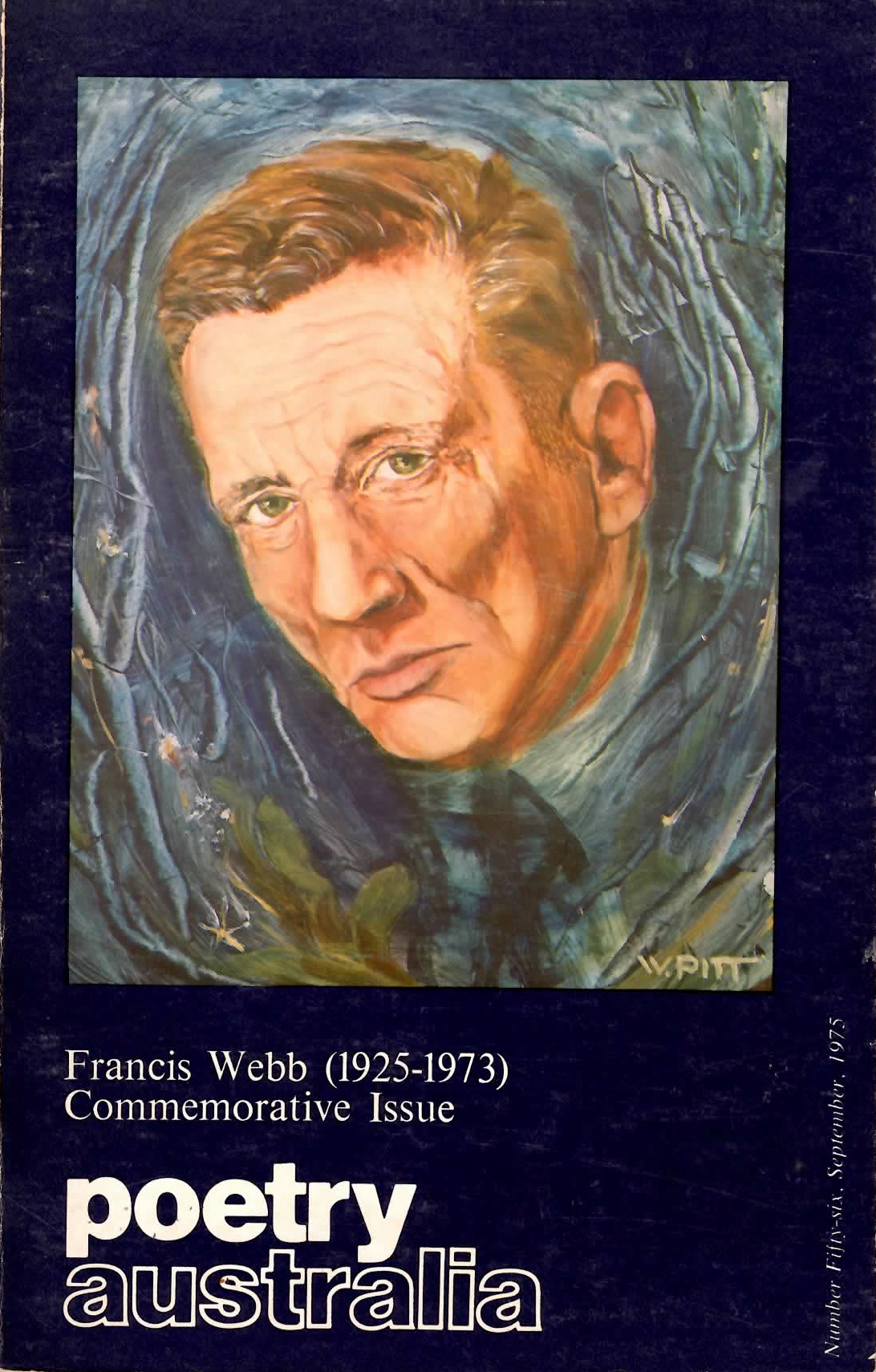
The September 1975 issue of Poetry Australia was devoted to Webb, who had died nearly two years earlier. As well as several previously unpublished poems (all of them now available in Toby Davidson’s 2011 Collected Poems), it includes essays by Griffith, Ashcroft and other scholars, but its enduring interest lies in contributions from Webb’s fellow poets who knew him and appreciated his work – Rosemary Dobson, A D Hope and Vincent Buckley among them. There is also a poignant memoir by Sister M. Francisca Fitz-Walter, a Good Samaritan Sister who befriended Webb.

These essays are a striking reminder of how the language of literary criticism has changed in the last 40 or so years. Compare Vincent Buckley, in his essay ‘A Poet of Harmony’:

He was a great phrase maker and 
there are phrases, sentences, cadences in poem after poem that are quite 
unforgettable. He was a great master, and sometimes a victim, of metaphor, 
the most metaphor addicted poet in this country, I would say, and it is noticeable that time and time again the energy of those very ample driving
 rhythms is also the energy with which metaphors are picked up, created
 and extended through the stanza.

with Bill Ashcroft, 30 years later:

The compatibility of schizophrenia and the post-colonial, or to put it a different way, the schizophrenic discourse of post-colonialism, is seen most markedly in the similarity between the absence of the metacommunicative mode in schizophrenic language and [the] metonymic gap [of post-colonial discourse].

I don’t discount the importance of Bill’s theorising – on the contrary, it opens up great vistas of understanding. But Vin (as Webb called him) says a lot more about the immediate experience of reading the poetry.
Francis Webb, Poet and Brother is a labour of love, compiled and self-published by Webb’s younger sister and her husband in 2001, when they must have been in their 70s. It includes a number of poems that had not been previously published – but which are mostly in Toby Davidson’s collection. Its appendices include an impressive bibliography of critical writings about Webb; nearly 60 pages listing all his poems, the place and date of first publication, the place of composition where that’s known, and all subsequent publications; and 12 pages listing errors in those publications and in writings about Webb. All this will probably be of interest to scholars, but then there are the letters – 56 of them, written to his three sisters and his brothers-in-law from 1943 when he was 18 to a month before his death in 1973, with linking passages by the Meeres, including occasional quotes from other sources, such as for example Vincent Buckley’s memoir Cutting Green Hay – a quotation which, incidentally, tells a story of youthful drunkenness that Buckley hinted at but declined to tell in his Poetry Australia essay. If Webb’s letters to colleagues are as compelling, and poignant, and interesting as these, someone really ought to be getting a collection together.

Four things shine through: Webb’s great affection for his family, especially for Leonie and Peter Meeres; his Catholic piety (almost every letter ends asking to be remembered in the recipient’s prayers, and promising to remember them in his); his single-minded dedication to his calling as poet; and his mental anguish. The reason for his repeated confinement in psychiatric institutions remains (of course) obscure: he repeatedly insists that he is completely non-violent, but the letters are peppered with references to incidents such as ‘a silly brawl’. Whatever the reason, it’s heartbreaking to read his pleas for help, his assurances of his harmlessness, his wretched descriptions of himself as a no-hoper, and towards the end his warnings not to upset and possibly damage children by bringing them to see him in his abject state – and through it all, his piety, his affection and his hunger for solitude and peace enough to write poetry.

The Japanese artist Yayoi Kusama lives in a mental hospital in Tokyo, and is able to go to her studio regularly. It may be that Francis Webb needed to be kept apart from the general community, for his own or other people’s safety, but that he lived a life of such deprivation must surely stand as a reproach to the way people labelled mentally ill have been treated in this country. Yet the miracle of it is that he too created marvellous works:

Are gestures stars in sacred dishevelment,
The tiny, the pitiable, meaningless and rare,
As a girl beleaguered by rain, and her yellow hair?