Tag Archives: Francis Webb

Rereading Francis Webb

Francis Webb, Collected Poems (Angus & Robertson 1969)
Toby Davidson (ed.), Collected Poems: Francis Webb (UWA Publications 2011)

I reach for Francis Webb’s poetry fairly regularly – mainly the same handful of late poems. After listening to pieces about him on the Book Show and Poetica (parts One and Two), both on the ABC, having wept at the superb readings on the latter and been stung by Geoff Page’s describing the poetry as defective on the former, I decided to re-read the whole book. I started out on my 1969 edition, with its copious pencilled annotations by twenty-something me, but about a third of the way in I bought a copy of the new edition and switched to that. One learned person, according to my faint pencil notes, wrote that ‘reading Francis Webb is like wrestling with an angel’. No one would disagree that wrestling is involved: just decoding the syntax can be a challenge in many of these poems, then there are compacted metaphors, elusive rhyme schemes, buried religious references, and an expectation that the reader will be as alarmingly erudite as the poet. Just have a look, say, at the first lines of ‘Stendhal’:

Italy, and a nom de plume – better than in the van
Of France defeated: his clean scarlet brain
Must work in a pure detachment over man
Who was nothing without his D.R.O.s again.
Love, hate, ambition mustered at his bugle,
Sorties of good and evil were in vain.
With watchful eye and towerings of the eagle
He must disarm the priests, immobilize pain.

To which I admit I don’t have much more to say than ‘Huh?’

The angel part is harder to describe – the exciting part, that makes you feel you’ve been through the wringer, but that the world is somehow clearer, richer and more harshly beautiful because of it. He writes about sunsets, fog and wind as if they contain all the deepest struggles of the cosmos.

If you haven’t read any of Webb’s work, I recommend you start with the relatively straightforward ‘Five Days Old’. My mother, no lover of difficult language, wrote to me in a 1972 letter: ‘”Five Days Old” is sweet. I have to concentrate to read poetry so I haven’t read the others yet.’ More ambitiously, you might try the two sequences, Eyre All Alone and Ward Two. (If you’ve got plenty of time, I recommend reading Edward John Eyre’s Journals of Exploration as interesting in itself, but also, as my pencilled notes remind me, because it sheds interesting light on Webb’s poem, which at some points comes close to paraphrasing passages from it.) I’d skip the radio plays about Hitler (Birthday, this one was broadcast on the BBC in 1955), the Holy Grail (The Chalice), the anthropogenic end of the world (The Ghost of the Cock) and the man who invented electroconvulsive therapy (Electric).

One of the things that I loved about Webb’s poetry from the start is that it’s work. You can feel the labour of getting the words down, squeezing meaning onto the page, into the shape of the poem. Even at his most difficult, he is working at communication, never being difficult for its own sake.

Forty years ago I went searching for the first publication of his early poems, and found one or two that hadn’t been collected, and others that had been substantially edited on the way to being collected. The former and one or two of the latter are in the new collection, but my favourite example of revision isn’t. Here are the first three stanzas of ‘The Day of the Statue’, in which fishermen catch an ancient statue in their nets, as they appear in both Collected Poems:

You look for prodigies leaning on the sill of storm,
Or loose in the yellow gap at a candle’s end,
But here was patience: fishermen out on the bay,
Work and silence inching with the minute-hand.

Moored in a lulled spinny of sun and shadow,
With an impotent tremor in the sails, the ketch nosed down
To the long lunge of the swell, rose dripping, gasping
As if with eagerness to suck in air again.

And the men, snug in this casual pediment of time,
Their gestures grouped and restricted and interlocking,
Felt the haul stubborn to their hands, an eye-tooth wrenched
From the iron gums of the sea-bed, shuddering and aching.

Compare the first five stanzas of the version published in the Bulletin on 8 October 1947, when Webb was 22 years old:

You look for prodigies leaning on the sill of a storm
Or loitering about the wake of a snuffed-out light;
But such things are apt, as you know, on these days of full sunshine
To be quietly pocketed or else shoved clean out of sight.

Certainly, three fishermen out on the bay
And the shaping of a miracle are rarely aligned,
History bells hours only, clock on the walls of speeches:
Work and silence tick unnoticed with the second-hand.

Moored to drifting banks of sun and shadow,
With an impotent tremor in the sails, the ketch nosed down,
plunged to the bowsprit in the swell, rose dripping, gasping
As if with eagerness to suck in air again.

And the men grouped snugly in this leeward pediment of time,
With their slow gestures of toil, felt a curious lagging in the strands
Of their sunken net, as if parallel action under the water
Passed on a sort of nerveless shock to the hands.

Your touch on a net-load of fish short-circuits life:
The cargo is arteries stabbed in their element and shaking,
But this haul yielded stubbornly like an eye-tooth wrenched
From the iron jaws of the sea-bed, shuddering and aching.

I love the way he pared those stanzas down, even at the risk of making his meaning harder to grasp. And the revisions towards the end of the poem are even more telling. The last stanza changed from

Beauty comes baleful as a skull, comes riven from the sea:
Well to consider the mortal, the native token
Before you polish, incise – before you replace
What that bronze arm once clutched that time has broken.

to

There were some to roll back the heavy stone of the sea;
There was none to ponder the mortal, the living token.
But later, men polished, incised, established at last
What that raised hand once clutched and years had broken.

With great economy, the resurrection of Christ is invoked, and the contrast between the practicalities of dragging up the statue and understanding it is conveyed as a further piece of narrative rather than in a slightly priggish address from the author.

Ramona Koval said she’d never heard of Francis Webb. That’s a great shame. The Sydney Writers’ Festival has a session on ‘The Lost Poetry of Francis Webb’. I’m assuming that phrase refers to his whole body of work rather than to the handful of previously uncollected poems that begin and end Toby Davidson’s collection. I plan to be there.
In which I go on a bit about buying two books

I happened to be in Glebe this morning, and as I had earned a little bit of money last weekend I allowed myself to yield to the allure of the bookshops.

First, the secondhand poetry shelves of Sappho’s beckoned. There were a number of tempting morsels – enough to make me think that a Sydney poetry lover had recently died or radically downsized. There was a book of Philip Martin’s, inscribed in a shaky hand  that suggested he had already embarked on the disease that was eventually to kill him; Adamson’s Waving to Hart Crane signed ‘affectionately Bob’. But the one I bought was a selection of Stevie Smith’s poems. When I worked at Currency Press, our Editor in Chief Phillip Parsons impressed me hugely by reciting the last page of Stevie Smith’s Novel on Yellow Paper, and I became a fan on the spot (of Phillip, yes, but also of Stevie Smith). I recently saw a copy of her slected poems on a friend’s bookshelf – I took it down, and behold it was inscribed on the inside cover as a birthday present to a different close friend – a birthday present from me. The birthday girl later denied all knowledge of having given the book away, so I was left with a nagging sense that one or other of my dear friends was a book thief, a liar or an ingrate. Somehow when I saw this book in Sappho’s today – same selection, different cover – it seemed that buying it would make everything all right again. So I bought it.

Oh I am a cat that likes to
Gallop about doing good.

And then next door to Gleebooks. I’d listened to Poetica’s excellent two part broadcast on France Webb recently, heard Geoff Page deliver a  lukewarm account of him on the Book Show (Maybe you need more than one poetry reviewer, Ramona! But I don’t need to say much, as commenter named Junius has given you the rounds of the kitchen on this one.) and been prompted to open up my 1969 Collected Poems. This is one of my favourite books – I mean the actual battered, slightly foxed object on my shelf, which I love because I spent quite a bit of intensive time with it in my mid 20s. I was planning on writing an MA thesis on Webb’s poetry. It didn’t happen, but I did a bit of work that left its traces in the margins of my copy (as well as in a little exercise book in which I pasted photocopies of poems by Webb that had been published but not collected). His explorer poems sent me off to read the published journals of Leichhardt, Sturt, Grey and Edward John Eyre. My book has notes on when and where poems were first published, textual variations and any annotations, and occasionally there’s a commentary from me. For example, in ‘Leichhardt in Theatre’, just before the explorer’s party is attacked by the people whose land they have invaded, the poem goes:

————————————Gilbert, the naturalist,
is planting some precious flowers that he has found,
Cradles them in his hands like diamonds

There’s a pencilled note in the margin:

This indicates he had probably not read the Journal – Gilbert was learning to plat (sic)

Presumably it was Leichhardt who misspelled ‘plait’. I imagine these notes would annoy anyone else, but they fill me with an affection for my younger self.

But back to the visit to Gleebooks. On the display table in the poetry section was the new Collected Poems, published by UWA Publishing and edited by Toby Davidson. I flipped it open and had to buy it. Not only does it include the poems I had found in my postgraduate days, plus more. It also promises to correct errors Webb had noted in the 1969 edition (his notes evidently came to light in the 1980s). Am I doomed to read with both books open – one for the poetry and the other for young Jonathan’s occasional comment?

I thought you’d like to know.

Sad news

I notice that my note from last June about Diana Wynne Jones’s illness has risen to the top of my ‘Top Posts’ list over on the right. I assume people are coming here to learn something of her death on the weekend. For anyone who has come for that purpose,  some links:

The Diana Wynne Jones Official Website
Neil Gaiman: Being Alive. Mostly about Diana
Misrule: Saying Goodbye to Diana
Emma Bull on tor.com: Remembering Diana Wynne Jones
Farah Mendlesohn, also on tor.com: Diana Wynne Jones
Christopher Priest in The Guardian:  Diana Wynne Jones obituary

No doubt there are others. The Australian newspapers may mention it, but don’t hold your breath – she’s not a sports star or an obscure US politician. In 1973 it took the Sydney Morning Herald weeks if not months to mention the death of Francis Webb, a great poet who had spent his last decades living in Sydney.

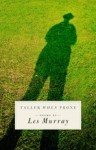
Les Murray, Prone to be Tall

Les Murray, Taller When Prone (Black Inc 2010)

A new book by Les Murray is an event, and I didn’t hesitate to use my birthday voucher to buy this. And I wasn’t disappointed. The book has already been reviewed well by people more articulate and perceptive than I am. Clive James in The Monthly, for instance, may be a little OTT in suggesting the Nobel for Literature and characterising the intemperate and possibly libellous ‘The 41st Year of 1968’ as ‘a sharp rebuke to ageing hippies who imagine themselves to be in sympathy with Gaia’, but he generally does a nice job of illuminating the poetry.

I was struck many years ago by something Francis Webb – who like Les Murray experienced severe depression – wrote about poetry:

I do value in poetry that heightening or ameliorating sense of companionship in human experience. What do we seek of the trusted companion? His honesty, and that half-loaf of comfort. Poetry, as in Dante, can teach; but that is not its primary function. And pure, honest companionship may implicitly carry  comfort within itself, neutralising the often frightening sense of solitude in our affairs.

Much as I admire and enjoy Murray’s poetry, I don’t get much sense of companionship from it.  I don’t have anything against the man – after all he published a poem of mine in Quadrant. And I’m a fan – I’ve been buying his books for decades. I’ve just seen a copy of The Weatherboard Cathedral going for more than $500 at Biblioz.com, but I’m not even slightly tempted to part with mine. But I do have a creeping sense that his poetry doesn’t much like me. I don’t mean just the splenetic outbursts like ‘The 41st Year’ (which, though its explicit targets are amalgamated Hippies and Greenies and New-Classies, none of which I quite am, I manage to take personally). Nor do I mean only the obscure pieces – Robert Gray says in The Australian that about a third of this book leaves him not having the faintest idea what it is about, and not ‘cajoled by the expression into wanting to find out’. I have a sense that the poetry generally doesn’t seem to want to communicate, to expect a relationship with the reader: it’s as if it’s reporting brilliantly on the world sharply seen and heard and thought about, on understandings (and positions and judgements) reached, even on emotions felt, and all it expects of me is that I look on,  admiring its brilliance. To vary the metaphor, the poems are like grenades lobbed over a wall – they may explode in verbal fireworks, release lyrical aromas, or scatter the shrapnel of opinion, but the wall stays there, solid and opaque between us and the thrower.

Or maybe that’s all rubbish. One of the many poems I liked here is ‘The Filo Soles’:

When tar roads came
in the barefoot age
crossing them was hell
with the sun at full rage.
Kids learned to dip
their feet in the black
and quench with dust,
dip again, and back
in the dust, to form
a dark layered crust
and carry quick soles
over the worst
annealing their leather
though many splash scornfully
across, to flayed ground.

When I wrote just now that I liked this poem, I thought of writing instead that the poem ‘spoke to me’, but actually it didn’t, even though I lived in the barefoot age in the tropics, and know about crossing a bitumen road in the summer heat. The poem doesn’t work on me by reminding me of that experience. What I like about it is the way the title adds a clever visual element, the way the disintegration of the rhyme and metre towards the end  mimics the desperate, unprotected run as opposed to the methodical application of protection, and the way ‘flayed’ unexpectedly describes the ground rather than the young feet in the last line. There’s a lot to like. Maybe my grumbling about lack of communication is just lack of sleep. I’d be interested to hear other people’s thoughts.

Adamson’s best of 2009

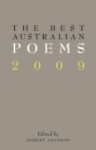
Robert Adamson, The Best Australian Poems 2009 (Black Inc 2009)

This is an excellent anthology. In fact, in the context of previous years’ round-ups, both from Black Inc and UQP, it’s a strong contender for Best of the Best. It includes a wonderful range of poetic styles and modes and subjects – incomprehensible post-modern stuff, impassioned story-telling, linguistic virtuosity, delicate lyric. There’s Clive James‘s assured iambic pentameter, Pam Brown‘s asthmatically short lines, Ali Cobby Eckermann‘s lines you might need to know didgeridoo breathing to recite adequately. In the introduction, Robert Adamson talks about his solution to the difficulty of reducing his short list to fit the space available – he persuaded Black Inc to give him more space. I’m glad he did, and that he kept commentary, analysis and explanation to a bare minimum. He does offer this gem of commentary:

People ask me, why are so many bird poems being written and published? I have a theory: we miss having poets among us who can imagine that a soul can ‘clap its hands and sing, and louder sing’, that we need to acknowledge visitations by intense psychological presences, and that birds are the closes things we have, more or less, to angels.

Perhaps that’s mainly a clue as to how to read his own poems, but it’s an interesting general thought as well.

I’m not going to try to name the poems I liked best.  My copy has far too many page-corners turned down for that.

As I was reading this anthology, my Art-Student Companion, as part of her preparation for an assignment on Australian Federation, was reading The Sentimental Nation by John Hirst, and kept regaling me with interesting bits about the major role poetry played – poetry, he says, is ‘the best guide to the ideas and ideals that inspired the movement’ for Federation, and again: ‘The nation was born in a festival of poetry.’ Well, even though poetry festivals rarely make the news pages these days, to judge by this book poems are still looking for words for what inspires and ails us as a nation and a species. But now, instead of writing bush ballads or ponderous and forgettable sonnets, they tell about Iraq, global warming, the ills of capitalism, but they tell it slant. There are any number of examples, but I’ll just mention Luke Davies’ ‘Maldon, 991 AD’ which ends:

oooooooooooo I felt an outsider
to laughter. Out there the Vikings sang,
that was more like it, something eerie
to get spooked about, distracted by:
and the world so tenderly
unveiling its final unveiling.

I was also struck by the sense of community among the poets, particularly as shown in the number of poems honouring those who have died: Dorothy Porter (‘Word‘ by Martin Harrison), but also John Forbes (‘Letter to John Forbes‘ by Laurie Duggan, Jan McKemmish (Pam Brown’s ‘Blue Glow‘), Francis Webb (‘Reading Francis Webb‘, by Philip Salom [the link is to a PDF]) and Bruce Beaver (a couple of mentions, but mainly Peter Rose’s beautiful imitation, ‘Morbid Transfers‘).

Buying this book in March felt a little bit silly, like buying hot cross buns in July, but it turns out it’s not a seasonal thing at all. It’s an anthology that I’m sure I’ll go back to.

Footnote: One of my wise younger relatives recently chided me for reading while walking: ‘It’s as bad as walking around with those things in your ears, Jonathan,’ she said (by which you can she’s not so very young). ‘You have to let the world in.’ She may be right in general. But sometimes reading while walking is a way of letting in both world and poetry. The other morning I was throwing the ball for Nessie at the bottom of the hill and noticed that the longish grass was pearled with dew so that previous walkers both human and canine had left tracks of darker green, and the rosellas wouldn’t shut about something. I realised it must have rained quietly in the night. The next words I read were these, from Sarah Day’s ‘A Dry Winter: Some Observations About Rain‘:

… an elemental transition from dry to damp.
Listen, you can hardly hear its outward breath

on the tin roof. In the morning,
grass and earth are wet and everything

but the mercuric globe in the nasturtium leaf
is translucent.

I don’t know anything about nasturtiums, but the rest could have been a condensation from my surroundings. (The whole poem is lovely, by the way.)

Added later: Tara Mokhtari on the Overland blog has a completely different view. She does identify herself as a ‘shunned poet’.