Tag Archives: Heat

Recent journals (2) – Overland 197

Jeff Sparrow (ed), Overland issue 197 (OL Society December 2009)
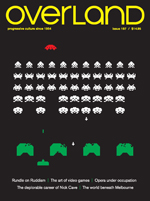
overland 197I initially intended to write a single post about the three journals that arrived in my letterbox this month, but after rabbiting on about Heat at such length I decided I’d better split them up.

In a world where passionate anti-Communist Robert Manne  has been described as a preeminent lefty, there’s clearly a crying need for Overland, whose Communist Party origins flutter from its masthead in the slogan, ‘Progressive Culture since 1954’ (and smirk on the back cover in a quote from The Australian describing it as ‘loopy-Left’). Even before the recent online Subscriberthon I’d been thinking of subscribing – I loved (and blogged about) the biography of Guido Baracchi, Communism: a Love Story, written by current editor, Jeff Sparrow, and I have been a freeloader (ie, online reader) for some time.

After the mainly elevated austerity of Heat, Overland‘s direct speech is refreshing. You won’t find essays here that begin as dauntingly as ‘It was while reading Jean-Paul Sartre’s monumental study of Flaubert, The Family Idiot, that I fell into an “epileptiform” state’ or ‘I have long associated landscape with passion and solace, and with the urge to record it’. Instead, we get ‘Last Sunday I went to church to be with my father, to say goodbye,’ or ‘Sometimes in life you get lucky.’ Not that the Overland pieces lack heft. The former introduces ‘My Father’s Body‘, Francesca Rendle-Short’s moving and, for my money, profound essay on her relationship with her father who has Alzheimer’s. The latter leads in to Fiona Capp’s ‘The Lost Garden‘, an extract from her My Blood’s Country, which promises to demonstrate Judith Wright’s continuing relevance (‘These hills and valleys were – not mine, but me …’).

There is some engaging fiction, some punchy argument (a trenchant go at Nick Cave, who is a closed book to me so I don’t mind one way or the other), short reviews, engaging essays (Sophie Cunningham, just popping over from Meanjin, visits the drains of Melbourne; Thomas Rye visits an island in Arnhem Land), a swathe of poems. There’s nothing I recognise as loopy-Left, though there are two very interesting articles – one on Ruddism and the other on education as export and its relationship to border control –  written in learned-Left language that makes for hard going (‘The CFMEU and other Left trade unionists wish to increase control of the borders of their labour markets at the point of intersection with the borders of the nation, and definitions of “Australians”‘).

The whole content is available online. I’ve linked to the articles I particularly liked.
—–
I’ve been lamenting the frequent copy-edit and/or proofing mistakes in Heat for a while. I kept my carping eye peeled for Overland as well. Interestingly enough, although Overland doesn’t include a credit for a copy editor (as Heat does), it doesn’t have anything like the same incidence of irritating and sometimes perplexing mis-edits and typos. There is a spot where lay and laid are used in place of lie and lay , but as this happens consistently over a number of paragraphs I’m willing to put it down to a difference of opinion (in which, of course, they are completely wrong!) rather than sloppiness or ignorance.

Recent journals (1) – Heat 21

Ivor Indyk (ed), Heat 21: Without a paddle (Giramondo December 2009)

Some of the reasons why you should subscribe to Heat, or at least read it:

1. Worthiness. Your money and attention help to sustain cosmopolitan Australian literary culture.

2. Self-protection. Extracts from works in progress allow you to prejudge the finished work. I’ve decided to avoid a significant number of award winning books on the basis of such advance warnings, and I’m likely to steer clear of one or two foreshadowed in this issue. The poetry provides a similar warning function: poetry is so much a matter of taste, and journals like Heat can play the crucial role of taster. And there are the critical pieces: on the strength of Kate Lilley’s detailed exposition of Susan Howe’s The Midnight, I won’t go looking for it any time soon (far too rich and recondite for my thin blood); Peter Craven’s critical review has put me right off Brian Matthews’s biography of Manning Clark. But it hasn’t enamoured me of Peter Craven: he’s bracingly forthright in his judgements, and even when he’s completely wrong-headed he provokes interesting conversations, but he comes across as too full of himself and too pugnacious for me to actively seek him out.

3. Titillation. Then there are the poems and extracts from works in progress that have the opposite effect. Poems from, among others, Pam Brown, Ken Bolton, Chris Price make me want more.

4. Education. In this issue, Josiane Behmoiras embeds an introduction to the work of Paul Virilio, a cutting edge French thinker, in an account of her recent trip to France (complete with implied travel advisories on the stench of urine by the Seine and problems with Australian Visa cards on the Metro); where her discussion of his work descends from glorious abstraction, it seems to be arrive at important conclusions about how we should live, very close to those of Bill McKibben’s much less abstruse Deep Economy.

The four-colour section in the middle introduces us to the  painter Jon Campbell, and offers us a hand in understanding why we should be interested in his work.

5. Base pleasure. Maybe this is only for people who are or have ever been editors, but Heat can be counted on for regular hits of the sour pleasure of Other People’s Gaffes. The best one in this issue occurs in a poem: ‘a woman rides a / pink vesper that you could / park anywhere’. I’m reasonably sure the poet had a chic little Vespa scooter in mind rather than an evening star blazing to the kerb in the sky.

6. More substantial pleasure. This is of course the real reason for reading Heat at all.

Here, Jena Woodhouse interviews Michael Hofmann, poet and translator, and though her introductory paragraphs use rude words like polytropic, once we get to Hofmann himself the prose becomes a joy to read.

Luke Carman’s three prose pieces gathered under the title ‘The Easy Interactions of an Elegant Young Man’ have a wonderful, disturbingly comic cumulative effect. Part way through the second I realised I saw him read similar work at the Sydney Writer’s Festival earlier this year, and described his reading as rapidfire and surreal. It works that way on the page as well.

And then there’s James Ley’s ‘A Degree of Insanity’, a straightforward, intelligent essay on Samuel Johnson that is splendid in itself, not least because it quotes generously from Johnson’s sonorous prose. Its appearance in this journal gives added pleasure, as it seems to send ricochets out, pinging off the rest of the content. Peter Craven, for example, drops a couple of Johnson’s famous quips into his argument for no apparent reason other than to establish his own gravitas. The notion, from Johnson’s Rasselas, that ‘all power of fancy over reason is a degree of insanity’ bounces prettily off the mild derangement of Luke Carman’s pieces and some of the poetry. The excitement surrounding literary journals in eighteenth century London sparks reflections about the role of their descendants in our time, Heat among them.

Next:  Overland issue 197.

Heat 20: Plain Vanilla Futures

Ivor Indyk (editor), Heat #20: Plain Vanilla Futures (Giramondo Publishing Company August 2009)

heat

John Freeman, of Granta magazine, had an excellent piece in The Australian in July (pretty much the same article as published in the Independent a month earlier, with a little Australian – and Australian – content inserted). The primary function of literary journals, he said:

is to […] promote gross miscegenation, messiness, conflict and disorder; to subvert the market; and to place writers in unexpected places, where they can create an unlikely community of readers. …

It is presumptuous of any literary journal to claim that it has discovered any writers – novelists and poets are hardly nickel deposits, after all – yet a good journal can make it far easier for readers to discover a new writer’s work. It can take a piece of writing, regardless of where it comes from and what unusual shape its story takes, and ask readers to smash into it. For these reasons the ideal reader of a literary journal is one who yearns for the lash of the new, the way a boxer needs to be hit.

I can’t say that I yearn to be lashed by anything, really, but Heat does offer the kind of discomfort John Freeman describes, and I suppose I read it as a kind of homage to the gods of literature. Every issue contains things by writers who are completely new to me. Admittedly some of them are also, to me, almost completely unreadable; but others are sublime. In this issue Jennifer Maiden’s ‘Diary Poem: Uses of Privacy’ is in the sublime category, though I’m not new to her poetry. And there are a number of pieces that range from completely engrossing to callow, self-indulgent or academic-exercise-ish. I enjoyed and was instructed by Elizabeth Bryer’s ‘Peru’s Heartbeat’, an essay on a Peruvian drum. I was glad to learn about Aileen Palmer, daughter of Vance and Netty, and Rosa Cappiello who wrote novels in Italian during her years as an immigrant in Sydney (though I’m deterred from reading the latter’s Oh Lucky Country by the fact that her translator’s article here includes more than one sentence as awkward as this: ‘The Italian original is written in a language that is precise and explicit and yet metaphorically complex, and which sometimes reflects the influence of Neapolitan syntax and lexemes, popular Italian and some elements of the Australian variety of Italian.’)

It’s two translations from the Chinese, though, that got me closest to a lashing and mashing experience, both of them being unsettlingly odd: ‘An Inexperienced World‘ by Sheng Keyi, in which an older woman/writer lusts after a younger man she meets on a train; and ‘1989: My Confession‘ by Ah Jian, which seems to be excerpts from a longer, gossipy account of events among Beijing intellectuals in and around Tian’anmen Square in that year.

Part of each issue these days seems to be devoted the literary equivalent of “The Making Of” pieces: this time Evelyn Juers writes fascinatingly about her recent Giramondo title House of Exile: The life and times of Heinrich Mann and Nelly Kroeger-Mann, blending diverse elements including subtle self-disclosure, intriguing historical snippets, and tourist impressionism.

I share Pavlov Cat’s view that Ivor Indyk is a living national treasure, but the copy-editing of Heat often gives me pause. This issue is no exception: a supercede and at least one faux-gentility (‘a literary prize that enabled my partner and I to…’) have snuck past the editorial defences. Everyone makes mistakes. But there is one genuine puzzlement. In Ah Jian’s piece we read that the writer’s friend Zhao Yueshen wrote ‘about the ancient Greek [sic] poet Virgil’s Georgics‘. That ‘[sic]’ is not mine. It’s in the magazine. So someone – most likely the (uncredited) translator – made a note of Ah Jian’s slip (Virgil was actually Roman), and someone – most likely an editor or a series of editors and proofreaders –  decided to leave it there so the readers would see it as well. It looks as if the editors, being primarily academics, treated the text as if it were something they were quoting in a scholarly paper, distancing themselves from the error but taking care to quote it accurately. But such meticulous respect for the text ends up looking like derision of the author. For the record, I want editors, quietly and without fuss, to correct my stupid mistakes.