Tag Archives: Jeanette Winterson

Sydney Writers’ Festival 2025: My day two, part one

Friday, and there’s a pile of umbrellas just inside the main entry to the Carriageworks.


23 May, 11 am: Songstress Poetica (Link to be added when/if podcast is released)

This was a charming hour with four First Nations women from this continent and a distinguished Emirati poet and scholar. It was in part a master class in relationality as the Indigenous women found many points of warm connection – shared Irish heritage, similar experience with singing, sharing of language, appreciation of each other’s work.

In the chair was Dr Alethea Beetson, a Kabi Kabi/Gubbi Gubbi + Wiradjuri artist who has, she said, many slashes in her work résumé, but works mainly in music.

Aunty Kerry Bulloojeeno Archibald Moran, ‘matriarch and medicine woman of Silver City Aboriginal Reserve – the Mission or Mish – on Anaiwan gooten country, Armidale’, sat in the middle, in splendidly colourful clothes and white ochre face paint. In striking physical contrast next to her was Dr Afra Atiq, an Emirati spoken word poet and scholar, dressed in magisterially flowing black. On the other side were two young writers (note that from my perspective anyone under about 50 is young) – Wiradjuri poet Jazz Money (most recent book mark the dawn) and Gunai woman ‘who rarely stays in her lane’ Kirli Saunders (most recent book Eclipse).

Each of the panellists spoke about her relationship to music. None of them owned up to playing a musical instrument, or even singing well, though Auntie Kerry said she always sang in response to the music of the bush that is always here if you listen. Kirli Saunders quoted her mother , ‘Birds in the bush, Babe, birds in the bush,’ meaning that when one bird needs to pause to draw breath the others will carry the song: it’s not all about individual effort in a choir, or in life.

Speaking about her own work, Aunty Kerry said she was inspired by what she reads in books – she produced two from her tote bag, one of which was Granny Duval by Sue Pickrell. She walks in the shadows of other people, she said, and when she reads when becomes the characters, just as in the bush she becomes the kookaburra, magpie, echidna. She performed a poem based on the story in Granny Duval.

Jazz Money spoke of the tension between the impulse to speak and the need to be heard. When she wrote her first book, she had no thoughts of publication. With her second book, she felt th gift of responsibility. As a queer Aboriginal woman, it was something new to expect her voice to be heard. Before she read her poem, ‘ember‘ (you need to scroll down at the link), she said that it was iportant inwith that responsibility not to focus on struggle: ‘The horrors of colonisation are such a tiny part of our story.’ She aims to be part of legacies of joy.

Kirli Saunders took up that theme, saying that though she writes about the stormy places, it’s often in the moment when the storm has passed and the smell of petrichor is everywhere. She performed ‘In the before time’, a poem/dance from the performance piece she is currently developing.

Afra Atiq reminded us that in her work is not reclaiming anything that has been lost, but is part of a continuing tradition, to which she has responsibilities. She performed a poem from her book, Of Palm Trees and Skies. The poem, whose title as best I could scribble it down was ”Six minutes that may be erased today’, was inspired by an art installation in which a mechanical device drew images and then erased them after six minutes. It’s a breathless poem that ends (the line breaks are my guess):

We write because we must
we erase because we think we should.

After the session, these extraordinary women stayed on the stage and generously posed to have group photos taken by a number of intrepid audience members.


12.30: Q & A with Jeanette Winterson in the Patrons Lounge

Thanks to a generous friend, I was a guest at this bonus event. Jeanette Winterson stood on a tiny stage in the Patrons Lounge and answered questions for a little over half an hour. Though some questions came from the munching and sipping patrons, Radio National’s Kate Evans served as excellent stooge, asking questions that elicited a lively story about the origins of Winterson’s first book, Oranges are Not the Only Fruit, including the role played by Australian Dale Spender; reflections on the influence of the Manchester of her childhood on her prose (evidently in Manchester, people talk to strangers in the street in staccato, irreverent humour); and about the importance of reading to enable people to broaden their horizons past the confines of their one short life, and to learn how to express themselves in ways without which the main alternative would be violence

I had a break for lunch, and am now having a break from blogging. The afternoon will be another post


The Sydney Writers’ Festival is happening on Gadigal land, where on this day the ground was doing its best to soak up a lot of water. I have written this blog post on Gadigal and Wangal land. I acknowledge their Elders past present and emerging, and welcome any First Nations readers of this blog.
November verse 7 & Jeanette Winterson’s Weight

November verse 7: Pick your myth
Trump's confidence is his Achilles'
heel? He's sulking in his tent.
Freud's Oedipus was doomed to kill his
dad. Camus' Sysiphe was meant
to be heureux. And Jeanette Winter-
son: will Atlas represent her?
Did those old poets know us all,
no life too big, no fate too small?
I dip into the well of fable,
ornament of childhood days,
and find Perseus in the maze.
With Ariadne's thread, he's able
to find his way. But I'm not sure
I'm ready for a minotaur.

This verse was prompted by a piece of US political commentary and by:

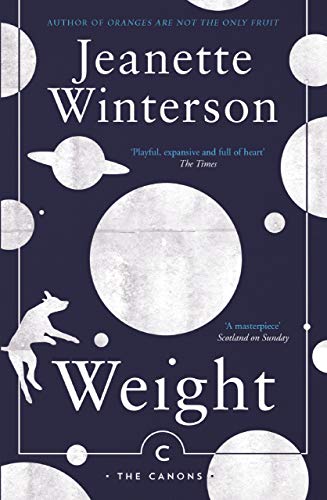
Jeanette Winterson, Weight (©2005, Canongate 2018)

Weight is Jeanette Winterson’s contribution to Canongate’s series The Myths. Other titles in the series include Margaret Atwood’s The Penelopiad, Philip Pullman’s The Good Man Jesus, the Scoundrel Christ and Ali Smith’s Girl Meets Boy.

Weight is a lively retelling of the Greek myth of Atlas, the Titan who was condemned to hold the heavens on his shoulders for eternity. This being Jeanette Winterson, there’s quite a lot of rhapsodic testifying as to the myth’s deeper meanings and its personal significance for the writer.

The retelling focuses on Atlas’s relationship with Heracles, who briefly relieves him of his burden. There’s a bit of rough humour at Heracles’ expense and reflections on their different kinds of strength: Atlas can hold still and Heracles is a man of action. Heracles comes close to stealing the limelight as the narrative follows him to his marriage to Deianeira and his horrible death in the burning shirt of Nessus. But Atlas has his quiet surprises as well, such as when Laika, the astronaut dog, comes into his life.

I confess I didn’t quite follow a lot of the meditation on the myth’s meaning. Something about boundaries and desire, fate and decision. It becomes personal. Jeanette Winterson finds in Atlas an echo of her own adoption story, her ignorance about her birthparents (this was written before Why Be Happy When You Could Be Normal, where she writes about her birth mother), and her rejection by her adopted mother:

Having no one to carry me, I learned to carry myself.
My girlfriend says I have an Atlas complex.

The task she took on, first as a rejected child and then as a writer, was to create a world of the imagination, a world that she has had to carry as a great weight.

I generally read Jeanette Winterson’s writing with a mixture of irritation and exhilaration. This book was no different. I’m irritated by her (presumably deliberate) false version of the myth that Atlas held up the whole world, when it was the heavens that he had to hold up in the original story. I’m irritated by the crude dick humour around Heracles (though maybe it’s not meant as humour but, even more irritatingly, as a version of male sexuality). I’m irritated by the way the prose sometimes feels like revivalist preaching, whether the subject is scientific cosmology or the pain of not knowing who your parents are. I’m irritated by occasional lapses of logic. But – and this is why I kept reading and am glad I did – I’m exhilarated by the way the book yokes together a scientific understanding of the universe with images from Ancient Greek myth (Laika nestling in Atlas’ shoulder, for example) and, in the final pages, I’m exhilarated at the notion of Atlas (and so possibly Jeanette) laying down his (and possibly her) burden.

Why would Jeanette Winterson be normal when she could be happy?

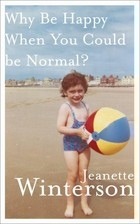
Jeanette Winterson, Why Be Happy When You Could Be Normal? (Jonathan Cape 2011)

20111227-185519.jpg I read this aloud to the Art Student (who insists, in the face of mounting pressure, that her nom de blog not progress to ‘the Artist’) on a leisurely drive from Sydney to Melbourne. We made it through all but 30 pages. It was a good choice for the gig.

The book is in two unequal parts. In the first, longer part Jeanette Winterson revisits territory she covered in her novel Oranges Are Not the Only Fruit: her relationship with her adoptive mother, a terror to Jeanette as a child but a gift beyond price to a novelist. The title of the book quotes the response of Mrs Winterson, as she is often called here, when teenaged Jeanette told her she was in love with a woman. Another of her striking utterances may have been almost as attractive as a title: ‘The trouble with books is you don’t know what’s in them until it’s too late.’ The experiences recounted in this section have clearly been thought about long and deep. I haven’t read the novel, and don’t know what’s distinctive about this version. There are some colourful bits about her mother’s response to the novel, but at the end of this section, roughly two thirds of the way through the book, there was no obvious reason why it had been written at all.

And then, after a two-page ‘Intermission’, it takes off. In the second section, which a note at the end tells us was written as the events it describes unfolded – that is, without knowledge of the outcome – the author tells of a period of severe mental distress that followed the break-up of a long-term relationship and her discovery of some papers that seem to be her birth records. This leads to a search for her birth mother, which is eventually successful. The whole long first section provided necessary background and orientation: we need it to grasp the force of the emotional turmoil and the extraordinary effect of some key phrases, which might otherwise seem to be ordinary, even platitudinous. What we get is a revelation about the powerful feelings that can attach to an adopted person’s search for birth parents. We also get an account of an experience that in another person might have been medicated, but here is an extraordinary, if painful, process of discovery and blossoming.

This is a marvellous book.

You wouldn’t read about it

On Friday night my book club had its end of year meeting. That’s the book club where we swap books and keep discussion to a minimum. I missed the end of year meeting of the book group, where the rest of the chaps discussed a book of essays by David Foster Wallace which I hadn’t managed to read, so I didn’t miss anything but conviviality and shame (unless of course something happened that they’re being secretive about). The book club met at Anong in Kings Cross for the best Thai food I remember ever eating, and we had a wonderful night, helped by two of our number being on first name terms with the restaurant owners and several having had recent travel adventures.

Rather than the usual complex swapping, this meeting each year is the occasion of a bit of simple giving. Each of us brings a gift-wrapped book, and each goes home with one. Two years ago three of the six books turned out to be The Slap, which has become even more ubiquitous since then, if that’s possible. This year, despite all the double guessing and byway exploration that goes into the choice of books, there was another hat trick: Jeanette Winterson’s Why Be Happy When You Could Be Normal?