Tag Archives: Kirli Saunders

Journal catch-up 35: Southerly

Roanna Gonsalves and guest co-editor K. A. Ren Wyld, Southerly Volume 80 Number 1: First the Future
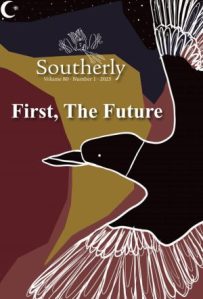
After pestilence, after pain, after wholeness, after emptiness, after life, after death, after a long hiatus, Southerly is back. (Page 6)

It has indeed been a long hiatus. Soon after Volume 79 Number 1 appeared in 2019 (my blog post here), the editors started a Go Fund Me page. Vol 79, Nos 2 and 3 were squeezed out by guest editors – one devoted to writing by refugees in 2021 (my post here), and an online-only issue of Covid-related work in 2022 (my blog post here). And then silence!

So welcome back, Southerly! And how good that Roanna Gonsalves is the new editor. I’ve heard her speak a number of times on Writers’ Festival panels, where she has been smart, generous, and always interesting.

There’s lots of good stuff in this re-birth issue:

  • a brief intellectual memoir from Barry Corr, a self-described ‘grumpy old man, highly averse to writing about himself’, who doesn’t mentiopn that his daughter is brilliant poet Evelyn Araluen
  • a wonderful conversation on First Nations poetics, interspersed with actual poems, featuring Natalie Harkin, Kirli Saunders, Elfie Shiosaki and Ellen van Neerven
  • a poem by John Kinsella in which he reveals that he has read Lord of the Rings well over 30 times
  • a poem by Omar Sakr whose title, ‘Walking to day-care in the genocide’ captures its piercing grief
  • a wonderful family memoir by Angelo Loukakis about growing up in a Greek migrant family in Sydney
  • Louise Adler on the implications of recent political interference in the arts – a speech given long before such interference led to her resignation as director of Adelaide Writers’ Week
  • a prose poem by Eileen Chong incorporating myriad internet memes
  • and more, much more, making up 172 rich pages.

There is more passion in these pages than you might expect in a literary journal. So much so that it feels at times like a group therapy session for very real pain, rage and despair created by the Israeli genocide in Gaza, and the ongoing genocidal treatment of First Nations people on this continent. It’s a rough ride at times, but a necessary one, and one that there are powerful forces in this country and elsewhere doing their best to prevent.

Not everything is rage and grief. There’s also a powerful thread laying out work that needs to be done. Elfie Shiosaki for example, has done a lot of work the archives of Noongar country. She says on page 91:

During the [Referendum] campaign, I was reflecting on research I had done at the State Records archives in Western Australia, which included reading letters written by Noongar women calling for representation for Aboriginal people in Parliament since the 1930s and earlier. Their calls have remained unanswered for almost a century.
I want to live in a community that rsponds to what we have been calling for, for such a long time …
The aftermath of the referendum, I wanted to re-envision First Nations poetry as a practice of peacemaking. Regardless of the outcome of institutional processes, poetry continues to contribute to conflict resolution by healing unreconciled relationships in the present and unreconciled narratives of the past as well as imagining futures of peace.

Literature without truth-telling would be rubbish. Truth-telling without discomfort is bull. Three cheers for Southerly, first now, then the future.

No blog post by me on Southerly would be complete without mentioning that, as is only right in a university-based literary journal, there are one or two densely academic pieces that I tried and failed to read. But lest that be taken as me feeling inferior, I will also mention that, embarrassingly, Gandhi’s name is misspelled on page 64.


I am an Australian man of settler heritage. I’ve written this blog post on the land of Gadigal and Wangal of the Eora Nation. I acknowledge Elders past and present of those clans, and welcome any First Nations readers and commenters.

Sydney Writers’ Festival 2025: My day two, part one

Friday, and there’s a pile of umbrellas just inside the main entry to the Carriageworks.


23 May, 11 am: Songstress Poetica (Link to be added when/if podcast is released)

This was a charming hour with four First Nations women from this continent and a distinguished Emirati poet and scholar. It was in part a master class in relationality as the Indigenous women found many points of warm connection – shared Irish heritage, similar experience with singing, sharing of language, appreciation of each other’s work.

In the chair was Dr Alethea Beetson, a Kabi Kabi/Gubbi Gubbi + Wiradjuri artist who has, she said, many slashes in her work résumé, but works mainly in music.

Aunty Kerry Bulloojeeno Archibald Moran, ‘matriarch and medicine woman of Silver City Aboriginal Reserve – the Mission or Mish – on Anaiwan gooten country, Armidale’, sat in the middle, in splendidly colourful clothes and white ochre face paint. In striking physical contrast next to her was Dr Afra Atiq, an Emirati spoken word poet and scholar, dressed in magisterially flowing black. On the other side were two young writers (note that from my perspective anyone under about 50 is young) – Wiradjuri poet Jazz Money (most recent book mark the dawn) and Gunai woman ‘who rarely stays in her lane’ Kirli Saunders (most recent book Eclipse).

Each of the panellists spoke about her relationship to music. None of them owned up to playing a musical instrument, or even singing well, though Auntie Kerry said she always sang in response to the music of the bush that is always here if you listen. Kirli Saunders quoted her mother , ‘Birds in the bush, Babe, birds in the bush,’ meaning that when one bird needs to pause to draw breath the others will carry the song: it’s not all about individual effort in a choir, or in life.

Speaking about her own work, Aunty Kerry said she was inspired by what she reads in books – she produced two from her tote bag, one of which was Granny Duval by Sue Pickrell. She walks in the shadows of other people, she said, and when she reads when becomes the characters, just as in the bush she becomes the kookaburra, magpie, echidna. She performed a poem based on the story in Granny Duval.

Jazz Money spoke of the tension between the impulse to speak and the need to be heard. When she wrote her first book, she had no thoughts of publication. With her second book, she felt th gift of responsibility. As a queer Aboriginal woman, it was something new to expect her voice to be heard. Before she read her poem, ‘ember‘ (you need to scroll down at the link), she said that it was iportant inwith that responsibility not to focus on struggle: ‘The horrors of colonisation are such a tiny part of our story.’ She aims to be part of legacies of joy.

Kirli Saunders took up that theme, saying that though she writes about the stormy places, it’s often in the moment when the storm has passed and the smell of petrichor is everywhere. She performed ‘In the before time’, a poem/dance from the performance piece she is currently developing.

Afra Atiq reminded us that in her work is not reclaiming anything that has been lost, but is part of a continuing tradition, to which she has responsibilities. She performed a poem from her book, Of Palm Trees and Skies. The poem, whose title as best I could scribble it down was ”Six minutes that may be erased today’, was inspired by an art installation in which a mechanical device drew images and then erased them after six minutes. It’s a breathless poem that ends (the line breaks are my guess):

We write because we must
we erase because we think we should.

After the session, these extraordinary women stayed on the stage and generously posed to have group photos taken by a number of intrepid audience members.


12.30: Q & A with Jeanette Winterson in the Patrons Lounge

Thanks to a generous friend, I was a guest at this bonus event. Jeanette Winterson stood on a tiny stage in the Patrons Lounge and answered questions for a little over half an hour. Though some questions came from the munching and sipping patrons, Radio National’s Kate Evans served as excellent stooge, asking questions that elicited a lively story about the origins of Winterson’s first book, Oranges are Not the Only Fruit, including the role played by Australian Dale Spender; reflections on the influence of the Manchester of her childhood on her prose (evidently in Manchester, people talk to strangers in the street in staccato, irreverent humour); and about the importance of reading to enable people to broaden their horizons past the confines of their one short life, and to learn how to express themselves in ways without which the main alternative would be violence

I had a break for lunch, and am now having a break from blogging. The afternoon will be another post


The Sydney Writers’ Festival is happening on Gadigal land, where on this day the ground was doing its best to soak up a lot of water. I have written this blog post on Gadigal and Wangal land. I acknowledge their Elders past present and emerging, and welcome any First Nations readers of this blog.