Tag Archives: journals

Journal Catch-up 32: Meanjin Autumn 2025

Esther Anatolitis (editor), Meanjin Vol 84 Nº 1 (Autumn 2025)
(links are to the Meanjin website: I believe that they are now all accessible to non-subscribers)

Unless Melbourne University Publishing’s recent decision to shut Meanjin down ‘on purely financial grounds’ is reversed, this is the fourth-last issue of Australia’s third-longest-lived literary magazine. (The New South Wales School Magazine, a literary magazine for children, is the longest lived. Southerly comes second.) The two part-time employees responsible for the journal have lost their jobs. Even given the long list of other people whose work goes into each issue, it’s astonishing that this extraordinary publication has been produced by so few paid workers.

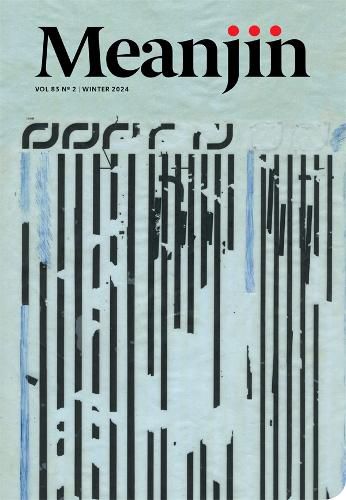
The cover design is weirdly prophetic. It represents the predictive results for a web search for “the work of”. Early this year, readers would hardly have noticed the battery icon in the top right showing a dangerously low charge, a speck of red on a mostly black page. Now, thanks to what has been correctly described as outrageous cultural vandalism, the battery is dead flat. But that’s the only sign of imminent demise. The rest of the issue – more than 200 pages of text and image – is as lively, varied and thought-provoking as you could wish.

There are the regular features:

  • Even before the contents page, there’s The Meanjin Paper, an essay by a First Nations writer: ‘Different Plants for Different Meanings‘ by Anyume John Kemarre Cavanagh with Gabriel Curtin reads like poetry
  • State of the Nation: topical essays, this time it’s Sisonke Msimang, Andrew Lemon and Rachel Withers on the Voice referendum, gambling and the housing crisis respectively, each with a twist
  • Australia in three books‘: Sarah Walker writes about Ethel Turner’s classic children’s book Seven Little Australians, Jessie Cole’s Desire (2022) and Helen Garner’s Yellow Notebook (the first volume of her published diaries), all of them dealing with girls or women who ‘are trapped in the great looping flood’ of their feelings
  • Interview: It’s Winnie Dunn, author of the novel Dirt Poor Islanders and mover and shaker in the Western Sydney’s rich literary scene, and it makes very interesting reading
  • The Year In … : The year in Yellowface. Jacqueline Lo focuses on the web trailer for a ballet production at the 2024 Adelaide Festival, which she argues represents a persistence in Australian culture of attitudes to Asian characters and actors that are no longer tolerated where Blackness/Blakness is the issue.

There are short fictions, memoir, essays, book reviews and poetry. I’ll name just one or two of each.

In the short story ‘The farmer‘ by Suzanne McCourt, the title character is a woman of a certain age searching for a calf that has gone missing, presumed stolen by her neighbour. There’s a lot there for any reader to like, but because I spent a lot of time with cattle when I was young, I particularly loved the way the story captured the intimate bond between human and cows and their calves, including the delicate process of adoption.

Of the four pieces labelled ‘Memoir’, Jess Lilley’s ‘My pregnant life‘ stands out. It begins with the author’s first pregnancy when she was nineteen and dealing with the legal and social hurdles to abortion. I don’t think it’s a spoiler to quote the essay’s last words:

When I lay with his tiny body in my arms, I knew this signalled the end of my pregnant life. Nine pregnancies across 25 years. A quarter of a century of having my  world rocked over and over and over by my own bodily forces.

minganydhu ngindhumubang / What am I without you?’ by Tracy Ryan is a generous bilingual essay in a class of its own that challenges readers to deconstruct our assumptions and practices around language – much of it is written in Wiradyuri language, first transliterated then translated: ‘my soul wants to decolonise language but that would make this work nearly incomprehensible to an English-dominant culture.’

Architect Naomi Stead’s essay ‘Wheatscape with Cathedral‘ deals with the extraordinary Stick Shed in Murtoa, rural Victoria. The author’s full-page photo of the shed’s interior cries out for an explanation of the extraordinary vision, and the article more than satisfies.

Of poetry, I’ll mention just ‘Sacrificed on Altar of Vice’ an erasure poem by Brittany Bentley. If you click on the link, you’ll see the image of two columns of newspaper copy most of which has been redacted in red. The words that are still legible constitute the poem. The hard-copy Meanjin includes a link to the unredacted article. The poem stands on its own feet but read in conjunction with the original article its power is greatly amplified. Most of the poem’s title comes from the redacted text.

The three book reviews tend to be in rarefied scholarly language. Here’s a sentence from ‘Queer perforations‘, a review by Dylan Rowen of Blackouts, an experimental work of fiction by Justin Torres:

Determined to free the queer subject from the realm of the symbolic and to give voice to those erased from history, this text critically fabulates – to borrow Saidiya Hartman’s term – a history gleaned from the redacted bits of what little was left in the records.

Mercifully, this kind of insider language is mainly restricted to the book reviews.

With any luck, by the time I’ve read the final issue, in who knows how many months’ time, Meanjin, like Heat before it, will manage some kind of resurrection, in spite of Melbourne University’s reported refusal to entertain many offers of financial support from other institutions.


I  finished this blog post on the land of Bidjigal and Gadigal of the Eora nation. I acknowledge their Elders past and present, and welcome any First Nations readers.
Journal Catch-up 31: Overland 256

Evelyn Araluen and Jonathan Dunk (editors), Overland Nº 256 (Spring 2024)
(Links are to the online versions unless otherwise indicated.)

This is the third of four promised editions of Overland dedicated to commemorating its 70th year. In some ways it marks the end of an era as Toby Fitch, who has been poetry editor for a decade, breaks his silence with ‘A farewell and a poem from poetry editor Toby Fitch, 2015–2025‘, and resigns from the ‘simple work, of carving down a cornucopia of submissions into a small set menu for each issue’.

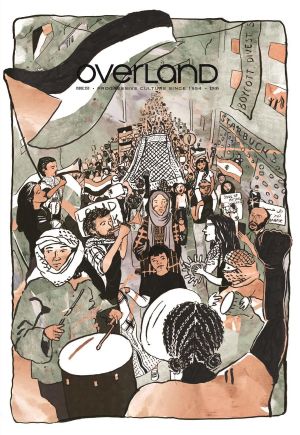
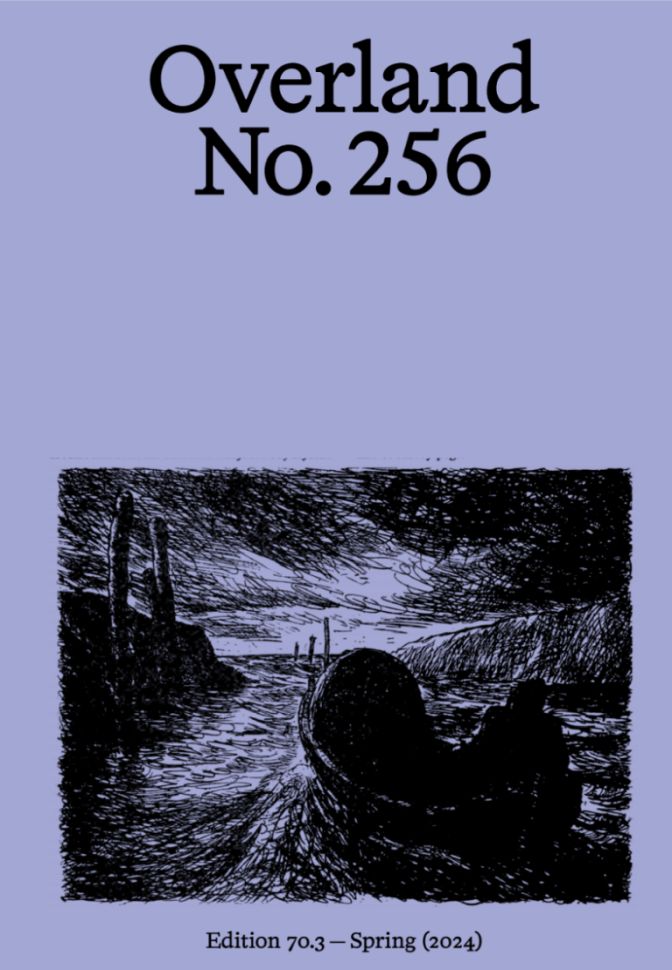
There is an element of nostalgia in the design and the illustrations reproduced from past issues – by artists including Fred Williams (from 1985), Ian Rankin (from 1987) and Richard Tipping (from 1993). The writing by contrast tends more to the urgent.

Plant hatred in our hearts‘ by Sarah Wehbe, ‘the child of refugees who are the children of refugees’, contextualises the current atrocities in Gaza by listing events reported from there in the first week of the writer’s life. The essay includes this, a reminder of Edward Said’s resonant statement that ‘Palestinians have been denied permission to narrate’:

The recent genocide in Gaza has planted hatred in the hearts of its survivors and onlookers, a painful wound so immense that it will continue to throb generations on. Plant hatred in our hearts and watch as hope and resilience grow in its place. Long after the rubble has settled and the refugees have dispersed across the world, we will share our stories. … We are here, we tell our stories, and as long as that is true, there is hope.

There’s a lot else besides. ‘Dust‘ by Lilli Hayes is a brief, harrowing first-hand account of the impact of asbestos-related mesothelioma on her family. In ‘Résonances‘, Daniel Browning – whose book of essays Close to the Subject won the 2024 Prime Minister’s Literary Award – writes about the work of Swiss–Haitian artist Sasha Huber, as seen through an Australian First Nations lens.

There is more poetry than usual (Toby is going out in a blaze of glory). There are some big names, but I’ll just mention ‘speed, a pastoral‘ by Ruby Connor, which has a subtitle ‘(After John Forbes)‘. It doesn’t feel very Forbes-ish to me, but it captures an episode in a young woman’s life in vivid, unpunctuated three-line stanzas.

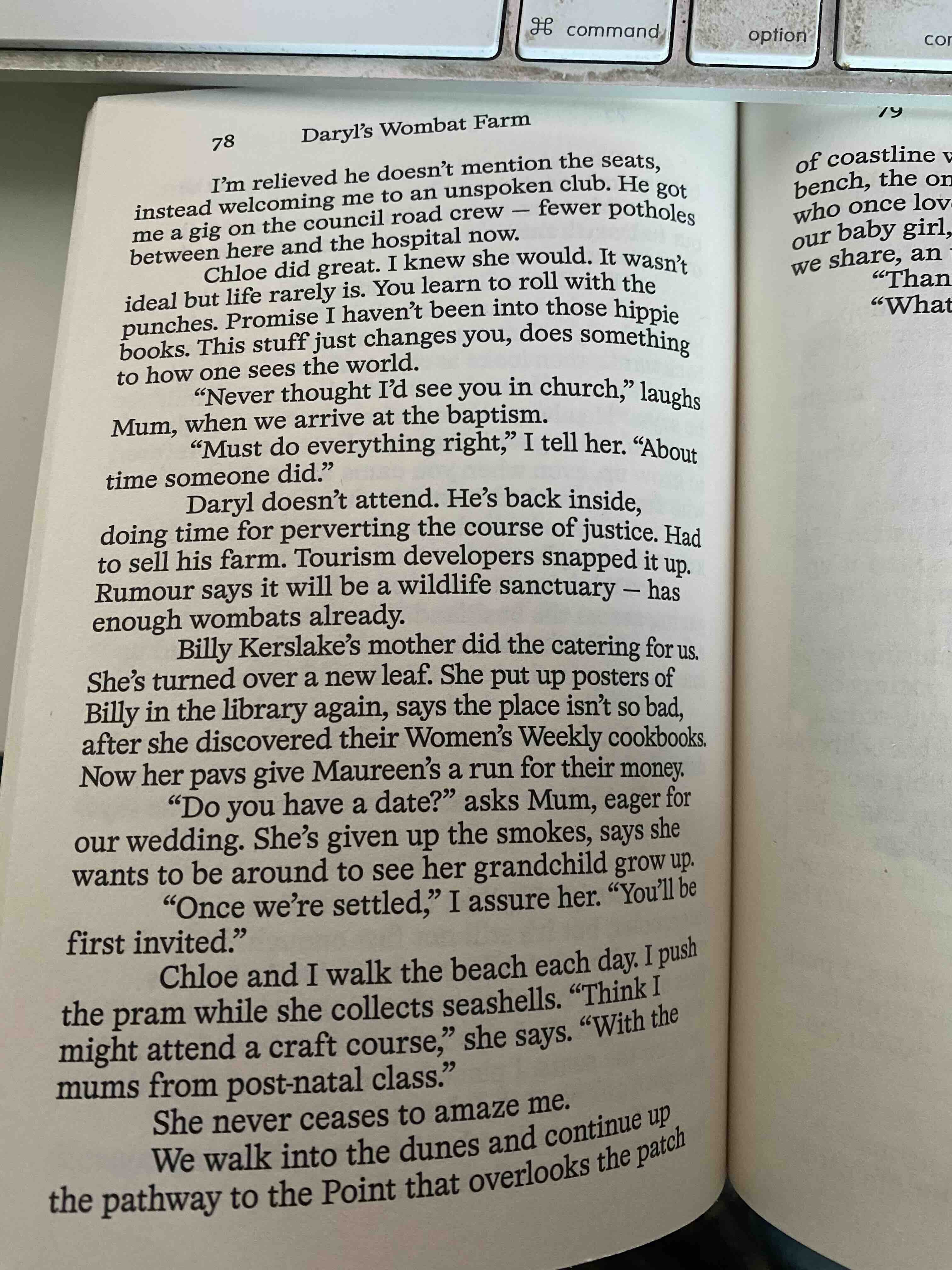
My page 78* practice serves me well with this Overland. It falls in the middle of one of the three pieces selected by fiction editor Claire Corbett, the masterly ‘Daryl’s wombat farm‘ by Rowan MacDonald.

The image gives you an idea of the retro design – the chunky type face and larger font size, and the plain white, matt paper stock. I don’t necessarily prefer this to the modern design, but the larger font is a relief to my ageing eyes, and the poorer paper stock creates a companionable vibe rather than an austerely professional one.

I know I said there’s not much nostalgia in the writing in this Overland. I’ll now contradict myself. This story reminds me solid, social realist, working-class fiction that was a staple of Australian short fiction decades ago. I hasten to add that it does it in a good way.

At the start the narrator, wearing his girlfriend Chloe’s pink gumboots, is shovelling cube-shaped wombat poo. What grows from there is a portrait of a small, marginalised rural community filled with histories of violence, untimely death, ‘unspoken stories’, and a cast of characters who are known only by their first names and vague reference to their status, exploits or fates. Within that portrait is the sweet, elliptically told story of fatherhood.

When I say elliptically-told, I mean it sometimes take a bit of pleasurable work to figure out what’s going on. The beginning of page 78 is an example. The narrator has just returned Curly’s borrowed Skyline (a make of car – my four-year-old grandson would be ashamed of me that I had to look it up) with mess on the seats. Curly, who hasn’t been mentioned previously, doesn’t make a fuss about the mess. Instead he says, ‘Congrats, brother. You’re one of us now.’ Only as the first sentences of page 78 unreel, the reader understands. Curly has played a good role in the narrator’s life in other ways than lending the car, and his ‘one of us’ refers to fatherhood. The narrator has borrowed the car when Chloe was in labour, but didn’t make it to the hospital in time:

I’m relieved he doesn’t mention the seats, instead welcoming me to an unspoken club. He got me a gig on the council road crew — fewer potholes between here and the hospital now.

On the rest of the page, the aftermath of the birth plays out and a number of economically sketched subplots are resolved. The narrator catches himself voicing some of Chloe’s hippie-book-derived philosophy. He has an oblique conversation with his mother about breaking the pattern of neglect and abuse set by his father. Daryl of the wombat farm gets a degree of justice for his role in the narrator’s father’s death. The mother of a missing boy overcomes her dislike of libraries and education enough to put posters back up. Maureen, mentioned once before in connection with pavs, gets another mention. A wedding is mooted. And there’s a tiny, beautifully pitched conversation about the future.

Chloe did great. I knew she would. It wasn’t ideal but life rarely is. You learn to roll with the punches. Promise I haven’t been into those hippie books. This stuff just changes you, does something to how one sees the world.
Never thought I’d see you in church,’ laughs Mum, when we arrive at the baptism.
‘Must do everything right,’ I tell her. ‘About time someone did.’
Daryl doesn’t attend. He’s back inside, doing time for perverting the course of justice. Had to sell his farm. Tourism developers snapped it up. Rumour says it will be a wildlife sanctuary – has enough wombats already.
Billy Kerslake’s mother did the catering for us. She’s turned over a new leaf. She put up posters of Billy in the library again, says the place isn’t so bad, after she discovered their Women’s Weekly cookbooks. Now her pavs give Maureen’s a run for their money.
‘Do you have a date?’ asks Mum, eager for our wedding. She’s given up the smokes, says she wants to be around to see her grandchild grow up.
‘Once we’re settled,’ I assure her. ‘You’ll be first invited.’
Chloe and I walk the beach each day. I push the pram while she collects seashells. ‘Think I might attend a craft course,’ she says. ‘With the mums from post-natal class.’
She never ceases to amaze me.

The story could end there, really, but it continues for another 75 words, and concludes on an explicitly optimistic note that sings:

We hold our baby girl, smile in awe at this creation, the love we share, an unwritten future ahead.
‘Thank you,’ I say to Chloe.
‘What for?’ she laughs.

It’s a story that repays the closer attention that my page 78 practice requires.


I wrote this blog post on the land of the Wangal and Gadigal clans of the Eora nation. I gratefully acknowledge the Elders past and present who have cared for this beautiful country for millennia, and lived through extraordinary changes in the land and climate over that time.


My blogging practice is focus arbitrarily on the page of a book that coincides with my age, currently page 78.

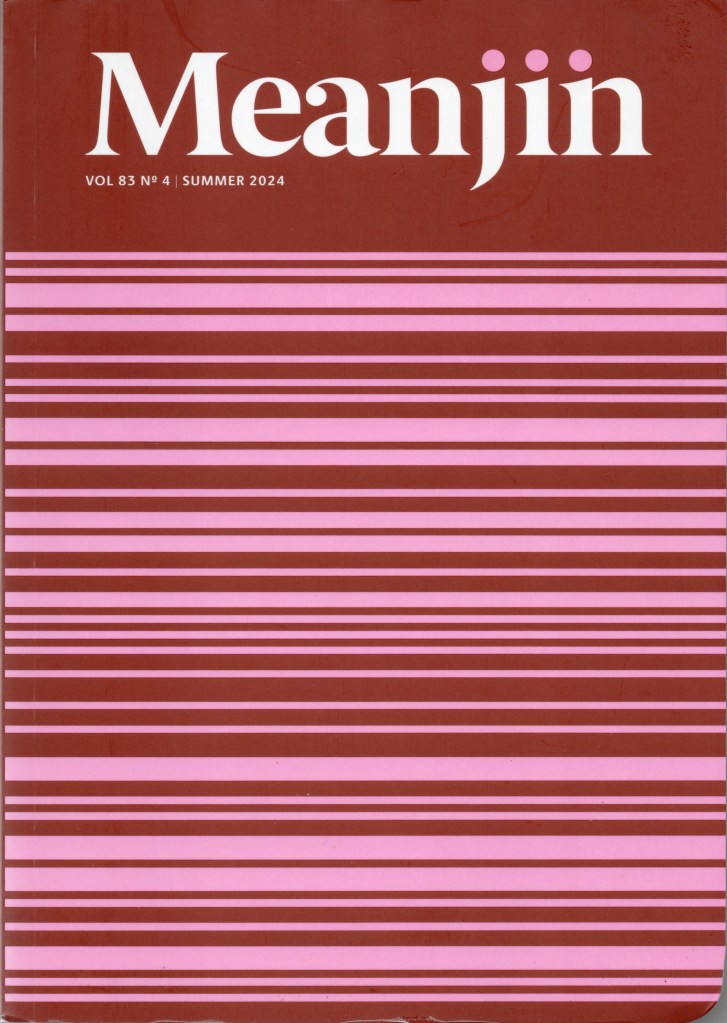
Journal Catch-up 30: Meanjin Summer 2024

Esther Anatolitis (editor), Meanjin Vol 83 Nº 4 (Summer 2024)
(links are to the Meanjin website: some but not all of them are available to non-subscribers)

I’m usually at least three months behind in my journal reading, so I don’t expect the journals to comment on the day’s headlines. So it was nice serendipity, on the day I read a piece in the Guardian about bulldozers moving in on a tent city in Moreton Bay Council Area, to read ‘The tent village at Musgrave Park‘ by Lillian O’Neill, which addresses a similar fleeting community in south-east Queensland with curiosity, empathy and (this is Meanjin after all) erudition.

Other essays have a more general but no less pointed timeliness:

Meanjin has a number of regular features:

  • Even before the contents page, there’s ‘The Meanjin Paper’, an essay by a First Nations writer: it this issue it’s ‘Sing for the Black: From Act to Treaty‘, in which singer-songwriter Joe Geia talks bout his art, particularly his show From Rations to Wages to Treaty
  • Australia in three books‘: Shakira Hussein discusses three books about Meanjin/Brisbane – by David Malouf, Melissa Lukashenko and Ellen van Neerven
  • Interview: ‘All colour and light’, an interview with Gerald Murnane, eccentric and elusive as ever
  • ‘The Year In…’ This issue has ‘… Poetry‘, not a survey, but discussion of a very few favourites by Graham Akhurst & Shastra Deo.

There are short fictions, memoir, book reviews and poetry. To name just one of each:

  • Your heart sir‘ by Grace Yee is in the poetry section, but to my taste it’s the best short story in the journal, about the sudden death of an old man and the dementia of his widow
  • Seven Snakes‘ by Carrie Tiffany isn’t in the memoir section, but it is a kind of memoir, in which the author, a park ranger, tells of seven encounters with snakes and one, more toxic, with a male manager.
  • How Novel is the Novel Prize?‘ by Maks Sipowicz, a review of It Lasts Forever and Then It’s Over by Anne de Marcken and Tell by Jonathan Buckley, joint winners of the 2022 Novel Prize, includes reflections on the function of prizes and awards in the literary ecosystem – and wonders if perhaps the prize should have gone to books of less obvious appeal
  • @ClanC #overflow‘, a lovely parody of Banjo Paterson written by Ian Simmons, whose bio says he ‘has been writing bad teenage poetry for almost five decades’, introduces some much-appreciated levity.

There’s much more in the journal’s 191 pages. I’ll give the last word to Maks Sipowicz. He was referring to literary prizes. I think the words apply just as well to literary journals:

As readers, we can only collectively benefit from the spotlight falling onto more challenging texts


I wrote this blog post on the cloud-covered, windy land of Gadigal and Wangal of the Eora nation. I acknowledge their Elders past present and emerging, and gratefully acknowledge their care for this land for millennia. I welcome any First Nations readers of this blog.

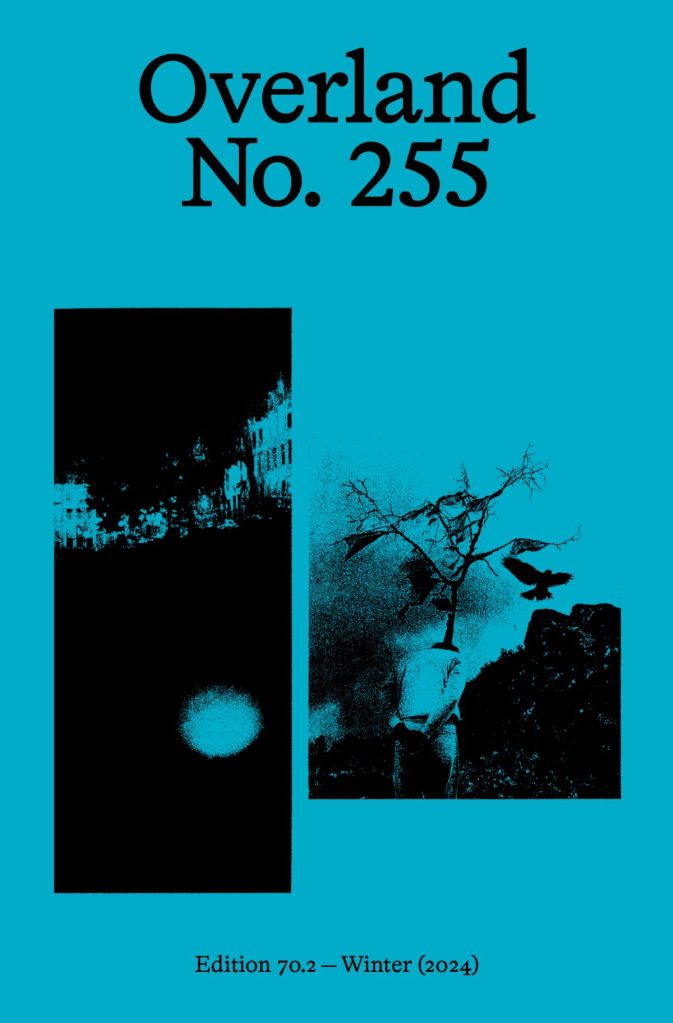
Journal Catch-up 29: Overland Nº255

Evelyn Araluen and Jonathan Dunk (editors), Overland Nº 255 (Winter 2024)
(Links are to the online versions unless otherwise indicated.)

I sometime approach literary journals as if shouldering a grim obligation – doing my bit in the cultural ecology. (Added later: The morning after I uploaded this post, I read in a letter from Esther Anatolitis, editor of Meanjin, that my subscription ‘supports the ecosystem of Australian writing: that fragile yet incredibly powerful space where the finest new work is written’. Great minds draw on the same tropes.) The austere retro design of this Overland, one of four to mark a 70th anniversary, didn’t do much to dispel the grimness. Nor did the editorial, which underlines the darkness of our times. But then

The first thirty pages or so are taken up with ‘Writing from the South: an interview with Kim Scott’. It’s leisurely, full of unfinished sentences and swirling crosscurrents of thought and information – there’s no apparent attempt to tidy up the spoken conversation, and as a result you (or at least I) get to feel you’re in the room with the the living, breathing, thinking author of, among other things, That Deadman Dance, Taboo (links to my blog posts) and (what I haven’t read but now really want to) Benang. He’s in conversation with Samuel J. Cox.

I’ll mention two other non-fiction pieces: ‘The Australian media’s problem with Palestine’ by Juliet Fox, which tells about decades of government suppression of Palestinian voices on a Melbourne community radio station; and ‘“Arts funding is fucked”: Overland 1973–1975’, a plus-ça-change piece by Overland‘s digital archivist Sam Ryan about the politics of funding to the arts in Australia 50-odd years ago.

As always, there’s poetry, ranging in this issue from probably-very-good-if-you’re-motivated-to-spend-a-lot-of-time-with-it-but-today-I’m-not to a beautifully executed punch to the guts. The latter is ‘The Killer in Me’ by Ann-Marie Blanchard, in which the speaker personifies her uterus after a miscarriage. Somewhere between the two extremes is the dauntingly titled ‘Poem in asymmetric transparency’ by Shari Kocher, a meditation on a Margaret Preston painting:

Three lotus lookalikes floating in solar darkness.

As it happens, page 78* occurs in the piece of fiction that speaks most to me, Jordan Smith’s ‘Something Is Rotten’, in which a technological solution to the climate emergency goes terribly wrong, seen from the point of view of young lawyers who thought their normal work was high-pressure. At page 78, the catastrophe is beginning to unfold, though the characters stay with their usual preoccupations. Paul, one of the barristers, looks out of his high-rise window at the ‘sat-drones’ doing hi-tech stuff to the upper atmosphere:

‘Fuck knows what they’re doing but it does look good.’ The sat-drones twinkled as, one by one, they flew up then plunged down, like waves running up and down a skipping rope. The colour of each oscillated between a crystal blue and a sharp, metallic crimson. Rob felt a bit dizzy. He and Sarine looked at each other.

As required by a tight deadline, Rob puts the dizziness aside, takes ‘a few painkillers’ and gets back to work.

His phone buzzed incessantly.

Sydney 6G
Friday, 6 June 11:43
Notification centre
News alert:
PM urges calm after atmospheric pressure dr… (10+)

Rob cleared notifications and switched on do not disturb.

The reader feel the disaster happening while the character sticks to the his mundane urgencies. It’s deft storytelling. Like the poems I’ve mentioned it’s marked as ‘Online soon’ on the Overland website, and may be available by the time you read this.

I don’t usually google authors, but I did look up Jordan Smith. He’s a barrister who has an Honours degree in nuclear physics, so I guess he knows what he’s taking about on both sides of the equation.

I haven’t exactly dispelled the notion of grimness I invoked in my first sentence – colonisation, genocide, miscarriage, climate catastrophe aren’t cheery subjects. But taken along with the evocative decorations from past issues (Richard Tipping in the 1970s, Rod Shaw and John Copeland in the 1990s) there’s something exhilarating about the way Overland has survived so much change in the world and in itself, still giving a platform to new voices, still saying things that aren’t easy to hear elsewhere.


I wrote this blog post on the land of the Wangal and Gadigal clans of the Eora nation. I gratefully acknowledge the Elders past and present who have cared for this beautiful country for millennia, and lived through extraordinary changes in the land and climate over that time.


My blogging practice is focus arbitrarily on the page of a book that coincides with my age. This is first time I’ve looked at page 78.

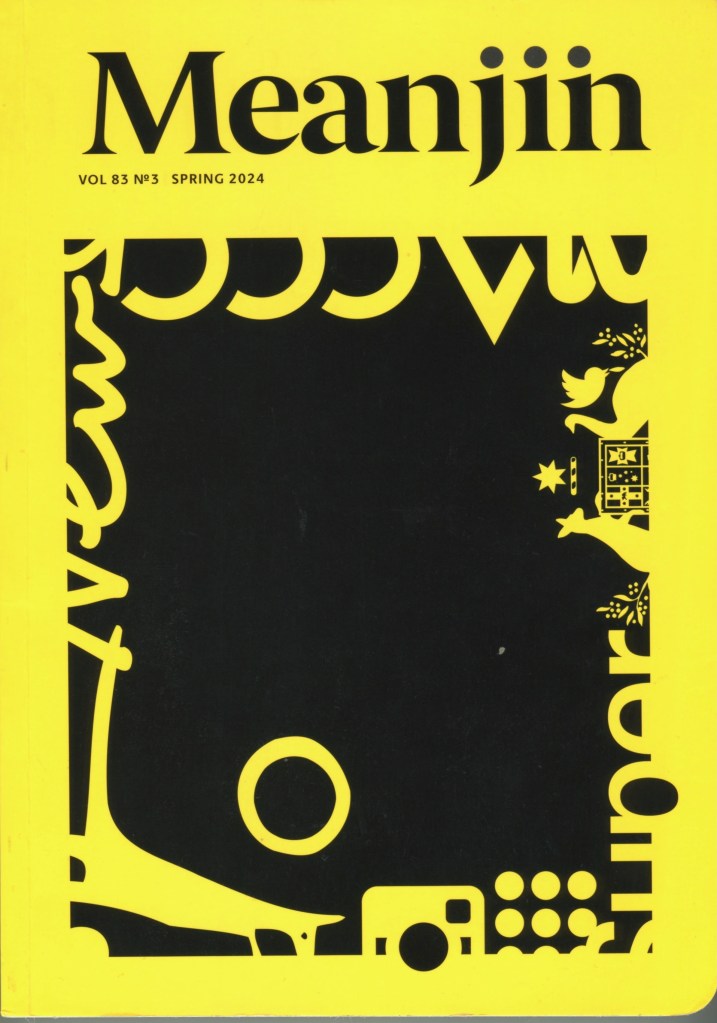
Journal Catch-up 28: Meanjin Spring 2024

Esther Anatolitis (ediitor), Meanjin Vol 83 Nº 3 (Spring 2024)
(links are to the Meanjin website: some but not all of them are available to non-subscribers)

This Meanjin was published before King Charles visited Australia last year. This means Jenny Hocking’s blistering essay, ‘Remnants of Empire: Racism, Power and Royal Privilege‘, appeared well before Lidia Thorpe’s headline-grabbing outburst. The article, which amply fulfils the promise of its title, made me feel much more sympathy for the outburst.

There’s a lot else in this issue to delight and enlighten. Some pieces that I think of as necessary. Apart from Jenny Hocking’s, three that stand out are:

  • Well, It’s Beautiful Country, Really –‘ by Mike Ross. Each issue of Meanjin these days begins with a ‘Meanjin Paper’ – an essay by a First Nations person. In this one Mike Ross, an Olkola man who has been at the vanguard of land rights for the people of Cape York for three decades, talks about finding meaning in Country, about constantly learning
  • Lucky for Some‘ by Frank Bongiorno on the 60th anniversary of publication of Donald Horne’s The Lucky Country, which I read in tandem with Nick Bryant’s recent piece on the same subject in the Guardian
  • Jews, Antisemitism and Power in Australia‘ by Max Kaiser, which parses the way accusations of antisemitism have been used to silence important points of view. This article may have been published six months ago, but it feels hyper-relevant today as actual vicious antisemitism and and dubious accusations of antisemitism are ramping up.

There are pirces that may not be necessary, but they’re fun and educative all the same:

  • an interview with poet Ellen van Neerven (which I enjoyed even though it focuses on a book of theirs I haven’t read)
  • a scathing annotation of the Australian Constitution from First Nations writer Claire G. Coleman

There is some excellent fiction, including these two:

  • The Feeling Bones‘ by Lucy Nelson, which tells a family’s story in terms of their bone ailments; and incidentally informs me that ‘sits bones’, a term for the backside I had only heard used by my Pilates instructor, actually comes from the world of dance.
  • The Other Doctor‘, in which James Salvius Cheng finds a way to talk about the exhausting business of being a medical practitioner without coming across as a whinger.

A trio of memoirs call out to each other about disability, religion and sexuality:

  • Love Is Worship by Adrian Mouhajer, about finding peace in a Muslim family as a queer person
  • Dirty Things, Precious Things by Anna Hickey-Moody, about Catholicism, disability, family violence
  • Crocodile by Ella Ferris, brilliant, complex piece of writing which includes experiences of Aboriginality and disability

There are some excellent poems. The ones I warm to most (not necessarily the ‘best’) are:

  • ‘Mothertongues’ by Grace Chan, which begins ‘My son is starting to speak / in English’ and later, as she tries to teach him some Chinese, ‘our tongues stumble / in synchrony’
  • ‘The Women’s Shelter’, a rhyming sonnet by Claire Watson, in which a woman creates a knotted rag rug from strips of old bedsheets

There are things that aren’t my cup of tea: a smart-alecky essay on satire, an incomprehensible poem, some ‘experiments’, a review or two that convinced me not to read the books under consideration. But I can imagine each of those finding readers who will delight in them


I wrote this blog post on the land of Gadigal and Wangal of the Eora nation. I acknowledge their Elders past present and emerging, and gratefully acknowledge their care for this land for millennia, as once agin the sun is rising later in the mornings, and spiders are making their presence known in the bushes.

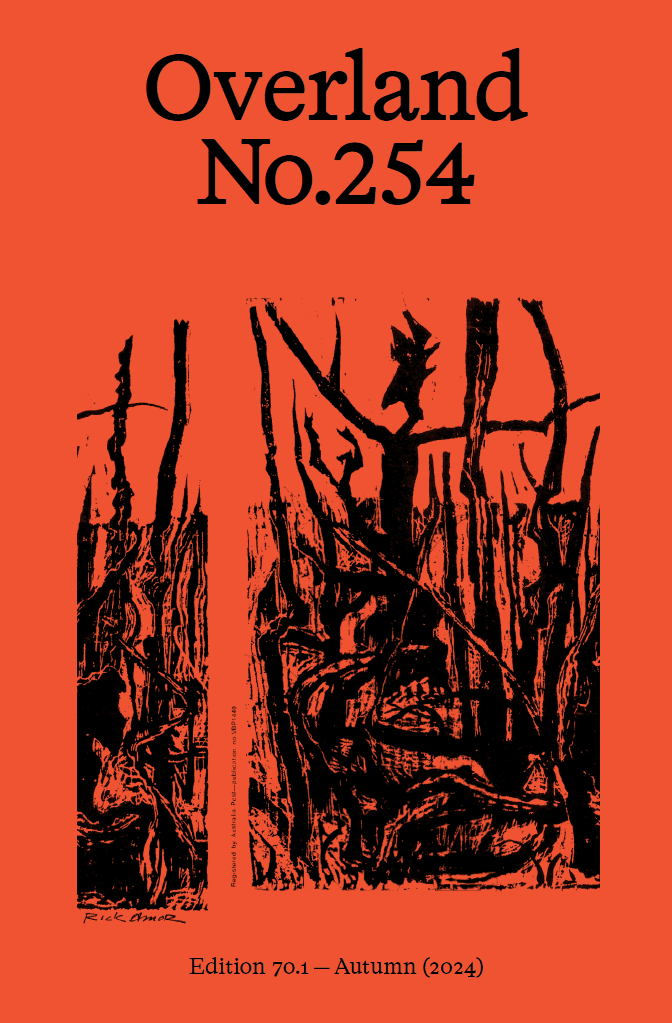
Journal Catch-up 27: Overland Nº254

Evelyn Araluen and Jonathan Dunk (editors), Overland Nº 254 (Summer 2023)
(Only the editorial is online at the time of writing – so I haven’t included links, sorry!)

The first thing you notice about this issue of Overland is its design – an austere black and red cover and monochrome throughout, a smaller format, and surely the paper stock is cheaper than we’ve become used to. Could this be a sign of a funding crisis?

Of course there may be a funding crisis – this is an Australian literary journal after all. But there’s a definite retro aesthetic to the new look. Editors Evelyn Araluen and Jonathan Dunk call it an ‘archivally informed design’, and explain that it’s the first of four issues to mark Overland‘s seventieth year of publication. The internal illustrations are all from the archives, and include stunning ink drawings by Noel Counihan from the 1970s and Rick Amor from the late 80s and early 90s. Fabulously, page 128 features a Bruce Petty cartoon from 1976.

The nostalgia stops with the look. The words are all 2024.

I recommend the whole issue, but want to single out two articles that make me sorry so little of this content has made it to Overland‘s website. They are ‘“A State of Waste”: Myall Creek, the Sydney Herald and the Foundations of Australian Capitalism’ by Jeff Sparrow, and the anonymous essay, ‘Writing after … October 7’.

I’ve recently read how the 16th century Papal ‘Doctrine of Discovery’ (Wikipedia entry here) was explicitly invoked to justify dispossession and genocide of Indigenous people in the Americas and elsewhere well into the 19th century. Jeff Sparrow’s magisterial essay offers a very different account of how similar acts were justified in Australia. It’s a clear and cogent history of how the closing of the commons in 18th century Britain led to a new understanding of ‘ownership’ of land, which was applied ruthlessly by the settlers in Australia. The content may not be startlingly new, but Sparrow’s copious quotation from the Sydney Herald in the first part of the 19th century is, for me at least, revelatory. It’s not that the way First Nations people related to the land was strange to the settlers. It was all too familiar:

Like the British commoners, Indigenous people clearly did ‘make use’ of the land. They lived in a use-value society, tending their country to encourage the animals and plants they required. The Herald, however, understood ‘productivity’ in capitalist terms, with use values significant only insofar as they generated profit. (Page 67)

The essay spells out the way this thinking leads shockingly, but logically to the minds of the Sydney Herald editors, to justification of massacres.

What can I say? If you get a chance, read this essay.

The author of the other stand-out essay is a person of Arab background, writing in the context of conversations with Arab and Palestinian friends who work in academic or cultural contexts. They describe how they have always held in their mind the history of Palestine as ‘a bustling site of plurality and coexistence’. The establishment of the state of Israel in the nakba put an end to that condition but it has remained as a vision of possibility.

Jews worldwide were shaken by the visceral hatred shown for them in the Hamas attacks on 7 October last year. Palestinians and Arabs have been no less shaken by the hatred and disregard for them that subsequent events have demonstrated. The multi-religious and plural world of pre-1948 is now unthinkable. ‘We had not realised until this carnage started,’ the author writes, ‘how dehumanised Palestinians and Arabs are in the eyes of most Israelis.

There’s more. Back here, well-intended and well-informed colleagues have been carefully ‘balanced’ when discussing the situation of Palestinians in Israel, in large part because of not wanting to be seen as antisemitic. The author and friends have believed that if a point came when Israel unleashed its full fury on Palestinians their colleagues would take a stand. But it has happened, and many have not changed their stance:

It is not hyperbole to say we are grieving as we watch our kin annihilated on an hourly basis … We feel neglected, betrayed and discarded. We have always stood in solidarity with the causes these colleagues are most passionate about because those causes are ours too. Why isn’t Palestine their cause? (Page 49)

There’s another fine Palestine-related essay – providing devastating perspective on the brouhaha over three actors wearing a keffiyah at a preview of The Seagull in Sydney last year. But it’s the anonymous writer’s cry from the heart that strikes home.

There’s poetry – including the winners of the 2023 Judith Wright Poetry Prize and an excerpt from Nam Le’s 36 Ways of Writing a Vietnamese Poem.

There are short stories, of which my favourite is ‘Who Rattles the Night’ by Annie Zhang, a comic ghost story that won the Neilma Sidney Fiction Prize.


I finished writing this blog post in the land of the Bidjigal and Gadigal clans of the Eora nation, overlooking the ocean and surrounded by birdsong. I gratefully acknowledge the Elders past and present who have cared for this beautiful country for millennia.

Journal Catch-up 26: Meanjin Winter 2024, and November verse 6

Esther Anatolitis (ediitor), Meanjin Vol 83 Nº 2 (Winter 2024)
(links are to the Meanjin website: some but not all of them are available to non-subscribers)

This Meanjin is incredibly rich and varied. I’ve carried it in my backpack for weeks, mostly reading a single article or story at a time when on public transport, in waiting rooms or queues, or occasionally – as in the days before podcasts – while walking. I have learned about:

Click on any link in that list, and you may find something instructive, challenging, entertaining or all three.

As the child of a farmer in North Queensland, where Mamu land has never been ceded and sugarcane monoculture has not been kind to the land, I was particularly moved by Katherine Wilson’s brief memoir about regenerative farming and collaboration with traditional owners, ‘Our Bog Paddock’s Understory‘.

I also want to mention ‘We, small heroes‘ by Micaela Sahhar, a short reflection on what it means in the current era that Palestinian culture has hospitality as a core value.

Of the four excellent pieces of fiction, Katerina Gibson’s ‘Something Dormant‘ stands out as a complex story of young, unrequited love remembered, with an environmental twist.

One of the joys of this Meanjin is the way its nine poems are spread throughout, so each one comes as a pleasant surprise among the prose. Having just this morning read an editorial on ‘eco-poetry’ in the Guardian (poetry ‘cannot ignore global heating’), I’ll single out Caitlin Maling’s ‘Ordinary Disaster‘, a chillingly affectless account of a mass dying of fish among coral in Western Australia.

It’s my blogging custom to focus on page 77. In November, I try to include a verse stanza in each blog post. Page 77 in this issue is part of a fascinating interview with architecture critic Naomi Stead (link here). The phrase that gives me my opening line comes from this paragraph:

I don’t want to be the schoolmarm, but if people understand more about the built environment – how it’s procured, how it comes into being, how it’s not an accident, how there’s almost nothing in our cities that is not deliberately designed – then they can begin to see the role that they themselves could play. I mean we should expect more, we should demand more of our cities and buildings and built environment, but we can only do that with a degree of knowledge and education about how this came to be, and what could be.

Rather than enlarge on Professor Stead’s point, my little verse follows where the phrase takes it. That and the plane that flew over our flat as I typed the first full stop.

November verse 6: We should demand more of our cities
We should demand more of our cities.
Not more aircraft overhead.
No more oh-dears, what-a-pities –
Packer's Pecker, Jeff's Shed.
Perhaps less civil inattention,
less of what's too gross to mention,
neighbours partying till four,
Mormons knocking on the door.

Demand more? Let me try. O Sydney,
Demand more? Let me try.
O Sydney,
give me silence, show me stars,
let me breathe air free from tars.
So many things I'd have you give me.
Make your waters clear again,
and some day soon please change your name

I wrote this blog post on Gade / Wane, not far from Warrane, which some people want to give its name to the whole of Sydney. I acknowledge the Gadigal and Wangal Elders past present and emerging, and gratrefully acknowldge their care for this land for millennia.

Journal Catch-up 25: Overland 253

Evelyn Araluen and Jonathan Dunk (editors), Overland 253 (Summer 2023)
(Some of the content is online at the Overland website – I’ve included links)

This Overland begins with a trio of generational contrasts.

First, gen x-er Brigid Rooney, Associate Professor of English at Sydney University has an article on the late Professor Elizabeth Webby in which, though she describes herself as a friend of her subject, she maintains a serious academic distance where you can feel a more personal tone struggling to assert itself.

Second, baby-boomer John Docker, also an Associate Professor at Sydney Uni, has a review article on a book about Sydney’s New Theatre. He begins with a convincing account of himself as a non-theatre person, and one, moreover, who is strangely ill at ease when he visits the current site of the New Theatre, which is about ten minutes by car from the suburb where he currently lives. Amusingly self-indulgent, but it might have been better to reject the commission.

In the third item, Dženana Vucic, self-identified as a millennial, has a piece about Sailor Moon, a manga serial that was big in her 1990s childhood and I’m sorry to say of very little more interest to me after reading her article than it was before – though I enjoyed the complex irony in which she pretended to claim a deeply anti-capitalist message in the show.

After that, things get serious with ‘Prison healthcare as punishment‘ by Sarah Schwartz, a gruelling article which begins with the grim statement that an Aboriginal woman ‘passed away on the floor of a prison cell on 2 January 2020, after days of crying out for help.’ It continues, ‘Three years later, a Coroner found that if she had received the healthcare she needed, she would not have died.’ It’s a penetrating look at the way for-profit prison healthcare in Victoria and other Australian states leads to terrible outcomes, especially for First Nations people. A year after the coronial findings mentioned in its first paragraph no one had been held accountable for the neglect.

Of the poetry, curated by Toby Fitch, ‘Water under the bridge‘ by Jeanine Leane stands out. Among other things, it looks at the way different generations of First Nations people have responded to colonisation. The title phrase takes on a telling ambiguity:

that there were names in the river
that were not just water under a white man's
bridge

Fiction editor Claire Corbett has gathered four excellent, diverse short stories. ‘Parliament‘ by Simon Castles is a sketch of young love and protest on the lawns of the new Parliament House in Canberra in 1988. Anna May Samson, currently starring in the dreadful Australian spin-off of Death in Paradise, packs a complex set of relationships into a very few pages in ‘Summer work‘. ‘Hot season‘ by Anna Quercia-Thomas is a post-apocalyptic pastoral vignette. In ‘At first, nobody died‘ by Nasrin Mahoutchi-Hosaini the protagonist, herself an immigrant, is on vacation from her work as a counsellor of ‘boat people’.

It took me a long time to read this journal. It wasn’t for lack of interest.


I wrote this blog post in Gadigal Wangal country, where the weather is swinging back and forth between a nurturing warmth and a chilly wind that murmurs in the casuarinas. I acknowledge Elders past and present for their continuing custodianship of this land.

Journal Catch-up 24

As I have mentioned before, I once had a substantial collection of Meanjins. I parted company with them in the course of moving house, probably forty years ago or so, and I haven’t kept up with Meanjin‘s changing identity since. In 2021 I toyed with the idea of resubscribing, but I may have been daunted by the sheer size of each issue. I have now bitten the bullet.


Esther Anatolitis (ediitor), Meanjin Vol 83 Nº 1 (Autumn 2024)
(links are to the Meanjin website: some but not all of them are available to non-subscribers)

This issue is a doozie!

It’s as engaged with current social and political issues as Overland. There are a number of essays on aspects of the Israeli invasion of Gaza, including Sarah M Saleh’s brilliant argument for the importance of Palestinian solidarity movements to the political wellbeing of Australia as a whole. There’s a concise summary article by father and daughter team Stephen Charles and Lucy Hamilton on the role of lies and disinformation in the Voice referendum. There’s a portrait by Jack Nicholls of eco-warrior CoCo Violet. There’s Amy Remeikis on the significance of the (first) Bruce Lehrmann rape case. And more.

It’s as culturally diverse as Heat in its heyday. Editor Esther Anatolitis (Σταθία Ανατολίτη) interviews Peter Polites. André Dao gives the 2023 State of the (Writing) Nation Oration. And more.

It’s as academically challenging as Southerly. See Dan Disney’s esoteric discussion of a Korean verse form and the fraughtness (impossibility?) of translating it, or imitating it, without subsuming it into the linguistic dominance of the English language; or Ianto Ware’s account of the challenges he fac ed in writing about his mother’s life and death.

First Nations writing has a strong presence. Among other things, ‘Ilkakelheme akngakelheme—resisting assimilation‘, a powerful essay by Theresa Penangke Alice, has pride of place before the contents page, and the new poetry editor is Wiradjuri woman Janine Leane.

I learned a lot – from Renata Grossi about the law concerning wills and what happens when they are contested; from Tom Doig about the long shadow of the 2014 Hazelwood disaster; from Marcus Westbury about the possibilities of something like a Universal Basic Income.

There are memoirs, including a brief snippet by Clare Wright, which starts out from an elaborate piece of costumery in the Powerhouse Museum and takes the reader to an unexpected ugly teenage encounter.

There are book reviews, and poetry. I was delighted to read, ‘Thread‘ a new poem by Eileen Chong. Two very different poems, ‘Oomarri—coming home‘ by Traudl Tan with Kwini Elder Ambrose Mungala Chalarimeri, and ‘Dreaming in Bourke‘ Paul Magee, talk to each other across the pages about the importance of country for First Nations people.

I picked up a couple of new words. My favourite is::

  • pipikism, a term coined by Philip Roth, who defined it as ‘the antitragic force that deconsequentalises everything – farcicalises everything, trivialises everything, superficialises everything’. Naomi Klein revisits the term in Doppelganger, her book reviewed in this Meanjin by Sam Elkin.

I’ll give the last word of this post to Peter Polities, whose words on page 77* in some ways speak to the journal as a whole:

I remember when I was in art school … this guy said to me: ‘I’m not political.’ And I was like: What did you say?!?’ I was just so shocked the first time I heard it, but then by the second time, I was so sarcastic: I said, ‘Yeah, what’s political about making goods for a luxury market?’ So this is what these kids wanted to be: to create work that you hang above a fucking couch for rich people. My interest in art is as a site for intervention, a site for politics, and culture is one of the most political things that we have.


I finished writing this blog post in stunningly beautiful Kuku Yalanji country, to the tune of parrots, curlews and the calls of other birds I don’t recognise.


* My blogging practice for some time has been to focus arbitrarily on the page of a book or journal that coincides with my age.

Journal Catch-up 23

Two more journals in my endless attempt to keep up to date!


Evelyn Araluen and Jonathan Dunk (editors), Overland 252 (Spring 2023)
(Some of the content is online at the Overland website – I’ve included links)

This Overland‘s editorial describes itself as a ‘second run’. The first run had reflected on the Voice referendum, but as publication came closer – in October last year – ‘the temptation to linger on the politics of symbolic recognition and constitutional reform seems a luxury in the face of escalating violence against Palestinians in Gaza and the West Bank’. With feet and throats sore from a solidarity march, the editors draw attention to an essay by Palestinian-Australian writer and historian Micaela Sahhar, ‘which reminds [them] of Overland‘s historic role in indexing Palestine’s survival and resistance’.

Quite apart from its serendipitous relevance, the essay, ‘An idiosyncratic archive: Overland 169 & the Wolstonecroft years‘, is a joy to read, as Sahhar revisits two copies of Overland she acquired in 2002 and 2004. She compares her reading of them then and now, talks of her relationships to people who appeared in them, and generally takes us on a journey into her mind. I love this passage – and so, I assume, do the editors:

As a journal at odds with the mainstream, Overland offered a younger version of me an intellectual place where radical thinking could reside, and a dawning awareness of a community I could take a place in. In this sense, Overland was the tangible expression of a counter to the indifference and invisibility of a young Palestinian woman, the significance of whose identity was rewritten just as she came of age at the time of a catastrophic intellectual nadir represented in 9/11; and a place of refusal against socio-political disengagement and apathy which have been the horsemen of these neo-liberal times.

The other stand-out essay is ‘The Disappearance of a.k.a. Victor Mature‘ by Vivian Blaxell, which ranges far and wide, high and low, into memoir and poetry appreciation, circling the subject of beauty. It’s a great read, from which I can’t resist quoting what may be the silliest paragraph, but one that made me laugh:

Australian English is wanton with beautiful. Beauty pops up in not the usual beautiful places there, thereby revealing the radical contingency of beauty itself, probably unintentionally: beautiful, Australians might say of a pork sausage, which seems a surprise at first until you realise that beauty does not exist before we say it exists, for beauty relies entirely on disclosure for its existence. That lucky sausage.

Other essays are a discussion by Peter D Mathews of Sophie Cunningham’s 2004 novel Geography and an idiosyncratic but fascinating essay by πO on concrete poetry in Australia and related matters.

There are five pieces of fiction and nine poems.

Of the poetry, ‘Balloch’ by Eileen Chong stands out for me. An apparently simple poem about a visit to a Scottish loch, it leaves an uncanny aftertaste that only gets richer with further readings.

The fiction covers a wide range, from a celebration of Rotuman culture (I had to look it up) by Dorell Ben to a fantasy of a catastrophic world post climate emergency by Jodie How, with a little social realism by Chloe Hillary and other pieces in between.


Alexandra Christie (editor), Heat Series 3 Nº 12 (Giramondo 2023)

This may be my last issue of Heat before my subscription expires. Despite having a selection of poems from Nam Le’s 36 Ways of Writing a Vietnamese Poem, a book I’m looking forward to, the journal is a bit of a fizzer for me, though the dominating US presence I’ve complained of in earlier issues is absent, and only one member of Heat‘s editorial advisory board gets a guernsey.

  • You can read Paddy O’Reilly’s ‘Redundant‘ on the Heat website. It’s an experimental prose piece in which the experiment seems to consist of not finishing sentences. See what you think.
  • Jordi Infeld’s ‘Poet’s Pocket’ would and indeed does pass for a short essay on sewing and related matters – just a footnote identifying one of its otherwise unremarkable phrases as a quote from Gertrude Stein’s Tender Buttons suggests deeper undercurrents.
  • ‘The Phoenix Apartment’ by Bella Li feels to me like notes towards a larger project.

Items from beyond the Anglosphere are ‘We Shall Be Monsters’, a meditation on Mary Shelley’s Frankenstein by Argentinian writer Esther Cross, translated by Alice Whitmore, and six terrific short poems by Iranian Maryam Nazarian, translated by Malaysia-based Arash Kohshsafa. Here’s the first and shortest of the poems, which does wonderful things with an echo of William Carlos Williams’s poem about the plums:

One
I've set the breakfast, the kisses, and the keys on the table.
Please, forgive me
if I find freedom more pleasant than your love.

The most interesting piece is Stephanie Radok’s ‘Inventory 2020’, an impressionistic chronicle of a working artist’s life, made up of mostly very short entries. It reminded me of the late Antigone Kefala’s journals in the way it combined observations of the passing moment with considered reflections and descriptions of the artist’s process. As 2020 was a year when the even tenor of our lives was disrupted by Covid, a narrative emerges. Here’s the entry for 23 February, on page 77*:

23. What you thought was passing/casual was your life. And a particular red purple near a blue hillside that seemed to reflect you.

As for Nam Le’s poems, they seem to be part of a larger whole. I’ll wait for the book.


* My blogging practice for some time has been to focus arbitrarily on the page of a book or journal that coincides with my age.