Tag Archives: Katerina Gibson

Journal Catch-up 26: Meanjin Winter 2024, and November verse 6

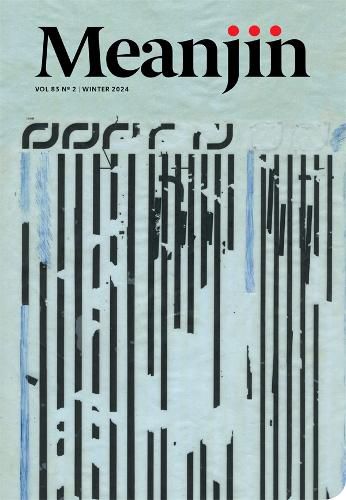
Esther Anatolitis (ediitor), Meanjin Vol 83 Nº 2 (Winter 2024)
(links are to the Meanjin website: some but not all of them are available to non-subscribers)

This Meanjin is incredibly rich and varied. I’ve carried it in my backpack for weeks, mostly reading a single article or story at a time when on public transport, in waiting rooms or queues, or occasionally – as in the days before podcasts – while walking. I have learned about:

Click on any link in that list, and you may find something instructive, challenging, entertaining or all three.

As the child of a farmer in North Queensland, where Mamu land has never been ceded and sugarcane monoculture has not been kind to the land, I was particularly moved by Katherine Wilson’s brief memoir about regenerative farming and collaboration with traditional owners, ‘Our Bog Paddock’s Understory‘.

I also want to mention ‘We, small heroes‘ by Micaela Sahhar, a short reflection on what it means in the current era that Palestinian culture has hospitality as a core value.

Of the four excellent pieces of fiction, Katerina Gibson’s ‘Something Dormant‘ stands out as a complex story of young, unrequited love remembered, with an environmental twist.

One of the joys of this Meanjin is the way its nine poems are spread throughout, so each one comes as a pleasant surprise among the prose. Having just this morning read an editorial on ‘eco-poetry’ in the Guardian (poetry ‘cannot ignore global heating’), I’ll single out Caitlin Maling’s ‘Ordinary Disaster‘, a chillingly affectless account of a mass dying of fish among coral in Western Australia.

It’s my blogging custom to focus on page 77. In November, I try to include a verse stanza in each blog post. Page 77 in this issue is part of a fascinating interview with architecture critic Naomi Stead (link here). The phrase that gives me my opening line comes from this paragraph:

I don’t want to be the schoolmarm, but if people understand more about the built environment – how it’s procured, how it comes into being, how it’s not an accident, how there’s almost nothing in our cities that is not deliberately designed – then they can begin to see the role that they themselves could play. I mean we should expect more, we should demand more of our cities and buildings and built environment, but we can only do that with a degree of knowledge and education about how this came to be, and what could be.

Rather than enlarge on Professor Stead’s point, my little verse follows where the phrase takes it. That and the plane that flew over our flat as I typed the first full stop.

November verse 6: We should demand more of our cities
We should demand more of our cities.
Not more aircraft overhead.
No more oh-dears, what-a-pities –
Packer's Pecker, Jeff's Shed.
Perhaps less civil inattention,
less of what's too gross to mention,
neighbours partying till four,
Mormons knocking on the door.

Demand more? Let me try. O Sydney,
Demand more? Let me try.
O Sydney,
give me silence, show me stars,
let me breathe air free from tars.
So many things I'd have you give me.
Make your waters clear again,
and some day soon please change your name

I wrote this blog post on Gade / Wane, not far from Warrane, which some people want to give its name to the whole of Sydney. I acknowledge the Gadigal and Wangal Elders past present and emerging, and gratrefully acknowldge their care for this land for millennia.

Journal Catch-up 20

My current practice of focusing on page 76 when blogging about books serves me well when the subject is journals. It helps to resist the pull to go on at tedious length about the whole contents.


Alexandra Christie (editor), Heat Series 3 Nº 8 (Giramondo 2023)

This is a fabulous issue of Heat. A clutch of ‘animal poems’ by Judith Beveridge would have justified the cost of the magazine. ‘Mourning a Breast’ by the late Hong Kong writer Xi Xi, translated by Jennifer Feeley, is an excerpt from a yet-to-be-published novel that includes, among other things, a gruelling account of breast surgery and some fascinating reflections on different Chinese and English translations of Madame Bovary. Send Me a Sign? is a charming essay on Henry Handel Richardson and spiritualism by Cameron Hurst (this one can be read on the Heat website).

Page 76 occurs in the short story ‘Shopping’ by Katerina Gibson, whose collection, Women I Know, won the Christina Stead prize this year. Like Xi Xi’s narrator, the protagonist of this story is interested in translation. She works at a writers’ centre where she is in love with her boss. The story is like an elegant tapestry of twenty-something lostness and finding a way: her work; her relationships, both those at work and her initially unromantic sex life; her compulsive overspending on clothes and her general angst/anomie. I loved it, especially for a key turning point where she reveals her compulsion to a friend and instead of running a mile he laughs and says, ‘But you don’t seem crazy at all.’ (Sorry for the spoiler!)

This seems an appropriate place to mention Giramondo’s promising new online initiative, Re:Heat. It’s a bi-monthly newsletter in which a current contributor to Heat Series 3 encounters an item from the archives. The first of the newsletters features an article by Josephine Rowe on ‘Alive in Ant and Bee’ by Gillian Mears, which was published in Series 2 Number 13, in 2007. You can read Gillian Mears’ piece here, and Josephine Rowe’s response here.


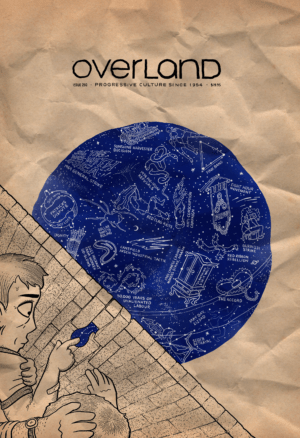
Evelyn Araluen and Jonathan Dunk (editors), Overland 250 (Summer 2022)
(Some of the content – less than in the past – is online at the revamped Overland website, and I’ve included links)

Great editors think alike. Overland is also launching a series in which current writers respond to items from the archives, in their case as part of the print journal. Jordana Silverstein kicks it off with a response to a 1988 story by Lily Brett, which is republished in the journal. Neither piece in online yet, but both are interesting.

At the other end of a readability spectrum is the issue’s first article, ‘Structures don’t go out onto the streets? Notes on John Tranter’s radical pastiche‘ by Louis Armand, which must be the ultimate in poetry insider talk, making no concessions to readers who don’t know their Jacques Lacan from their Ern Malley. Definitely for the spectacularly well read.

Other articles are more accessible and, to me at least, infinitely more interesting: Dallas Rogers on early colonial maps as instruments of colonialism, Jeff Sparrow on elite capture of identity politics, Fiannuala Morgan on colonial literature and bushfires are all worth reading. That’s all before we get to the poetry and fiction sections.

The twelve pages of poetry include the runners-up in the 2022 Judith Wright Poetry Prize (the winner was published in the previous issue). Of these, ‘Camperdown grief junk’ by Wiradjuri poet Yeena Kirkbright spoke most to me in its tour of the Camperdown Cemetery, so beloved of poets. Cameron Lowe’s prose poem ‘Ribbons’ ten pages later also spoke to me. Having just gone on about line breaks in a recent post, I found this phrase just a little squirm-making:

in the rear view mirror there were the back slappers, as usual, jerking off over line breaks.

I’ve been told.

There are 23 pages of fiction, ranging from grim to dystopian, all interesting. The story beginning on page 76, ‘Song and dance’ by Sik Chuan Pua is at the grim end of the spectrum, taking us inside the mind of Clara O’Brien, once a celebrated pianist who is now struggling with physical and mental incoherence in an institution of some kind. Right from the start, the story deftly maintains a double perspective: what Clara sees and what the reader understands in play with each other. It’s no spoiler to say that the story builds towards the word ‘Parkinson’s’. That condition, or something close to it, is there in the first non-bold sentence of this:

She was forty-seven when it began
Her head is locked towards the timber casement windows. Beyond the glass, a lake spreads out. A breeze rattles the shutters. It could be morning. Or late afternoon.
Look, a mysterious orange hue appears. What a hoax, for lakes should be blue as ink. Someone has been up to mischief. Someone has dumped such obnoxious colour, contaminating the lake, transforming beauty into farce. Will someone please restore the lake to its natural colour?

This is Overland‘s 250th issue. Long may it thrive.

2023 NSW Premier’s Literary Awards night

Tonight, the New South Wales Premier’s Literature Awards were announced at an event livestreamed from the State Library of NSW. I missed the start but got to see two of Debra Dank’s four acceptance speeches, and Sara Mansour and Bilal Hafda accepting the Special Award on behalf of Bankstown Poetry Slam (Bilal’s hands were a joy to watch). It’s been a while since a Premier has actually presented the awards – Chris Minns may be the first to do it since Christina Keneally in 2011. The recording is on YouTube, and I can think of worse ways to spend a couple of hours if you’re interested in Australian literary culture.

The winners (with links to the judges’ comments):

UTS Glenda Adam’s Award for New Writing: We Come With This Place, DEBRA DANK (Echo Publishing)

Indigenous Writers’ Prize: We Come With This Place, DEBRA DANK (Echo Publishing)

Multicultural NSW Award: The Eulogy, JACKIE BAILEY (Hardie Grant)

Nick Enright Prize for Playwriting: Whitefella Yella Tree, DYLAN VAN DEN BERG (Griffin Theatre Company/ Currency Press)

Betty Roland Prize for Scriptwriting: Blaze, DEL KATHRYN BARTON and HUNA AMWEERO (Causeway Films)

NSW Premier’s Translation Prize: People from Bloomington, BUDI DARMA, translated from Indonesian by TIFFANY TSAO (Penguin Classics)

Ethel Turner Prize for Young People’s Literature: The Upwelling, LYSTRA ROSE (Hachette Australia)

Patricia Wrightson Prize for Children’s Literature: The First Scientists: Deadly Inventions and Innovations from Australia’s First Peoples, COREY TUTT and BLAK DOUGLAS (Hardie Grant)

Kenneth Slessor Prize for Poetry: The Singer and Other Poems, KIM CHENG BOEY (Cordite Books)

Douglas Stewart Prize for Non-fiction: We Come With This Place, DEBRA DANK (Echo Publishing)

Christina Stead Prize for Fiction: Women I Know, KATERINA GIBSON (Scribner)

The People’s Choice Award: Every Version of You, GRACE CHAN (Affirm Press)

The Special Award: Bankstown Poetry Slam

Book of the Year: We Come With This Place, DEBRA DANK (Echo Publishing)

The evening ended with a bunch of flowers to Jane McCredie, Senior Judge, to mark her final year in that role.

I have read exactly none of the winning books, plays or TV shows, but I am a huge fan of the Bankstown Poetry Slam and couldn’t be more delighted by that award.

Journal Blitz 2

I still have nearly a year’s worth of subscribed journals on my TBR shelf. Here some gleanings from a second catch-up binge.

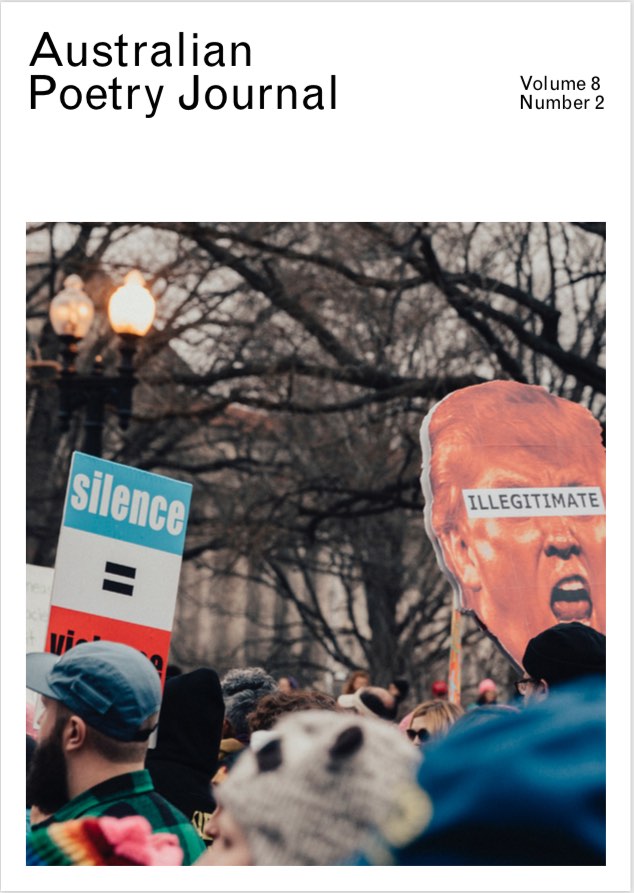
Andrew Galan and David Stavanger (guest editors) plus Toby Fitch (Big Bent editor), Australian Poetry Journal Volume 8 Number 2: Spoken

This issue of APJ is in two parts: ‘Spoken’ comprises 42 poems intended primarily for performance – ‘Spoken Word’ creations; and ‘Big Bent Poetry’ is 19 poems commissioned to be read at a series of LGBTQIA+ events at literary festivals in 2018. Sound recordings of both sections are accessible at the Australian Poetry home page, australianpoetry.org.

The Big Bent poems may have been commissioned for performance, but they are mostly ‘page poems’, compressed, elegant, needing to be taken slowly; the Spoken poems are definitely ‘stage poems’, with declamatory rhythms and big gestures, one of them actually including stage directions.

I’m a long way from being a Spoken Word aficionado, but I love Bankstown Poetry Slam and was pleased to recognise a number of its stars here. Sara Saleh’s ‘InshAllah’ offers a multitude of meanings for that expression, of which my favourite is, ‘InshaAllah is the answer / when there are still questions but no answers to give.’ Ahmad Al Rady has a group of three short, tantalisingly oblique poems (on rain: ‘wet bullets crave the warmth of flesh’). In Omar Musa’s ‘Christchurch’, that earthquake-ravaged city is a setting for a break-up poem (‘I don’t believe in miracles any more, just bridges – some you walk across, some you jump from’).

There are strong Aboriginal voices, including Lorna Munro, whose ‘cop it sweet’ evokes the ravages of time on her inner city Aboriginal community, and Steven Oliver of Black Comedy fame, with a brilliant list poem, ‘Diversified Identity’.

Other poems that stand out for me are Emilie Zoey Baker’s ‘Hey, Mary Shelley’, in which the speaker imagines herself inhabiting Shelley’s body ‘like a flexible ghost’; Emily Crocker’s ‘the refrigerator technician’, a breakup, or near-breakup, poem full of sharp domestic metaphors; Tim Evans’s ‘Poem Interrupted by’, in which the speaker answers a phone call from the Abyss (this is the one with stage directions); and the anthem-like ‘Forget’ by the late and much-missed Candy Royale. The section ends with a photograph of a splendid graffiti mural at the Newtown hub featuring Candy Royale with a halo made up of the words, loving instead of hating, living instead of waiting.

Coming to this issue late means that I’ve actually read a couple of the Big Bent poems in books published in the meantime. It was a pleasure to re-encounter Tricia Dearborn’s ‘Petting’ and Kate Lilley’s ‘Pastoral’. Of the others, I particularly warmed to joanne burns’s shit-stirring in ‘a query or two’, which includes:

is there a point to getting grumpy
if you're addressed as 'sir' by
a sushi seller or a supermarketeer –
better than being addressed as nothing
or no one service is better for the sirs
of this world.

There’s also ‘(weevils)’ by Pam Brown (I don’t understand the title, but it’s a terrific poem); ‘my human’ by Quinn Eades (he’s the poet who appears in both sections – ‘my human’ is spoken by a dog); ‘A Song of Love’ by Omar Sakr; and ‘Bathers’ by Zenobia Frost (a longish prose poem that takes a Rupert Bunny painting as its starting point). There’s a lot of excellence to choose from.


Jacinda Woodhead (editor), Overland 232 (Spring 2018)

First thing you notice about this Overland is the stunning collages by guest artist Bella Li, especially the front and back covers – a great waterfall among skyscrapers, and oceanside apartment blocks bursting into flower. Bella Li’s artist’s statement can be read on the journal’s website, here. (Most of the contents of this issue can be read on the website. The titles here link to them.)

As always there are excellent columns by Alison Croggon (‘On memory‘ – ‘The human capacity for delusion isn’t so much a bug as a feature’), Giovanni Tiso (‘On remembering to back-up grandpa‘ – a touch of dystopian technofuture) and Tony Birch (‘On Kes‘ – the role of books and an imagined falcon in his childhood, plus a sweet present-day harking back).

Overland always includes the results of at least one literary competition. This time it’s the VU Short Story Prize and the PEN Mildura Indigenous Writers Award. The winner and runners-up for the former are all terrific: in How to disappear into yourself (in 8 steps) by Katerina Gibson the narrator juggles an internship, a paid job, motherhood, a possible new relationship, and cultural complexity, and the story stays lucid; in Dear Ophelia by Erik Garkain a trans man who works in a morgue speaks to a trans woman whose corpse he tends – it’s a little teachy, but I just now many of us need teaching; Nothing in the night by Ashleigh Synnott is a short, gripping, surreal piece which Bella Li’s collage illo suggests is set in a dystopian future, though I’m agnostic about that. Her eyes by Maya Hodge, winner of the PEN Mildura prize, takes that moment when you look into a baby’s eyes and understand something profound.

I’m always grateful for Overland‘s poetry section, currently edited by Toby Fitch. This issue has nine poems, of which the two that speak most directly to me are Peripheral drift by Zenobia Frost (who also got a guernsey in Big Bent Poetry, above), which begins:

Turns out you can still pash in a graveyard
at 28, though by now my fear of spooks
has faded into a more realistic fear of people

and Patternicity by Shey Marque, a terrific evocation of a tiny sandstorm that includes the wonderful word ‘apoidean’.

Of the articles, the ones I have been talking about compulsively are The bird you are holding by Ashleigh Synnott (who also appears as one of the VU Prize runners-up) and Against apologies by Joanna Horton. Each of them makes a case for keeping in mind our common humanity, or at least our common struggles. Among other things, Synnott provides brief literature survey of the concept of ‘precarity’, and Horton, while agreeing that talk of ‘privilege’ is useful, argues that apologising for one’s privilege is actually buying into neoliberal individualism:

We desperately need a politics that frames a comfortable, stable life, one as free from oppression as possible, as a right to be fought for, not a privilege to be denounced.

‘Making the desert bloom’ by Barbara Bloch is a trenchant criticism of the Jewish National Fund’s activities in the Negev/Naqab desert. Like Chris Graham’s ‘So much like home‘ in the previous issue, she draws parallels between the treatment of the Palestinians and colonialism in Australia, which chimes with my sense that Israel is not a special rogue case, but part of a planet-wide pattern.

I’ll just mention finally that I was delighted to read ‘Everything that is courageous & beautiful‘ in which Nell Butler argues that Paul Gallico should be brought back from obscurity – ‘from the dead’, she says. The Snow Goose, the book and the record of Herbert Marshall’s reading, was one of the joys of my childhood.


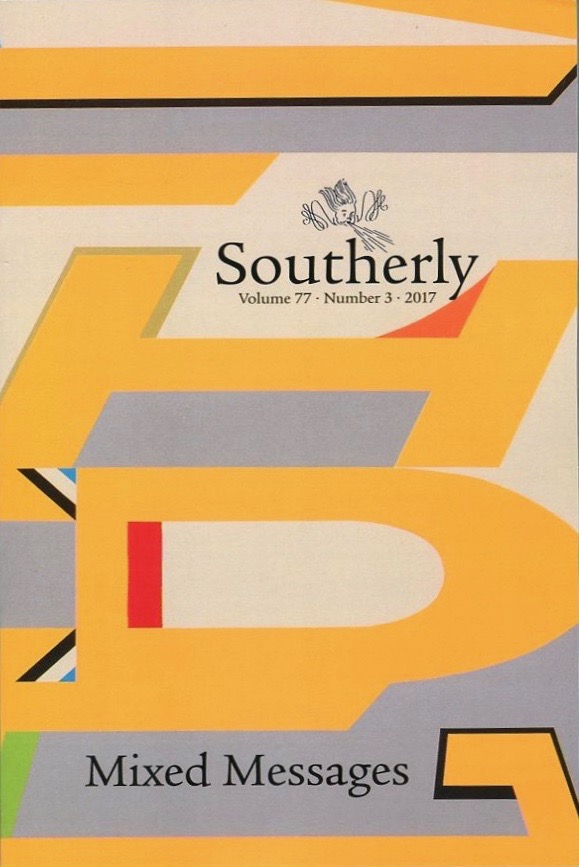
David Brooks and Elizabeth McMahon (editors), Michelle Hamadache (guest editor), Southerly Vol 77 No 3 2017: Mixed Messages

Southerly is a literary journal. I expect culture warriors of the right would say it was infected by the Gay-Marxist-feminist agenda, but it’s a broad church, with no avowed political leanings like Overland (or for that matter Quadrant, which I rarely read). David Brooks, retiring co-editor, has come out as seriously vegan, as has John Kinsella, who has a poem and a story i this issue. Yet Debra Adelaide’s story, ‘Festive Cooking for the Whole Family’, makes a cheerful mockery of vegans, among others, as her Christmas hostess wrestles with the complex dietary and other demands of a large family gathering.

David Brooks’s article ‘Seven Gazes’ (for which I broke my rule not to read anything that mentions Derrida in the first sentence) wrestles with the challenge of moving outside the human bubble to understand what is happening in the Gaze (his capitalisation) of ‘non-human animals’, and if he is aware that there’s something potentially risible in leaving the door of his house open so the sheep can drop in, he gives no sign of it; John Kinsella’s ‘Roaming the Campsite’, a sharp short story told from the perspective of a neglected child, doesn’t push any belief system, and his poem ‘Graphology Soulaplexus 36: loss’, despite its hi-falutin title, is a straightforward and beautiful elegy.

One pleasant surprise is ‘Poetic Fire’, an article written by Thea Astley when she was a school student, reproduced here because Cheryl Taylor has an article about Astley’s novels that refers to it, and the editors have kindly made it immediately accessible. In these days when schoolchildren are playing a major role in fighting for action on climate change, it’s good to have another reminder not to patronise the young. (I broke another rule, not to read Eng Lit scholarly articles about books I haven’t read, and read Charyl Taylor’s article: her use of the school-student essay is deeply respectful.)

Among other excellent things are ‘Fresh Food People’ a short story by Nazrin Mahoutchi about a small, diverse group of migrants in a food preparation business. I broke another rule (not to read excerpts) and read Peter Boyle’s ‘Excerpts from Enfolded in the wings of a Great Darkness‘, a tantalising seven pages from a long poem in progress:

who picks among
the clothes left
by those stripped bare
for mourning

Who rinses their hands in
water that can no longer
cleanse

Who goes to hear
the hymns of forgiveness
but clutches in one hand
the prayer beads of vengeance

S K Kelen’s ‘More Words: Uses for a Father’, a joyous list poem that does what the title says, speaks to my condition as a new grandfather, though ‘cricket bat whack kick / box new fun’ isn’t on our agenda just yet.

And that’s all from me. Thanks for persisting to the end. I expect to do a ‘Journal Blitz 3’ post, but not for a little while.