
Kiran Desai, The Loneliness of Sonia and Sunny (Penguin 2025)
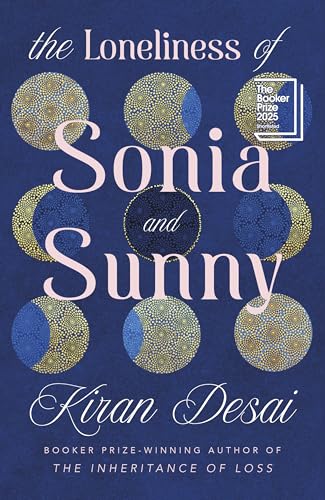
Before the meeting: This is a massive family saga that spans three continents, a romance, an Indian–US comedy of manners, and a magic-realist tale (though Sonia, a writer, is critical of that term).
All of the principal characters are caught, one way or another, in a tangle of Indian and US culture. The central difference, gestured towards in the book’s title, is the contrast between US individualism and Indian sense of belonging to a family and a community: loneliness and embeddedness, self-determination and obligation. When this plays out in comic mode, it works brilliantly. In the Indian scenes, again and again, someone is asked in shocked tones why they are alone.
As you’d expect from the title, the central narrative strand is a romance. True to the form of the romcom (no spoiler really) the protagonists Sonia and Sunny have sex at almost exactly the midpoint and then are separated, seemingly irretrievably. Integral to the romcom are family intrigue, corruption, violent murder, and a dispersed conversation about arranged marriage. I loved all that.
There’s another story jostling for the centre. This begins with an unconvincing episode of coercive control and develops into a kind of ghost story that more or less centres on a mystic talisman that Sonia has inherited from her grandfather. A European painter who has held Sonia in his thrall steals the talisman and makes it central to his art (yes, appropriation!). I found this strand unconvincing at the level of character, but there’s an interesting reflexivity to it as the artist keeps telling Sonia, an aspiring novelist, what she should and should not write: we are clearly being invited to read this book as a repudiation of his advice.
Page 78* is early in the book, part of Sunny’s narrative. He is a young man living in New York City in the late 1990s with Ulla, a white US woman. He’s intent on making it in the USA as a journalist, and embarrassed by his mother’s insistent claims on him. He can barely read her long letters (‘Mummy, please stop this gossip!’), and on this page he explains the context of one of them to Ulla (and, incidentally, to the reader):
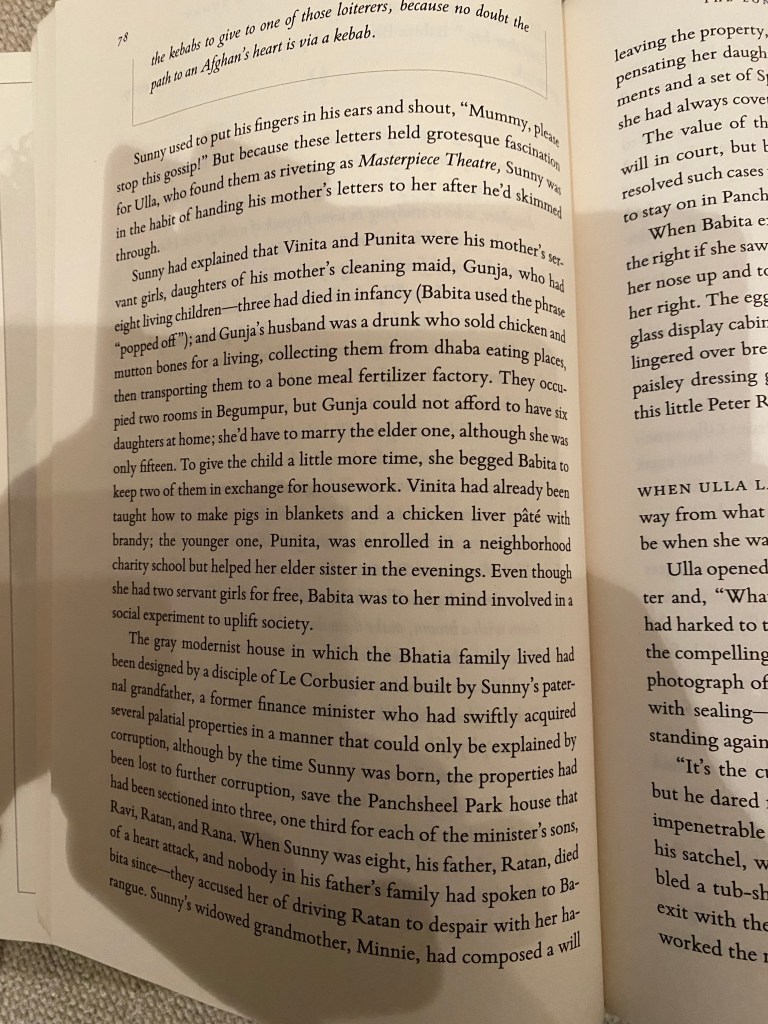
One tiny thing I’ll mention in passing. The bottom paragraph describes Sunny’s family home as a ‘gray modernist house … designed by a disciple of Le Corbusier’. So much information is conveyed in those few words. First, the family comes from wealth. Second, they are to some degree westernised – their house is modernist. Third, the fact that the architect was a disciple rather than Le Corbusier himself suggests something about the limitations on the aspirations of colonised elites. And fourth, ‘gray’ is an example of the the North American spelling conventions used throughout (‘neighborhood’ later in the paragraph is another): that these spellings persist in the UK edition is not a mistake, but an enactment at the micro level of the way US culture has come to dominate the book’s westernised Indian characters.
Before that, there’s a paragraph of raw exposition:
Sunny had explained that Vinita and Punita were his mother’s servant girls, daughters of his mother’s cleaning maid, Gunja, who had eight living children – three had died in infancy (Babita used the phrase “popped off”); and Gunja’s husband was a drunk who sold chicken and mutton bones for a living, collecting them from dhaba eating places, then transporting them to a bone meal fertilizer tactory. They occupied two rooms in Begumpur, but Gunja could not afford to have six daughters at home; she’d have to marry the elder one, although she was only fifteen. To give the child a little more time, she begged Babita to keep two of them in exchange for housework. <snip> Even though she had two servant girls for free, Babita was to her mind involved in a social experiment to uplift society.
The fate of Vinita and Punita, known collectively as Vini-Puti, is to be significant much later in the book. But because it’s November*, rather than discuss further, here’s a little verse:
November verse 5:
So much in his mother's letter
needs to be explained. Just who
is Vini-Puti? Who is Ratty?
What's this kebab how-de-do?
Gunja, mother of six daughters,
trains two up to follow orders,
flee the confines of the slum,
work for free for Sunny's mum,
cook liver pâté soaked in brandy.
This is tragic seen up close:
the mum's small gain, the girls' great loss.
But this ain't Hamlet, this is Sunny.
Vini-Puti serve their turn
like Rosencrantz and Guildenstern.
After the meeting: We discussed The Loneliness of Sonia and Sunny along with Arundhati Roy’s Mother Mary Comes to Me. I was astonished when the discussion of this book kicked off with one person saying she hated it and gave up at the 40 percent mark (she’s a Kindle reader). Nothing happened, she said. And that included Sonia’s harrowing emotional enthralment to the bizarrely irrational western artist. Probably needless to say, others disagreed.
Of the three of us (out of five) who had read the whole book, I liked it the best. For all three of us the first 40 percent (I make that about 260 pages) was what we enjoyed most. We had different versions of why it became less enjoyable: perhaps there’s a forced assertion of Indian ways of story-telling, a cultural repudiation of the western mode of the earlier parts; perhaps the talismanic object is too sketchily realised to carry as much narrative weight as seems to be intended; perhaps the book is just too long.
I persist in my opinion, shared by one other Clubbie, that it was a good idea to pair this with Mother Mary Comes to Me. Both books have domineering, eccentric mothers. The protagonists in both are secular Indians appalled at the rise of Hindu nationalism and the BJP – the Demolition of the Babri Masjid mosque looms in the background. Both explore myriad ways in which cultural differences can be negotiated by people from a globally non-dominant culture. Both have main female characters steeped in classic English literature.
We had an excellent dinner, including a dessert that fell flat on the floor when it was taken from the oven, but was delicious anyhow.
The group met on the land of Gadigal of the Eora Nation, and I have written this blog post on the land of Gadigal and Wangal. I acknowledge Elders past and present of all those clans, and welcome any First Nations readers.
* My blogging practice is to focus on the page that coincides with my age, currently 78, and in November I write fourteen 14-line stanzas in the month. which means incorporating one into most blog posts.


 Me fail? I fly!