I subscribe to a number of literary journals as a way of supporting Australian cultural workers – specifically writers. I generally read the journals I subscribe to, plus occasional others: the prospect of this reading tends to loom as an obligation as the pile of unread journals grows, but the reading itself dependably turns out to be a joyful and invigorating experience. Then I blog, in the hope of communicating some of that pleasure, and possibly encouraging some of my readers to back these crucial enterprises. So here goes, with three journals that were published, um, some time ago …
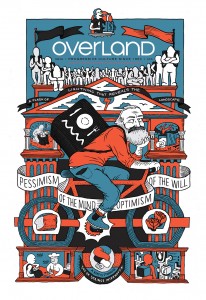
Jacinda Woodhead (editor), Overland 236 (Spring 2019)
I mistakenly wrote that Overland 235 was the last issue of the journal edited by Jacinda Woodhead. This one is actually her second last, and the new editors have brought out their third issue as I’m writing.
Overland 236 kicks off with two excellent articles. (Links are to the full items on the Overland web site.) In ‘After hours‘ Leigh Hopkinson, herself a former stripper, writes about the death of a stripper in a Melbourne club (Overland tend to be Melbourne-centred), and uses the case as a springboard to describe the terrible, and worsening, conditions of women who work in the adult entertainment industry. In ‘The great acceleration‘ Jeff Sparrow traces the history by which cars came to be established as the dominant, ‘natural’ mode of transport in the USA. Did you know, for instance, that before the automobile industry made a concerted effort to introduce the concept of a jaywalker, the term jaydriver was in common use, meaning someone who drove a car in the city with cloddish disregard of the danger for pedestrians, especially children?
There are more articles later, of which two stand out for me. But then, face to face by Joanna Horton is a wonderful account of the joys – and difficulties – of door-knocking for the Greens. Tina Ngata’s Toppling Cook puts a strong case, from an Aotearoa/New Zealand perspective, against celebrating the 250th anniversary of James Cook’s voyages of exploration.
Guest artist Sam Wallman has three spreads of sequential art (what some might call comics) that are brilliantly accessible lessons in recent English history, specifically the Sun boycott in the Liverpool region, the Annual Durham Miners’ Gala and the Grenfell Tower fire.
There are 13 pages of interesting and challenging poetry. My North Queensland heart leads me to single out ‘Toad‘ by Damen O’Brien, which begins:
Toad in the garden, which is the same as
a snake in Eden or a crack in a mirror.
and includes the gorgeously evocative line:
Inexhaustible armies of malevolence
Of the especially rich batch of short stories, the ones that most struck me are Jack Vening’s ‘Don’t tell me‘, a runner-up in the Victoria University Short Story Prize, and Allanah Hunt’s ‘Running to home‘, winner of the Nakata Brophy Prize for Young Indigenous Writers. No spoilers from me on either of them.
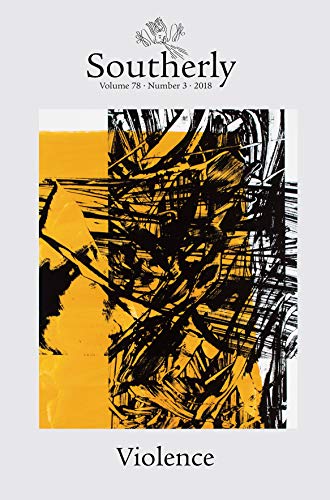
Elizabeth McMahon (editor), Southerly Vol 78 No 3 2018: Violence (2019)
Southerly, after 80 years of publication Australia’s second-oldest literary journal*, is in trouble. In March this year the editors published a plea for help on Facebook, and in October the website went down with a promise of reappearing soon – we’re still waiting. The editors, who aren’t paid for their work, have set up a crowdfunding platform at https://gum.co/wYZRP in the hope of prolonging the journal’s life. As a reader I’m still back in 2019, and though the editors were already desperately chasing funds then, the journal itself came out, behind schedule but in rude good health. There has been at least one issue since.
Like the Overland, this Southerly starts very strongly, with three poems: jenni nixon’s ‘knock on the door at 6am’ is an impressionistic narrative that earns the right to its epigraph from Gandhi, ‘poverty is the worst form of violence’; Brenda Saunders’ ‘Boab tree, Derby’ comes at the famous ‘Prison Tree’ in a number of choral voices (click here if you want to know about the tree); Andy Jackson’s ‘To name what we feel’ enacts the ambivalence of working on a phone-in service for violent men.
And it goes on from there, compellingly. There’s memoir (including Brenda Downing’s writerly ‘Letter to the Editor’ in which she arrives at a huge ethical dilemma when she tracks down the man who sexual abused her when she was very young), essay (including David Brooks’ ‘A Roo Battue’, on the continuing mass slaughter of kangaroos, which raises the spectre of extinction for some species), short stories (including Winnie Dunn’s brilliant ‘Wanting to be White’, a drama set in a Western Sydney Starbucks). I usually skip the scholarly articles, but Fiona Morrison’s ‘The Antiphonal Time of Violence in Leah Purcell’s The Drover’s Wife‘ was a way to revisit the pleasures of a great night in the theatre. Likewise I tend to skip or skim the reviews, but Rachael Versace’s review of David Malouf’s An Open Book, by quoting generously and incisively, opened the door to revisiting the pleasures of that book.
There is one moment of eerie prescience in this Southerly. Josephine Clarke’s ‘transnational’ laments the way technology, while enabling connection over great distances, still leaves us bodily unconnected. Covid–19 wasn’t even a blip on the horizon when it was published, yet there’s this:
what if I take ill? who will come back /
come home / come through

and hold my hand      my real hand
where the creases run labyrinthine across my palm

– my palm where your newborn head once rested
and was safe
*The oldest is a children’s literary journal, The School Magazine, published since 1915 by the NSW Department of Education.
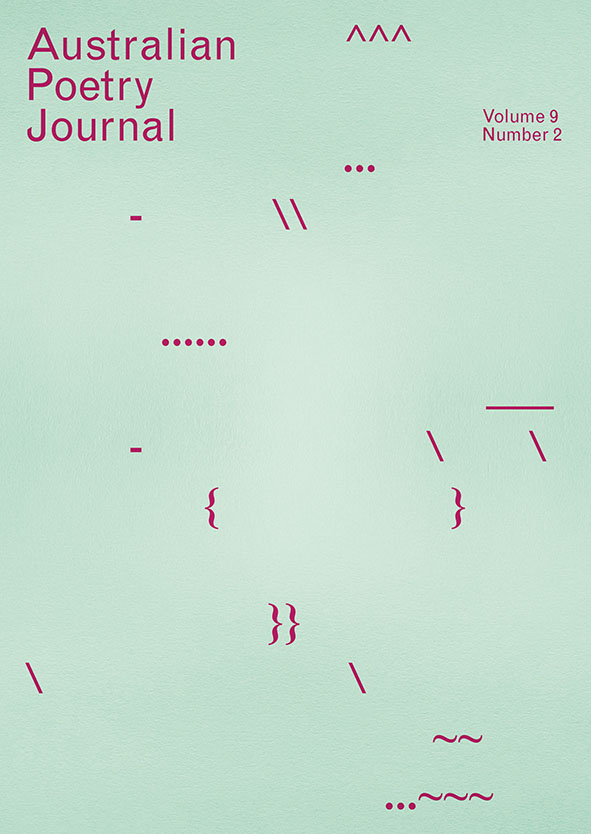
Andy Jackson and Jennifer Harrison (editors), Australian Poetry Journal Volume 9, Number 2: DIS– (2019)
Andy Jackson and Jennifer Harrison, guest editors of this issue of Australian Poetry Journal, are both poets and advocates for writers with self-identified disability/ies. They have collected more than 60 poems related to disability, aiming, as Andy’s foreword puts it:
… for a diversity of voices, in many senses of that word – bodily experience, cultural background, age, gender, philosophy, aesthetic. We also strongly prioritised poems of lived experience, including the voices of carers, friends, lovers – poems of solidarity and care that recognise that distancing ourselves from disability is impossible.
By arranging the poems, mostly, in reverse alphabetical order of poem title, the editors have added an extra stroke of disorder: each poem stands on its own, spatially disconnected from others on the same subject or by the same author, defying easy categorisation. The effect is indeed a marvellous ‘diversity of voices’, all dealing one way or another with disability. As Jennifer Harrison says in her Foreword:
What poetry gives us is birdsong alongside activism, the outside word alongside the internal world of emotions, hope shadowing despair … Poetry has a unique ability to see behind doors previously closed …
In this journal, many poets opens doors to whole worlds of difference.
A number of them are poets whose work I already know. Fiona Wright, who has written a lot about her own struggles, speaks to someone who may be a version of her younger self in ‘poem for jessie’ (‘I want you to remember / how to want’). David Brooks makes translation look easy with a version of Baudelaire’s ‘The Albatross’, which in this context becomes a powerful metaphor for physical disability. Samuel Wagan Watson’s ‘DISlocation’ captures a raw moment of betrayal (‘I may have challenges but my sensory perception is still sharp’).
Mal McKimmie’s ‘Thirteen Ways of Looking at Blackbirds’ is wonderful. It begins:
There are no 'blackbirds with disabilities' –
_____________all blackbirds can fly.
There are only 'blackbirds with disabilities' –
_____________all blackbirds will one day fall from the sky.
E A Gleeson, whose bio tells us that she ‘cares for her sister who lives with significant physical and intellectual challenges’ gives us a graphic childhood vignette in ‘The First Seizure’. Oliver Mills, in ‘De-Coding’, speaks clearly and succinctly, and wittily, about the difficulty of being understood when you have cerebral palsy, as he does: :
When I'm out of breath
Or having a lazy laugh
I make the sound of a creaking door
I could go on quoting. There’s plenty here for anyone interested in poetry. There are drawings, as well as poems, by people with mental illness diagnoses and people with learning difficulties. Just reading the poets’ bios is a revelation of the myriad ways the body and mind can differ from the typical. Even if you’re (temporarily) non-disabled and not interested in poetry, these pages may expand your world immensely. They have mine.
As a bonus, up the back, half a dozen pages are given over to Rachael Mead, winner of the 2019 Australian Poetry/Nature, Art & Habitat Residency. She lived in a village in the Taleggio Valley in northern Italy in June 2019, and three of the poems she write during her stay there are reproduced here. What with one thing and another, it’s glorious to read her poem, ‘Pacing myself’, about waking in that beautiful place, so far beyond the reach of most of us just now.
Speaking of journals, there’s some good news on the horizon concerning Heat, which ceased publication in 2011, after 39 issues in two series over 15 years. According to the Giramondo web site, ‘The third series of Heat, in a new design and format, will be published from 2022.’




 Me fail? I fly!