Tag Archives: Mark Mordue

SWF 2023: My sixth day

Another early start with 10–11 am: Barrie Cassidy & Friends: State of the Nation

Veteran journalist Barrie Cassidy has been a regular at the Sydney Writers’ Festival, but this is the first time I’ve been to one of his sessions. He was on stage with what the festival program calls ‘his hand-picked squad of the country’s sharpest pundits’: Amy Remeikis, Niki Savva and Laura Tingle. They’re all regulars on current affairs TV, but I don’t think I’d seen any of them in person before.

The subject was politics, that is to say mainly electoral politics and the state of the major parties. The most telling comment was towards the end when Barrie Cassidy said, ‘When there’s consensus between the major parties, the media doesn’t chase it up.’ This means that the press doesn’t do a lot of interrogating of the AUKUS deal – is it actually in Australia’s interest or is it a matter of us serving the interests of the UK and the US? Similarly, coverage of climate issues through a party-political lens can often miss the point.

Nikki Savva’s subject seems to be the Liberal party. She sees the current dominance of Labor in Federal parliament and in all mainland states is largely due to the decline of the Liberals as a fighting machine and also as representative of a population. They are ceasing to be an effective opposition, or even an opposition at all. Peter Dutton’s survival strategy depends on three things: the failure of teh referendum on the Voice; an economic crash; and the rise of intolerance. Hard to cheer for him, then, and she says many dyed in the wool Liberals can no longer bring themselves to vote for what the party has become since Howard.

Amy Remeikis, introduced by Barrie Cassidy as political correspondent for The Australian much to the amusement of the Guardian readers in the audience, thought Labor’s ascendancy had something to do with changing demographics. Millennials now outnumber boomers, and in addition to the tendency of people to be more progressive when young, there’s the fact that life is particularly tough for the young these days.

Laura Tingle added that politics tends to go in cycles. This is Labor’s time for dominance, it was at rock bottom in 2014.

All agreed that there is a growing disconnect between the political class – politicians, political journalists, people who turn up for panels like this one – and the rest of the community. People are doing it hard, inequality is bigger than it’s ever been, our sense of common life is being eroded (not as badly in the USA, yet). Things are better than they were before last year’s election. The people in charge now are there with good motives, but business as usual could lead to disaster. We need grown-up conversations about tax and climate policy, and we’ve got a way to go for that.

A non-party-political subject that got some airplay was the recent resignation of Stan Grant after he was subjected to vicious and sometimes racist attack for giving a Wiradjuri perspective on the British Crown. Laura Tingle, as recently elected member of the ABC’s Board, said she had been out of action for a couple of weeks because of a bereavement, but deeply regretted Stan’s lack of support from management and the Board.

I haven’t ever watched Insiders, which used to be Barrie Cassidy’s Sunday morning show on the ABC. I imagine this was a slightly generalised version of that. One of the questions at the end referred to the fact that over a number of years not one non-white panellist had appeared on that show (the questioner didn’t need to point out that all the panellists today were white). Barrie did the only thing he could do and said it had been a mistake.


11 am: Osman Faruqi on Australia’s War Against Hip Hop

I listened to this Curiosity Lecture almost by accident. I know almost nothing about hip hop, and I guess I skip over headlines saying that it has been banned in venues including Sydney’s Royal Easter Show.

Osman Faruqi’s exasperated plea could have been meant specifically for me: ‘For once, listen to some art that doesn’t come from Bondi or Balmain.’ (Though, to be honest, I don’t know when I last listened to music from either Bondi or Balmain.)

He told us that NSW Police have taken steps to ban particular hip hop performers saying, nonsensically, that their music is used to ‘procure’ members for criminal bikie gangs etc. This censorship, he said, is ‘the greatest example of artistic suppression in Australia’s history’. If Nick Cave, who is white and part of the music establishment, sings about murdering every woman he sees, no one bans his song as inciting murder. When Bill Henson’s photographs are taken down, there’s an outcry. But if a brown rapper uses violent imagery they are banned from performing and police have their videos removed from YouTube, and there is resounding silence from the art world, including from successful white rappers.

Showing my age: in the 1970s the campaign against censorship focused on erotic material, because the banning of material deemed pornographic (the famous example if Lady Chatterley’s Lover, but Norman Mailer’s Why Are We in Vietnam was also banned). You don’t have to love pornography or be a fan of drill-rap to be uneasy about what’s happening now


12–12.30 pm: Beginnings: Remembering Robert Adamson and Frank Moorhouse

There were a number of ‘Beginnings’ sessions. It’s a nice idea: people read the beginnings of their favourite books, or perhaps their own books, on the assumption that writers put a lot of attention to their opening paragraphs.

This short session used the format to honour Frank Moorhouse and Robert Adamson, who both died in the last 12 months. I wonder if it would be an idea to plan a couple of elegiac sessions along these lines for every Writers’ Festival. Spaces could be left blank for people who die too late to be included in advance publicity. John Tranter, who died on 21 April this year, might then have been honoured.

As it was, Annabel Crabb and Mark Mordue read to us.

Annabel read the opening pages of the first two ‘Edith’ books, the first line of the third, and then the final pages, Edith’s death scene, from Cold Light, the third book. It was shockingly good.

Mark Mordue opened with a letter found in Adamson’s papers in which Frank Moorhouse responded warmly to one of Adamson’s poems. He spoke briefly about Adamson’s life, including his time in prison, his drug addiction and the role of his wife Juno Gemes. He finished with a poem that Adamson wrote for her, ‘The Kingfisher’s Soul’, which Adamson himself read at at least one previous Sydney Writers’ Festival. It ends:

_________________________ the future awaits you.
I stepped into the day, by following your gaze.

I want to make a final small observation about acknowledgements of country.

My initial prompt for this was an acknowledgement that was gobsmackingly perfunctory: the presenter didn’t look at us, but read hurriedly from a clipboard, stumbling slightly over the words. Disrespect may not have been intended, but it was certainly there.

I started to notice how other presenters made their acknowledgements personal. For example:

  • Michael Williams spoke briefly of how the land was unceded and so the issue of sovereignty was unresolved
  • Omar Sakr noted that some people object to the acknowledgements and responded that words – words like ‘genocide’ and ‘sovereignty’ – matter, that words give rise to actions
  • Sisonke Msimang made acknowledgement first in her own mother tongue and then in English
  • Felicity Plunkett quoted two lines about the power of country from First Nations poet Ellen van Neerven
  • Barrie Cassidy drew our attention to the coming referendum on a First Nations Voice to Parliament.

I was born on Mamu land in what is now North Queensland, and my father remembered as a child hearing ceremony down at the river behind our place. I’m writing this on Gadigal-Wangal land. Both places make my heart sing.

And the Festival is over, bar the podcasting.
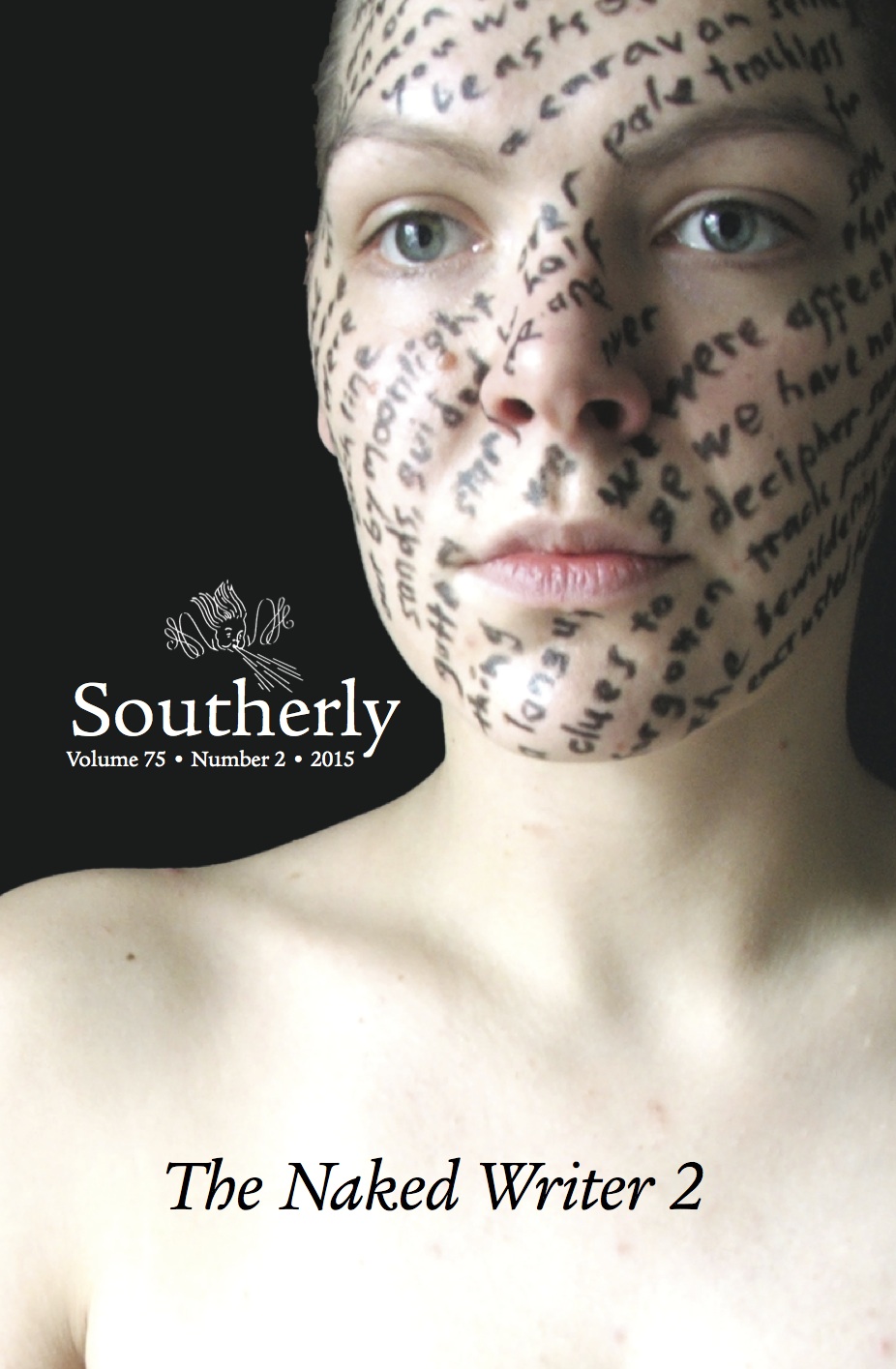
Southerly 75/2

Elizabeth McMahon and David Brooks (editors), Southerly Vol 75 No 2 2015: The Naked Writer 2 (The Journal of the English Association, Sydney, Brandl & Schlesinger)

southerly752.jpg

John Kinsella and Charmaine Papertalk-Green have a collaborative poem in this Southerly. The son of an Anglo-Celtic farmer, Kinsella lived in Geraldton, Western Australia, for the last three years of high school. Papertalk-Green is a Yamaji woman who grew up in nearby Mallewa and now lives just outside Geraldton. The poem – actually a sequence of poems written by the two poets alternately – responds to the works of Western Australian religious architect Monsignor John Hawes as enduring symbols of colonisation.

In what looks like an anxious concern that readers appreciate the significance of the poem, it is embedded in an article by Kinsella, ‘Eclogue Failure or Success: the Collaborative Activism of Poetry’, which among other things spells out the back story, makes learned observations about Virgil’s Eclogues, quotes Wikipedia, throws in a few Greek words, and makes sure we don’t confuse the poem’s first-person elements with the ‘entirely self-interested and subjective’ phenomenon of the selfie. Kinsella is willing to risk being annoyingly self-important if that’s what it takes to ensure that we take him and his collaboration with Papertalk-Green seriously.

Maybe it worked, or maybe the poems would have spoken for themselves, but it’s the kind of project that makes one glad to be alive in the time that it is happening. (Of course, it’s not unique: another stunning example is My Darling Patricia’s 2011 theatrical work, Posts in the Paddock, a collaboration between descendants of Jimmy Governor and descendants of a white family he murdered. That one seems to have sunk without a trace, so maybe all such works do need a John Kinsella to tell us how important they are.)

The challenge of unsparing conversation between Aboriginal peoples and settler Australians is also the subject of Maggie Nolan’s essay ‘Shedding Clothes: Performing cross-cultural exchange through costume and writing in Kim Scott’s That Deadman Dance‘. Apart from calling to mind the pleasure of reading the novel and quoting from it generously, Nolan suggests that, though Bobby/Wabalanginy’s failure to communicate to the colonisers by means of dance may end the book, ‘perhaps his invitation remains open, and Kim Scott, through this novel, is re-extending it to his readers’. I think she’s hit the nail on the head.

There is plenty else here to exercise and delight the mind. In no particular order:

  • David Brooks bids an idiosyncratic and clearly deeply felt farewell to his friend the literary critic Veronica Brady, who died last year.
  • Fiona McFarlane’s ‘On Reading The Aunt’s Story by Patrick White’, originally a Sydney Ideas lecture, is a warmly intelligent revisiting of that novel.
  • Hayley Katzen’s personal essay ‘On Privacy’ rings the changes on the perennial theme of its title, interestingly resonating with John Kinsella’s distinction between the writerly ‘I’ and the facebook or selfie ‘I’, and also with Kim Scott’s meditations on what happens when you write things down.
  • Jill Dimond and Helen O’Reilly delve into their respective family histories, the former with an engrossing tale of failed literary aspirations, the latter with the story of the connection between her second cousin Eleanor Dark and poet Christopher Brennan.
  • Joe Dolce, whom I should be able to mention without referring to ‘Shuddupaya Face’, interviews the late Dorothy Porter about C P Cavafy and they discuss his poetry’s importance to both of them.
  • Of the wide-ranging selection of poems, I particularly enjoyed Alan Gould’s ‘The Epochs Must Go Chatterbox’ and ‘The Insistent Face to Face’, Geoff Page’s genial ‘A Drinking Song for A D Hope’, and Mark Mordue’s Sydney train journey, ‘A Letter for The Emperor’.
  • Craig Billingham’s ‘The Final Cast’ reads like a slice of wryly observed Glebe literary life, though its ‘Fiction’ label should spare embarrassment all round.
  • Nasrin Mahoutchi’s story of widowerhood, ‘Standing in the Cold’, evokes a bitter Iranian winter with just the right amount of twist at the end.
  • In the review section, A J Carruthers discusses Michael Farrell’s Cocky’s Joy and Les Murray’s Waiting for the Past, justifying this unlikely pairing by claiming both poets as ‘experimental’, and arguing that experimental poetry is mainstream in Australia now (and as I write that I realise that the four poems I have singled out above are probably the least ‘experimental’ in this Southerly – ah well, I’m now in my 70th year, so I hope I may be forgiven).
  • In The Long Paddock, the journal’s online extension, Jonathan Dunk gives what he describes as a ‘gloves off’ review of Jennifer Maiden’s Drone and Phantoms, and elicits a bare-knuckled response from Maiden. Good on you, Southerly, for putting the conversation out in the open.

I tend to skip the densely scholarly articles (the ones that use words like chronotopic), or at best dip into them. Dipping can come up with some pleasant oddities. In this issue I stumbled on a quote from one Eric Berlatsky to the effect that in some ways ‘the institution of heterosexual marriage is “always already queer”‘. How far we’ve come since William Buckley Junior caused an uproar by calling openly gay Gore Vidal a ‘queer’ on US television in 1968. Now, it seems, in academic parlance, even those ensconced in heterosexual marriages are queer.

Overland 213

Jeff Sparrow (editor), Overland 213 Summer 2013

213o I’m coming to this Overland late: the next issue must be just about due. Here are some brief notes with links, and because I’m late in writing the links are all live.

The reliably enjoyable regular columnists,  Alison Croggon, Rjurik Davidson and Stephen Wright demonstrate that just about any life event can prompt a writer and habitual reader to reflect on readerly–writerly matters: in this case they start respectively from packing up to move house,  serious injury and building a bedroom–library. Mel Campbell’s article The Writer as Performer offers a more sobering view of the writer’s life – the freelance writer as no more free of panoptic supervision than the less glamorised office worker.

In Paul Keating’s Redfern Park speech and its rhetorical legacy, Tom Clark does a very nice job of explicating the distinctive nature of that speech – different in significant ways from Paul Keating’s usual mode, and interestingly the subject of public squabbles over its authorship (the existence of the squabbles is what’s interesting rather than any proposed resolution). John Campbell, the Anti-Kim by David Brophy, explores a Victorian proto boy’s-own-adventure story and the reality behind it.

The centrepiece of this issue is the 2013 Overland Victoria University Short Story Prize for New and Emerging Writers. The three shortlisted stories are published here, along with comments from the chief judge, Jennifer Mills. All three of the stories are worth your time: Turncoat by Jennifer Down (the winner), Rush by Nic Low and The job by Robyn Dennison. I’m not quarrelling with the judges’ decision at all, but if you only click on one of them I recommend you choose Nic Low’s for sheer subversive fun.

As ever, poetry is sequestered up the back on tinted paper, and as ever it’s a feast. Treasure hunt, a prose poem by Anne Elvey, finds poetic form for the experience of a parent’s dementia.  Refrigerator by Elizabeth Allen, also a prose poem, has this memorable ‘out of the mouths of babes’ moment:

There were also the brightly coloured fish in my brother’s aquarium. One day when I saw my five-year-old sister staring at the tank, I said to her, ‘The fish are pretty aren’t they?’ She said, ‘I’m not looking at the fish. I’m looking at the space between them.’

Fiona Wright gives us Marrickville, an inner city love poem … kind of. Samuel Wagan Watson’s Cloud burst invokes T S Eliot’s ‘The Hollow Men’ to devastating effect. Walmadany by Brenda Saunders puts poetic flesh on the issue of mining on traditional Aboriginal land. Mark Mordue (I didn’t know your eyes were blue) and Larry Buttrose (Toast) have elegies for their fathers, the latter with the arresting opening lines:

The smell of toast reminds me of my father,
Not only because he was cremated.

I want to pick a nit over Northgate by Adam Formosa, which begins

A cigarette bud sits
at my windscreen

but then doesn’t take the image of cigarette as blossom anywhere. It leaves its readers wrestling with phantom meanings until we finally conclude that bud was just a misspelled butt, and no metaphor was intended. The poem about the cigarette bud is yet to be written.