Tag Archives: Michel de Montaigne

Montaigne final progress report

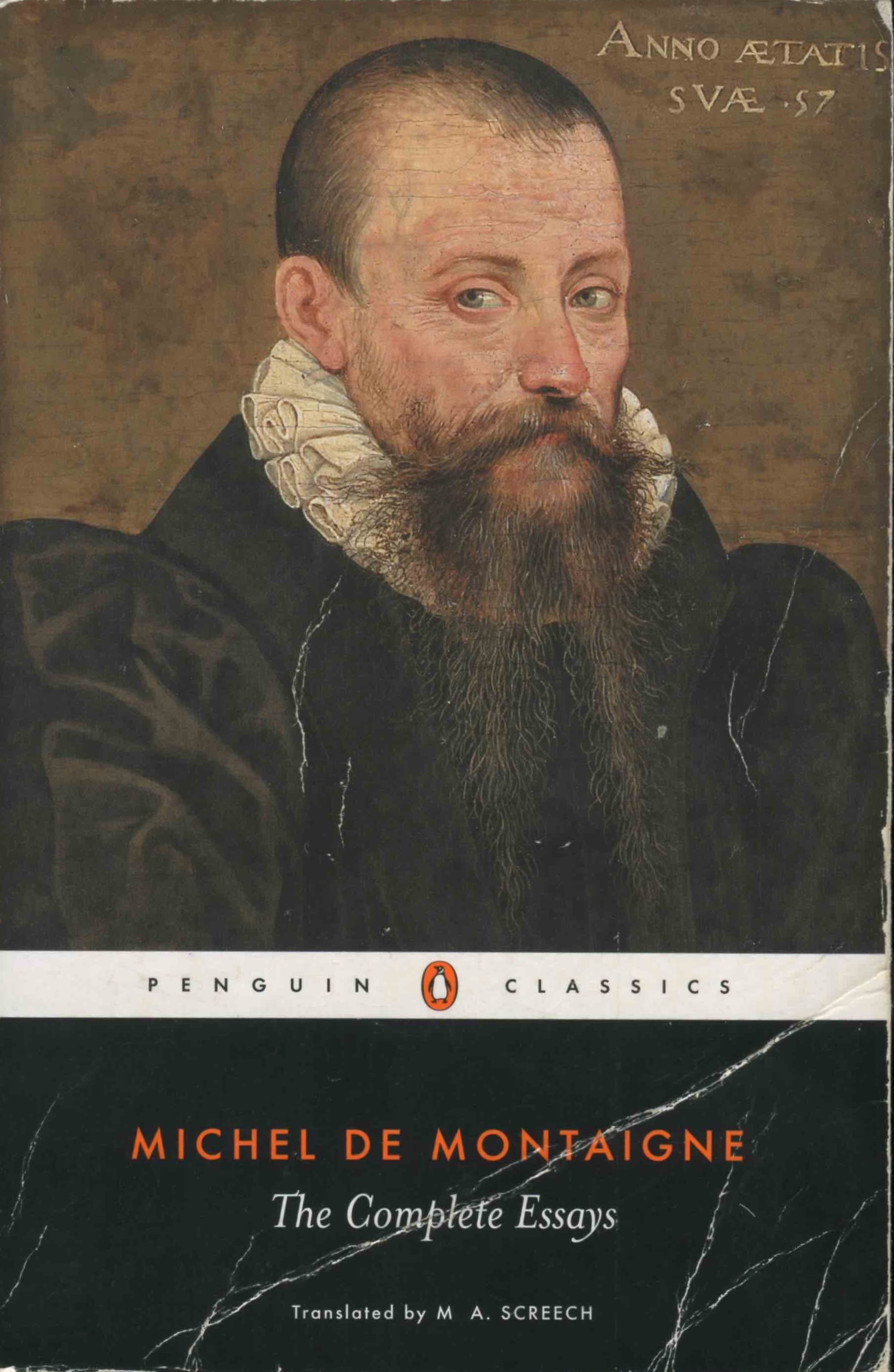
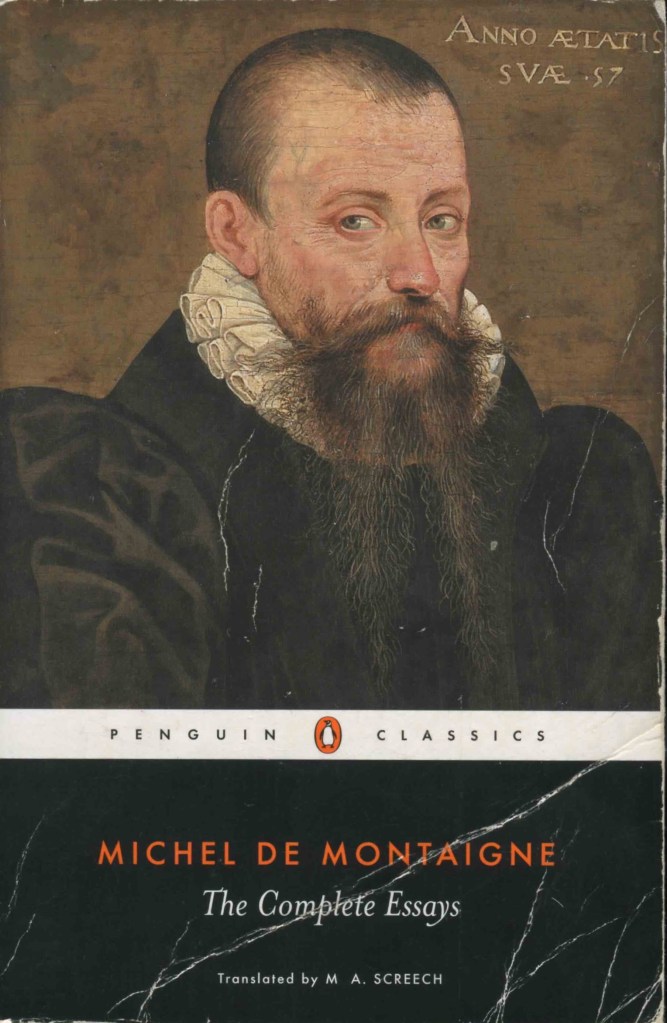
Michel de Montaigne, The Complete Essays (Penguin Classics 1991, translated by M. A. Screech)
– part way through Book 3, essay 10, ‘On restraining your will’ to end Book 3, essay 13, ‘On experience’
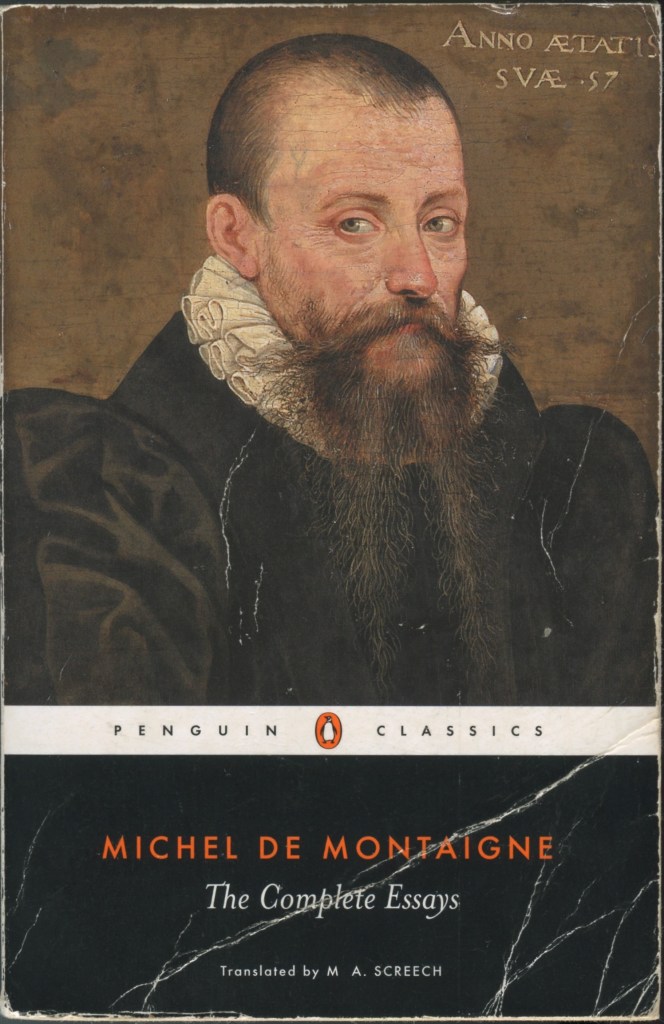
M A Creech, whose translation and edition of Montaigne’s essays I’ve been reading, a few pages a day, since March last year, says that it’s a mistake to read the Essais simply as a collection of separate pieces of varying lengths. There is a shape, he argues in his introduction, and in the final essay, ‘On experience’, Montaigne arrives at the place to which all the preceding essays have been heading.

Given the immersive task he has undertaken – not just finding English equivalents for Montaigne’s French, but also translating and identifying the sprinkling of quotes from Latin (and the few from Greek and more recent languages) – I’m not going to say he’s wrong, but I can’t see that he’s right.

But the final essay does read as a culmination, and a farewell. Its central argument is about the relationship between reason and experience, more specifically the limits of reason and the importance of giving full value to experience. There’s a long section in which he describes the mental process by which he comes to think of his extremely painful kidney stones as a good thing: the pain is intermittent so he has time to digest the experience; when the pain goes, its absence is delightful; unlike other diseases, this one doesn’t interfere with his normal life – he can spend up to ten hours in the saddle at the height of an attack; it’s an illness ‘which does not leave us guessing’ – that is, we know what it is, there’s no need to hunt for diagnoses; etc. At the end of the section, just as one is admiring his brilliant feat of mind over matter, he acknowledges that at least in part he has been whistling in the wind (page 1243):

With such arguments, both strong and feeble, I try … to benumb and delude my power of thought and to put ointment on its wounds. And tomorrow, if they grow worse, we will provide other escape-routes for them.

And then, in a twist that makes his writing as fresh now as it must have been nearly 500 years ago:

Since I wrote that, the slightest movements which I make have begun to squeeze pure blood from my kidneys again. Yet because of that I do not stop moving about exactly as I did before and spurring after my hounds with a youthful and immoderate zeal. And I find that I have got much the better of so important a development, which costs me no more than a dull ache and heaviness in the region of those organs. Some great stone is compressing the substance of my kidneys and eating into it: what I am voiding drop by drop – and not without some natural pleasure – is my life blood, which has become from now on some noxious and superfluous discharge.
Can I feel something disintegrating? Do not expect me to waste time having my pulse and urine checked so that anxious prognostics can be drawn from them: I will be in plenty of time to feel the anguish without prolonging things by anguished fear.

This last essay goes for more than 60 pages. It’s intensely personal: Montaigne describes his not entirely admirable table manners. He goes into some detail about his habits around eating, sleeping, excreting, walking, dressing, a little about sex (which at the ripe old age of fifty-something is largely in his past). He argues that what is customary for any individual or community should be maintained – it would be as wrong for a Frenchman to drink his wine undiluted as for a German to dilute his! And when he hits full stride he argues brilliantly that pleasure is a good thing, that life itself is a good thing. This is from page 1258:

When I dance, I dance. When I sleep, I sleep; and when I am strolling alone through a beautiful orchard, although part of the time my thoughts are occupied by other things, for part of the time too I bring them back to the walk, to the orchard, to the delight in being alone there, and to me. Mother-like, Nature has provided that such actions as she has imposed on us as necessities should also be pleasurable, urging us towards them not only by reason but by desire. To corrupt her laws is wrong.

And a little later:

What great fools we are! ‘He has spent his life in idleness,’ we say. ‘I haven’t done a thing today.’ – ‘Why! Have you not lived? That is not only the most basic of your employments, it is the most glorious.’ – ‘I would have shown them what I can do, if they had set me to manage some great affair.’ – If you have been able to examine and manage your own life you have achieved the greatest task of all. Nature, to display and show her powers, needs no great destiny … Our most great and glorious achievement is to live our life fittingly. Everything else – reigning, building, lying up treasure – are at most tiny props and small accessories.

How can I not love this man? All of this, of course, is interwoven with quotations from the ancients, with whom he sometimes argues robustly, even his beloved Socrates. Wonderfully, he ends with four lines from Horace:

Frui paratis et valido mihi,
Latoe, dones, et, precor, integra
Cum mentis, nec turpem senectam
Degene, nec Cythara carentem.

Which, drawing on M. A. Screech’s translation and explanatory footnote, I can paraphrase as: ‘Grant me, O Apollo god of healing, that I may enjoy the things I have prepared and, with my mind intact, I pray that I may not degenerate into a squalid old age, in which the lyre is wanting.’

It’s not age or death he feared, but the prospect of an old age when he was incapable of singing.


This blog post was written on Gadigal-Wangal land, on a fully hot, humid day when even the birds are silent. I acknowledge the Elders past, present and emerging of Gadigal and Wangal of the Eora Nation.

2024 End of Year List 4: Books

The Emerging Artist now keeps a record of the books she reads so she can easily whip up a list for me at this time of year. Here are her favourite reads from 2024 in her own words (links to LibraryThing pages or, at her request, to my blog post when there is one):

Fiction

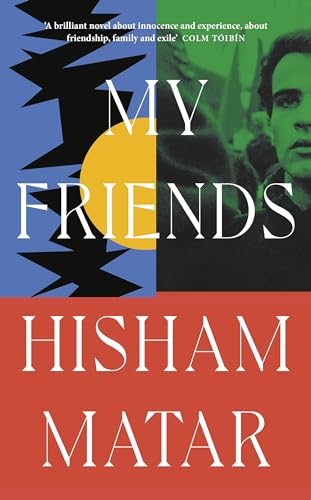
Hisham Matar, My Friends (Viking 2024)
I enjoyed Hisham Matar’s previous books, though I wasn’t enthusiastic about them as they often felt repetitive, and more like unreliable memoir than fiction. My Friends continues to draw on his life, but it feels more like a story that examines what it is to be an exile in a time of radical upheaval.

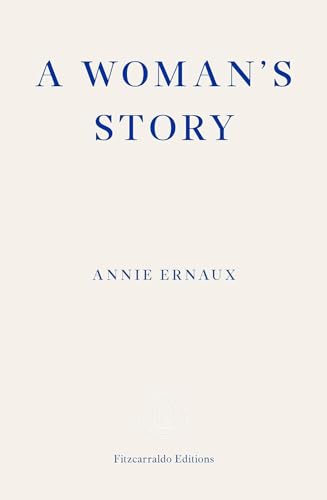
Annie Ernaux, A Woman’s Story (translated by Tanya Leslie 1991, Fitzcarraldo Editions 2024)
I read Annie Ernaux’s The Years before I got to this very slim volume, so I came to it with high expectations. I wasn’t disappointed. In such concise prose Ernaux describes the details of one woman’s life, and iin doing so conjures up a broader world.

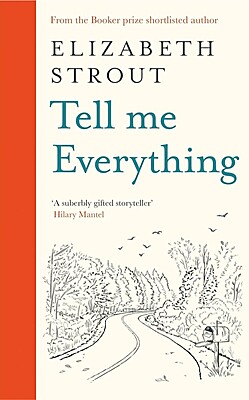
Elizabeth Strout, Tell Me Everything (Viking 2024)
This continues the stories of a number of Elizabeth Strout’s characters, bringing them together as they deal with death, ageing, love and lust. She writes with wit and kindness.

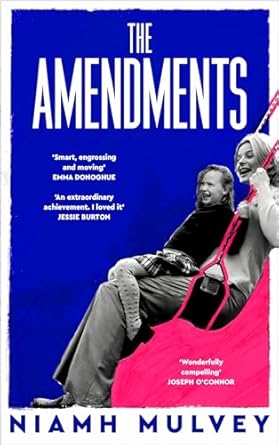
Niamh Mulvey, The Amendments (Picador 2024)
A new Irish writer for me. I hope she writes a lot more. This is a generational feminist tale about a family of women, dealing with the way issues of reproductive rights governed women’s lives before Ireland shifted from Catholic dominance – a shift made because of women demanding change.

Donal Ryan, Heart, Be at Peace (Doubleday 2024)
I had read two previous Donal Ryan novels, both of which I loved. In this one he continues to create the sense of Irish village community and disunity in the context of the Celtic Tiger and its collapse. Told from multiple perspectives, it builds a picture of complex relationships.

Non fiction

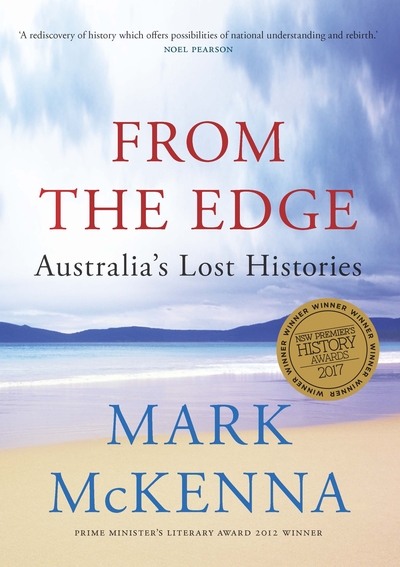
Mark McKenna, From the Edge: Australia’s Lost Histories (Melbourne University Publishing 2016)
Published in 2016, this is still a wonderful way to learn about First Nations and settler interactions. McKenna writes compelling history. These relatively short pieces include the pearl industry in Western Australia, the Barrup Peninsula petroglyphs and mining, early failed attempts to establish a colony in northern Australia, and the brutality of the Palmerston goldfields in north Queensland. They are written with a focus on First Nations agency, and they attempt to understand how colonisation played out in each specific time and place.

Naomi Klein, Doppelganger: A Trip into the Mirror World (Penguin 2023)
I’m still reading this, having put it down during the US elections as much of what Naomi Klein describes was playing out in the headlines. It’s a fascinating enquiry into the nature of truth, and the way fakery has become entrenched in political discourse.

From me

I can never pick a favourite or best book. My favourite is always the one I’m reading right now, unless the one I’m reading is the book I hate most in the world. Some highlights of 2024 were:

  • Montaigne’s Essays: I have read four or five pages most mornings since the beginning of March, and will have finished the book in a couple of weeks. He has been a great person to start the day with (apart from the Emerging Artist, of course)
  • Blue Mars, the final book in Kim Stanley Robinson’s Mars trilogy has finally made it from my TBR shelf, and it was a most satisfactory experience
  • the poetry of John Levy, who showed up in my comments to share his enthusiasm for Ken Bolton’s poetry, and offered to send me a copy of his own book. I’m so glad I accepted the offer
  • I read more of Annie Ernaux: if ever I write a memoir, I hope I can manage to be at least slightly Ernauxian

To get all nerdy, I read:

  • roughly 83 books altogether (counting journals but only some children’s books)
  • 34 novels
  • 21 books of poetry
  • 5 comics
  • 6 books in translation – 3 from French (counting Montaigne’s Essays), 1 each from German, Japanese and Chinese
  • 7 books for the Book Group, whose members are all men
  • 12 books for the Book Club, where I’m the only man (two of them to be reviewed after tomorrow night’s meeting)
  • counting editors and comics artists, 45 books by women, 46 by men
  • 3 books by First Nations writers, and
  • 11 books by other writers who don’t belong to the White global minority.

And the TBR shelf is just as crowded as it was 12 months ago.


Happy New Year to all. May 2025 turn out to be a lot less dire than it’s looking at the moment, and (to repeat my wish from last year) may fossil fuels at last be left in the ground. May we all keep our hearts open, our minds engaged, and may we all talk to strangers.

Montaigne progress report 9

Michel de Montaigne, The Complete Essays (Penguin Classics 1991, translated by M. A. Screech)
– part way through Book 3, essay 5, ‘On Some lines from Virgil’ to part way through Book 3, essay 10, ‘On restraining your will’

This post was due more than a week ago, but life in general made other plans for me. With a couple of lapses, though, I have consistently read four or five pages of Montaigne’s Essays each morning.

I won’t even try to summarise what I’ve read in the last six weeks. I’ll just mention that ‘On some lines from Virgil’ continued to be fascinating on the subject of sex and gender; in a piece with the innocuous title ‘On coaches’ Montaigne denounces the atrocities of the Spanish colonisation of Central and South America; in ‘On the disadvantages of high rank’ he pities those whose social position means no one will disagree with them, because they are deprived of the joys of conversation.

And then there’s ‘On vanity’, a long essay that made me fear age-related cognitive decline was catching up with me. As with many of the essays, ‘On some lines from Virgil’ being a prime example, this one’s title gives you no idea of its true subject. But in this case, I couldn’t tell if it even had a main subject. He writes about travel, about death (a lot about death), about how much he loves Rome. He explains why he’s glad he has no sons. He quotes at length from the document granting him Roman citizenship. He’s like a dog snapping – in slow motion – at whatever fly of an idea crosses his mental line of vision. But in the middle of it all, he has one of the passages that remind you that he is inventing the form of the personal essay – and k ows exactly what he’s doing:

There are works of Plutarch in which he forgets his theme, or in which the subject is treated only incidentally, since they are entirely padded out with extraneous matter … My God! what beauty there is in such flights of fancy and in such variation, especially when they appear fortuitous and casual. It is the undiligent reader who loses my subject, not I. In a corner somewhere you can always find a word or two on my topic, adequate despite being squeezed in tight. I change subject violently and chaotically. My pen and my mind both go a-roaming. If you do not want more dullness you must accept a touch of madness.

‘It is the undiligent reader who loses my subject, not I.’ I’ve been put in my place.

He defends his lack of coherence by applying to himself Plato’s description of a poet as someone who:

pours out in rapture, like the gargoyle of a fountain, all that comes to his lips, without weighing it or chewing it; from him there escape things of diverse hue, contrasting substance and jolting motion.

I don’t know that anyone seriously thinks that’s what poets do, but the idea that a reader needs to be ‘diligent’ to do justice to some writing has still got a lot of life in it, probably even more than it did in Montaigne’s day. He goes on to say he doesn’t stitch things together ‘for the benefit of weak and inattentive ears’:

Where is the author who would rather not be read at all than to be dozed through or dashed through? … If taking up books were to mean taking them in; if glancing at them were to mean seeing into them; and skipping through them to mean grasping them: then I would be wrong to make myself out to be quite so totally ignorant as I am. Since I cannot hold my reader’s attention by my weight, manco male [it is no bad thing] if I manage to do so by my muddle.

So, just as he’s getting tetchy with us for being lazy, he acknowledges that he’s a pretty lazy reader himself. And having claimed that his apparent incoherence is actually poetic brilliance, he now calls it a muddle.

Oh, and in the middle of all that charming back-and-forth between grumpiness and self-deprecation, there’s this lovely, enigmatic line:

Poetry is the original language of the gods.

I’m not sorry I gave up French Honours in 1968 because I found Montaigne almost as unreadable as Rabelais. I’m enjoying reading him now, in translation, much more than I possibly could have in the original when I was 22.


This blog post was written on Gadigal-Wangal land, where the days are getting hotter and more humid. I acknowledge the Elders past, present and emerging of Gadigal and Wangal of the Eora Nation.
November verse 4 & Montaigne progress report 8

Michel de Montaigne, The Complete Essays (Penguin Classics 1991, translated by M. A. Screech)
– part way through Book 2, essay 40, ‘On the resemblance of children to their fathers’ to part way through Book 3, essay 5, ‘On Some lines from Virgil’

Montaigne’s essays become even more interesting as he ages. By Book 3, he writes about his chronic pain from ‘the stone’ and, especially in the innocuously titled ‘On some lines from Virgil’, he does some spectacular writing about sexual politics.

I expect that whole books have been written about Montaigne and sex. I won’t try to untangle any of it here. I’ll just quote the paragraph from today’s reading that has given my poem its opening line. (For those who came in late, this November I’m writing at least 14 fourteen line poems, the first line of each coming from something I’ve heard or read that day.) The paragraph will give you just a glimpse of the complexity of Montaigne’s thought:

We do not weigh the vices fairly in our estimation. Both men and women are capable of hundreds of kinds of corrupt activities more damaging than lasciviousness and more disnatured. But we make things into vices and weigh them not according to their nature but our self-interest: that is why they take on so many unfair forms. The ferocity of men’s decrees about lasciviousness makes the devotion of women to it more vicious and ferocious than its characteristics warrant, and engages it in consequences which are worse than their cause.

I think he’s saying that making sexual behaviour a major criterion for a woman’s reputation is wrong; men make the rules that condemn women’s ‘immorality’; and the punishments are much worse than the so-called crimes. Further on in the essay he says that social expectations on women to be chaste are an intolerable burden.

I don’t know if he is putting a proto-feminist case, or arguing deviously that women should be more sexually available to men. Or both. Either way, it’s fascinating to have a voice from a very different epoch wrestling with questions that aren’t exactly resolved today.

But before I leave Montaigne for my own versification, I can’t resist quoting the final paragraph from Book 2, which follows some strong opinions about the medical profession, and rings out like a beacon of rationality for our times:

I do not loathe ideas which go against my own. I am so far from shying away when others’ judgements clash with mine … that, on the contrary, just as the most general style followed by Nature is variety – even more in minds than in bodies, since minds are of a more malleable substance capable of accepting more forms – I find it much rarer to see our humours and purposes coincide. In the whole world there has never been two identical opinions, any more than two identical hairs or seeds. Their most universal characteristic is diversity.

Yay Montaigne!

But on with my verse, which takes the phrase somewhere else altogether – and you can probably see the point when news from the USA knocked the poem off its tracks:

November verse 4: We do not weigh the vices fairly
We do not weigh the vices fairly,
thumb the scales to suit our whim:
I exaggerate, quite rarely –
you tell fibs – but look at him!
His lies destroy the trust that binds us,
lead us where no truth can find us.
Crowds have wisdom, mobs can rule,
electorates can play the fool.
He's murderous and self-regarding,
incoherent, vile, inane.
He once could boast a showman's brain,
but principles are for discarding.
Lord of Misrule, theatre's Vice:
How could you choose him once, then twice?

This blog post was written on Gadigal-Wangal land, where the tiny lizards are enjoying the beginning of hot weather, and jacarandas are the land’s most spectacular guests. I acknowledge the Elders past, present and emerging of Gadigal and Wangal of the Eora Nation.
The Essays of Montaigne, progress report 7

Michel de Montaigne, The Complete Essays (Penguin Classics 1991, translated by M. A. Screech)
– part way through Book 2, essay 17, ‘On presumption’ to part way through ‘On the resemblance of children to their fathers’

These aren’t so much progress reports as monthly snapshots from my reading of Montaigne’s Essays four or five pages a day. Last month I was part way though ‘On presumption’ and enjoying his unflattering self-portrait. That essay became even more fabulously self-deprecatory, including this (on page 730):

As for music, either vocal (for which my voice is quite unsuited) or instrumental, nobody could ever teach me anything. At dancing, tennis and wrestling I have never been able to acquire more than a slight, vulgar skill; and at swimming, fencing, vaulting and jumping, no skill at all. My hand is so clumsy that I cannot even read my own writing, so that I prefer to write things over again rather than to give myself the trouble of disentangling my scribbles. And my reading aloud is hardly better: I can feel myself boring my audience. That apart, I am quite a good scholar! I can never fold up a letter neatly, never sharpen a pen, never carve passably at table, nor put harness on horse, nor bear a hawk properly nor release it, nor address hounds, birds or horses.

Last month I snuck a look into the future and predicted that this month I would be writing about ‘Three good wives’. Fortunately I don’t have to spend time on that essay, as its version of a good wife is one who will kill herself when her husband dies. Did I mention that some of Montaigne’s views and attitudes can be pretty repulsive? The essay after that, ‘On the most excellent of men’, is hardly less repulsive: his three excellent men are Homer, Alexander the Great and Epaminondas, and in all three cases, including Homer, he seems to regard military skills as the main criterion for excellence. He also seems to take Alexander the Great’s PR at face value. (I shudder to think that essayists a thousand years from now will speak of Donald Trump as the greatest president ever.)

Today, however, I have started on the final essay of Book II, ‘On the resemblance of children to their fathers’, which is surely one of those that have endeared Montaigne to readers for nearly 500 years

Typically, the proclaimed subject of the essay is nowhere in sight in the first couple of pages. Instead, he reflects on the nature of his work and on changes that have happened in his life over the eight years he has been writing essays.

I think it’s true that Montaigne invented the essay form, and these paragraphs give a charming insight into how he went about it.

All the various pieces of this faggot are being bundled together on the understanding that I am only to set my hand to it in my own home and when I am oppressed by too lax an idleness. So it was assembled at intervals and at different periods, since I sometimes have occasion to be away from home for months on end. Moreover I never correct my first thoughts by second ones – well, except perhaps for the odd word, but to vary it, not to remove it. I want to show my humours as they develop, revealing each element as it is born. I could wish that I had begun earlier, especially tracing the progress of changes in me.

It’s probably that spontaneity and the possible vulnerability that goes with it, that makes the essays so alive even all these years later. Maybe I should be less judgemental about essays like the one on good wives – he may have thought differently on the subject on another day.

But that’s enough about the work. He needs to tell us about his health:

Since I began I have aged by some seven or eight years – not without some fresh gain, for those years have generously introduced me to colic paroxysms. Long commerce and acquaintance with the years rarely proceed without some such benefit I could wish that, of all those gifts which the years store up for those who haunt them, they could have chosen a present more acceptable to me, for they could not have given me anything that since childhood I have held in greater horror.

I’m roughly 30 years older than Montaigne was when he wrote that. Though I’m in reasonably good health, I recognise his impulse to tell the world about his bodily ills. As I turn the page, he moves on to one of his recurring topics: when it makes sense to kill oneself (see essay on good wives etcetera). Happily, he is leaning towards staying alive:

After about eighteen months in this distasteful state, I have already learnt how to get used to it. I have made a compact with the colical style of life; I can find sources of hope and consolation in it.

That’s a good thing for his readers, as there was a whole third book to come.


This blog post was written on Gadigal-Wangal land, where understandings of the universe beyond Montaigne’s imaginings were developed millennia before the Ancients he so loves. I acknowledge the Elders past, present and emerging of Gadigal and Wangal of the Eora Nation.
The Essays of Montaigne, progress report 6

Michel de Montaigne, The Complete Essays (Penguin Classics 1991, translated by M. A. Screech)
– end of Book 2 Essay 12, “An apology for Raymond Sebond’ to part way through Book 2, essay 17, ‘On presumption’

The month has flown by, and it’s time for another progress report on my project of reading Montaigne’s essays, four pages every morning. Two friends have sent me examples of Montaigne cropping up in their own reading: the first has just started reading Amor Towles’s A Gentleman in Moscow, and was reminded of my project when the confined Count finally gets to read Montaigne; the second forwarded me Nicholas Gruen’s weekly newsletter for the 18th of August, which includes Montaigne’s essay ‘On a Monstrous Child’. I’m not alone in reading him.

It’s taken much more than a month, but I’ve now finished ‘An Apology for Raymond Sebond’. Whether from shrinking attention span, lack of interest, or the nature of the essay itself, I happily confess that I had trouble following its argument. It went on and on, endlessly quoting ancient philosophers, repeating itself, and proclaiming radical scepticism. I thought it was about to discover the scientific method, but no, it seemed to end up saying you can’t trust reason or the senses, but – implied rather than stated outright – you can always trust the revealed Word of God. I’m glad that one is behind me.

Today I’m part way through ‘On Presumption’. Having discussed in the preceding essay the relative worthlessness of reputation (‘glory’) compared with actual virtue, in this one Montaigne begins by saying that one’s opinion of oneself is similar to glory – prone to wishful thinking and no real indicator of one’s real worth. He’s now in the middle of a generally unflattering – and I think intentionally funny – self-portrait. He loves poetry, but is a terrible poet. He loves fine writing but:

There is nothing fluent or polished about my language; it is rough and disdainful, with rhetorical arrangements which are free and undisciplined. And I like it that way, by inclination if not by judgement. But I fully realise that I sometimes let myself go too far in that direction, striving to avoid artificiality and affectation only to fall into them at the other extreme. … Even if I were to try to follow that other smooth-flowing well-ordered style I could never get there. (Page 725–726)

False modesty? Maybe not. It does read as a genuine attempt to describe his own writing.

Beauty, he says, is the ‘first sign of distinction among men’, and height is the only quality that determines manly beauty, but his own ‘build is a little below average’. In one of the passages that makes reading him such a pleasure, he lists the qualities that don’t count:

When a man is merely short, neither the breadth and smoothness of a forehead nor the soft white of an eye nor a medium nose nor the smallness of an ear or mouth nor the regularity or whiteness of teeth nor the smooth thickness of a beard, brown as the husk of a chestnut, nor curly hair nor the correct contour of a head nor freshness of hue nor a pleasing face nor a body without smell nor limbs justly proportioned can make him beautiful. (Page 729)

Having just told us that only height matters, he implies the counter argument: he’s at least a bit sorry that men who look good and don’t smell bad aren’t regarded as beautiful. Not that he attributes those qualities to himself. He says his build is ‘tough and thickset’ and describes (in Latin, possibly quoting someone) his bristly legs and tufty chest, etc.

So this isn’t so much a progress report as a snapshot of where I’m up to when the blog post falls due. I just flicked forward 120 pages to see that next time I may be talking about an essay entitled ‘On three good wives’!


This blog post was written on Gadigal-Wangal land, where understandings of the universe beyond Montaigne’s imaginings were developed millennia before the Ancients he discusses. The weather is warming up alarmingly early. I acknowledge the Elders past, present and emerging of the Gadigal and Wangal Nations,.

The Essays of Montaigne, progress report 5

Michel de Montaigne, The Complete Essays (Penguin Classics 1991, translated by M. A. Screech)
– part of Book 2 Essay 12, “An apology for Raymond Sebond’

Since my last Montaigne report, I’ve been faithful to my four pages of Montaigne each morning except for two breaks – one for a fortnight and the other just a weekend. The book is too heavy to take on a plane, and travel tends to disrupt routines like this one.

Five weeks ago, I had just started reading the longest essay in the collection, ‘An apology for Raymond Sebond’. Today I still have 60 odd pages of that essay to go. As I have only the vaguest idea of who Raymond Sebond was, or in what way Montaigne is attempting an apology, I’ll spare you any attempt at a summary, and just give a couple of snapshots.

Having declared himself to be a sceptic (as opposed to a dogmatist), Montaigne sets out to establish the limits of human reason. He piles on example after example of ancient philosophical versions of God, products of the ‘fierce desire to scan the divine through human eyes’. Arguing that if reason were able to determine the nature of God, then these versions would tend to some kind of agreement. Having established that this isn’t what happened, he (at least in M. A. Screech’s translation) drops his dignified mode of discourse altogether and exclaims:

So much din from so many philosophical brainboxes! Trust in your philosophy now! Boast that you are the one who has found the lucky bean in your festive pudding!

That’s on page 577. I’ve now reached page 625. In those 48 pages he has explored (and deplored) the limitations of reason in understanding even the world of nature or the human mind itself, and has been cheerfully insulting of many ancient writers whom he clearly admires enormously (including describing Plato as sometimes ‘silly’). Now he is going on about how philosophers can’t reach any agreement about the immortality or otherwise of the soul. He has reached the transmigration of souls:

the received opinion … that our souls, when they depart from us, go the rounds from one body to another, from a lion, say, to a horse; from a horse, to a king, ceaselessly driven from one abode to another.

And he’s having quite a lot of fun with it, citing the Epicureans’ objection:

What order could be maintained if the crowds of the dying proved greater than the number being born? The souls turned out of house and home would all be jostling each other, trying to be first to get into their new containers! They also ask how souls would spend their time while waiting for their new lodgings to be got ready.

Having added some lines of Latin poetry, he then goes on:

Others make our souls remain in the body after death, so as to animate the snakes, worms and other creatures which are said to be produced by spontaneous generation in our rotting flesh or even from our ashes.

In short, I’m enjoying this essay as a kind of romp in the history of philosophy. As a settled atheist who thinks my mind is a function of my body, I have a kind of museum-piece interest in a lot of the arguments. I was taught at school that until a certain point in European history people relied on the authority of, I think it was Aristotle, for their knowledge of the world. We knew from Aristotle how many teeth a human had, and only at a certain stage did it occur to people to look in each other’s mouths and count for themselves. As I read this essay, it feels as if I’m seeing that change happen before my very eyes, and it’s riveting. (Mind you, I think the essay itself is going to end with a declaration that Christian revelation is the ultimate source of Truth, but both things can be happening at once.)

To be continued.


This blog post was written on Gadigal-Wangal land, where understandings of the universe beyond Montaigne’s imaginings were developed millennia before the Ancients he discusses. It’s raining again, and my compost bin is alive with worms. I acknowledge the Elders past, present and emerging of the Gadigal and Wangal Nations,.

The Essays of Montaigne, progress report 4

Michel de Montaigne, The Complete Essays (Penguin Classics 1991, translated by M. A. Screech)
from Book 2 Essay 7, ‘On rewards for honour’ to part way through Book 2 Essay 12, “An apology for Raymond Sebond’

Three months in and I’m loving my morning chats with Montaigne. Not so much a progress report this month, as I’m poised to fly to warmer climes any second and am squeezing this post in among house-cleaning and similar chores.

Usually as I make my way through these essays I ignore the notes and references, as I’m not making a study of Montaigne, just reading him and living with my sometime incomprehension. For the current essay, ‘ An Apology for Raymond Sebond’, I read 24 pages of M. A. Screech’s introduction to the book, and listened to a podcast from David Runciman’s ‘Past Present Future’ series (a fascinating account of the essay, which you can find here).

It’s a serious argument, tackling the relationship between revealed truth as understood in 16th century Christianity and knowledge that can be acquired by observation and reason. It’s serious, and intricate. In the passages I’ve just been reading, which is all I’m going to talk about here, it’s something else.

In this part of the essay, Montaigne is arguing against human exceptionalism. Animals (he doesn’t quite bring himself to say ‘other animals’) give signs of being able to reason, to be loyal, seek justice, have compassion, grieve, do basic arithmetic, follow the movements of the stars. In many ways, we learn from the animals, even while we believe ourselves to be infinitely superior. He notes in passing that ‘you can see some male animals falling for males of their own kind’. He tells the story that I know as ‘Androcles and the lion’ in some detail, calling the human character ‘Androdes’. He piles on example after example – mostly from antiquity and in particular Plutarch.

For the sake of his argument, just a couple of examples would have been enough, but Montaigne is like a child in a lolly shop: there are so many stories old and new, verifiable and fantastical, it’s as if he can’t bear to leave any of them out. Today’s reading ends with this (on page 534):

As for greatness of spirit, it would be hard to express it more clearly than that great dog did which was sent to King Alexander from India. It was first presented with a stag, next with a boar, then with a bear: it did not deign to come out and fight them, but as soon as it saw a lion it leaped to its feet, clearly showing that it thought such an animal was indeed worthy of the privilege of fighting against it.

Montaigne had fought in battle, and the religious wars of the 16th century were raging around him as he wrote the Essays. His casual acceptance of violence, as in this paragraph, is one of the places where we feel how different his times were from ours. But his insistence at such length on the dignity of animals has a surprisingly modern feel.

Ok, that’s all I have time for. I have a plane to catch and warmer climes to visit.


This blog post, was written on Gadigal-Wangal land in between bouts of heavy rain, which enables the ibises and magpies in the park across the road to have a great time fossicking in the soft soil. I acknowledge the Elders past, present and emerging of the Gadigal and Wangal Nations.

The Essays of Montaigne, progress report 3

Michel de Montaigne, The Complete Essays (Penguin Classics 1991, translated by M. A. Screech) from Book 1 Essay 42, ‘On the inequality there is between us’, to Book 2 Essay 7, ‘On rewards for honour’

Three months in and I’m coming to love my morning chat with Montaigne.

I was delighted to hear an echo of his voice in a session at the recent Sydney Writers’ Festival. In conversation with Felicity Plunkett (my blog post here), the poet Nam Le was struggling to describe the complex way his mind works. According to my scribbled notes, he said:

Any attribute you can attribute to yourself, the opposite can also be yours.

That morning, I had been reading Montaigne’s Book 2, Essay 1, ‘On the inconstancy of our actions’, which begins:

Those who strive to account for a man’s deeds are never more bewildered than when they try to knit them into one whole and to show them under one light, since they commonly contradict each other in so odd a fashion that it seems impossible that they should all come out of the same shop.

I don’t know if Nam Le had Montaigne even at the back of his mind, but it’s fascinating to find in Montaigne, roughly Shakespeare’s contemporary, such a pre-echo of a 21st century way of seeing things. Fascinating, but not an isolated moment. His reflections on public life, oratory, warfare, frugality, education, suicide and so on often seem tailor-made for quotation in a discussion of anything from the US ex-president to drone warfare or the culture wars. He can be horribly sexist, and his class material is also horrible; but he’s often hard to take to task, because he’s likely to disagree with himself in the next paragraph.

At four pages a day, some essays extend over several mornings. I can see one coming over the horizon that will last me nearly a month. Mostly I ignore M A Creech’s prefatory notes, but sometimes I depend on them to make sense of an argument. Sometimes Montaigne piles up the anecdotes – drawing on ancient writers, recent history, contemporary gossip and personal experience – to such an extent that I lose track of his argument, and suspect he has lost track of it himself. Some of the anecdotes are bizarre in the extreme, especially when he is reporting on sexual or dietary habits of ‘exotic’ peoples.

I’m being fairly lazy in my reading. Whenever Montaigne quotes a line or two of poetry, usually in Latin, but sometimes in Old French or other languages, I skip straight to the translation provided by Mr Screech. I know I’m missing one of the pleasures of these texts, but it’s a pleasure that demands too much work for me (and, I expect, most 21st century readers).

One of the pleasures that is still alive and well is the constant delight of watching Montaigne’s mind chase after whatever rabbit catches his eye while he’s doing something else. This morning I read the essay, ‘On rewards for honour’, a short argument against adding a monetary or other material component to an award for valour, which morphs briefly into a reflection on why ‘valour’ is seen to be mostly a martial virtue when true valour in non-military circles is so much harder to achieve, and then ends in a sentence or two wondering at the way ‘virtue’ means different things for men and women, finishing up with a jokey note which, if he had continued his thoughtful wanderings, might have led in a proto-feminist direction:

Our passion, our feverish concern, for the chastity of women results in une bonne femme (‘a good woman’), and une femme d’honneur, ou de vertu (‘a woman of honour or of virtue’) in reality meaning for us a chaste woman – as though, in order to bind them to that duty, we neglected all the rest and gave them free rein for any other fault, striking a bargain to get them to give up that one.

‘On practice’, the longer essay that precedes ‘On rewards for honour’, is an even better example of the way Montaigne’s mind moves in unexpected directions. It turns out to be about death – which, he says, is the one thing you can’t get better at by practice. Or is it? The tone changes abruptly as he tells of a horrific near-death experience of his own, including a detailed account of the aftermath as he regained consciousness, pain, and memory. Then: ‘The account of so unimportant an event is pointless but for the instruction I drew from it: for in truth, to inure yourself to death, all you have to do it draw nigh to it.’ But that’s not the final swerve of the essay. It turns to the question of talking and writing about oneself, but first there’s this brief description – one of many – of what he is trying to do (essaying) in the essays:

Here you have not my teaching but my study: the lesson is not for others; it is for me. Yet, for all that, you should not be ungrateful to me for publishing it. What helps me can perhaps help somebody else.
Meanwhile I am not spoiling anything: I am only using what is mine. And if I play the fool it is at my own expense and does no harm to anybody.

I just read on Wikipedia that William Hazlitt described Montaigne as ‘the first who had the courage to say as an author what he felt as a man’. I’m loving his courage, and his humility, in putting his own experience and his own thinking out there for all the world to read.


This blog post, was written on Gadigal-Wangal land as the nights start earlier, spiderwebs multiply, and the rain buckets down. I acknowledge the Elders past, present and emerging of those Nations, and would love to hear from any First Nations people reading this blog.

The Essays of Montaigne, progress report 2

Michel de Montaigne, The Complete Essays (Penguin Classics 1991, translated by M. A. Screech) Book 1, from part way through Essay 26, ‘On educating children’, to Essay 41, ‘On not sharing one’s fame’

I’m enjoying my morning read of Montaigne, now at the end of my second month.

As expected, his name has cropped up elsewhere. The time I noticed was on Waleed Aly and Scott Stephens’s podcast The Minefield, when talking about the recent stabbings in Sydney. Scott referred to the essay that M. A. Screech translates as ‘On Affectionate Relationships’ to illustrate something he was saying about grief.

That essay was one I read this month. Though its discussion of grief is wonderful, the thing that stands out for me in it is his exalted notion of friendship. The meeting of souls that these days tends to be identified, hopefully, as part of romantic love he sees as quite distinct, and separate, from the love of spouse (he says ‘wife’) or children. Revisiting them now, I see that the paragraphs on grief are wonderful. For example:

I drag wearily on. The very pleasures which are proffered me do not console me: they redouble my sorrow at his loss. In everything we were halves: I feel I am stealing his share from him. (Page 217)

The essays I have just read are ‘Reflections upon Cicero’ and ‘On not sharing one’s fame’. I wish my Latin teachers could have told me about the Cicero one in high school: it would have made it much more fun to study that ‘Cui bono?’ speech if I’d known how Montaigne despised its author. Speaking of Cicero and Pliny the Younger, he writes:

What surpasses all vulgarity of mind in people of such rank is to have sought to extract some major glory from chatter and verbiage, using to that end even private letters written to their friends; when some of their letters could not be sent as the occasion for them had lapsed they published them all the same, with the worthy excuse that they did not want to waste their long nights of toil! How becoming in two Roman consuls, sovereign governors of the commonwealth which was mistress of the world, to use their leisure to construct and nicely clap together some fair missive or other, in order to gain from it the reputation of having thoroughly mastered the language of their nanny! (Page 279)

Then, wonderfully, two pages later in ‘On not sharing one’s fame’, in discussing the way ‘concern for reputation and glory’ is the most accepted and most universal of ‘all the lunacies in this world’ he writes this, without a trace of his earlier disparagement:

For, as Cicero says, even those who fight it still want their books against it to bear their names in the title and hope to become famous for despising fame.

But then, he regularly says that he has a poor memory.

The very last thing I read this morning is a wonderful example of how Montaigne can surprise and delight (though it’s also an example of the violence that permeates Montaigne’s world). He has been piling on examples of people (all male) who have acted to enhance someone else’s fame and glory, often to the detriment of their own. Then, in the last couple of sentences he swerves off into a comic non sequitur:

Somebody in my own time was criticised by the King for ‘laying hands on a clergyman’; he strongly and firmly denied it: all he had done was to thrash him and trample on him. (Page 289)


This blog post, like most of mine, was written on Gadigal-Wangal land as the days grow shorter and spiderwebs multiply, even in the heavy rain. I acknowledge the Elders past, present and emerging of those Nations.