
Ivor Indyk (ed.), Heat 24: That’s it, for now … (Giramondo January 2011)
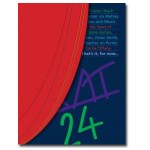
After 14 years, Heat is to appear no more in book form. In this final issue Ivor Indyk, the editor and publisher, departs from his usual practice and speaks to us, explaining the reasons for his decision and sketching some possibilities for an electronic afterlife. (He spoke again to Ramona Koval on the Book Show.) The sad economic reality is that as a 240 page book, Heat is a monster to produce several times a year and then to distribute and warehouse. The community of people who are glad of its existence is much larger than the journal’s market – the people who buy it, and so contribute to its viability. As I’ve subscribed for ten years and written blog entries (I don’t really think of them as reviews), I have a twinge of smug virtue mixed with my sorrow: like, ‘It’s not my fault!’ I don’t know that I’ve ever felt part of a Heat community – too middlebrow, too whitebread, too shy – but it hasn’t been a purely economic relationship. I’ll miss this regular dose of austere high culture, and emergent/experimental/cosmopolitan writing.
Some of the culture in this final issue is incontestably high. Adrian Martin’s article, ‘Devastation’, after a wonderful anecdote about a working class man’s response to Terence Davies’ Distant Voices, Still Lives, goes on to discuss the films of Maurice Pialat. I’m a keen and frequent filmgoer, but I had to check with Google to be sure the article wasn’t a spoof and Pialat a comic invention – an archetypally grim French auteur whom Martin praises for daring to have sitting and standing characters in the same shot, and compares to a number of other auteurs I hadn’t heard of. It’s not a spoof: it’s the kind of article that sheds enough light on its subject to reveal the dark vastness of its reader’s ignorance. By way of contrast, Andrew Riemer’s brilliantly erudite ‘Four Glimpses of the Zeitgeist’ takes one gently by the hand and illuminates a web of connections joining Freud, Mahler, Riemer’s ancestors, conductor Bruno Walter, His Master’s Voice records, Hitler, playwright Thomas Bernhard and others, all converging in a Viennese theatre in 2010. Jeffrey Poacher’s reflection on the poetry of Peter Porter , who died last year, is likewise kind to general readers without, I hope, boring those who know Porter’s poetry well.
Cosmopolitanism is alive and well, particularly n Andreas Campomar’s ‘Uruguay Made Me’, a discussion of Eduardo Galeano in the context of his native Uruguay that makes me want – need – to read Galeano.
There’s plenty of emerging/experimental work too, mainly in the poetry. I was happy to see two typographically adventurous poems by Patrick Jones, who commented critically on this blog a while back.
But I don’t want to get hung up on classification. There’s a terrific poem by Adam Aitken dedicated to Susan Schultz – both Adam and Susan have graced my comments section recently. Ali Alizadeh and Jennifer Maiden are in fine form. Alan Wearne does some Gilbertian editorialising on the current move to form an Australian peak industry body for poetry. Amanda Simons interviews Antigone Kefala on her writing practice: Kefala says that, for her, writing and speaking are two completely different forms, and it’s delightful to encounter the conversational Antigone here alongside two characteristically non-conversational poems (there’s that austere high culture again).
I was struck by two examples of things a book you hold in your hand can do that a boundless (the word is from Ivor Indyk’s editorial) electronic creation can’t. In Nicolas José’s ‘What Love Tells Me’ a recently widowed man and his young son attend a performance of Mahler’s Third Symphony where the ‘blasting and pummelling and smashing’ music opens them up to emotional resolution and communication. The story is moving in its own right, but it gains an extra fizz from the fact that 150 pages earlier Andrew Riemer has been telling us something of what Mahler’s music (though not this precise symphony) meant at the time it was written. In my mind at least, that mental connection is made possible by the weight of the book in my hand
The other moment is a theatrical coup in Gillian Mears’ ‘Fairy Death’. This memoir begins with a title page: a right-hand page that’s blank except for the title and a brief note on the author. When you turn over, expecting the story to begin on the verso, you find instead a striking image of what seems to be a dress-shop mannequin with a crack or join around its middle, arranged on a bed and photographed from above. The figure’s face makes you realise that it’s actually a live, extraordinarily thin woman, that what looked like a join is a string tied around her waist and attached to what you now recognise as a red balloon in the photo’s foreground. The photo, taken by Vincent Lord Long, is of the author, and her mannequin-like thinness is the result of advanced multiple sclerosis. The article is in part an account of how it came to be taken. Though the memoir is astonishingly powerful, addressing (with what in another context would be Way Too Much Information) the effects of MS on the author’s sexuality, the act of turning the first page onto that image creates extraordinary poignancy – which I don’t believe could happen in an electronic form.
One perhaps minor advantage of ceasing to exist as a physical object is that proofreading and even copy editing can continue after publication. Heat 24 is far from egregious in that department – apart from a miniscule (which is a special case as the Microsoft spellchecker ignorantly allows it), I was plunged into confusion and irritation by only one editing error, which I won’t bore you with. It looks as if the presumably underpaid copy editor had enough time and/or other resource to do an excellent job on this issue, so he can go out with his head held high.
Just to be half clever, here’s the last stanza of John Shaw Neilson’s ‘The Poor Poor Country’, slightly altered:
The New Year came with Heat and thirst and the little lakes were low,
The blue cranes were my nearest friends and I mourned to see them go;
I watched their wings so long until I only saw the sky,
Down in that poor country no pauper was I.
Update 1 March 2011:
Over at Adam in (), Adam Aitken was kind enough to link to this page, and he asked me a question. I tried three times to respond in his comments section but for some reason my comments wouldn’t stick, so I’ll have go here.
Adam:
Jonathan, I don’t know why you see yourself as “whitebread”. Are HEAT writers “brownbread”? I won’t miss the so-called austerity of HEAT, as I feel on the contrary that HEAT would sometimes verge on the too rich, too dense side of things (by virtue of each issue being such a fat book).
Well, Adam, I’m not sure where I picked up the term ‘whitebread’, but my (now former) suburb, Annandale, got described that way by some of my more hip friends. They meant that the people of the suburb were the kind who ate only white, preferably sliced and packaged bread, remaining ignorant of or uninterested in the existence of pumpernickel, sourdough, ciabatta and challah, let alone pita, roti and naan. So my implication was Heat writers (and anyone else who belongs to its community) can come from anywhere in that vast world of different breads (quite a few of which are actually white, come to think of it). I have never read an issue of Heat without having my horizons extended, and I was amusing myself by saying that in a self-deprecatory way.
I agree with you on the richness and density of Heat. It’s been admirably austere in the sense that it would never have given us a review of the latest Oprah recommendation or blockbuster movie, and in a different way I’ve thought of Ivor Indyk’s editorial silence as austere. In this final issue he speaks to us, but presents it as asking our indulgence. I for one would have happily indulged him in this way many times over.
End of update



 Me fail? I fly!