Tag Archives: Novel

Tim Winton’s That Eye, the Sky at the Book Group

Tim Winton, That Eye, the Sky (McPhee Gribble 1986)

1TETSBefore the Meeting: That Eye, the Sky isn’t an obvious choice to discuss at a book club close to 30 years after it was published. It’s even less obvious, given that one or two of our members have disparaged Winton’s work (apart from Cloudstreet) fairly comprehensively. But we were looking for a film–book pairing and a couple of us – at least, I hope it wasn’t only me – remembered being moved by John Ruane’s movie based on this book. And it’s short.

I have mixed feelings about Tim Winton’s work. I loved The Turning, felt that the slow bits of Dirt Country were adequately compensated by other elements, especially the ending, and found The Riders close to pointless. His chapter in Big Surf, last year’s  essay on class  and his Palm Sunday oration about asylum seeker policy are all marvellous. Generally, I love his sentences. So, though I had loved the film (apart from a dimly remembered unease about the Peter Coyote character), I approached That Eye, the Sky with cautious optimism.

The narrator, Ort (short for Morton), is the 12 year old son of ex-hippies, living poor on the outskirts of a Western Australian city. His father has a car accident which leaves him in a coma then pretty much vegetative until the very last pages. Henry Warburton, a man Ort and his angry older sister Tegwyn have seen living rough under a nearby bridge, turns up and helps the family, bathing the incapacitated father and doing odd jobs. Henry, it turns out, is a bit of a loose cannon, but before his looseness becomes completely apparent he converts Ort and his mother to his peculiar brand of Christianity. Meanwhile, Ort is the only one who sees a strange light that hovers over their little house – possibly an after-effect of Ort having been comatose and died, twice, when he was little and had meningitis; or possibly Ort’s contact with a reality beyond this one.

The complex web of relationships is beautifully done, including Ort’s belligerent friendship with the boy from across the road, but I wasn’t convinced by the magic realism, if that’s what it is, and there were whole swathes where it felt awfully as if Tim Winton was wanting to tell us about the Bible. I was reminded of what someone said about Rob Reiner’s movie Stand by Me: there’s a lot of swearing and other stuff that lets the movie get away with its moments of tenderness. Well, Ort’s matter-of-fact description of bodily functions, and the final revelation of Henry’s moral dubiousness aren’t enough for this book to get away with its spiritual message. Not that there’s anything wrong with non-institutional Christianity – I just don’t believe in it in this book. The device of the uncomprehending child narrator – ‘What Ort Knew’ if you like – becomes annoying as one feels the ventriloquist author behind him:

The forest moves quiet tonight. Jarrahs move a long way up and out of sight. Now and then I hear little animal noises. All these trees are dying, and all these little animals will have nowhere to live. One day the whole world will die and we’ll die too. My back hurts and my bum stings and the backs of my legs too. I’ve got no clothes on out here in the forest. Prickles and burrs and twigs stick in me all over. I rub them in, squirm and shake around. It hurts a lot. I’m hurting myself. I want to hurt myself. I want to.

It made me yearn for the easy flow of Winton’s own unmediated prose.

The meeting: We couldn’t find a copy of the film anywhere. So what we had was dinner, each other and the book!

(That much was uploaded prematurely. Here’s a bit more about the meeting.) Perhaps because two of the six of us arrived late, the discussion of the book kept up for most of the evening. Each new arrival would be asked for an opinion and that opinion would set us all off again.

My impression is that we were all uneasy about the book’s supernatural/ religious/ spiritual elements , which just weren’t integrated into the story. On the other hand, when I singled out as implausible the passage where Ort summarises the Bible, someone said that a childhood friend of his had told him about this fantastic story of a bloke who gets nailed to a tree. So not so implausible.

Interestingly enough, the book triggered a spate of reminiscences: of country childhoods, of vengeful boyhood impulses involving urination, of helplessly witnessing someone’s life spiralling towards disaster.

As someone said, irritating but compelling.

Favel Parrett’s When the Night Comes

Favel Parrett, When the Night Comes (Hachette Australia 2014)

wncFavel Parrett’s first novel, Past the Shallows, published in 2011, was a hard act to follow. In When the Night Comes, her second, she moves to a bigger world, out past Tasmanian waters to Antarctica and Scandinavia, and into a delicate, tender relationship between an adult man and a girl just entering her teens.

I’m tempted to say that it’s actually two novels.

First there’s the one described in the author’s endnote. This is a celebration of the Norwegian ship, Nella Dan, a real ship whose history is sketched in the note, along with affectionate quotes from a number of people who sailed in ‘the little red ship’. If such a celebration had been written by, say, Neal Stephenson, it might have included bravura passages dramatising the ship’s inner workings – the heat and noise of the engine room, the pinging wheelhouse, the compartmentalisation of the hull. But this is not that kind of celebration. Here the engine is background noise that helps the sailors sleep; we spend time in the ship’s kitchen, but no ink is spilled on describing the stoves; if the size of the crew may be mentioned I don’t remember it. In fact, apart from its bright red paint and its size – sometimes surprisingly small, sometimes surprisingly big – we don’t have much sense of the ship as a physical thing at all. What we do have is the way all the characters respond to it, to her, as a dependable almost-maternal, almost-comradely, presence. Almost those things, because Nella Dan never really emerges as a character in her own right.

The other novel is the one I read, and was moved by. In it, the Nella Dan is an interesting setting for part of human story. This story moves between two points of view. The first is that of Isla, 12 or 13 years old, who has recently moved to Hobart with her mother and her younger brother (never known as anything other than ‘my brother’) after their parents’ marriage break-up. A Danish sailor named Bo becomes a regular part of the family. As Isla is completely uninterested in the world of adult relationships, we pretty much have to deduce that Bo and Isla get to spend time together because Bo and Isla’s mother are having a fling, a romance, a domestic relationship of some sort.  Bo’s is the other point of view, and we travel with him on the Nella Dan into Antarctic waters.

Dramatic things do happen: each of the main characters has to deal with the violent accidental death of a close friend, for example, and the Nella Dan runs into the perils of the Southern Ocean. But the strength of the book lies in it depiction of the delicate connection between these two people that allows Isla to imagine herself in a much bigger world, and Bo to find sweet companionship. It feels easy, but when you consider we live in a climate where closeness between an adult male and a child not his own is often looked on with deep suspicion, I can only say I’m deeply impressed – and grateful – for what the book offers.

Sadly, my copy was on loan and has been reclaimed by its owner, so I can’t quote anything. Trust me. Favel Parrett writes lucid, supple prose. The book is full of pleasures.

aww-badge-2015This is the third book I’ve read for the Australian Women Writers Challenge for 2015.

Joshua Ferris’s To Rise Again at a Decent Hour

Joshua Ferris, To Rise Again at a Decent Hour (2014)

0141047380

If this hadn’t been shortlisted for the Man Booker Prize I wouldn’t have lasted more than 30 pages. The narrator is a dentist who has a gift for clever sounding banality. He goes on about US baseball teams, his dental hygienist’s Catholicism (he’s an atheist himself, of Protestant background), Jews (one of whom has described him as philosemitic), the internet and of course himself – his sorry history with women and, obliquely, his miserable childhood. When on page 96 he uses the phrase ‘the chronic affliction of my self-obsession’, I felt strongly that it was the readers who were afflicted. 

Take this, from page 120:

While standing in line to buy cigarettes …, I noticed a headline on the cover of a celebrity magazine. ‘Daughn and Taylor Back Together?’ it read on big print, and my mind returned to it later in the day while I worked on a patient. I didn’t know that Daughn and Taylor had gotten together, to mention nothing of them breaking up, and now, possibly getting back together again. More troubling still, I didn’t know who Daughn and Taylor were. Daughn and Taylor … I thought to myself. Daughn and Taylor … who are Daughn and Taylor? It was clear that I should know them, given the significant real estate their debatable reconciliation had commanded on the cover of one of the more reputable celebrity magazines. But I didn’t know them, and not knowing them, I realised I was once again out of touch. I would be in touch for a while, and then a headline like ‘Daughn and Taylor Back Together Again?’ would come along to let me know that I was out of touch again.

And he ruminates for another page and a half until he finally asks his office manager/ex-wife who Daughn and Taylor are.

Some readers might be riveted. The plot, to that point, is very slight. Someone has set up a web site in his name advertising his practice, and there is an odd quote that could be from the Bible in his website bio.

I told myself that if the Man Booker judges liked the book enough to prefer it to Siri Hustvedt’s The Blazing World, then something interesting must be lurking over the page. I read on.

The second half of the book is much more interesting than the first. It turns into a kind of Da Vinci Code or Foucault’s Pendulum, only written in decent prose and without exhausting historical research. It explores similar territory to  Howard Jacobson’s The Finkler Question, with added fantasy. It even becomes fun. As a non US-er, I’m glad to have known a Red Sox fan and witnessed her joy when they won a 2004 baseball competition – it turns out that the narrator’s regular rants about the Red  Sox have an excellent pay-off (as the many rants like the one about Daughn and Co don’t – they just don’t).

So my recommendation, in short: speed read the first five chapters (as literary judges, being busy people, may well have done) and you might end up loving this book.

Damon Galgut’s Arctic Summer

Damon Galgut, Arctic Summer (Atlantic Books 2014)

0857897195After Howard’s End was published, E M Forster began another novel named Arctic Summer, but never finished it. Damon Galgut has co-opted the title for this novel about Forster, appropriately enough given that the book is suffused with a sense of unfulfilled desire and unachieved goals.

Forster is homosexual (his term is ‘minorite’), which for a middle-class Englishman just a few decades after Oscar Wilde’s trial is terrifyingly illegal and paralysingly shameful. A central powerful thread of the novel follows Forster’s agonised path towards an active sexual life and the closely allied quest for intimacy. He has two great loves, neither of them ‘minorites’, and neither of them Englishmen. One, the Indian Masood, rejects his physical advances; the other, Egyptian Mohammed, accommodates what he calls his ‘foolishness’. Forster has other, more compliant sexual partners, but it is with these two men that he forms abiding emotional connections, as each of them reciprocates his love in deeply un-English, heartfelt ways.

The novel is also a story of artistic triumph, an imagining of how Forster came to write his greatest novel, A Passage to India. If I didn’t have other more pressing demands on my time I would now be rereading that novel, which must surely have been changed – enriched, I would guess – by the light shed on it by this one. Damon Galgut inspires trust, partly because he has obviously researched his subject meticulously, and partly because his protagonist’s inner life is so powerfully realised. The story he tells, persuasively, is that Forster’s cross-cultural relationships, with the men he loved and with others in India and Egypt, provided the emotional and dramatic heart of his novel. 

It’s interesting how much this book is in dialogue with others. There are Forster’s books, of course: phrases from and references to A Passage to India  are scattered though it, apparent even to someone whose memory of the book is as vague as mine; Howard’s End and Room with a View crop up, though they’re not named; Forster writes Maurice pretty much as wish fulfilment and shows the manuscript to friends; he has a couple of collections of short pieces published. The richly evocative dedication of Galgut’s novel, ‘To Riyaz Ahmad Mir and to the fourteen years of our friendship’, echoes that of A Passage to India, ‘To Syed Ross Masood and to the seventeen years of our friendship’, surely as elegant an indication of an author’s relationship to his subject as you’re likely to find anywhere.

Forster has significant conversations with other writers: Leonard and Virginia Woolf (the former wanting to publish him, the latter agreeing, not unkindly, when he says he’s not a novelist); Lytton Strachey (who loves Maurice and wants its title changed to Lytton); Edward Carpenter (who gives him a vision of relaxed homosexual intimacy); D H Lawrence (hilariously, dogmatically voluble, and totally heteronormative); and Cavafy (who reads his poems to Forster in Alexandria). Even the raffish character who in the first pages shows Forster some explicit erotic writing (a neat way of showing that Forster’s problem is not simply prudishness) turns out, according to the acknowledgements pages, to be historical.

As well as the intertextuality implied in these encounters, I wanted to put  Arctic Summer on a shelf between Amitav Ghosh’s Sea of Poppies and a DVD of The Best Exotic Marigold Hotel: the three of them could have an interesting chat about the Raj, with Galgut’s novel forming some kind of bridge between the horrors portrayed by Ghosh and the movie’s golden-glowing nostalgia. I’d also like to eavesdrop on this book in conversation with Robert Dessaix’s Arabesques: where I found it hard to read Dessaix’s accounts of Oscar Wilde and André Gide’s erotic adventures with much younger men of colour as anything other than sex tourism, Galgut’s version of Forster’s superficially similar experiences reads as complex cross-cultural encounters.

At the Sydney Gay and Lesbian Mardi Gras Fair on Sunday there was a Police Department stall in the middle of all the glitter. That evening I went to Belvoir Street to see the supremely silly and sexy The Blue Wizard – billed as ‘the gayest one-man show ever’. I had this book in my bag at both events.

Ali Smith’s How to Be Both

Ali Smith, How to Be Both (Penguin 2014)

024114521XThe Art Student gave up on this book after a very few pages. But, well, I’d heard people rave about it, so I decided to brave those first pages of what looked like sub-modernist gobbledygook and give it a go anyhow.

Sure the opening pages are tough going. (The book is in two parts. In different copies, the parts, both labelled ‘One’, are in a different order, so my introductory pages may be your transitional ones, and the problem may not exist for you.) It turns out that the narrator is a 15th century Italian artist re-emerging from oblivion into temporary ghostly existence in 2013. At first, the artist’s grasp on language is rusty, but within 10 pages or so the narrative settles down. The artist, Francescho del Cossa (who really existed, generally known as Francesco), tells his own story in fragments as they come back to mind, and tells what he observes of a young woman in modern England who has been instrumental in his return to the world. That’s not quite accurate, but if I fixed it I’d be getting into spoiler territory, so it will have to do.

It’s an ingenious book. One part (the first in my copy) is Francescho’s narration. The other tells the story of George, the modern young woman. Each sees parts of the other’s story from the outside, only partly understanding it, but the reader doesn’t understand the whole of either story until you’ve read both: Francescho’s modern narrative begins where George’s leaves off; George gives us details of at least one painting that in effect completes Francescho’s story.

It’s an interesting and amusing read, and the writing is generally elegant and lucid. There’s an interesting and plausible take on gender as perceived in 15th century Italy: not exactly 21st-century inner-city gender fluidity, but not a rock-solid binary neither. A lot of time is spent on Francescho’s art, the making of it in the first part, the viewing of it in the second. This is all lively and intelligent; it moves the plot forward, and sends the reader off to look for the paintings (which all exist, beautifully, in the real world); but maybe some of it could have been saved for the DVD extras, and there is a climactic revelation about a painting that only works if you don’t actually use Duck Duck Go to see the painting for yourself. The modern story, dealing with bereavement and adolescent stirrings, also has its bits that might have been better as DVD extras, particularly mother–daughter arguments about History, and sessions with the school counsellor (all good, but repetitive and surely not all necessary). And at times both narrators seem almost coy about telling their stories: was George’s mother having an affair? was she the subject of surveillance? how did she die? who was the older woman who gave George cups of tea? why? what do the painted eyes mean? Is it all just pretty patterns formed by events with no actual connection? We’ll never know.

So I’m not about to tell the Art Student and other people who were deterred by the first pages that they’ve made the biggest mistake of their lives, but it’s a book that keeps you on your toes, and I’m not sorry I read it.

Ruth Ozeki’s Tale for the Time Being with the Book Group

Ruth Ozeki, A Tale for the Time Being (Penguin 2013)

9781922079183

Before the meeting: I doubt if I would have persisted with this book if not for the Book Group. I can pinpoint the moment on page 97 when I would have given up:

The past is weird. I mean, does it really exist? It feels like it exists, but where is it? And if it did exist but doesn’t now, then where did it go?

At what possible level could this be interesting? Yes, it’s from the diary of Nao, a 14 year old girl, but this, a couple of pages later, is from Ruth, a mature woman:

What is the half-life of information? Does its rate of decay correlate with the medium that conveys it? Pixels need power. Paper is unstable in fire and flood. Letters carved in stone are more durable, although not so easily distributed, but inertia can be a good thing.

It’s not just the banality of such writing, it’s the ominous sense that the author is out to Communicate Something. And there’s a lot of it in this novel.

However, I did persevere, and I’m glad I did.

There are two interlinked stories. In the first, Nao, a Japanese teenager who spent most of her childhood in California but returned to Japan because her father lost his job when the dot com bubble burst. She is bullied at school with increasing viciousness, drops out and makes some unfortunate life choices, but finds strength and comfort with her great grandmother who is a very old Zen Buddhist nun. Her father has sunk into a deep depression and tried to kill himself a number of times. Nao likewise intends to kill herself once she finishes her project of writing her great grandmother’s life story. Bit by bit, she learns the story of her great uncle, a poet and dreamer who was conscripted to be a kamikaze pilot.

In the second story, Ruth (a novelist who shares a first name and many biographical details with the author) lives with her partner Oliver (same name as the author’s partner) on an island on the west coast of Canada (where the author lives). She finds a parcel containing, it turns out, Nao’s diary – the one that is intended to become the great grandmother’s life story – and a diary and some letters written by Nao’s great uncle.

So there you have a set-up for lots of cool intertextuality. We watch Ruth reading and responding while we are reading and responding. What is ‘now’ for Nao (they are pronounced the same), is past for Ruth. Ruth finds out things from the letters that the Nao of the diary doesn’t know, and desperately wants to intervene, convinced that this information would pull Nao and perhaps her father out of their downward trajectories.

Oliver and his friends occasionally lecture Ruth about scientific matters connected to climate change. Nao’s great grandmother lectures on zen themes, including a neat set of instructions on how do do zazen (zen mediation). Ruth ruminates a lot on time (in a garrulous way that feels very un-zen to me, but what would I know, Ruth Ozecki is a zen priest and it’s a long time since I read Allan Watts). There’s a crow that is in some way spiritually significant. At one stage an event disrupts the space-time continuum – which would have been fine in a fantasy novel, or as a Paul-Austerish bit of postmodern play, but the characters keep on trying to make sense of it in a way that seems to be claiming great spiritual significance for it, and ends up underlining its arbitrariness.

What the novel does brilliantly is cast a net over the idea of a Japanese identity that can include such great contradictions: militarism, suicide cults, zen wisdom, cosplay, origami, brutality and a deep honouring of persons. The sections about the young men conscripted to be kamikaze pilots is gruelling and convincing. The descriptions of schoolgirl bullying, which I would have been inclined to dismiss as whipped up for effect, gain plausibility from their juxtaposition with the earlier generation’s bullying.

There are other pleasures, such as the irresistible image of Oliver hiding in a refrigerator delivery crate in the cellar to avoid visitors who let themselves in and wait in the kitchen for someone to come home (it’s that kind of island). But on the whole this a literary novel that makes me wonder why I would ever bother to read another literary novel. No doubt I’ll come back to ‘mainstream’ fiction in good time, but the next book I read will have to be either honest non-fiction or honest fantasy.

The meeting: There were seven of us. We ate pizza. There was lots to talk about lots of subjects. We told travellers’ tales – from Florence, Manila, Shanghai, the York Peninsula and Gerroa. One chap had had a gruesome experience with warts on his index finger. Another had finally emerged from a winter of child-borne infections. Three of us had had deaths in the family since our last meeting. One of us had received an award or two in his professional life.

Three of us had finished the book. No one else disliked it as much as I did. One guy described how he kept seeing it as a different kind of novel as he progressed, and accepted the discontinuities cheerfully. He had laughed out loud when the fantasy element appeared, appreciating its – my word – impertinence. I got some glimmering of how the book could be enjoyed by many people. Sadly, I think I managed to convey eloquently how it might be disliked by at least one. Some of us found the title to be an uncomfortable mouthful, and we  all agreed that the cover design is terrible.

David Malouf’s Remembering Babylon and the Book Group

David Malouf, Remembering Babylon (©1993, Vintage 1994)

009930242X Remembering Babylon is an A-Stranger-Comes-to-Town story. The Stranger is Gemmy, who was thrown overboard as a boy from a ship somewhere off the Queensland coast in the first half of the 19th century. Already not quite the full quid after an impoverished early childhood in London, and traumatised further by his near death by drowning, he was taken in by a group of Aboriginal people. The Town is a tiny community of white settlers who arrive in the area some years later. As Gemmy observes them, his half-remembered previous life stirs in memory, and on encountering a group of children he stammers words David Malouf has appropriated from the historical Gemmy Morrell (or Morril), ‘Do not shoot. I am a B-b-british object!’

Although we have some access to Gemmy’s inner life, the book is mainly about the small settler community, about their range of responses to this part white, part Aboriginal man, and more broadly about the process of British settlers accommodating to the new Australian reality. Malouf would never put it this crudely, but it’s as if Gemmy, for all his addledness, has adapted to the new world more fully than any of them, so his presence becomes a catalyst for their differences and tensions to be exposed.

In Gemmy’s early days in the settlement, for example, a number of the men try to extract information from him about ‘the blacks’, but he resists:

And in fact a good deal of what they were after he could not have told, even if he had wanted to, for the simple reason that there were no words for it in their tongue; yet when, as sometimes happened, he fell back on the native word, the only one that could express it, their eyes went hard, as if the mere existence of a language they did not know was a provocation, a way of making them helpless. He did not intend it that way, but he too saw that it might be true. There was no way of existing in this land, or of making your way through it, unless you took into yourself, discovered on your breath, the sounds that linked up all the various parts of it and made it one.

Yet while this theme is being explored, the narrative adopts one character’s point of view after another – two of the three children who first meet Gemmy, their parents, the young school teacher, the minister – and each time on feels one is meeting a real person, someone Malouf knows well, perhaps even someone he in some way is or has been.

I read Remembering Babylon as part of a body of work by non-Indigenous writers, including Inga Clendinnen’s Dancing with Strangers (2005), Ross Gibson’s 26 Views of the Starburst World (2012) and David Brooks’ essay ‘Origins of Modernism in the Great Western Desert‘ (2008), which explore ways the encounter between these vastly different cultures plays out in non-Indigenous minds. It’s not really a historical novel: I doubt if any part of the Queensland coast was settled as peacefully as this fictional one apparently was, or if there would have been so little contact (ie, none apart from Gemmy) with the local Aboriginal people if it had. It’s surely symbolic rather than historical that an aristocratic woman lives in a beautiful Queenslander just a little way off in the bush from the rudimentary dwellings of the other settlers.

I’m sorry it’s taken me so long to read this book, but it’s interesting to see that some of the themes of Malouf’s recent poetry – particularly the idea of humans as creating a planet-wide garden – were being developed 20 years ago.

The group is meeting tonight. I can’t go because there are things happening in my family that have priority. It’s a pity, because there’s a lot to discuss.

John Williams’s Stoner and the Book Group

John Williams, Stoner (1965, NYRB 2006)

1590171993Published in 1965 and rediscovered by the New York Review of Books in 2006, this novel is currently having a big day in the sun, and our Book Group has its metaphor-mixing finger right on the pulse.
Before the group met: I loved this book, though I find it hard to say why with any confidence. William Stoner, born late in the 19th century into a grim farming community is sent to university at age 19 because his father grasps that education in agriculture will help the farm to survive. He has an epiphany part way through his second year of study when a lecturer recites a Shakespearean sonnet, and he changes course. He goes on to complete a PhD in literature and then to a life of teaching at that same university. He marries unhappily, has a daughter who doesn’t turn out well, makes powerful enemies in academia who stymie his career, endures a major heartbreak, lives on and finally dies. Grim, grim, grim, you might say.

What’s more, William Stoner is no man of action: he chooses not to enlist in the First World War, not to leave his intolerable marriage, not to challenge lies being circulated about him. There’s a moment near the end when he has a chance to speak in public, to communicate something of what matters to him: he says six words – words that are moving to the reader, but must sound almost completely inconsequential to his listeners. He is exactly not the ideal protagonist of a Hollywood movie.

Which may be his appeal. He isn’t noteworthy because of any great achievements, but he is a man who falls in love with a vocation – the vocation to teach – and is true to it for the rest of his life. Even though for long stretches he is a mediocre teacher, he finds a deep spiritual nourishment and meaning there, and at key moments chooses to sacrifice his chances for advancement or happiness in order pursue it.

The book is beautifully written. Every now and then, I’d forget that I’ve only got so many years left and so many books still to read, and just linger over a turn of phrase, a sentence, a paragraph. Like this:

In his extreme youth, Stoner had thought of love as an absolute state of being to which, if one were lucky, one might find access; in his maturity he had decided it was the heaven of a false religion, toward which one ought to gaze with an amused disbelief, a gently familiar contempt, and an embarrassed nostalgia. Now in his middle age he began to know that it was neither a state of grace nor an illusion; he saw it as a human act of becoming, a condition that was invented and modified moment by moment and day by day, by the will and the intelligence and the heart.

 After the meeting: It’s winter: one man was down with a heavy cold starting a second round of antibiotics, two were off in the European summer, a third had an early flight to Manila this morning, one who works for an environmental organisation had urgent work sprung on him (whether because of the good news from the State government or the continuing torrent of bad from Canberra he didn’t say), and yet another had been intending to come but mysteriously failed in the  attempt.

So four of us drank from crystal glasses and sat down to far too much food and a sustained and animated conversation about the book, which we had all read (a rare event) and were all enthusiastic about. I think everyone read something, each picking out a different bit to hold up for the collective enjoyment.

Someone said that he wept in public as he read it; that when Stoner found love in middle age it was as if the novel changed from black-and-white to colour, and then, wretchedly, back again.

One of the passages that was read out was the account of Stoner and his wife’s sex life in the early years of their marriage. Be warned this might trigger sexual abuse memories:

Out of an unspoken stubbornness they both had, they shared the same bed; sometimes at night, in her sleep, she unknowingly moved against him. And sometimes, then, his resolve and knowledge crumbled before his love, and he moved upon her. If she was sufficiently roused from her sleep, she tensed and stiffened, turning her head sideways in a familiar gesture and burying it in her pillow, enduring violation; at such times Stoner performed his love as quickly as he could, hating himself for his haste and regretting his passion. Less frequently she remained half numbed by sleep; then she was passive, and she murmured drowsily, whether in protest or surprise he did not know. He came to look forward to those rare and unpredictable moments, for in that sleep-drugged acquiescence he could pretend to himself that he found a kind of response.

Williams doesn’t shy away from the word ‘violation’, but ‘love’ isn’t just a euphemism either. As someone in the group said, your heart breaks for both of them.

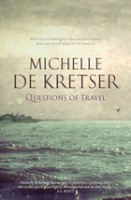
Michelle de Kretser’s Questions of Travel

Michelle de Kretser, Questions of Travel (Allen & Unwin 2012)

Questions of Travel Cover

A number of my friends gave up on this book, one as early as page 80.

At page 80, by contrast, I was on the edge of my seat. Things had moved slowly, true, as the novel traced the lives of its two protagonists in roughly alternating chapters bearing their names and the decade: ‘Laura, 1960s’, ‘Laura, 1970s’, ‘Ravi, 1970s’ and so on. By page 80 we’ve reached the 1990s. Laura Fraser, an Australian in her 30s, is travelling in Europe and her small inheritance is running out, so something has to give. And devastation surely looms for Ravi Mendis, a young Sinhalese man whose wife is a Tamil activist. It’s not exactly a thriller, and my interest hasn’t really been in plot developments. Nor have the characters grabbed my emotions. What is really keeping me in there is the unfailingly elegant writing, and the way subject of travel has been held up to the light like a multifaceted stone, reflecting endless variations.

The musical play on the theme of travel continues to be the book’s holding power: people travel through time, and markers of the passing decades – in clothes, public preoccupations, communication technology – are carefully noted; they travel in different modes – as tourists, refugees, travel-guide researchers; they walk, ride bikes, fly, catch buses; they travel with joy and ennui and hope of starting over; their motives for travelling are probed – a recurring question for Laura is, ‘What are you doing here?’, a question that resonates ever more broadly as the novel progresses.

I did come close to giving up a little past halfway: where nine full pages are given over to enumerating a days’s activities of someone working in a publishing company, including 52 emails. That, and an accumulation of observations of physical and social Sydney as seen through foreign eyes with no discernible progress of the stories just about did me in. But, you know, many narratives lose momentum just after the midpoint: in a rom com’s soppy montage after the characters have finally had sex, the extended recap in a police procedural, the conversation where the action hero spells out his tragic back story. So I was prepared to weather the doldrums, keep hoping for a breeze.

The breeze came. It’s a very impressive book that I can imagine being read a hundred years from now (if people still read) as a compelling portrait of an age when people travelled as never before, out of desperate need, from heedless self-indulgence, or as a nameless quest, a pilgrimage without a shrine. Especially in the first quarter, there are turns of phrase and observations that made me catch my breath. These were offset by some passages where minor characters are pilloried in what I suppose counts as satire, but comes across as snobbery. And even when terrible things happened to the main characters, the sense that they happen to fill a general schema gets in the way of a direct emotional response. Among all the images of travel, for example, images of flowers, especially flowers in a vase, are deployed brilliantly: and the brilliance has an unexpected effect of creating emotional distance at moments that should pack a huge wallop.

I’m deeply impressed by this book. I completely get why critics and judging panels have lauded it. But it’s already fading from my mind.

awwbadge_2014 Questions of Travel is the sixth and biggest book I’ve read as part of the 2014 Australian Women Writers Challenge.

The Book Group and Siri Hustvedt’s Blazing World

Siri Hustvedt, The Blazing World (Sceptre 2014)

144477963X

Before the meeting: I’d missed a number of book group meetings – travelling, and then other evening commitments had got in the way. Alice Munro, The Red Badge of Courage, some Hemingway, The Dinner by Herman Koch – all were discussed without me. I thought I was going to miss out on the Siri Hustvedt dinner as well until Friday, when I realised the evening was wide open. I dashed into Gleebooks on Saturday morning and bought a copy, not actually intending to read the whole thing – I had a lot on my plate and the group’s emails that been less than enticing: ‘I am only up to page 32 and struggling with it!’ ‘I think page 32 is a mammoth effort.’ I planned to read to page 40 or so, enough to have some hope of following the talk when we met.

It was not to be.

The book is presented as a collection of documents – journal entries, art reviews, interviews, transcripts of statements, scholarly essays – by and about a New York artist Harriet Burden, edited by a scholar named I V Hess, whose ponderous introduction accounts for the first 12 pages and no doubt led to the book’s lack of appeal in some quarters. But Harry, as she is known to her friends, transcends the ponderousness. Having been the wife of a successful art dealer, she embarks after his death on a new artistic trajectory. Her work and she herself have been largely ignored or discounted by the art scene, and she comes up with a project to present new works as the creations of a series of three male artists. She’s tackling gender issues with passion born of a lifetime’s struggle, and at the same time exploring questions about the role of the creator’s reputation in how a work of art is seen, and deeper philosophical and psychological issues of identity, creativity, intersubjectivity, perception. I was hooked.

Other pressing demands on my time fell by the wayside and I read the book in three days. I rationalised that it was relevant to the online writing course I’m doing: this was a chance to see if in spite of its fragmentary appearance the book had something like the classic three-act structure. And behold, it does have the nine plot points we have been learning to identify, pretty much where they are suppose to fall. As a result, at any point in the novel you can feel it moving in a clear direction: the scholarly citations, the dissertations on hoaxes (mainly gender based ones such as James Tiptree Jr, but Ern Malley is mentioned in passing), the intellectual arguments, the meta moments such as the reference to ‘an obscure novelist and essayist, Siri Hustvedt’, the detailed descriptions of artworks, the ruminations on art history, the quotes from Whitman, Milton and Emily Dickinson, are all borne on a current leading inexorably towards what we know from near the start is a conclusion with more than one dead body. Novels, of course, don’t have to be tied to the classic three-act structure as tightly as we’re told films do, but I was gobsmacked to see how closely this novel, apparently so all over the place, sticks to the shape. It’s hard to talk about without spoilers, but here – perhaps of interest only to me – are the 9 points (there are 380 pages in the novel):

  1. set-up: We meet all the characters, or at least learn their names; Harry is widowed and in upheaval; she dreams up the Maskings project
  2. inciting incident (10%): page 39–40, she chooses her first ‘mask’
  3. change of plans: page 41–58, three new, widely divergent perspectives are introduced
  4. significant setback (25%): page 117, Harry’s first ‘mask’ having told her he was damaged by the project, she tells her friend Rachel: ‘There’s something in me, Rachel, something I don’t understand. … It’s something horrible inside me.’
  5. midpoint – sometimes called the point of no return (50%): page 213, ‘We have made the pact’
  6. darkest hour (75%): page 301, ‘He said, You look dead, Harry. She said, I feel dead.’
  7. glimmer of hope: page 314 ‘And then I said the right thing for once.’
  8. climax (90%+): Depending on how you read it, the climax is either page 322–324, a description of an artwork (he said, tactfully avoiding any spoliation), or page 351–361, which I don’t know how to characterise without giving too much away
  9. resolution: the very last page, the description of another artwork.

As I drove to the meeting I was prepared to be alone in having been completely absorbed, completely satisfied by the book.

The meeting: There were six of us, of whom two had read the whole book and one other was intending to finish it. A key thing that made the difference seemed to be that the three finishers had an interest in some kind in the art world: thanks to the Art Student, I’ve picked up a smattering over the last few years so I knew of many of the women artists named in the text, and found something almost uncannily familiar some of Harry’s observations about being an older woman in a scene that privileges youth and masculinity; another finisher has recently been an art student at TAFE; and the third has some wonderful art on his walls and is generally interested in it. Without some kind of prior interest, the device of multiple narrators and the general sense of contrivance seem to have stopped people from engaging.

There’s not much more to be said about the discussion of the book: conversation ranged instead over Pesach (last night was the second night), walking out of the theatre, a risqué witticism that Governor Marie Bashir once made to one of our number, the excellent seafood pie we ate, the inequity of raising the pension age, the difference between our current way of taking in most information through seeing and earlier times when it was mainly through hearing. The book, wonderful though it is, was a bit of a fizzer, but the dinner was a great success.

PS added later: I forgot to mention that one of us had started reading the book on his Kindle and found it very frustrating. When he shifted to a hard copy it became a much more manageable and pleasant experience. The difficulty seemed to have something to do with the way footnotes are treated in the ebook. They work better on the page.