Tag Archives: Novel

Merde

Stephen Clarke, A Year in the Merde (2004, Black Swan Books 2005)

A year in the merde

My travelling companion read three of Stephen Clarke’s Merde books in quick succession between Paris Gare de Lyon and La Grande Motte on the Mediterranean. Not only did she laugh frequently, but she would read bits out prefaced with phrases such as, ‘Ah, this is what was going on the other day.’

We were in France at the start of September and the phrase la rentrée is everywhere. We’d gathered that it signified the equivalent of our Back to School, with added intensity gained from the fact that an awful lot of enterprises shut down for les vacances d’été and open their doors again at this time. But this book explained it from the point of view of someone working in Paris, and certainly enriched our grasp of its meaning – a time for resolutions and new beginnings, etc.

Then there was the mysterious siren we heard exactly at midday in a small village during our walk on the Loire. Completely mystifying until – in Merde actually – we learned that at midday on a certain day every month all the airraid sirens of France have a practice run and are completely ignored by everyone except ignorant tourists. (We can vouch for the ignoring bit.)

I was confirmed in my impression that one asks for un carafe d’eau rather than simply de l’eau at a café unless one wants to pay for mineral water.

Apart from these useful snippets of information, and interesting bits of language artfully disguised as comedy, the book is a well-executed romp. I don’t plan to read the others, but if you’re travelling to France you could do a lot worse by way of preparatory or companionable reading.

Landscape of Farewell

Alex Miller, Landscape of Farewell (Allen & Unwin 2007)

It pains me to say it, but the best thing about this book as far as I am concerned is that it’s short. I read it in a day.

In the first couple of pages, it seemed to hit wrong note after wrong note. Just two examples, tiny in themselves, but part of a cumulative effect that left me simply not believing in the characters: an elderly German professor, meditating on the notion of honour, remembers that somewhere in the bible, probably in the New Testament, we are told to honour our father and our mother; a young Australian History professor asks that same man what his father did in the war, and when he reacts with shock says it was just a piece of Australian humour. Just what planet do you have to be an academic on not to know the Ten Commandments, or that Germans of a certain age might not like to be asked by complete strangers about their family’s relationship to Nazism.

In spite of encountering some fine prose and being invited to confront difficult realities, I never recovered from the blow my trust received in those first pages. The book’s centrepiece is a powerful account of a meticulously planned massacre of white settlers in North Queensland by Aboriginal men in reprisal for the unwitting violation of a sacred site. Everything else seems to be there to justify this piece of writing. It didn’t work for this little white duck. I was left with an uneasy feeling that some kind of equivalence was being proposed between the Aboriginal action and unnamed actions taken by German operatives during the Second World War. I’m sorry, but my response, in a word, is ‘Ewww!’

My Book Group is to discuss this book at our next meeting. Since the meeting is on the evening of the day I get home from a month in France, I may not make it. If I do, I’ll let you know what other people thought.

Wolf Hall

Hilary Mantel, Wolf Hall (4th Estate 2009)

This is a truly engrossing historical novel – I hope it wins the Booker Prize.

Written in beautiful, slightly quirky and so captivating prose, it’s full of vividly realised scenes and characters to care about, of engrossing argument in which the stakes couldn’t be higher. For me the main pleasure was of historical revisionism. In taking Thomas Cromwell as its hero, it effectively challenges the version of the English Reformation – indeed of the Protestant Reformation as a whole – that I absorbed from the nuns and brothers and, I’m embarrassed to acknowledge, remained pretty much intact under the assault of an undergraduate course in Reformation History. I’m consoled somewhat by having the great Erasmus as an offstage character who pretty much shares my understanding, and by a sense, especially toward the end, that it’s Robert Bolt’s A Man for All Seasons rather than my young self that Hilary Mantel has in her sights. Thomas More – that’s Saint Thomas More to me – is portrayed here, among other things, a pitiless torturer and a misogynist a***hole. I suppose my younger self might have read this as Protestant propaganda. I hope I would have checked the evidence, and come to the conclusion that if it is propaganda, what it’s propagating is the view that rigid and intolerantly held religious views are an abomination, and that there is great virtue in devoting one’s self to making things go well.

I can’t read historical fiction these days without sensing Inga Clendinnen reading over my shoulder. I think she would approve of this.

Girl 2

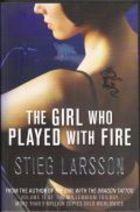
Stieg Larsson, The Girl Who Played with Fire (2006, English translation 2009)

541

I apologise for not listing the translator’s name – I left the book in the Paris Bercy train station so can’t check on such things. It was gripping enough, and I plan to read the third book in the trilogy; I did see the three books, in French, with much more appropriate covers than the English editions’, in a shop window in Lyon (yes, I read the book while travelling). The French title of this one translates as something like The girl who dreamed of a jar of petrol and a match.

I wish Stieg Larsson had lived to see his book through the editing process. I think they would have benefited — less repetition, perhaps, a less plodding pace. But even though I’m not as entranced by Lisbeth Salander as Stieg evidently was, this was a very good train and hotel read. A comedown after Anna Karenina, but then what wouldn’t have been?

My next blog post will be about walking in the Loire Valley.

The train has left the station

Leo Tolstoy, Anna Karenin (1873-1877, translated by Rosemary Edmonds 1957, 1978)

anna002 What with cleaning the house, travel, conference, broken computer and jet lag, this has taken me longer to read than it normally would have. It’s wonderful wonderful – funny, confronting, deeply instructive. At times I felt as if Tolstoy wrote the book to explain the society of his time to readers who wouldn’t be born for at least 70 years (the situation of women, the conditions of the peasants …). I knew in advance that this was a book about a woman who throws herself under a train, and expected it to have a bit of A Doll’s House about it. I didn’t expect it to have elements of P G Wodehouse twittiness at one extreme and almost Joycean internal monologue at another. And is there a bit of proto-Wittgenstein (‘Whereof one cannot speak, thereof one must remain silent’ ) in Levin’s decision to renounce argument in the last chapter? And how about those similes! (Just in case you’re reading this and haven’t read the book: maybe half a dozen times, at intense moments in the narrative, a character’s mental state is explained through a simile, and each time it’s just brilliant.)

Why didn’t anyone tell me? I may have to set aside time for War and Peace sooner than I’d planned. (I’ve been told I should have read it first, because it’s not as grim. Oh well …)

Les voies d’Anubis

Tim Powers, Les voies d’Anubis (J’ai Lu 1986; translated by Gérard Lebec from ‘l’americain’, original title The Anubis Gates)

2290020117When this turned up on BookMooch en français I decided to seize the chance to brush up my French at the same time as crossing an Apollo Award winner off my TBR list. The plan worked out excellent well. The novel is a fabulously over the top fantasy, like an extended episode of Doctor Who, only there’s no Doctor to help out when the quantum mechanical (or in fact magical) time travel to the England of Coleridge and Byron, and beyond, goes horribly wrong. Or it could be likened to a Cairo Jim adventure with an organisation very like the Old Relics Society and a time-travelling Eng Lit scholar cum pseudo-werewolf in place of Geoffrey McSkimming’s poet-archaeologist: it’s got Egyptian gods, animated statues, history mysteries, but sadly no animal companions. It’s a vastly inventive, rip-roaring picaresque adventure, with a lovely array of grotesque villains, some almost Shakespearean crossdressing, and much derring-do.

Reading it in translation reintroduced me to the childhood pleasures of incomplete comprehension, guessing meaning from the context, sometimes with a fair degree of confidence, occasionally looking a word up, every now and then having a word’s meaning emerge into clarity with repeated appearances, and even – once in a while – knowing what a word means without knowing the English for it (I had to look up embarcadère, for instance, to translate it as landing stage, but I knew what structure it referred to without benefit of dictionary).  I could just about feel my neurons reconfiguring.

The other pleasure came from pace: I was forced to read slowly, so slowly that by the time I’d finished the prologue and the first chapter, I felt as if I’d read a whole book, so in effect I got four or more books for the price of one. This effect was helped, of course, by the episodic structure.

I probably missed a lot, though I did laugh out loud more than once, which means I got at least some of the jokes, and that’s supposed to be the hardest thing when you’re reading in a language you’re not fluent in. In fact, there was at least one joke that might easily have been tailor-made for my situation: a character says at one point ‘Psaume en chemise sans cote de quarte?’ and I wracked my brains (‘Psalm in shirt on side of quad?’ Really?), only to be relieved five lines later when the character articulates carefully, ‘Sauté en mille six cent quatre-vingt-quatre’ (‘Jumped to 1684?’ which is simply reiterating incredulously what someone else has just said). [I just Looked Inside This Book at Amazon, and found that the original poorly articulated line was ‘Jutmoop sidskeen eftee door?’, gibberish which I don’t think would create the same puzzlement in someone who knew English as well as I know French.]

If this had been a ‘serious’ literary work and I’d enjoyed it this much, I’d probably feel that I ought now to read it in the original. While I now have Tim Powers on my list of authors to look out for, I’m happy with one reading of this, happy to recommend it as a constantly surprising and delighting romp either in French or in English.

Middle aged men talk about Anna K

anna002Last night my men’s group book group met to talk about Anna Karenina (Anna Karenin, as she’s called in the second hand copy I bought on Monday), and an excellent evening it was. We had Russian-themed food, largely bought from the venerable Cyril’s delicatessen, and unlike other books this one had us talking from the moment we arrived until suddenly, after a couple of hours, we moved on to fierce debate about what to read next.

Having been distracted by Other Things, I’d only managed to read a little more than 100 pages. But that didn’t stop me from joining in. In fact, as people talked about their favourite bits, I was able to remind them that almost all of those bits were foreshadowed in the early chapters. Another guy, who’d grown a Leninesque beard for the occasion, had read about half as much as I had (pushing out hairs on the chin clearly saps the reading power). Undeterred, he became a technical consultant for the evening, reading passages of exegesis or commentary from the essays up the back of the uni library copy someone had brought: why an adulterous woman in Russia at that time would lose her children, Tolstoy’s quasi-pointilliste method (not at all the mimesis it first seems – and we did have to chat a little about that word mimesis), the way Levin and Anna were two quite different ways of seeking, um, transcendence …

Sadly, if the way Anna dies hadn’t been the one thing I knew for sure about the book, it would certainly have been spoiled for me. No one bothered, in the manner of Mark Kermode discussing the latest Harry Potter, to refer to ‘the unhappy event’. I guess Anna’s suicide isn’t the big surprise that  Dumbledore’s death is.

What a wonderful book! As someone said, it’s a page-turner, yet it had us talking about spirituality, sexism, the industrial revolution, deep moral dilemmas, the uses of fiction, Tolstoy’s journey, the fascinating architecture of the book, excellent university moments from bygone days (two people remembered with awe Peter Shrubb‘s lecture on the first paragraph of Emma), the perils of translation (three translations in the room, three versions of the famous opening sentence) and much more. ‘I don’t read classics,’ one man said, ‘I don’t want to read stuff that someone thinks is good for me – but this was terrific.’ Now I’ve got a week to finish it.

Anathem, Heavy

Neal Stephenson, Anathem (Atlantic Books 2008)
14f4541I approached this book with enthusiasm (based on my love of everything by Neal Stephenson I’ve ever read) tempered with guilt (is it the best use of my time to read a 900 page science fiction novel?) and resentment (surely he could have told his story in fewer pages than that, and given us something not quite so heavy to lug around). Three hundred pages later, resentment was a dim memory, guilt had faded to irrelevance, and enthusiasm was transformed into something like exhilaration.

Imagine a cross between Harry Potter and The Name of the Rose, with a substantial dash of A Brief History of Time thrown in, and the faintest possible hint of The Da V*nci Code. A group of adolescent (that is, awfully earnest but also charmingly naughty) members of an religious order set out to solve a mystery, not of a murder but of an invasion from outer space, and uncover a secret conspiracy that’s thousands of years old – only it’s not a religious order exactly, but a vast enclosed community devoted to reason, debate and theoeticcal (theoric in the world of the novel); it’s oversimplifying to say that the invasion is from outer space, and the conspiracy … well, I’m not sure I quite grasped what was going on there, something you could never say about D*n Brown’s plots). There’s maths, there’s physics, there’s philosophy, all redolent of what we know on earth but twisted into new and strange shapes. There are space ninjas (sort of), time travel (sort of), 7000 years worth of back story, and more diverging alternative realities than you can poke a Diana Wynne Jones at. In fact, just when you think you’ve got the measure of this book, it does some kind of athletic sault (oh yes, it makes you want to do that sort of thing to language) and you’re casting about for a new measuring device. The sheer energy of Neal Stephenson’s mind is amazing. His erudition is matched only by his playfulness. His acknowledgements page more or less wrings its hands, says there’s not enough room, and refers the interested reader to 4700 words or so on the web. He can make a fifty-page conversation about the philosophical idea of multiple cosmi not just readable, but fun, though I confess that in that part of the book I was occasionally tempted to skip. But it’s hard to skip when the text is so thick with invention he coins the term Artificial Inanity to describe something that sounds very like spam, for example, and one of his ‘aliens’ says incomprehensibly alien things such as  ‘say zhoost’ to signify agreement or ‘monyafeek’ to express admiration. For those who enjoy an in joke, the marvellously long-lived Enoch Root, a character from earthbound novels Cryptonomicon and the Baroque Cycle, makes an appearance here – he has a different name, but there was no mistaking him.

I marked this passage at about the half way mark, just because I liked it. Interestingly, I think it comes close to articulating what the book, beneath all the prolixity, the explosions and the mind boggling theorics, is about:

Thousands of years ago, the work that people did had been broken down into jobs that were the same every day, in organisations where people were interchangeable parts. All of the story had been bled out of their lives. That was how it had to be; it was how you got a productive economy. But it would be easy to see a will behind this; not exactly an evil will, but a selfish will. The people who’d made the system thus were jealous, not of money and not of power but of story. If their employees came home at day’s end with interesting stories to tell, it meant that something had gone wrong: a blackout, a strike, a spree killing. The Powers That Be would not suffer others to be in stories of their own unless they were fake stories that had been made up to motivate them.

Notes from an Exhibition

Patrick Gale, Notes from an Exhibition (2007, Harper Perennial 2008)

Consensus at the Book Club was that this is excellent. Penny brought it home as part of her swag and urged me to read it. Since she also sounded as if the book made her yearn to become a Quaker, and went to the Glebe Library to borrow every Patrick Gale novel she could find to take away on our current holiday, I understood her to be strongly recommending the book. Resistance was useless. I agree – it’s a wonderful read.

Far too many novels, even very good ones, have me at least occasionally counting how many pages I am from the end. Not this one. It reminded me of the two-laughs-a-page rule that a comic novelist friend of mine swears by – any fewer than that you’re losing the reader, he says. Notes from an Exhibition isn’t a comic novel, but it manages at least two flashes of something a page. If the descriptions of Quaker practice and ethos don’t hold you, there’s the engrossing web of relationships of a family whose mother is diagnosied as bipolar. If that’s not enough, there are engrossing accounts of an abstract painter’s creative process. There’s a steady progress towards the heart of a mystery, and a sense from early on that we’ll get the detail of a family tragedy before the last page. The narrative shifts among at least half a dozen convincing points of view and back and forth in time, so that the story emerges with four-dimensional solidity. There are sharply visualised minor characters, some of them trailing hints of complex, heart-wrenching narratives of their own. I wish I’d got to the final chapter before my other Book Group’s evening on erotica, because it includes a lovely account of a teenage boy’s first sexual encounter: a straightforward narrative, with the emotional meanings front and centre.

As you can probably tell, I’ve joined the consensus.

Patrick Gale was on Radio National’s Book Show in February, and among other things it was heartening to hear him defend his main character against Ramona Koval’s charge of being a terrible mother.

My book club swag

Pam Brown, True Thoughts (Salt Publishing 2008)
Margo Lanagan, Tender Morsels (Allen & Unwin 2008)
Peter Steiner, Le Crime (Thomas Dunne Books 2003, 2008)

Apart from the conviviality, the food, the cards, the ever expanding list of draconian (and largely ignored) rules, what I love about our book club is that it makes me read things I might otherwise not have touched – books about secret rendition and Guantanamo Bay, someone else’s favourite detective novels, intimidating poetry.

One of the welcome consequences of my self-imposed task of blogging something about every book I read is that it pushes me to reflect on my reading.
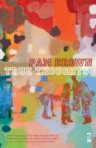
True thoughtsSo with Pam Brown’s True Thoughts I’m doubly blessed: without the book club I doubt I would have read it, but here it is with an affectionate inscription to one of the club members; without the blog my mind might not have lingered on it any longer than it took my initial bemusement to fade. But here I am, remembering that poetry usually requires the reader to do a little work, and knowing that I would be revealing myself as an unforgivably lazy reader if I just wrote something like, ‘I don’t get it,’ or even, ‘I don’t grasp how these pieces hang together to make poems — I can barely tell where one ends and the next begins.’ (By pure serendipity, after I’d written that para I heard a Poetry Off the Shelf podcast in which Matthew Zapruder talks about immersing himself in John Ashbury’s poems because they moved him somehow even though he didn’t understand them at all, so I’m clearly in good company, and I imagine Pam Brown would be happy to be discussed analogously to Ashbury.)

So, in spite of feeling that I needed someone to take me by the hand and explain how to read Pam Brown’s poems, I went back, took my time, ruminated, savoured, absorbed and, eventually, enjoyed. It was a fascinating process. At the start I was like a colour-blind person looking at one of those red-and-green patterns, then with sustained, though not strained, attention it was as if the colour-blindness healed and the formless array of dots and squiggles reorganised themselves before my eyes into elegant shapes. For example, ‘Peel me a zibibbo’ begins:

I could go [extra characters are spacers &  meant to be invisible]
oooooooin any direction
but it’s best that ooohere and now
ooI remain lesbian,
ooooo keep my vanishing cream
sealed.

On first reading, this seemed little more than verbal noise, a bit like the start of an Ern Malley poem. And in the middle of the poem, there’s this:

imperfection in kindness
ooooooocomes with the void,
oyou need to
ooooochoose
ithe ‘I’m feeling lucky’ google option.

To which I said, ‘Huh?’

I still don’t really get this second quote, but now that the green dots and the red dots have sorted themselves out, I do get that the first quote is meant to tease, and not meant to yield its meaning until the last line, where she addresses the poets and others whose names have cropped as the poem meanders with apparent aimlessness through a day in the life of the poet, and we realise they are all men:

Hi Kurt, ooooooo oooooooooohi John T,
oooo
hi Nick, oPaddy, oooohi Shakespeare,
ooooooo
opeel me a zibibbo
ooooooo
ooooooo ooooo would you,
ooooone of you guys?

(A zibibbo, as a note up the back tells us helpfully, is a delicious kind of grape.) The first lines suddenly yield their meaning. The busy-busy Lesbian poet, after making workaday contact with male poets and artists alive and dead, indulges for a moment in a fantasy that she’s some kind of Mae West femme fatale surrounded by male attendants. And I am amused.

tendermorselsTender Morsels an exception as book club books go: I would have read it with or without the BC’s agency. In fact, I’ve been wanting to read it since it came out nearly 12 months ago. I gave it as a Christmas present to one of our members, secure in the knowledge that it would come to the table at one of our meetings. When it did surface, I was a little taken aback when the person offering it, she to whom I’d given it for Christmas, said she’d stopped reading at about 40 pages because she didn’t want to go on reading a litany of suffering. And I confess that when it was my turn, I was close to giving up on page 40 myself. But I read on, and can report that on page 42 everything changes!

This is a wonderful book, and the gruelling first movement is absolutely essential. We need to know just how much the heroine suffers, so that we understand her need to escape, and when other characters (and possibly the back cover blurb as well) make assumptions about what she is avoiding, we know that they completely fail to grasp the strength of character that has enabled her to survive and function as well as she does. The fairy tale ‘Rose Red and Snow White’ plays through the story beautifully. The use of language is exhilarating. Though in one sense things are resolved by about the two thirds mark, there are unexpected twists and turns right to the very last page. Margo Lanagan walked across in front of my car when I was stopped at lights in the city recently. She looked like just another person on her way to an office job. I wondered how many of those others crossing the street were also total geniuses in disguise.

lecrime Le Crime‘s cover quotes compare Peter Steiner to John Le Carré, Len Deighton, Peter Mayle, Agatha Chsitie, Robert Ludlum, Alan Furst and Graham Greene. I have no idea how embarrassed the quoted reviewers are to see their phrases taken out of context like that. The book is not in the league of any of those writers. It creaks, its psychology is implausible, the plot is completely silly, and the structure barely holds up – but it’s a quick, enjoyable read. I liked it mainly for a flashback that lasts for three of the 26 chapters, in which the hero goes on a long walk through the French countryside, starting at Charles De Gaulle Airport and finally crossing the border into Spain (though we don’t go all the way with him). P and I have just booked in for a much shorter walk in France later this year, supported as befits our ageing selves, and these thirty-odd pages make it seem like a very good idea.

Ready for the next Book Club meeting now, I am.