Tag Archives: Paul Magee

Journal Catch-up 24

As I have mentioned before, I once had a substantial collection of Meanjins. I parted company with them in the course of moving house, probably forty years ago or so, and I haven’t kept up with Meanjin‘s changing identity since. In 2021 I toyed with the idea of resubscribing, but I may have been daunted by the sheer size of each issue. I have now bitten the bullet.


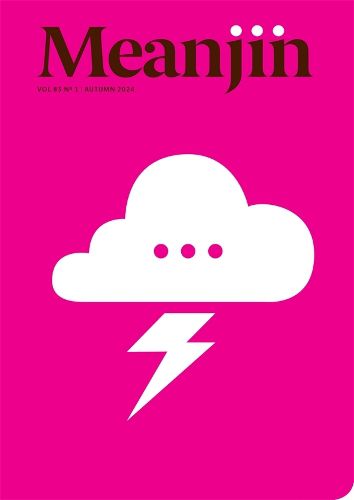
Esther Anatolitis (ediitor), Meanjin Vol 83 Nº 1 (Autumn 2024)
(links are to the Meanjin website: some but not all of them are available to non-subscribers)

This issue is a doozie!

It’s as engaged with current social and political issues as Overland. There are a number of essays on aspects of the Israeli invasion of Gaza, including Sarah M Saleh’s brilliant argument for the importance of Palestinian solidarity movements to the political wellbeing of Australia as a whole. There’s a concise summary article by father and daughter team Stephen Charles and Lucy Hamilton on the role of lies and disinformation in the Voice referendum. There’s a portrait by Jack Nicholls of eco-warrior CoCo Violet. There’s Amy Remeikis on the significance of the (first) Bruce Lehrmann rape case. And more.

It’s as culturally diverse as Heat in its heyday. Editor Esther Anatolitis (Σταθία Ανατολίτη) interviews Peter Polites. André Dao gives the 2023 State of the (Writing) Nation Oration. And more.

It’s as academically challenging as Southerly. See Dan Disney’s esoteric discussion of a Korean verse form and the fraughtness (impossibility?) of translating it, or imitating it, without subsuming it into the linguistic dominance of the English language; or Ianto Ware’s account of the challenges he fac ed in writing about his mother’s life and death.

First Nations writing has a strong presence. Among other things, ‘Ilkakelheme akngakelheme—resisting assimilation‘, a powerful essay by Theresa Penangke Alice, has pride of place before the contents page, and the new poetry editor is Wiradjuri woman Janine Leane.

I learned a lot – from Renata Grossi about the law concerning wills and what happens when they are contested; from Tom Doig about the long shadow of the 2014 Hazelwood disaster; from Marcus Westbury about the possibilities of something like a Universal Basic Income.

There are memoirs, including a brief snippet by Clare Wright, which starts out from an elaborate piece of costumery in the Powerhouse Museum and takes the reader to an unexpected ugly teenage encounter.

There are book reviews, and poetry. I was delighted to read, ‘Thread‘ a new poem by Eileen Chong. Two very different poems, ‘Oomarri—coming home‘ by Traudl Tan with Kwini Elder Ambrose Mungala Chalarimeri, and ‘Dreaming in Bourke‘ Paul Magee, talk to each other across the pages about the importance of country for First Nations people.

I picked up a couple of new words. My favourite is::

  • pipikism, a term coined by Philip Roth, who defined it as ‘the antitragic force that deconsequentalises everything – farcicalises everything, trivialises everything, superficialises everything’. Naomi Klein revisits the term in Doppelganger, her book reviewed in this Meanjin by Sam Elkin.

I’ll give the last word of this post to Peter Polities, whose words on page 77* in some ways speak to the journal as a whole:

I remember when I was in art school … this guy said to me: ‘I’m not political.’ And I was like: What did you say?!?’ I was just so shocked the first time I heard it, but then by the second time, I was so sarcastic: I said, ‘Yeah, what’s political about making goods for a luxury market?’ So this is what these kids wanted to be: to create work that you hang above a fucking couch for rich people. My interest in art is as a site for intervention, a site for politics, and culture is one of the most political things that we have.


I finished writing this blog post in stunningly beautiful Kuku Yalanji country, to the tune of parrots, curlews and the calls of other birds I don’t recognise.


* My blogging practice for some time has been to focus arbitrarily on the page of a book or journal that coincides with my age.

Journal Catch-up 18

I’m not across the detail of the Australian government’s National Cultural Policy – ‘Revive: a place for every story and a story for every place’ (here’s a link) – but I hope it means our literary journals are in a less desperately mendicant state. Certainly, I’m grateful that they continue to exist and even proliferate, even though my reading is limited. Just two on this blog post, both from last year, and both blogged with attention to page 76 as per my arbitrary blog policy.


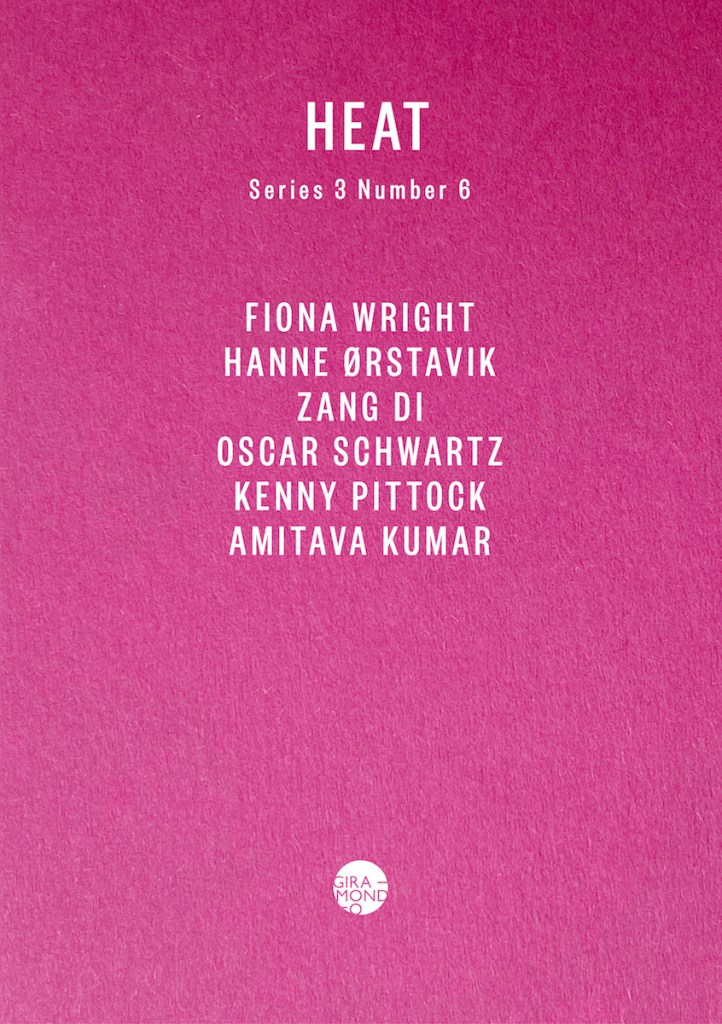
Alexandra Christie (editor), Heat Series 3 Nº 6 (Giramondo 2022)

There are two wonderful homegrown pieces in this Heat: Fiona Wright’s essay about ageing, ‘To Begin / It Broke’; and Oscar Schwartz’s ‘Father Figures’, a collection of ultra-short prose pieces written as the birth of his first child approached. You can read the latter on the Heat website at this link.

There are translations – four poems translated from Chinese and an essay from Norwegian – and six pages devoted to images of witty ceramic pieces by Kenny Pittock with the self-explanatory titlePost-It Notes Found While Working in a Supermarket’.

Page 76 is near the beginning of the longest and most ambitious piece, ‘Dear Editor’ by Amitava Kumar. Kumar was born in India and now lives in Poughkeepsie, New York. The story starts with a writer flying to Mumbai from New York composing an op-ed in his head about the plane’s broken toilets and the smell of shit. He keeps it up:

My ability to exaggerate does on occasion get the better of me but, believe me, I’m not being fanciful when I say that even the blue carpet in the aisles exuded a faecal odour – no, a heavier element, a moist miasma, that entered the nose and seemed to paralyse the senses. This preceding sentence was going into the op-ed.

My resistance was immediate and intense. Why is an Australian literary journal giving over more than a third of its pages to an Indian-born USian complaining about his country of origin? There are quite a few more sentences for the op-ed, but just as I was about to skip to the end of the story, the scene changes to a hotel in Mumbai where the daughter of an old friend is to be married.

It took a few pages, but the narrator has a fleeting sense of himself as an obnoxious expat and starts a conversation wth a fellow guest, an older woman. The imagined op-ed takes on a more serious tenor, and eventually disappears altogether as the narrator is absorbed by the woman’s story. I have no idea how much of this story is fiction, how much journalistic truth, but the ‘mix of arrogance and condescension’, as he later describes it, turns out to have been a slipway into an account of the coming of Hindu-style fascism to a small village. My resistance was completely dissolved, and I’ve added Amitava Kumar to the list of writers I wish had been invited to the Sydney Writers’ Festival in May.


Evelyn Araluen and Jonathan Dunk (editors), Overland 248 (Spring 2022)
(Some of the content – less than in the past – is online at the revamped Overland website, and I’ve included links)

Many of the articles in this Overland have a literary academic feel: Thomas Moran writes about M Barnard Eldershaw’s Tomorrow and Tomorrow and Tomorrow; Michael Griffith compares and contrasts T S Eliot and Catholic German sometime Nazi Party member Carl Schmitt; Abigail Fisher discusses Bella Li’s Theory of Colours. All three are in accessible English, but aim for a readership who is more specialist than usual for Overland articles and, I confess, more specialist than I am.

The poetry, on the other hand, is more accessible than usual. I especially like Isobel Prior’s ‘The Medical Man’, a narrative about a hospital tragedy somewhat in the manner of the late, great Bruce Dawe; and Paul Magee’s ‘Flag mask’, a reminder of what the Australian Parliament was like before May 2022.

Of the five short stories, two play masterfully and unsettlingly with the notion of consent: ‘Espalier‘ by Kerry Greer and ‘What it means to say yes‘ by Megan McGrath.

Page 76 falls in the middle of the other short story that spoke strongly to me, ‘In the garden‘ by Jayda Franks. A character introduced as ‘a young man’ visits another character referred to mainly as ‘the woman’ in an aged care facility. As they chat and play with dirt in the garden, we realise that they have a history but there is a reason beyond her dementia for her not remembering him. It’s a simple, poignant tale whose twist is an emotional twist of the knife rather than a surprise. Here’s a little from the dialogue in the garden to give you a sense of the way the narrative captures the way conversation with someone with demential can go, while suggesting that something else is going on:

‘I don’t remember you,’ she says. She is much more lucid now. Her eyes are sharp and clear and they fix on his own.
‘I know.’
‘I’m sorry.’
‘Please don’t be. I don’t blame you at all.’
She watches him crack his fingers and her brow furrows. ‘The counsellor here says we should ask visitors to tell us about themselves. Even if it doesn’t help us remember. Would you like to do that?’
He smiles sadly. ‘I am afraid I am a very different person to the one you remember.’
She turns to the spider lilies and he watches the conversation leach away from her. She beams at their slender petals and her whole face crinkles up like a young bud in bloom. When she looks back at him, she falters and his heart contracts.
‘Hello.’
‘Hello.’


I subscribe to two other journals, but they seem to be on hiatus. May they be revived by Revive before my next Journal Catch-up blog post.

Journal Blitz 9

I’m still way behind with my journal reading. Here’s a quick catch-up.


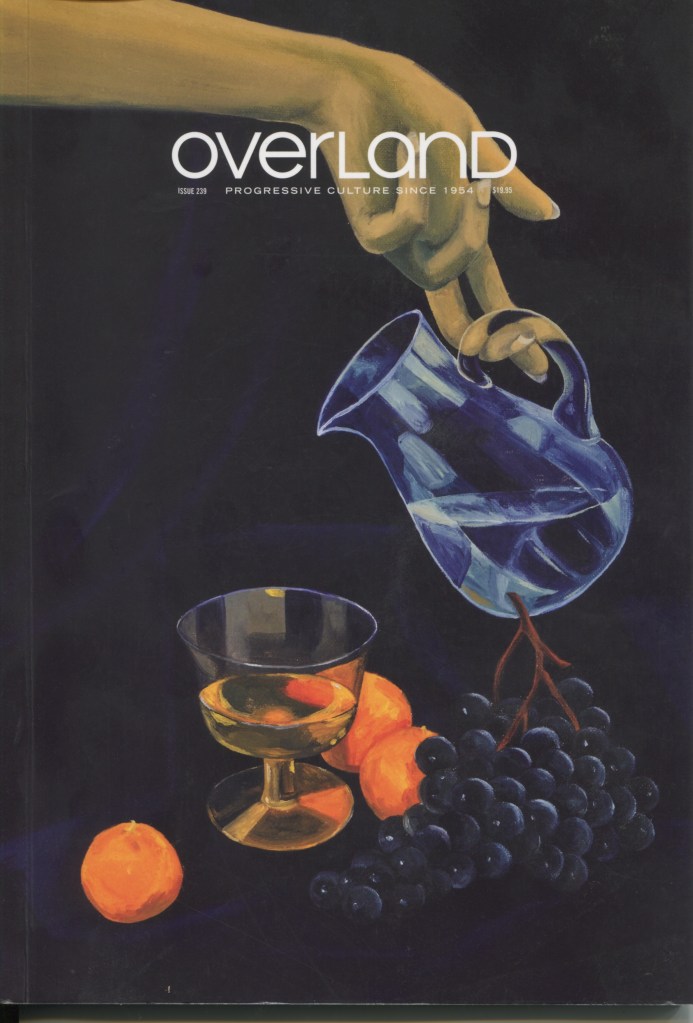
Evelyn Araluen and Jonathan Dunk (editors), Overland 239 (Winter 2020), with links to the articles at overland.org.au.

As with every issue, this Overland is full of reminders of things the mainstream media would prefer us to forget, and offers perspectives that are mostly unseen in those media.

Most strikingly, there’s ‘Ignorance is bliss?‘, an article by Sam Lieblich, psychiatrist and neuroscience researcher, on what he calls ‘ the mental health business’. His thesis is that psychiatry ‘pathologises the normal problems of human life, enforces highly constrained paradigms of thought and behaviour, and insufficiently values patients’ autonomy’. He goes on:

There is still, however, a lot of confusion about the status of the things that psychiatrists treat. These are by no means illnesses, and the medications doctors use to treat them are by no reasonable measure effective.

These are fighting words, and he backs them up with solid references scientific papers that go mostly unreported and remain uncontradicted in scientific circles. The pharmaceutical industry, preying on the desperation of patients and doctors, has ‘insinuated itself into the state and into academia so thoroughly that to find a research project or piece of regulation untouched by their money is almost impossible’. Even so-called mental health advocacy organisations such as Beyond Blue, he argues, ‘act as de facto pharma advertisers’. His discussion of the changing definition of Major Depressive Disorder in the Diagnostic and Statistical Manual of Mental Disorders (DSM) is an entirely convincing demolition job.

No doubt this essay, like the many books and article it cites and like, say, Gail Bell’s Quarterly Essay The Worried Well and Robert Whitaker’s Anatomy of an Epidemic (links are to my blog posts), will be dismissed out of hand, all evidence to the contrary, by the vested interests it challenges. But I hope it’s widely read. I do wish Sam Lieblich had allowed space for hope with more than a passing mention to ‘the emancipatory and compassionate potential within psychiatry’, but that’s probably another essay.

This Overland‘s theme is ‘Health’. There are other articles on mental health, including the misery caused by Australia’s offshore detention regime (‘Behrouz Boochani and the Penal Archipelago‘ by Dashiell Moore), and a manifesto-like piece on hospitals as places of oppression (‘On hospitals‘ by Vanamali Hermans).

Overland showcases new poetry, short fiction and visual art, all worth paying attention to. I’ll mention just one piece from each category.

Philip Neilsen’s poem ‘Cockatoo‘ tells a comic tale of cockatoos disrupting a football game that widens out beautifully. Who can resist a poem that includes this:

Horns are honking, people are shouting, the cockatoos are shouting
back, with an intensity that is winning the contest. 

Freya Cox’s short story ‘A murmur of resistance‘ evokes the moment of the Russian invasion of Czechoslovakia in 1968 as experienced by a mostly non-political young Czech woman.

May Day 2020: Organising in the Pandemic‘ is a spread by comics artist Sam Wallman, whose distinctive pieces have appeared in Overland regularly for some time. This one is a witty, concise account of the way ‘some of the more staunch segments of the union movement’ found ways to celebrate May Day under lockdown conditions in 2020 that is, and a pleasure to read.

Occasionally, there are signs that Overland‘s writers and editors want us to know they’ve been to university, and that loss of funding has meant cutting back on copy-editing. The editorial, for example, laments that under Covid ‘we forego almost all the habits of flourishing and eudaimonia’, managing a spelling error and a ten-dollar word in one short clause. But maybe you have to be a copy editor to care about such things, and the pain they cause is vastly outweighed by the good stuff that surrounds them.


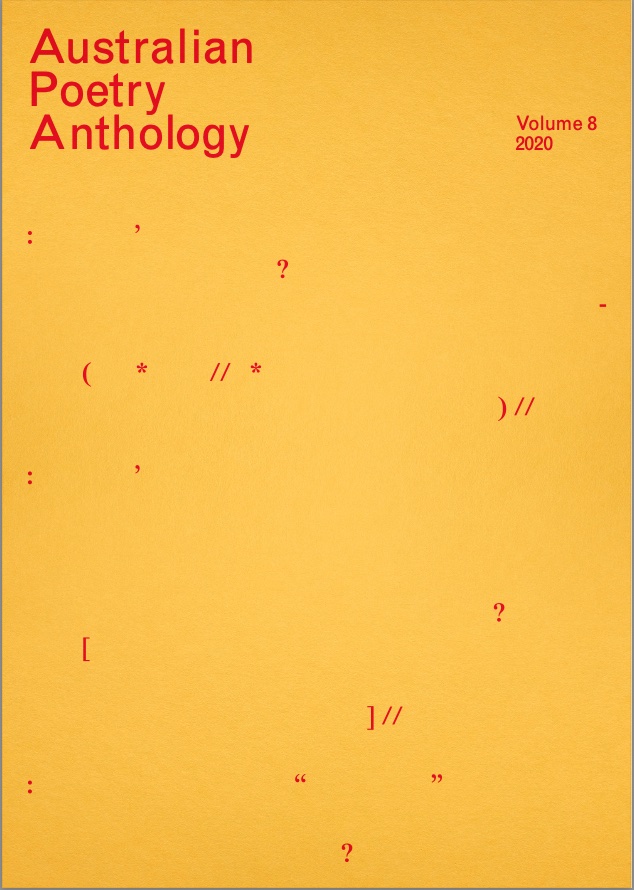
Sara Saleh and Melinda Smith (editors), Australian Poetry Anthology Volume 8 (2020)

Each year the Australian Poetry Anthology focuses on a different state or territory. Of the 120+ poets in the 2020 anthology, 23 are from the ACT. A more perceptive reader than I am might be able to distinguish locality-based differences in the poetry, but I couldn’t tell who comes from where without checking the biogs up the back of the journal.

Not that there’s any kind of dull uniformity here. The foreword puts it nicely:

Arguably our duty as artists is to bear witness to all of it – from the looming catastrophes of runaway climate change, epoch-making bushfires and a deadly global pandemic, to ever-present entrenched societal injustice, to the smaller griefs, puzzles, and epiphanies that enter every human life. If we ignore the big picture we become irrelevant, if we ignore the small things we ignore the beauty, complexity and mystery of what it is to exist; of what it is we stand to lose. It is in allowing us to play (and hear) many notes at once – to encompass contradictions without being destroyed by them – that the strength of poetry lies.

That range and variety is the strength of poetry, and it’s the strength of this anthology. There’s something here for everyone, and for a wide range of moods and concerns. I enjoyed the presence of many poets whose work I know and love, and many who are new to me. There are indeed poems about climate change and other aspects of ‘the big picture’. There are (of course) poems that didn’t speak to me at all; others that took the words right out of my mouth – or from wherever they were before they got to my mouth – and made them shine; and others still that came from a whole other paddock and made me laugh or, once or twice, cry.

I could list the poems that stirred me, but I’m pretty sure your list would be different from mine. I’ve marked about a third of them for rereading when I pick up this book again, and probably should have marked more. They range from Shastra Deo’s ‘Orichalcum’, which begins:

I don't know what will happen to my body
afterwards, but I want to return 
to the reservoir outside our hometown
where we caught catfish in the summer
my father close to kneeling
at my feet.

to Jennifer Compton’s ‘Late and Soon’, which deals with anxiety about climate change and ends:

Ha ha ha ha ha
____________________________________ha ha.

Regular readers of this blog know that I’m fascinated by translation, of which there are a couple of fine examples here. I want to say a bit about Paul Magee’s poem on page 61, whose title tells us everything we need to know: ‘Seneca, ‘Omnia tempus edax depascitur’ (‘Time eats everything up’)’. If you’re interested, you can see the original Seneca poem with a close translation at this link. Magee, who is one of the featured Canberrans, renders it like this:

Time eats everything up – it snatches it all 
from the root. Nothing's for long here.
Rivers lose heart. The beach is desert. 
Exiled, the sea. Tallest mountains fall. 
Why chatter? The giant sky’s beauty
will burn to a cinder again. Suddenly 
not as punishment but law everywhere 
death insists. And away with worlds.

Like Seamus Heaney’s 9/11 poem ‘Anything Can Happen‘, which is a translation of a poem by Horace, this speaks directly to the present moment – it summons up images of thousands of dead fish in the Darling/Barka last year, horrendous bushfires, and the dire warnings of climate scientists. The tone of Seneca’s original is a kind of stoic (or Stoic) resignation: ‘Everyone dies; everything come to an end sometime.; that’s just how it is.’ This translation has the same content, the same images; just two words that aren’t there in the original create a key difference: ‘again’ and ‘Suddenly’. We can no longer think of the sky on fire as a fanciful imagining of doom – it has already happened; we can no longer think of global destruction as something that will happen in the distant future – it’s happening now. The poem’s key thought that this is not punishment but a law of nature might in other contexts be somehow consoling, but here it’s chilling. I don’t read it as despairing, but as insistently grim: this is real, we’d better face it.

Someone said that one of the aims of poetry is to slow the reader down. Magee’s little poem does that. Sara Saleh and Melinda Smith have put together a collection that will slow its readers down, open us up, broaden us, deepen us, and I hope strengthen us.

Australian Poetry Journal, recent issues

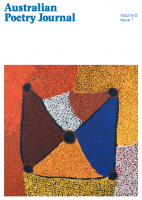
Michael Sharkey (editor),  Australian Poetry Journal, Volume 5, Issue 1 (2015)
Bronwyn Lea (editor),  Australian Poetry Journal, Volume 3, Issue 1 (2013)

apj51

Australian Poetry Journal is a twice yearly publication of Australian Poetry Ltd, which describes itself, surely with a wistful edge, as the peak industry body for poetry in Australia. You don’t have to be a poet to join APL (the poetry industry includes readers), and membership fees cover a subscription to the journal.

This issue is attractively democratic. Award winners with many books on their CVs rub shoulders with people who have had poems published in newspapers and journals. I wouldn’t dream of singling any poems out as ‘the best’ but I do need to give you a taste of some. This is from Judith Beveridge’s ‘Clouds’:

Let blue skies stop their rhetorical grandstanding.
We know they’re filled with the breath of men cocked
and fettled by greed. One by one I call the clouds in.
A cloud for each child hungry, ragged, naked. A cloud

for all exiles whose voices can’t find a single raindrop,
whose eyes are stones that out-weather the past.
A cloud for those in war-ravaged places where shadows
terrorise doorways, and the old live between rubble
and crumbled bread.

Jeff Rich’s ‘Not getting things done’ deals with those to-do lists where some items just got moved from list to list, or projects dreamed of but never begun. The final lines bring it all home beautifully:

Whole careers, projects without plans.
Journeys of recovery and feats of weakness

Pile like chaos in the attic
Awaiting defeat

By distraction and habit and boredom and chance
Four deadly horsemen more real than the rest.

Fay Zwicky’s ‘Boat Song’ responds to the callous feral poetry of a Tony Abbott slogan with child-like rhyming that is anything but infantile. I’ll resist the pull to quote the whole thing:

Remote ideologies send bonnie boats
Like broken-winged birds to our merciful votes.

And we turned them away, yes we turned them away
As we went out to play
In our dead-hearted country, the bounteous place
Where neighbourly love puts a smile on each face.

Apart from the poetry, there are interviews – Paul Magee interviews Samuel Wagan Watson and Josh Mei-Ling Dubrau interviews Julie Chevalier; a personal introduction to Greek poet Tasos Leivaditis by his translator N N Trakakis; a review by Tim Thorne of eleven titles from Ginninderra Press – which expresses gratitude for the publisher’s ‘let a hundred flowers bloom’ policy while being unsparing of the blooms that aren’t up to scratch; a history of another small publisher of poetry, Black Pepper Press, by Margaret Bradstock, who paints a fascinating picture of the critical reception of a number of their books; and three review articles that I found illuminating, especially Bonny Cassidy on Spatial Relations, a two-volume collection of John Kinsella’s prose.

Bonny Cassidy begins her review, ‘It must be said, straight up, that this two-volume publication … is unlikely to attract the recreational reader.’ (And she might have finished it by saying that a smaller, more selective publication may yet bring Kinsella’s prose to a wide and appreciative readership.) I could have said, straight, up that while Australian Poetry Journal might not attract too many recreational readers, any who wander into its pages are likely to be pleasantly surprised.

1apj31Having been pleasantly surprised by Volume 5 No 1, I realised Volume 3 No 1 had been wallflowering on my bookshelf for a year. It turns out to be another treasure trove. I’ll just mention two very funny poems by Anthony Lawrence –  ‘The Pelican’, in which the eponymous bird snatches a Jack Russell puppy, flies off with it

clearly visible through the lit
_____transparent pouch beneath its beak

and swallows it in full view of a horrified human crowd, and ‘Lepidoptera’, in which a gift of butterflies to the speaker’s sister meets with a dreadful fate, with an implied analogy to the frequent fate of poems.

There’s  a section on the poetry of the late Philip Hodgins – an introduction by Anthony Lawrence and then a selection of poems, mostly in some way to do with farming life, and death. A section titled ‘Criticism’ includes, among others, David McCooey on Jennifer Maiden; Martin Duwell – always worth reading – on a book about postwar US poetry; and an essay by Stuart Cooke about stray animals in Central and South America, which I enjoyed but whose title suggests I missed the point: ‘A Poetics of Strays’.