Tag Archives: poetry

Ken Bolton’s Metropole

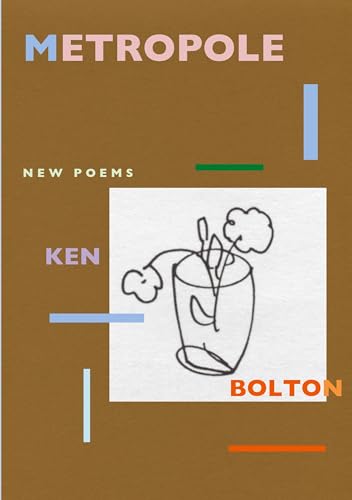
Ken Bolton, Metropole: New Poems (Puncher & Wattmann 2024 )

I’m more than a bit in love with Ken Bolton’s poetry, but I was at a loss what to write about Metropole without in effect repeating what I’d said about his three previous books that I’ve read (you can see those blog posts here, here and here).

Then I saw a headline on the Overland website: ‘The trouble Ken Bolton’s poems make for me, specifically, at the moment’ by Linda Marie Walker. Ah, I thought, someone who hates his poetry! Maybe they’ll point out ingrained misogyny or other cancellable qualities. Someone I can get into an argument with!

No such luck. The article is a very funny account of how Linda Marie Walker has enjoyed three of Bolton’s poems – where the word ‘enjoyed’ has complex meanings. All three poems she discusses appear in Metropole. Her ‘trouble’ with Bolton is partly summed up in this sentence:

These poems are, for me only, perhaps, enormous art museums with small and hopeful labels beside the works, just tempting enough to turn me into a rabbit sitting beside a trap at the mouth of the burrow/hole.

It’s not only you, Linda Marie.

So, rather than someone to fight with, I found someone who can describe the pleasures of these poems infinitely more satisfyingly than I can.

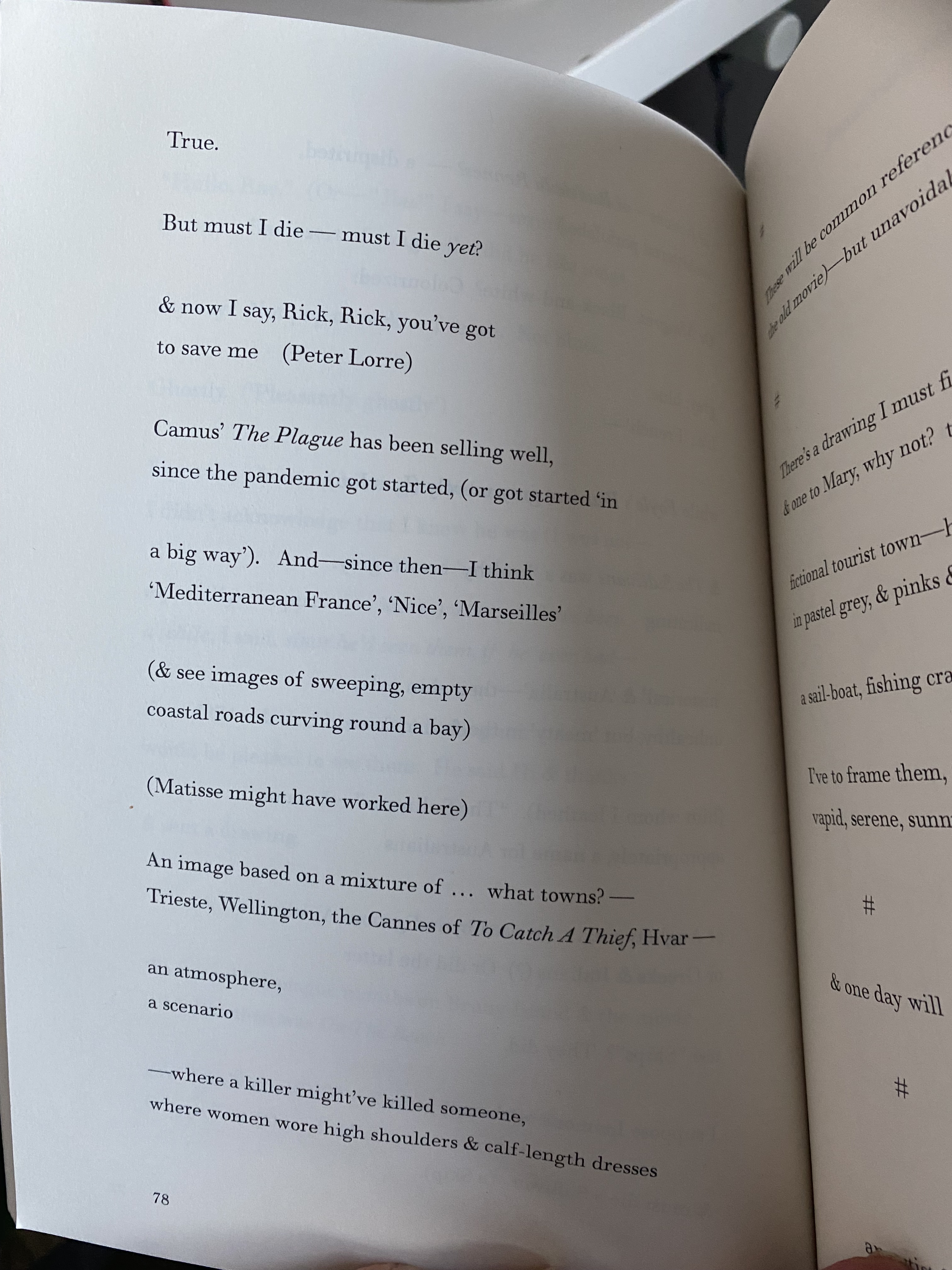
So I’ll stick with page 78*, which is the 12th of 14 pages of the poem ‘A Misty Day in Late July, 2020’, and has its own small and hopeful labels. It’s a Covid poem – specifically, according to one of Bolton’s delightful endnotes, Covid ‘as experienced by Adelaide: a “phoney war” situation as the city at the time remained relatively disease-free’.

The first lines of this page will seem melodramatic when presented without what has gone before:

True.

But must I die – must I die yet?

You could read the preceding pages as designed to blunt the force of that question. They have circled the subject of the Covid pandemic – describing family activities and a richly metaphorical fog on Bruny Island, quoting an ‘unflappable’ writer in the London Review of Books, remembering friends who have died long ago, and referring to movies and TV shows of tangential relevance. Somehow the poem arrives at the 1970s WWII TV series The Sullivans, and Bolton/the speaker remembers that ‘the Sullivans’

_____________________ _______________ became
appropriately, a name for Australians

or Anglo types ... as used by Indigenous Aussies ...
or Greeks & Italians

He supposes he is ‘one of them’ and says he ‘must die a Sullivan’. Almost by accident, it seems, he has explicitly acknowledged the prospect of his own death – and the stark threat from Covid is momentarily present.

True.

But must I die – must I die yet?

The rest of the page is a lovely example of the way Bolton’s poetry fizzes with allusion. (I’m reminded of a favourite line from Martin Johnston: ‘Even my compassion reeks of libraries.’) First, in recoiling from the thought that Covid might kill him, expresses the recoil by quoting from an old movie:

& now I say, Rick, Rick, you’ve got
to save me (Peter Lorre)

That’s from Casablanca, which has been mentioned earlier in the poem because of the fog. I went down that little rabbit hole to watch the scene on YouTube. The actual line is, ‘You must help me, Rick. (Then, as he is being dragged away) Rick! Rick!’ This is not an academic exercise where the quote needs to be exact – the line is quoted as it sits in the poet’s memory.

It turns out that the quote is a bridge back to safe ground. Mention one classic story, and the mind can go to another, and at the comfortable remove provided by sales figures. He also finds reassurance by putting ‘in a big way’ in minimising quote marks:

Camus' The Plague has been selling well, 
since the pandemic got started, (or got started 'in

a big way').

And then he’s away, play on associations with the foggy scene outside.

a big way'). And – since then – I think
'Mediterranean France', 'Nice', 'Marseilles'

(& see images of sweeping, empty
coastal roads curving round a bay)

(Matisse might have worked here)

An image based on a mixture of ... what towns? –
Trieste, Wellington, the Cannes of To Catch a Thief, Hvar –

Bolton is well-travelled. I haven’t been to Trieste, hadn’t heard of Hvar, and have to do a bit of mental calisthenics to see what Wellington and the Cannes of To Catch a Thief have in common – I guess it’s the coastal roads and steep hillsides. A reader could get hung up on not knowing the town referred to, or wondering about Matisse landscapes (and I did just google “Matisse landscapes”). The effect, though, is to find distraction / refuge / escape (?) – the poem’s speaker has travelled in his mind to faraway places, to works of art.

In the last lines on the page, he progresses in his escapist reverie from an image, to an atmosphere, to a scenario. In the final couplet, death again shoulders its way into the picture, to be turned away from in a whiplash switch to images from the old movies:

– where a killer might've killed someone, 
where women wore high shoulders & calf-length dresses

When I read the poem for the first time, I confess I just went with the flow, enjoying the back and forth of image and allusion, picturing Audrey Hepburn and Cary Grant in their convertible on the Corniche. Only reading it now with hands on the keyboard, I can go some way to articulating what’s happening. The final lines of this poem, two pages further on, make new sense to me:

The West has invented
some great glass-bead games

& I have been a sucker for all of them

Hermann Hesse’s The Glass Bead Game is another classic work I haven’t read. According to Wikipedia, the game ‘is essentially an abstract synthesis of all arts and sciences’ which ‘proceeds by players making deep connections between seemingly unrelated topics’. Not a bad description of what happens in Bolton’s poetry in general, and this one in particular. But Bolton doesn’t present himself as a polymath champion of the game. Polymath he may be, but that just makes him a sucker.

This is poetry that cries out for a collaborative reading. Or maybe it’s me that’s crying out – not ‘you’ve got / to save me’ but ‘come and enjoy this with me!’


I wrote this blog post in Gadigal Wangal country, as the days are starting to get longer, and the banksia are in flower. I acknowledge Elders past, present and emerging for their millennial long, and continuing custodianship of this land.


My blogging practice, especially with books of poetry, is to focus on the page that coincides with my age, currently 78.
Richard Tipping’s Instant History

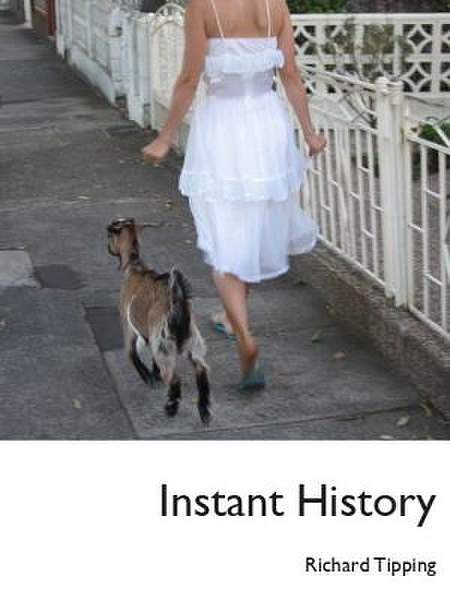
Richard Tipping, Instant History (Flying Island Poets, 2017)

As a subscriber to Flying Island Poets, I receive a bundle of ten books at the start of each year. The pocket-sized books belie their miniature appearance by being substantial poetry collections. Taken as a bundle they are wonderfully various – poets being published for the first time and poets with established reputations, embittered old poets and bright-eyed young ones, Chinese poets and poets from rural Australia (Flying Island’s co-publishers are Cerberus Press in Markwell via Bulahdealh and ASM in Macao).

I was delighted to find Instant History in my bundle this year. Richard Tipping is a multi-disciplinary creator whose work I have been encountering and enjoying for more than 50 years.

Probably my first encounter was the poem ‘Mangoes Are Not Cigarettes’ performed as a duet with Vicki Viidikas in the Great Hall at Sydney University in the early 1970s, then reprised immediately as ‘Oysters Are Not Cigarettes’. (That poem lives on – I just found the text, with photos, on Michael Griffith’s blog at this link.)

Tipping’s ‘signed signs’ appear regularly at Sydney’s Sculpture by the Sea. Photos of a couple of them have featured in recent issues of Overland: in issue 255 two chunky rocks near the shoreline bear gold leaf lettering, ‘SEA THREW’; in issue 256 a road sign reads, ‘FORM 1 PLANET‘.

Tipping’s Wikipedia page lists poetry, art, spoken word, documentary films, an art gallery, and more. Yet he doesn’t look at all exhausted in his cover photo.

Instant History bristles with quotable lines. Rather than focusing on just page 78*, here goes with a brief description of each of its four parts and a couple of lines from each.

‘The Postcard Life’ comprises 33 mostly short, impressionistic poems that are like, well, postcards from travel destinations from New York City to the Malacca Strait. My favourite in this section is ‘Snap’, a collection of short poems that are either haiku-like or snapshot-like, depending on your point of view, that capture a visit to Japan, individually and cumulatively wonderful. For example:

Bullet train to Kyoto
speeding by still river, reflecting rain
Chain-smoking chimneys
Greyroofed villages, rice fields, cement

‘Rush Hour in the Poetry Library’, for me the most memorable section, has 28 poems that are mainly about art and works of art. I particularly like ‘On Film (for Steve Collins, editor)’, which reads to me as a poem gleaned from conversations with its dedicatee. It begins with this resonant paradox:

Film is painting in light with time 
for the ears' extra pleasure
even if the pictures are better on radio

‘Earth Heart’ has just nine poems, and includes images of his typographic visual poem ‘Hear the Art (Earth Heart)’ – if you write either of those phrases out a couple of times without word spaces, you have the poem, a wordplay that absolutely sings. Its appearance in this book is one of many manifestations. For a land art version in the grounds of the Lake Macquarie City Art Gallery, you can go to Richard Tipping’s website.

‘Kind of Yeah’, the final section, feels mostly like a bit of fun with the vernacular, nowhere more so than in ‘Word of Mouth’ which includes this:

It was hair-raising, pulling your leg,
turning the other cheek; quick as a wink
you got me by the short and curlies
just as I'd finally got my arse into gear.

That’s just a taste. There’s politics, Buddhism, whimsy, and always a sense of performance, in the best senses of the word.


I wrote this blog post on land of Gadigal and Wangal of the Eora Nation, and finished it in a brief pause from heavy rain. I acknowledge the Elders past and present of this country, never ceded, and welcome any First Nations readers.


My blogging practice, honoured in the breach here, is to focus on the page of a book that coincides with my age, currently 78.

Pádraig Ó Tuama’s 44 Poems

Pádraig Ó Tuama, 44 Poems on Being with Each Other: A Poetry Unbound Collection (Cannongate Books 2025)

Books are risky gifts. I’m very glad the friend who gave me this one took the plunge.

It’s a collection of 44 poems, with commentary. I stumbled across an online review that said something like, ‘The poems are excellent, but I could have done without the commentary. It would probably be helpful for people who are learning how to read poetry.’

With all due respect, that person needs to have another look. It’s true, all 44 poems in this anthology are excellent, but the commentary isn’t there to help the ignorant (though it might do that): Pádraig Ó Tuama is a warm, charming, reader companion. Rather than assuming his readers are incompetent, needing to be instructed in the art of reading, he tells us how he reads poems himself – bringing to them his own history, knowledge and concerns, and by implication inviting his readers to do likewise. In a time when so much writing about poetry comes from the more esoteric corners of academia, his is fresh, conversational, smart, humble and completely engaging.

The anthology is an offshoot of the podcast, Poetry Unbound, and follows its format. First there’s a single page, printed white on black, in which Ó Tuama sets up a context with a personal anecdote or a reflection on life or literature. Then there’s the poem, followed by several pages of discussion. Ó Tuama finishes each podcast with a second reading of the poem, which readers of the book are of course free to do. I love the podcast, and I love the book.

Ó Tuama isn’t out to create a canon of ‘best’ poems. He may have what Trumpians would call an undeclared DEI agenda. Most of his poets are from non-mainstream groups of one kind or another: LGBTQI+, Native Americans, African heritage and other People of Colour, people with disabilities. A couple of poems are translated from other languages. But it’s far from being an exercise in box-ticking inclusiveness. There’s a clue in the book’s title – these poems are gathered from a wonderfully diverse range of poets, and together they create a sense of what it is to be together on this planet.

If I were to stick to my practice of writing about page 78*, I’d now look at the discussion of the shortest poem in the book, written by its most mainstream poet – ‘The Uses of Sorrow’ by Mary Oliver. But instead, I want to go to pages 310 to 315. The poem is ‘The Change Room’ by Andy Jackson. It’s the book’s only Australian poem, but my reason for focusing on it is that I already know it well, and have discussed it in this blog. Here’s a link where you can read the poem and, if you want, my discussion of it. (For those who don’t click: the poem consists of seven three-line stanzas and a two-liner. The poem’s speaker has three encounters at a swimming pool: a young child asks about his physical shape, a woman admires his tattoos, and a man chats with him in the shower after his swim.)

Ó Tuama’s introductory page, just 11 lines, tells us how the poem is personal to him. ‘Where do you carry shame in your body?’ he begins. And he ends:

The story of my body’s relationship to my own body – and the bodies of others – is a poem that’s asking for my attention.

You wouldn’t know from this that ‘The Change Room’ deals with disability or marked physical difference. Ó Tuama approaches it, as he does all the poems, from the standpoint of a shared humanity – a ‘being together’.

After rereading his discussion just now, I had another look at my blog post (here’s the link again), and I like the conversation we’re having.

We both discuss the rich ambiguity of the title of the book the poem comes from, Human Looking. Ó Tuama adds a reference to the tagline of Andy Jackson’s website, which includes the phrase ‘a body shaped like a question mark’, and relates that to the children’s questions in the poem. He pays close attention to the language:

In ‘The Change Room’ we read of nostrils, skin, tattoos, gaits, swimming, floating, showering, nakedness, proximity, speaking: all parts, functions and experiences of the body, all vehicles for body language, all ways in which the body is in conversation with itself and others.

Both of us puzzled over the poem’s last line, ‘Speaking, our bodies become solid.’ On rereading my blog post I quite like what I wrote about it, even if my reference to the Latin Mass may be a bit idiosyncratic. Here’s what Ó Tuama writes, to give you a taste of his prose:

‘Bodies’ here are held in a plural pronoun ‘our’. Why have they become solid? Were they not before? Were they fluid, or see-through, or gaseous? Perhaps solid is meant as the antonym for unreliable. The final stanza is composed only of two lines, in comparison with the seven tercets that preceded it. The missing third line of the last invites, perhaps, buoyancy, nature, exchange, consideration among all the bodies in, and reading a poem about, ‘The change room’. The poem asserts a shameless body-knowledge it establishes for itself.

I love the way he draws our attention to the precision of the language, and then the way, like Andy Jackson’s missing last line, he opens out to possibilities, rather than closing down on a particular reading.

I recommend this book, for yourself or as a gift to someone who likes a bit of poetry – for the poems, and for the companionship of the editor.


I wrote this blog post on land of Gadigal and Wangal of the Eora Nation, under an almost cloudless sky and feeling the chill from a mildly bitter wind. I acknowledge the Elders past and present of this country, never ceded.


My blogging practice is focus arbitrarily on the page of a book that coincides with my age, currently page 78.


Dombóvár, the anthology

Hunter Writers’Centre, Dombóvár: Newcastle Poetry Prize Anthology 2024 (Hunter Writers’ Centre 2024)

On its web page, the Newcastle Poetry Prize describes itself as the most prestigious poetry competition in Australia. Few people would disagree.

The Hunter Writers’ Centre has coordinated the prize since 2002, and it publishes an anthology every year that includes the prize winning poem, the runners up, a number of subsidiary prize winners and a selection of other submissions.

As the 2024 judges Caitlin Maling and Peter Boyle, each with their own impressive list of prizes, point out, a distinctive feature of the prize is that poems up to 200 lines are accepted. And most of the poems in this anthology are of substantial length – the shortest is 27 lines. The anthology is a rare opportunity to read a selection of longer poems from a wide range of Australian poets.

As my regular readers know, I read quite a lot of poetry, if not enough to call myself a critic. I was happy to read poems here by people whose work I respond to:

  • Mark Tredinnick, whose ‘A Godwit Sonnet Cycle’ won the Hunter Writers’ Centre Member Award
  • B. R. Dionysius, whose three-line stanzas in ‘Fishbone Ferns’ give us scenes from life on the Darling Downs – ‘it can be quite WW1 out on the downs, bodies / hung up on barbed wire, left to rot as a sign to / others – don’t try it, don’t cross into no man’s.’
  • Brendan Ryan, with another of his wonderful cow poems, ‘The snaking accuracy of cow trails’
  • Kathryn Lomer, with ‘Hyaenia song’, a narrative poem set in Ethiopia.

And there’s the immediate reason that I bought a copy, Christopher (Kit) Kelen’s ‘Dombóvár’, which won the prize and gave its name to the anthology. I don’t envy the judges their task, but they’ve chosen well with ‘Dombóvár’, which evokes the small Hungarian town that Kit Kelen’s family come from (at least that’s how I read the poem).

I can’t do better than quote the judges (a PDF of their report is available at this link, and is worth reading in full):

‘Dombóvár’ skilfully integrates thoughtful reflection on important issues, humour, inventiveness and an engaging partly colloquial tone. This evocation of small town rural Hungary carries echoes of the moral ambiguities and violence of settler societies like Australia. Throughout the poem there is the suggestion of a larger, potentially national, narrative, but the reader is left to work through the weave themselves … With great skill the poem breaks standard idioms and expected word choices to produce a clipped, very tight effect that intensifies the reader’s experience. ‘Dombóvár’ uses the form of a poem sequence to powerful effect, shaping a masterful poem that can be read on multiple levels.

this is the land of forgive ourselves
for all we've done, will do

There’s lots more in the anthology. To be true to my page 78* practice, I’ll mention ‘The Keeper of the Field’ by Mal McKimmie (pages 74–80). It’s one of several sonnet sequences in the anthology, and a quick web search informs me that it’s far from being the only one written by Mal McKimmie.

The sequence is prefaced by a quote from the Bhagavad Gita, and I’m guessing that the ideas it explores are related to Hinduism: the field is (crudely speaking) the mind, and it is populated by sheep (ideas? poems?). The sonnets circle around the notion of an empty field – mind empty of thought, perhaps. In the two sonnets on page 78, the sequence moves forward to the notion that all fields (all minds?) are connected – we are not the isolated individuals that we think we are in the West. That might sound abstract and difficult, but the poems are remarkably lucid. Here, ripped from its context, is one of the two on page 78 to give you a taste:

Did I say this field has a fence? Well, it 
doesn't anymore. It seems the fence came
down, was taken down, or disappeared
with the sheep, as if they were interdependent
(I faintly recall a lyric passing
through here, singing something along these lines).
Given the absence of a fence, where is
the distinction between this field and another?
Do I tend a disappearing border?

Leaves of grass, field to field, lean in sympathy,
mirror each other; flowers too; even
weeds copy their kin; creepers creep towards
each other; and roots, well, roots have always known:
nothing is alone, nothing under the sun.

if the poem is exploring ideas from Hinduism, it manages to remind us that the quintessential North American poet Walt Whitman was in similar territory – his poem ‘Song of Myself’ includes lines like ‘For every atom belonging to me as good belongs to you.’ And recent science about tree roots supplies the poem with a beautiful metaphor for interconnectedness.

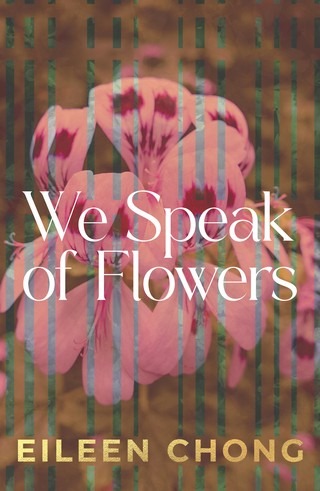
Eileen Chong’s We Speak of Flowers

Eileen Chong, We Speak of Flowers (UQP 2025)

The author’s note at the start of this book begins:

We Speak of Flowers is a book-length poem in 101 fragments that can be read in any order. Each reading will construct the poem anew, and the shifting juxtapositions will give rise to innumerable permutations of the poem.

Considered as a book-length poem, the book is an elegy for the poet’s beloved grandmother. It also deals with other losses, especially those that come with being a member of the Chinese diaspora (and within that, of Hakka, Hokkien and Peranakan heritage). The dedication reads, ‘A poem for my ancestors’. But this isn’t a book with tunnel vision: there are Covid poems, childhood recollections, observations of life in Sydney, travels, meditations on artworks, and – as you expect if you’ve read any of Eileen Chong’s previous five collections – plenty of food. Images from Buddhist funerary rituals recur, and the clicking of mah jong tiles is heard more than once.

The author’s note goes on to explain that in Buddhist belief, the soul of a person who has died is reborn after 100 days, so the hundredth day ‘marks the end of the formal process of grieving the dead’. The 101st poem/fragment marks the moment of the soul’s reincarnation. The end is also a beginning. The invitation to read in any order implies that the grieving can begin and end with any one of the 101 fragments. Contrary to popular oversimplifications of Elisabeth Kübler-Ross‘s thinking, grieving is not a linear process. At the Gleebooks launch earlier this year, Eileen described the book as a choose-your-own-grief-adventure.

This sets up us for a tremendously complex – and engrossing – reading experience. I’ll limit this blog post to beginnings and endings.

In the book’s order, Fragment 1 consists of just two lines spaced widely apart on the page: ‘a singular, cracked voice // words matter, can still rise –’. In context this is the moment when a person caught in the intensity of immediate bereavement realises that they can still speak/write, and so the process of grieving can begin. It’s a perfect place for the larger poem to start. Fragment 101 begins, ‘And what did you leave me / in the end?’ I won’t quote the rest of it, just say that it brings the sequence to a perfect, heartbreaking end.

Though I found Eileen’s order very satisfying, I obediently ran the numbers 1 to 101 through a randomising program, and followed the resulting order for my second and subsequent readings.

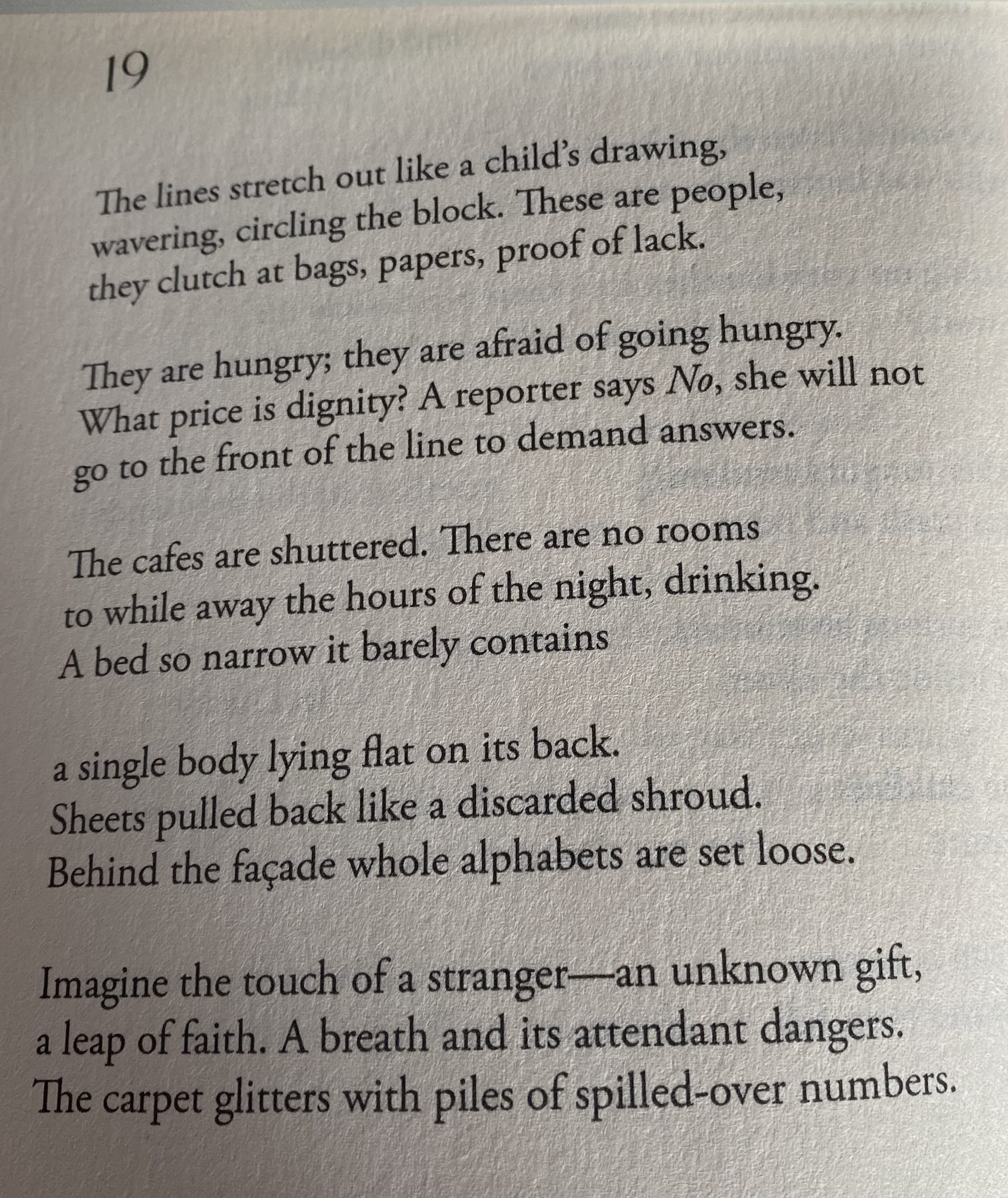
In this order, the larger poem begins with Fragment 19:

The poem consists of five three-line stanzas (triplets), a form this poet uses often. And as in many of her poems, there are some brilliant line breaks. One of several Covid poems, it captures a moment in our shared history. Beginning with a striking image of queues – for Centrelink, perhaps, or at a testing station – it goes on to evoke the loneliness, underlying dread and obsession with statistics that characterised lockdown days for many of us. I love this:

Imagine the touch of a stranger – an unknown gift,
a leap of faith. A breath and its attendant dangers.

What oft was thought but ne’er so well expressed!

The fragment works brilliantly as the beginning of the larger poem. We learn later that the poet’s grandmother died when Covid restrictions were in place, and the poet and her Sydney-based parents weren’t unable to attend the Singapore funeral. So this poem establishes the setting for the main story. And there’s something else:

Sheets pulled back like a discarded shroud.

The image suggests a resurrection – that waking and getting out of bed, perhaps after an illness, is to have avoided death. But it also reminds us that not everyone has avoided it, foreshadowing the overarching theme of bereavement.

In my ordering the poet’s grandmother doesn’t appear until the third poem (Fragment 72), where she is very much alive at the mah jong table:

She pulls a tile and runs her thumb
along its underside, over its carved
indentations.

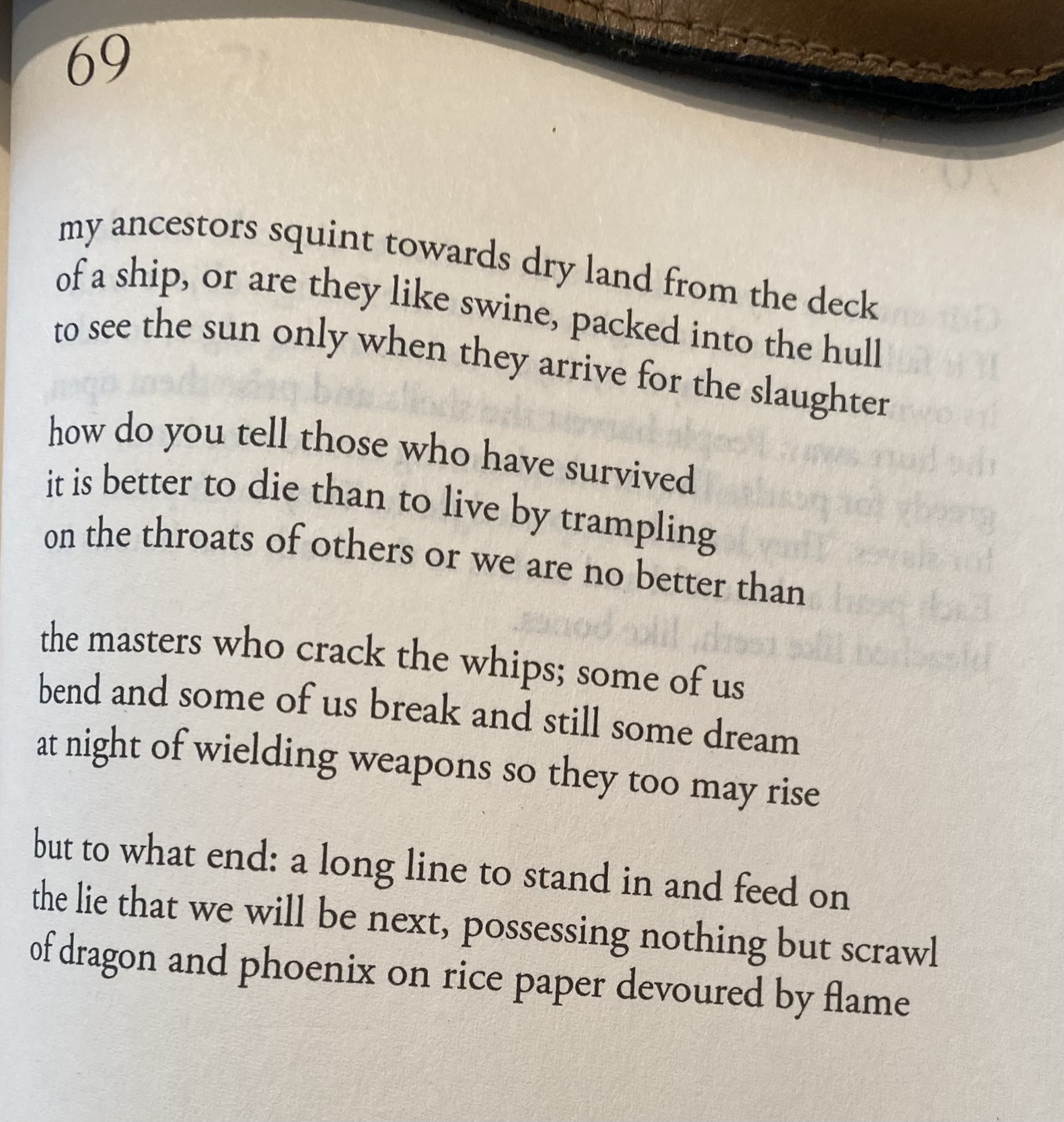
My randomised sequence ends with Fragment 69:

This is one of Eileen’s many poems exploring her family history and heritage. As often happens with these poems, I find myself thinking about my own very different heritage, but with a powerful sense of what is in common. When I blogged about her ‘Burning Rice’ (here), for instance, I brooded on the role of sugar in my life as the son of a sugar farmer. My forebears came to this country, some ‘squinting towards dry land from the deck / of a ship’, some as convicts ‘packed into the hull’. I guess that’s a way of saying that while the poem has specific historical references (about which I am vague), it somehow – as good poems do – makes a bridge to other, different experiences. This isn’t closed-off identity poetry. The ethical questions it poses aren’t just for people of Hokkien heritage.

I keep wanting the first line of the second triplet to be, ‘How dare you tell …’ That is, I want the lines to challenge anyone who passes judgment on survivors. But the actual words, ‘How do you tell …’, appear to endorse the stark ethical principle that it is better to die than to live by oppressing other people. Lines 4 to 7 ask how to communicate that principle to people who have made the choice to live in those circumstances. The question is left hanging and the poem moves on: in response to oppression, there are just three options: to bend, to break or to plot rebellion. The final triplet arrives at what is surely a doctrine of despair: no matter what we do we all end up dead. The dragon and the phoenix, traditionally paired in Chinese art and literature to represent harmony and prosperity, are possessed only as scrawled images on paper, and that paper will burn in a funeral ceremony.

How does this fragment function as the final moment in this longer poem?

Astonishingly well, as it turns out. For one thing, the image of standing in line occurs in both first and last poems. In Fragment 19, people line up around the block clutching at ‘bags, papers, proof of lack’, hoping for something. In Fragment 69, standing in line becomes a metaphor for a doomed aspirational life. We will never reach the front of the queue – it’s a ‘lie that we will be next’ – and what we possess is ‘nothing but scrawl’, paper ideals that will be destroyed at the funeral.

This fragment doesn’t end the sequence with the notion of rebirth or transcendence, but with resignation to the finality of death. The ship has reached its harbour. The funerary papers have been burned. There’s nothing left but profound sorrow.

At the launch, Eileen said, ‘I’m really a cheerful person.’ And I don’t want this blog post give the impression that We Speak of Flowers is a gloomy book. On the contrary, it deals with grief, it refuses to idealise or prettify its subject, but it’s still full of colour and light and the magic of language. Maybe I can leave you with the final couplet of Fragment 34 – which in my randomised order is Nº 78, the number that I usually blog about:

death in the afternoon
wild plants still flower

I wrote this blog post on land of the Gadigal and Wangal clans of the Eora Nation, where the earth’s processes are asserting themselves in heavy downpours followed by brilliant blue skies. I acknowledge the hundred of generations of past Elders, and present Elders, of both countries, never ceded.

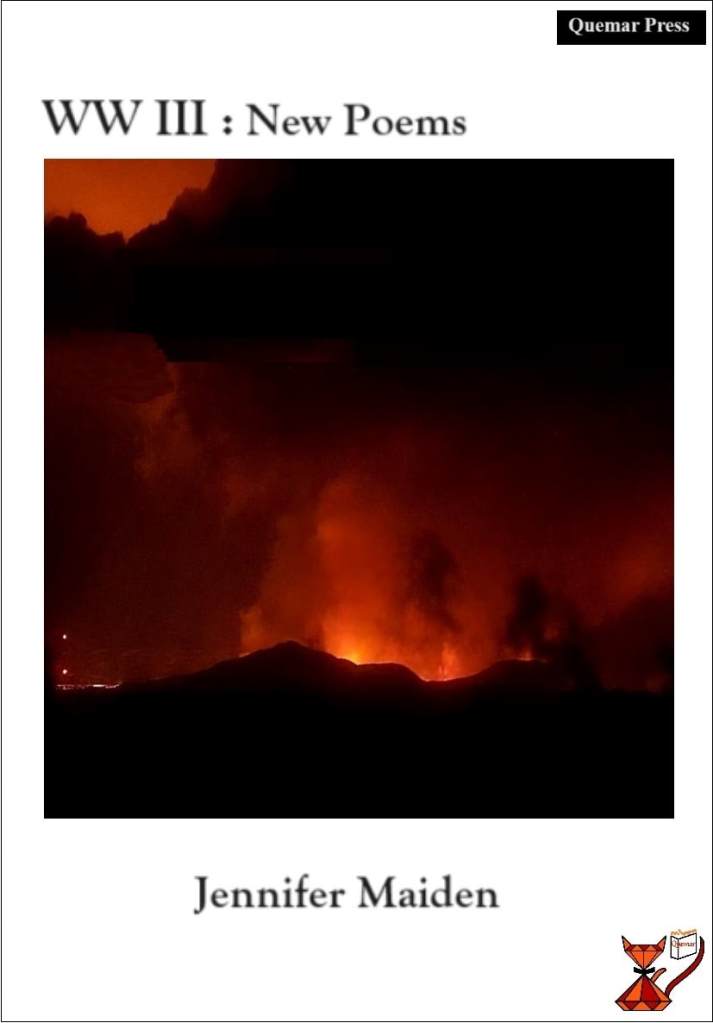
Jennifer Maiden’s WWIII: New Poems

Jennifer Maiden, WW III: New Poems (Quemar Press 2025)

You don’t go to Jennifer Maiden’s poetry for a comfort read. For almost a decade now she has announced the title and theme of a forthcoming book early each year, and uploaded sample poems as they were written over the following months, generally relating to violence, political hypocrisy, and villainy from the headlines. The book has appeared, as promised, early the next January. It’s as if a fragmentary epic poem of our times is unfolding in real time.

WW III: New Poems is the latest instalment. As the title suggests, violent conflict, especially in the Ukraine and Gaza, features prominently, behind it the looming threat of global war. For a proper review, I recommend Geoff Page in the ABR at this link. This blog post isn’t so much a review as a disjointed reflection on just page 47*.

Before going there, a personal note. My blog post about Maiden’s previous book – The China Shelf: New Poems (Quemar Press 2024) – focused on the poem, ‘It’s an odd thing, pity’, and included this:

Not everyone will grasp how US imperialism can be seen as ‘falling’. If anything, some would say it’s on the verge of exploding and bringing the rest of us down with it, terrifying rather than poignant. 

The title poem of WW III includes this:

Reviewing The China Shelf, a kind critic worried
that my reference to the falling Empire could
lessen the idea that it wasn't just falling
but exploding, and possibly dragging
its allies hellward with it, but he was only
considering one poem and of course the book
and others before it always took
often a stance of sharper warning

I may have got it wrong, but at least I’m kind, and as a humble blogger I’m flattered to be called a critic.

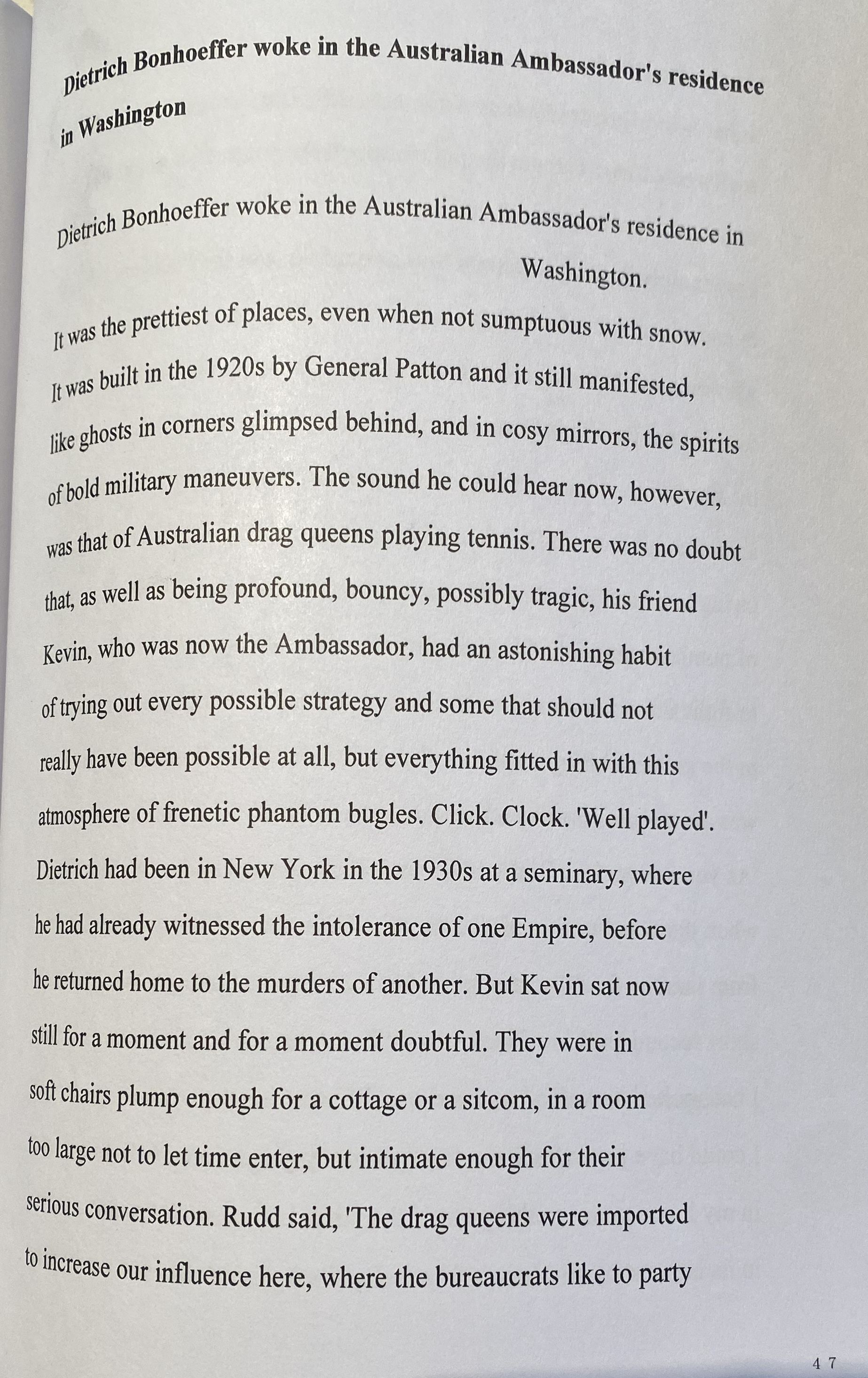
Page 47 of WW III is the first 19 lines of ‘Dietrich Bonhoeffer woke up in the Australian Ambassador’s residence in Washington’.

This page sets the scene for a much longer poem. The ‘serious conversation’, foreshadowed in the second-last line, could be summarised as, ‘Dietrich Bonhoeffer tells Kevin Rudd that it’s not wise to set Australia up to be the US’s proxy in a future war with China.’ The poem could be summarised abstractly: ‘With Dietrich Bonhoeffer as mouthpiece, Jennifer Maiden repeats her warning that the USA is not to be trusted as an ally to Australia.’ Luckily, as with any poem worth its salt, that summary tells you almost nothing and is pretty misleading. You can buy the book to read the whole poem, or you can hear Jennifer Maiden performing it at this link.

The poem belongs to Maiden’s personal tradition of poems where a famous person, historical or fictional, ‘wakes up’ to interact with a living person. In 2009 her fictional character George Jeffreys woke up in a number of global hotspots to see George W Bush on television. Kevin Rudd is one of a number of Australian politicians who have figured since then in delicious conversations: Tony Abbott with Queen Victoria, Julia Gillard with Aneurin Bevan, Malcolm Turnbull with Jessica Fletcher from Murder She Wrote, Tanya Plibersek with Jane Austen. (Beyond these shores, pairings have included Mother Teresa and Diana Spencer, Gore Vidal and Julian Assange, Eleanor Roosevelt and Hillary Clinton.) Usually the pairings are based on something the politician has said or written. In Kevin Rudd’s 2006 essay, ‘Faith in Politics’, published in The Monthly (link here, if you want to refresh your memory), he named Bonhoeffer as an inspiration. The pair made their maiden Maiden appearance in Drones and Phantoms (2014).

It’s interesting to notice just how much information is either given or assumed in these lines. It wouldn’t be a crime to read without googling. As Magdalena Ball said in her review of The China Shelf (link here), ‘You don’t have to have the kind of encyclopaedic knowledge of Australian history and command of current affairs that Jennifer Maiden does to read her books.’ But it helps, and there’s always the invitation to learn more.

First, Dietrich Bonhoeffer. I’ve vaguely heard of him as a pastor who spoke out against the Nazis and was murdered by them. So I know he brings a kind of moral integrity to the conversation. The poem give me a little more:

Dietrich had been in New York in the 1930s at a seminary, where
he had already witnessed the intolerance of one Empire, before
he returned home to the murders of another.

I might not have gone googling if I wasn’t blogging about the poem, but I did, and found that while studying theology in New York in 1930, Bonhoeffer engaged with African-American churches, and became strongly anti-racist. I don’t know that he used the term ‘empire’ about either the USA or Nazi Germany, but it wouldn’t be a poem without that kind of editorialising.

Second, Kevin Rudd. You’d probably know that he was the Australian Ambassador to the USA, but for those who know him there’s a deft evocation of his persona: ‘profound, bouncy, possibly tragic’. (Further on in the conversation, Kevin asks a question ‘and answered himself, as was his custom’.)

Third, the setting. Here’s a pic from the building’s facebook page – ‘the prettiest of places’. Who knew it was associated with the notoriously belligerent US general George Patton? (For readers of my generation no explanation needed: George C Scott in the movie Patton leaps to mind.) According to my googling, Patton rented the house rather than built it, but the association is still there.

DJ Kity Glitter with Rudd. Photo from Sydney Morning Herald 5 June 2023

Fourth, the headlines. Kevin Rudd did host a party featuring drag queens at the ambassador’s residence in June 2023. As far as I can tell, the tennis party was a different occasion, but who’s to say there wasn’t tennis at the Pride party as well? The fabulous image of drag queens playing tennis is an example of a news items seized on for poetic purposes, in this case with what looks like glee.

Given recent events in the USA, the mention of drag queens suggests that the poem will be about culture wars. But it’s actually a piece of misdirection. Over the page, the poem’s real subject is revealed, when Kevin asks:

____________________________________ But I suppose
really you are here about the police force?

And the poem’s key news item is identified: a hot-mic moment in August 2024 in which a US official, talking to Prime Minister Anthony Albanese,

_________________________ named Rudd as the schemer 
who dissuaded America from proposing their own police
force in the Pacific in favour of one organised and paid for
by Australia.

All this information, of course, doesn’t lie inert on the page, but is woven into engaging poetry. For instance, one of Maiden’s themes is the way the US, behind its benign façade, is a ruthless military power. The residence, with its link to Patton, could have been built to her specifications. The prettiness and cosiness of the residence is haunted by bold military maneuvers (note the US spelling), yet the sensuous reality is also there:

still for a moment and for a moment doubtful. They were in 
soft chairs plump enough for a cottage or a sitcom, in a room
too large not to let time enter, but intimate enough for their
serious conversation.

We are given enough of Kevin and Dietrich’s histories and personal quirks for them to be more than simply avatars for positions or points of view (like, say, the characters in Plato’s dialogues). On the other hand, neither on the page nor when performing the poem, does Maiden make any attempt to give them different voices. (Maiden-Trump has none of real-life-Trump’s incoherence.) They are not fully-rounded dramatic characters (it’s not a sitcom) but they have enough independent reality that you feel the poet herself is curious to hear what they have to say in their ‘serious conversation’. I think that’s why this long run of imaginary conversations doesn’t feel tired or repetitive – they are still part of a process of discovery. (There’s an underlying question that this poem goes on to address: What are we to make of Kevin Rudd’s current incarnation as Ambassador? What’s happened to his irritability, his love of China, his social awkwardness, any bitterness about being ousted by Julia Gillard? It doesn’t address Trump’s hostility to him … that would be a different poem.)

It’s easy to be caught up in Maiden’s subject matter. Her poems can be contentious – over the page, Kevin says, as if it’s plain fact, ‘the Americans replaced me with Gillard’, and even on this page there may be an implied equivalence between Nazi Germany and 1930s USA. (If ever there was a poet who didn’t expect her readers to agree with her sentiments a hundred percent, it is Jennifer Maiden.) But this is poetry, and what is said isn’t necessarily more important than the way it is said.

Weaving isn’t a bad metaphor for how these lines progress. The reader’s attention moves back and forth like the shuttle on a loom: the residence with and without snow, General Patton then and now, corners and mirrors, military manoeuvres and drag queens, Kevin’s contrasting qualities, a room large but intimate, the shift from drag queens to the Pacific police force. Maybe it’s not so much a shuttle as a tennis ball. ‘Click. Clock.’

The way the poem sounds is interesting. Some of Maiden’s poems have sustained rhymes that you barely notice on first reading. That’s not so in this one, but especially in the opening lines there’s a lot of alliteration, especially of sibilants (‘prettiest of places’, ‘still manifested, / like ghosts in corners’, ‘every possible strategy and some that should not’). The long lines often break in mid sentence, even mid phrase (‘his friend / Kevin’, ‘should not / really have been’, ‘where / he had already witnessed’, ‘before / he returned’, ‘they were in / soft chairs’, ‘their / serious conversation’). To my ear, these result in a kind of clutter, a feature rather than a bug, that adds an odd urgency to the voice, an urgency that’s all too fitting in poems that predict war.

Since WW III: New Poems was published, Dietrich and Kevin have had a further conversation in the Residence. Click on this link to the Quemar Press website and search for “Rare Earths”.


I wrote this blog post on land of Gadigal and Wangal of the Eora Nation. I acknowledge the Elders past and present of this country, never ceded.


My blogging practice is focus arbitrarily on the page of a book that coincides with my age, currently page 78. As WW III: New Poems only has 76 pages, I’m reverting to the year of my birth, ’47.

George Herbert’s Love (III), Simone Weil and me

I’ve been suspicious of the notion that a poem is always a collaboration between poet and reader (or readers) – that each reader, even each reading, creates a different poem. My suspicion has been softened, but not completely dispelled, by taking part in the fabulous online Modern and Contemporary American Poetry course (‘Modpo’).

But I’ve realised that one of my favourite poems, ‘Love III’ by 17th Century English poet George Herbert, is a brilliant example of how that notion can hold up.

Here’s the poem:

Love (III)

Love bade me welcome. Yet my soul drew back
Guilty of dust and sin.
But quick-eyed Love, observing me grow slack
From my first entrance in,
Drew nearer to me, sweetly questioning,
If I lacked any thing.

A guest, I answered, worthy to be here:
Love said, You shall be he.
I the unkind, ungrateful? Ah my dear,
I cannot look on thee.
Love took my hand, and smiling did reply,
Who made the eyes but I?

Truth Lord, but I have marred them: let my shame
Go where it doth deserve.
And know you not, says Love, who bore the blame?
My dear, then I will serve.
You must sit down, says Love, and taste my meat:
So I did sit and eat.

If you’re interested, there’s a beautiful, scholarly account of the poem by Hannah Brooks-Motl at this link. What follows is not particularly scholarly. If you make it to the end you may even find it amusing.

I’m currently reading Wolfram Eilenberger’s The Visionaries, translated by Shaun Whiteside, a fascinating look at a decade in the parallel lives of four brilliant women – Hannah Arendt, Simone de Beauvoir, Ayn Rand and Simone Weil. The book reminded me that Herbert’s poem played a major role in the life of Simone Weil.

In 1938, Weil was suffering extreme pain. She had lost her teaching job, and doctors couldn’t find a diagnosis or offer any respite. She found relief mainly in listening to sacred music, when, to quote Eilenberger, ‘the pain receded into the background and even allowed her to feel, in her deep devotion, removed from the realm of the physically restricted here and now.’ As well as the music, she turned to poetry. ‘Love (III)’ was important to her. In her Spiritual Autobiography, quoted by Hanna Brooks-Motl, she wrote:

Often, at the culminating point of a violent headache, I make myself say it over, concentrating all my attention upon it and clinging with all my soul to the tenderness it enshrines.  I used to think I was merely reciting it as a beautiful poem, but without my knowing it the recitation had the virtue of a prayer. It was during one of these recitations that ... Christ himself came down and took possession of me.

It was a turning point in her life, and a wonderful example of how to read a poem. George Herbert would have been thrilled.

My reading was a little different.

I was 23 year old English Honours student at Sydney University in 1970. At the end of the previous year I had left a Catholic religious order where I had been ‘in formation’ for seven years, and at the time I’m talking of I was in my first intimate sexual relationship.

In my youthful enthusiasm, emerging from a world dominated by concepts like the love of Christ into one where I was experiencing the joys of sex and human connection as a different kind of sacred, I loved this poem for the way it eroticises the love of God.

No one else seems to have noticed that it can be read as a sexual encounter. (And I did my BA Honours thesis on Herbert, so I read a lot of critics.) It’s hard to spell out what I mean without seeming to snigger, but I don’t, and didn’t, feel at all sniggery. Love (the beloved), observes me ‘grow slack / When I first entered in’, and asks what the problem is. ‘It’s not you, it’s me,’ says the speaker of the poem. There’s a bit of back and forth, reassurance from the beloved and so on, and then she (because, heterosexual me, I was quite capable of letting ‘Lord’ be feminine) says, ‘You must sit down … and taste my meat.’ And the last line fills me with joy every time.

The poem spoke to me powerfully, and kindly, and with great tenderness about (to use cold 21st century words) performance anxiety, erectile dysfunction and alternatives to penetrative sex.

I don’t know what Simone Weil, or George Herbert for that matter, would think of that, but well, it’s my poem now.

Michael Crane’s Urban / Landscape / Ordinary Lives

Michael Crane, Urban & Landscape / Ordinary Lives (Flying Island Books 2024)

Michael Crane organised Australia’s first poetry slam in 1991, and has been a significant figure in Melbourne’s spoken word scene ever since – or at least until his Wikipedia entry was updated, which may have been more than a decade ago until I added this book.

So this is a book of poems by a spoken word practitioner. That is, they are mainly poems for the stage rather than the page.

There are three sections: ‘Urban’, ‘Landscape’ and ‘Ordinary People’.

The first is mostly snapshots of life in inner-city Melbourne, with a couple of Brisbane scenes thrown in. The ones I like best are list poems. Take ‘The Emerald Hill Library Story Time’, for example, which lists many aspects of Clarendon Street that make it a tough place to live, and ends with the tenderness of storytime for children at the library; or ‘Hi Rise’, made up of fifteen couplets, each describingsomeone we take to be a resident of the building:

Marlene ran a tight ship
as her cat, Teddy, rubbed its tail between her legs.

Many visitors arrive unannounced,
cheating the security system.

Harry lives with his father
who he must treat like his child to manage him.

‘Landscape’ mostly moves out to the country, though in its final poem, ‘Life in the Big Smoke’, a poet from the country (a version of Michael Crane in his post-Wikipedia days?) visits the city, has a number of (non-)encounters and goes back ‘to where he came from’. This poem is enriched by being read in this context: its string of encounters echo similar ones on the first section, but the emotional impact is the opposite. In particular, it pairs nicely with ‘White noise of an urban landscape’, which begins, ‘The country life was not for him.’

The third section, ‘Ordinary Lives’ begins with ‘Introduction’, which lays out the section’s rationale, including this:

I find most people more interesting than me, but my job
is to document their success and failures, the moment of glory or
the times when they are alone without love.

The poems in this, as in all three sections, are mostly direct, straightforward, unassuming. They tend to name things without analysis or commentary. On the page they tend to be flat, but my sense is that they would come alive with the gesture, tone of voice and facial expression of spoken-word performance. They’re also mostly on the depressive side – fewer moments of glory, more times alone without love.

My arbitrary blogging practice, especially with books of poetry, is to focus on the page that corresponds to my age, which is currently 77. Page 77 of this book features one of the ‘Ordinary People’ poems, ‘On a plane to Cuba’:

This seems straightforward on a quick read, but there’s something unsettlingly off kilter about it – which may be another way of saying it couldn’t have been written by AI.

After I wrote that last sentence, I decided to test my assertion, and asked Chat GPT to write a poem about a woman who is about to leave her sleeping husband and go to Cuba. I’ve given the result at the bottom of this post, so as not to confuse it with real poetry*.

ChatGPT was worryingly proficient. But what it produced demonstrates that a mechanical aggregator just can’t do what a human poet can. The AI product has sharp images of the room, gives reasons for the woman’s choice of Cuba, and even has a last line that works, but none of it is surprising.

Michael Crane’s poem, on the other hand, pretends to be offering us clichés, but undermines them all the way. In the first ten lines, even as the poem evokes the woman’s yearning for elsewhere, it subtly, almost invisibly, distances itself from her. Does anyone in touch with reality think of Paris, City of Lights, as dimly lit? And though I’ve been in London when it snowed, surely ‘snow-covered footpaths’ is an idiosyncratic way of evoking that city. Her version of Cuba is similarly idiosyncratic. The ‘almost naked dancing women’ are a cliche from Rio rather than Havana. She seems to be vague about Cuban history. What is the ‘long war’? Maybe she’s thinking of Fidel wearing military fatigues? And, in the most telling split between the woman’s perspective and the poem’s, why does she find memories of war attractive?

In lines 13 to 15, the woman’s situation becomes clear:

She is going to catch a flight to Cuba 
as soon as she leaves the snoring man
who kidnapped her youth, ransomed her beauty.

Perhaps the woman’s idea of a ‘long war’ has come from the implied long time that she has been unhappily married. The definitive final line is hinted at here.

The poem continues to tread a fine balance between sympathy and – what is it? – scepticism. She takes no responsibility for whatever has one wrong with the relationship: there’s no indication that the man has been abusive – just that she took up with him when young and beautiful, and now feels the loss of those qualities (and we understand that she means he held her beauty to ransom rather than, what the words literally mean, that he paid a price to set it free). The feeling of loss is real, but we (or is it just me?) can’t help suspecting that she lacks insight.

Crucially, it’s her dreams that she packs along with supremely impractical clothing, and the last line strikes a superbly ambivalent note: all through the poem she has been dreaming of Cuba, and she heads off to ‘the songs of endless summer nights’, but really it might as well be dim Paris or snowy London, because what matters is

days filled with the absence of him.

It’s not ‘She’s Leaving Home‘, with it’s brilliant empathy for both sides of the departure, but then what is?


I finished writing this blog post on land of Gadigal and Wangal of the Eora Nation, as the sun was breaking through clouds after a day of heavy rain. I acknowledge the Elders past and present who have cared for this land for millennia.


*ChatGPT’s poem:

She watches him sleep, his chest rising and falling,
the steady rhythm of a man who never saw her breaking.
The sheets tangled around him,
a quiet fortress she once called home.
But now it feels like a cage.

Her bags are packed, a quiet rebellion in the corner.
Cuba waits—its colors, its heat,
its freedom, a place where she can feel her pulse again.
She runs her fingers over the window sill,
tracing the outlines of a life she no longer wants.

She should wake him, say goodbye,
but the words are too heavy,
the goodbyes too worn.
Instead, she steps lightly,
a ghost slipping past the threshold.

She breathes in the cool air of the morning,
the world opening wide in front of her.
And with every step,
she leaves behind the woman she used to be.

Montaigne progress report 9

Michel de Montaigne, The Complete Essays (Penguin Classics 1991, translated by M. A. Screech)
– part way through Book 3, essay 5, ‘On Some lines from Virgil’ to part way through Book 3, essay 10, ‘On restraining your will’

This post was due more than a week ago, but life in general made other plans for me. With a couple of lapses, though, I have consistently read four or five pages of Montaigne’s Essays each morning.

I won’t even try to summarise what I’ve read in the last six weeks. I’ll just mention that ‘On some lines from Virgil’ continued to be fascinating on the subject of sex and gender; in a piece with the innocuous title ‘On coaches’ Montaigne denounces the atrocities of the Spanish colonisation of Central and South America; in ‘On the disadvantages of high rank’ he pities those whose social position means no one will disagree with them, because they are deprived of the joys of conversation.

And then there’s ‘On vanity’, a long essay that made me fear age-related cognitive decline was catching up with me. As with many of the essays, ‘On some lines from Virgil’ being a prime example, this one’s title gives you no idea of its true subject. But in this case, I couldn’t tell if it even had a main subject. He writes about travel, about death (a lot about death), about how much he loves Rome. He explains why he’s glad he has no sons. He quotes at length from the document granting him Roman citizenship. He’s like a dog snapping – in slow motion – at whatever fly of an idea crosses his mental line of vision. But in the middle of it all, he has one of the passages that remind you that he is inventing the form of the personal essay – and k ows exactly what he’s doing:

There are works of Plutarch in which he forgets his theme, or in which the subject is treated only incidentally, since they are entirely padded out with extraneous matter … My God! what beauty there is in such flights of fancy and in such variation, especially when they appear fortuitous and casual. It is the undiligent reader who loses my subject, not I. In a corner somewhere you can always find a word or two on my topic, adequate despite being squeezed in tight. I change subject violently and chaotically. My pen and my mind both go a-roaming. If you do not want more dullness you must accept a touch of madness.

‘It is the undiligent reader who loses my subject, not I.’ I’ve been put in my place.

He defends his lack of coherence by applying to himself Plato’s description of a poet as someone who:

pours out in rapture, like the gargoyle of a fountain, all that comes to his lips, without weighing it or chewing it; from him there escape things of diverse hue, contrasting substance and jolting motion.

I don’t know that anyone seriously thinks that’s what poets do, but the idea that a reader needs to be ‘diligent’ to do justice to some writing has still got a lot of life in it, probably even more than it did in Montaigne’s day. He goes on to say he doesn’t stitch things together ‘for the benefit of weak and inattentive ears’:

Where is the author who would rather not be read at all than to be dozed through or dashed through? … If taking up books were to mean taking them in; if glancing at them were to mean seeing into them; and skipping through them to mean grasping them: then I would be wrong to make myself out to be quite so totally ignorant as I am. Since I cannot hold my reader’s attention by my weight, manco male [it is no bad thing] if I manage to do so by my muddle.

So, just as he’s getting tetchy with us for being lazy, he acknowledges that he’s a pretty lazy reader himself. And having claimed that his apparent incoherence is actually poetic brilliance, he now calls it a muddle.

Oh, and in the middle of all that charming back-and-forth between grumpiness and self-deprecation, there’s this lovely, enigmatic line:

Poetry is the original language of the gods.

I’m not sorry I gave up French Honours in 1968 because I found Montaigne almost as unreadable as Rabelais. I’m enjoying reading him now, in translation, much more than I possibly could have in the original when I was 22.


This blog post was written on Gadigal-Wangal land, where the days are getting hotter and more humid. I acknowledge the Elders past, present and emerging of Gadigal and Wangal of the Eora Nation.

Andrew Burke’s Historic Present

Andrew Burke, Historic Present (Flying Island Pocket Poets 2023)

The ‘About the author’ paragraph at the back of this book begins ‘Andrew Burke was an Australian author’ – and you realise that the Acknowledgements two pages earlier were written very soon before the writer’s death in his 79th year (as confirmed by his Wikipedia entry), and that one of the last things Andrew Burke wrote was this tiny love note:

The many moods of this collection were suffered in partnership with my wife, Jeanette – so thanks for discussions over blueberries and porridge.

The preceding ninety pages of poetry do reflect and capture many moods, and it’s not hard to imagine the man who wrote them enjoying a quiet chat over blueberries and porridge – not just with his wife but with a community of poets living and dead. Many of those poets find their ways into the verse, either by name or by quotation, very occasionally in a way that made me go googling, but mostly as a way of invoking a community, of readers as well as writers of poetry.

There are poems of travel and childhood memory, poems marking the death of a friend, poems that seem above all to be recording a passing moment. They don’t strive for effect or makes a song and dance of their emotional content or insights, but quietly do their work and are gone.

‘Testicular Check-up’, for example, begins:

I fell in love with my balls
all over again when
they were endangered. 

(You’ve got to love those line breaks!) What follows is a good humoured conversation with the ‘lady’ scanning his testicles. He doesn’t spell out the emotional content of the moment. Enough to say that amid the chat and the matter-of-fact handling, first of his penis then of each testicle, he feigns comfort and indifference, the repetition of the word ‘feigning’ lying like a blanket over what is left unsaid.

Page 77* falls in the middle of the book’s longest poem, ‘Lone Patrol: Darlington 1991’. Again looking to Wikipedia, I find that Darlington is a small community some distance east of Perth frequented by artists. The speaker of this poem is living in someone else’s cottage, perhaps an Airbnb (or the 1991 equivalent) or a writerly retreat, or just to take a break from a difficult time on his life. He chats with a visitor, attends an AA meeting, writes, listens to Jack Kerouac, reflects on his life, enjoys the surroundings.

The poem is in 23 sections, and reads like notes on his time in the cottage. These lines, from page 78, referring to work he is doing on another poem, shed light on the nature of this poem:

'Triplog' poem edited
___________ down to 15 pages
but what to do
with such an
________idiosyncratic poem ...

‘Log’ isn’t a bad description of the current poem – ‘staylog’ perhaps, part journal, part jottings of observations and reflection. And it’s not hard to imagine that it has been edited down from copious daily notes to its 14 pages. I usually look for an overarching narrative in long poems, but here I couldn’t see anything other than a string of moments – and I’m happy with that.

Page 77:

The first two sections are short haiku- or senryu-like poems.

The first, as I read it, juxtaposes the speaker’s grim mood (‘Comedian – / no!’) with the cheerfulness of the natural world, represented by kookaburra’s laughter. Whether the laughter is derisory (the kookaburra is laughing at the poem’s speaker) or simply indifferent (the kookaburra is just laughing without reference to him) is left open.

The second is less successful. I googled ‘Do bees fart?’ Apparently it’s an age-old question, and they sort of do but not really. My sense is that the poem doesn’t care about that. It catches itself in a cliche celebration of flowers in the spring, and throws in a bit of vulgarity to shake the image up. (It does make me want to echo the earlier lines: ‘Comedian – no!’, but in a friendly way.) You might enjoy the way ‘break wind’ has a second, more literal meaning – the bee interrupts the flow of the breeze. If so I’m happy for you.

The third section starts out as a prosaic to do list, then in the second stanza that prosaicness finds what in my distant university days was called an ‘objective correlative’ – an embodiment of the underlying emotion:

I stare at the dry stick
propped against the wall

The narrative behind the matter-of-fact notes ‘pay car reg / pay lawyer’ comes more fully into view – there may be a divorce in the mix:

_________ all
creativity gone, energy,
sapped by money
and marriage hassles.
dry.

The section goes on, to describe an afternoon of talking, and then of trying to write. It ends, taking the image of the dry stick one step further:

dead spider talks
about mortality

Unlike the kookaburra, the dead spider (on a windowsill?) reminds him of his mortality; or perhaps he himself, dead-spider-like, can’t write of anything but death.

The poem is a staylog, and also a pretty matter-of-fact account of what a more egotistical person might have called a Dark Night of the Soul. In 1991, the poet was approaching 50. Perhaps the matter-of-factness was there at the time, or perhaps the poem got to its present form much more recently, and the matter-of-factness comes from the thirty-plus intervening years.

It’s a bitter-sweet thing to meet a poet only after he has died. But it is sweet.


I wrote this blog post on Gade / Wane. I acknowledge the Gadigal and Wangal elders past present and emerging, and gratefully acknowledge their care for this land for millennia.


* My blogging practice is to focus on page 77 (at least until I turn 78). In books like this, the practice saves me the impossible task of choosing one poem to represent them all.