Tag Archives: science fiction/fantasy

China Miéville’s Un Lun Dun

China Miéville, Un Lun Dun (Macmillan 2007)
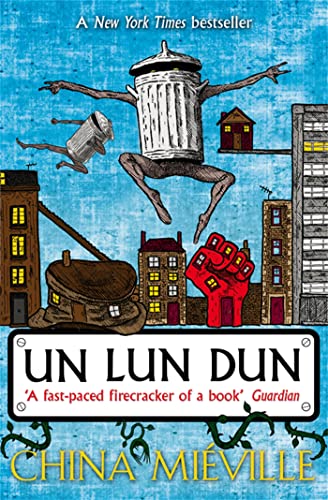
I was quite a few pages into Un Lun Dun before I realised it’s a children’s book. It’s wonderfully fast-paced. It’s witty, endlessly inventive, full of surprising plot twists, respectful of young readers and welcoming to old ones. I had a great time from start to finish. I’d say China Miéville did too, and so would any 10 or 11 year old with the stamina for a 521 page novel and a taste for the scary fantastic.

UnLondon – like Parisn’t, No York and other abcities – exists alongside its real-world equivalent. It’s mostly constructed from garbage and discarded objects that have crossed over. Broken umbrellas are particularly significant. The citizens of UnLondon are a motley lot, not all of them completely human. They are threatened by the Smog, a sentient noxious cloud that feeds on smoke and pollutants, can break up into smoglets and possess the living and the dead. Aided by its greedy or power-hungry humanish accomplices, it plans to take over UnLondon and, later, the world. There are smombies, binjas, stink-junkies, a doughnut-shaped sun and any number of weird creatures and buildings, many of them not only described but lovingly illustrated in ink drawings by the author.

Into this situation wander young Zanna and her friend Deeba. Zanna is hailed as the Shwazzy, which we learn is a phonetic representation of the French choisie. A prophetic book foretells she will defeat the Smog. But, mercifully for the enjoyability of the novel, the book is thoroughly unreliable (much to its own regret, because of course the book can talk).

At page 78* things are just warming up, but even on this one page a gallery of characters is on display and there’s plenty of colour and movement.
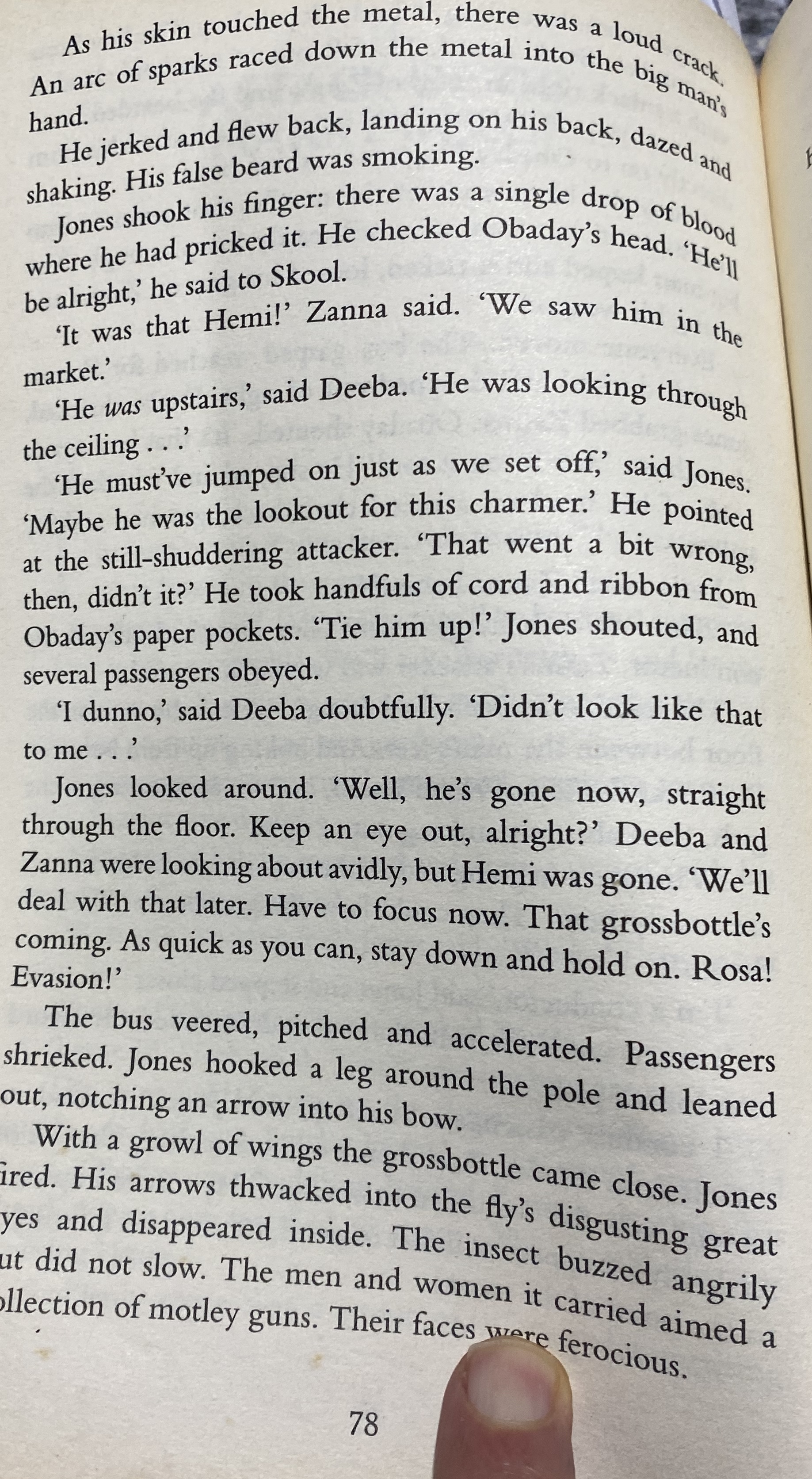
Let me take you through it.

As his skin touched the metal, there was a loud crack. An arc of sparks raced down the metal into the big man’s hand.
He jerked and flew back, landing on his back, dazed and shaking. His false beard was smoking.

The skin belongs to Jones, an UnLondon bus conductor. Naturally, he also conducts electricity, and here he sends an elecric shock into the sword wielded by a big, bearded man who is attempting to abduct Zanna.

Jones shook his finger: there was a single drop of blood where he had pricked it. He checked Obaday’s head. ‘He’ll be alright,’ he said to Skool.

Jones has injured his finger by touching the tip of the bearded man’s sword. Along with Jones and a milk carton called Curdle, Obaday and Skool are Zanna and Deeba’s companions. Obaday, who wears clothes made of paper and has pins instead of hair, has been knocked unconscious on page 77. The silent Skool, Obaday’s friend and constant companion, is invisible inside a deep-sea diver’s suit. (The meaning of Skool’s name is to be revealed in the final battle scene.)

‘It was that Hemi!’ Zanna said. ‘We saw him in the market.’
‘He was upstairs,’ said Deeba. ‘He was looking through the ceiling . . .’
‘He must’ve jumped on just as we set off,’ said Jones. ‘Maybe he was the lookout for this charmer.’ He pointed at the still-shuddering attacker. ‘That went a bit wrong, then, didn’t it?’ He took handfuls of cord and ribbon from Obaday’s paper pockets. ‘Tie him up!’ Jones shouted, and several passengers obeyed.
‘I dunno,’ said Deeba doubtfully. ‘Didn’t look like that to me . . .’
Jones looked around. ‘Well, he’s gone now, straight through the floor. Keep an eye out, alright?’ Deeba and Zanna were looking about avidly, but Hemi was gone.

Hemi is a boy who approached our heroines when they first arrived in UnLondon. He seemed friendly, but they were warned that he was a ghost boy who wanted to steal their bodies. This, is turns out much later, was only partly true. But they fled from him and now they realise that he has followed them onto the flying bus, and has somehow passed down through the ceiling of the lower deck and then out through the floor. Hemi is an ambiguious figure at this stage of the story – as Deeba’s doubts about Jones’s narrative remind us.

But Hemi and the man with the sword must now wait because the bus is being attacked by a grossbottle, a giant fly, with a platform on its back carrying a gang of heavily armed airwaymen and airwaywomen.

‘We’ll deal with that later. Have to focus now. That grossbottle’s coming. As quick as you can, stay down and hold on. Rosa! Evasion!’

Rosa is the bus driver.

The bus veered, pitched and accelerated. Passengers shrieked. Jones hooked a leg around the pole and leaned out, notching an arrow into his bow.
With a growl of wings the grossbottle came close. Jones fired. His arrows thwacked into the fly’s disgusting great eyes and disappeared inside. The insect buzzed angrily but did not slow. The men and women it carried aimed a collection of motley guns. Their faces were ferocious.

And so it goes.

There is an army of unbrellas, an infestation of Black Widows in Webminster Cathedral, a shadowy organisation called the Concern that sees the Smog’s attack as a commercial opportunity, a diabolical link between the Smog and the UK government. Things are rarely what they seem. Expectations are always met but rarely in the way you expect.

What’s not to like?


I wrote this blog post on Wulgurukaba land, the luxuriant island of Yunbenun, and have finished it with the tropical sun warming my back. I acknowledge the Elders past and present, and welcome any First Nations readers.


My blogging practice is to focus on the page that coincides with my age, currently 78.
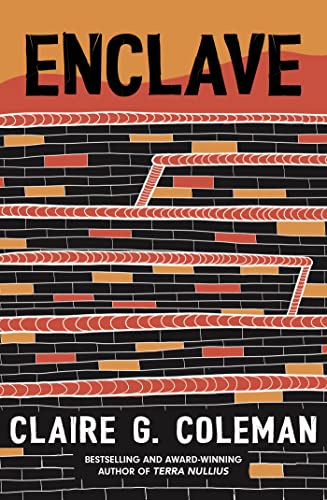
Claire G. Coleman’s Enclave

Claire G. Coleman, Enclave (Hachette Australia 2023)

This is the first book I’ve read by Noongar writer Claire G. Coleman. Her first novel, Terra Nullius, won prestigious prizes and her poetry and essays appear regularly in journals I read. (If you want to plough through my earlier posts to see what I’ve managed to say about those earlier encounters, here’s a link.) So I was happy when I got hold of a copy of Enclave, her third novel. I enjoy science fiction, so the fact that it’s a dystopian genre novel was an extra cause for joyful anticipation.

The book delivered on both fronts – filling the spot in my heart reserved for intelligent speculative fiction, and expanding my acquaintance with Claire G. Coleman’s writing. If you want to read a proper review, I recommend Magdalena Ball at Compulsive Reader (here’s a link), Maggie Nolan on The Conversation (link), Bill Holloway at The Australian Legend (link)or all three.I’ll stick to my resolve of focusing on page 78*. As often happens, this arbitrarily chosen page reveals a lot about the book, and hints at a lot more.

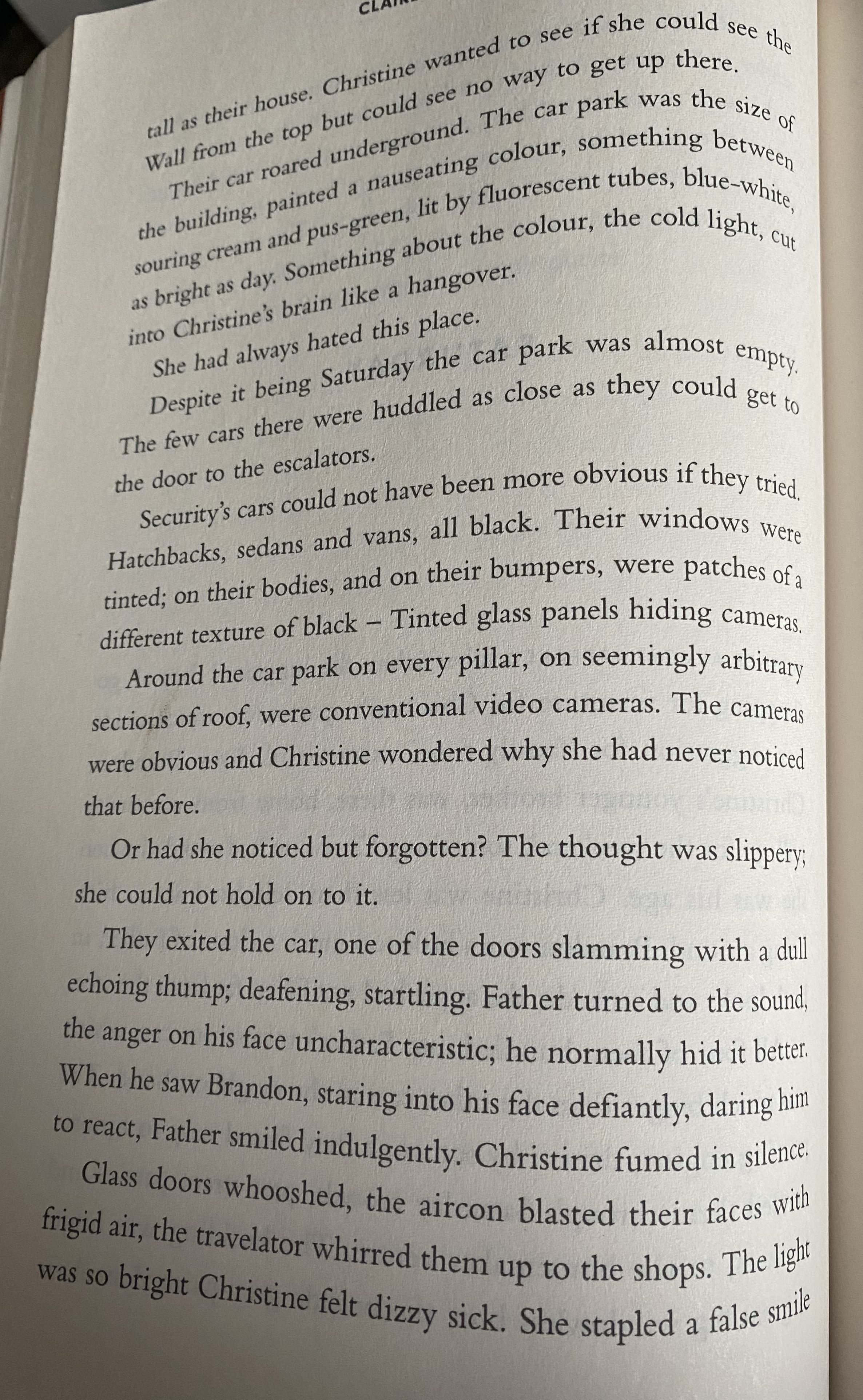
We are at about the one-quarter point of the narrative. Christine is the protagonist, a young white woman from an affluent family living in the walled city of Safetytown. Her father has bought her a new apartment as a reward for her success at university, and on this page her parents are taking her to ‘the homemaker centre’ to buy furniture, along with her younger brother, Brandon.

The building was huge. A great big windowless box, the outside grey-painted steel, as tall as their house. Christine wanted to see if she could see the Wall from the top but could see no way to get up there.
Their car roared underground. The car park was the size of the building, painted a nauseating colour, something between souring cream and pus-green, lit by fluorescent tubes, blue-white, as bright as day. Something about the colour, the cold light, cut into Christine’s brain like a hangover.
She had always hated this place.

The citizens of Safetytown are constantly being told how fortunate they are, how safe. Yet the adjectives here tell a different story: ‘windowless’, ‘grey-painted’, ‘nauseating’, souring’, ‘pus-green’. Even more significant is the ever-present Wall. It’s a powerful image, inevitably reminding us of Trump, Berlin and Israel–Palestine. Christine has always been told that beyond it is nothing but predatory violence, misery and chaos. In the otherwise sharply visual elements of this page, it is present to Christine as an object of curiosity even though it’s out of sight. She is beginning to suspect that she has been lied to: she is clear that she has always hated the homemaker centre, but a deeper discontent is brewing.

The next paragraph goes further into the reasons for her discontent:

Security’s cars could not have been more obvious if they tried. Hatchbacks, sedans and vans, all black. Their windows were tinted; on their bodies, and on their bumpers, were patches of a different texture of black – tinted glass panels hiding cameras.
Around the car park on every pillar, on seemingly arbitrary sections of roof, were conventional video cameras. The cameras were obvious and Christine wondered why she had never noticed that before.
Or had she noticed but forgotten? The thought was slippery; she could not hold on to it.

This first part of the novel is about Christine’s awakening. Here she’s noticing things she has never noticed before, in particular the ominously ubiquitous surveillance and enforcement. Not on this page, but part of the same process, she has noticed that one of the anonymous brown ‘servants’ is extraordinarily beautiful. These uniformed servants, all people of colour, are bussed in each day from beyond the wall and then out again in the evening. They ensure that the citizens don’t have to lift a finger to tend to the necessities of life. No one asks how they live on the other side, and in the early chapters they might as well be invisible, but like the women in the movie Conclave they are very present to the reader. Christine’s attraction to the woman servant is so outside the realm of what is considered possible that, like her ‘slippery’ thought about the cameras, it only fitfully enters her consciousness.

They exited the car, one of the doors slamming with a dull echoing thump; deafening, startling. Father turned to the sound, the anger on his face uncharacteristic; he normally hid it better. When he saw Brandon, staring into his face defiantly, daring him to react, Father smiled indulgently. Christine fumed in silence.

So much of what is to unfold is hinted at here. The benevolent father bestowing a brand new flat and furnishings on his daughter is suddenly enraged: not that he’s usually calm, but that he normally hides his rage. When he sees that it’s his son who has made the noise, he is pacified. It will come as no surprise, a few pages later, when the rage is unleashed against his daughter, while the son remains firmly in favour.

So Safetytown is authoritarian, sexist and – we know from earlier and will soon learn – intensely racist and homophobic. Christine is noticing at least some of it, and fuming.

The overall shape of the narrative is strongly implied on this page. Christine will incur her father’s wrath. Somehow she will find herself on the other side of the wall. Will she finally discover she has been lied to all her life? (Anyone who’s read any dystopian fiction would be astonished if the answer to that was no.) Will she escape or be exiled to the other side of the Wall? (See previous parenthesis.) Will she find a better world out there? (Likewise, you’d be pretty astonished at a no answer.) Will she find happiness with the beautiful brown servant woman, and will that woman have a name? (See previous parenthesis.) Will she play a role in bring Safetytown down? (One would certainly hope so, but that would mean she’d have to make giant strides out of her complacent self-absorption.) Perhaps most importantly for the success of the novel: are there any surprises? (No spoiler alert, but yes.) Does it get preposterous? (Yes – in many ways, but mainly in a delightful sequence that could only have been imagined by someone who lives in Naarm/Melbourne and loves it with a passion.)

Bill Holloway at The Australian Legend enjoyed this book less than Claire G. Coleman’s two previous novels, Terra Nullius (Hachette Australia 2017) and The Old Lie (Hachette Australia 2019). I take that as encouragement to go looking for them.


I wrote this blog post on land of Gadigal and Wangal of the Eora Nation. I acknowledge the Elders past and present of this country, never ceded.


It’s my current age.

J. G Ballard’s Crash

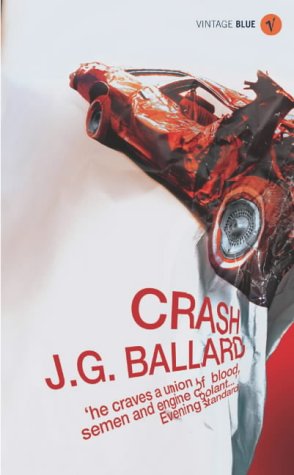
J. G. Ballard, Crash (© 1973, Vintage Books 2005)

tl;dr: Yuk!

Having seen Crash on Tim Walters’ list of must-read science fiction / fantasy novels about 15 years ago, I got hold of a copy via Bookmooch, and it has been sitting on my To Be Read shelf ever since. I knew a David Cronenberg movie was based on it, and that it was about car accident survivors who share a sexual fetish for cars and car crashes.

Not an attractive proposition. But it’s a slim paperback, so I overrode my reluctance and packed it to read on the plane on my recent trip.

The Vintage Books edition has an Introduction written by J. G. Ballard in 1995, which includes this:

Throughout Crash I have used the car not only as a sexual image, but as a total metaphor for man’s life in today’s society. As such the novel has a political role quite apart from its sexual content, but I would still like to think that Crash is the first pornographic novel based on technology.

If pornography is something that feels you leaving just a bit less than fully human, he succeeds. If it’s something that makes you feel sexy, not so much. I’m a long way from being a connoisseur of porn, but the book this reminded me of was the one in the podcast My Dad Wrote a Porno. It has the same obsession with genitalia and sex-related bodily fluids – which in this book means pretty much all bodily fluids – but it’s not funny, even unintentionally. The patriarchal world view is overwhelming, and the sex is somehow tangled up with, or smeared or squirted on, car dashboards, crumpled metal, and terribly scarred bodies. The book is not for the faint-hearted, and I include myself in that category. In case that makes it sound titillating, I should add that it’s not for the easily ignored either: it goes on and on with unerotic sex scenes that are described in clinical, mechanical language (I won’t inflict examples on you) but still manage to be anatomically/mechanically confusing..

It’s not that I was clutching my pearls. I read the whole thing in the hope that it would deliver on the ‘total metaphor for man’s life’ etc. There’s a whiff of a promise that it would shed light on our society’s widespread fascination with car crashes, or the frisson produced by famous road deaths (Jane Mansfield, Albert Camus and James Dean are mentioned). But no more than a whiff. The opening paragraph foreshadows a near escape by ‘the film actress Elizabeth Taylor’ (whose Cleopatra appeared in the year the book was published), but she pretty much remains an abstraction.

Suffice to say I’m not rushing out to see the movie.


I wrote this blog post on the unceded land of the Gadigal and Wangal clans of the Eora Nation, where the earth has been reshaped over the last century to accommodate the needs of motor vehicles. I acknowledge their Elders past and present, with gratitude for their care of the land over millennia, and hope that the rest of us can learn from them in time.

William Gibson’s Peripheral

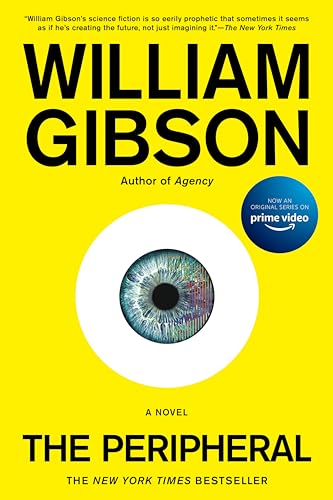
William Gibson, The Peripheral (Berkly 2014)

I picked up The Peripheral in a street library soon after I finished reading and blogging about its sequel, Agency, nearly four years ago. Since then, it has been my TBR shelf as a treat for a rainy day. Its time has now come.

There’s a peculiar challenge in writing about it. Possibly the main thing I enjoyed about it is that a lot of the time the reader has no idea what’s actually happening. You’re not even sure what some words mean, or what the characters are not saying. Explanations do come, eventually, but there’s a delicious disorientation as AI devices and other technical marvels multiply, we only half-see crucial incidents, cultural events are described from the point of view of someone who knows a lot more about the background than the reader does. The action takes place in two unspecified future time periods that interpenetrate in often unclear ways. However serious the issues may be – and there’s a plausible version of how the global emergency will develop – there’s a pervasive sense of play. If I summarise the plot, or even the set-up, I’ll be depriving you of that experience.

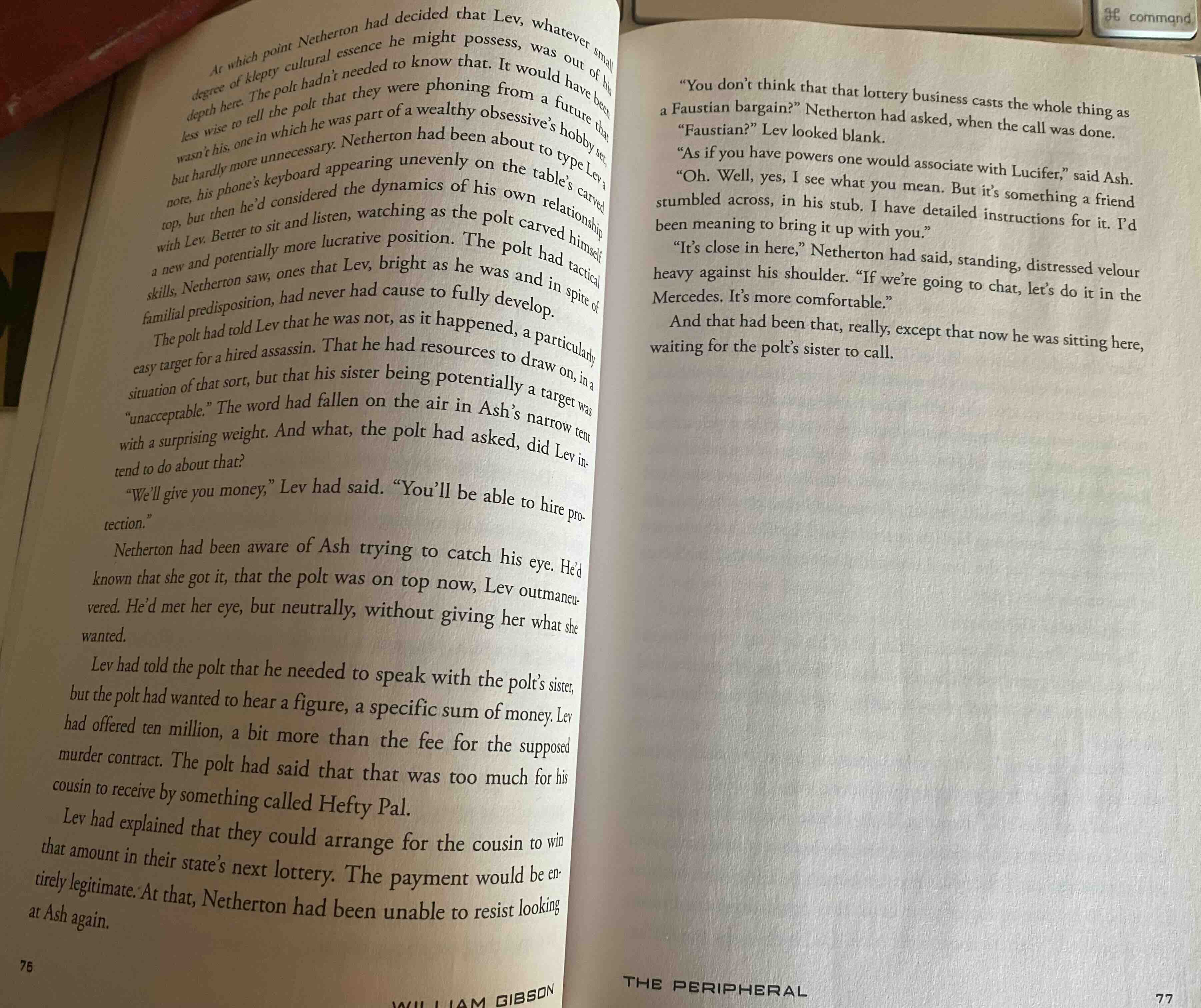
My first idea was to write about first two short chapters – all the chapters are short – but then I thought, oh what the heck, I’ll skip straight to page 77* to give you a taste, and let the spoilers fall where they will.

Lev had told the polt that he needed to speak with the polt’s sister, but the polt had wanted to hear a figure, a specific sum of money. Lev had offered ten million, a bit more than the fee for the supposed murder contract. The polt had said that that was too much for his cousin to receive by something called Hefty Pal.
Lev had explained that they could arrange for the cousin to win that amount in their state’s next lottery. The payment would be entirely legitimate.

Gibson has a gift for coining terms. ‘Cyberspace’ is his invention. Of The Peripheral‘s many coinages, three appear in this short passage: ‘polt’, ‘Hefty Pal’ and ‘stub’. They each have the virtue of suggesting their origins if not their precise meanings. A polt, derived from poltergeist, is a person who is bodily in one place and/or time, but is somehow seeing and acting in another time. (A peripheral is a human-looking artefact, that can be the host to a polt.) Hefty is a mega corporation of which Hefty Pal, as in PayPal, is a subsidiary. A ‘stub’, known more formally as a ‘continuum’, is a key invention of the book, something that readers and half the characters come to understand only gradually. All I’ll say here is that it is something that results from people going back to an earlier time and changing that time’s future.

There are three characters in this scene: Lev, the son of a fabulously wealthy Russian gangster capitalist, whose hobby involves mucking about with the past (stubs/continua are his playthings); Ash, a tech wiz who makes it happen for him (among other distinguishing features, she has tattoos of animals that move around on her skin, often glimpsed running for cover when someone tries to look at them); and Wilf Netterton, put-upon publicist, from whose point of view the story is told in alternate chapters. Page 77 is at the end of a Wilf chapter.

Three more characters are referred to. ‘The polt’ is Burton, a battered veteran in Netterton’s past / our future (though that way of describing things isn’t quite accurate). ‘The polt’s sister’ is Flynne, a gamer in a small US town who is the focus of the non-Wilf chapters. Burton and – on one fateful occasion – Flynne have been employed as polts by Lev under the impression they were testing a computer game. The main narrative is set in motion by Flynne’s witnessing what may be a murder. ‘The cousin’ is Leon, one of their tribe of loyal family members.

At that, Netherton had been unable to resist looking at Ash again.
‘You don’t think that that lottery business casts the whole thing as a Faustian bargain?’ Netherton had asked, when the call was done.
‘Faustian?’ Lev looked blank.
‘As if you have powers one would associate with Lucifer,’ said Ash.
‘Oh. Well, yes, I see what you mean. But it’s something a friend stumbled across, in his stub. I have detailed instructions for it. I’d been meaning to bring it up with you.’

Tiny moments like this give the book its rich texture. There’s the complicity between WIlf and Ash, two underlings who have cultural memories, unlike their rich and powerful employer. (Similarly in the earlier paragraph, it’s fun that Hefty Pal is something in the reader’s future and Flynne’s present that has been forgotten in Wilf’s time.) Like the implied reference to poltergeists, the mention of Faust reminds us that even though the narrative is presented as a tale of high tech, AI and nanotechnology, it often has the feel of demonic possession and fairytale magic. (If you’ve read Gibson’s Sprawl trilogy – Neuromancer (1984), Count Zero (1986) and Mona Lisa Overdrive (1988) – you’ll remember the prominence there of the legba of Voodoo.)

And that had been that, really, except that now he was sitting there, waiting for the polt’s sister to call

That’s the first hint of the almost-romance that is to almost-blossom between these characters who can only spend time together by means of weird time travel mediated by a peripheral in one direction and an odd little children’s toy in the other.

Now I’m tempted to reread Agency. I remember that it was also gleefully inventive and similarly had two interrelating times. I’m pretty sure that some of the distant future characters are in both books, but my memory is dim. William Gibson is anything but dim.


I wrote this blog post on the unceded land of the Gadigal and Wangal clans of the Eora Nation, not far from where what we now call the Cooks River has been cared for by Elders for many millennia. The weather has just turned cold, but spider webs are still proliferating.


* My blogging practice is to focus arbitrarily on the page of a book that coincides with my age, currently page 77. For The Peripheral, I’ve included a little from page 76 as well.

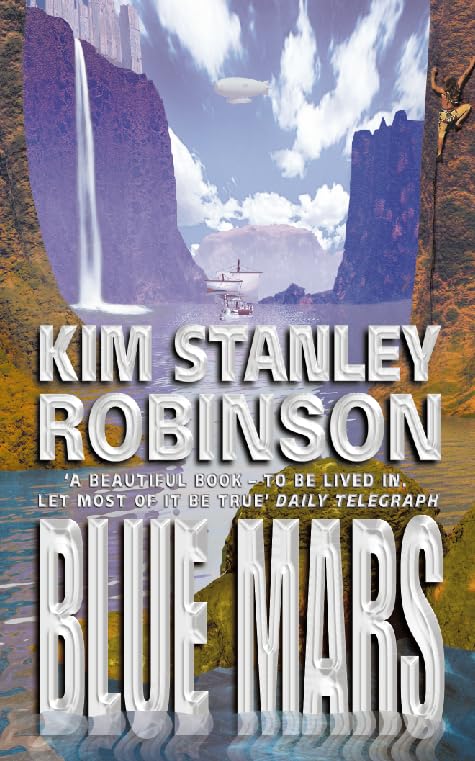
Kim Stanley Robinson’s Blue Mars, page 76

Kim Stanley Robinson, Blue Mars (1996)

This wonderful book is the third in Kim Stanley Robinson’s Mars trilogy.

I read the first two books – Red Mars (1992) and Green Mars (1993) – in pre-blogging days, that is, before 2003. I was swept away by them, but I kept deferring Blue Mars. In fact, last summer I read Kim Stanley Robinson’s more recent novel 2312 (my blog post here), thinking I would never return to Mars.

Yet here I am.

The trilogy begins in what was the future year of 2020 with the first human landing on Mars. In Red Mars, a hundred selected individuals and one stowaway, to be known and revered as the First Hundred, make the journey to the red planet, and the narrative follows the engineering, cultural and political processes of colonisation. The book ends, in about the year 2060, on a hopeful note in the middle of violent conflict against the forces of Earth capitalism, the ‘metanats’, and their political arm, the UN. Though the politics and the many individual stories are fascinating, what I remember most vividly of this book is the practicalities of interplanetary travel and survival on the arid, low-gravity planet.

Green Mars deals with the terraforming project (the greening of Mars), and the continuing struggle against the Terran forces. It ends in 2127, when Earth is devastated by a huge flood and Mars attains independence. Mars is largely habitable now, with tented cities, large bodies of water, a thickening atmosphere, and a huge reflecting mirror in space that augments the effect of the sun. A longevity treatment has been developed and is almost universally available.

Blue Mars starts in 2127 and finishes in 2212, so covers nearly a hundred years. The key characters are again from either the First Hundred, well over 200 years old by the book’s end, or the next two generations. As well as sorting out Mars’s relationship to Earth and the other colonies now being established elsewhere in the solar system (including those that feature in 2312), the main global story concerns the political struggles among the different Martian groupings. The Reds, including extremist ecoteurs, want Mars kept as close to its original state as possible. The Greens want it to become ever more Earthlike. Civil war is avoided and a new constitution is thrashed out in early chapters. We follow the teething problems of the new government structure and economy, and witness the development of distinctively Martian cultures. The younger generations grow very tall by Earth standards, tend to disregard gender binaries and can be spectacularly hedonistic.

The book is full of delights. Kim Stanley Robinson is interested in everything – politics, sociology, art, music, theatre, philosophy, religion, history, engineering, geology, climatology, rocket science, brain science, psychology, linguistics, myths, fairy tales, sports, the Basque cooperatives of Mondragon and the katabatic winds of Antarctica. All this and more finds its way into the story.

There are lovingly detailed descriptions of Martian landscapes and seascapes. In one meta moment a character observes, ‘This small-planet curvature is producing effects no one ever imagined.’ Yep, and Kim Stanley Robinson describes these effects, and those of the lower gravity, in such detail that you feel he has actually been there and seen what no one ever imagined.

None of that would work without a set of characters that we care about. Each of the book’s 14 parts is narrated from a different character’s the point of view, and Robinson has an almost Shakespearean ability to disappear into his characters.

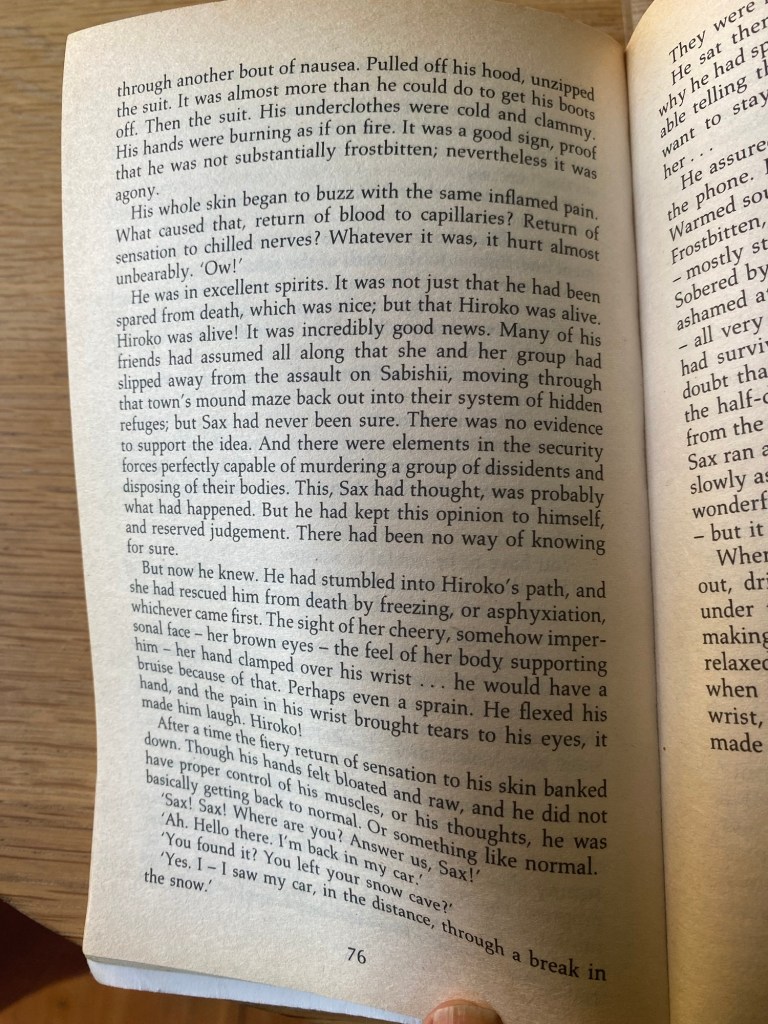
I could go on, but I want to give an example of the writing. Here’s page 76 (control click / right click to enlarge if you want to read it in full):

This is in Part Two, ‘Areophany’, told from the viewpoint of Sax Russell, one of the First Hundred who had his brain reconstituted after a stroke in the second book and has been oddly dissociated ever since. He is a brilliant scientist, committed to rational thinking and out of his depth when it comes to articulating emotional matters.

On the preceding 10 or so pages, Sax has been on a solo excursion, enjoying a Mars that is newly free from earth domination. Civil war has been averted, but only by appeasing of the Reds by removing the soletta, the mirror in space that created Earth-like warmth and light. Now, he has been caught out of his vehicle in a violent snow storm, one of the extreme weather events brought on by this removal – and the protection of his suit is almost useless against it. APS (as in Areological Positioning System) and a call on his wristpad have not helped him get back to his rover. He is facing certain death when a helmeted figure comes out of the storm, takes him firmly by the wrist and leads him to safety. He recognises his rescuer as Hiroko Ai, one of the First Hundred who is believed to have been killed. As soon as he is safe, she vanishes into the blizzard.

The high drama is over, but a lot happens on page 76.

First, there’s some deft character development. Sax manages to strip off his frozen clothes in the warmth of the car, and it hurts. But he’s Sax, always alive with scientific curiosity:

His whole skin began to buzz with the same inflamed pain. What caused that, return of blood to capillaries? Return of sensation to chilled nerves? Whatever it was, it hurt almost unbearably. ‘Ow!’

The next couple of paragraphs do a lot of work. They recap incidents from the earlier book, and they introduce a recurrent motif of this one. Since I’ve forgotten almost all the details of Green Mars‘ guerrilla struggles, I’m grateful for the recap, which is not so much a memory prompt as a general outline of what happened. (Incidentally, you could probably read Blue Mars as a stand-alone novel, but you’d have to fill in a lot of gaps from your own imagination.)

He was in excellent spirits. It was not just that he had been spared from death, which was nice; but that Hiroko was alive. Hiroko was alive! It was incredibly good news. Many of his friends had assumed all along that she and her group had slipped away from the assault on Sabishii, moving through that town’s mound maze back out into their system of hidden refuges; but Sax had never been sure. There was no evidence to support the idea. And there were elements in the security forces perfectly capable of murdering a group of dissidents and disposing of their bodies. This, Sax had thought, was probably what had happened. But he had kept this opinion to himself, and reserved judgement. There had been no way of knowing for sure.

But now he knew. He had stumbled into Hiroko’s path, and she had rescued him from death by freezing, or asphyxiation, whichever came first. The sight of her cheery, somehow impersonal face – her brown eyes – the feel of her body supporting him – her hand clamped over his wrist … he would have a bruise because of that. Perhaps even a sprain. He flexed his hand, and the pain in his wrist brought tears to his eyes, it made him laugh. Hiroko!

Stan, as he’s called in his bio, can spend pages describing a landscape (some readers might skip – I didn’t!), but he knows when to hold back. People with fresh memories of the earlier books will understand the reason for Sax’s joy. But the rest of us don’t need to be told, the joy itself is enough for us to know that Hiroko has been a key and much loved figure in the history of Mars.

Beginning with his lie when people at base finally contact him on his wrist on this page, Sax never tells anyone of this encounter, but its vivid physicality keeps Hiroko alive for the reader. In the remaining 700 pages, people report sightings, even some on Earth, none of them ever verified. In her absence she becomes a kind of genius loci, a spirit of the place – not part of the ordinary world of laboratories and constitutional assemblies, but elusive, concealed, anywhere. In the final act, when the surviving members of the First Hundred meet to remedy a glitch in the longevity treatments, I was on the edge of my seat hoping she would appear. I’m not saying if she does.

I went to Wikipedia to fill the gaps in my memory: it was Hiroko who created the spiritual underpinning of the new Martian culture – ‘a new belief system (the “Areophany”) devoted to the appreciation and furthering of life (“viriditas”)’. My understanding of viriditas is a little different from Wikipedia’s. I think of it as the universe’s impulse towards life, what Dylan Thomas called ‘the force that through the green leaf drives the flower’. It’s probably true to say that what makes the book more than a dry, overlong piece of speculation is the way on every page it bears witness to an imagination shot through with the thing that Hiroko comes to symbolise: Viriditas.


Added later: I meant to include this wonderful, terrible description of a future Earth, from page 511

Steaming, clotted, infectious, a human anthill stuck with a stick; the panic pullulation ongoing in the dreadful mash of history; the hypermalthusian nightmare at its worst; hot, humid, and heavy; and yet still, or perhaps because of all that, a great place to visit.

Ah, Earth, you’ve gotta love it!

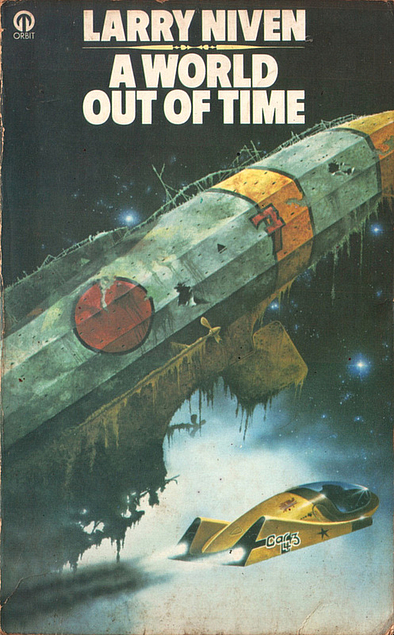
Larry Niven’s World out of Time: page 76

Larry Niven, A World out of Time (©1976, Orbit 1977)

It had been a while since I read something that was just good fun, and I turned to my Spec Fic TBR shelf to fill the lack. This yellowing Bookmooched copy of A World out of Time reminded me of the pleasure of Larry Niven’s Ringworld books, of which pretty much the only thing I remember is that I enjoyed them. It practically leapt into my hands.

And now that I’ve read it I don’t have much to say beyond that it is indeed fun. There are whizz-bang planet-shifting fusion engines; there are sex scenes that would barely raise a vicar’s blush these days but were probably titillating for 14-year-old boy readers in 1977; there are chase scenes, theory about the nature of empires, cool improvised weapons, cute mutated animals, scary mind manipulation, and a plot that’s full of unexpected twists. It’s not ‘hard’ science fiction like Kim Stanley Robinson, or weird like China Miéville, or space opera like Star Wars, but it’s got elements of all of them, and it zips along.

It begins, ‘Once there was a dead man.’ People who opted for cryogenics in the 1970s (‘corpsicles’) are revived as slave labour a couple of centuries later; that is, their personalities are harvested and implanted in the bodies of condemned criminals whose brains have been wiped. Our hero, Corbell, is one of the revived corpsicles. The totalitarian government of the future (‘the State’) assigns him the task of piloting a spacecraft on a round mission that is planned to take hundreds, even thousands of years.

The RNA conditioning that enables him to learn his interstellar pilot craft in a matter of days also modifies his brain so he identifies as a servant of the State. But he manages to rebel and takes off instead to visit the black hole at the centre of the galaxy, where he will almost certainly die, again.

I don’t think it’s too much of a spoiler to tell you that, with the reluctant help of his State-loyalist computer Peerssa and the wonders of speed-of-light travel, Corbell survives. My arbitrary policy of focusing on page 76 once again bears fruit, as on that page he has just arrived back on a much-changed Earth not thousands of years but roughly three million years into the future. (Maybe one reason I found the book so refreshing is that though the Earth’s temperature is mostly unbearably hot in that distant future, the global heating didn’t happen in the 21st or even the 24th century and wasn’t brought about by anything as mundane as carbon emissions. Ah, the innocence of 1976 future-imaginings!)

On page 76, while Peerssa is orbiting the Earth in their interstellar spacecraft, Corbell has found what looks like a dwelling in a devastated landscape. It made me think of the house at the end of Antonioni’s 1970 movie Zabriskie Point, except this appears to be a single bedroom looking out over the desert. Corbell tells Peerssa that he can’t find a door, and after they decide that it’s unlikely that the roof is meant to lift off or that the entrance is underground:

‘I’ll have to break in,’ he said.
‘Wait. Might the house be equipped with a burglar alarm? I’m not familiar with the design concepts that govern private dwellings. The State built arcologies.’

I had to look up ‘arcology’. It’s a portmanteau word combining ‘architecture’ and ‘ecology’, meaning, according to my phone dictionary, a city built according to a system of architecture that integrates buildings with the natural environment. Peerssa means something slightly different: the State’s arcologies were integrated ecologies of their own, with little attention to the natural environment. I love a book that makes me learn about such concepts.

‘What if it does have a burglar alarm? I’m wearing a helmet. It’ll block most of the sound.’
‘There might be more than bells. Let me attack the house with my message laser.’
‘Will it–?’ Will it reach? Stupid, it was was designed to reach across tens of light-years. ‘Go ahead.’
‘I have the house in view. Firing.’
Looking down on the triangular roof from his post on the roadway, Corbell saw no beam from the sky; but he saw a spot the size of a manhole cover turn red-hot. A patch of earth below the house stirred uneasily; rested; stirred again. Then a ton or so of hillside rose up and spilled away, and a rusted metal object floated out on a whispering air cushion. It was the size of a dishwasher, with a head: a basketball with an eye in it. The head rolled, and a scarlet beam the thickness of Corbell’s arm pierced the clouds.
‘Peerssa, you’re being attacked.’

Peerssa doesn’t have much trouble repelling the attack, and Corbell gets into the house. Though the washing machine plays no further role, both it and the room’s doorlessness foreshadow the kind of challenges Corbell is to face.

This is now the world out of time of the title: apparently deserted, with faint signs of active energy that are almost certainly just machines that have somehow continued to be active long after their human creators and users have died out. The question I had at this point was: ‘If there are no humans left, and the remaining three quarters of the book is to be a Robinson-Crusoe story, how can it stay interesting; and if there are humans, how can they with any degree of plausibility have survived in the devastation that Earth has become?’ At page 76, the real subject of the book is about to become a little more visible: it takes its time showing itself, and when it does, well, it’s fun.

Philip K Dick, Flow My Tears, the Policeman Said

Philip K Dick, Flow My Tears, the Policeman Said (1974, Gollancz SF Masterworks edition 2001)

I have a shelf full of science fiction and fantasy books that I acquired through BookMooch after finding a list of titles recommended as essential reading in the genre. Every now and then I actually read one of those books.

Flow My Tears, the Policeman Said was on that shelf.

I had previously read just one Philip K Dick novel, Do Androids Dream of Electric Sheep? (my blog post here), which was the basis of the movie Blade Runner; and I’d seen at least two other brilliant movies based on his work: Total Recall and Minority Report. So I was expecting a dystopian future, a surveillance state, psychological dislocation and the kind of philosophical rumination that can be hard to tell apart from quasi-psychotic, drug-induced meandering. My expectations were filled to overflowing. The book is like a weird waking dream, put together without much care for logical coherence, and at the same time it feels somehow deeply personal. It’s also masterly story-telling.

Jason Taverner is the phenomenally successful host of a weekly TV show. He’s a six, a genetically engineered superior human, handsome, charismatic and super-smart. Without warning he finds himself in a seedy hotel room, stripped of his identity – all records of him have disappeared from the data banks, there’s no trace of his TV show, and none of his associates recognise him or have any memory of him. Somehow he has to somehow acquire forged ID papers to avoid being picked up by the pols or nats and sent to an FLC (forced labour camp).

The story progresses through a series of encounters with women: his long-term partner in the TV show who is also a six; a woman he has seduced and dumped who unleashes an alien creature on him that (we believe) precipitates his crisis; a disturbed teenaged girl who forges his documents and tries to blackmail him into having sex with her; a spectacular, drugged out dominating woman who lures him into her mansion with disastrous results; a quiet ceramicist who is impressed to be meeting a celebrity. There’s a lot of drugs, a weird death, plenty of sexual titillation (see below), and a final bonkers explanation of what has been happening that an early reviewer described as ‘a major flaw in an otherwise superb novel’, but which I loved. Take your pick.

The book was published in 1974 and set in 1988, so the book’s near future is our fairly remote past, and readers in 2023 have the extra pleasure of clocking how wrong Dick’s predictions were. People fly around the city in self-flying quibbles and flipflaps but have to find a public phone to make a call. They read the news on foldable newspapers. The 70s protest movements have led to the Second Civil War in the USA; the surviving students now live underground beneath the ruins of universities and risk being captured and sent to forced labour camps if caught outside looking for food. The USA is a police state, and everyone is apparently on drugs of one kind or another.

Also dated is a creepy sexual element that seems to function mainly to assert Dick’s status as a pulp writer. Police surprise a middle-aged man in bed with a boy who has a blank expression, and though they are disgusted by the evidence of child sexual assault it is revealed to us that the age of consent has been lowered to 13. There are regular references to pornography and phone network orgies (as close as the book comes to predicting the internet). Two of the main characters are brother and sister who live in an incestuous love-hate relationship and have a son who is away in boarding school. And so on.

While the sexy stuff might assert the book’s pulp status, there’s also a strand of references to ‘high culture’. The book’s title, as the main example, comes from the 16th century lute song ‘Flow My Tears’:

Each chapter begins with a couple of lines from the song, so that it becomes in effect a sound track, a melancholy, orderly counterpoint to the characters’ panic and disorder. Sadly I didn’t look it up until I started writing this blog post, so it didn’t work that way for me.

Taverner’s progress is marked by his encounters with women. Meanwhile he is pursued by men, chief among them Police General Felix Buckman, who listens to classical music, and whose tears flow when he decides to seal Taverner’s fate. He has one of the weirdest scenes in the book, when he stops his quibble at a refuelling station and, out of the blue, has an intimate (but not sexual) moment with a Black stranger, which Dick later said was a mystical reference to a scene from the Christian Bible (Acts 4:27–38) – which he hadn’t read.

Having said that the book seems not to care for logical coherence, I should give you an example of the writing, which is always measured, even flat. Here is the moment, about a third of the way into the book, when Buckman makes his first appearance. His personality is revealed to us deftly – his easy authority, his cultural sophistication, his kindness. At the same time, details of the book’s world are filled in effortlessly, including the presumably intentionally comic bodily reference in ‘sphincter’ and the unintentionally jarring distinction between an ‘officer’ and a ‘female officer’:

Early in the grey of evening, before the cement sidewalks bloomed with nighttime activity, Police General Felix Buckman landed his opulent official quibble on the roof of the Los Angeles Police Academy building. He sat for a time, reading page-one articles on the sole evening newspaper, then, folding the paper up carefully, he placed it on the back seat of the quibble, opened the locked door, and stepped out.
No activity below him. One shift had begun to trail off; the next had not quite begun to arrive.
He liked this time: the great building, in these moments, seemed to belong to him. ‘And leaves the world to darkness and to me,’ he thought, recalling a line from Thomas Gray’s ‘Elegy’. A longcherished favourite of his, in fact from boyhood.
With his rank key he opened the building’s express descent sphincter, dropped rapidly by chute to his own level, fourteen. Where he had worked most of his adult life.
Desks without people, rows of them. Except that at the far end of the major room one officer still sat painstakingly writing a report. And, at the coffee machine, a female officer drinking from a Dixie cup.
‘Good evening,’ Buckman said to her. He did not know her, but it did not matter: she – and everyone else in the building – knew him.
‘Good evening, Mr. Buckman.’ She drew herself upright, as if at attention.
‘Be tired,’ Buckman said.
‘Pardon, sir?’
‘Go home.’

(Page 77)

Kim Stanley Robinson’s 2312

Kim Stanley Robinson, 2312 (Orbit 2012)

I picked this fabulous book up from our local street library, and it was a perfect fit for my personal tradition of reading a big SF novel over the end-of-year break.

According to Wikipedia, Kim Stanley Robinson is best known for his Mars trilogy. I read the Red Mars (1992) and Green Mars (1993) decades ago. Though I loved them, was totally absorbed in their world, and felt that I was learning a lot about the practicalities of space travel, the realistic possibilities for terraforming Mars, and the opportunities for new political beginnings provided by leaving the Earth, I somehow didn’t get around to Blue Mars (1996). Now I don’t know if I ever will, because 2312 takes up the story some centuries later.

This novel begins on the surface of Mercury, where the domed city of Terminator moves on rails, staying always in darkness, because the direct heat from the sun would devastate the city and kill any living thing. There are ‘walkers’, who stay outside the city and by walking briskly remain just ahead of the dawn, though they will often turn back to watch the first flames of the sun spread across the eastern horizon, and (most of them, most of the time) tear themselves away from the spectacle before destroying their retinas or worse – much worse.

And so it goes. Mars is long-established. Earth, the sad planet, still recognised as humanity’s home, is as strife-torn and irrational as ever. Venus and some of Saturn’s moons have been settled, and any number of asteroids have been hollowed out to make space ships, known as terraria. Every settlement and every asteroid has its own distinctive qualities and challenges, and the passage of time has meant humans have begun to diverge: there are smalls, and rounds, and talls. Most spacers live for more than a century, and most have had some form of gender modification surgery – because it has been discovered that gender fluidity (not the term they use) increases the human lifespan significantly.

At every moment it feels as if Kim Stanley Robinson has lived in the world of the novel. It’s an amazing feat of imagination. We see how the light falls on the surface of Mercury, we feel the heat on Io, we struggle with the effect of Earth’s gravity after living so lightly on Mercury. We look about with wonder at the stars as we float, marooned in space.

There’s a lot of hard SF. Between the mostly short chapters of story there are numbered sections labelled ‘Extract’, which comprise fragments from texts explaining the science or history behind events: instructions on how to terraform an asteroid, the science of longevity, ‘human enhancement’, and so on.

There’s a romance, about which I’ll say only that it’s unexpected but (to me at least) completely convincing. There’s a mystery, involving quantum computers (‘qubes’), organised crime and political skulduggery. There are loose threads, whose effect isn’t so much to make us want a sequel as to reassure us that this world will continue after the book ends. There are music, and microscopic alien life forms, and huge explosions.

This future world has cultural tendrils reaching back to our time and beyond. Andy Goldsworthy and Marina Abramović have become lower-case names for art forms. Emily Dickinson is quoted at a climactic moment; Beethoven animates more than one key scene; Philip Glass recurs. There are lovely snippets, like this:

After a while she said, ‘Mozart’s pet starling once revised a phrase he wrote. The bird sang it after he played it on the piano, but changed all the sharps to flats. Mozart described it happening in the margin of the score. “That was beautiful!” he wrote. When the bird died, he sang at its funeral, and read a poem to it. And his next composition, which the publisher called A Musical Joke, had a starling style.’

(Page 158)

There are moments that remind us that Kim Stanley Robinson is an environmental activist:

Obviously most in the bar felt they were only helpless observers of a giant drama going on above their heads, a drama that was eventually going to suck them down into its maelstrom, no matter what they said or wanted. Better therefore to drink and talk and sing and dance until they were stupid with exhaustion and ready for a stagger through the early-morning streets

(Page 387)

There’s an account of life on Earth, as seen by the Mercurial protagonist, Swan Er Hong, on a visit:

The dead hand of the past, so huge, so heavy. The air seemed a syrup she had to struggle through. Out in the terraria one lived free, like an animal – one could be an animal, make one’s own life one way or another. Live as naked as you wanted. On the God-damned Earth the accumulated traditions and laws and habits made something that was worse than any body bra; it was one’s mind that was held in place, tied in straitjackets, obliged to be like all the others in their ridiculous boxed habits. Here they were, on the only planetary surface on which you could walk freely, naked to the wind and the sun, and when they had a choice, they sat in boxes and stared at littler boxes, just as if they had no choice – as if they were in a space station – as if the bad old days of the caged centuries had never gone away. They didn’t even look up at the stars at night. Walking among them, she saw that it was so. Indeed if they had been people who were interested in the stars they would not have still been here. There overhead stood Orion at his angle, ‘the most beautiful object any of us will ever know in the world, spread out on the sky like a true god, in whom it would only be necessary to believe a little.’ But no one looked.

(Page 387)

As far as I know, there is no sequel to 2312. But New York 2140 (2017) and Red Moon (2018) look as if they belong on the same universe. Perhaps the former gives the history behind 2312‘s images of Manhattan as a city of canals as a result of sea-level rises. Maybe it can be my big SF book next December.

Rhoda Lerman’s Book of the Night

Rhoda Lerman, The Book of the Night (©1984, Women’s Press 1986)

This book is on a list of SF/F must-reads I stumbled on some years ago, a list that has since introduced me to some wonderful novels from the dark crannies of the genre, as well as its spotlit centre-stage (some of my blog posts about them are here, here, here and here). I took The Book of the Night down from my TBR SF/F bookshelf thinking it would be a bit of light reading before I move on to Jess Hill’s See What You Made Me Do or other demanding reads. Ha! A 1984 Kirkus Review may have been a tad negative, but it captured something of the feel of the book when it called it an ‘an over-riddling allegory, steamy as a cow shed with unprocessed invention and quasi-feminist murk.’

This is a book set on the Irish island of Iona in the 10th century CE, though elsewhere in the world it’s the late 20th century: coke-bottle caps turn up in the first chapter and a tourist group comes visiting at one stage. On the island is a monastery whose monks who are caught up in that great moment when the Irish church was resisting the call to be obedient to Rome. And there is traffic between the world of the living and that of the dead. The main character, Celeste, is brought to the island as a young girl by her father who becomes increasingly lost in incoherent quasi-mystical wordplay. He sends her, disguised as a boy, to join the monastery, and through a series of misadventures, including some spectacularly metaphorical sex, she becomes – as you do – a cow.

There’s a man who by flapping his arms and farting flies out a window. Celeste’s father has unmetaphorical sex with a woman who comes to the island as a cook, and Celeste, who at that stage is believed to be a (human) male, is cast out of the monastery as the putative father. There’s a bloody battle, a walk through the underworld, an underclass who deliberately split their noses to avoid paying a nose tax. There’s more than one scene where a human man and a cow have consensual sex – told from the cow’s point of view. At least, I think that’s what’s happening among all the fiery language. Above all, there’s elaborate punning wordplay, and the whole story seems to revolve around the philosophical concept that, according to an authorial note, under certain circumstances, ‘An organism is able to reorganise itself into a higher level of order, to transcend itself.’

Take this as a confession of my thickness, but none of it made much sense to me. That didn’t stop me from enjoying the ride. The Kirkus Reviewer was wrong to describe the book as an allegory. That’s like wanting the zombies in zombie movies to mean something: maybe they do, maybe they don’t, but if you don’t respond to them viscerally as zombies, there’s no point. Rhoda Lerman may be have been exploring serious ideas, but (did I mention the farting man who flew?) she’s not po-faced about it. I did go back and skim-read the first couple of chapters again, and it turns out that this is one of those books where that’s a fruitful thing to do: what felt like gobbledygook on first reading now casts light on the confusing and tumultuous final few pages. I’m not going to read it all again, at least not right away, but I’m prepared to believe that in the midst of the exuberant, self-contradictory, sometimes chaotic eventfulness and wordiness, which are a blast in their own right, there’s something coherent going on.

As far as I can tell, this was Rhoda Lerman’s only fantasy novel. I have no idea what impact if any she had on the genre. It’s a long way from The Lord of the Rings.

William Gibson’s Agency

William Gibson, Agency (Viking 2020)

It’s more than a decade since I’ve read any William Gibson. Picking him up again has been a joy.

The book starts in San Francisco, in roughly our time. Verity Jane, our hero, has just come out of a period of hiding away from the tabloids after breaking up with a celebrity tech billionaire, and has got a job testing a cool new device. The device consists of a headset and glasses: when she puts them on, she is immediately in contact with an entity who identifies herself as Eunice, who sees through the glasses, has a great line of patter and a vast store of knowledge whose origin she herself doesn’t know. Eunice is pretty bossy. She shields her conversations with Verity from the surveillance of the company that owns her, amasses a fortune by playing on the internet, and has soon organised a network of agents who know her only as Verity’s PA. As the story develops we realise that this is a world where Hillary Clinton won the 2016 election, and Brexit didn’t happen, but things aren’t all roses: there’s a threat of imminent nuclear war over an incident in Turkey. Eunice is a miraculous new form of AI who may be on track to prevent the nuclear disaster.

Meanwhile, in alternate chapters, a group of characters in a weird, technologically advanced future (implanted phones, invisible flying driverless cars, animated tattoos, and un-described things with names like stub, peri, controller) go about their lives looking after babies and getting by in a society dominated by a group called the klept, with ‘the pandemics’ and ‘the jackpot’ mentioned as major past events. These characters are taking a godlike interest in Verity and Eunice.

That’s the set-up. It’s all told with an infectious delight in detailed invention,

Paragraph by paragraph, it’s witty, surprising, and inventive. The stakes are high, the humour is sly. The unexplained technologies and relationships are tantalising. As far as I was concerned nothing could go wrong.

And, though for great slabs there was a lot of colour and movement that didn’t amount to much, and some bits were complete nonsense, I loved every moment.

I was enthralled by Gibson’s first three books of dazzling and often incomprehensible science fiction, the Sprawl trilogy – Neuromancer (1984), Count Zero (1986) and Mona Lisa Overdrive (1988). I was less thrilled by the Bridge trilogy, which came next – Virtual Light (1993), Idoru (1996) and All Tomorrow’s Parties (1999). I read the first two books of the Blue Ant trilogy – Pattern Recognition (2003) and Spook Country (2007), and didn’t bother with Zero History (2010). These six books are also science fiction, but set in a time and on a planet very like ours with technology not that different from ours, with a lot of virtual reality, location-based art and social media.

It turns out that Agency, a birthday present from a friend, is the sequel to Gibson’s 2014 novel The Peripheral. If I’d read that book, the not completely unpleasant disorientation I felt in the first half of this one might have been mitigated, though – this being William Gibson – maybe not. I’m attached to these characters and to these (spoiler alert) bifurcating time lines. The Peripheral and whatever comes next are now on my to-be-read list.