Tag Archives: short stories

Ellen van Neerven’s Heat and Light, page 76

Ellen van Neerven, Heat and Light (UQP 2015)
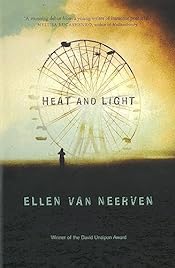
This book of short stories gives no external indication that it’s a work of Blak queer fiction. The back cover and introductory pages describe the contents accurately enough – traditional story telling with ‘a unique contemporary twist’, characters ‘caught between a desire for freedom and a sense of belonging’ – but make no reference to First Nations, unless you count mention of the NSW Premier’s Literary Awards – Indigenous Writing, and the David Unaipon Award, and a discreet badge that reads ‘Black Australian Writing’. Queerness gets even less acknowledgement: apart from a quote from the ABR that the stories ‘evoke mystery and sensuality in equal measure’, there’s no mention of sexuality at all.

So let me tell you: this is a book in which there’s a lot of sex. In most of the stories, queerness and Blakness are taken for granted.

Having got that off my chest, I can tell you that this collection of stories by Mununjali Yugambeh writer Ellen van Neerven is terrific. It’s in three parts: ‘Heat’, five stories that amount to a compellingly compressed family saga; ‘Water’, a single longer story that is the big surprise of the collection; and ‘Light’, ten tales of complex intimate relationships. Most, perhaps all, the main characters are First Nations and most of the action takes place in either Queensland or Western Australia. (One character refers to my home as ‘slimehole Sydney’.)

Page 76 (still my age) comes part way through ‘Water’. The story is set in a future Australia, where ‘Aboriginal spirituality’ is a dominant religion, and President Tanya Sparkle is implementing some dire policies regarding First Nations people while presenting a veneer of respect – creating chaos in the public transport system by changing all route destinations to not-always-accurate Indigenous names and, at the heart of this story, re-forming offshore islands to create a ‘super island’ where Aboriginal people can apply to live, a kind of apartheid dressed up as innovative native title.

The reader has barely settled in to this brave new Australia, when further weirdness is revealed. The narrator has been employed as ‘Cultural Liaison Officer’ for the first re-formation project, in the islands of Moreton Bay. Her job places the story well into the realm of the fantastic: she is to liaise with non-human beings who have recently appeared on the islands, the ‘plantpeople’. Page 76 introduces them:
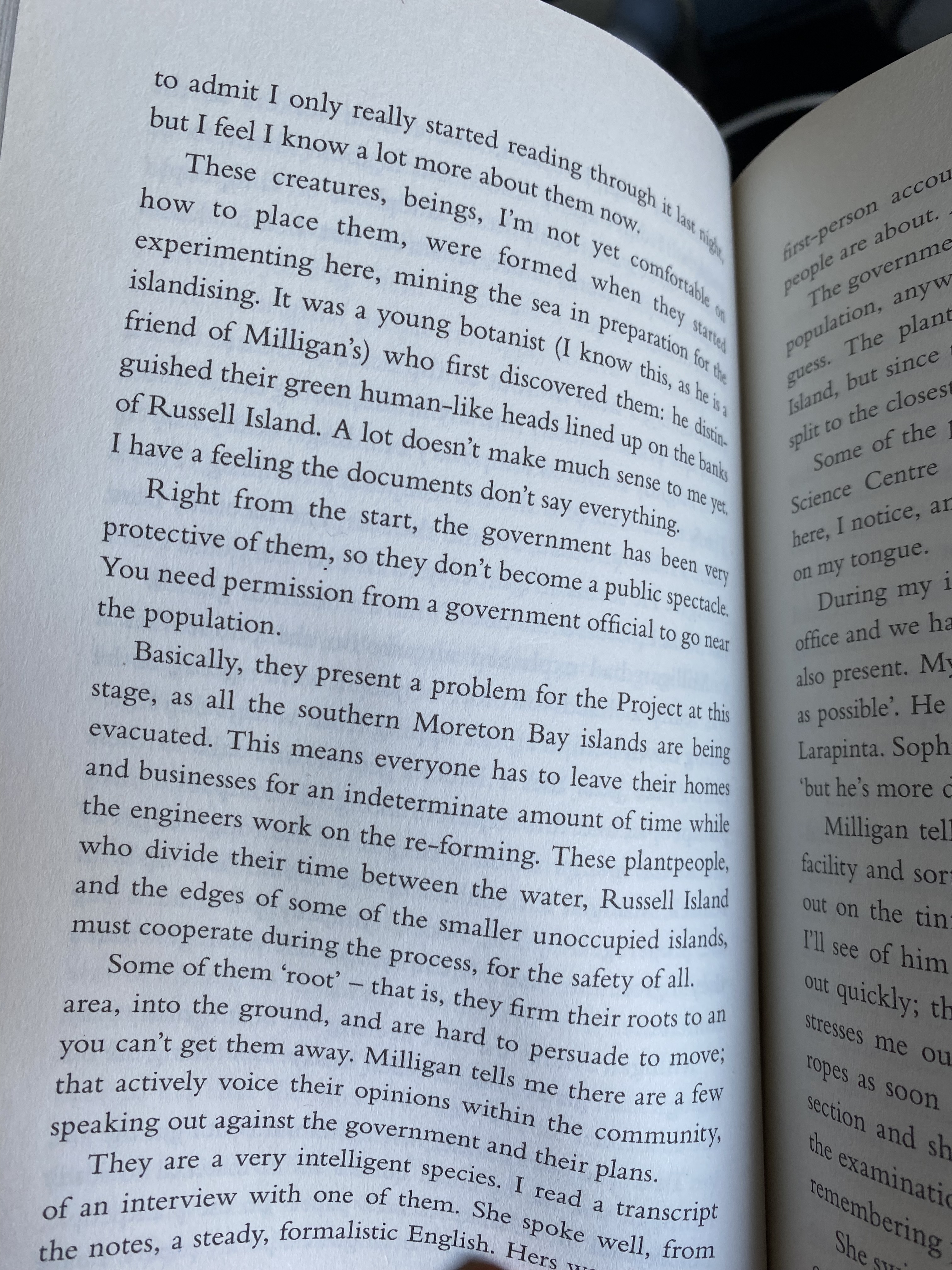
These creatures, beings, I’m not yet comfortable on how to place them, were formed when they started experimenting here, mining the sea in preparation for the islandising. It was a young botanist … who first discovered them: he distinguished their green human-like heads lined up on the banks of Russell Island …

Right from the start, the government has been very protective of them, so they don’t become a public spectacle. You need permission from a government official to go near the population.

Basically, they present a problem for the Project at this stage, as all the southern Moreton Bay islands are being evacuated. This means everyone has to leave their homes and businesses for an indeterminate amount of time while the engineers work on the re-forming. These plantpeople, who divide their time between the water, Russell Island and the edges of some of the smaller unoccupied islands, must cooperate during the process, for the safety of all.

Some of them ‘root’ – that is, they firm their roots to an area, into the ground, and are hard to persuade to move; you can’t get them away. Milligan tells me there are a few that actively voice their opinions within the community, speaking out against the government and their plans.

They are a very intelligent species. I read a transcript of an interview with one of them. She spoke well, from the notes, a steady, formalistic English. Hers was the only first-person account and insight I have into what these people are about. A plant’s mind.

So in the middle of a collection of more or less social-realist stories about queer Blak life in Australia, there’s a weird – and very funny – piece of fantasy science fiction.

It’s a complex set-up. The Cultural Liaison Officer’s job is to persuade the plantpeople to cooperate, to allow themselves to be displaced. At first she is successful – she gets on well with these non-human creatures and comes to believe, as her white employers don’t, that they are fully sentient. As her sympathy for their plight deepens, she comes to suspect a darker purpose behind her ‘liaison’ work. She forms a forbidden bond with Larapinta, a female of the species, and that bond … well, I already said there’s a lot of sex in this book. But then there are further twists as the origins of the plantpeople are revealed and the parallels with the original dispossession of First Nations peoples on this continent come into sharp focus.

Ellen van Neerven is better known as a poet than as a fiction-writer. Their two books Comfort Food and Throat (links are to my blog posts) are wonderful. I found Heat and Light in a street library. I’m not parting with it.

Yumna Cassab’s Australiana

Yumna Cassab, Australiana: A Novel (Ultimo Press 2022)

I came to this book with inappropriate expectations. I had just read Dean Ashenden’s Telling Tennant’s Story and Julianne Schultz’s The Idea of Australia, and the title Australiana seemed to suggest a similar attempt to speak to the state of Australian culture – possibly, given the author’s name, from a non-Anglo perspective. If those other books hadn’t been in my mind I might have expected an ironic treatment of clichés of national identity, like kangaroos, slouch hats, or Big Things.

But neither of those expectations was met. As far as I can tell there is no attempt at a grand unifying statement about Australia, and there’s no cute wildlife or cultural kitsch. Nor is the book a novel, as proclaimed in small print on the cover (but not on the title page, which makes one suspect that it was the cover designer who added the descriptor). It’s a number of short fictions.

There are five stories, all more or less presenting grim sketches of life in rural New South Wales, up Tamworth way. The first and longest, ‘The Town’, is the most interesting. It consists of roughly 30 short pieces – ranging from half a dozen lines to seven pages in length. Most pieces pick up a detail of the previous one – a character, an action, a piece of furniture – and place it in a different story, as if the writer’s attention is caught by a detail in one story and lets it lead her (and us) where it will. What emerges is not so much a mosaic of country town life as a meander through parts of it: there’s flood, fire, and drought, so maybe a hint of a grand national panorama in the background.

In the first piece, an unnamed character has his house broken into a number of times, and on the fourth time he has a weirdly amicable chat with the intruders. Subsequent pieces introduce us to the intruders, and then to other people in their lives. The pattern repeats: asomething happens, then we see it from another perspective, and what had seemed arbitrary, weird or perhaps insane, becomes comprehensible – or vice versa. The writing is spare, and trusts the reader to make the connections – even sometimes to make them up.

If you picked the book up in a bricks-and-mortar bookshop and turned to page 76 to check it out, you would be in the midst of the section ‘The Knife and the Axe’, featuring a man consumed with anxiety when his nine-year-old daughter invites a friend home from school. The friend, we know from the previous story, has set fire to his father’s fields in reaction to something his father did that enraged him:

Would you believe it? No, he did not believe it. His own daughter was nine years old and he tried to imagine her burning their home or even the fence and he couldn’t. She would never do it. She had pigtails and ribbons and went around in a dress and polished shoes. His little Mia would never do that.

He truly believed that until she brought Jayden around after school. She told her dad that Jayden was in her class and he was afraid to go home, could he stay a while, please.

That’s all we hear about the aftermath of the boy’s arson in his own home. This story stays resolutely with the point of view of the girl’s father, and becomes a tale of parental paranoia:

He hid the matches and the lighter before they entered the house and he worried about the fireplace giving Jayden ideas. So he seated then at the dining table with their backs to where the fire could have been.

Not to spoil the episode for you, but his anxiety cranks up when the children go to Mia’s bedroom and Mia asks for a candle. ‘The Knife and the Axe’ ends with a classic horror-movie cliffhanger (I should mention that the fragments in this and the other stories move in and out of a range of genres, including fairy tale and prose poem and micro fiction), as the children, armed with a knife and an axe, come towards him demanding that he give them candles:

He turned and ran for the door but he didn’t make it that far. As he fell to the ground he thought: I never imagined my life would end like this.

(Page 79)

And the next section, ‘Lost’, picks up the story from his wife’s point of view. I won’t disclose why he failed to reach the door beyond saying that the story isn’t lacking in sardonic humour.

As befits such a set of linked episodes, the final one returns to an object that was stolen in the first.

Each of the other four stories is similarly made up of short, sometimes very short sections. Three of them are grim contemporary tales, and the fourth, ‘Captain Thunderbolt’, is a mix of narrative, verse, and reflective essays inspired by the lingering presence of the titular bushranger in the New Englandregion.

I still don’t understand the book’s title. I suppose ‘Tamworthiana’ or ‘New Englandiana’ don’t have much of a ring to them.

Edwidge Danticat’s Everything Inside

Edwidge Danticat, Everything Inside (riverrun 2019)

Edwidge Danticat (Haitian Creole pronunciation: ɛdwidʒ dãtika) is a Haitian-born writer whose first novel, Breath, Eyes, Memory, was published in 1994. Since then she has published other novels, short stories, children’s and Young Adult books, memoirs essays – a substantial body of work. Everything Inside, a collection of eight short stories, is the first of her books I’ve read, but I didn’t feel I was coming in late. Each of the stories is a fresh beginning, inviting the reader to enter into the lives, and in some cases deaths, of a newly-created group of characters.

Almost all the characters are Haitian immigrants to the US, or immigrants from other Caribbean nations. The stories mostly focus on relationships among women, often but not always with men in the mix – a dying father, one corner of a love triangle, an ex who has suffered a terrible loss, a sexual exploiter, the prime minister of a small Caribbean island nation. (The least successful story, ‘Without Inspection’, is the only one with a man at its centre.)The women’s relationships cross generational and class barriers, so that what emerges from the stories taken as a whole is a complex picture of Haitian diasporic life. In ‘Hot-Air Balloons’, for instance, a young woman’s college non-Haitian room-mate goes on a working trip to Haiti where she sees at first hand the terrible suffering of poor women at a rape recovery centre in a poor neighbourhood of Port-au-Prince. The room-mate decides at first to quit college in order to volunteer for the non-government organisation that arranged her trip. The young woman who stays behind does so because she wants her first experience of her parents’ home to be of its physical beauty, not of its suffering people. The story is told with deep sympathy for both points of view, but in the end we are left with an aching sense of the gulf between the hard-won privilege of the protagonist and those women at the rape centre.

The 2010 earthquake looms as a backdrop to some of the stories. Poverty and corruption in Haiti and Miami, and the US’s immigration regime have devastating effects on people’s lives, but complex human beings remain front and centre. As I read this book, I had at the back of my mind a quote from W E B Dubois in the ‘backmatter’ of the Afican-American comic series, Bitter Root (my blog post here):

All Art is propaganda and ever must be, despite the wailing of the purists. I stand in utter shamelessness and say that whatever art I have for writing has been used always for propaganda for gaining the right of black folk to love and enjoy. I do not care a damn for any art that is not used for propaganda.

(Criteria of Negro Art, 1926)

If this book is propaganda, it lacks the stridency or sense of hidden agendas usually associated with that term. But my guess is that W E B Dubois would approve of it as it asserts that ‘black folk’ do love and enjoy as well as laugh, weep, make music, form unbreakable childhood bonds, and face difficult moral dilemmas.

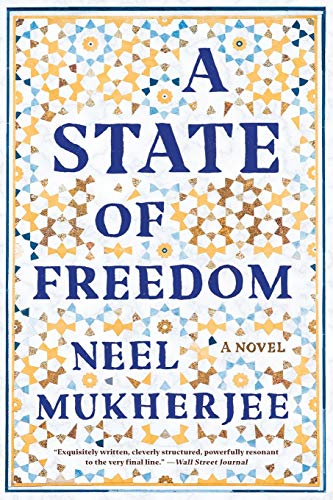
Neel Mukherjee’s State of Freedom

Neel Mukherjee, A State of Freedom (W W Norton & Co 2019)

Short stories don’t sell. At least, I believe that’s the prevailing wisdom among publishers. That’s probably why this excellent collection of short stories – or more accurately three short stories and two novellas – has been marketed as a novel. Still, if that’s what it takes to draw readers in, then why not?

All the stories happen in India, though they are five different Indias. An expat returns from the USA with his seven-year-old son, and takes him to see the Taj Mahal and Fatehpur Sikri; another expat, this one from England, visits his parents and gets to know their cook; a man from a poor village goes on the road with a dancing bear; a girl from another poor village is sent off to a life of domestic servitude in ever bigger and further away cities, while her best friend joins the Maoist guerrillas; a man suffering from asbestosis does dangerous construction work in a city far from his home village.

All the protagonists are dislocated. Some of them turn up as minor characters in another’s story: the bear man is the twin brother of the man with asbestosis, and both of them, having left home intending to send money back, have left their wives and children to fend for themselves. The cook in the second story has it in for another servant, who turns out to the the girl in the fourth story.

These are grim stories. The first starts out like a mini-travelogue, though one with a dark cloud over it, and ends with devastating heartbreak; in the second, what might have been a piece of food-tourism comes hard up against the desperation of the poor; and in the rest, the harsh inequalities of class destroy people’s lives. There’s a Reading Group Guide up the back of my copy, which I skimmed. These notes insist that this is a novel with a brilliant structure. Perhaps they’re referring to the way the stories are ordered as a descent into ever more desperate situations.

It’s a grim book, and a beautifully written one. There’s some romance, some intrigue, some terrible domestic violence and cruelty to animals, but also kindness and a glimmering promise that things might improve.

I’ve read it during the Great Covid–19 Lockdown, and am writing this with cold symptoms waiting in strict isolation for the results of a Covid test [test came back negative about six hours after I wrote that]. Without wanting to trivialise the situation of the character, here’s a passage that seems to speak to my current situation and may give you a feel for the writing, and also a sense of the irony in the book’s title. Milly, the protagonist, is working as a maid in Mumbai, and her employers have forbidden her to leave the apartment block:

It was not that she needed to go out – where would, could, she go, in this endless city, without knowing anyone? – but something so fundamental denied is that thing made disproportionately enormous, consuming, and she began to think of herself as a caged bird, defined by the fact of nothing except its imprisonment …

She experienced a new feeling, at night, of the kitchen walls inching forward slowly from all four sides to crush her, lying in the middle. Their hut in the village had been tiny and eight of them had to sleep together, huddled, but she had never thought of that as small. Besides, there was always the great open outside – fields, forests, groves, river bank. The idea of space of something small or big, something that could be reduced, had never occurred to her, not even on the train, in the general compartment so dense with people that the air had sometimes felt too thick to breathe. not even in that battery-cage had the thought ever crossed her mind that ‘this is too small’. Now, in a Mumbai flat bigger than any house she had ever known, she felt trapped and squeezed.

(Page 228)

Sound at all familiar?

My copy of A State of Freedom is a loan from my book-swapping club.

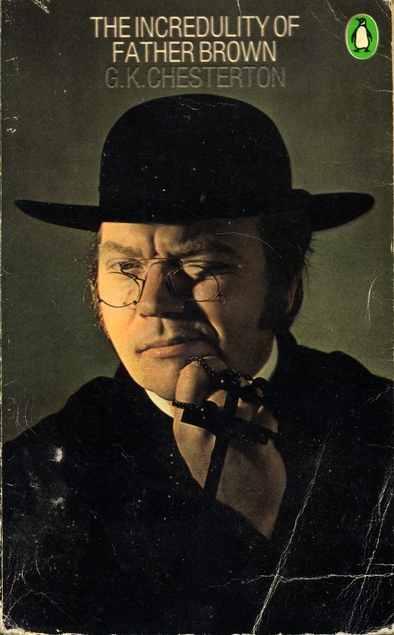
G K Chesterton’s Incredulity of Father Brown

G K Chesterton, The Incredulity of Father Brown (©1926, Penguin 1958, reprinted 1970)

On my eleventh or twelfth birthday, my parents gave me The Father Brown Omnibus, a doorstop of a book containing all 53 of G K Chesterton’s Father Brown stories. If they hoped it would break my addiction to Agatha Christie and Ngaio Marsh, they were to be disappointed, but I did love Father Brown, and once I’d read all his stories, I sought out everything I could find by Chesterton: the autobiography, essays (including ‘On chasing after one’s hat’), his books on Francis of Assisi and Thomas Aquinas, Orthodoxy, some poetry (‘I don’t care where the water goes/ If it doesn’t get into the wine’) and more. I loved his way with paradox. I thought his aphorisms, ‘Blessed is he who expecteth little, for he shall often be surprised,’ and ‘Anything worth doing is worth doing badly’ were words to live by.

Then, having not read anything by him for roughly half a century, I found this slim, yellowing paperback in a street library.

The Incredulity of Father Brown was the third of five collections, and contains eight stories. Father Brown’s nemesis Flambeau doesn’t appear, and more action takes place in the USA than I remember. Most of the stories are locked-room mysteries: someone was murdered in a room that no one else could have got into or out of. There’s an arrow, a sword-stick and a noose, all ingeniously deployed, and a couple of corpses that aren’t who or what they seem. All the elaborately conceived crimes are solved by the brilliantly pragmatic but unassuming little priest (the reader doesn’t have a fighting chance of figuring them out).

Not all the murderers are arrested, or even identified. These aren’t stories in which the detective reassuringly restores order by bringing criminals to justice. The interest lies elsewhere: first in the pleasure of the puzzle, and secondly in the platform they provide for Chesterton to preach his particular form of Catholicism. This collection (and possibly the whole Father Brown corpus – I can’t claim to remember) has at its heart a paradoxical assertion that a man of faith like Father Brown is less vulnerable to being hoodwinked by ‘spiritual’ claims than a modern ‘secular’ person. In these stories, God is real and There’s a Perfectly Natural Explanation for Everything Else. Father Brown himself, usually mild-mannered and Britishly polite, has occasional angry outbursts about ‘heathen humanitarians’. The polemic gets most explicit in ‘The Miracle of Moon Crescent’:

‘By the way,’ went on Father Brown, ‘don’t think I blame you for jumping to preternatural conclusions. The reason’s very simple, really. You all swore you were hard-shelled materialists; and as a matter of fact you were all balanced on the very edge of belief – of belief in almost anything. There are thousands balanced on it today; but it’s a sharp, uncomfortable edge to sit on. You won’t rest till you believe something; that’s why Mr Vandam went through new religions with a tooth-comb, and Mr Alboin quotes scripture for his religion of breathing exercises, and Mr Fenner grumbles at the very God he denies. That’s where you all split: it’s natural to believe in the supernatural. It never feels natural to accept only natural things. …’

That’s rubbish of course. But the underlying paradox of a man of religion who is more immune to oogy-booginess than a wide range of hardboiled types is fun to read

My only specific Father Brown memory from 60 years ago wasn’t of anything in this book. It’s an observation in ‘The Vanishing of Vaudrey’ in The Secret of Father Brown. It took some searching, because I didn’t hve the exact words, but I found it eventually:

… there are two types of men who can laugh when they are alone. One might almost say the man who does it is either very good or very bad. You see, he is either confiding the joke to God or confiding it to the Devil.

Again, that’s nonsense, but I can testify that it’s memorable nonsense, because it lodged in my memory. I loved it for its audacity, or maybe just for its cleverness. And it’s the kind of thing I still enjoy in Chesterton. I should mention that there’s plenty of colonialism, racism, antisemitism and sexism (women being mainly absent in this volume). It’s hard to be an unqualified fan, but I’m not sorry to have revisited these stories.

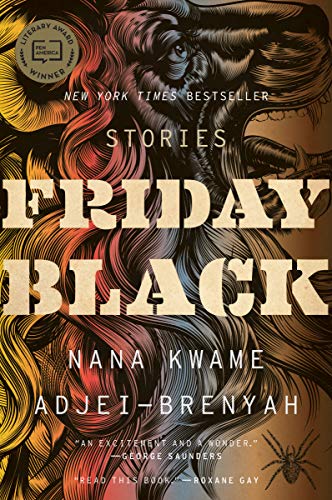
Nana Kwama Adjei-Brenyah’s Friday Black

Nana Kwama Adjei-Brenyah, Friday Black (Mariner Books 2018)

The Black Lives Matter movement looms large in the warp and weft of this book, especially in the first story, ‘The Finkelstein 5’, which features an activity known as Naming – African-Americans brutally kill random white people while shouting the names of the victims of a hideous racist murder –, and in ‘Zimmer Land’, in which a theme park named for Trayvon Martin’s killer caters to white men acting act out fantasies of killing young African-American men.

But it’s a long way from being a political manifesto. This is strong, beautifully crafted fiction, with a weird, fantastic edge to it: the killer in ‘The Finkelstein 5’ dismembered five teenagers in a parking lot with a chainsaw and was still found not guilty because he argued that what he did was for his own children; and the protagonist in ‘Zimmer Land’ wears a hi-tech suit that enables him on the one hand to become hugely threatening to the customers and on the other hand not be killed when they shoot him.

The other stories are less violent – though there is one set in a department store that involves a callous acceptance of the death of many customers in the Black Friday sales. (I was being all complacent about us not having such a barbaric ritual in Australia despite the efforts of Amazon and others to impose it – here Black Friday refers to some terrible bushfires – when I saw a news item about people being crushed in a mall in Parramatta, and the story retrospectvely took on a much more urgent feel.)

The sensibility behind the stories has a lot in common with Jordan Peel’s brilliant, borderline-horror movies, Get Out and Us. As in those movies, the stories are the thing, and the implications trail behind them like the tails of comets, staying in the mind a long time.

My copy was a gift from a friend who bought the book in New York to read on the flight home. He thought that because I enjoy China Miéville I would like these stories. I have no idea if Nana Kwama Adjei-Brenyah has even heard of China Miéville, but my friend was right about my response to the book.

The Book Group and Gerald Murnane’s Collected Short Fiction

Gerald Murnane, Collected Short Fiction (Giramondo 2018)

murnane.jpg

Before the meeting:
Gerald Murnane has been described as ‘Australia’s most distinguished unread writer’. His most recent novel, Border Districts, is shortlisted for this year’s Miles Franklin Prize. He is the author of seven other novels, two books of essays and a memoir as well as the 20 short fictions in this book, which have previously been gathered in three collections: Velvet Waters (1990), Emerald Blue (1995) and A History of Books (2012).

My introduction to Murnane was ‘The Breathing Author’, an essay published in Heat 3 (New Series) in 2002, in which he portrays himself in such a negative way (‘I cannot recall having gone voluntarily into any art gallery or museum or building said to be of historic interest’) that I felt absolutely no desire to read more.

So when the Designated Book Chooser chose Murnane’s  Collected Short Fiction for our August meeting, I was less than thrilled.

And now I’m grateful to the Book Group for once again taking me places I wouldn’t otherwise have gone. The book may not be everyone’s cup of tea, but I was enthralled – I loved it.

It’s hard to say why I loved it. These fictions (every time you see that word here, I have first typed ‘stories’, and then deleted it and replaced it with ‘fictions’) have no named characters (unless you count the uncle of the main character in the third last story who is given the name Nunkie), they generally have very little action, and it’s sometimes hard to see how they even hold together. They feature an obsessive repetition of words and phrases and constantly draw attention to themselves as something being written. If the word ‘introspection’ didn’t exist it would have to be invented to describe them.

What do they have? Well, the narrator of one of the stories, ‘In Far Fields’, who is described in the story itself as its implied author (that is, I think, he is implied to be Gerald Murnane), describes to a hypothetical student his own approach to creating fictions. He begins by writing a sentence, which is ‘a report of a detail of an image in [his] mind’, an image that ‘was connected by strong feeling to other images in [his] mind’. He then proceeds to write a sentence that is a report of a detail of another image that was connected by feelings to the first image. And then a third image, and so on. This chain of images forms the basis of the story. It becomes complicated after that, but it’s worth quoting a little from near the end of his talk to the hypothetical student:

Before she left my office, I would tell her, as a last piece of advice, that she need not have learned the meaning of every image reported in a piece of fiction before she had finished writing the final draft. Nearly every piece of my fiction, I would tell her, included a report of an image whose connections I did not discover until long after the piece had been finished. Sometimes these connections had not appeared until I was writing a later piece of fiction, and then I would understand that the image in the earlier piece of fiction was connected with an image in the later piece.

I think it’s this sense that the (implied) author is always exploring something that involves deep and not yet understood emotion, not knowing where the writing is taking him, that kept me pretty much spellbound on almost every page of this book. The prose is generally dry, methodical, self-referential, but the analogy that come to my mind is of an archaeological dig in a temple of Aphrodite: meticulous brushing, digging, scraping around objects that speak for themselves of great unruly passion.

One effect of this approach is that no distinction is made in the text between memory and fantasy. Most of the fictions feel autobiographical, but that isn’t the point: the reader is invited/expected to respond to the images and the fiction that connects them without knowing or caring if they come from Murnane’s actual life. Many of the images that the fictions ‘report’ are scenes from rural Victoria, and I expect that readers from that part of the world would feel an extra connection with the writing. Another whole swathe of images relate to the Catholic childhoods and adolescences of the unnamed main characters, and it’s probably these that led me to a deeper emotional engagement.  ‘Pink Lining’ is an example. It begins:

The image that caused me to begin writing this story is an image of a single cloud in a sky filled with heaps or layers of clouds. The single cloud and all the other clouds in the sky are coloured grey, but the single cloud is surrounded by an aureole or nimbus of pink.

It turns out that this image is on a holy card preserved from the narrator’s childhood. Adult, non-believing cynicism having been raised and brushed aside, the image leads to memories of the narrator’s favourite aunt, a pious woman, bedridden since the age of twelve, who taught him a lot about Catholic teachings. The story of the narrator’s relationship to that aunt emerges, and the fiction wanders through other parts of his life, with every now and then a tight focus on the colour of a wall, a pink holy water font, a sky ‘filled with heaps or layers of grey clouds’. Here’s perhaps the most dramatic paragraph (which reports on one of the key images of the piece):

At certain times during the years following his twenty-fifth year, the man who was first mentioned in the second paragraph of this story believed that he had never looked at or touched the naked body of any woman before his twenty-fifth year. At other times during the years just mentioned, the man believed that he had looked at the naked body above the waist of a certain woman during his fifth year. Whenever the man believed what is mentioned in the previous sentence, he believed that he had seen, after he had opened the door mentioned in the previous paragraph, the naked body above the waist of his favourite aunt as she leaned over a dish of white enamel filled with water and on that body two breasts, each with a nipple surrounded by a zone of pink. Whenever the man believed what is mentioned in the sentence before the sentence mentioned in the previous sentence, he believed that he had seen, after he had opened the door just mentioned, the naked body above the waist just mentioned and the dish filled with water just mentioned and on the body the nipples of a girl whose breasts had not yet begun to grow,

The affectless, asperger-ish quality of this is typical of Murnane’s prose. The prim but eloquent silence about what happened when the man was 25, and then the pedantically framed account of what he had seen when he was five (leaving the reader to imagine the emotional content of the experience) have a feel I recognise from my own Catholic childhood: some things simply aren’t meant to be spoken of, especially if sex or the naked human body is involved. (My mother’s response to The Female Eunuch comes to mind: ‘You don’t look over people’s shoulders when they’re brushing their teeth, so why do it with that?’) The result, though, is that moments like this or the final words of this story, which quote a line from a song ‘previously mentioned’, pack a huge punch.

Now that I have actually read this book, I am left wanting more: maybe I should start with Murnane’s first novel, Tamarisk Row. I am immensely grateful, not only to this month’s Designated Book Chooser, but also to Giramondo for my complimentary copy.

The meeting:
There were six of us. One of the absentees said on the phone, in a voice affected by a heavy cold, that he thought Murnane used a lot of words to say almost nothing. But those of us who ate the spinach pie and ice creams found a lot to talk about. In fact, we probably stayed with the book more than any other night except maybe Anna Karenina. I wouldn’t say everyone was wild about the book, and only three of us had read all 20 stories (plus one was part way through Border Districts), but we had all engaged with the writing, with Gerald Murnane’s mind (or to be more precise his way of writing about his mind).

One chap came back from a toilet break saying, ‘I’ll give him a hundred percent for slowing time down. I love dance and music that does that, and he’s done it  in writing.’ I think he meant that Murnane’s fiction moves from emotionally charged image to emotionally charged image is something that we all do, but what we do in fractions of a second, he slows down and dissects meticulously.

Someone quoted from a review that said that with Murnane’s writing, what matters is what you find yourself thinking about as you read it. That struck a chord: some of us had found ourselves reflecting on our intensely religious upbringings; others on our connection to the land where we live; others still on the complexities of early adolescent attitudes to sex.

Someone said that even when Murnane is annoying – and at least one person said he’d felt like throwing the book across the room more than once – he’s interesting. Someone said he’s cruel, leading the reader in one direction and then springing a nasty surprise. Others disagreed, reading him as not really caring how the reader responds, but following the logic of his own process. In fact, we generally felt there was a ruthless honesty in his self-exploration.

When someone gave a 30 second version of one of the stories, it produced belly laughs, which for me at least was a revelation, as I hadn’t found the story funny when I read it in its own tempo.

That is to say, I’d recommend these short fictions as an excellent choice for a book group.

Andy Kissane and the Swarm

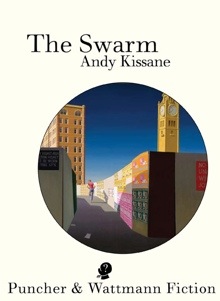
Andy Kissane, The Swarm (Puncher and Wattmann 2012)

20121003-175856.jpg I read this collection of Andy Kissane’s short stories a month or so ago, just after reading some Chekhov stories for the first time. (The reason for the delay in posting is that – a rare event for me – I received an advance copy from the publisher, and the book isn’t being launched until Sunday.) The stories in The Swarm made me realise, with some embarrassment, that I had read Chekhov as if I was visiting a museum: it was interesting, instructive, challenging, but all at arm’s length, preserved, from another time and place. Andy Kissane’s stories are as alive and immediate as neighbourhood gossip.

Partly that’s because these stories, all except two, are set in the present. And partly because of the book’s strong sense of place. Most of the action takes place in an inner city landscape as distinctive as Chekhov’s rural villages, and the characters – musicians, mostly unsuccessful actors, a twenty-something artist, a young mother screwing up her courage to invite her recently widowed father to move in – are as much part of that landscape as Chekhov’s peasants, idlers and provincial bourgeoisie are of theirs. I imagine the sense of the local in these stories would appeal to any reader, including one for whom the Marlborough or St Vincent’s are no more than names, but it’s especially sweet to me because by and large, it’s my local.

[About 200 words about being a North Queenslander deleted here.]

A sense of place doesn’t make a good story, of course. And there is a lot more than that to enjoy here. Again and again a commonplace experience is seen freshly, charged with moral or emotional meaning the way commonplace things often are. A young man stands at a condom vending machine in a pub toilet. A couple spend an evening playing Monopoly when the TV set has died. An old man cleans up his daughter’s yard. A musician watches his cello being played badly by a prospective buyer. A man (who could have come from the pages of On Western Sydney) boasts of car-related derring-do. Looking at that fairly random list of closely observed, mostly domestic events, I realise that the common subject of the stories is love: romantic love, parental love, love betrayed, love unfulfilled, love surprisingly revived or belatedly recognised. Nothing flashy, just a deepening sense of what it means to be human and in connection.

The historical stories – ‘A Bright Blue Future’ and ‘A Mirror to the World’, about asbestos mining at Wittenoom and racist frontier violence respectively – mostly keep to a similar domestic perspective. They too can be read as about love – one man makes disastrous moral compromises out of concern for his family’s short-term wellbeing; tentative overtures between Aboriginal Australians and settlers end in disaster.

‘A Mirror to the World’ is the longest and most ambitious story in the collection. It is based on an incident that happened in Rockhampton in the 1870s – an incident, interestingly, that’s interpreted quite differently in Ross Gibson’s Seven Versions of an Australian Badland. At least, one of the story’s two narratives is based on that incident. The other belongs to the author–academic who is writing that historical narrative, in between running a creative writing course where he lectures on multiple narratives, mise-en-abîme and other devices that are used in the story itself. So, yes, unlike the other ten stories it draws attention to itself as an artefact. It does this in other ways as well. There are explicit references to at least two other stories in the collection: a character from one makes an offstage appearance, and a situation from another is echoed in detail. It’s cleverly done, and there’s a final twist that crowns the cleverness, but it serves a serious purpose. As the story turns back on itself, it opens the way for questions about what it means for a white Australian to tackle the appalling injustices of our colonial past, about the question of moral judgement, the difficulty of imagining the inner world of the early settlers without either surrendering or imposing a modern perspective. The ending is both a technical delight and a moral/political challenge. It’s a story I’d love to discuss – but not here, not to spoil it for people who haven’t read it.

Full disclosure: As well as receiving a free book, I have a degree of commitment to Andy Kissane’s work, since the script for the short film currently known as Scar!, which regular visitors here will know I co-wrote, was inspired by his poem ‘The Station Owner’s Daughter, Narrandera’.

Janette Turner Hospital’s Forecast: Turbulence

Janette Turner Hospital, Forecast: Turbulence (Fourth Estate 2011)

This collection of nine short stories and a memoir has been shortlisted for a number of awards and it may have won some. Sentence by sentence it’s very well written. It is populated by a range of eccentrics, outsiders and non-neurotypicals and should have been interesting. But as far as I was concerned it didn’t touch the sides. I didn’t believe a word of it, even the memoir, which I know is truthful. Newspaper reviewers seem to have loved it, though I’m not convinced they’ve all actually read it.

That is all.

The Book Group reads Chekhov short stories

Anton Chekhov, The Lady with the Little Dog and other stories, 1896–1904 (translated by Ronald Wilks, Penguin 2002)

I was enthralled by The Brothers Karamazov when I was 16 – the Grand Inquisitor raised the hairs on the back of my Catholic neck – but have so far managed to read very little of other 19th century Russian writers. The Book Group made me read Anna Karenina a while back, and now it’s Chekhov.

Before the meeting:
Knowing that Chekhov is one of the masters of the short story, I was vaguely expecting a display of virtuosity – cleverly constructed mechanisms with twists in the tail, perhaps, like O Henry’s ‘The Gift of the Magi’ only profound. The stories in this late collection aren’t like that at all. (I don’t know about his earlier stories, and it would probably have been better to start with some of them.)

To generalise, the stories are studies in Russian provincial life at the turn of the twentieth century. It’s hard if not impossible to read them now without an awareness that the Communist revolution was on the horizon. Chekhov’s picture of the oppression of the peasants, the hand-wringing of liberal land-owners and the viciousness of others, the flailing about of the intellectuals, and the way the economic and social system stifles and corrupts everyone, clearly reflects a world ripe for revolution. Not that he calls for revolution, but he does lay out the inadequacy of anything else on offer. These are stories, not tracts. They contain a lot of argument, but they don’t push a line – or if they do, it’s in terms that have become impenetrable to this casual reader a century and a hemisphere away.

In ‘The House with the Mezzanine’, when a socially responsible woman chides the artist–narrator for having no interest in such matters as the creation of a clinic for peasants, he replies that on the contrary the question interests him a great deal, and in his opinion the peasants do not need a clinic:

‘To my mind, with things as they are, clinic, schools, libraries, dispensaries only serve to enslave people. The peasants are weighted down by a great chain and instead of breaking this chain you’re only adding new links … What matters is not Anna dying in childbirth, but that all these peasant Annas, Mavras and Pelageyas toil away from dawn to dusk and that this unremitting labour makes them ill. All their lives they go in fear and trembling for their sick and hungry children. … You come to their aid with hospitals and schools, but this doesn’t free them from their shackles.’

And he goes on. Up to the point where he starts talking about spirituality, he could be a hardline lefty of a couple of decades ago railing against reformism. In the story, the dilemma is not resolved. At the end the peasants are still suffering and the narrator, without explanation and perhaps symbolically, fails to find true love. (A while after I’d written that, I came across this quote from Chekhov’s correspondence:: ‘You … are confusing two concepts: the solution of a problem and the correct formulation of a problem. Only the second is required of the artist.’)

Or take this rant in ‘Gooseberries’, in which a character is talking about his brother, who chose to live a contented life on a small farm. It could be 21st century polemic against the self-help industry:

It’s obvious that the happy man feels contented only because the unhappy ones bear their burden without saying a word: if it weren’t for their silence, happiness would be quite impossible. It’s a kind of mass hypnosis. Someone ought to stand with a hammer at the door of every happy contented man, continually banging on it to remind him that there are unhappy people around and that however happy he may be at the time, sooner or later life will show him its claws and disaster will overtake him in the form of illness, poverty, bereavement and there will be no one to hear or see him. But there isn’t anyone holding a hammer, so our happy man goes his own sweet way and is only gently ruffled by life’s trivial cares, as an aspen is ruffled by the breeze. All’s well as far as he’s concerned.

There’s a lot of grim humour. The wedding celebration in ‘In the Ravine’ could have been the inspiration for Jack Hibberd’s Dimboola – but audiences laugh at the latter, while any laughs at the former are tinged with despair and disgust. And the stakes are raised by the peasants outside, one of whom shouts, ‘You’ve sucked us dry, you rotten bastards. You can all go to hell!’ That moment, of course, quickly passes as the peasants too join the celebratory mood. But the reader has been warned.

Chekhov isn’t one of those writers who ties everything up in a neat little bow. In ‘In the Ravine’ when a baby is murdered, his mother is blamed and the murderer goes free – but we are given no explanation for the mother’s failure to defend herself or other people’s silence about the cruel injustice. ‘The Lady with the Little Dog’ is a love story. Instead of ‘happily ever after’, it ends, ‘ And both of them clearly realised that the end was far, far away and that the most complicated and difficult part was only just beginning.’ Which is my sense of what all the stories are saying, about everything.

I’ve seen Eudora Welty quoted on the Internet as saying, ‘Reading Chekhov was just like the angels singing to me.’ That transforms my sense of what an angel can be.

The meeting: This meeting was postponed a number of times because I was hosting it and I was down with a heavy cold. As a result, most people’s recollection of the stories wasn’t very precise, but we’d had time to absorb them – in particular I had read some new Australian short stories (about which I’ll post separately), and my appreciation of the Chekhov had grown with the comparison. A big impediment to our discussion was that, as it turned out, we’d read different books: three of us had read The Lady with the Little Dog and other stories, 1896–1904. Others had read Lady with Lapdog and other stories, translated by David Magarshack, which contains a different set of stories (damn you, Penguin, for giving different books almost identical names!). The only stories in both books are ‘The House with an Attic’ aka ‘The House with the Mezzanine’, ‘Ionych’, and ‘Lady with Lapdog’ aka ‘The Lady with the Little Dog’.

We had a lively discussion. I think Chekhov was a bit of a surprise for everyone – not enough story for one chap (who thought the title of ‘A Boring Story’ said everything that needed to be said about it), a bit on the grim side for another, surprisingly modern in his discontinuities and sexual morality, surprisingly not, or not always, about the sufferings of the peasants.  At one stage, for the benefit of someone who hadn’t read it, I gave a synopsis of ‘The House with the Mezzanine’. It seemed a bit on the incoherent side, and then someone realised that I’d thrown in a key scene from another story altogether. Will I ever be trusted again?

Since the meeting, I found ‘A Dreary Story‘ on the internet in Constance Garnett’s translation (I think). There’s a wonderful passage near the beginning that could have been about me:

 I write poorly. That bit of my brain which presides over the faculty of authorship refuses to work. My memory has grown weak; there is a lack of sequence in my ideas, and when I put them on paper it always seems to me that I have lost the instinct for their organic connection; my construction is monotonous; my language is poor and timid. Often I write what I do not mean; I have forgotten the beginning when I am writing the end. Often I forget ordinary words, and I always have to waste a great deal of energy in avoiding superfluous phrases and unnecessary parentheses in my letters, both unmistakable proofs of a decline in mental activity. And it is noteworthy that the simpler the letter the more painful the effort to write it.