Tag Archives: Sydney Writers’ Festival

Sydney Writers’ Festival 2015: My Day 1

I arrived at the Sydney Theatre (recently renamed something else in honour of a member of a media dynasty) yesterday morning without a lot of time to spare before my first event at this year’s Writers’ Festival.  In the absence of electronic ticketing I had a whole swag of cardboard to collect and the foyer was jam packed with milling sex- and septuagenarians. Luckily the system was working smoothly and within minutes I was settled in my seat next to a couple of women who had come down from Brisbane for the Festival, and for Vivid (which starts tonight).

11:30 Writers on Writers: Malouf and Mendelsohn on the Classics (click for the podcast)
Daniel Mendelsohn, memoirist and literary critic from the USA, was in conversation with David Malouf. They spent minimal time praising each other’s writing – Mendelsohn reviewed Malouf’s Ransom very positively in, I think, the New Yorker. They launched straight into stories of how they first became interested in classical culture – that is, the culture of ancient Greek and Rome. Mendelsohn, master of the witty remark, quoted John Winkler (I think): ‘What’s not to love about the Greeks? Naked statues and bad behaviour!’ They were both drawn to Greek culture when young as an alternative to the ones they were brought up in. The classics allowed exploration of aspects of existence that were forbidden in their own cultures – including but not limited to sex, and, as David Malouf put it, ‘the flesh as a good place’.

There was a seamless shift from their early attraction to classical images and stories to their serious engagement with the same as adults. Mendelsohn is a classicist, and Malouf put a case for polytheism as a sophisticated way of thinking about the world, certainly more interesting than the worship of what William Blake called Nobodaddy.

I hope that some of our current adapters of ancient drama for the Australian stage get to hear this conversation. Both men agreed that it is a mistake to strip away all the things that make the Greek characters different from us. Mendelsohn described a Medea in which the lead character was pretty much a New York housewife on the edge of a nervous breakdown. This, he said, completely missed the point of Euripedes’ play: that Medea was a granddaughter of the Sun, possessed of uncanny powers, and the Greek male audience would have been afraid of her because she was a woman who acted like a man – that is, destroyed her enemies. To make the play a domestic drama about a pill-popping neurotic is to drain it of its power. Likewise, they talked about how most modern adaptations take the Chorus out – but to do that is to radically change the nature of the play. Among other things, the Chorus underlines the nature of those plays as concerned with public events. In ancient Greece, you could never be alone. That may be why Achilles is so hard to grasp: he had almost figured out how to be an individual, and everyone freaked out because no one had ever tried that before.

There was a lot more: western poetry owes a huge debt to Ovid, the first flâneur; drama owes a similar debt to Aeschylus, who was the first to have woman characters give voice rage against the state of things, a tradition that led directly to Ibsen and Tennessee Williams; balance is central to ancient Greek culture (what is the Bacchae about if not the importance of stopping at three drinks?). Mendelsohn mentioned Edith Hamilton a number of times: I’m guessing she introduced generations of US children to the myths of ancient Greece and Rome – the way the Queensland School Reader did for David Malouf (and me), and the Argonauts Club for many of us as well. Oh, and my parents gave me a copy of Kingsley’s heroes when I was about ten.

Then out into brilliant sunshine and more milling bodies, to catch  a bus home. Back into the city in the evening, to the fabulous Eternity Theatre, where I met up with a number of friends for:

6.00 Readings of Matchbox Theatre
Michael Frayn, every inch the British literary gent, explained that while writing his many plays, novels etc, he also writes tiny plays that just accumulate in his files with nowhere to go. His wife, without consulting him, suggested to his publisher that these little doodles could’ve gathered into an anthology. The publisher agreed, and the book exists. It probably helped that his wife is the brilliant biographer Claire Tomalin.

Frayn then left the stage to four actors who read no fewer than eleven of these plays: a David Attenborough account of the shy species of scene changers that lurk in the theatre; a mobile phone conversation between two people who turn out to be in the same supermarket; an irritable dialogue between tomb sculptures that could have been inspired by Philip Larkin’s ‘An Arundel Tomb’; a torturer-tortured Pinter parody.

It was all good clean fun. Which is more than I can say for the Wok On Inn where we had a quick and unpleasant dinner before getting back to the Eternity for:

8.00 Dalloway
A bravura one woman performance by British actor Rebecca Vaughan of an adaptation by Elton Townend Jones of Virginia Woolf’s Mrs Dalloway. My companions enjoyed this a lot more than I did. I responded to it as an actorly reading of the novel, which just made me want to read the novel itself without abridgement and without someone else’s insistent emotions being imposed on it. Others saw it as an engaging theatrical rendition of the substance of the novel.

And so home to the lonely dog.
Sydney Writers’ Festival: My Day 5

Sunday morning gestured vaguely in the direction of imminent winter. The sky was overcast and the breeze was making a stab at being chill. By the middle of the day, we were back in balm once more, but don’t anyone mention climate change. If I was  a truly conscientious blogger I would have managed at least three events, but non-SWF life called, so I’m reporting on only one:

10 am: Real Worlds / Imagined Worlds
This poetry session was chaired by Ivor Indyk, whose Giramondo Press publishes all four poets on the panel. (It also publishes at least two of the #threejerks from yesterday, which says a lot about the diversity of its list.)

Having acknowledged the traditional custodians, Ivor also acknowledged the slipperiness of themes at the SWF. The title and description of the session were what he had come up with for the program, he said, but the poets might well decide  to read something else altogether. The theme, which might or might not hold, was to be travel – either to other places or to other realities. Actually, it’s hard to imagine a poem that can’t be tied to that theme somehow so it was fairly safe.

Judith Beveridge took us to ancient India in readings from her new book, Devadatta’s Poems, written from the point of view of the Buddha’s cousin who tried to kill him three times, and in his voice: many intensely physical images of unpleasant things, delivered in Judith’s cool, self-effacing manner.

Ali Alizadeh ruminated a little about whether the whole idea of travel poem amounted to some kind of commodification, then read a number of what I think were unpublished works, plus ‘Robespierre’ from Ashes in the Air (my blog on which is here).

Kate Middleton’s most recent book, Ephemeral Waters, is a trip down the Colorado River, so she fitted the theme exactly. I especially liked a poem about Monument Valley, bristling with movie references (the Valley and the poem both). My sense is that we got the barest hint of the richness of this book.

Ivor Indyk introduced John Mateer as Australia’s main traveller poet. He read from his most recent book, Unbelievers, or ‘The Moor’ and other places, taking us to mediaeval Spain and Portugal, and then to those modern places.

There was time for questions. Poetry readings always seem to provoke questions that are either profound or silly, or both. Here the first question, something like, ‘What use does poetry have in the West, for us … for me?’ provoked interesting responses. Ali Alizadeh took it as a challenge – ‘You obviously think it doesn’t have any use, from the way you asked the question’ – and went on to argue that poetry is useless: it doesn’t make any money in the novels do, and it doesn’t give information like non-fiction. He then ruined his own argument by telling us he was working on a poem called ‘The Wink’, so that people would never forget what kind of man we have as Prime Minister right now.

The other question was even more profound/silly. ‘How do you work out what words to use when you write poetry?’ As the questioner explained what she meant, it emerged that as someone from a complex cultural background, she was wrestling with how to write when it felt as if she had to choose between languages and cultures. Again, Ali Alizadeh played the enfant terrible: ‘I disagree with you about cultural difference. If someone came here from Mars and looked at us, they’d say, “You all look the same to me. Get over it.”‘

And my Festival was over: three poetry sessions, two movies, one evening of stand-up, no rain; the world as a battlefield, the heart and mind as tools for liberation; a lot of laughter, a quantity of rage, some tears, and one or two gasps of delight. I got to see a fraction of it, but I intend to see more by way of the blogosphere and podcasts as I seek them out or stumble across them. Plus, I’ve got a swag of books either already bought or on my list to buy.

I love this Festival.


Sydney Writers’ Festival: My Day 4

Saturday dawned with yet another clear sky. I finally understood that El Niño and the weather gods are smiling on the Writers’ Festival this year, and my light linen jacket was all the warmth I needed. It was my busiest day at the Festival, even busier for The Art Student, who went in early for The Joy of Art with Betty Churcher, John Armstrong and Alex Monroe. Rachel Kent, director of the MCA, who chaired the session, tried to keep up the SWF tradition of ditching her advertised topic, in this case presumably because joy hasn’t been sufficiently theorised, but according to the Art Student the panellists gave the audience what they’d paid for and kept joy on the agenda.

I arrived at Walsh Bay in time to join the AS in the packed Sydney Theatre for

11.30 am: Reza Aslan: Zealot
There’s a famous clip on YouTube of Reza Aslan being interviewed on Fox News. The Fox person is outraged that Aslan, a Muslim, has written Zealot, a book about Jesus Christ. The implication hangs in the air that this close to a literary equivalent of 9/11. Aslan is the very picture of cool reason, repeating over and over that he is a scholar who studies religion and has a scholarly interest in Jesus. He insists, to the point of being boring, that his primary identity in this context is as a scholar rather than as a Muslim.

I was a little worried that he might be just as one-track boring when not dealing with a terrified fundamentalist, a worry which was intensified by my past experience of interlocutor Steven Gale as somehow impersonal, even mechanical. But my worries were total garbage  – both men were fabulous. Reza Aslan was witty, warm and exuberant as well as scholarly; Steven Gale obviously liked him and revealed a mischievous streak of his own, at one stage slapping his thighs in enjoyment.

Aslan’s book is about the historical Jesus rather than what he calls ‘the Christ of faith’, but he’s not a debunker – not, as he put it one of those biblical scholars who peers as if down a microscope and cries, ‘Ooh, look at all the people believing things!’ Asked what was known with certainty about the historical Jesus, he said that if you brought a hundred biblical scholars onto the stage and asked that question, once the fisticuffs had finished they would come up with a hundred different answers. But they would agree on three things: he was a Jew; he preached something called the kingdom of heaven, though there would be much disagreement about what it was; and the Roman occupiers executed him because of that. All the same, he says there’s nothing particularly new in his book – its aim is to open up the field to a wider audience. Sure, he takes many positions that other scholars will disagree with, but then he lists the disagreers in copious endnotes.

Jesus was almost certainly illiterate. He was one of probably hundreds of self-proclaimed messiahs of the first century of the common era, which Aslan said was the Middle East’s most turbulent period in history (cue gasp from audience!). Every messiah, including Jesus, had a project to free the Jewish people from the oppressive Romans, and when each one failed he was seen not to have been the real messiah. Jesus differed crucially (no pun intended, the cross wasn’t particularly distinctive) in that his disciples reported experiencing him as risen from the dead – something completely novel in the Hebrew context.

The four Gospels, he pointed out uncontroversially, were written after the destruction of the temple in 70 CE. Given that the Jesus movement had been pretty unsuccessful among Jews, the Gospel accounts were tailored to make it more attractive to the Romans. This they did in three ways: they made Jesus’ teachings seem less embedded in Jewish culture, more ‘universal’; they removed the nationalism, translating it into ‘spiritual’ terms; they shifted the blame for his death from the Romans to the Jews (what we know of the historical Pontius Pilate’s extraordinary cruelty makes the Gospels’ account of him reluctantly complying with the High Priests’ demand that he crucify Jesus completely implausible).

Aslan ended on an enigmatic note: in all the gospels, it was women who discovered that Jesus had risen from the dead. This is a stumbling block for historians, because at that time women could not be called as witnesses, so if the gospels were inventing the story they would have picked  someone else as the discoverers. [I immediately decided that Mary Magdalen was the key person who ensured that the Jesus movement survived his death.]

We had an hour for lunch and then were just about the last people to squeeze into the Philharmonia Studio for

1.30: The Changing Face of Indigeneity: Now and Beyond
Wesley Enoch, Anita Heiss and playwright Nakkiah Lui were on a panel chaired beautifully by Lydia Miller. If I understood what Lydia Miller said in her introductory remarks, Native Title legislation of the early 1990s changed the way people in Australia think about indigenous identity, because it led to a diversity of narratives. There is also diversity because of intergenerational differences – I think I heard correctly that 60 percent of Aboriginal Australians are now under 25 years old, and 40 percent of those are under 15.

The panellists, two from the theatre and one novelist, addressed the theme interestingly. Wesley Enoch described himself as a psychological vampire, looking around for young Aboriginal blood for use in the theatre. Anita Heiss told us that there are 60 different pieces of legislation in Australia defining what it is to be Aboriginal, and this obsession on the part of whites with defining Aboriginal identity  was something that Aboriginal artists constantly have to negotiate: ‘We don’t sit around discussing identity with each other all day, you know. We have other things to do, like shopping.’  Nakkiah Lui, who spoke very quickly with the result that she was often incomprehensible to me (more about that later), said she was interested in critiquing the power relationships that were the context of cultural work. All three of them brought both zest and urgency to the question of challenging the dominant culture’s unremitting project of containing Aboriginal and Torres Strait Islander peoples in straitening identities.

[I’m writing this after seeing the wonderful Brothers Wreck at Belvoir Street on Sunday evening. The play reminded me of two other comments: Nakkiah Lui pointed out that there had been two Indigenous productions a year at Belvoir Street for some time now, and that this was building on an established tradition of Aboriginal theatre making. Wesley Enoch said that at the Queensland Theatre Company (of which he is Artistic Director) they find that if the audience is more than 20 percent Aboriginal, the response to Aboriginal theatre is completely different – the white audience members become a lot less uncertain in their responses, more open to the work.]

And then with a rapid change of mindset, to

3 pm: #three jerks,
This is a descendant of Alleyway Honour, a highlight of the 2009 Writers’ Festival. Like that event it is an austerely theatrical reading devised by Michael Mohammed Ahmad and directed by Roslyn Oades. Michael Mohammed Ahmad, Luke Carman and Peter Polites, three of the five readers from the earlier production, here read interlocking first-person stories. My assumption is that each of them wrote his own story.

Opening with an infamous 2006 quote from Sydney Muslim cleric Sheikh Hilaly about where blame should be apportioned for a number of rapes in Western Sydney, the stories play out a key couple of days in the lives of a number of Western Sydney adolescents – a gay Greek boy, a white boy who gets caught up in a petty crime, and Lebanese boys dealing with adolescent sexual politics. Some of it is confronting stuff, but there’s an intelligent reaching for understanding, and a basic decency in all three narratives.

The show is scheduled for a second appearance at the Emerging Writers Festival in Melbourne: at the Wheeler Centre 7 pm Friday 30 May. So if you’re in Melbourne here’s a chance to hear voices direct from Western Sydney, to provide some kind of counterpoint to the constant wailing about Western Sydney in the political commentariat.

[Luke Carman read very quickly, too quickly for me to understand most of it. This being the third time I’ve made such a complaint at this Festival, I have to ask if the problem isn’t with me rather than the rapid speakers. My ever-sympathetic partner is adamant that the problem is not that Melbourne poets, young playwrights and anglophone Western Sydneysiders talk too fast, but that my deafness has passed the point where I need a hearing aid.]

Bickering amiably about my growing disability, we headed up the queue outside the same theatre for the next session:

4.30: Jeremy Scahill: Dirty Wars
Jeremy Scahill, an investigative journalist from the US, chatted for an hour to Australian TV journalist  Mark Davis about his book detailing the extent of the US’s covert military operations, particularly those undertaken by the Joint Security Operations Council.  This was pretty scary stuff: Scahill’s early discoveries were dismissed by a spokesman for the White House as conspiracy fantasy, but the Snowden tapes confirmed that he was right on the money. Denied access to top levels of the military and the government, he has nonetheless built a substantial number of sources at the operational level. Mark Davis repeatedly expressed his astonishment and envy that in the US public employees seem to be willing to speak frankly to the press in a way that is not only illegal in Australia, but also simply not done.

Scahill’s book, Dirty Wars: The World is a Battlefield (subtitle taken from a Dick Cheney memo) is a hefty paperback. We stayed to watch the film of the same name, which follows his investigation into darker and darker territory until it reaches the climax of the killing by drone of a 16 year old boy, a US citizen against whom no charge had every been made. This was by a military unit that was legitimised by Rumsfeld but now operates under Barack Obama’s direct authority.

We walked to the train though the incredible crowds that had turned out for the first Saturday night of the Vivid Festival. The Opera House, the Museum of Contemporary Art, Customs House are all lit spectacularly. Having just come from these revelations of what the government of our special allies are doing in almost complete secrecy it was hard not to think of bread and circuses. Here’s the bit from Juvenal’s 10th Satire (which I found on Wikipedia):

Already long ago, from when we sold our vote to no man, the People have abdicated our duties; for the People who once upon a time handed out military command, high civil office, legions — everything, now restrains itself and anxiously hopes for just two things: bread and circuses.

Sydney Writers’ Festival: My Day 3

20140523-161141-58301843.jpg

The view from outside the Bar at the End of the Wharf

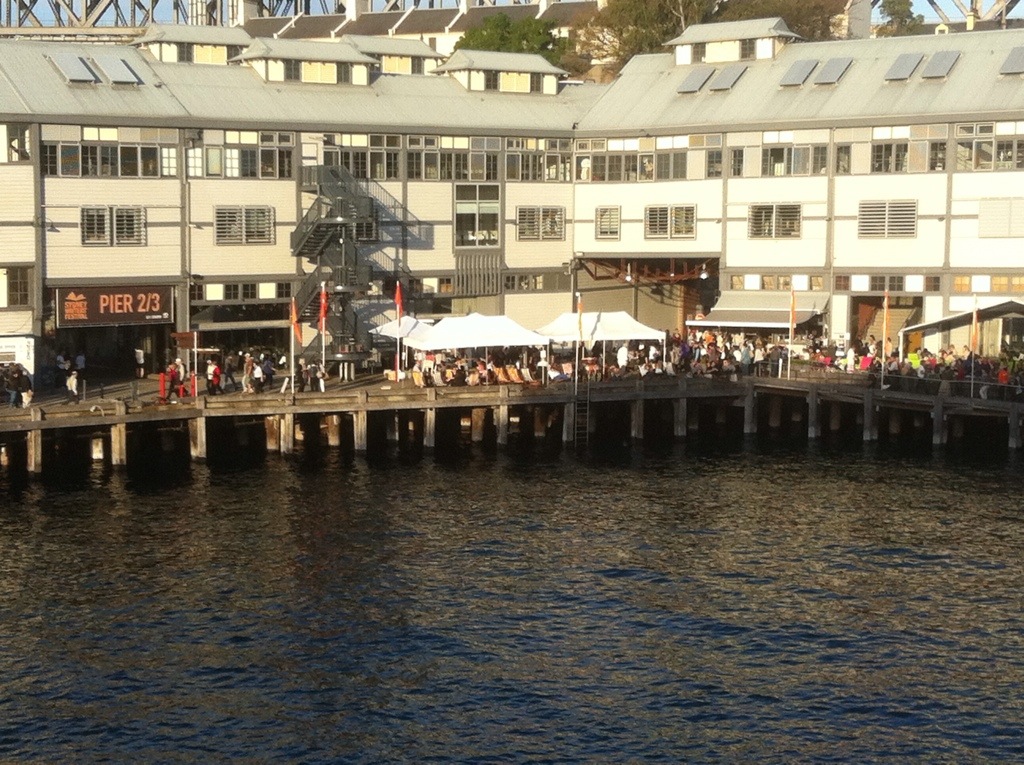
On Friday the sun was still shining. My only event of the day, in the Wharf Theatre 2, confusingly located on Pier 4, was

4.30: The Big Read

This is story time for a big room full of big people. It’s not quite as comforting as dozing off on your mother’s lap to the sound of a Hans Andersen horror story. Dozing is not unheard of, but the main point, at least for me, is to sample bits from writers who are new to me or who, as with two of this year’s line-up, I’ve developed a prejudice against (I’m not saying which).

But first, the Sydney Morning Herald Best Young Australian Novelist awards were presented by Linda Morris, who writes for the Herald on literary matters. These awards, instigated 18 years ago by Susan Wyndham who was and still is  Herald‘s literary editor, carry no monetary prize – each of four young(ish) people was presented with a certificate and what looked like a bottle of wine. They were: Luke Carman (An Elegant Young Man), who has been appearing in this blog for some years now; Balli Kaur Jaswal (Inheritance); Hannah Kent (Burial Rites); and Fiona McFarlane (whose The Night Guest won a money prize at the NSW Premier’s Awards). They stood in a row looking awkward while we applauded, then politely melted into the darkness to make way for the older writers, introduced with her trademark enthusiasm by Annette Shun Wah.

Lian Hearn, the novelist of mediaeval Japan formerly known as Gillian Rubinstein, author of much loved children’s books such as Space Demons and Beyond the Labyrinth, read to us from her latest Japan novel, The Storyteller and his Three Daughters, a smooth, lucid excerpt that was mainly about writing.

Dara Horn from the US read from A Guide for the Perplexed – her book, not Maimonides’ – giving us an intriguing glimpse of a book in which tales from two different eras explore the idea of having a total record of a life: in one, a character develops software that records everything; in the other a late 19th century scholar discovers a comprehensive trove of documents in a Cairo synagogue that had not been cleaned out for a thousand years.  Such a trove of documents really has been found, and such software isn’t entirely implausible

Alex Miller read from Coal Creek. I’m afraid I didn’t get much sense of the book from this reading. It was largely a mundane recount of a man and a horse called Mother and it went on well over its allotted time so that everyone else had to whip their readings along.

Eimear McBride read from A Girl is a Half-Formed Thing. In the bit she read the character was a 13 year old girl who may or may not have been contemplating suicide by drowning. The uncertainty was in the character’s mind, rather than mine, I think. The precise meaning didn’t matter so much: as Annette Shun Wah commented, it was like listening to jazz with, I would add, a beautiful Irish/Joycean accent. (The ABC has uploaded an earlier session of Eimear McBride in conversation with Michael Cathcart.)

Adam Johnson finished us off with a chilling bit from The Orphan Master’s Son. ‘You won’t understand this,’ he said, ‘because it’s an extract.’ It was the session’s only piece with a clear, strong narrative, and I would have rushed out to buy the book only two of my companions said they had read most of it, thought it was  really wonderful, but couldn’t finish it because it was so unremittingly grim. I still might give it a go …

We were on the train home before the Opera House and Customs House lit up for the Vivid Festival. We’ll look at the lights tonight, after a full day at the festival.

Sydney Writers’ Festival: My Day 1

By one count, the Sydney Writers’ Festival has been going since the weekend. The opening address, by all accounts brilliant, was on Tuesday night. My festival started yesterday.

My first event – a poetry reading in the English Department’s Common Room at the University of Sydney – wasn’t strictly part of the Festival, but two of the poets were in Sydney for the Festival, so I’m counting it. I had to leave early to catch a bus to the Opera House so I only got to hear one and a half poets, all of Fiona Hile and half of Kate Lilley. Sadly, I missed out on Louis Armand from Prague, and Pam Brown.
The room was full of poets. Overheard pre-reading conversations (there were nibbles and drinks) included happy reports of ‘having something accepted ‘ in a coming anthology. John Tranter recorded proceedings for the Penn Sound Archive. Vagabond Press was selling in a back corner.

I enjoyed Fiona Hile’s reading but I wouldn’t say I understood much of the poetry. Partly this was because she read fast, the room was a bit echoey, and I’m a bit deaf. Mainly, though, I expect it was because she’s what the Spoken Word people call a page poet, and even more an experimental poet, which tends to mean that meaning isn’t easy to grasp. There were lots of striking lines. I managed to jot down:

The lilliputian threads of the old ways make me want to lose a limb

and in a context to do with sheep:

That wolf you’re wearing goes with everything.

In introducing Kate Lilley, Fiona Hile conjured up a fabulous image. She said she used to think it was uncool to have heroes, but when she began writing her own poetry, she had four horsewomen: Kate Lilley, Pam Brown, Gig Ryan and Jennifer Maiden. I’d love to see the movie that has those four poets charging into battle.

Kate Lilley read from Ladylike, and was about to read from Realia when I reluctantly tore myself away to catch a bus to the Quay, have dinner and then climb the stairs to the Joan Sutherland Hall of the Opera House for:

7.30 pm: The Life and Times of Alice Walker, in which Alice Walker was interviewed by Caroline Baum and joined by Archie Roach. The SWF blog already has a report.

As is customary at the Sydney Writers’ Festival, the session bore little relation to its title. Alice Walker was in no mood to tell her life story, or to discuss her ‘times’ with any specificity. The tone was set right at the start when Caroline Baum asked, ‘Are you nervous at the start of events like this?’ and Alice Walker replied, ‘No,’ and waited serenely for the next question. CB bounced back by asking her to read us a poem, and she obliged with ‘You Should Grow Old Like the Carters’, which she read beautifully, giving each word its full weight, conveying the music , treating herself and the poem as worthy of our full, serious attention. That mix of awkwardness, resilience on Caroline Baum’s part, and weight on Alice Walker’s kept up for the whole session.

Part of the awkwardness came from the level of unaware racism in the room, or at least a reasonable expectation of it on Alice Walker’s part. She didn’t give her interlocutor the benefit of any doubt. For example (from memory, so probably missing a lot of nuance):

CB: So you grew up in a house without books and were part of an oral, story-telling culture.
AW: Oh, no, we had books. My parents got hold of old books that people had thrown out. But yes, there were lots of stories that everyone told, wonderful stories. [End of reply.]
….
CB: You read a lot when you were young. I believe your favourite books were … and Jane Eyre. What was it like the first time you read a book with black characters you could identify with?
AW: Oh, I identified completely with Jane. White people seem to think they can’t identify with black characters, but when we read it’s not about these divisions. It’s the spirit we identify with.’ [Applause]

Fortunately, Caroline Baum has a wonderful capacity for putting herself out there, and then bouncing back when she has her knuckles ever so serenely rapped.

Another reason the session seemed such hard work is possibly a problem of definition. Is Alice Walker at the festival as a writer, an activist, or a vague kind of celebrity?

Well, obviously, she’s a writer. But The Color Purple was published roughly 30 years ago, and I wonder how many people in that huge hall had read Possessing the Secret of Joy, or made it all the way through The Temple of My Familiar. As a poet she would draw a crowd, but not this big a one. Many of her essays are absolutely brilliant: ‘In Search of Our Mothers’ Gardens’, ‘Only Justice Can Remove a Curse’, her essays on Zora Neale Hurston and Bessie Smith, on olive oil, the scar in her eye … I can rattle those off without googling. And a new collection of essays – Cushion in the Road: Meditation and Wandering as the Whole World Awakens to Being in Harm’s Way – has just been published. But how many essayists can fill the Opera House?

As an activist, she has an impressive record. She campaigned very visibly against female circumcision a while back, and was part of the flotilla that was intercepted so dramatically on its way to Gaza. But as far as I know she’s not part of any activist organisation and her activist philosophy boils down to stressing the importance of having friends (a ‘circle’) you can be completely honest with, and meditation seems to fit there.

Celebrity seems to be the key. So although the conversation touched on many things, and Caroline Baum kept pulling the conversation back to the recently published book, my overwhelming impression was that we were in the presence of celebrity, who was dispensing her wisdom for our benefit. The most telling celebrity moment was when she was asked about her daughter’s very public statements that her activism had made her a neglectful mother. Her reply included no whiff of self doubt, no hint that her daughter might have had a legitimate point (as the children of many activists surely would). The problem was that her daughter suffered from ‘mental instability’, from which she had now mercifully recovered. This dismissiveness was cloaked in serious and valid reflections on the legacy of slavery on her family, but it was dismissive all the same. We were to make no mistake who was the important person in this conversation.

I’m sorry if that’s jaundiced. I’m still a fan. I will buy the new book of essays, and probably her new book of poetry as well. I’m seeing another session with her on my second day, and hoping I’ll have a change of perspective.

The Book Group and Book One of Karl Ove Knausgaard’s Struggle

Karl Ove Knausgaard, A Death in the Family (My Struggle: 1) (2009, translation by Don Bartlett 2012, Vintage 2013)

0099555166When we googled “My Struggle” at the Book Group last month, the top result was Hitler’s Mein Kampf. We were mildly amused by what we took to be a google oddity. But the Norwegian title of Karl Ove Knausgaard’s six-volume novel is Min Kamp – a similarity that could hardly be accidental. At the Sydney Writers’ Festival, the man himself told us that the sixth and final volume is a 400 page essay about Adolf Hitler. One has to wonder: if A Death in the Family is point A, how does he get from point A to point Way Off the Chart?

But since only two of the books are available in English so far, that’s a question for later.

Before the meeting: I finished reading A Death in the Family a couple of weeks ago, just after hearing Karl Ove speak at the SWF. I would have moved straight on to the second volume, A Man in Love, if I hadn’t had other more pressing demands on my imaginative faculties. The appeal, for me, is to do with shoe leather.

In the movie business shoe leather is the term for precious screen time wasted on actors walking from place to place. Knausgaard has elevated its written equivalent to a high art. It seems no one ever just gets in a car and drives somewhere: they always turn on the indicator, check the rear-vision mirror and pull out into the traffic, then follow a series of carefully named streets until they arrive at their destination. When a character cleans a book case, it goes like this:

I sprayed the glass door of the bookcase, crumpled up the newspaper and rubbed it over the runny liquid a few times until the glass was dry and shiny. Looked around for more to do while I had the spray in my hand, but saw nothing apart from the windows, which I had determined to save until later. Instead, I went on with the bookcase, tidied everything, starting with its contents.

That man be unremarkable, but so much of the book is taken up with similar attention to detail that how a reader responds to it will have a huge influence on their response to the book as a whole. Early on, there’s a passage about growing up that helps explain what’s happening, as I understand it:

As your perspective of the world increases not only is the pain it inflicts on you less but also its meaning. Understanding the world requires you to keep a certain distance from it. Things that are too small to see with the naked eye, such as molecules and atoms, we magnify. Things that are too large, such as cloud formations, river deltas, constellations, we reduce. At length we bring it within the scope of our senses and we stabilise it with fixer. When it has been fixed we call it knowledge. Throughout our childhood and teenage years we strive to attain the correct distance from objects and phenomena. We read, we learn, we experience, we make adjustments. Then one day we reach the point where all the necessary distances have been set, all the necessary systems have been put in place. That is when time begins to pick up speed. It no longer meets any obstacles, everything is set, time races through our lives, the days pass by in a flash and before we know what is happening we are forty, fifty, sixty.

I read the narrative’s wealth of undifferentiated detail as an attempt to reverse that process: to give priority to specific observations and experiences over any abstraction, to go for immediately apprehended ‘meaning’ over calm, generalisable ‘knowledge’, to avoid our habitual exclusion of some things from consideration. As well as the tiny acts, the brand names, the hyper-specifics, we are given the narrator’s play of mind, apparently unfiltered – memories and meditations that are jogged by the brand names on cleaning products, say, his adolescent worries about the shape of his penis when erect, or  the strange feeling he had as a boy about the gravel on the floor of the family garage. And, because nothing is being left out, he tells us things that are just not talked about: how he shakes his little girl when she irritates him, the extraordinarily squalid circumstances of his father’s death, his grandmother’s incontinence. These last things don’t feel deliberately shocking – more like the inevitable result of a  decision made at the beginning to put everything in.

Karl Ove has said that the overwhelming emotion he had while writing the novel was shame. He couldn’t believe anyone would read it, and now he is embarrassed to realise that roughly half a million people know all about his failures as a parent and his sexual inadequacies (those are yet to come, perhaps in the second book).

After the meeting:  This book provoked as much sustained conversation as any we’ve discussed in the group. One man who spent his childhood in Britain was most deeply struck by the way the weather was evoked: the grimness of the winter and the way spring came as a great relief. This struck a chord with others who had lived in northern Europe for any length of time. Another man, following his daughter’s lead, had been watching a lot of Simon Amstell‘s recent melancholy stand-up and found a striking resonance with this book. Another man was struck by the book’s failure to make him empathise with the narrator – at one stage he thought it might all be total fiction, that Knausgaard the author might be no more Karl Ove the character than Mark Haddon is Christopher in The Curious Incident of the Dog in the Night-time – and in that case it’s a brilliant creation. I don’t know that anyone liked it as much as I did.

As always, the conversation ranged widely, from the sexist bile being showered on Julia Gillard to details of our lives, all to the tune of excellent pasta, grilled zucchini and fennel and tomato salad.

Sydney Writers’ Festival: My Weekend

The best laid plans etc. I was going to blog about the SWF daily, but it turned out that though I only got to one event on Saturday I still had no time to write about it then or on Monday or Tuesday, so here are my days 3 and 4 all mooshed up.

Saturday returned to the cloudless sky that’s traditional for the festival. The average age of the punters dropped by about 20 years, but the crowds at Walsh Bay didn’t seem to be any worse.

My day started with the half past two session, Shami Chakrabarti: WOW at Sydney Writers’ Festival Lecture. WOW, ‘Women of the World’, is a big feminist festival held annually at London’s Southbank Centre. There were a number of WOW events at this festival, a kind of taster-festival within the festival, and a friend I met at quarter past two or thereabouts had been wowed at one of them in which a number of women spoke for ten minutes each (there’s a nice blog post about that one on Guys Read Gals).

The 2.30 session was a tepid affair. Jude Kelly, Artistic Director of the Southbank Centre and founder of WOW, gave a long and  promising introduction – introducing herself as a very senior arts administrator, WOW as a feminist festival unlike any other in the world, and Shami Chakrabarti as her friend and a foremost human rights activist in the UK. ‘Why Women of the World rather than Feminists United?’ she asked, and I honestly thought she was going to say, ‘Because Wow! is so much more attractive than Eff you!’ Sadly no: she explained that it was because the word feminist had such a bad rep and they wanted to attract as many people as possible. This explanation enraged one of my companions, who also bridled at Jude’s admittedly eccentric suggestion that the men in the audience should consider themselves to be women for the occasion. Neither of those things particularly distressed me, but I could understand.

Then Shami Chakrabarti spoke. The same friend told me later that Ms Chakrabarti is a brilliant and heroic activist, who often appears on British TV and is completely formidable, someone you are very glad to have on your side. That wasn’t evident from this speech. She started off saying that in her view gender rights is the most important human rights issue in the world today – she hadn’t always thought so, but she now does. But instead of giving the reasons for her change of mind – arguing, for example, that no other human rights abuse can be adequately addressed unless women’s issues are also addressed – she just repeated the assertion, listed off a number of appalling statistics and atrocities, gave us a timeline of the gaining of important rights by women in Australia and the UK respectively (a part of her talk that someone said afterwards sounded like notes she had taken in preparation for visiting Australia, failing to realise that a Sydney audience might already know, for example, that women had the vote here 20 something years before Britain). Towards the end, she said, ‘It’s not my place to tell you what you should be doing in this country …’, and it struck me that that may have been the problem: as a citizen of London she was trying so hard not to be condescending to us ex-colonials that she ended up not saying anything much. Or maybe she was just jet-lagged.

Whatever, I think I picked the wrong WOW event. I do wonder if at I’m a Feminist – Can I Vajazzle? Jude Kelly invited the men in the audience to consider themselves as women.

I tried to get into the 4 o’clock Marathon Poetry Reading, but if the room holds 100 people, I was 102 in line. I tried to sit in the sun and listen: the ear was willing but the bum was sore and I got a cramp. So I went and sat and read until I could meet up with my companions who had gone to hear Bob Brown on the Future of Activism, where the reciprocal passion so absent from the WOW talk was by all accounts there in spades – even though he kept pointing an accusing finger at his audience and telling them that come September they were about to vote against their own interests and the interests of their children.

Sunday was another brilliant day – I speak mainly of the weather and the way it was possible to strike up an interesting conversation with compete strangers.

We started with Sylvia Nasar: Is the West Over and What Would Keynes say? at 10 o’clock, probably my most worthily motivated event of the festival. As is often the case, the conversation bore very little relation to the title of the session. It was mainly a promotion of Sylvia Nasar’s book, Grand Pursuit: The Story of Economic Genius, which tells the history of economics through the lives of its key practitioners, and argues that economics is responsible for transforming the possibilities for human wellbeing. As one of my companions remarked afterwards, if the book is as facile as this session, it’s a good one to skip. Her responses to two questions at the end are indicative of that facileness.

A young woman, after a courteous squee about having a woman discuss economics, asked how Ms Nasar’s account of the vast benefits brought to humanity by economics related to the imminent threat from global warming. Ms Nasar said that many problems had been solved in the past and there was plenty of time so she was optimistic that economics would solve this one too. She probably didn’t mean that we should just place our faith in neoliberalism, but she could have meant that, and evidently didn’t see any need to dissociate herself from that view. Then someone asked what she saw as the importance of Amartya Sen. This question might well have been a chance to distance herself from the neoliberal world view, and perhaps come at last to the advertised theme of the session; instead she told us how she had followed ‘Amartya’ around in India for weeks when writing the book, and been struck by the way his photo appeared constantly on the front page of newspapers there – that in India economists could be treated as rockstars are in her native USA. End of reply.

Sylvia Nasar wrote A Beautiful Mind, the book about economist John Nash that was made into the excellent movie with Russell Crowe, so she’s clearly done better than this. Maybe she was jet-lagged too.

I dashed to the scene of my unsuccessful queuing on Saturday, and this time I was among the last five people admitted – to stand at the back of the room for Research and Writing. This session turned out to be a lot of fun. The panel was the winner and two shortlisted authors for the 2012 Nib Waverley Library Award for Literature: Jane Gleeson-White (Double Entry: How the merchants of Venice shaped the modern world – and how their invention could make or break the planet), Robin de Crespigny (The People Smuggler: The true story of Ali Al Jenabi, the ‘Oscar Schindler of Asia’) and Fiona Harari (A Tragedy in Two Acts: Marcus Einfeld & Teresa Brennan). They were billed as talking about their approaches to research, and that’s what they did.

If there was a common thread, it is that each of their books began with the discovery of an interesting person, and none of them knew when they started what the book was going to be about. Jane Gleeson-White (who incidentally had just done a fine job as Sylvia Nasar’s amiably sceptical interlocutor) started out writing about the Viennese Monk Luca Bartolomes Pacioli, intimate of Leonardo and teacher of Dürer, and had to be told by her editor that she had actually written a history of accountancy. Robin de Crespigny set out to make a film about people smuggling, but was so captivated by Ali Al Jenabi that it had to be a book and, evidently, an enduring friendship. Fiona Harari began with questions about Marcus Einfeld, the eminent former judge who perjured himself over a speeding offence and ended up disgraced and in gaol, intending to devote just one chapter to Teresa Brennan, the deceased person he had claimed was the speeding driver, but expecting hostility from Einfeld’s friends and family she decided to write the Brennan part first, only to discover a whole rich story there. The panellists enjoyed themselves and each other, and a good time was had by all.

Fiona Harari said that Teresa Brennan was famous for telling outrageous lies for the fun of it – she had convinced Sir Gustav Nossal that she was planning to become a nun. As I’d relayed on this blog something I was told by Teresa when I met her in 1976, I used question time to ask if I’d been sold a pup: but no, it’s on record that, among many other improbabilities, she had indeed been a publicist for Barry Humphries and it was quite plausible that she had written jokes for Edna.

My final event was Karl Ove Knausgaard in conversation with Sarah Kanowski. I’d nearly finished the first book in his six volume novel My Struggle, A Death in the Family, which we’ll be discussing at my Book Group, and which I’ll write about here after the meeting. So this session was like homework. All homework should be so mesmerisingly interesting.

Sarah Kanowski seemed to have read everything Karl Ove had written, some of it at least twice. She pronounced his name as if she had been speaking Norwegian all her life, and was right up there with Ramona Koval in establishing a warm rapport with her interviewee. Karl Ove said that shame is the dominant emotion in Norwegian culture and these books set out to name things that are simply not talked about: drunkenness and incontinence, but also mistreatment of children and sexual matters. When he was writing the novel he couldn’t imagine anyone wanting to read it, and now he is alarmed to think there are more than 500 thousand people who know all about his sexual inadequacies. He claimed that when he finished speaking to us he would go off by himself and vomit with shame. Was it just me, or would everyone in the room have been willing to hold him by the shoulders while he vomited?

I hadn’t been sure I would read on past the first book, even though I was exhilarated by it. Now it looks as if I won’t be able to resist reading the whole 2000+ pages. Evidently the final book is a 400-page essay about Adolf Hitler. Can you believe I’m looking forward to it?

So that was my festival. We didn’t get to the Big Read, a highlight of previous festivals, because its new time slot was in working hours. I’ve subscribed to the podcast of  ABC Radio National’s pale shadow of the Book Show so as to hear some of the sessions I missed. I’ll happily advise people devising sessions to think in terms of readings and conversations rather than delivery of papers or rambling discourse. I recommend anyone travelling to Sydney to time it so you can attend, especially if it continues to overlap in time and location with the Vivid Festival (about which I’ll blog a little tomorrow).

Sydney Writers’ Festival: My Day 2

Friday began wet and grim but cleared up to a spectacular harbourside brilliance, only to pelt down as darkness fell. But that was only he weather.

I only managed two events.

As a common or garden blogger and minimally published writer, I would have felt remiss if I didn’t attend Writers Who Blog. The four panellists came at blogging from quite different perspectives.

Mark Forsyth writes a short blog entry every day, always about some peculiarity of the English language (while here he met the word yakka for the first time). He admitted that he had started his blog The Inky Fool in the hope that it would lead to a book contract, and it did, to two books in fact.

Tara Moss already had a number of books published when she stumbled into blogging – she did a gig as guest blogger for the SWF a couple of years ago and wrote 21,000 words in a week. The appeal of writing and publishing without a moderator was irresistible, and as she has done more over the years, breaking all the standard rules about length, range, language level and frequency, her sense of herself as a writer has transformed.

Lorraine Elliott blogs full time at Note Quite Nigella, a blog about food. For her, blogging was a way out of the advertising world, which is ‘all about money’. I didn’t quite get how she does it full time, that is, whether it generates an income, but she told lovely stories of ow her blogging has created a bridge in her relationship with her mother.

Angela Meyer, of Literary Minded, was a participating chair who necessarily focused on chairing and made it look effortless. I would have liked to hear more about her own blogging experience, which she described in her intro as being in part about tracking her own trajectory as an emerging writer.

All four panellists seemed to count their hits in the hundreds of thousand. My biggest day scored 228. My impression is that questions at the end came mainly from bloggers on my scale. I got to ask the first question, and resisted the temptation to be one of those grey-haired gentlemen who seizes the opportunity to tell his life story. I asked about difficulties with comments. Mark had a ready, sensible answer: ‘Don’t start an argument on the Internet.’ Tara took the microphone: ‘My advice is, Start arguments on the Internet.’ They were both right, of course. I liked Tara’s final note: ‘When you do get into an argument, don’t say anything you wouldn’t want to see quoted in the newspaper.’

One key observation – I don’t remember by whom – chimed with Robert Green’s reflections on creativity the day before: blogging is still very new, and there are no hard and fast rules about how it should be done, and each of the panellists said that the rules as formulated so far as guides for beginning bloggers didn’t really apply. Come back in 50 years and we might have a set of clear rules like the ones that govern journalism now, but for the time being the field is wide open for creativity and discovery.

At half past two I had to choose among Beyond Climate Denial on a Neoliberal Planet with Jeff Sparrow, Robert Manne and others, Dermot Healy in conversation with Luke Davies , and Turning the Tide with Lionel Fogarty, Melissa Lucashenko and others. Would I opt for anxiety, pleasure or pain? It was a toss-up, and in the end I went for anxiety and climate change: I admire Jeff Sparrow’s writing and editing – I was interested to hear him and Robert Manne in conversation; I had read the article on climate change and neoliberalism in the current Overland by Philip Mirowski, Jeremy Walker and Antoinette Abboud, of whom the last two were also on the panel, and would love to hear its implications teased out in discussion.

It was probably a wrong decision. There was no conversation. Jeff Sparrow was a non-participating chair. Each of the three panellists delivered a paper, they didn’t address each other’s points except to complain that the session was too short, and as far as I could tell none of the presentations added anything substantial to what had been said in the previously published articles. ‘As far as I could tell’, because Jeremy Walker read so fast and assumed so much prior knowledge of (I think) economics that I was completely at a loss to know what he was saying. In short, Robert Manne thinks there’s little reason not to despair. Antoinette Abboud warned us not to be seduced by the neoliberal three-step strategy of denialism, carbon trading and geo-engineering. Jeremy Walker said something very complex and possibly profound.

The first person to speak in question time said we should all pay attention to Bill McKibben, and all panellists seemed to agree. ‘Why aren’t we out in the streets screaming about this?’ the same man asked when instructed by the chair to get to the question. Robert Manne had a ready answer: ‘Because we’re consuming.’

The problems of the world weren’t solved, and if Robert Manne is right they never will be. But change is never linear, and hope, the thing with feathers that perches in the breast, lives on.

Sydney Writers’ Festival: My Day 1

The Sydney Writers’ Festival has been going for days now, but my festival started yesterday, on a bleak, wet, grey Thursday.

I began with a 10 o’clock launch of four chapbooks in Vagabond Press’s Rare Objects series. Chapbooks are books of poetry so small they don’t even rate an ISBN. But where some chapbooks have a cheap and cheerful feel, the Rare Objects are beautifully crafted, a hundred numbered and signed copies of each title. The books being launched were by the stellar line-up of David Malouf, Robert Adamson, Martin Harrison and Adam Aitken.

Luke Davies gave one of the best launch speeches I’ve heard. He paid tribute to Michael Brennan of Vagabond Press and to the four poets in warmly personal terms, as people and as creators. The mutual respect and affection among the five people on the dais was something wonderful: completely the opposite of the internecine strife for which poets are supposedly famous. Each of the four launchees read: Adam Aitken from November Already, Robert Adamson from Empty your Eyes, Martin Harrison from Living Things)and David Malouf from Sky News (which my deafness heard Luke Davies announce, improbably, as Sky Nudist, but that would be a different chapbook). We the audience were very restrained, applauding politely after each reader – my guess is that we were too busy processing the complex pleasures we were being given to be too demonstrative. It really was a brilliant reading: a stunning prose poem from Adamson, crisp imagery from Malouf, Aitken taking the New York School to a tiny French village (not really, but that’s a mangled form of his own joke), Harrison in fine rhapsodic form. I loved Martin Harrison’s account of the genesis of his ‘Wallabies’: witnessing two young Australians in full xenophobic flight in a Parisian Internet cafe (and he described them to us with great relish), he took notes intending to write a satirical poem, but realised when he sat to write that what he really wanted to do was to celebrate the part is Australia they came from.

I couldn’t have asked for a better start. I bought all four of the Rare Objects, found a spot out of the rain and sat and read, did email things on my iPad, and chatted. (One of the striking things about the SWF is how easy it is to strike up a conversation with complete strangers.) Then it was time for the 1 o’clock session:Harbour City Poets: Some People You May Know, my first event in the Bangarra Mezzanine, which I think of as the poets’ space at the Festival. Again it was a pleasure to be read to, this time by a quintet of poets – Margaret Bradstock, John Carey, David Musgrave, Louise Wakeling and Les Wicks. The poems were about people, real, and imagined. Margaret Bradstock’s pieces about colonial characters made me want more. And there was some witty and elegant light satire. It may be because someone had told me just before the session about the man being hacked to death in London, but I found myself thinking that light satire, especially when performed giving broad Austealian accents to its objects, is a dangerous mode in which the satirist can all too easily come off as smug, class-bound, narrow-minded, bien-pensant and otherwise unappealing.

I rushed home (bus–train–bus), walked and fed the dog and was back, just a few minutes late for Robert Green: On Creativity at 4 oclock. This session wasn’t on my schedule, but a friend had a ticket she couldn’t use, and the Festival program promised ‘exercises to help rid [me] of blocks and unleash thinking that is more fluid and creative’. Given that I’m feeling out of my depth with a writing project just now, it was a case of what the hell archie, and I’d taken the tickets off her hands. It was turned out to be pretty much a motivational talk. The ‘exercises’ were three broadbrush strategies: embrace the blank page; think like an outsider; subvert your patterns of thinking. I enjoyed the talk, not least for the wealth of anecdote and Robert Green’s manifest passion for his message that every human brain is capable of brilliance, that mastery is possible. I especially liked the first question and response at the end. In summary, a white-bearded man suggested that next time a journalist asks him if he can seriously believe the stuff he says, he should try thinking like a mushroom; this was evidently meant as a witticism, but Green was completely nonplussed; after a bit of back and forth in which the point of excuse tin remained obscure, he agreed that he would give it a try.

More bus, more train, dinner at a pub in Chippendale then to the Carriageworks for Stories Then & Now. I’m a big fan of William Yang’s slide-show story telling, especially his exploration of his Chinese and north Queensland heritages over the years. For this show, along with Annette Shum Wah, he has mentored six mainly younger Asian-heritage people to tell the stories of their families (‘then’) and their personal stories (‘now’). Each story-teller had two turns alone on stage with a microphone in front of hem and two screens showing a series of photographs behind them. Ien Ang, Jenevieve Chang, Michael C. S. Park, Sheila Pham, Paul van Reyk and Willa Zheng were each completely engaging, and the combined effect of heir six presentations was extraordinarily rich. The Cultural Revolution, the Korean War, the American War in Vietnam, Indonesian independence, the White Australia Policy; a hilariously failed attempt at an arranged marriage, a weirdly romantic tale of serial fatherhood by sperm donation, a successful Internet match, intergenerational tension and conflict fled, faced and reconciled. We came out into the night exhilarated.

Overland 207

Jeff Sparrow (editor), Overland 207, Winter 2012

The winter issue of Overland arrived here while I was summering in Turkey, and it was still in its plastic wrapper when spring arrived with a burst of grevillea flowers and the thud of issue 208 on the front step. The spring arrival looks great – it includes a comic – but it will have to wait. Winter is enough for now.

Fat people are oppressed, says Jennifer Lee in ‘A Big Fat Fight‘, and they’re organising on many fronts. It’s a pugnacious article, which seems to anticipate a hostile response, and indeed I found myself wanting to argue with it. Anwen Crawford responds in issue 208, and addresses the things I was uneasy about much better than I could. I recommend the articles as a diptych. It doesn’t help your argument to tell readers that if they disagree with you it’s a knee jerk reaction.

Porn and the misogyny emergency‘ is a debate between Gail Dines and Sharon Smith, which I’m happy to report doesn’t descend into name-calling, as feminist debates on this subject have been known to – as in a twitter storm around Gail Dines at a recent Sydney Writers Festival.

Jessica Whyte’s ‘“Intervene, I said”‘ addresses the vexed subject of how talk of human rights is used to rationalise imperialist aggression and other nastiness. It strikes me as a sober discussion, not looking for villains or getting lost in its own rhetoric as sometimes happens when mainstream discourses are being critiqued. I didn’t know that Médecins Sans Frontières, undoubtedly good guys in my book, played a major role in popularising the so-called ‘right to intervene’ on humanitarian grounds, which was used to justify the invasion of Iraq and other dubious military ventures.

Matthew Clayfield’s ‘Waiting on the Arriaga-Ixtepec‘ is a first-hand observer’s account of the ordeals of undocumented immigrants to the US from South and Central America. It’s powerful stuff. I could have done without the occasional literary flourish, especially the opening reference to Casablanca with its use of the manglish ‘torturous’ instead of the original’s perfectly sound ‘tortuous’.

Louis Proyect, in ‘Republican Democrats‘, offers an analysis of Obama’s policies that is a bracing contrast to what wishful thinking would have us believe. He argues that the time may soon be at hand when the USA’s rigid two party system yields to something closer to real democracy. In the meantime, he seems to be suggesting that African-Americans are mistaken to support Obama. Having just read Ta-Nehisi Coates’s brilliant ‘Fear of a Black President‘ in The Atlantic (if you haven’t read that article stop wasting your time here and click on the link now), I found Proyect’s argument thin and unconvincing on this point.

There are three pieces identified as fiction, though the most immediately touching of them, 19 year old Stephen Pham’s ‘Holiday in little Saigon‘, isn’t fiction at all, but a meditation on the changes he has seen in his suburb, Cabramatta, in the last ten years, as it has transformed from heroin capital of Australia to tourist destination.

Sequestered up the back on different colored paper is the poetry. I particularly liked Andy Quan’s ‘Islands‘, a cool despatch from a grieving family; Mark O’Flynn’s ‘Corydalis‘, a poignant glimpse of someone else’s homesickness; Fiona Yardley’s ‘Your Bath‘, an unlikely celebration of a long lived love, perhaps an elegy; and Alan Wearne’s ‘Also Starring …‘ poem as parlor game or vice versa, in which actors arecast as dozens of Australian poets living and dead, and a couple of politicians. The pairings that I recognised in that last poem ranged from the wittily spot on, through cheerfully insulting, to gloriously inspired. My favourite is George C. Scott as Francis Webb. It’s a poem that invites reader participation: I’d add Robert Morley as Les Murray and Katharine Hepburn as J S Harry.

Undoubtedly the serious reflections in this issue on all that’s amiss in the world and the possibilities for change will have lasting impact on how I am in the world, but right now my vote for the best thing in it goes to Alan Wearne’s utterly frivolous poem.