Tag Archives: Sydney Writers’ Festival

SWF 2020, Post 3

The Sydney Writers’ Festival 2020 didn’t happen, but it’s still going. I’ve now listened to five more sessions: rich conversations between authors none of whose books I’ve read (though I have read shorter pieces by some of them), sometimes about other authors whose books I haven’t read.

Philippe Sands: The Ratline 27 May

Otto von Wächter was one of Nazi Germany’s mass murderers. In 1945 he disappeared from public view and turned up dead in a Roman hospital four and a half years later. Philippe Sands, barrister and author of other books about Nazi leaders, gained possession of a huge trove of the papers of von Wächter and his wife Charlotte, and set about rediscovering the story of this almost forgotten Nazi. He produced a podcast and radio series and now a book: The Ratline: Love, Lies and Justice on the Trail of a Nazi Fugitive.

This is a terrific conversation between Sands and SBS World News presenter Janice Petersen. Because of his access to private papers – given to him by von Wächter’s son Horst – Sands has been able to give an account of Wächter’s personal life and relationships.

At the end of the conversation, Janice Petersen asked why he thinks there is such a continuing interest in the Nazis. He confirmed her premise: if you put the word ‘Nazi’ in a book’s title or subtitle, he said, its sales in the UK increase by 50 percent, though it’s probably not the same in other parts of the world, including the US.

For the British in part it’s a reminder of what is seen as a glorious episode, the vanquishing of evil, and it is also the fact that the people we are dealing with were highly educated, highly cultured, highly intelligent, highly organised and they left behind a wealth of detail. …
I think what’s different in this case is Charlotte. Charlotte is the beating heart of this story because Otto was not alone. Otto had a close, loving, dutiful, intelligent, articulate, literate wife who recorded the totality and so we’re able to get another perspective, and that enables us to think a little bit more about the question, ‘How is it possible?’ and the related question that any reasonable person might ask themselves, ‘Could I do it?’ …
In our own countries, we cross lines. In Britain as in Australia, the treatment of refugees and of certain minorities is a very very big issue. Some of the conditions, for example, in which women refugees are being held in Britain and of course the treatment in Australia of the refugee community, parts of it, parking them on faraway islands, raise very serious questions. It raises to my mind a most serious question which is evoked indirectly in The Ratline, ‘What happens when we commit ourselves as a society to cross a line?’ The lesson of Otto Wächter is that once you’ve crossed one line it becomes a lot easier to cross another line.


James Bradley: Ghost Species 1 June

I hope to read one of James Bradley’s books one day. But as I’ve heard quite a lot of him on the radio recently, I skipped through this conversation with Cassie McCullagh of ABC Radio’s The Bookshelf about his most recent book, Ghost Species, in which there is a project to resurrect extinct species, including Neanderthal humans. In my skipping, I heard some fascinating tidbits, including this about the role of CliFi, as someone is calling fiction about climate change:

We inhabit this weird space where we know what’s going on but we don’t let ourselves know.
One of the things fiction can do is let you sit in that space for a while and let you actually let go of having to keep that other stuff at bay. You can encounter your anxieties, think about them. …
One of the things that fiction helps people do is to find their way to a space of acceptance, that space of recognising the reality of things, which seems to me to be a good place to get to, because if people get there then we can start having honest conversations about where we are.


Cassandra Pybus: Truganini 3 June

Truganini is on my TBR shelf. This is a brilliant conversation about it. It’s by Cassandra Pybus, white historian, whose family ‘owned’ land on Bruny Island, Truganini’s country, land that Truganini visited often in her last years. By all accounts, including the account given in this podcast, the book reclaims Truganini’s memory from the prevailing image of her as the archetypical victim of colonial violence, ‘the last Tasmanian’, and presents her as a woman who was never colonised, who was resourceful and strategic and ultimately in important ways successful.

Here she talks with Jakelin Troy, a Ngarigu woman from south-eastern Australia and professor at the University of Sydney, who clearly loves the book, and loves that Cassandra Pybus has written it:

For me, as an Aboriginal woman, it’s so important to have this story told, and by somebody who is an expert at interrogating the historical record but who can bring out the reality of the story. It’s obviously something that has become part of your own story. I love when you say that Truganini inhabits you now. I’m sure that’s what she intended to do by continuing to walk across your family’s country, which was her family’s country. She was making the point, I’m sure she was making the point, that this was still her country and that she’s there, and even if they didn’t think deeply about the fact that it was her family’s country, I think that in reality you can’t avoid that that’s what it is.


Kay Kerr: Please Don’t Hug Me 3 June

This is a conversation between two neurodivergent women from southern Queensland, both of whom have young-adult novels appearing at about the time of the conversation. The focus is on Kay Kerr’s epistolary novel Please Don’t Hug Me, but there is frequent reference to Peta Lyre’s Rating Normal by Anna Whateley, her interlocutor.

Both women are smart, charming and have interesting things to say, especially about autism and prevalent misconceptions about people living with autism.

If this had been a live event, I would have been hoping someone would ask about ‘own voices’, a term they used to describe their books. The term is close to self-explanatory, and I’d heard it vaguely in the past, but it sounded as if there was history attached to it. In the absence of a Q&A session, I went online, and found that #OwnVoices is a hashtag originated in 2015 by a Dutch writer of young adult science fiction and fantasy novels, Corinne Duyvis (a longish interview with her about the hashtag is at this link).
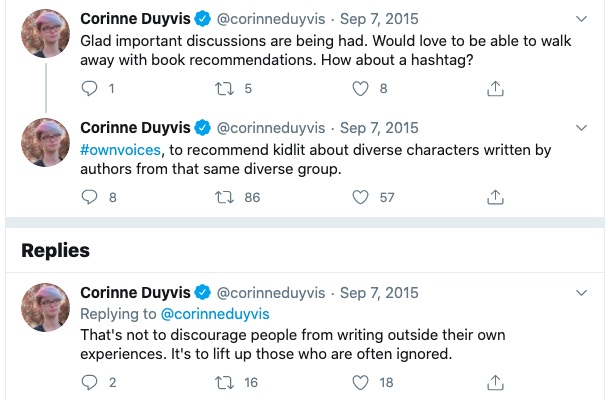
A quick look around Young Adult publishers’ sites shows that the hashtag has taken off and, though sometimes used as a weapon by call-out warriors, it represents a powerful movement to recognise that the best people to write about a marginalised group are those who experience that marginalisation. Both participants in this conversation are #ownvoices authors about characters on the autism spectrum.


Eimear McBride: Strange Hotel 9 Jun, 2020

I heard Eimear McBride read, beautifully, from her first novel, A Girl is a Half-formed Thing at the 2014 Sydney Writers’ Festival. Here she talks to Heather Rose (whose books are on my TBR list) abut her third novel, Strange Hotel. I enjoyed the conversation. Unlike A Girl Is a Half-Formed Thing, the new novel is punctuated conventionally, but the author says she doesn’t think it’s any easier to understand (she’s a big fan of Joyce and Beckett). She read an excerpt, which was beautifully written, but – and that ‘but’ says more about me than her – it’s a scene where the protagonist is in a hotel in Auckland, and thinks of herself as being at the very edge of the earth, about to go over the edge. This raised my antipodean hackles. I was reminded of a British writer who visited my student household in the early 1970s and treated us to a stoned fantasy about how the edge of the world lay just outside the heads of Sydney Harbour. Too easy, and too unaware of the audience.


Coming when I’ve listened to them: Bob Brown and some interesting-sounding genre fiction, but still no books I’ve read.
SWF 2020, Post 2

The Sydney Writers’ Festival, cancelled in deference to Covid-19, has gone virtual and is appearing in as a series of podcasts. This is my second post about it: five sessions I’ve listened to since 9 May (when I posted my first report, here). With any luck I’ll post about future sessions with shorter intervening intervals.

This time: five books that I haven’t read, all by authors none of whose books I’ve read talking to and sometimes about other authors whose books I haven’t read. So I’ve been learning a lot

Sophie Hardcastle: Below Deck 12 May 2020

Sophie Hardcastle talks to journalist and feminist commentator Georgie Dent about her novel Below Deck. She wrote it, she explains, in her time as a visiting scholar at Oxford University, where in her weekly meetings with her tutor she read to him from the work in progress. She reads to us at the start of the session, and to judge from that short and beautifully-written passage it wears its academic genesis very lightly. Nor does it show traces of what she says later in the session were its beginnings as a facebook status.

The key incident in the book is a rape at sea, and the podcast includes there’s a nuanced conversation about consent, sexual assault and #MeToo. An unexpected bonus is a fascinating chat about synaesthesia, a condition (or should that be superpower) shared by Hardcastle and her novel’s protagonist, in which a person sees sounds, numbers and other non-visual things as colours.

My favourite moment is this exchange, soon after the 30:40 mark, about a terrible relationship in the book:

Georgie Dent: Obviously I can’t ask you, but was it difficult to find inspiration for that relationship?
(Sounds that can probably be best described as snigger-snorting.)
Sophie Hardcastle: No.
Georgie Dent: That’s what I thought when I was reading it.


Intan Paramaditha: The Wandering 13 May 2020

Shirley Le from Western Sydney, who is working on her first novel, chats with Intan Paramaditha, Indonesian and currently living in Sydney, author of The Wandering, which is described on the Festival website as ‘a choose-your-own-adventure story’. The conversation feels intimate in a way that would have been hard to achieve on a stage in front of hundreds of mostly white festival-goers, and ranged widely – tips from a more-experienced to a less-experienced writer; the idea that the category of travel writing looks very different if you think of it as including Behrouz Bouchani’s No Friend but the Mountain as well as the usual books by white men and Eat Pray Love; brief but fascinating notes on the translation process (in this case the translator, Stephen J Epstein, worked closely with the author and the translation has some significant differences from the original); and much more.

I haven’t been a fan of the choose-your-own-adventure genre, which emerged when my sons were in the target audience, but it sounds as if in The Wandering it becomes a powerful – and also entertaining – way to embody stark contrasts between different modes of travel (as in tourism at one extreme and flight from threatened death at the other).

If this had been a live session, perhaps someone would have asked if either of the speakers had read Michelle De Kretser’s monumental novel Questions of Travel (my blog post here), which tackles similar issues, in a more conventional manner.


Ellen van Neerven: Throat May 19, 2020

Throat is second poetry collection from Mununjali Yugambeh writer Ellen van Neerven. In this podcast she talks with poet Tessa Rose. van Neerven reads her homage to a Brisbane suburban shopping centre, ‘Chermy’. The poem is a beauty, filled with affection for the place, family lore, and an occasional ember burst of long-range history. It’s a ‘page poem’ rather than spoken word, and you can read it in full on the Overland website, here, but I’m infinitely glad I first encountered it in this beautiful reading. van Neerven’s account of how she wrote it – interviewing elder relatives so that it became a social poem – is wonderful.

There’s a lot more to the conversation: the Queensland Art Gallery of Modern Art commissions poets to write poems inspired by their exhibits; though still relatively young, van Neerven works as a teacher and mentor and feels like ‘an emerging Auntie slash Uncle’; van Neerven speaks of young people and elders as both having a kind of wisdom that people in between may lack through being caught up in the day-to-day; a visit to Germany enriched van Neerven’s understanding of colonialism; there are many ‘Queensland Blackfeller’ artists who inspire the poet; and the process by which the book came together is described in an illuminating way. It’s now on my To Be Read list.


Richard Cooke: On Robyn Davidson May 20, 2020

Robyn Davidson is known almost entirely for her 1980 book Tracks, which told of her trek from Alice Springs to the Indian Ocean in 1977 at the age of 27 with only camels for company. Self-described fan Richard Cooke sets out to expand her image in the latest title in Black Inc’s Writers on Writers series of books. In this conversation with Michaela Kalowski, he observes that in his case it could have been called the Non-writers on Non-writers series, given that Davidson hasn’t exactly been prolific. Nevertheless, he makes some big claims for Davidson’s status as an Australian writer.

It turns out that this session is the middle of a trio about travel writing. I would love to have seen Richard Cooke on a panel with Intan Paramaditha and Liam Pieper, with the brilliant Roanna Gonsalves as moderator.


Liam Pieper: Sweetness and Light May 25, 2020

This is the third session in the trio about travel writing. Liam Pieper is a white man whose novel, Sweetness and Light, involves a white Australian man and a white US woman in India. There is no elephant in the room, as Roanna Gonsalves names the obvious with characteristic acuteness and generosity right at the outset:

As an Indian Australian I am particularly interested in that version of India and Indianness as experienced by white people that you render on the page in a very interesting way in Sweet ness and Light. In some ways the book may be read as part of a long tradition of white people, including many white Australians whose names we shall not name here, of writing about finding themselves or losing themselves in India or saving Indians with no mention of the crucial work being done by Indians on the ground already, or of using India as a backdrop for coming to terms with their own frailty or … India as a catalyst for their true natures being validated or confirmed

What follows is a wonderful conversation. I love the moment where the speakers find common ground: neither can swim, and both have experienced the humiliation of being an adult in a swimming class with seven year olds.


I’m still missing the milling crowds, the glare from the Harbour at Walsh Bay, the celebrity spotting and eavesdropping, the queuing for muffins and hot drinks, the odd poetry readings that almost certainly won’t make it onto the podcast program, and all that. But this is turning out to be a terrific Festival.

SWF 2020 Day One

This year, because of viral matters, the Sydney Writers’ Festival has gone virtual. According to its website, more than 50 re-imagined sessions from the 2020 program will be presented as podcasts over the next few months. I don’t usually blog about podcasts, but since I’ve been blogging about the Sydney Writers’ Festival for 16 years off and mostly on, why not? I’ve made a monetary donation to help the festival through this crisis (and you can too, at this link). Here’s my bloggetary one, hopefully the first of several.

The first six podcasts were uploaded last Friday, all excellent. Here they are in my listening order, plus an earlier one that’s technically part of the Festival. The titles of the sessions here are linked to the Festival website where you can find the podcast..

Alison Whittaker: Opening Night Address: Alison Whittaker, described on the Festival website as ‘Gomeroi poet, essayist and legal scholar’, evoked the isolated condition in which she recorded her talk. She said her brief included a request to avoid talking about Covid-19 if it was possible, but she couldn’t find a way to avoid it. The theme of the Festival is Almost Midnight: she suggested that it’s now a minute past midnight, that we are living in apocalyptic times, but that First Nations Peoples have been doing that for 250 years. It’s a salutary talk, in which Whittaker pays tribute to many other First Nations writers who were scheduled to appear at the Festival.

Ann Patchett and Kevin Wilson: A Conversation with Friends: A free-ranging conversations between two US writers. Wilson first met Pratchett when he was beginning his postgraduate studies. She asked him to look after her dog for a time, and in that time she kept giving him books to read, which they would discuss, and it sounds as if they’ve been talking about the books they read ever since. It’s a warm, entertaining conversation with a lot of insight into how each of them approaches writing. I haven’t read any of his books, and just two of hers., but both were equally interesting to me.

Rebecca Giggs: Fathoms: I knew nothing about Rebecca Giggs’s book Fathom: The World in the Whale before listening to this. Nor had I heard of Sweaty City, an independent magazine about climate change and urban ecology, whose co-founding editor Angus Dalton is her interlocutor on this podcast. I learnt a lot about whales that I didn’t know I wanted to know. For example parts of whales’ bodies were used to make things and perform functions that are now being made or done using plastics, so the reason for the wholesale slaughter of whales in the nineteenth and early twentieth centuries; but now, in a terrible irony, many whales are dying because of the plastic that is polluting the oceans and ending up in their intestines.

Jess Hill: See What You Made Me Do: Jess Hill’s book about domestic and family violence won this year’s Stella Prize. Before listening to this I thought I might make myself read it in order to Be Good. It turns out that when Jess Hill was commissioned to write a long article on the subject many years ago she accepted without a lot of enthusiasm, but felt that she couldn’t let ‘the sisterhood’ down. As I listened to her describe in this conversation with fellow feminist writer and journalist Georgie Dent how her enthusiasm for the subject grew with her understanding of its complexity, I was similarly enthused. This is a terrific conversation.

Miranda Tapsell: Top End Girl: Miranda Tapsell talks with Daniel Browning from the ABC’s Awaye! about her memoir Top End Girl. Another terrific conversation. Mind you, I’d be delighted to listen to Miranda Tapsell talk about anything or nothing for as long as she wanted. How does a 31 year old women get to write a memoir? She says it’s because when she read memoirs by, for example, Judi Dench or Michael Caine, she was struck by how they struggled to remember details of their youth, so she decided to write about her youth while it was still fresh in her mind. But that’s just a typical bit of charming self-deprecation: in the course of the conversation, it turns out that the book is also something of a manifesto (DB’s term) for diversity of representation and acknowledgement of the presence of Aboriginal people in all aspects of the arts, in particular film. They discussed the movie Top End Wedding, and the process of getting cultural permissions. I especially loved that at the very end, Browning asked about the episode of Get Krack!n when she and Nakkiah Lui took over the stage, and she spoke of the huge privilege she was given there of speaking in a ‘raw, unfiltered’ way while also exercising her ‘comedy chops’ to the full. That was one of my Great Moments of Television, and I was delighted to hear that they both thought so too.

Return of the Sweatshop Women: Sweatshop is a Western Sydney Literacy Movement. Its Sweatshop Women is an anthology of short stories, essays and poems produced entirely by women of colour. This podcast, shorter than the others, consists of readings by five of its contributors: Phoebe Grainer, Sara Saleh, Sydnye Allen, Janette Chen and Maryam Azam. One of the joys of the Festival is being read to, and another is hearing from voices that are usually marginalised if not completely silenced. This podcast provides both joys. The readings are introduced by Winnie Dunn, general manager of Sweatshop.

If I was attending this Festival at somewhere like the Carriageworks (currently in dire straits thanks to governments’ decision that the arts aren’t eligible for Covid–related help) or Walsh Bay (currently being ‘redeveloped’), I’d be in the company of hundreds of other silver heads, and I’d skip more sessions than I attended. So I have any misgivings about not listening to Malcolm Turnbull in Conversation with Annabel Crabb, but there’s the link of you’re interested. (Full disclosure: I did listen to the first 20 minutes of this conversation, and MT’s urbanity and AC’s apparently genuine affection for him are seductive.)

I miss those hundreds of other bodies, the unexpected questions at the end of sessions, the catching up with old friends, Gleebooks’s groaning trestles, the coming out blinking into the sunlight after being taken to a whole new view of things. But in the absence of all that, I’m grateful for the existence of podcasts.

Simon Schama’s Story of the Jews (Part One)

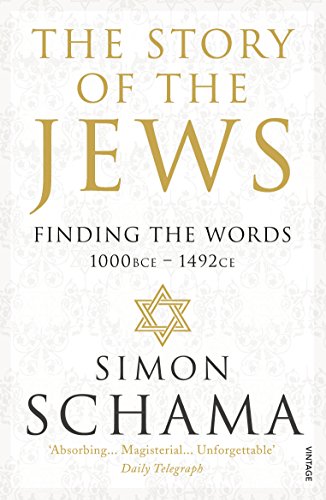
Simon Schama, The Story of the Jews: Finding the Words (1000 BCE to 1492) (Vintage 2014)

Some decades ago, I borrowed a book called The History of the Jews from a friend, and was disappointed to find that it was little more than a smoothing out of the Biblical stories. As far as its author was concerned, it seemed, you didn’t need to go past the Hebrew Bible (the ‘Old Testament’) to get the history up to the beginning of the current era.

Simon Schama’s book is the one I was hoping for back then. The Hebrew Bible, he writes, is not primarily history, but

the imprint of the Jewish mind, the picture of its imagined origins and ancestry; it is the epic of the YHWH treaty-covenant with Israel, the single formless God moving through history, as well as the original treasure of its spiritual imagination.

(page 7)

Schama’s story doesn’t begin with Abraham leaving Ur, or even with Moses leading his people from Egypt. Schama isn’t confident that the exodus from Egypt even happened. It begins with the documented beginning of ordinary Jews, the earliest Jewish city that archaeologists have been able to reconstruct, on the island of Elephantine in Egypt, in the early 5th century BCE, hundreds of years after the Biblical account of the exodus. And although that city was a military outpost – Jewish soldiers employed by the Syrian empire – the book begins not with a battle or any grand scheme, but with a letter from a father to his soldier son.

Though the book’s title promises ‘The Story’, Schama insists from the beginning that there’s more than one story: the Biblical story and the archaeological story; Jerusalemite stories and stories of communities in exile; stories of those who integrate with their non-Jewish neighbours – Babylonian, Egyptian, Christian, Muslim – and of those who insist on rigorous separateness; stories of brilliant intellectual and spiritual achievement and stories of unimaginable horror (and this book ends in 1492).

I spent my first two decades in an intensely Catholic environment, so the account of Christianity’s transformation from a Jewish sect to a demonically anti-Jewish institution is particularly gripping to me. Cherie R Brown and Amy Leos-Urbel’s Anti-Semitism asserts that religion is not the cause of anti-semitism, but has been used as a tool to foment it. I think that makes sense, but reading how John Chrysostom, revered father of the church, preached vile slander and murderous injunctions against Jews (evidently thinking it was necessary because a lot of Christians in the 380s happily participated in Jewish festivals), tests the proposition. And my childhood image of St Francis preaching to the birds must now be accompanied by that of his Franciscan friars torturing and murdering men, women and children who refused to renounce Judaism, and many who had renounced it but continued to eat their customary food.

But the terrible history of humiliation and massacre is not the main story here. Again and again, Schama gives us stories of brilliant survival. The Talmud and the mishnah – tumultuous documents filled with wisdom, argument and disputation – grew in a state of exile. And before them, the Hebrew Bible itself was an extraordinary creation. A roll call of the people in this book who did great things would be very long: administrators, generals, poets – why haven’t I ever heard of Shmuel ibn Naghrela or Yehuda Halevi?

One small warning: I’m pretty knowledgable about Biblical stuff, have a smattering of mediaeval history, and some knowledge of current Judaic feasts. There were times when I found it hard to keep my bearings in the tumult of this story. So it may not a good place to start. If you don’t know who Moses is, or you’ve never heard of Purim, you might need something more straightforward, and move on to this when you’re ready.

Speaking with Paul Holdengräber at the 2019 Sydney Writers’ Festival, Simon Schama spoke of the heroism of the displaced. I don’t think the phrase occurs in this book, but it could have. His main subject at the SWF was the second volume of this story. You can hear that wonderfully entertaining conversation by clicking here, and my blog report on it here. He is now girding his loins for the third volume, which brings us through the twentieth century up to the present.

SWF 2019 Sunday, Part One

I managed four sessions at the Festival on Sunday. Time is at a premium just now, so I’ll split it into two posts.

At 10 in the morning we went to A Dangerous Time to Tell the Truth in which, as the Festival web site say, ‘In conversation with ABC’s Sophie McNeill, three uniquely placed foreign writers and journalists share[d] their perspectives on the struggles and costs of reporting the truth and exposing lies under corrupt and oppressive governments.’ The three writers were Mexican Anabel Hernández (author of Narcos, about the far and deep reach of Mexican drug cartels), Iraqi-American Dunya Mikhail and Turkish Ece Temelkuran (author of How to Lose a Country).

I’d seen Dunya Mikhail in a more intimate session where she was wearing her poet hat, and this was the second of three sessions on my schedule featuring Ece Temelkuran. There was some repetition but I didn’t find any of it tedious.

We hear a lot about the noble calling of journalism these days, often from journalists whose work is deeply compromised. But from my seat in the stalls I felt something like awe, thinking that the three women on the stage were heroes of our time, exposing corruption and naming tyranny in the face of threats to their safety and even their lives. ‘Why are you here?’ Ece asked, as if having read my mind. ‘Do you want to see three martyrs? Do you want to learn about the realities of journalism?’

Quite apart from anything they said, the passion of all three women was deeply impressive. Anabel Hernández in particular delivered what was practically an aria on the importance of the truth, and the attempt to find and communicate it. In Mexico, where the institutions of society have pretty much failed, she said, journalists are currently called on to do the work of governments, investigators, prosecutors, even therapists. I think it was she (though it might have been Ece) who said, responding to a question from Sophie about the difficulty of persuading people to speak out, and picking up on the therapist tag, that people want to be heard: it takes two people to remember; if just one person has the memory it comes to feel like fantasy; an important part of the journalist’s job is to listen, even sometimes when you know that you will never be able to publish what you hear.

There was some dark humour. ‘Protect your journalists even if you hate them. We are not nice people.’ ‘Journalism is not a profession. it is a sickness in the head.’

On Julian Assange: He is not a pleasant person, but he has changed history. The impact of social media is huge, changing how we experience ourselves as human beings, and he is part of that much larger story. Social media are controlled by large companies for whom they make huge profits, and democracies are no longer strong enough to leash them.

In question time, someone asked what we could do to support good journalism. Ece gave the expected answer: Buy newspapers. Anabel picked up the baton: ‘Everything is connect,’ she said. When you take drugs in Sydney you become part of the problem for Mexico. Neoliberalism has penetrated deep into our minds to make us believe we are isolated individuals who are primarily consumers, but in reality we are all connected, and our actions have far reaching effects.

This is the first session I attended that had remote attendance. I expect it will turn up on the Festival’s podcast over the coming months. I’ll happily listen to it again.


At half past one, I joined an unexpectedly long queue (seats are allocated, so why queue?) for Simon Shama in conversation with Paul Holdengräber in Belonging: The Story of the Jews. This was the only session I attended that was all men, or even a majority of men, on stage. Simon and Paul gave the impression that they were old friends, though they had never appeared together in public before. I gleaned from the Festival program that Paul does a lot of conversing with famous people in public, and lives in the USA. He seems to be a kind of US Richard Fidler rather than a Kerry O’Brien.

Simon Shama’s recent book is the second in his intended trilogy, The Story of the Jews. This volume, Belonging, spans the period 492–1900 of the Current Era. I have had the first volume, Finding the Words 1000BCE – 492CE, beside my bed for some time, and have cracked it open since Sunday. I expect I’ll blog about it in time.

This was a remarkably entertaining, free-ranging chat, starting with Paul announcing that Simon had just told him he loved meeting and signing books for men, women, children and dogs, and would do so after the session. The very mild laughter had barely died down when he followed up with a passage from the last pages of Finding the Words, a contemporary Christian monk’s account of the sufferings and courage of Jews fleeing Spain in 1492, and we were away: two hugely intelligent, warm and mutually appreciative Jewish men going where the subject and the moment took them, interrupting each other (especially Paul interrupting Simon), telling little bits of their life stories, swatting a fly and accusing it of being anti-Semitic, telling jokes that were only marginally relevant, but funny. When asked if he was Jewish, Jonathan Miller said, ‘Well, Jew-ish‘. This joke was relevant because Simon Shama was describing himself as more a Jewish historian than a historian of the Jews (or possibly the other way round – I didn’t take notes).

They talked about the Jews who faced the choice between fleeing Spain in 1492, converting to Christianity or pretending to convert – and how neither converting or pretending to convert was any protection from the Inquisition that came soon after. They spoke of Moses Mendelssohn, 18th century intellectual who believed that the Enlightenment promised a degree of safety for the Jewish people, and how his hopes were largely dashed.

Simon said he was dreading writing the third book in the series. Asked why, he said that writing about the Holocaust is a huge challenge. So much written on it, especially fiction, is meretricious. The third volume will have to come right up to the present, given the new wave of anti-semitism sweeping Europe and elsewhere.

I came away determined to read the first volume, which covers 1500 year in 169 pages, and then this one, if the world and I last that long: just 500 years but something like 800 pages. These guys may have seemed a bit chaotic, but they knew how to whet their audience’s appetites.

SWF 2019 Saturday

My second day at the festival turned out to be fairly light on – just two events.

We had double booked for the 11.30 am session, and reluctantly chose to pass on to friends our tickets to Akala‘s sold-out session (the Festival has a no-refunds and virtually-no-exchanges policy). The Emerging Artist then went to The Kingdom and the Power: Saudi Arabia, and I went to:


Poetic Justice. This was in ‘Track 12’, a small theatre space that was only about a fifth full, but soundproof. Dunya Mikhail, Iraqi journalist and poet now living in the USA in exile was in conversation with US poet Michael Kelleher.

Dunya Mikhail’s most recent work is a non-fiction prose work, The Beekeeper of Sinjar, but for the sake of this session she was a poet. Unusually, I turned up with a question in mind. Having learned from an excellent issue of Southerly edited by Laetitia Nanquette and Ali Alizadeh that poetry occupies a central and honoured place in Iranian culture, I wondered if the same was true of Iraq. The question was given added point by the apparent discontinuation at this festival of the tradition of lively poetry events, and by Fiona Wright’s admittedly facetious defensiveness about her poet identity on Friday.

My question was answered resoundingly in the positive. Actually, it was implicitly answered in Dunya Mikhail’s whole demeanour and way of speaking. Michael Kelleher asked her to read the title poem from her first collection, The War Works Hard, which manages to be both slyly witty and devastating, and then invited her to talk about her first 15 years, the only years of her life when there has not been war in Iraq. She painted a marvellous picture: children in Baghdad lived their lives on the roofs or the streets. It’s a big city, but if a child wandered too far from home, someone would always bring them back.

She spoke of the ancient Mesopotamian practice of burying the dead with food and water to sustain their bodies and poetry to nourish their souls in the afterlife. And it is still the practice in Iraq to have poetry recited at funerals – bad poetry at her father’s funeral, she said. There is a strong oral poetry tradition of which the funeral poems are a part, and poetry is held in high esteem: when she was about to go into exile, a friend was concerned, not whether she would be able to continue working as a journalist (she hasn’t really) but whether she would sill be recognised as a poet (she has been).

Though was brought up Catholic, religious, ethnic, or linguistic differences weren’t used as pretexts for mistreatment in her childhood, she said: the oppressive regime was pretty evenhanded on those matters. And the Qur’an has a surah about poets.

Asked if the 1001 Nights had been an influence, she said not directly: she had heard many of those stories, and others, from her grandmother, and they had found their way into her poetry.

Poetry, she said, has literally saved her life: she put ‘Poet’ on her passport when she thought she was going to travel to the US as a young woman; that fell through, but much later when she was fleeing the country because it had become seriously dangerous to be a journalist, the official at the airport noted that she was a ‘Poet’, and waved her through.

She spoke interestingly about translation. Poetry, she realised when she started writing poetry in the US, was her true homeland. Now, she writes her poems in Arabic and translates them herself. She prefers to do this because she has more freedom than a translator who is not her. In effect, she produces two distinct poems.

I don’t think I mentioned that yesterday, talking about mental illness, Fiona Wright and Luke Carman agreed that writing doesn’t work terribly well as therapy. Dunya Mikhail echoed their sentiment in response to a question about the role of poetry in terrible situations such as Saddam’s Iraq or the decades of war since his overthrow. ‘My poetry,’ she said, ‘will not save. Poetry doesn’t heal a wound, but it is a way to see it and understand it.’

Michael Kelleher was an exemplary interlocutor – self effacing, well-informed, flexible, and asking questions that opened doors.


We went home for lunch etcetera, then I caught the bus back intending to go to the 3 o’clock session, Blak Brow: Blak Women Take Control, with Evelyn Araluen and other first Nations women poets. But it was a free session and I’d forgotten about the SWF queues. I arrived at 2.45 to see a queue of about 30 people, who turned out to be the ones who were left over once the room was full. So I went home and finished blogging about Friday.


After an early dinner we went downtown for Lie to Me: An Evening of Storytelling at Sydney Town Hall. Our tickets were for General Admission in the stalls, so we arrived with more than half an hour to spare. The queue that snaked around Town Hall Square must have been a thousand people long, but we eventually got decent seats, and the readers/performers all appeared on a huge screen as well as in their tiny persons, so all was well.

I hadn’t looked closely at the program, and was half expecting a fun evening along the lines of that British TV show where you have to guess whether a panellist is telling an outrageous lie or an even more outrageous truth. That’s not what I got.

Benjamin Law, warm, suave and revealing naked ankles, did a great job as host. Each of six story-tellers delivered their piece, and then had a brief chat with him.

Patricia Cornelius, whose plays I’m ashamed to say I’ve not seen any of, read the powerful opening monologue from a new play, Julia, which turned out to be about child sexual abuse and the Catholic church, and added something I didn’t understand about Julian Assange. Chatting with Benjamin, she said she didn’t care for naturalistic drama, and often wrote dialogue in a very poetic mode, but no one seemed to notice.

Turkish journalist Ece Temelkuran’s opening gambit was to say that though she knew we expected her to talk about politics, she was going to tell some long concealed truths about herself. ‘I was a concubine in Saudi Arabia for ten years,’ she said, and before we could even gasp, she went on, ‘It was fun.’ She then reeled off a string of sordid, deeply cynical and increasingly improbable confessions. All these things had been written about her, she said, and not by Twitter trolls but by prominent journalists. She went on to talk about the absence of shame about lying in public life under neo-liberalism, and not only in Turkey. The idea of freedom, she said, has been corrupted so that it now applies only to consumption and sex.

Tim Soutphommasane, former Race Discrimination Commissioner, spoke soberly of the foundational stories of Australia, about our fabled egalitarianism and commitment to the fair go, which he argued don’t stand up to scrutiny.

Nayuka Gorrie, a Gunai/Kurnai, Gunditjmara, Wiradjuri and Yorta Yorta writer, warmed us up by chatting about the Harry Potter movie where Harry is accused of lying when he has told an uncomfortable truth, and his punishment includes ‘I must not tell lies’ being magically carved into the skin of his arm. Then they spoke powerfully about the lies that colonisation depended on – White lies about Black truths, repeated in curriculums, in literature, in speeches, until they become accepted as truths.

Oyinkan Braithwaite gave a deceptively modest talk. She began with assertions young women make to each other. ‘All men are cheats,’ for example. And she talked about things she learned about the oppression of women in Nigeria when she challenged these assertions.

Scott Ludlam was the only one in my festival who spoke about climate change. Memorably, he said that the Antarctic ice shelfs haven’t even heard of Tony Abbott.

And the evening finished with a song by Megan Washington: I’m probably showing my age here, but I wish they’d managed to get Tim Minchin.

SWF 2019: Friday

I was in England when last year’s Sydney Writers’ Festival broke away from its harbourside venue, so this is my first Festival at the Carriageworks. I miss stepping out of dim rooms full of bright words into the dazzle, or sometimes drizzle, of postcard Sydney. But I can walk there and back, which is something.


My SWF this year kicked off with a 10 o’clock session on Friday: Taking Flight: Stories of Expulsion and Migration

Julian Burnside chaired a conversation with German novelist Jenny Erpenbeck, and Omid Tofighian, translator of Behrouz Boochani’s No Friend but the Mountains, which is still on my To Be Read pile.

All three participants were interesting, more than that, compelling. Jenny Erpenbeck’s most recent novel Go, Went, Gone is based on a year befriending and documenting the experiences of migrants in Berlin – the kind of migrants who would be called refugees or asylum seekers in Australia, but have been defined out of that category in Germany. It emerged that the characters in her novel are all real people with changed names, except the main character, named Richard, who she admitted is herself. Asked by Julian Burnside abut the many references to classic Greek and Roman gods, she explained that part of her goal was to make it clear that northern African peoples aren’t the Cultural Others that mainstream media would paint them – that much of that ancient culture was shared by Europe and Africa. In the very brief Q and A, asked if sessions like this and perhaps novels like hers weren’t preaching to the converted, she said that migrants are generally portrayed as millions of displaced people deserving pity or stirring dread: what fiction can do is help us realise that ‘the millions are not millions’, but each one has a story, and these stories show our connection as humans.

Omid Tofighian has an impressive CV in his own right and a scholar and activist. He was on the panel as translator of Behrouz Bouchani’s book. He was fascinating about the process of translation from Farsi to English. (Incidentally, Farsi is an Indo-European language, with many similarities to German in how its sentences are constructed.) About 40 percent English version is in verse: this is because in many passages Behrouz’s long Farsi sentences had to be broken up into smaller sentences to make them work in English, and in that process what had been beautiful Farsi prose begged to be presented as English verse. Translator and author worked closely together on the translation. Replying to an audience member who asked for a practical solution to the problem of offshore detention, ‘the key word being practical’, he said two things were necessary: first to analyse and broadcast the financial dimensions of the detention industry, in particular what he and Behrouz call the horrific surrealism of Manus, which creates vast profits for a small number of people; and second to challenge the ideology that sees refugees as passive and not fully human. On the preaching to the converted question, he said that the thing about Behrouz is that he is holding a mirror up to Australian society in general, not pleading his own case as victim or seeking a benefactor: he is calling out Australians in general to reflect on our history of harshness towards the marginalised, from the beginning of colonisation.

Julian Burnside in the chair promised at the start that we were about to hear a conversation between the two others on the stage. In the event there was very little, if any conversation between Jenny and Omid. This seemed to be mainly because there was no obvious bridge between their subjects and were both giving us information, but also because Julian Burnside, admirable activist and advocate, had his own point of view and contribution to make.

The session was marred for me bursts of laughter and applause from the adjacent hall, actually part of the same vast space separated only by thick hanging curtains. And the man next to me should be given an award of some kind. He spent a lot of the time fanning himself with a newspaper, which tended to obscure my view of the stage, send a blast of air to the woman on the other side (we talked after the show), and make creaking sounds that disturbed the people in front of him as well as us. Every now and then he would reach down to a paper bag on his lap and rustle it a bit for no obvious reason. And then his phone rang, he answered it, he left by a gap in the curtain at the front left, and after a couple of minutes came back to rejoin his paper bag and his fan. I’m pretty sure if I’d asked him to tone it down he would have done so, but I was stupidly wimpy.


At half past eleven, Christos Tsiolkas chaired An Irrevocable Condition, a conversation with Melanie Cheng, Moreno Giovannoni (my review of his The Fireflies of Autumn here) and Melina Marchetta.

The title of the session came from James Baldwin, who wrote, ‘perhaps home is not a place, but an irrevocable condition.’ I don’t know how the quote related to the conversation, but it was a brilliant conversation. Tsiolkas kicked it off by asking, ‘Where are you from?’, a question he acknowledged is often rude or hostile, but can be a way to open connection. Certainly in this case that’s how it worked. The panel members told of complex relationships with the countries of their parents’ origins – sometimes their own birth or childhood countries, others experienced only in the communities in Australia.

Christos invited each of the others to read from their work. This is always the best thing in these panels, and in this case it was beautifully integrated into the conversation, as they were also invited to reflect on how the passages they read were part of developing an inclusive Australian language.

It was a wonderfully warm, generous conversation. The four panellists had had an interesting conversation in the green room, which they referred to frequently – the mutual appreciation of each other’s writing was palpable. Christos told of a recent visit with his mother to Richmond, where he was a child. She looked around and said, ‘Christos, it’s not the same,’ namong, as he said a kind of double migration: first from Greece to Richmond, and then from Richmond to a whole other suburb. This prompted someone to say that although they had been talking about the experience of being migrants, there was something universal there as well: the childhood home no longer exists for any of us. The panel members had a fabulous range of stories about their experience of the nominal home country.

The panellists all agreed that home is where their family and friends are: the family and community that they live among now. Cosmopolitanism is great, but hard for many people, and a local community gives something that meets our deep needs.

As the lights came up, before filing out into the lunchtime crowd, I had a chat with the elderly woman who had been sitting on my left. (Elderly in this case could mean younger than me, but hey!) After we’d told each other how much we’d enjoyed the session, she said, ‘I’m fro South Africa, and I love living here. But I realise I’ve been unfair to other South Africans who complain about Australia – I’ve just thought they should appreciate what they’ve got here, but now I feel I haven’t been understanding enough about their pain.’


4.30 pm Home Truths

 This session was nominally about home, and would have made a thematic hat trick for my festival so far, but after briefly covering their discomfort at being categorised as Western Sydney Writers, Fiona Wright (click here for previous mentions in this blog) and Luke Carman (ditto here) got the bit between their collective teeth and gave us a very interesting chat about mental illness. 

Like Carman has a great gift for deadpan comedy about uncomfortable topics – in this case a psychotic episode and its aftermath. By contrast, Fiona laughs a lot, cheerfully asserting that she’s allowed to use words like ‘crazy’, at least when talking about herself. (Incidentally, I tend to be with Raimond Gaita in preferring the scary word ‘mad’ over the blandly medical ‘mentally ill’ to name a truly scary phenomenon.)

Ashley Kalagian Blunt did an excellent, self-effacing job of enabling the conversation. The Western Sydney gambit didn’t lead to much, but asking them each to name a favourite piece in the other’s book of essays and to say why was a brilliant way of setting them free to enjoy each other, their literary friendship, and their experiences with the mental health system.

Fiona said her first book of essays, Small Acts of Disappearance, was about extremes; her second, The World Was Whole, which is on the pile beside my desk, is about the ordinary, and how the ordinary must be negotiated by someone whose health is fragile. She mentioned her poetry, adding with mock defensiveness, ‘Don’t judge me!’ (I do judge, and the verdict is beyond favourable.)

Prompted by Ashley, Luke gave a wonderful account of the genesis of one of the essays in his book: he picked ‘Getting Square in a Jerking Circle’, in which he set out to write something that would enrage some people he was feuding with. It did that, as well as pretty much alienating everyone who read it. He decided to include it in the book all the same, as it fitted with the madness theme of the collection – an example of something written by a person who was off the air. (I just found the essay inits Meanjin incarnation, here.)


We went home for dinner, and watched a little tele, including Ece Temelkuran on the Drum. We’re seeing her in Sunday at the Festival.

Then we were back at the Carriageworks for Story Club at 9 o’clock.

Story Club is a monthly event that’s been running for 11 years at the Giant Dwarf in Sydney, created and hosted by Ben Jenkins and Zoe Norton Lodge. This evening’s hour was supposed to have a theme, ‘Fool Me Once’, in keeping with the Festival’s over-all theme, ‘Lie to Me’. As everywhere else I’ve seen at the Festival so far, the theme was completely ignored. Well not completely: it was named. But as Ben, then Alex Lee (a regular on the now defunct The Checkout with Ben and Zoe), journalist Jacqueline Maley and fonally Zoe took the stage to read stories from their lives from a big red book, if a theme emerged it was in two mercifully separate parts: excessive consumption of alcohol and the tribulations of early motherhood. Breasts, sleeplessness, public humiliation and family reunions gave rise to much merriment.

And so home to bed.


Hanya Yanagihara’s Little Life with the Book Group

Hanya Yanagihara, A Little Life (Picador 2015)

We keep deciding we’re not going to pick big books for the Book Group, and then we keep picking them. A Little Life runs to 720 pages.

Before the meeting: I’d been warned this was a gruelling read, and I’ll add my own warning: do not read this book if you’re set off by accounts of cruelty, sexual abuse or self-harm.

The ‘little life’ of the title is that of Jude St Francis. His story, which emerges piecemeal throughout the novel, involves systematic sex abuse and physical violence from a very young age until his mid teens. His life turns around, and he finds deep companionship and love, professional success as a lawyer, a family such as he wouldn’t have dreamed  of. But the horrors of the past have left him with serious physical difficulties and a deep sense of his own worthlessness, even grotesquerie. He believes he must hide ‘what he is’ from the people he loves. In his 30s he has his first sexual encounter since the abuse of his childhood, and it leads to unbelievable brutality. From then on, there is a struggle between the demons of the past and the angels of the present, between his belief that somehow he deserves terrible things and the evidence all around him that he is cherished by his friends and adoptive family.

Some readers have seen the book as a kind of suffering porn, particularly in the graphic accounts of self-harm. (The harm inflicted by other people, including sexual harm deliberate and otherwise, is mostly told at a level of abstraction, with an almost fairytale quality.) I know what they mean, but I see it differently. Phrases like ‘mental health’, ‘sex abuse’ and even ‘child sex abuse’ are used a lot these days, and overuse can drain them of some of their meaning. For instance, when discussing the Australian government’s policy on people seeking asylum, leaders of both major parties can discount evidence that the policy results in ‘mental health problems’ and ‘sexual abuse’ for children. The words become political catch-cries, and their human meaning fades. The great strength of A Little Life is that it remorselessly, repetitively, unflinchingly but not (for my money) preachily pounds home the deep damage done to the human spirit by sustained abuse.

I don’t find the stories of abuse completely plausible, and I find the love story/stories saccharine at times. The financial and creative success of all the major characters and their upper-class New York lifestyles may irritate. But it’s a very powerful book. It would be hard to read it thoughtfully and ever again tell someone who had been severely abused to ‘get over it’, or think that there was some easy chemical or behavioural solution. There are moments in the narrative when there seems to be a breakthrough, but again and again we have been misled by hope. I don’t think the book preaches despair [though Hanya Yanigahara sometimes sounds as if that’s what she intends – as in the podcast linked to below], but it does urge us to remember that suffering is a long way from over when its cause is removed, that in some ways the worst that happens to a person isn’t the worst – the worst is not finding a way to recover from it.

A minor point: I’ll sometimes turn to the last page of a book looking for reassurance that things are going to turn out all right. I don’t know if Hanya Yanagihara had people like me in mind, but I can tell you, I hope without giving anything away, that the last paragraph of this book is completely misleading.

When the meeting was postponed because it clashed with the second State of Origin match: One of the chaps flagged that for him the book raises questions of ‘what and why we read’. I listened to the podcast of Hanya Yanigahara’s closing address to the Sydney Writers’ Festival. It’s a brilliant exegesis of her intentions in this novel, but I found myself retrospectively turning against the novel when she said things like:

For anyone who has turned away from a book because it is unbearable I would argue that there is a danger in forsaking a piece of art only because it is unpleasant, because it is destructive. The impulse to do so is human of course, and understandable, but the best that one human can do for another sometimes, the ultimate human act, is to witness, to open our eyes wider and look at what we would rather not, to regard what we think we cannot endure. When we give up seeing, we give up something greater. Once we start limiting what we can tolerate in literature, in art, we also start limiting our ability to see our fellow humans.

This reminded me reactively of the old comedian’s line, delivered in tones of high moral outrage: ‘I don’t want to see violence, incest, torture in films. I get enough of that sort of thing at home.’ That is to say, being a witness for another human being is a very different thing to being a witness for a made-up person.

Then, in another podcast from the festival, Charlotte Wood commented about her novel The Natural Way of Things (currently on my TBR pile):

You couldn’t live in this book as a reader for longer than it is. It’s a short book … It’s important not to leave people in that world for too long. I know there are some big books around at the moment that are very harrowing … and I think, ‘I don’t want to go there as a reader, I don’t want to put people through that.’

The reference to A Little Life was only half-serious, and the audience laughed, but she had a point.

At the meeting: Eventually we met, and it was one of the group’s more intense discussions.

Not everyone had finished the book. There’s nothing unusual about that, but this time the non-finishers all had reasons other than lack of time: one gave up after a mere hundred pages because none of the characters had enough individuality to claim his interest; two gave up close to the two-thirds mark because they realised that they didn’t have to stay trapped in the horrible imaginings of Hanya Yanagihara, and they reported that their lives improved when they closed the book.

Most of us acknowledged the power of the writing, though one said that he remained unmoved (except to anger at being manipulated) even by the graphic descriptions of self harm. Most of us felt that if the book was attempting a portrayal of male friendships, it failed. Shockingly, we realised that we never saw why the other men – friends and adoptive father – were drawn to withholding, self-effacing Jude: surely there was more to it than his beauty?

The most articulate disliker described his sense of being given no room for his own responses: at every turn he was being told how to feel about what he was being shown, and he was being shown only those parts of the characters’ lives that fitted the author’s agenda. Where were the jokes, the casual intimacies, the teasing? And as for sex, in this book it’s about men sticking a sex organ into someone else’s orifice, something you either do or don’t do with (to?) someone, with nothing between those two options, and no place for mutuality or negotiation. Sigh! (We noticed in passing the almost complete absence of women, unless one reads the main characters as really women with a communication disability.)

In short, the book had no passionate defender, but it made a deep impression on most of us.

SWF: My Day 4

Saturday at the Sydney Writers’ Festival the weather held, brilliantly.

My first session was at 11 o’clock: Paul Muldoon: On Seamus Heaney. Advertised as Muldoon discussing Heaney’s poetry, this turned out to be Muldoon reading Heaney. Did I mention earlier that David Malouf described Paul Muldoon’s reading as ‘at the right speed’? It’s such a spot-on observation: he makes every word count, the way Mandela did in his oratory. He read ‘Follower‘, ‘Digging‘, ‘Tollund Man‘, ‘Keeping Going‘, and stopped for questions. A woman in the front row – it may have been Kate Tempest – asked him to read more poems. He read ‘When all the others were away at Mass‘. It was an absolute treat.

Meanwhile, the Emerging Artist went to see First Dog On The Moon Live, which she said was wonderful: from the symptoms of windfarm pathology (all taken from real if somewhat delusional sources) to the grief caused by the death of a pet dog, the Dog is as captivating in person as his cartoons are compulsory reading.

We both went to see Kate Tempest: The Bricks that Built the Houses after lunch. Wow! Michael Williams, her interlocutor, set the ball rolling by reading the first couple of paragraphs of the novel that this session was named for. As he said, he’s not a bad reader. Then he asked Kate to read the same bit. She stood up with the closed book in her hands and gave us the first several pages as a passionate spoken word performance. It was a whole other thing!

For the whole hour, she was not just passionate about her world and about the world, but constantly self-questioning, challenging herself not to fall back on setpieces when talking about her work. Responding to one question she rhapsodised about the joys of freeform rapping; to another who asked what William Blake said to her she quoted half a dozen bits from (I think ) ‘The Proverbs of Hell’. As the session drew to a close and Michael Williams made the standard announcement that her books were on sale at Gleebooks, she interjected, ‘Nothing you can buy will make you whole,’ then explained that she would have to be snappy with any signing because she wanted to get to the session on the Stolen Generations with Ali Cobby Eckermann in half an hour.

We had some quiet time, then queued for The Big Read at half past 4. This lovely event has been downgraded from the main Sydney Theatre stage to the cavernous space known to the Festival as The Loft, with just enough room on the  tiny stage for MC Annette Shun Wah and the five writers. All the same, it was  a great pleasure to be read to by

  • Carmen Aguirre (Chile and Canada), from her memoir Mexican Hooker #1: And My Other Roles Since the Revolution
  • Paul Murray (Ireland), from his novel The Mark and the Void
  • Petina Gappah (Zimbabwe), from her novel The Book of Memory, a reading that included some very sweet singing
  • Marlon James (Jamaica), from A Brief History of Seven Killings and
  • William Boyd (England and France), from Sweet Caress.

I dashed straight from there to Avant Gaga, to be read to again, this time by poets in the Sydney Dance Lounge. One end of the space was occupied by people eating their dinner, and not doing so in monastic silence. Our crowded end was full of people straining to listen. There weren’t enough chairs for the audience – some sat on the floor, some on the spiral stairs in the middle of the room, one (me) sat on a low table under the stairs and managed to draw blood by bumping into the sprinkler there. Avant Gaga is a monthly event in the back courtyard of Sappho’s bookshop in Glebe, which it goes without saying is a lot more comfortable (unless it’s raining).

I can’t say it was an unadulterated pleasure to be read to in those circumstances, but there was a lot of pleasure. Our MC was Toby Fitch. He kicked things off with a seemingly endless list of entities and activities, real and then increasingly fanciful, that might be represented by the initials SWF. ‘Sesquipedalian’ featured and so did ‘fellatio’. Then, in order, a.j. carruthers, Amanda Stewart, Astrid Lorange, Elena Gomez, joanne burns, Kate Fagan, Kent MacCarter, Lionel Fogarty, Pam Brown and Peter Minter read. Toby Fitch asked our indulgence an read a poem called something like ‘A hundred fully-formed words’, in honour of his infant daughter. Here’s what Astrid Lorange looked like from my vantage point:

avant gaga.jpg

While I was there, the EA went to My Family and Other Obstacles in which Richard Glover hosted three much younger people talk about books about growing up with seriously dysfunctional parents. One of my siblings once said that our birth family was dysfunctional, and I’ve no doubt that my sons at various times would say the same of theirs. After hearing the stories from this session, I’m confident that its participants would be entitled to sneer.

And though the festival continues today, that was it for me. I didn’t mention arriving one day to pass a senior poet wheeling a baby in a stroller, or pretty much looking up from the book I was reading to see someone whose name had been mentioned just a page earlier, or hearing a well respected political essayist exclaiming a common obscenity, or discovering that the Children’s Book Council had scheduled a conference to coincide with the Festival, or the pleasure of having my name spelled correctly on three hot chocolate lids in as many days, or the books I bought. But I don’t have to blog everything.

SWF: My Day 3

Circumstances made me miss Friday morning at the Sydney Writers’ Festival. The Emerging Artist, however, got two sessions under her belt.

10:00–11:00 am: Sri Lanka: This Divided Island. She said this was marvellous. Samanth Subramanian, an Indian Tamil journalist, spoke with Michael Williams from Melbourne’s Wheeler Centre. Quite apart from its main thrust, an account of the recent three-decade war and its aftermath, the conversation helped her think about the ethics of her own current art project, which involves many people making small terracottta hearts.

11:30 am – 12:30 pm: Jonathan Franzen: My Reading Life. The main things she reported was that he enjoyed the famous German sense of humour, and was influenced by a number of women writers.

At 3 o’clock the Emerging Artist went to Migration: A World Without Borders? and pretty much fell in love with Aleksandar Hemon. She bought two of his books, even overcoming her vehement dislike of zombie stories to buy his novel, The Making of Zombie Wars.

At 4:30 she went to hear Starlee Kine: From This American Life to Mystery Show and discovered a new podcast to subscribe to, dealing in ‘mysteries that can’t be solved by Google’.

Meanwhile, apart from sitting and chatting over lunch, my Festival day began at 3 with The New Australian Poetry. Unlike previously, this year’s poetry events are in largish rooms and mostly aren’t free. This one was a book launch – of an issue of the US journal Poetry devoted to Australian poets.

As we queued in the scorching afternoon sun (yes, scorching in mid- May), we were regaled by the booming opinions of a youngish man who had evidently been all over the world (perhaps his time in the US accounted for his LOUDNESS) and wanted the world to know that poetry is held in lower esteem in Australia than anywhere else.

The room was filled to capacity. After brief remarks from Don Share, soft-spoken editor of Poetry, and Robert Adamson, guest editor of this issue, we were read to by Ali Cobby Eckermann, Lionel Fogarty, Lisa Gorton, Michael Farrell and Robbie Coburn. In response to an audience request, some of them read poems by other people that appear in the anthology. Then two poets – Susan Fealy and Petra White – were drafted from the audience. Taking a cue from David Malouf the previous day, I asked if any of them would read the same poem a second time – I named Lionel Fogarty and he obliged.

There were two questions, both from the same person, one for each of the Indigenous poets. Don Share made that’s-a-wrap noises, and we were gathering up our stuff when Lionel Fogarty stepped up to his mic again and called on us to break out of our individualism and think in terms of community.

Ali Cobby Eckermann took a turn at the mic and told us, shockingly, that when she was at an international gathering of poets recently some Syrians had asked her how come she writes war poetry. They recognised in her poetry about Aboriginal Australia striking similarities to their own war-torn lives, and she realised that, however deep and strong the denial, the Australian war of dispossession is still going on.

Don Share rose beautifully to the occasion: ‘The difficulty we have in understanding a poem,’ he said, ‘is the same as the difficulty in hearing another person.’

I went home to deal with various animals, then rejoined the EA in the evening for Magda Szubanski and George Megalogenis: Rated PG (Polish and Greek), an entertaining conversation between two children of immigrants.