Tag Archives: Sydney Writers’ Festival

SWF 2012: Poetry, prose, performance

Here it is, Sunday already and this is my blog on Friday at the Writers’ Festival. Sorry! All this talking to people takes up good blogging time.

After a morning spent catching up on email and keeping the neglected dog company, I bussed back to the Wharf for what Kate Lilley called the Mum Show: Dorothy Hewett Remembered.

It’s ten years since Dorothy died and this Monday would have been her 89th birthday. The room was full of fans, friends, fellow poets and family, including my former employer Katharine Brisbane, founder of Currency Press. The elderly woman sitting beside me told me that when she was a Communist in Melbourne in the 1950s, someone from the Party had said to her, ‘There’s a young woman Party Member who’s just come over from Perth. She doesn’t know anyone yet and has a very sick baby. Would you go and visit her?’ The young woman was Dorothy and her friendship with my new acquaintance endured.

I expect that half the people in the room could have shared Dorothy Hewett / Merv Lilley stories (Merv, as larger-than-life as Dorothy, is her widower, whose health is too fragile to allow him to attend). On this occasion, fittingly, Dorothy was celebrated almost entirely through her own words: ‘I used to ride with Clancy’, ‘On Moncur Street’, ‘The Dark Fires Burn in Many Rooms’, other poems, excerpts from memoir and a conference paper.

Kate Lilley was joined by her sister Rozanna Lilley and their brother Joe Flood, as well as Fiona Morrison (editor), Gig Ryan (poet), Rosie Scott (novelist). As a finale we were invited to sing along with Dorothy’s song ‘Weevils in the Flour’, which Joe described as ‘synonymous with the Depression in Australia’:

Dole bread is bitter bread
Bitter bread and sour
There's grief in the taste of it
And weevils in the flour.

I had a ticket for my next session, so no need to queue, and could spend some time catching up with old friends, one of whom I didn’t recognise until we were introduced – embarrassingly, we had chatted as strangers the day before.

Then I crossed the road to the Sydney Theatre for some prose in The Big Reading. This is as much a tradition as Thursday’s pitching session, but this one has been on my must-see list for years. I love being read to, and I’ve been introduced to some fabulous writers. I also tend to nod off – though not deliberately: my sleep mechanism has a mind of its own and is unyielding in its judgement. This year’s sleep-inducers will not be identified.

As always, the writers were wonderfully diverse in age, gender, nationality, and reading style.

Emily Perkins, from New Zealand, played a straight bat with an excerpt from her most recent novel Forest. Geoff Dyer’s comic tale of cultural difference and queue jumping from Geoff in Venice, Death in Varanasi struck a chord – pertinent for me as I’d just seen a man who could have been from Varanasi blithely bypass the previous session’s sluggishly moving queue.

Riikka Pulkkinen read her quiet, introspective piece in Finnish first ‘so you get the idea’, a great way of educating us in how to listen to someone whose English is a little unsteady. Jesmyn Ward’s Katrina piece would have been the highlight of the evening if she hadn’t been followed by Sebastian Barry, who began and ended in resonant song and filled the space with the music of his narrative, from The Other Side of Canaan.

Then we hopped in the car, stopped off at home to feed the aforementioned dog, picked up some friends and drove to Bankstown for the not-to-be-missed BYDS and Westside Publications event, this year entitled Moving People.

With Ivor Indyk as tutelary deity and Michael Mohammed Ahmad as inspired energiser, these events are always strikingly staged. This year there was a microphone and a lectern on a bare stage, backed by a screen. Each of the fourteen participating writers in turn strode out from the wings and read to us without introduction, explanation or by your leave. This created a tremendous sense of connection between each reader and the audience – there was nowhere to hide. Unlike at the rest of the Festival, there was no veil of celebrity, no established persona to speak through. The exceptions test but don’t demolish the rule: Luke Carman has appeared in the pages of Heat and in This Is the Penguin Plays Rough Book of Short Stories, about which I’ll blog when I’ve finished reading it; Fiona Wright, also with Heat connections, published Knuckle, her first book of poetry, last year; Michael Mohammed Ahmad himself appeared recently in Roslyn Oades’s brilliant I’m Your Man Downstairs at Belvoir Street. Their pieces – respectively an oddly dissociative tale of male, twenty-something aspiring inner-city writers, a memoir of a stint as a young female journalist in Sri Lanka, and a riproaring cautionary tale about young Lebanese men, cars and drugs – were given no special treatment, simply taking their places as part of the evening’s tapestry. Benny Ngo did some spectacular break dancing while his recorded words played. Nitin Vengurlekar had a nice turn reading absurd short poems from crumpled pages found in his jacket pockets. A smooth essay on getting the dress codes wrong in Indonesia, a dramatic monologue from a supermarket security guard, traveller’s tales, the chronicle of a shared house experience, a young Muslim woman’s story of getting a tattoo and her family’s unexpected response (this one sounded like autobiography, but the writer’s family were in the row in front of us and their attitude was not at all that of the story’s family): it occurred to me that part of the reason that I was less enthusiastic than many people about Christos Tsiolkas’ The Slap may be partly that his treatment of multicultural suburbia doesn’t seem so very groundbreaking if you’ve been following the creations of this group.

And they gave us pizza!

[Added on Wednesday: Kevin Jackson, theatre blogger, was at Moving People too. You can read his excellent account of it here. And the Australian Bookshelf blogged it here.]

I’ll write about the weekend tomorrow.
SWF 2112: Poets, Harbour, pitches and more poets

This was my first day at Walsh Bay, and in striking contrast to recent weather, the sky was cloudless and there was no wind – perfect festival weather.

The tiny harbourside room generally reserved for poets at the Festival couldn’t have been a more appropriate venue for my first event of the day, Harbours and Rivers, with Robert Adamson, Neil Astley, Martin Harrison and Jennifer Maiden. I joined the uncharacteristically long queue with minutes to spare, and only when it became clear I wasn’t going to get in I realised I was in the wrong place: this time the tiny room had been given to young writers talking about the Second Novel Effect, and the poets had been given a much bigger and incidentally much darker space. I briskly walked the length of the Wharf and arrived part way through the introductions.

The poets, refusing as poets should to be pigeonholed, paid at best slant regard to their allocated topic. Jennifer Maiden read a long new poem, ‘The Uses of Powerlessness’, which she described as a diary poem but was actually pretty much a philippic on Julia Gillard, not in the ‘X woke up in X’ form, but a straightforward furious meditation. I wrote down one of many striking lines: ‘The Labor Party, like Gillard, is an obedience addict.’ Martin Harrison and Robert Adamson both spoke of the complex interplay between observation of the natural world and self-discovery. ‘All my harbours and rivers are internal,’ the latter said, somewhat disingenuously, ‘even though I live on a river.’ Among the poems he read was the sublime ‘Kingfisher’s Soul’, an intensely personal love poem that grows richer with each hearing. Neil Astley, advertised as editor of English publishing house Bloodaxe Books, turns out to be a poet as well. He was in Darwin for Cyclone Tracy, about which he read two striking poems followed by an excerpt from a novel that engages with an English countryside.

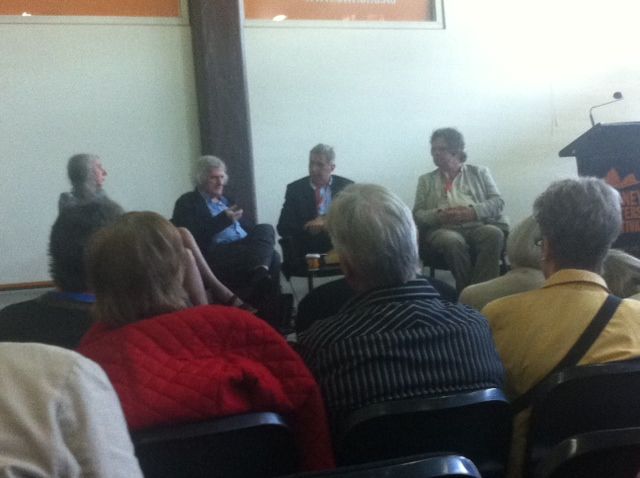
Jennifer Maiden, Robert Adamson, Martin Harrison and Neil Astley not far from the Harbour

In short, it was very good. Afterwards I ventured to introduce myself to Jennifer Maiden, but I was probably working so hard at no being too fanboyish for the conversation to have made much sense.

After a brief interval I went to the Club Stage for So You Think You Can Write, my first time to this a regular Festival event in which random audience members get to pitch a project to a panel of publishers.

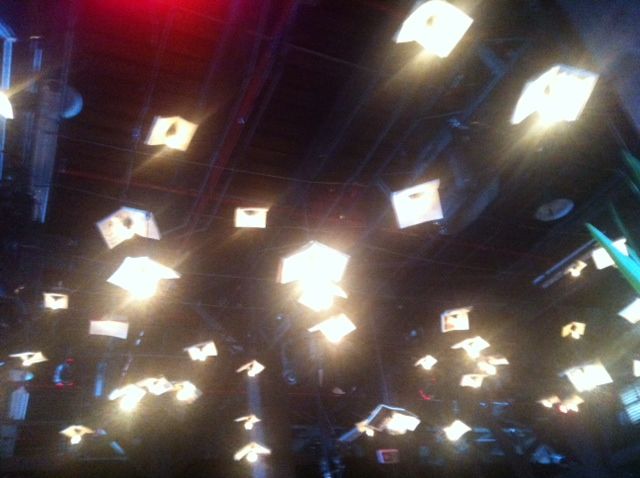
The specially decorative lights for the Club Stage area – each bulb has an open book for a shade.

I don’t know that anyone who was at all savvy about publishing would participate in this, unless for the sheer fun of it. And it was mostly fun. A 15 year old boy pitched a detective story set among the Egyptian pyramids. There was an earnest tract for children aiming to foster leadership skills and an understanding of democracy. One or two pitches were for books that could have been anything, so broad were the descriptions. One woman had already had an iBook version of her project downloaded thousands of times. The winner – of nothing apart from the glory – was a psychological detective story in which the character realises a day of her life has gone missing and then is shown photos of herself taken on the missing day. The thing that won the audience and panel’s approval was that the photos were improbably and bizarrely orgiastic, involving vegetables and cigars in unspecified lewd ways. It may not be Scandi-Crime, but this audience loved it. You read about it here first.

And then off to the poets’ lightfilled room. Gig Ryan and Kate Lilley, feminist-identifying experimental poets, drew an overflow crowd, including Adamson, Harrison and Astley from this morning, plus John Tranter, Ivor Indyk, Toby Fitch and many faces familiar from the Sappho open mike nights. Each of the poets introduced the other. They read from recently published books and, on being requested by an audience member to  compose a poem together on the spot, they parlayed the request down to each of them reading a poem by the other – with interesting results.

I confess that I went to this session expecting to suffer. I’ve read very little of either of them and my experience has been that if I don’t know a poet’s work I have trouble hearing it when read to me. (A possible contrary experience was hearing Jennifer Maiden this morning, but I am familiar with her voice and preoccupations, so had a head start.) Gig Ryan reads quickly, and her language is very compressed: I had difficulty distinguishing the words, let alone grasping the connections between them. Kate Lilley has a gratifyingly expressive delivery, and the woman beside me kindly allowed me to look over her shoulder and read along as the poems were read. But I was still pretty completely mystified. Both women talked about how people in their lives met their work with blank expressions, so I didn’t feel too stupid, or at least not alone in my stupidity.

One of Kate Lilley’s poems, ‘Maisily’, consists of a string of about a hundred adverbs. This was the first time she’d read it aloud and it was quite a feat – all those lys. It seemed like pointless nonsense to me. Then she explained that it was made up of all the adjectives used by Henry James in What Maisie Knew. That made it seem like hi-falutin pointless nonsense to me. Then I remembered that it was part of an elegiac sequence about the poet’s relationship with her mother, and it no longer seemed so pointless – maybe I was finding an emotional subtext because that’s the kind of reader I am, but I did find one, like a deeply submerged nostalgia for childhood when the adult world was as inscrutable as to little Maisie in James’s novel. I wonder how it wold go if read, not as a near tongue twister, but with the rhythm of a tolling bell.

As if the poets had read my thoughts, their conversation turned to the business of reading poetry aloud. Lilley said she knew and loved her poetry long before she heard her read, but when she did hear her read it was a revelation. Maybe my difficulty is as much to do with my increasing deafness as with unfamiliarity with the poetry.

So the poetry was difficult, but the session was excellent. Both were very funny about the business of being poets, and how they see each other’s poetry. Even when they drew our attention to the complete absence of critical articles on Gig Ryan’s work, even though she is generally acknowledged as an important Australian poet, and surmised that this absence may well be because she is a woman, somehow that seemed richly comic.

On the way home in the bus, I ran into an old friend who had been to a panel with Peter Hartcher, George Megalogenis and a third journalist talking about Australia’s parlous economic situation. I felt I had been very frivolous, but I was glad of it.

SWF 2112: Mark Tredinnick Throwing Soft Bombs

The State Library again, this time for a morning poetry workshop with Mark Tredinnick. I did a community college creative writing workshop with Mark a couple of years ago, soon after which I had my first poem accepted for publication. Since then Mark has published The Blue Plateau and won some prizes, including the prestigious 2011 Montreal Poetry Prize. I liked the blurb’s idea of ‘learn[ing] some old ideas and new tricks to turn [my] poems into soft bombs’, though I wasn’t sure what that meant.

There were 16 of us. Mark’s distinctively resonant voice had taken on a richer tone thanks to a head cold, but he soldiered on. One of the six male participants excused himself, explaining that he had recently had a lung removed and didn’t want to risk catching whatever Mark had, but the rest of us presumably had less at stake and were willing to risk it.

It was fun. He took us, instructively, through a series of drafts of a short poem, and handed out several sheets of poems, reflections on poems, aphorisms about poetry. He covered a white board with suggestive phrases – ‘self:Self’, ‘enormous moments’, ‘politics of poetry’, and so on. He talked and answered questions without an obvious structure, and after some time passed we realised he had covered all the phrases on the white board. Then we did an exercise, and each of us read out what we had written, or one we’d prepared earlier. Mark commented, always generously and appreciatively, and did what he called some editing on the run.

Linda Gregg’s poem, ‘Adult‘ provided the ‘prompt’ (evidently a technical term in writing workshops) in its opening phrase: ‘I’ve come back’. This is what I wrote:

I’ve come back to this room
he fills with viral baritone
words – his own, his teachers’,
ours. Teresa sees language as God’s
best gift, but worries sometimes
she mistakes gift for giver.

He rightly said I needed to think whether this would lead anywhere or whether it was just a clever thought in a writing class.

That’s all. I’m writing this on my iPad in the reading room of the Mitchell Library. Now I’m off to catch a bus home. Oh, the thrill of almost live blogging!

SWF 2112: Tabloid – David McKnight on Rupert Murdoch

The Sydney Writers’ Festival has started. In recent years I’ve been kicking my festival off by attending the Premier’s Literary Awards dinner on the Monday night, and it’s been a great way of getting momentum up. This year, the dinner – if there is one – will be in November, so I began with a visit to the State Library on this cold cold night to hear David McKnight talk about Rupert Murdoch in a conversation with Jonathan Holmes. It was good to see Mr Media Watch in person, and David McKnight has read and watched an awful lot of a certain kind of journalism so the rest of us don’t have to. And written a book, Rupert Murdoch: An Investigation of Political Power.

My pick for quote of the evening was David McKnight on the anti-elite ideology pushed by Murdoch and his allies: ‘A librarian living on a pension is a member of the elite if she has liberal views, and Rupert Murdoch is not. It’s a beautiful move ideologically.’

In the Q&A, someone remarked that the  Australian‘s columnists seem to have contempt for their readers, considering them incapable of rational thought. Jonathan Holmes said something to the effect that the columnists see themselves as speaking to the concerns of those readers, echoing and amplifying their anxieties and prejudices; if they have contempt, it is for people like the questioner, who is clearly one of the ‘elite’.

No one asked David McKnight if he there was anything he admired about Rupert Murdoch, but he told us anyway, saying that he had prepared the answer and in all his presentation about the man no one had ever asked the question: he has never heard him be racist, and he seems to be a genuine believer in free speech, as he has never sued anyone, or even threatened to sue them, for libel.

It was like a top level Gleebooks evening – which would cost maybe $5 and  be free to Gleeclub members. I don’t know if either of the presenters was paid for his appearance, but each of the mainly silvery heads at tonight’s sold out event  paid $20. I guess the money went to a good cause.

Asia Literary Review 22

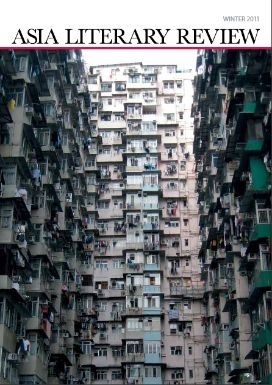
Martin Alexander (Editor), Asia Literary Review 22, [Northern] Winter 2011

20120416-173808.jpg

[Note added in 2021: All the links in this blog post are broken except the ones in the journal title above and in the image to the left, and the profile of Amitav Ghosh and ‘The Sacred Cow‘. The whole journal is still available online to subscribers.]

The Asia Literary Review has a new Editor in Chief, the third in the nine issues since I first subscribed. There’s no note of farewell to Stephen McCarty, as there was none to Chris Wood before him. The silent turnover is just a little unsettling, but I guess we don’t read the journal for news of its staff. Martin Alexander, the new occupant of the chair, was previously (and still is) Poetry Editor. In his editorial, he addresses the journal’s identity:

… while Asia is a concept we may broadly understand, it would be foolish to attempt a precise definition. Asia’s identity is in a state of motion; we aim to capture that motion in these pages.

That’s not bad: if Asia is an imprecise entity, it would be a mistake to overdefine the journal’s scope or purpose. Its contents are in English, and they ‘capture’ Asia in some way. That’s enough.

‘Capture’ can describe what a tourist snapshot does, and there’s quite a lot of that in this issue, mainly but not exclusively in its four photo essays – of street scenes in Java, Vietnam, Hong Kong, and the grand but as yet unpopulated city of Kangbashi in Inner Mongolia. The photography is brilliant in each case, but in the end they are all picturesque street scenes, and so a lot less interesting than, say, Jack Picone’s ‘Planet Pariah’ about life on the Burma Thailand border in issue 19.

There are a number of excerpts from longer works, both prose and verse, which are like snapshots in a different way: tantalising glimpses, but sometimes hard to tell what it is one is glimpsing. An exception is the excerpt from Chen Xiwo’s novel I Love My Mum (banned in China, translated by Harvey Thomlinson, and published by Make Do Publishing), which stands alone as a tale of desperate brutality with chilling allegorical implications. You can read the whole excerpt at the link.

Sticking with the idea of ‘capture’, there’s Fionnuala McHugh’s profile of Amitav Ghosh. I’ve only recently discovered his writing, and was delighted to learn more about him, and about his Sea of Poppies. He reveals, for example, that having done a little sailing he knew that sailing was ‘very dependent on words’:

I thought there has to be a dictionary. I happened to be at Harvard but I found the Lascari dictionary in Michigan – published in 1812 in Calcutta by a Scottish linguist. I didn’t have to make anything up.

He sounds like a terrific man – if a Sydney Writers’ Festival scout happens to read this, could you invite him some time soon, maybe when the third book of the Ibis trilogy comes out?

The Ghosh profile is also part of what Martin Alexander calls ‘motion’, if he means by that the kind of dynamic interplay that can add spice to a literary magazine.  Ghosh, we read, turned down the 2001 Commonwealth Writers’ Prize because it was for works written in English, from a region ‘that was once conquered and ruled by imperial Britain’. This is honourable and hardly surprising, given the unflinching portrayal of the Raj in Sea of Poppies. But here it resonates interestingly with a short piece by Pico Iyer, The Empire Writes Back, Revisited, which argues that the formerly colonised have taken charge of the cultural centre, and that the English language, no longer dominated by the former colonisers, is being reclaimed and revitalised by a host of writers from India, China, the Caribbean, Africa, New Zealand, Australia. This ALR tends to bear out Ghosh’s side of the conversation, as most of the contributors seem to be of European or US extraction, and there is that strong touristic element. But Pico Iyer would find material to support his view as well.

Of the short stories, ‘The King, the Saint and the Fool‘ by A. K. Kulshreshth weaves a sweet romance from elements taken from the folk history of Singapore, and Sindhu Rajasekaran’s ‘The Sacred Cow‘ tells a distinctly modern love story in the context of Indian village life. The essay that stands out is Michiel Hulshof’s ‘Special Academic and Art Zones‘. Hulshof is a Dutch journalist living in China. Among other things his essay gives a fascinating account of the economic and political context of contemporary Chinese art (of the kind Sydneysiders get to enjoy at the White Rabbit Gallery).

Almost as good as getting on a plane and travelling for six months.

SWF: A C Grayling, curtain raiser

‘The Private, the Public and the Line Between’, a lecture by A C Grayling

This was the start of my 2012 Sydney Writers’ Festival. I’ve become accustomed to starting the Festival with the Premier’s Literary Awards dinner, which is always a good night out, though the last two had become a bit corporate. This year the awards evening has been moved to later in the year (not, as feared by some, cancelled altogether), so my Festival begins with this 90 minute event at the Angel Place Recital Centre a month or so ahead of the Opening Address. I’m calling it a curtain-raiser because that ‘s how Peter Shergold (from the SWF Board) described it when introducing the talk, but really it was more of an advance scatterling.

A C Grayling is the very picture of an urbane philosopher. He spoke lucidly for an hour without notes, and fielded questions deftly and courteously. Sadly I slept for maybe as much as half the talk, so I’m not a reliable reporter. But I quizzed my four companions over dinner at the nearby Wagamama and my impression is that I didn’t miss a lot by dozing off. Basically, Professor Grayling told us, we are being watched by Internet corporations who track our online activities for commercial purposes, by government for security purposes, and by journalists for partly public interest and partly commercial interests, and that this isn’t a good thing. I have listened to his interview with Richard Glover on the ABC, which is an excellent 18 minutes of radio and includes everything that the $25 lecture had to offer, including the teasing references to the Professor’s impressive hair. What we got for our money was the sense of occasion, a chance to play Spot the Famous Person (both the Art Student and I saw David Marr and Annette Shun Wah, but some of our other companions hadn’t heard of either of them, which rather spoiled the thrill).

If the purpose of a talk by a philosopher is to prompt one to think, then this one was a big success for me. During the question time, Professor Grayling talked about a village in southern Italy where, when a husband and wife have a quarrel the woman runs out into the street and the couple proceed to shout at each other, while all the neighbours come to their doors and windows to listen. These people, he said, live with a strong sense of community but at the cost of losing their privacy. That raises a much more interesting question about ‘The Private, the Public and the Line Between’ than the question of intrusion by the state, corporations and the press. I would have thought that that kind of intrusion is obviously a bad and dangerous thing – and of course that it’;s a good thing to have the dangers pointed out. But don’t we then need to think carefully and precisely about what it is that we’re protecting. Are we protecting our right to be isolated individuals, to have secrets and present a conforming face to the world? Sure, those young people who give out far too much information on facebook or twitter may be laying themselves open to attack, but isn’t also worth asking if there’s not something utopian about that rather than simply foolish? That’s what I’d have liked to hear him talk about.

LoSoRhyMo #5: Leslie Cannold’s Book of Rachael

Leslie Cannold, The Book of Rachael (Text 2011)

At the Sydney Writers’ Festival earlier this year I embarrassed myself and Leslie Cannold, author of this book about an imagined sister to Jesus, by singing her a snatch of Dory Previn:

Did he have a sister, a little baby sister,
Did Jesus have a sister?
Was she there at his death?

I was expecting to find in the novel the kind of revisionist pleasure provided by ‘Did Jesus Have a Baby Sister‘ (the link takes you to the song on YouTube). But it turns out to be quite a different beast: it doesn’t so much ring changes on the biblical story as set out to imagine what life would have been for a spirited young woman in the time of Jesus, using the biblical story as a kind of baseline. There is some revisionism, of course: the virgin birth is explained – almost incidentally – by the familiar Roman soldier story; as a young man, Joshua/Jesus comes home late at night smelling of alcohol and women; and there’s an excellent account of the raising of Lazarus. But the aim isn’t to debunk or mock.

It’s years since I read any theology, apart from Tissa Balasuriya’s Mary and Human Liberation. Leslie Cannold’s approach to the biblical narrative goes quite a bit beyond Balasuriya’s ‘hermeneutics of suspicion’, and she certainly doesn’t take up his vision of Mary (here called Miriame) as a revolutionary figure. I doubt if many scholars would take seriously the book’s version of how Joshua came to go on his preaching mission (he was looking for a woman who was pregnant to him, who had been consequently sold into prostitution by her father). It’s clear from this and other examples that this is not an attempt at historical excavation. Such pernicketiness aside, I don’t think I’ve ever read an account of the Jesus story that brings home more clearly what it meant to be poor or outcast or female in those times. That was the main pleasure of the book for me, rather than an engagement with the characters, who never quite came completely to life, despite even the scattering of cheerful sex scenes. Still, the pleasure was considerable.

But it’s November, and a sonnet is compulsory, even though it may create even more embarrassment all round than an off-key rendition of Dory Previn:

Sonnet 5: Where were the women?
These days I think of the Last Supper
and wonder where the women were
when Jesus foretold in that upper
room his foes would soon bestir
themselves and take his life. Who cooked
and shared that meal, were overlooked
by gospels and two thousand years
of art and preaching? More than spears
such silence pierces the hearts
of half the world. Oh they were there,
not just their sinful, perfumed hair
or veils, or wombs and other parts.
They've always held up half the sky.
Their absence is a stupid lie.

Antony Beevor’s Stalingrad

Antony Beevor, Stalingrad (2004, Penguin 2008)

Antony Beevor visited Sydney for the Writers’ Festival in 2007. His talk was interesting, and it evoked high-quality audience questions that came from a whole world of War History geekiness previously unknown to me. Although he’d recently published a book about the Spanish Civil War, it was Stalingrad that generated the serious senior fanboy passion. We bought the book not much later, but didn’t start reading it until July 2008. Now here we are, in mid 2011 and it’s done!

Notice I said ‘we’. The reason I took longer to read the book than Anthony Beevor took to write it is that I read it exclusively on long car rides, aloud to my regular driver, usually known on this blog as The Art Student. Apart from the reading being disrupted by our lamentable failure to do much travelling by car in the last three years (two return trips to Canberra, perhaps one southward, and just now north to Red Rock and surrounds), it was an excellent way to read this book.

As with Jared Diamond’s Guns, Germs and Steel, another car-journey book, the flow would be interrupted frequently by one or other of us exclaiming, querying, drawing parallels or pronouncing judgements. Once or twice, we had to stop the car so the driver–listener could peruse a map. After a certain point I stopped reading out the full name of every military unit, and occasionally I would give up the struggle to pronounce a German or Russian name in full. But such bumpy moments in no way detracted from the book’s holding power. It manages to move, apparently without effort, from close-up accounts of human cruelty, brutality and suffering to a broader strategic narrative; from the obsessions and denials of Hitler and Stalin, to the petty rivalries, quirks and duck-shovings of the officers on both sides, to the German troops’ sentimental yearning for family or the Russians’ pursuit of alcohol.

The wonderful Barbara Ehrenreich said on her blog recently, ‘War has been, and we still expect it to be, the most massive collective project human beings undertake.’ Having just read about the sheer logistics of attack and counter-attack, siege and counter-siege at Stalingrad, I can only say, ‘True, that!’ ‘But,’ Barbara Ehrenreich continued, ‘it has been evolving quickly in a very different direction, one in which human beings have a much smaller role to play.’ If that’s so, we can only be glad of it. The human participants in Stalingrad endured almost unbelievable extremes of cold and hunger: men literally dropped dead from hunger, wounded soldiers froze to death by the cartload. They performed acts of understandable but almost unimaginable cruelty and callousness: Russian prisoners-of war starved in scenes that foreshadowed the images of Jewish prisoners at the end of the war; German prisoners were shot at random by their Soviet guards. There was plenty of heroism as well, of course, and an extraordinary episode of contact between individuals from both sides.

I turned down two page corners. The first was to mark the account of Hitler’s speech on 30 January 1943, the 10th anniversary of his accession to power, when the German army at Stalingrad was surrounded, starving, under-equipped, low on ammunition and facing almost certain defeat (Hitler expected them to fight on and the generals to commit suicide). The speech, delivered for some reason by Goebbels, made just one mention of Stalingrad:

The heroic struggle of our soldiers on the Volga should be an exhortation to everyone to do his maximum in the struggle for Germany’s freedom and our nation’s future, and in a wider sense for the preservation of the whole of Europe.

Of course there’s no comparison with the circumstances of Australian troops in Afghanistan, but doesn’t that rhetoric sound awfully familiar, and isn’t it equally hollow?

My other turned-down corner marks that contact between individuals I mentioned. In early January, when things were already obviously hopeless for the Germans, the Russians sent envoys under a white flag to offer a truce. The whole episode, drawing on an unpublished manuscript by Nikolay Dmitrevich Dyatlenko, one of the envoys, is marvellously told, full of poignant detail, but one moment grabbed my imagination.The envoys approach the German lines. They call out that they have a message for the German commander-in-chief.

‘Come here then,’ [a warrant officer] said. Several more heads popped up and guns were levelled at them. Dyatlenko refused to advance until officers were called. Both sides became nervous during the long wait. Eventually, the warrant officer set off towards the rear to fetch his company commander. As soon as he had left, German soldiers stood up and started to banter. ‘Rus! Komm, komm!’ they called. One soldier, a short man, bundled in many rags, clambered up on to the parapet of the trench and began to play the fool. He pointed to himself in an operatic parody. ‘Ich bin Offizier,’ he sang.
_____‘I can see what sort of an officer you are,’ Dyatlenko retorted, and the German soldiers laughed. The joker’s companions grabbed his ankles and dragged him back into the trench. Smyslov and Siderov [the other envoys] were laughing too.

And then back to the serious business of war, of the truce being offered and refused as per Hitler’s orders, and thousands more deaths being decided by the event. But in the middle of all that, with the stakes so high and the conditions already so desperate, that short man, bundled against the terrible cold, could stand tall and mock the whole catastrophe.

Cate Kennedy’s taste of river water

Cate Kennedy, The Taste of River Water (Scribe 2011)

When Cate Kennedy read, marvellously, from this book at the Sydney Writers’ Festival, she described her poems as meditations through narrative, and that’s a nice description. Her poems generally have a narrative thread, whether it’s the story of the woman who wins second prize in a photography competition in ‘8 x 10 colour enlargements $16.50‘ or the moving hand of a baby at the breast in ‘Dawn service’.

Mostly this is no-frills poetry: very little by way of formal rhyme schemes, and even less prosodic adventure – no clever enjambement, uncanny syntax, esoteric allusion. Almost universally, the cadences and imagery are those of conversation, sometimes intensely intimate but always intelligent, generous and emotionally engaged. There’s an attention to fleeting moments, to things easily overlooked: a tight smile, a gesture accidentally caught on camera, a detail from a larger narrative, a parent’s childhood memory, a tiny act of wanton cruelty. These become the subject for meditation, their meanings explored. Many of the poems can be read as reflections on art and communication, though the immediate subjects range from the laying of a brick path to being caught in a rip, and include a locust plague coming to the city, a little girl dancing in a square of sunlight, or the auction of the contents of a deconsecrated church.

What I wasn’t prepared for was that the sixteen poems in the second section of this book constitute what Frank Moorhouse used to call a discontinuous narrative: each poem stands alone, but there are lines, even words (a throat-tightening ‘again’ in ‘Thank you’, for instance) that gain tremendous force from their place in the sequence. Although it’s in many ways a very different beast, I was reminded of Sarah Gibson’s wonderful short lyric film The Hundredth Room.

Cate Kennedy read some of the poems and chatted with Ramona Koval on the Book Show on 19 May. It’s worth a listen, but be warned that the conversation reveals quite a lot about Section 2. Not that there’s a twist to the tale or anything of the sort – but there’s something to be said for letting a narrative reveal itself to you rather than approaching it with foreknowledge.

SWF2011: Sunday

I didn’t get to the Festival on Sunday morning, so missed out on A C Grayling’s session, The Good Book, which the Art Student said was superb. I plan to listen to the podcast. We bought a copy of the book, which describes itself as a secular bible, and the Art Student is threatening to organise a bible reading circle among our atheist friends.

I was back on deck in the afternoon for

2:30: Poems on Pillows
Australian Poetry Ltd, the new ‘peak industry body for poetry’ (I didn’t make that up!) ran a competition in the lead-up to the Festival. People were asked to submit 10-line poems on the theme of Sweet Dreams. Seven poems were selected, printed on postcards and placed on the pillow of every bed in the hotel where Festival guests were staying. At this session the seven winning poems were read to us, six of them by the poets.

My guess is that the audience was mostly friends and relatives of the winners, and losers who had come to see what they’d been beaten by. It turned out I belonged in both categories. My submission, which I’m too embarrassed to reproduce here, played around with  Daisy Bates’s phrase ‘smooth the pillow of the dying race’ and amounted to a little squib about genocide. I’d failed to notice the Sweet Dreams theme and wasn’t surprised when I didn’t make the cut.

I would have been delighted to find any one of winning poems on my pillow, and it wasn’t surprising to hear that at least one distinguished writer was seen addressing his postcard poem to his mother.

Five of the winners are connected in some way with writing for children or young adults: Tricia Dearborn, Bill Condon, Libby Hathorn, Laura Jan Shore and Richard Tipping. I don’t know about the others, Scott Chambers and Josh McMahon. When I pointed this preponderance out during the brief question time, one of the panellists recognised me and replied by drawing attention to me as a benefactor of children’s poets in my past life as editor of the School Magazine, which was good squirmy fun.

4.00: David Hicks and Donna Mulhearn
This was my last Festival event, David Hicks’s first public appearance since the publication of his memoir, in fact since his detention in Guantanamo Bay. He was in conversation with pacifist Donna Mulhearn, who had gone to Iraq as a human shield. She did a very nice job of shepherding him through what must have been a gruelling event, even though the audience was demonstratively sympathetic. She kicked off, for example, by saying she was going to ask him the question that was on the forefront of everybody’s mind: was it true that he had been invited by Channel 7 to appear in Dancing with the Stars? Yes, he said, it was true, and his wife had wanted him to wear the costume to this event, but it’s purple with sequins.

For the most part, things felt very raw. Talk about terror and pity – and shame and rage! Mine, I mean. Hicks said at the start that during those years of being kept incommunicado, thankfully unaware that he had been abandoned by the Australian government, he had learned to detach from his experience, and that was how he was managing this experience. He spoke pretty much in a monotone, but did manage to say he was ‘annoyed’ by the way the press had bought into the lies and distortions told about him. He has never been convicted by a legitimate court of breaking the US or Australian law, and has received no compensation, explanation or apology from either government, not even an acknowledgement of the extraordinarily harsh treatment. The press received his memoir with almost total silence. And Donna Mulhearn told us of something Miranda Devine said in her review that went beyond her normal level of vicious contrarianism to pure evil. The current Labor government, having decried the treatment of Hicks when in opposition, has made no moves in his support in government.

‘This shouldn’t be about me,’ Hicks said. He got passionate describing the sufferings of the people of Kosovo as they were told to him when he went there to join the KLA, and reminding us that people are still being killed in Kashmir. Julia Gillard’s statements about Julian Assange sound very like John Howard’s about Hicks: both seem perfectly content to abandon an Australian citizen to a dangerously extra-legal fate in the US.

One tiny grace note: throughout, Donna Mulhearn pronounced the Gitmo prison’s location as Guantamano Bay. Of course this was inadvertent, but I imagine angels rejoicing at this tiny act of disrespect.

I plan to buy David Hicks’s memoir. It feels like a duty to give the horse’s mouth a go, given all agenda-driven stuff I’ve read about him elsewhere.
——
I haven’t mentioned the absence of PEN Chairs this year. At past Festivals theere has been an empty chair on the stage at some events, representing writers who are imprisoned or harmed by governments. At each session where there was a chair, details about one such writer would be read out. It’s a shame that the tradition was abandoned this year, when Liao Yiwu, invited to appear here, was prevented from attending by the Chinese government. And I haven’t mentioned the busker who sat hunched over a clickety-clackety typewriter offering to type a word portrait for five dollars. I haven’t said much about the weather (glorious), the crowds (big), the volunteers (orange-shirted and everywhere), the app (fabulous), the serendipitous encounters (constant), but I imagine you know the sort of thing.

Now it’s all over bar the reading.