Tag Archives: The School Magazine

Vale Ian Dodd

This afternoon I attended a celebration of the life of Ian Dodd, who died last month. Ian was a much loved member of Sydney’s photographic community, and the celebration focused on his extraordinary career as a photographer. His most famous photograph is probably Wet Hair (1974), which is in the collection of the Art Gallery of NSW (you can see it here). More recent work is up at the website of the now defunct and sadly missed Stills Gallery, where he had a solo exhibition in 2006.

Ian and I knew each other through the School Magazine, a monthly literary journal for primary school students published by the NSW Department of Education since 1916. In the 1980s, the magazine’s editor Kath Hawke set out to overhaul the look of the magazine. She wanted something better than what she described as blurry postage-stamp sized drawings. Ian was a childhood friend who had been art director of a small adult magazine. When Kath offered him the challenge he rose to it, and when I started working at the magazine soon after he was designing lay-outs and coming into the office a couple of days each month to be the de facto art director. He continued to do the job under Kath’s successor, award winning children’s book author Anna Fienberg, and then me. It was a far cry from the sophisticated and often erotic work for which he was known in the world of photography, but we all learned a lot from him, and enjoyed his warm, wry humour.

I wasn’t able to stay for the speeches this afternoon. I hope someone told the story he once told me about a mother who asked him for help. Her teenaged son had his heart set on becoming an artist, and she asked her friend Ian, himself an artist and photographer, to have a chat with him, explaining how important it was to get a trade of some sort rather than dive straight into the precarious life of an artist. Ian agreed, and gave the boy a pep talk. As I remember him telling it, the gist of his talk was to tell the boy that if he wanted to be an artist, life would probably be hard, but if he didn’t do it he would probably regret it for the rest of his life. The boy was George Gittoes, and it’s fair to say that the world has benefited from Ian’s advice.

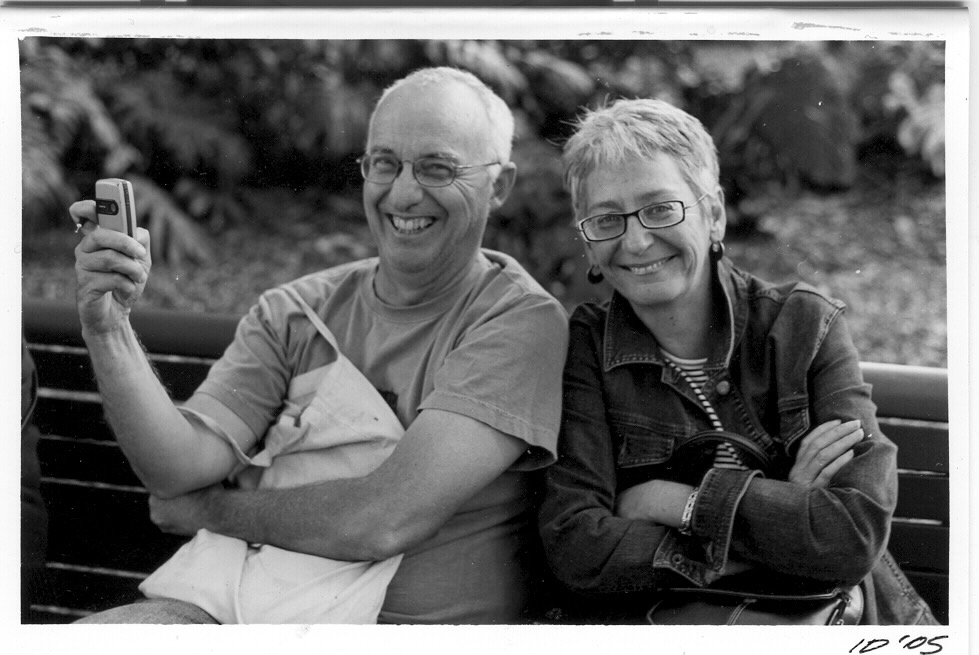
Here’s a photo Ian took of me and the Emerging Artist in Hyde Park, well before she set foot on the artistic path. I treasure it.

Benjamin Gilmour’s Paramédico: page 76

Here’s another post where I talk about a book with a focus on page 76 – chosen because it happens to be my age., but also because I remember someone saying that flicking to a page in the 70s (they may have suggested page 73) was a good way of checking out a book before buying

Benjamin Gilmour, Paramédico: Around the World by Ambulance (Pier 9, 2011)

If you were to judge Paramédico by its bullet-punctured, blood-spattered cover with its photo of an ambulance nosing through an impossibly dense crowd, you wouldn’t be wildly off the mark. To write the book, Benjamin Gilmour spent a number of years’ annual holidays from the NSW ambulance service working in ambulance services all over the world. Gunshot wounds and huge, virtually impenetrable crowds do feature.

But the cover gives no clue to much of the book. Gilmour abandons his holiday plans in Thailand to help treat survivors of a tsunami. He attends elderly people dying in the back streets of Venice. He wakes in fright in outback Australia. In the longest chapter, he explores two different ambulance systems that serve the urban poor of Pakistan. Everywhere he gives vivid accounts of injuries and illnesses the ambulance workers encounter, of the workings of the different systems: some have doctors in the ambulance, for instance, while in others the vehicle exists entirely as a transportation service for the dead as well as the living. It’s a kind of travelogue with a paramedical theme.

The main thing not hinted at by the cover – and as far as I recall not part of Gilmour’s 2012 documentary of the same name – is the book’s intensely personal nature. As paramedic and occasional interviewer of key people, Gilmour is always at the centre of the action. There’s a sense of jeopardy, not just in the proximity to gun violence or the hair-raising races through the streets of London and South African townships with sirens blaring, but in the ways the ambulance staff of various countries let off steam. The book’s comedy brings home the reality that ambulance workers put their bodies on the line: they do it not only in their work, but also in their play. Gilmour has fun mocking his own modesty when expected to sauna naked in Iceland, and plays up his terror of a Mexican initiation ceremony that involves having alcohol poured on his chest and set alight.

On page 76 he’s in Macedonia at the midsummer feast of Saint Nicholas. Even though his crew of four are on duty, they celebrate the feast in the traditional way, visiting a series of friends through the night, joining briefly in a feast at each stop. The page begins soon after they arrive at their first destination, the home of Igor, an ambulance worker on his night off:

Igor puts a strong hand on my shoulder, bangs a small glass down in front of me and fills it from a bottle of crystal-clear rakija inside of which is a miniature wooden ladder, as if inviting me to climb in.
‘Drink! Drink! Drink!’ Igor shouts at me.
Everyone is looking my way, at the foreign guest about to taste their rakija. It is customary in the Balkans to sample a family’s home brew after entering a house and, if one values one’s life, declaring it the best brandy one has ever tasted. Any reservations I have about drinking on shift are subdued by the fact that Sammy [the driver] and nurse Snezhana Spazovska also have a fully laden glass of rakija in their hands, while Dr Aquarius is savouring a mixture of red wine and Coca-Cola known as bamboos.

He drinks, and offers appropriate words of appreciation. The party breaks into approving applause, someone plays the accordion, and then:

Everyone is in fine spirits.
We have been at Igor’s for fifteen minutes when Dr Aquarius – now finishing off her second glass of bamboos – says we should keep rolling. This is not so we can return to our area for work but instead to visit the next home for another round of everything we have just ingested. We get up, offer our thanks and leave.

You get the picture. The visiting and partying continue, Gilmour suffers, and the reader is amused by his bruising journey on a loose stretcher in the back of the speeding ambulance. Then, in one of the moments that makes the book truly memorable, the crew that we just saw carousing is called to the home of a Roma woman who has died. When they arrive on the scene, the dead woman’s sister begins to sing:

Everyone listens intently. Everything is surreal. Quiet grief pours out of each person here. So moving is the sister’s song, my heart is hurting for the woman I never knew. On a card table nearby, tears belonging to Dr Aquarius fall onto the death certificate. She tries her best to dab it dry with her sleeve. In this moment the dead lady is everything and Saint Nicholas is nothing. Nurse Snezhana Spazovska, Dr Aquarius, Sammy the driver; it’s the longest I’ve seen them stay on scene. Never could I imagine that these hardened Macedonian medics on hearing this seemingly endless song would become so sad and – God forbid – weep. Nor could I imagine the gypsies of Shutka would appreciate our presence like they do now, our willingness to stay and listen, to give the most valuable gift a medic can give a patient – the gift of genuine feeling.

(Page 81)

Benjamin Gilmour spoke at the recent Sydney Writers’ Festival. As I mentioned in my blog post about his Curiosity Lecture, I was instrumental in publishing some of his poems when he was a teenager. Since then he has made at least two movies besides Paramédico: Son of a Lion (2007) and Jirga (2018), the latter dealing with a former Australian soldier returning to Afghanistan to submit to the judgment of a tribal court, a jirga. (Here’s a link to the Guardian review, which also describes the conditions in which the film was made, significantly more hair-raising than the adventures in Paramédico).

It’s quite a body of work, one that has involved going to places where most writers and filmmakers fear to tread. Let this be a lesson: if a teenager presents you with a handful of poems with titles like ‘An ode to a snake charmer (from his snake)’, encourage them. You don’t know what might they might do next.

Nicola Knox’s Green Light Running

Nicola Knox, Green Light Running (self published 2012)

glr.jpgThis is not one of those self-published books with a chip on its shoulder about the publishing industry.  It’s much more modest than that – so modest that I can’t find any information about where to buy a copy. Mine was a gift from the author, an honour to which I owe a number of Nicola Knox’s poems having appeared in The School Magazine when I was editor. My impression is that she only ever intended a small, intimate circulation. (Maybe I’m projecting: my own three self-published books of verse are glorified end-of-year greeting cards – though of course I’m delighted whenever someone buys one from Lulu.)

The book is a witness to the value of creativity, of making in response to experience. Where one person might take out a sketch book and pencil or paints, another will reach for pen and notepaper. Poems here have been inspired by travel, by family life, by childhood reminiscence, by works of art, by ancient and modern history. They are the fruits of life lived with an active mind, a mind that it’s a pleasure to spend time with.

Just to give you a taste, here’s a poem that speaks softly but carries a big stick to one of the big issues facing us at the present moment:

Refugee Boat

The heart of Pharaoh
was dry and shrivelled
as an old walnut.

But his daughter
dove gentle
beautiful and kind
was loved as her father
was feared.

On a morning
splashing with court ladies
in the Nile, she did not hide
her pity for the plump infant
found in a coracle
rocking gently
among river reeds.

So the princess
and the alien child
gazed upon each other
and from that moment
all things changed.

A second volume of Nicola Knox’s poetry, Verandah Man, was published by Ginninderra Press in 2016, and is available from the Ginninderra website.

aww2017.jpg

Green Light Running is the eleventh book I’ve read for the 2017 Australian Women Writers Challenge.

Dimity Figner

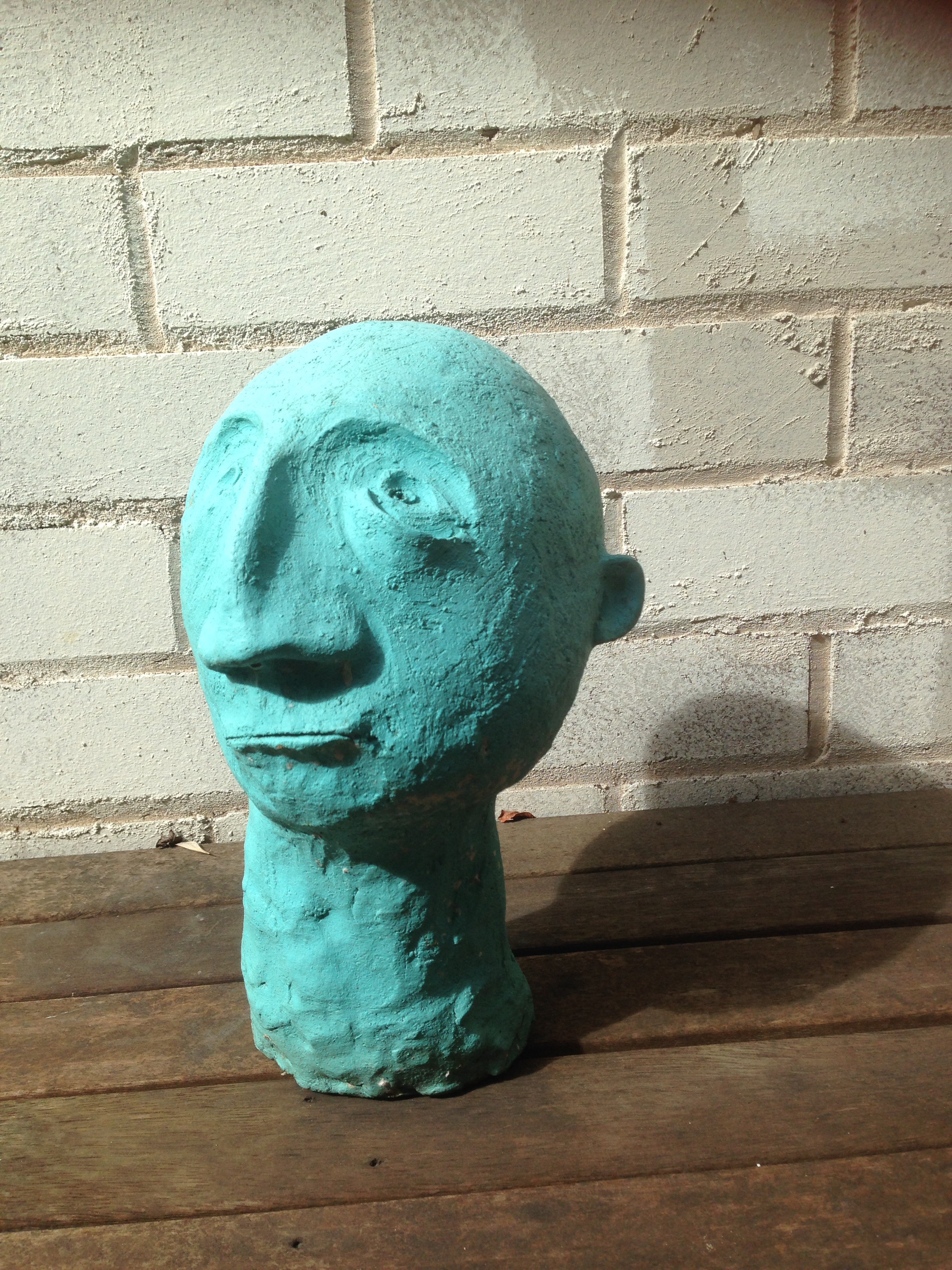
Dimity Figner, feminist, artist and generally lovely person died on Thursday in a nursing home in Nowra. She had been sick for some time, and some of her many friends were with her at the end.

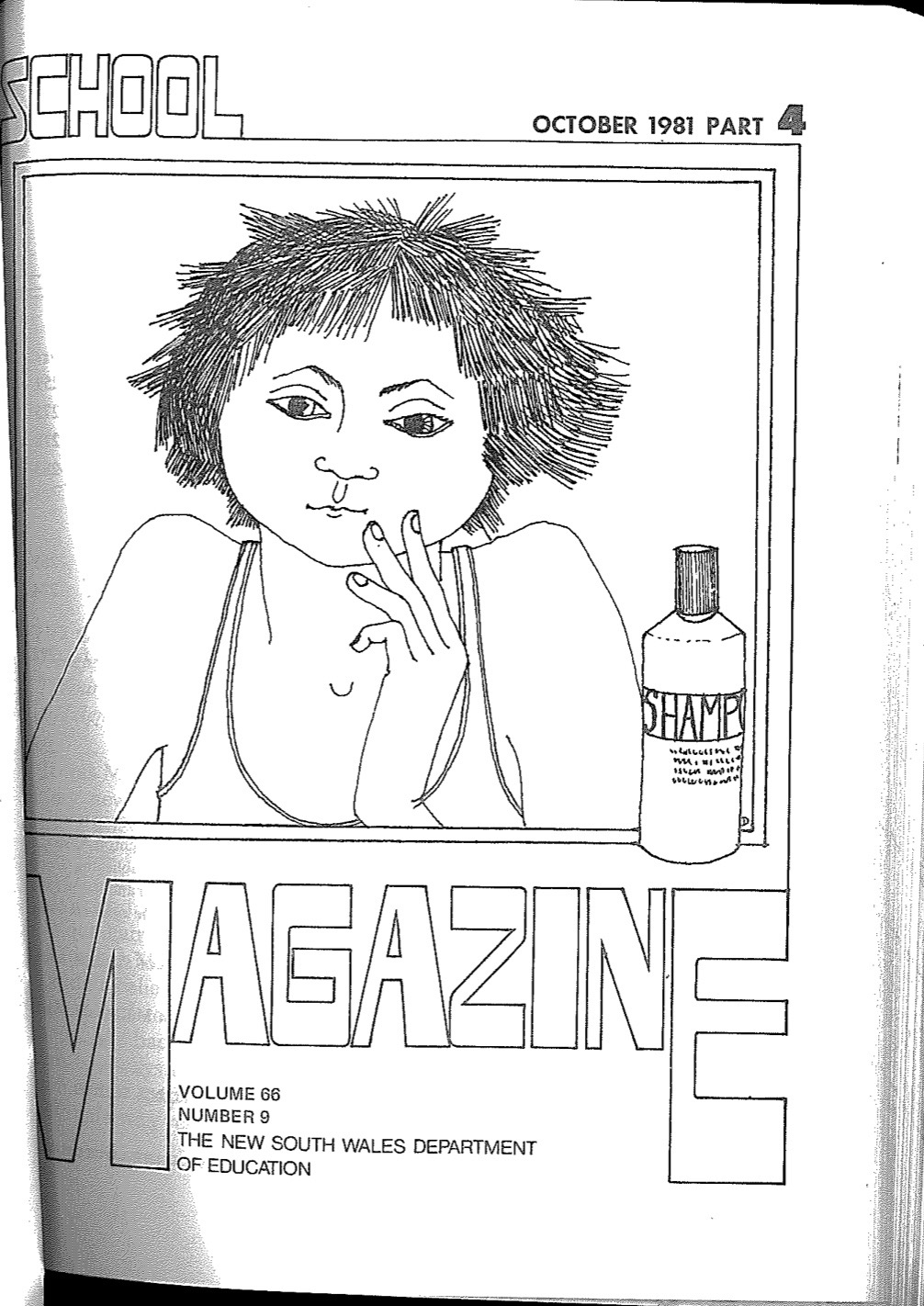
There was a retrospective exhibition of Dimity’s art in Nowra earlier this year, and she was active in the Older Women’s Network until recently (at that link is a photo of Dimity and 13 other rambunctious older women celebrating the publication of a history of Nowra OWN). In the 1970s she designed a beautiful Women’s Liberation symbol that has been widely used on badges and publications in Australia. She briefly illustrated for The School Magazine in the early 1980s. Back when I used to run into her regularly I could count on her to say she liked my hair just about a day before my official grooming consultant told me it was time to visit the barber.

One of our most cherished art acquisitions is this wonderful little bust, her creation:


Many people will miss Dimity. I’m one of them.

Added on 6 May: I don’t think many people will be aware of Dimity’s work with The School Magazine. Here’s a scan we managed to get of a 1981 cover by her (difficult if not impossible to get a perfect scan, as the bound volumes don’t flatten out without damage):

A hundred years of The School Magazine

sm100.jpegI will probably write more about The School Magazine as its centenary year progresses, but for now I want to draw your attention to a sweet thing that happened on World Poetry Day. A number of poets wrote blog entries about their experience of being published in the magazine, and they combine to create a powerful statement of the magazine’s importance. You can see at least some of them by clicking on these links:

Jackie Hosking
Claire Saxby
Janeen Brian
Julie Thorndyke
Lorraine Marwood
Pat Simmons
Rebecca Newman
Sally Murphy
Sophie Masson
Stephen Whiteside
Yvonne Low

I was editor of the magazine for some years, and  (ahem!) am mentioned by one of these poets as a ‘great encourager’. I’m relieved that none of the poets took the opportunity to mention any of my blunders. And I’m delighted that a good number of them have begun publishing since my time.

Haruki Murakami’s Strange Library

Haruki Murakami, The Strange Library (2008, translation by Ted Goossen, Harvill Secker 2014)

1846559219I received this as a Christmas gift, and I’m pretty sure that’s what the publishers had in mind.
Tucked away on the imprint page is a credit to Suzanne Dean as designer with a copyright symbol next to her name, and that is just as it should be. The library record pocket glued to the front cover is just the beginning. As one reads the book, almost every page offers a little (or big) design surprise: gorgeous illustrations (many of tangential relevance to the text), to the illusion of different paper stocks, simulated water damage, clumsily stamped page numbers. You can never forget that you are dealing with a book as physical object. I haven’t been been as entranced by a book design since Marshall McLuhan and Quentin Fiore’s The Medium Is the Massage.

The creep, scary, dream-logical story of a boy who is imprisoned in a labyrinth beneath a library until he can memorise four thick books about taxation in the Ottoman Empire reads like Murakami’s version of a children’s story. If it had crossed my desk when editing The School Magazine, I probably would have voted to include it in our list of recommended books ‘for advanced readers’, though I would have understood if I’d been voted down because of some deliciously scary threats that the boy faces.

As it is, it’s a brief, pleasant diversion for adults as well as whoever else might find it.

Bill Willingham’s Legends in Exile

Bill Willingham, Fables Vol 1: Legends in Exile (Vertigo 2002)

140123755XIn my former life as an editor of children’s literature, we regularly received manuscript stories and plays that rang the changes on classic fairytales – the wolf as a good guy slandered by dodgy pig developers or, far too often, a frog who is nothing but a frog but tricks a princess into kissing him anyhow.

Bill Willingham’s Fables belongs in that tradition. The many lands of fairytales have been invaded by a monstrous Adversary, seen only in flashback in this first book of the series, and the survivors of his onslaught have now lived centuries-long lives among the mundanes (that’s us) in a film-noir inflected New York City. At least, the action of this book takes place among those who live in New York – we are told that others, who can’t pass as human, live in enclaves upstate.

I expect that later volumes will tell the story of the expulsion. Here we are plunged in medias res, and the workings of the Fable community are revealed to us in the course of  a murder investigation. Rose Red has vanished and her blood is all over her apartment. Bigby Wolf, almost always human in form, is the hardboiled detective who investigates. The main suspects are Bluebeard (who is engaged to Rose Red) and Jack, of beanstalk fame (who has been her boyfriend for a long long time). Old King Cole is the figurehead mayor while Snow White does all the community’s real administrative work. Beauty and the Beast are a bickering couple with a difference – whenever she is angry with him, he starts to revert to his beastly appearance. Prince Charming is a parasitic conman. Pinocchio is a real boy, who is permanently enraged for reasons you might be able to guess.

It’s all good, knowing, M rated fun. The art, pencilled by Lan Medina and inked by Steve Leialoha and Craig Hamilton, serves the story well, tactful with the violence, restrained with the comic transmutations, moodily noir when it has to be, and just every now and then completely over the top.

Looking back: June 1964, 1974, 2004

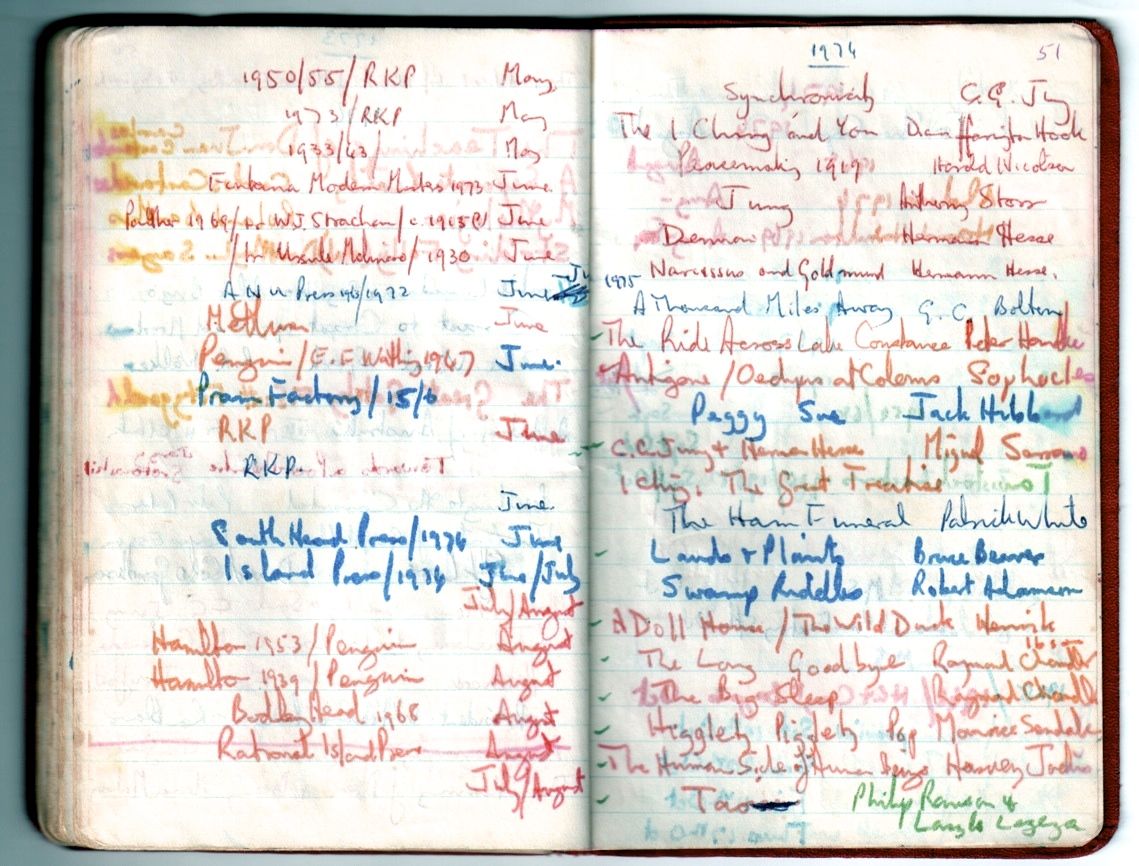
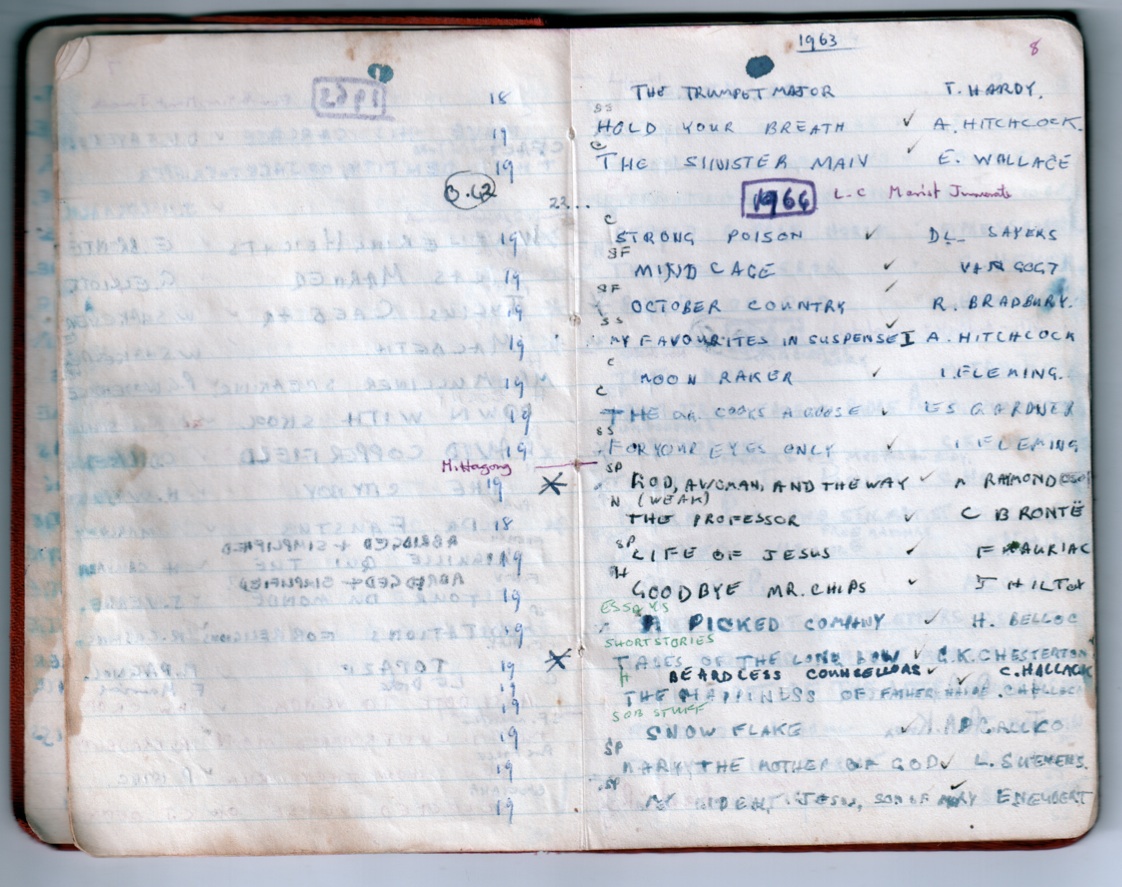
Yesterday, searching for the name of a book I read in the early 70s, I dug out the little notebook where I listed every book I read from 1961 to 1974 – from ages 14 to 27.

As pure self indulgence – after all, what’s a blog for? – here is most of 1964:

1964
It was my last year of high school so I didn’t read a lot. It’s interesting to notice that before heading off to boarding school I read science fiction, crime, and a coulpe of James Bonds. After that, it’s religious books (I was on my way to being a member of a Catholic religious order), Charlotte Bronte (but not Jane Eyre), Goodbye Mr Chips, some Belloc, some Chesterton and some Paul Gallico. I know I also read Wuthering Heights and Macbeth, both more than once – evidently I didn’t count study texts as reading material for the purposes of this notebook.

By 1974, now 27, I had abandoned my unfinished MA thesis in Aust Lit and was working at Currency Press, publisher of Australian plays.

1974 June

In June – 40 years ago this month – I read 10 books and went to the theatre once. Religion had been replaced by C G Jung: I read two books about him, and one on the I Ching (which he sometimes used to diagnose children and others). There were two novels by Herman Hesse, which I don’t remember at all. Kind of work-related, I read some Sophocles, some Patrick White and some Peter Handke. (I’m surprised to find I read the Peter Handke eight months or so before I saw Peter Wherett’s brilliant production at the Nimrod in Belvoir Street with Kate Fitxzpatrick and Peter Carroll.) I went to Melbourne to see a Jack Hibberd play, at the Pram Factory with Bill Garner and the fabulous Evelyn Krape.  I also began reading a history of North Queensland, which a note says I took more than a year to finish. And there’s a book each from Bruce Beaver and Robert Adamson. Nothing by women.

I stopped making a note of my reading in my late 20s, so I’ll skip to 2004, just 10 years ago, when I was keeping a blog, the precursor of the one whose entries now appear in the right-hand column here. It turns out in June 2004 I read an amazing 25 books,  almost all of them for my work at The School Magazine. So I was paid to read fabulous novels by Terry Pratchett, Geraldine McCaughrean, Allan Baillie, Susan Cooper and Gillian Cross, picture books by Julius Lester & Jerry Pinkney, Alan Ahlberg & Peter Bailey, Colin & Jacqui Hawkins, and Anna & Barbara Fienberg & Kim Gamble, and poetry by Myra Cohn Livingston. Good work and I was lucky to get it!

On my own 10 cents in June 2004, I read three volumes of Neil Gaiman’s Sandman epic, and – some suffering is self-induced – The Da Vinci Code.

So here I am in June 2014, two books read and three on the go. My recent excursion into self-improvement with Alain de Botton is perhaps an equivalent of the religious texts of 1964 and Jung in 1974. I’m still reading weighty Australian novels, poetry (this time from China as well as Australia), history, and comics artists.

Maybe by 2024 I’ll have kicked the addiction.

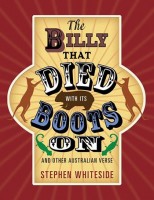
Stephen Whiteside’s Billy that Died with its Boots On

Stephen Whiteside, The Billy that Died with its Boots On and other Australian verse, illustrated by Lauren Merrick (Walker Books 2014)

coverDiane Bates, children’s writer and tireless children’s literature activist, recently set up the Australian Children’s Poetry web site. Its aim, she said,

is to, for the first time, give a national and international ‘face’ to Australian children’s poetry.

The website, which is well worth a look, may change things, but until now poetry written for children in Australia has struggled to have a public face. The School Magazine, published by the NSW Department of Education, has been a dependable outlet just short of 100 years, but its index fairly bristles with lovely poems that appeared there and then were seen no more (except in readers’ memories: in my time at the magazine we received regular phone calls from people trying to track down a poem they had read in the magazine 70 or so years earlier).

It’s always heartening, then, when a children’s publisher like Walker Books brings out a new book of poetry, especially one by a single author.* It would quickly become disheartening, of course, if the poetry wasn’t any good, but The Billy That Died with its Boots On delivers the goods.

The poet’s Introduction proclaims his life-long love of rhyme, and encourages readers to ‘find a brother or sister, or mother or father, or cousin, or aunt or uncle, or grandfather or grandmother, or simply a friend, and read a poem to them’. So be warned, if you give this to a young person as a gift, be prepared to sit still and be read to.

Not that you will suffer if that happens. The book is bursting with gleeful love of rhyme and bush-ballad rhythms. There’s nonsense, fantasy, word play, jokes (some laugh-aloud, some groan-worthy), historical narrative; the beach, the bush, the snow, the sports field; dogs and cats, cormorants and spotted quolls; dinosaurs and flying whales. It’s not hard to imagine a young reader becoming permanently addicted to rhyme if exposed to this book.

If I have a favourite poem, it’s probably ‘We Headed for the Beach Today’. I’d love to give you the whole poem, but it’s long and I don’t want to breach anyone’s copyright: suffice to say it lists all the things that could have gone wrong on a day at the beach but didn’t, mixing the all too common with the extremely unlikely, all in impeccably scanned, rhyming couplets, as for example:

No one grizzled. No one snarled. No one yelled or jeered.
We didn’t see a baby grab his daddy by the beard.
A change did not arrive to make the water dark and wild.
A shiny flying saucer did not steal a little child.

It’s perfect for learning off by heart and performing for your brother or sister, etc.

By way of full disclosure: Roughly half of these poems were first published in The School Magazine, many of them when I was editor. Stephen graciously mentions me in the acknowledgements, and also in his account of the book’s long gestation on the Australian Children’s Poetry site. I received a complimentary copy from Walker Books.
—–
* I wouldn’t want to give the impression that this is the only such book Walker have published. Far from it. The last page advertises Guinea Pig Town and Note on the Door, both books by Lorraine Marwood, another fine poet who has graced the pages of The School Magazine.

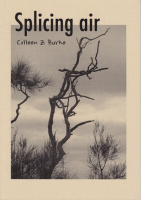
Colleen Z Burke’s Splicing Air (and Sonnet 13)

Colleen Z Burke, Splicing Air (Feakle Press, 2013)

1sa

More than 20 years ago in a pub in Glebe I heard Colleen Burke (I don’t think the Z had yet become part of her working title) read poems from which I still remember lines that move me, from what she presented as straightforward records of conversations with her children.

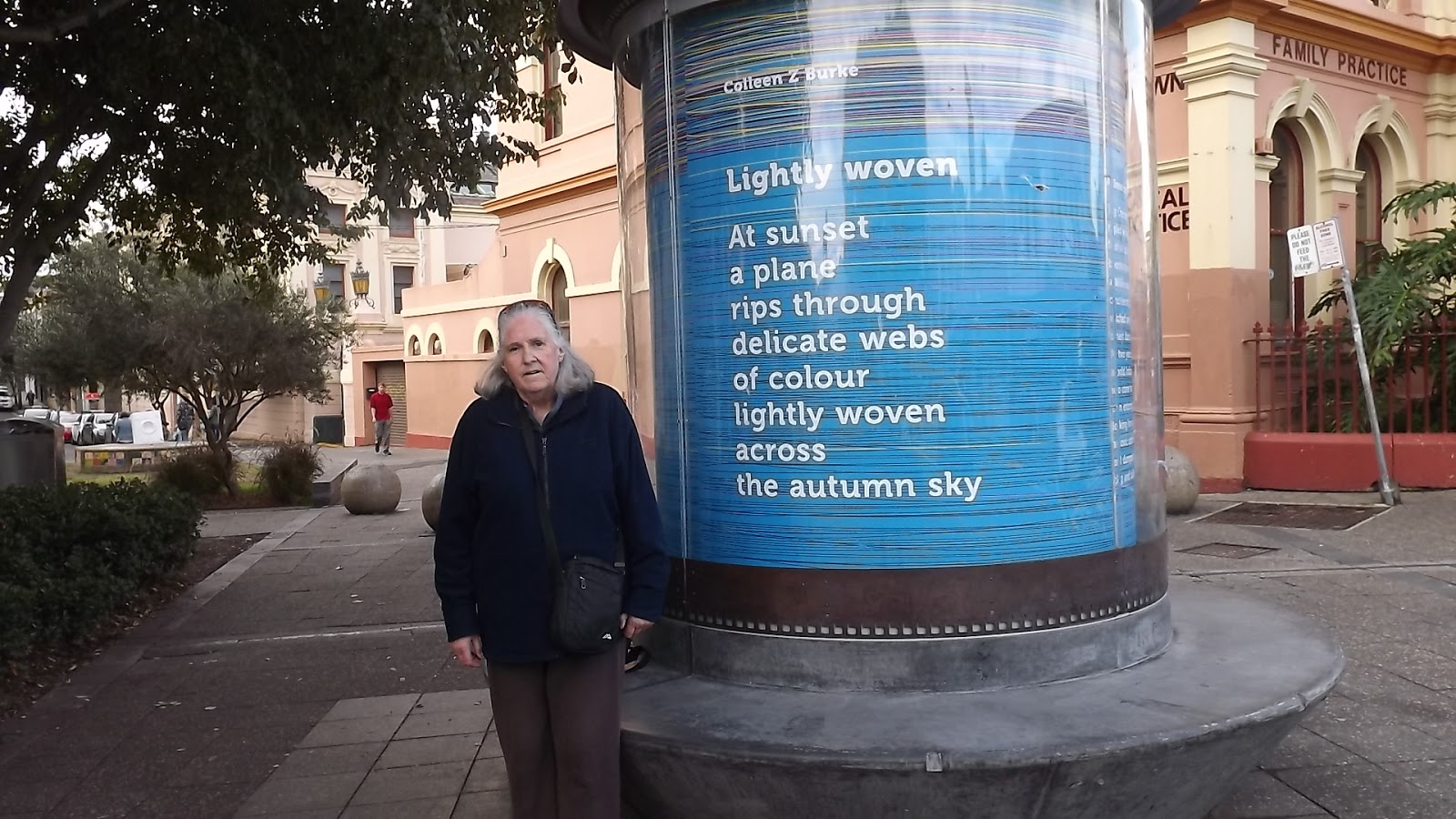
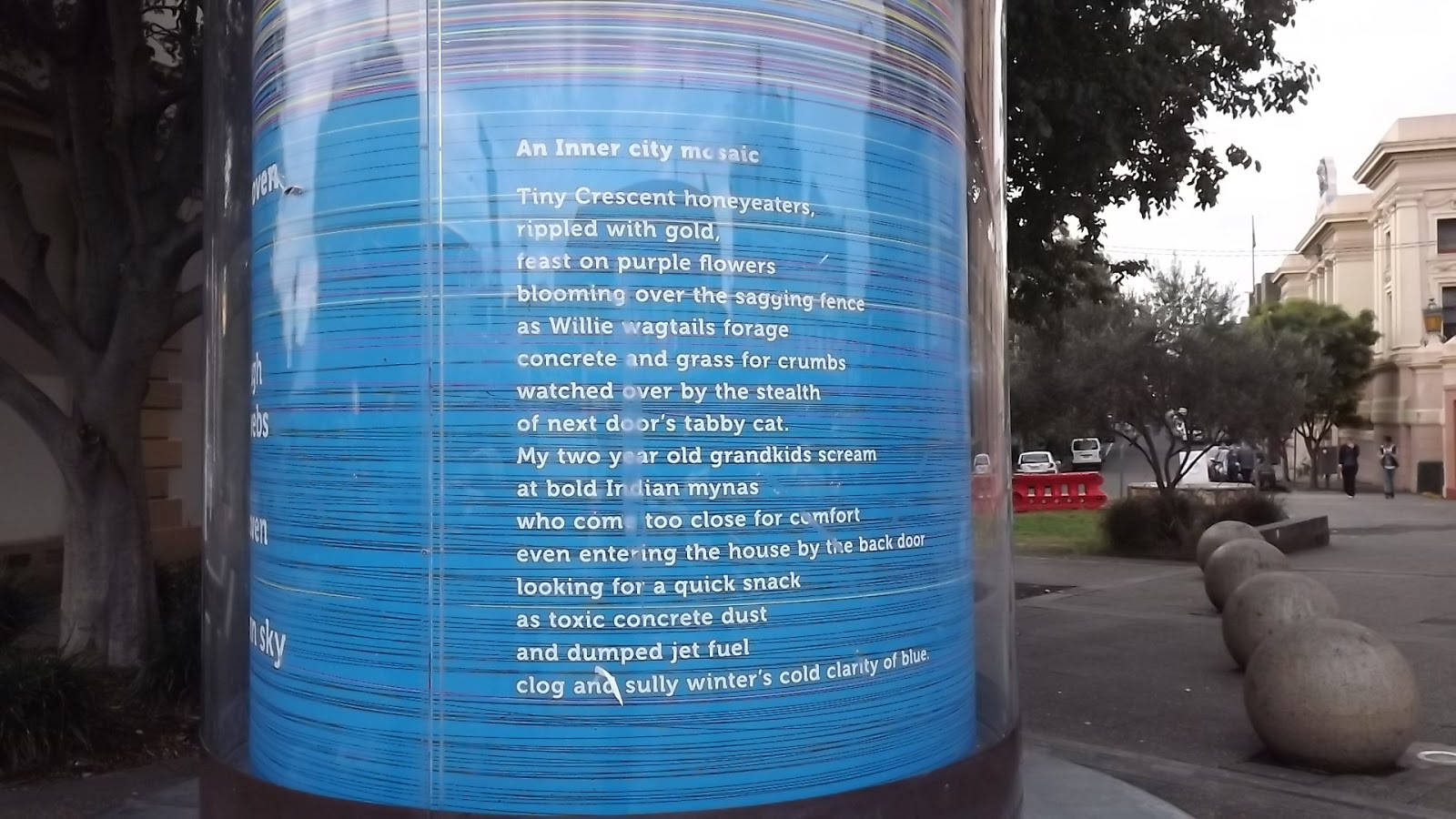
Many of the poems in Splicing Air capture moments with her grandchildren, and the conversations still smuggle killer lines into the poetry. Many others, in what I think of as her signature style, are short, impressionistic pieces about landscape or, especially, skyscape in and over Newtown and surrounds, or bushland. There are a number of pieces observing the social life of Newtown, past and present, and a handful of longer pieces. And some snapshots from New Zealand

Four of the longer pieces draw on the history of discovery and settlement of New South Wales: an narrative-essay on James and Elizabeth Cook, journal entries by the surgeon and an officer from the First Fleet, a biographical sketch of the early Australian poet Frank Macnamara. They lack obvious poetic embellishment, but in each of them the effect is unsettling and revelatory. There are straightforward accounts of the lives of two nineteenth-century women – ‘The publican’s daughter’ being the poet’s great grandmother, and ‘The fossil hunter – Mary Anning’ (which accounts for roughly a fifth of the book) an extraordinary Dorset woman who might easily have been lost to history because of her class and gender.

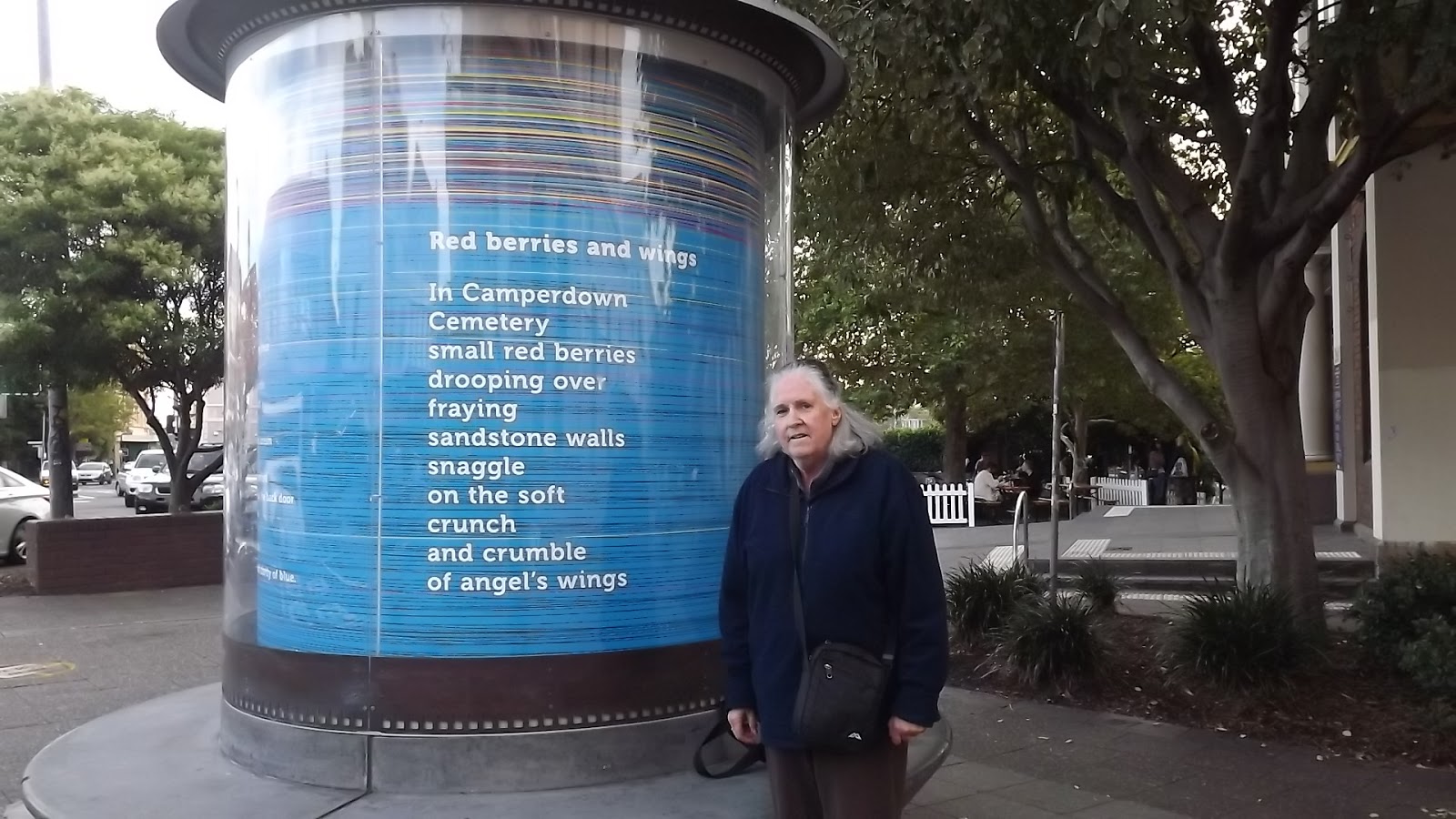
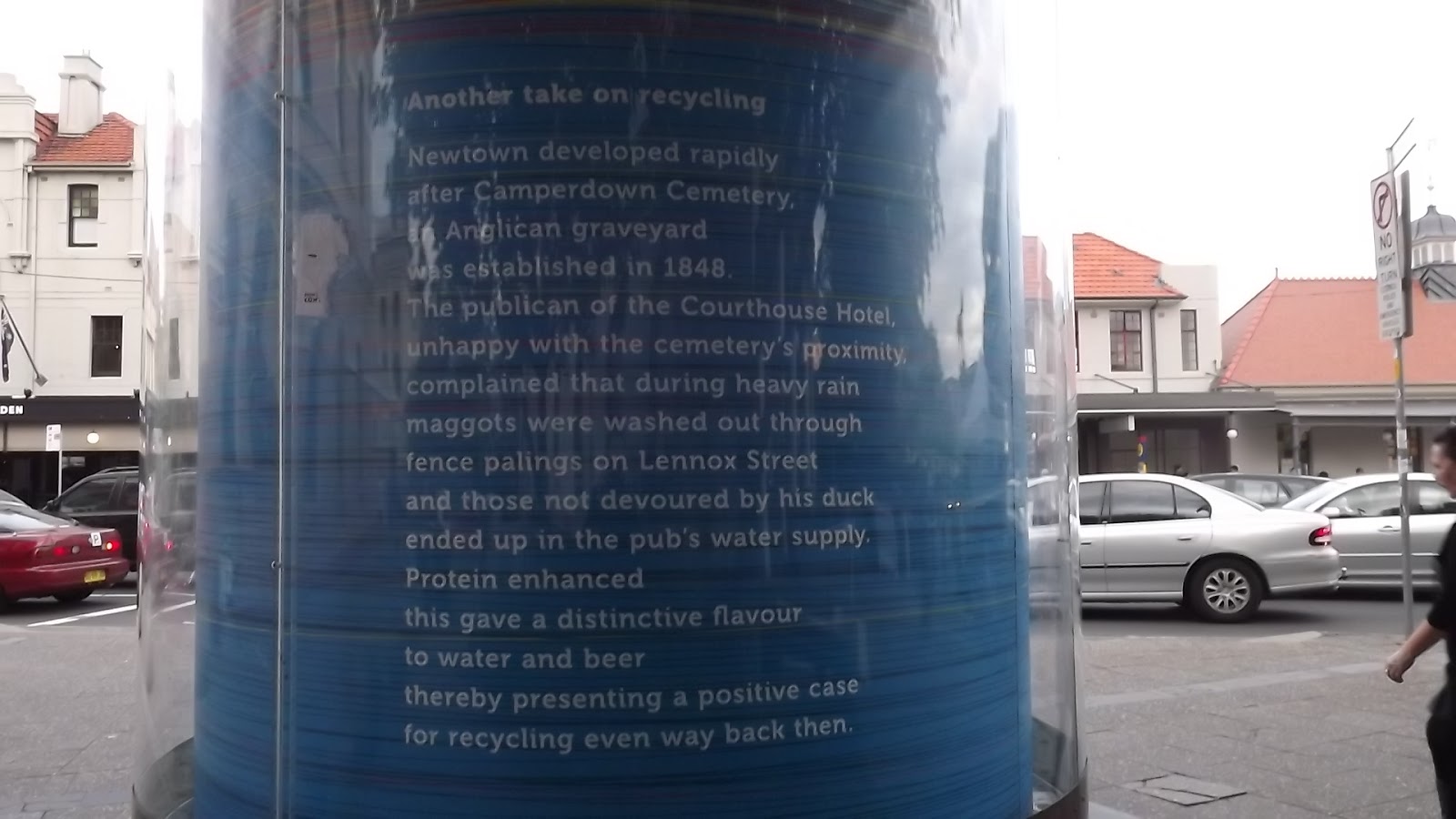
The sense of place is strong here as in all Colleen Z Burke’s work: I think of her as the poet of Newtown. Earlier books have included a number of pieces set in Camperdown Cemetery, and this book has two beauties set there too: ‘Kangaroo grasslands and my 20 month old grandson’ and the wicked ‘Another take on recycling’.

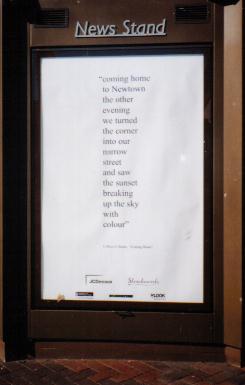
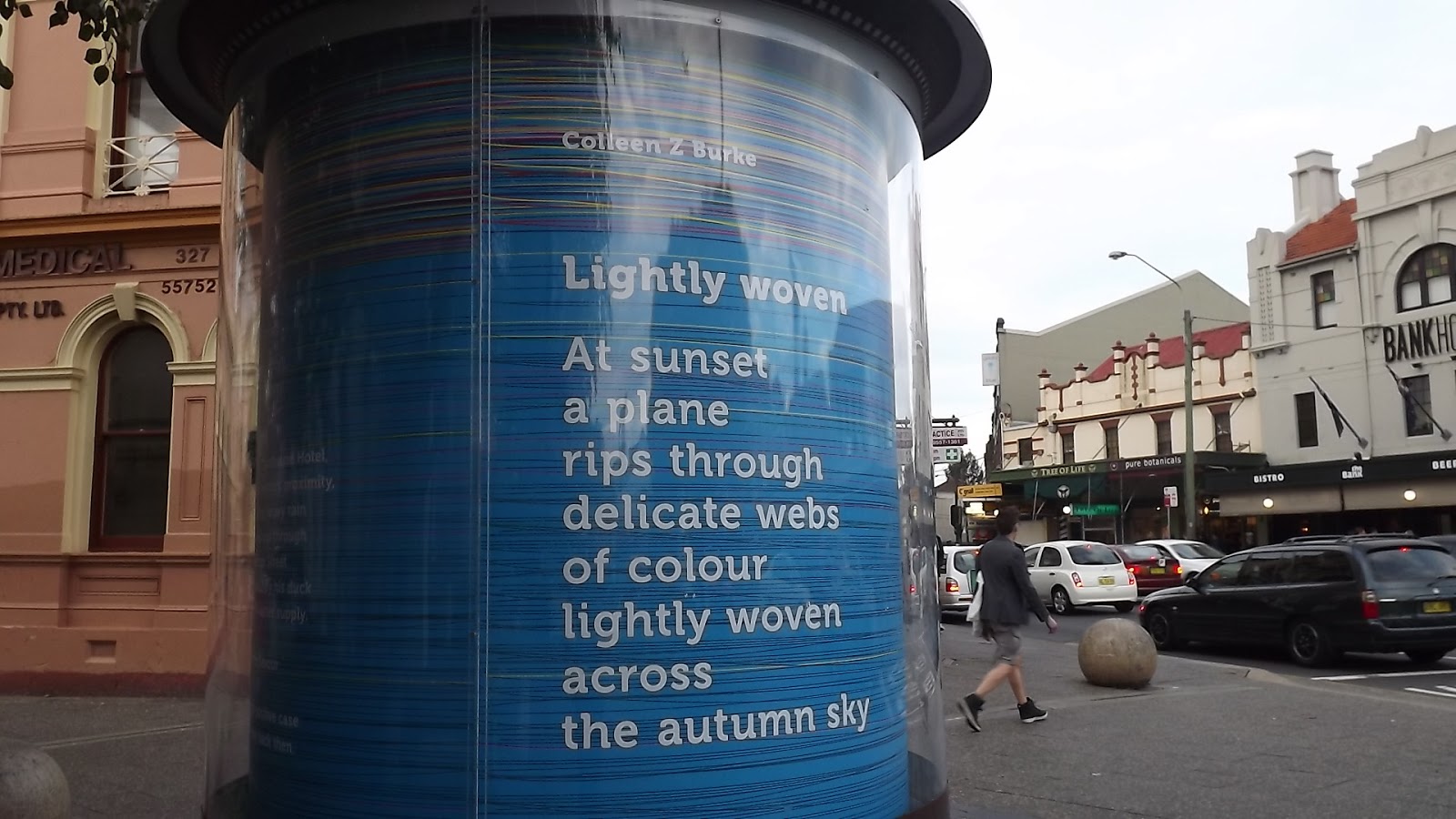
It’s November, so a sonnet is obligatory. This one draws on the last couple of times I laid eyes on the poet, and occasions when her work has featured large in the urban landscape, as illuminated posters that were part of the Sydney Festival some years ago, and more recently on the Newtown Art Seat. (there are six different links there, all to this site)

Sonnet 13: Colleen Z Burke
She reads to us beside a Whiteley –
her landscapes quiet, his lewd and loud.
I’ve seen her sunset words shine nightly,
tall amid a milling crowd.
Her tiny poems tread light, illumine;
the details of decay are human’
as she bids a friend farewell.
Human too what she can tell
of autumn air and Maralinga,
clouds, trees, coprolites, cats, birds,
muskets, trinkets, children’s words.
This poetry’s a pointing finger,
self-effacing, yet with grace
it helps to root us in this place.

Full disclosure: I published one or two of these poems in The School Magazine in my past life, and may have rejected one or two others A significant event in my mother-in-law’s pre-dementia life was a creative writing class taught by Colleen Burke.

awwbadge_2013

I think this is the 11th book I’ve read as part of the Australian Women Writers Challenge 2013.