Tag Archives: The School Magazine

Western Sydney on Western Sydney

Michael Mohammed Ahmad & Felicity Castagna (editors), On Western Sydney (Westside Publications 2012)

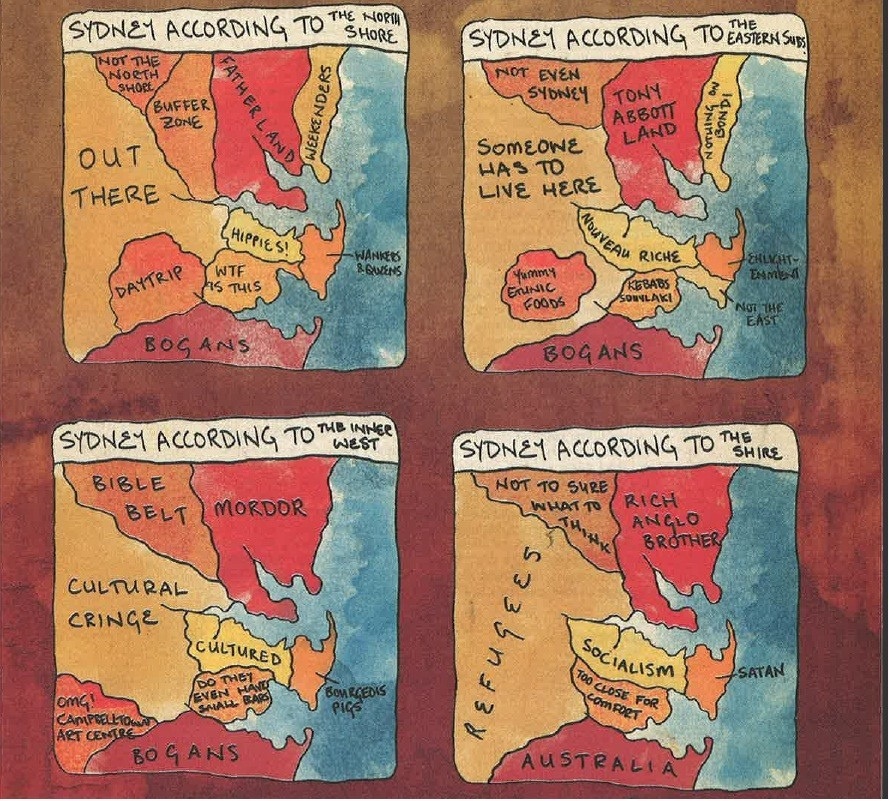
In early 2011, an issue of the University of New South Wales’ student newspaper Tharunka had a cover illustration of maps of Sydney according to four different regions. Like Yanko Tsvetkov’s stereotype maps, their probable inspiration, they manage to be cheerfully offensive about just about everyone, but you’d have to be thin skinned to take serious umbrage.
20120926-163722.jpg

All the same, look at Western Sydney: ‘out there’, ‘someone has to live there’, ‘yummy exotic food’, ‘cultural cringe’, ‘refugees’, ‘day trip’. The anonymous cartographer has caught something, but if you stop and think for a bit you realise that he/she/they has/have surely pulled her/his/their punches, avoiding any references to drugs, sexual violence, Islamophobic stereotypes or the class attitude invoked by the word westies. More interestingly, there is no ‘Sydney according to Western Sydney’ map. Evidently, in the mind of the maps’ creator(s), Western Sydney lacks a view of its own.

Westside Publications exists to create a counter-narrative: to provide a platform for Western Sydney voices and, at least in part, to undermine the stereotypes, less by denying them outright than by seeking to paint a fuller picture. ‘I don’t mind a story that makes us look bad,’ writes Michael Mohammed Ahmad, chief editor of Westside, in his introduction to On Western Sydney, ‘so long as it’s honest and complex.’

Under the auspices of BYDS (Bankstown Youth Development Service), Westside has work for years in schools and the community to develop skilled writers. On Western Sydney is their twelfth anthology featuring established and/or emerging writers and artists connected to the region. Ahmad says the goal has been ‘to source writing from Western Sydney and writing about Western Sydney’. Of course it’s not the only place where writers from Western Sydney get published – in my time at the School Magazine, for instance, some of our regular contributors were from the west, and off the top of my head eminent poets Jennifer Maiden and Peter Minter have strong Western Sydney connections. And a number of the writers in this anthology have been published elsewhere, including in the definitely Inner West This is the Penguin Plays Rough Book of Short Stories. But there’s no doubting the significance of Westside. Last week Mohammed Ahmad received the Australia Council’s Kirk Robson Award which honours ‘outstanding leadership from young people working in community arts and cultural development, particularly in the areas of reconciliation and social justice’.
20120921-175932.jpg So On Western Sydney is a phenomenon. It’s also a good read, and not at all the dry sociological collection the title might suggest. It includes short stories, poetry, absurd parables, a photo essay; there’s lyricism, satire, rap, stinging social commentary, domestic observation, fantasy, memoir (I think), travel writing … from as culturally diverse a bunch of writers as you’re likely to find anywhere. Many of the contributors are familiar from Westside’s readings at recent Sydney Writers’ Festivals, and scattered throughout are Bill Reda’s photos of Moving People, this year’s event.

I wouldn’t rush to say that the stereotypes are completely repudiated. Some are reversed with varying degrees of subtlety. Two poems – Andy Ko’s surreal ‘A South Line Travel Guide’ and Fiona Wright’s deliciously ironic ‘Roadtrip’ (which begins ‘And it certainly felt like a Food Safari, such a long way from Kirribilli’) – could be read as direct, mocking responses to Tharunka‘s ‘day trip’ and ‘yummy exotic foods’ stereotypes. Predatory men are scarily realised in Amanda Yeo’s train-story ‘Nine Minutes’ and Frances Panapoulos’ poem ‘”puss puss”‘, though there’s no racial profiling in either. The class attitudes not quite articulated by Tharunka are challenged throughout, as when the protagonist of Peta Murphy’s ‘Roughhousing with Aquatic Birds’ suffers through some kind of arty inner west event (‘She doesn’t speak to me, / it’s as if she can see my Bunnings uniform’). The world evoked in Lachlan Brown’s long poem ‘Poem for a Film’ could well be labelled ‘Someone has to live there’, but there’s art – and heart – in the telling:

______On a blistering afternoon
a council truck is removing tall trees

so that no one will confuse this vista with
a place of moneyed elegance. And maybe

the scream of the chainsaw means you’re
not ignored, as cut limbs crash through

the dry air. And maybe what’s left is
for your own good, and the streetscape

becomes a mouth mashed up during a bar fight,
with its bare stumps grinning cruelly in the heat.

My guess is that the writers are mostly under 35. The problems of negotiating relationships is a dominant theme: under the judgemental gaze of older Arab women in Miran Hosny’s ‘The Weight Divide’; by phone in Michael Mohammed Ahmad’s own brief contribution, the deeply unsettling ‘The First Call’; in the gap between the world of song and the world of experience in Luke Carman’s ‘Becoming Leonard Cohen’ (though it’s pretty impertinent to describe Carman’s weird tangential verse as about anything); in bitter-sweet recollection of a high school crush in Tamar Chnorhokian’s ‘Remembering Leon’.

There’s so much to like. We’re told that this will be Westside’s last print publication. Maybe there’s a sense that its work is done, and the writers it has fostered can now find platforms further afield – in Asia Literary Journal, for example, whose current issue has a number of pieces exploring migrant identity. I hope so.

I received my copy free from BYDS. You can buy one from independent book shops in Sydney or directly from BYDS (email in@byds.org.au with your postal address and they’ll give you details on cost and bank transfer details).
Hilary Mantel brings up the bodies

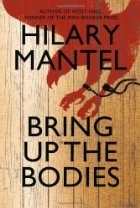
Hilary Mantel, Bring up the Bodies (Fourth Estate 2112)

20120704-175516.jpg I’m probably the only person of my generation whose grasp of what it was like to live in the courts of the Tudors comes mainly from an article written for The School Magazine by award winning children’s novelist and occasional commenter on this blog, Cassandra Golds. ‘The Princess in the Tower’ focused on Elizabeth, imprisoned during the reign of her half sister Mary, but there’s a memorable paragraph . It likens the court to a jungle where elegant people circled each other like wild beasts, seeking the advantage. Sadly, I’m writing this far from home, so can’t give you a quote. (Cassandra, if you read this, maybe you could add one in the comments section?) [Added later: Cassandra has commented with the passage which is even more apposite than I had remembered. Thanks, Cassandra.]

Even more than Wolf Hall, to which it’s a sequel, Bring up the Bodies validates that image in its portrayal of the court of Henry VIII. But at its heart there’s Thomas Cromwell, no wild beast but a methodical tactician, serving the king and good of the kingdom, receiving insults with apparent stolidity but forgetting nothing, keeping his own counsel, taming some beasts and destroying others.

I was reading this in a cafe in Goreme in Cappadocia, when an Australian woman (the cafe offered a decent flat white, much sought after by Australian coffee drinkers) called from several tables away.

Australian flat-white-drinking woman: ‘How are you finding that? I loved Wolf Hall but I found that one a bit hard to get into.’
Me: I’m loving it. I think it’s miraculous the way she gets right inside the minds of people from that time.
Australian flat-white-drinking woman’s grey-haired male companion: it’s all in the mind.
Me: Um, yes.
AFWDWGHMC: It’s past lives.
Me: Oh, you think Hilary Mantel was there in a past life.
AFWDWGHMC: Not just her, everybody.
Me: Well, that’s a conversation stopper if ever I heard one. (I didn’t say that, I just wish I had.)
AFWDWGH: She’s written another book, you know, a nonfiction book called Anne Boleyn, Witch.

So there you are. If anything was going to make me believe in past lives, it might well be this book. And if Hilary Mantel has written that nonfiction book, I wish she had spent the time on the next novel about Cromwell. It’s not that I want to see him get his comeuppance, as of course he will. I just want more of him. And I worry about his sweet, naive son Gregory.

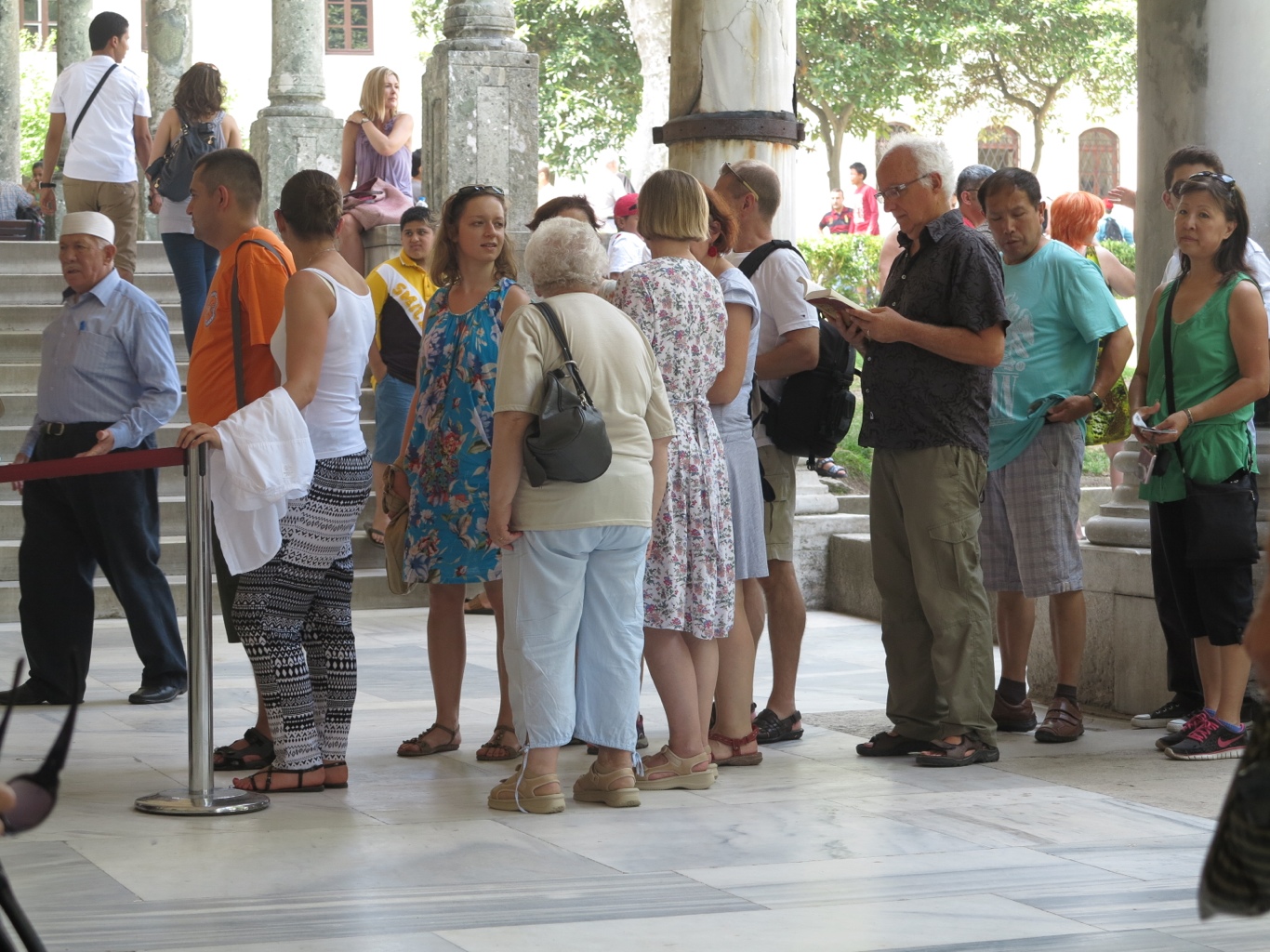
PS: I read this in Turkey, among relics of rulers at least as much at the mercy of their whims as Henry Tudor. I wonder how English history might have gone if Henry could have had a harem. Surely if he had four wives at a time the need to have a son might have been less desperate. Mostly I didn’t take the book on outings, preferring to take thinner volumes. But here I am, reading it in the queue to see the treasures in Topkapi Palace.

20120715-133643.jpg

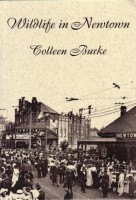
Colleen Burke’s Wildlife in Newtown

Colleen Burke, Wildlife in Newtown (Feakle Press,1994)

Poetry is good to travel with. Slim volumes are attractive when you’re packing light, and short poems are well suited to the short grabs of time for reading, in between gawking, eating, finding toilets, blogging and all that. Apart from such practicalities there’s this little syllogism: a) Whenever I travel I have intense dreams about home; b) poetry has been described as a waking dream; c) it makes sense to take poems about home when travelling. So of course I brought this book whose title promises poetry about places a couple of blocks from my home.

True to that promise, the book’s sense of place is very strong, in poems celebrating working class, culturally diverse Newtown, acknowledging its Dharug past and present, and repeatedly evoking Newtown houses, Camperdown Park and the historic cemetery adjoining it. The latter is the subject of elegant photographs scattered through the book, which I’m guessing were taken by the author. It’s evident that Colleen walked through that park on the way to and from work, that she often spent time in the cemetery. If that small part of the world were to be allocated a Poet Laureate, she’d be hard to beat.

The book has a number of interweaving strands: the walks home from work, often involving sunsets: relatively impersonal narratives about the history and make-up of the suburb; conversations with the poet’s children; the cemetery poems, some of which are about the history, some intensely personal; a very few strong poems that directly address the death of the poet’s partner. All the poems are short. If I was at home, I’d find the lovely line about Colleen Burke’s lyrics in Jennifer Maiden’s 1999 collection, Mines, but as I’m gallivanting in Turkey with fitful Internet access, I’ll just recommend that you look it up.

I hope Colleen won’t mind if I quote a poem that, while not necessarily my favourite, struck a chord because I was away from home – in Turkey, not India – when I read it.

And so I was there
for Kerry
‘And so I was there –
a recognition. My
heart full to bursting.
There’s something in the smell of
heat, dust, exhaust fumes,
oxen, tea, animal piss,
garam masala and ghee.
There’s something about women
in saris, beggars of all ages
and people living on the
cramped narrow streets –
an atmosphere of the
Arabian nights that
intoxicates and frees you –
like a window opening.’

ii
I read your letter
in the crumbling
graveyard sheltered
from the August winds
by the empty sandstone
church. Spring
murmured in the winter
soil, a whisper of wattle
in the air. I was close
to you in the gnarled
shadows and slender vines
of sunlight. Close to
the bare bones bound
down by the long dark
roots of the Moreton
Bay fig tree.

iii
‘In the small crowded
Kali temple people
sang, danced and gave
us flowers. Held our hands.
And so I was there’

Place calls out to place calls out to place.

Full disclosure: I published one or two of these poems in The School Magazine in my past life, and may have rejected one or two others; Colleen Burke taught a creative writing class to my mother-in-law, which was a significant event in her pre-dementia life; more than 20 years ago I heard Colleen read poems about her bereavement and her children that still move me, though I remember only a phrase or two.

(Re-)reading Kevin Gilbert’s poetry

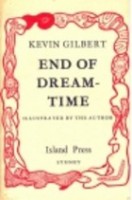
Kevin Gilbert, End of Dream-time (Island Press 1971)
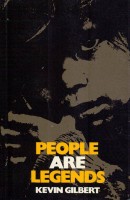
and People Are Legends (UQP 1978)

According to his Wikipedia entry, Kevin Gilbert (1933-1993) was an ‘Indigenous Australian activist, artist, poet, playwright and printmaker’. His first play, The Cherry Pickers, which he wrote when in prison. made a splash in 1970 or thereabouts. A Wiradjuri man, he played a role in setting up the Aboriginal Tent Embassy and was part of the Black Power group. He wrote a book for children, Child’s Dreaming (1992), from which we published a number of poems in The School Magazine, and a sweet memoir for child readers, Me and Mary Kangaroo (1994).

I own a copy of his first published book, End of Dream-time, number 104 of the edition of 200, and it’s sitting on my desk as I type. It’s a beautiful object, handset and printed on creamy, textured paper, with illustrations by the author in a range of single PMS colours. Phil Roberts, the poet founder of Island Press, treated his early books as labours of love. Of those on my bookshelves, this is the one most lovingly laboured over. The presentation is a clear message to anyone tempted to read the poems as sociological specimens (a book by an Aboriginal man was a rare thing in the early 1970s, and any spurious sociological appeal was made all the greater by its having been at least partly written when Gilbert was in prison for murder). These poems, the design announces emphatically, are to be read and respected as poems.

So I was shocked to learn, all these years later, that Kevin Gilbert ‘repeatedly and publicly’ disowned his poems as published in End of Dream-time. It seems that Roberts did substantial editing without his permission. He may have done no more than he would have done for any first book, and the poems may in some sense be the better for it, but Gilbert’s bitter complaint was about the lack of consultation. Adam Shoemaker tells the story, and reproduces the original and edited versions of the short poem ‘People Are Legends’, in ‘The Poetry of Politics‘, a chapter of his Black Words White Page: Aboriginal Literature 1929–1988. Go to the link, read it and cringe: Roberts’s good intentions are clear, but even a whitefella like me who’s been an arrogant enough editor in my time can see why Gilbert would consider it a betrayal of trust. His poems are full of rage and despair at the callous, complacent attitudes of whites toward Aboriginal peoples. Shoemaker quotes him as saying:

I’ve adopted writing as a means of voicing the Aboriginal situation … I try to present as truly as possible the Aboriginal situation and the Aboriginal response.

And:

There is the need to educate White Australians to the present situation of Aboriginal people … I’m presenting it as honestly as possible – it’s not a pretty picture.

What bitter irony, when struggling to find a voice in this way, to have one of those in need of education inject his voice into the mix! (I know Phil Roberts is Canadian, but in this context that’s a distinction without a difference.)

So I went out and bought a copy of People Are Legends, published seven years later by the University of Queensland Press. The back cover describes these poems as written ‘in the language used by living Aboriginals, without editing, without politeness or hypocrisy as practised in “cultured” verse’ (my bold).

Neither book is a comfortable read. Rather than emotion recollected in tranquillity, we get harangues that feel shot off in the heat of the moment. Many of the poems are dramatic monologues, spoken not so much by characters as by exemplars, either of the misery and debasement resulting from genocidal oppression, or of morally contemptible individual escape. There’s a bush ballad that doesn’t quite scan, and quite a lot of satire that has a bitterly intolerant edge, directed not only against whites but, almost, against any Aboriginal person who pursues a politics that’s neither despairingly passive nor holding out the option of retaliatory violence. Even the Gurindji’s heroic stand against Vesteys in 1970 gets the treatment. One of the two poems named for them begins:

They fast
They silently fast
Eloquently silent
In their thundering cry for Right

But by the end that silence has been found sadly, even culpably wanting:

They should remember
Back in time: throughout history
Justice, deprived of a strong voice slowly,
Inexorably dies
And the seeker of justice dies with it
Or silently becomes a slave.

But then, these poems aren’t aiming to give me a good time or lay out a workable political agenda. This was trail-making work: I don’t know that anyone would try to write poems about ‘the’ Aboriginal situation and response these days, and that’s due in part to Kevin Gilbert’s rising to the challenge to educate, to speak as a representative.

Since the thing that prompted me to read these books was the near absence of modern Aboriginal poets from Geoffrey Lehmann and Robert Gray’s Australian Poetry Since 1788, it’s probably worth remarking that there are quite a number of poems here that wouldn’t have looked odd in those pages. The other ‘The Gurindji’ brought a new music into Australian poetry:

Poor fellow
Simple fellow
Sweet fellow
00Strong
Sittin' in the desert
Singin'  desert song

And I’m no expert, but I think ‘Trying to Save Joan Ella’ not only stands up well as a bush ballad, but manages to hold out a significant challenge to the whole tradition. It tells of an Aboriginal woman’s arduous and terrifying ride to fetch a doctor for a dying white baby:

Quick she rode to Thiraweena
And she brought the doctor back
But the child died – and the father
Cursed the slowness of the black
....
If this cursed gin had ridden
Faster, harder through the night –
But the blacks are bad and useless –
Can't be trusted out of sight!'
Mary bowed her head in silence
Thought: 'I wishit me had died
Rode two horses an' it killed 'em
Never stop't though me dead tired
Frightened too of horse bin fallin'
When I passed the old ones' grave
Shut me eyes with courage 'gammon'
When the ghosts rise I ain't brave!
Couldn't do no more I tried but
Kill'd two horses; rode to death.
Didn't stop! I kept on runnin'!'
And she wept beneath her breath

Really, it’s a poem that cried out to be anthologised.

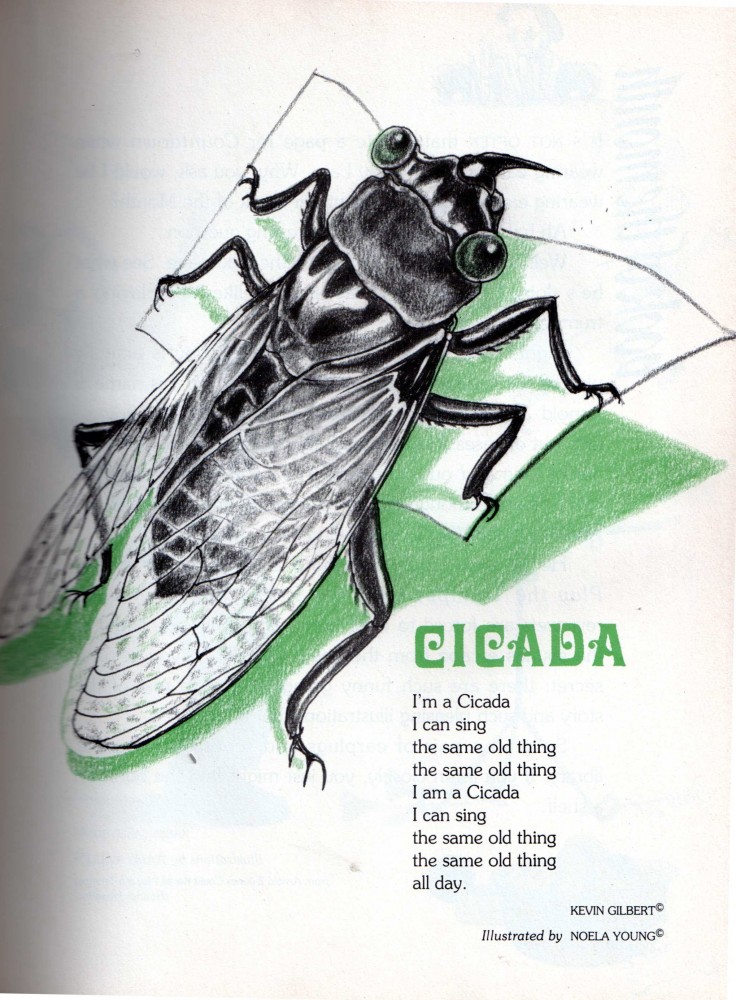
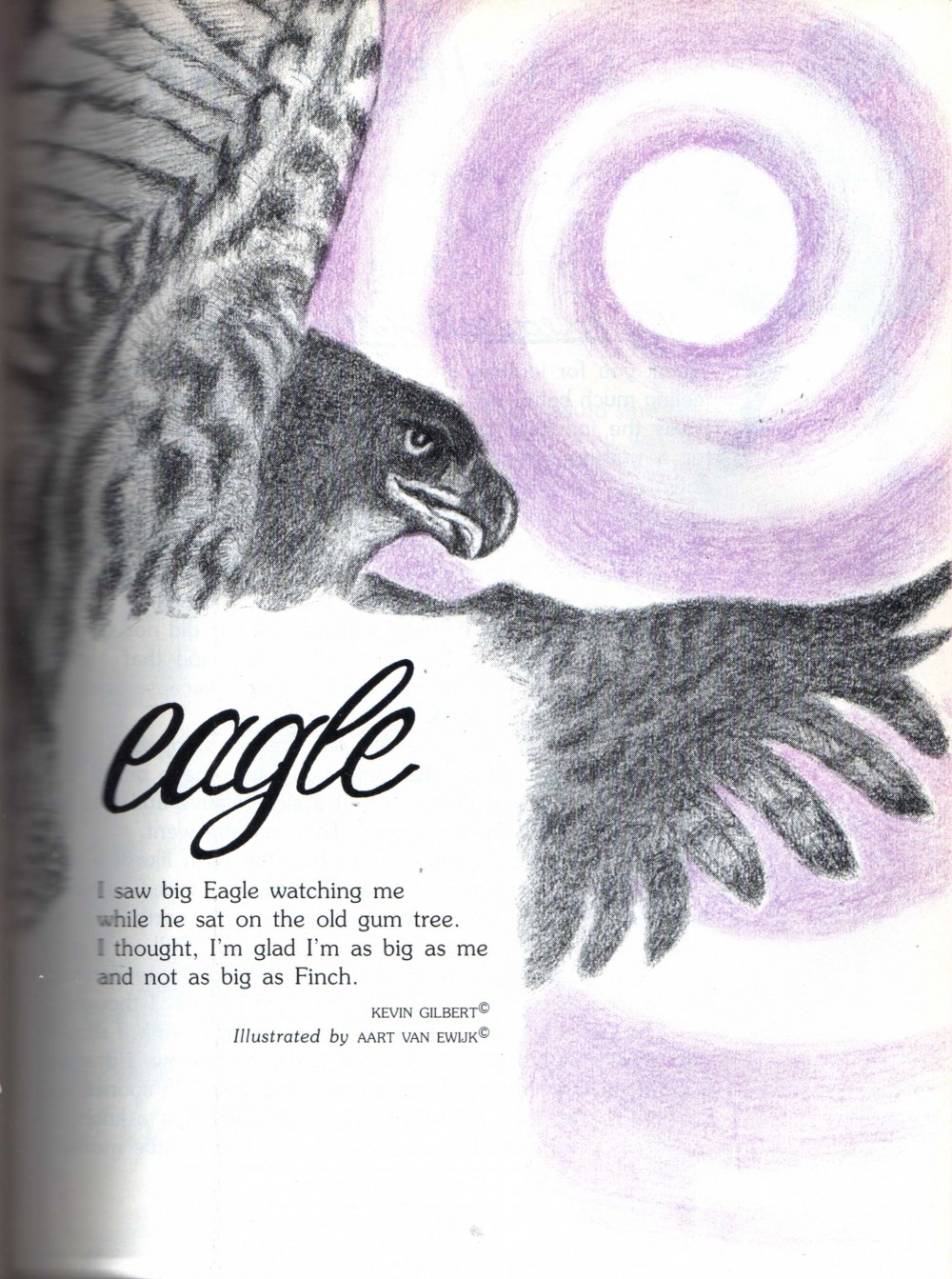
And one last note: in Child’s Dreaming, published a couple of years before his death, Gilbert showed that he could relax when the burden of being a representative was eased. There was still the element of protest, but without the same bitterness and despair (see ‘Emu and Koori’, as reprinted in The School Magazine  with an illustration by Arone Raymond Meeks, in the left-hand image below). ‘Cicada’ (image by Noela Young) may not be everyone’s cup of tea, but it’s given me much pleasure. ‘Eagle’ (illustration Aart Van Ewijk) is just plain genial.

By Swapna Dutta

My friend Swapna Dutta is a writer, translator and editor, mainly of children’s literature, who lives in Bangalore, in southern India. The School Magazine published some of her stories when I was editor, and she and I have kept in touch over the intervening years. Swapna mentioned in a recent email that she had translated a children’s book, The Arakiel Diamond, from Bengali into English, and asked if I’d like a copy. Of course I was interested, and a couple of days later it arrived in my letter box, with three other books. It’s been a treat and an education to read all four.


Swapna Dutta and Geeta Vadhera, The Sun Fairies (National Book Trust, India 1994, 2001)

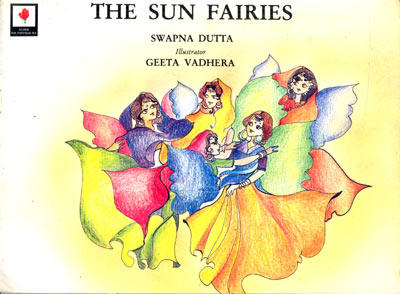
The Sun Fairies is a tiny picture book that plays around with science and fantasy. That is to say, it’s a fanciful account of the origin of clouds – some fairies who live in the sun build castles in the sky so it won’t be so bare and empty – that ends up being a decorative but accurate account of how the water cycle works: the cloud castles are made from water, air and dust, and when they get too heavy they fall to the earth as water. The fairies have discovered ‘a never-ending game’. The illustrations, by Geeta Vadhera, are fabulous. I see from the Internet that Ms Vadhera has gone on to international renown. This may be her only children’s book.


Swapna Dutta, Plays from India, illustrated by Baraan Ijlal (Rupa & Co 2003)

In some ways each of the other books is a work of translation. In Plays from India three episodes from Indian history are shaped into dramas suitable for performance by school students. In my ignorance I don’t know whether the stories would be familiar to most Indian students, so I can’t tell whether the history or the theatre is the main point. I was interested in both.


Swapna Dutta, Folk Tales of West Bengal , illustrated by Neeta Gangopadhya (Children’s Book Trust 2009)

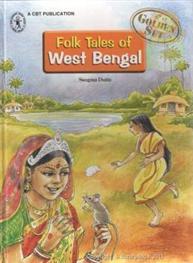
Folk Tales of West Bengal retells sixteen tales. Swapna has an article at papertigers from which I learned that what the Grimms were for Germany, and Moe & Asbjørnsen for Norway, the imposingly named Dakshinaranjan Mitra-Mazumdar was for what is now Bangladesh and West Bengal. At least some of the tales here were collected by him in the first decades of last century. Unsurprisingly to anyone who has entered the woods of Re-enchantment, there’s a lot in these stories that’s familiar to a reader brought up on European-origin fairy stories: kings and princesses, talking animals, metamorphoses, riddles, lost and found children, supernatural beings who reward the humble and punish the greedy. There’s also a lot that’s different: the heroine of the first story, for instance, is not a seventh child but a seventh wife. This blending of familiar and unfamiliar makes for a delightful read.


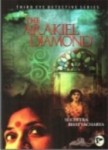
Sucitrā Bhaṭṭācārya, The Arakiel Diamond, translated by Swapna Dutta and illustrated by Agantuk (Ponytale Books 2011)

The Arakiel Diamond is the only book in my swag that is not Swapna’s original work. It’s a detective story for young readers, one of a series featuring a Bengali housewife and her niece. A wealthy man dies. His most precious possession, the eponymous diamond, has gone missing, and almost everyone in his household – and there are many – has had motive and opportunity to steal it. The plot has exactly the twists you’d expect, but the detectives’ relationship and the details of their domestic life are well captured, and I learned a lot about the Armenian community in Calcutta, in a way that reminds me of grown-up detective writers (Sarah Paretsky comes to mind) who take us to a new subculture in each novel.


The four books had me reflecting on multiculturalism in children’s literature. We make fun of the way US children’s publishers, apparently believing that their intended readers would shrink from anything not immediately recognisable as of the US, re-edit books from elsewhere in the English-speaking world to remove unsightly exotica. They don’t just want a world where British characters spend dollars and cents, or Australians walk on a pavement, weird as such a world might be. I remember hearing of a New Zealand novel whose publisher suggested the book’s Maori issues might be more accessible to US children if the setting was changed to California – that author held firm and the book still found readers, even got made into a movie.

I wish now to acknowledge that I’m a bit of a kettle to the US publishers’ pot. Though I enjoyed the slight cultural disorientation I felt as I read these books, I caught myself thinking young readers would be put off by it. To make the books accessible to Australian 11-year olds, the unexamined internal argument went, you’d have to do something about lakh and crorelunghi, salwar shameez and rakhi, not to mention the nitty-gritties of the game of chess or a casual use of thrice in conversation. On reflection, I think that argument profoundly misunderstands how young people read. The only thing that universally distinguishes young from adult readers is that the young ones are younger. One result of this is that they know they don’t know everything about the world, and mostly when they read there are words they don’t recognise but have to guess from the context. (I loved and understood pulverise and invulnerable in Superman comics long before I could define them.) So you might not know what a lunghi is, but the context tells you it’s an article of clothing, and there’s even an illustration to help. Likewise, lakh and crore are obviously big numbers, and that’s all you need to know. As I remember back to my own childhood reading, I think such things would have added spice to the book: if I was young now, I might even have fun googling them. As for nitty-gritties and thrice, I do think we can trust young readers to recognise when a word or a turn of phrase belongs to a different place. (Both my sons say zed in spite of seeing quite a lot of Sesame Street when young.)

The School Magazine on RN’s Hindsight

I received a text message yesterday afternoon: ‘You’re famous!’

Yes, the Hindsight program on The School Magazine went to air and my voice has now been heard by the vast multitudes who listen to the ABC on a Sunday afternoon, and the rest of the world can hear it on Thursday 16th at 1 o’clock in the afternoon. You can download it or listen to it here. My earlier post said it was scheduled for next Sunday – it was moved forward.

Lorena Allam, the producer, did a marvellous job. I expected her to use a couple of seconds of my semi-coherent ramblings, but it turns out there’s an awful lot of me in it, and she made me sound reasonably intelligent. Of course there are a dozen omissions, but since the program focussed on the period from 1950 to about 1980, it would have been a big ask to give Duncan Ball, Tohby Riddle or Joanne Horniman more than a passing mention, or to squeeze in a mention of Geoffrey McSkimming, Margrete Lamond, Kim Gamble, Di Bates, Judy Ridge, to mention only people who have worked for the magazine, let alone the writers who were first published there. And Oh, the poets!

But have a listen. There’s some lovely stuff there. I particularly like the way much is made, correctly, of Patricia Wrightson and Lilith Norman as formidable figures, and then Cassandra Golds, remembering herself as an opinionated 11 year old, says she had no time for them at all.

Added later: Joanne Horniman has written a blog post giving the long version of a major incident in the magazine’s history that was mentioned briefly in the program. It’s at http://www.secretscribbled.blogspot.com.

And later again: Another grace note from Joanne Horniman here.

Hindsight

I was interviewed recently by Lorena Allam for an edition of ABC’s oral history program Hindsight about The School Magazine. The program’s web site now has information up.

Throughout its 94-year history, The School Magazine has been edited by a who’s who of Australian literature: Patricia Wrightson, Lilith Norman, Duncan Ball, and more recently Anna Fienberg and Tohby Riddle.

These days the School Magazine is still around, but available only on subscription. In this era of school-ranking websites and results-based education, there’s pressure to keep up with the demands of the modern classroom. Yet it is as loved as it ever was.

Just for the record, I’m not at all offended at not being listed among the Who’s Who of Australian Children’s Literature. The show will be broadcast on 19 September at 2 in the afternoon, and repeated on the afternoon of Thursday 23 September at 1 o’clock. It should be fun.

How to direct a movie

I subscribe to the podcast of Mark Kermode and Simon Mayo’s film reviews on the BBC’s Radio 5 Mark and Simon being away on their summer holidays at the moment, their replacements, known as Floyd and Boyd, have been doing a sterling job. On Friday’s show they interviewed Stephen Frears and Tamsin Greig about the coming film Tamara Drewe, which they respectively directed and acted in. I loved this exchange:

Stephen Frears: There was this wonderful book written by Posy [Simmons]. There was Moira Buffini’s wonderful script. It was like, you know, robbing your kid’s bank. It was just a goldmine of jokes and funny things.
Floyd or Boyd: Now Tamsin, this is Stephen’s standard line – I’ve interviewed him once or twice before. His position basically is, Well, there’s this marvellous screenplay, then I came across these marvellous actors, like Tamsin Greig, then I just sort of turned up and they did it all really, while I just stood around. Now I’m guessing he probably has a little more input than that.
Tamsin Greig: It’s a little bit like — You know when you have a family gathering and there’s somebody there that everybody loves, and everybody trusts, and something just happens. Well, that’s the difference with Stephen Frears. When he’s not there, things don’t happen. But him just being there, and people trusting him, and having that relationship … I mean a lot of the crew have worked with him ten fifteen, twenty years or some more than that. There’s something palpable in the room, and you just get caught up in that. He just stands there and allows you, and so you do, and you never feel like a tit.

Yes, I know, from one point of view they were blowing smoke, but there’s something to it, just the same. It describes, for example, a good part of what I tried to do when editing the School Magazine: to allow the illustrators, editors and writers, so they did, and very rarely felt like tits.

Dorothea, Andrew and Mollie

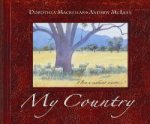
Dorothea Mackellar and Andrew McLean, My Country (Omnibus 2010)

I’ve always vaguely resented this poem. ‘I love a sunburnt country, a land of sweeping plains’, it seemed to my young self, consigned the lush east coast of North Queensland to some non-Australian limbo. So I was happy to learn that Dorothea Mackellar wrote it as an exercise in reverse cultural cringe while living in England, that there was an opening verse that went on about ‘field and coppice’. I was delighted in a schadenfreude kind of way years ago when I came across a letter from Dame Mary Gilmore in the School Magazine files replying to a request for permission to reprint the poem: the Dame explained loftily that it was unlikely that she had written a poem with such hackneyed images and dreary rhythms. I passed that splendid letter on to the Department of education’s Historian, and hope it is preserved under glass somewhere, but it was unfair. It turns out the poem was just waiting for Andrew McLean to illustrate it.

Penny bought our copy at the Orange Grove Markets this morning to read to Mollie. When I joined them after walking the dog, Penny asked me to have a turn at reading it – I don’t know how many times they had already been through it. Mollie was attentive all the way through, and as far as we could tell enjoyed the book.  So did I. It has to be one of the best presentations of a poem. Ever.  Andrew McLean’s landscapes are superb: the soft English countryside, the drought stricken farmland, the flood plain, the ringbarked gum trees ‘tragic to the moon’, the lush rainforest (yes, it’s there – just not in the only stanza that is usually quoted). The Grand Dame may have been right about the imagery and the rhythms, but there’s something wonderfully complex in the profession of love for an environment so full of challenge and suffering.

Patricia Wrightson and Chinese poetry

This blog post is the love child of two recent ones.

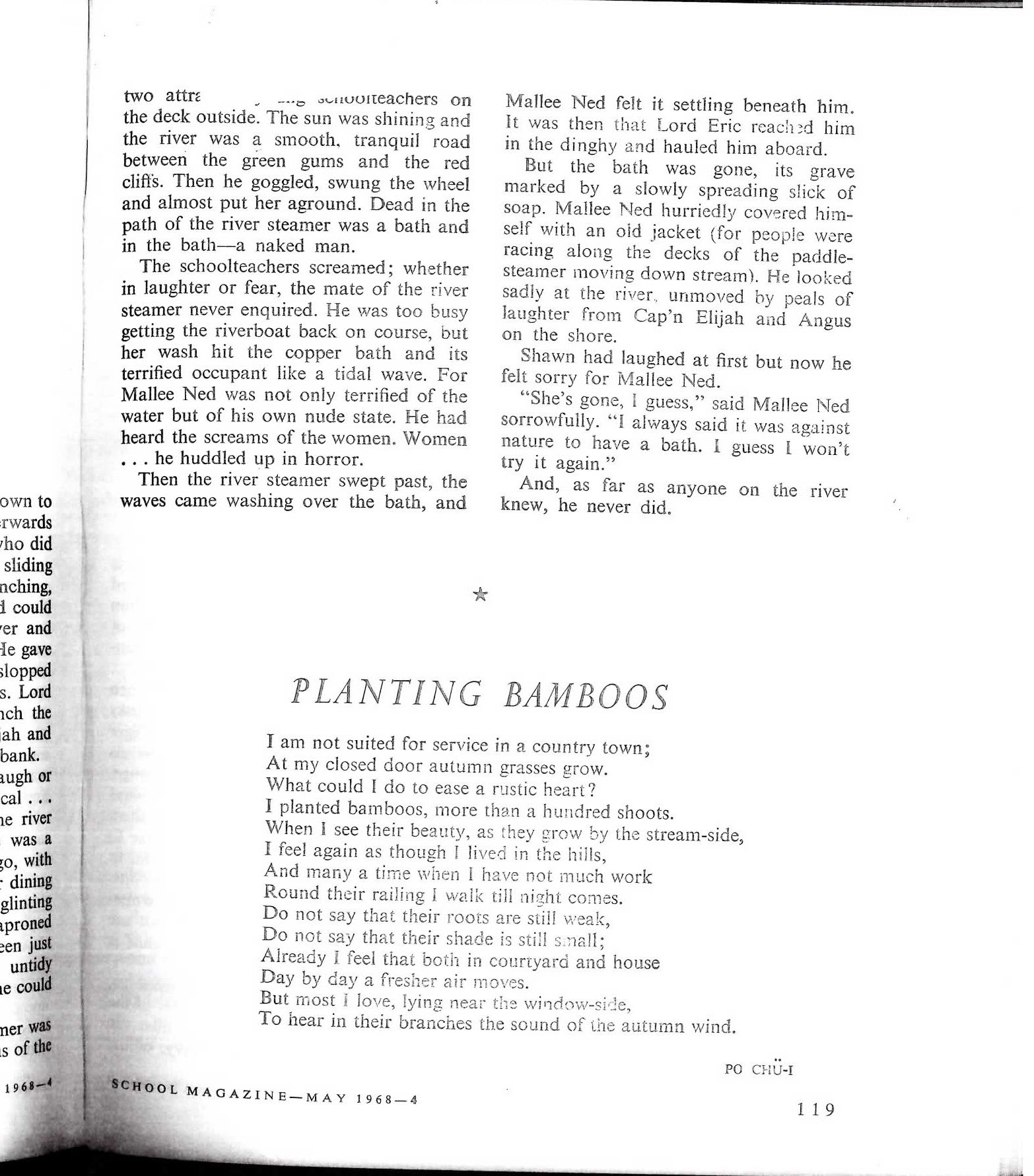
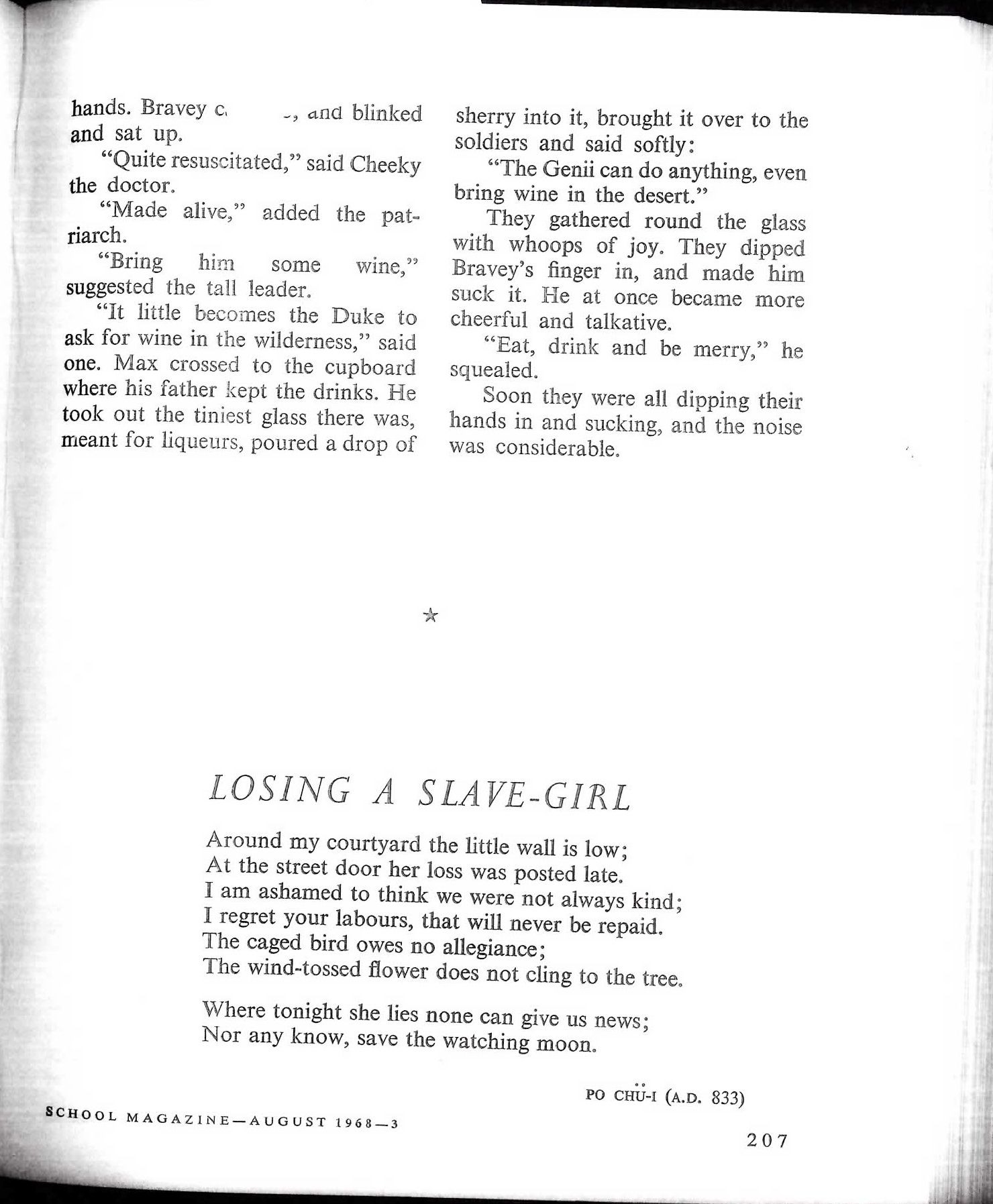
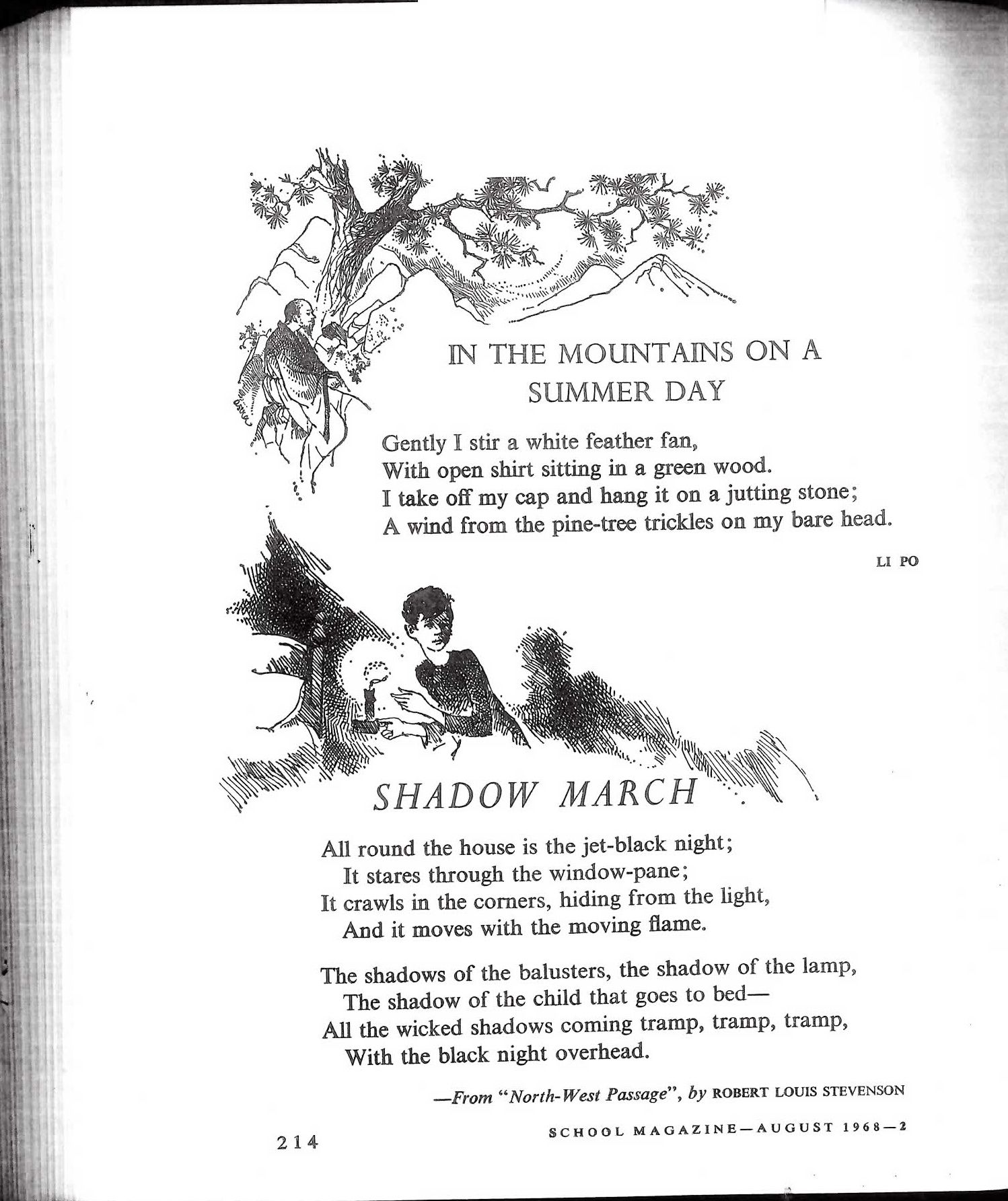
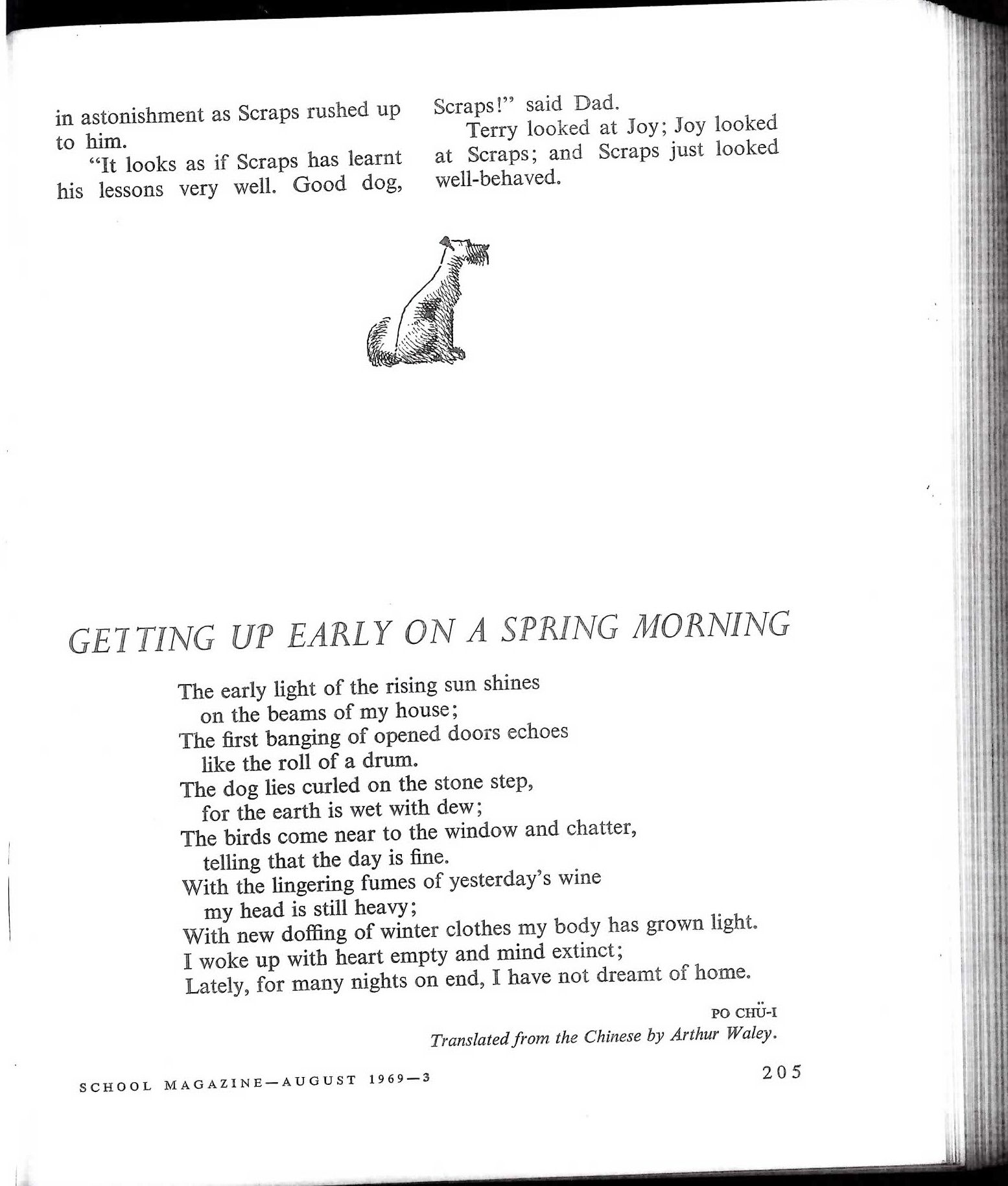
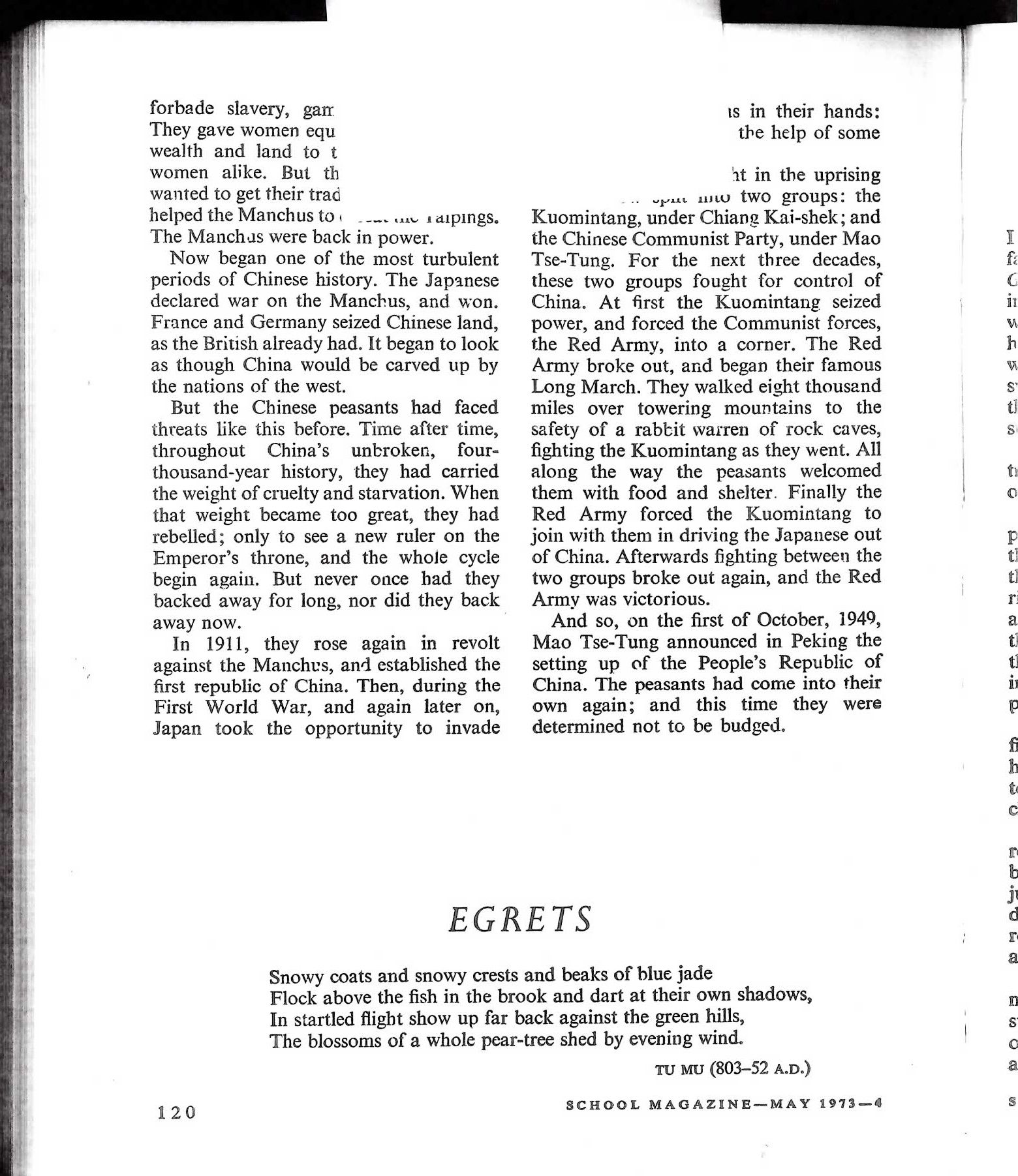
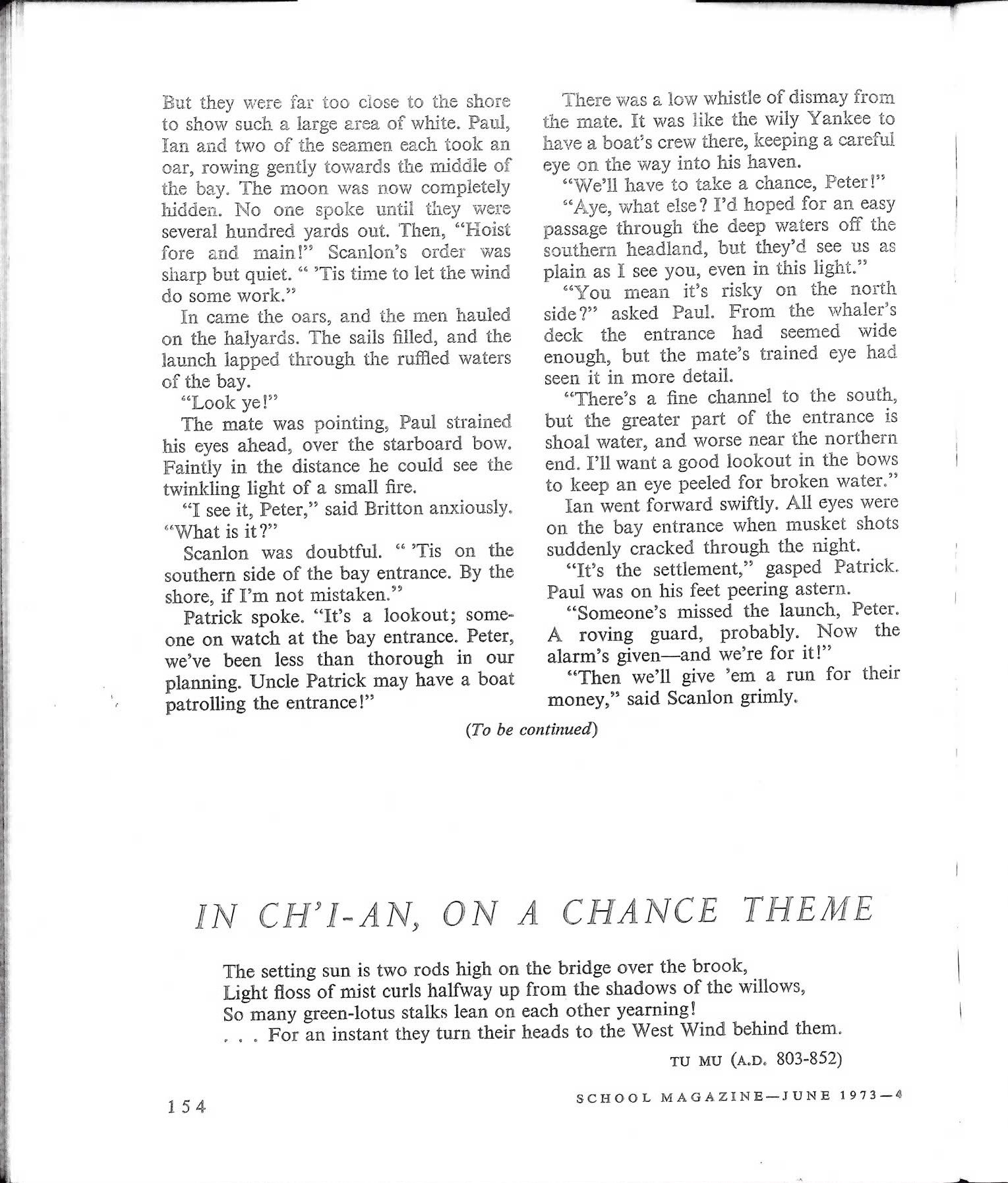
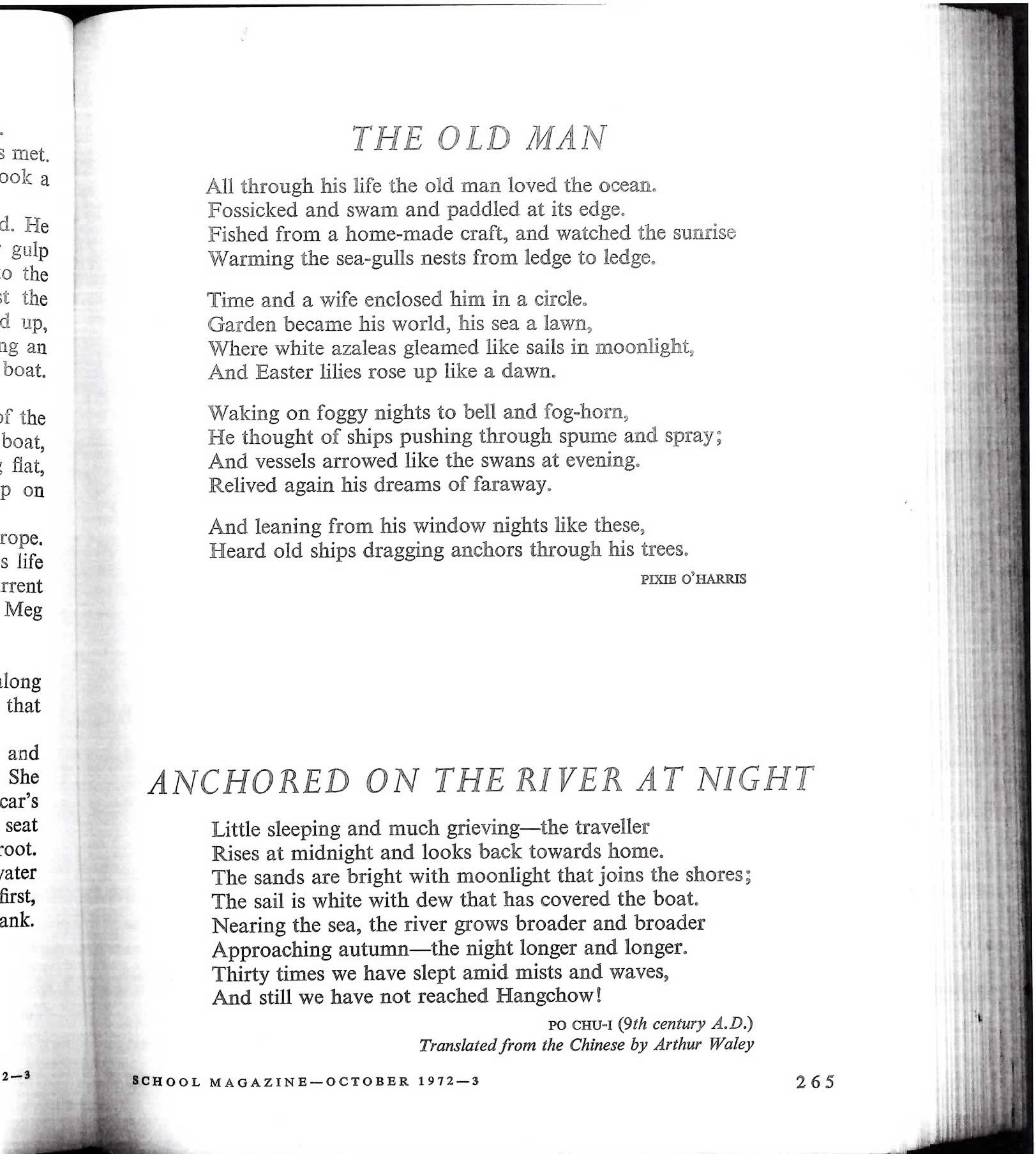
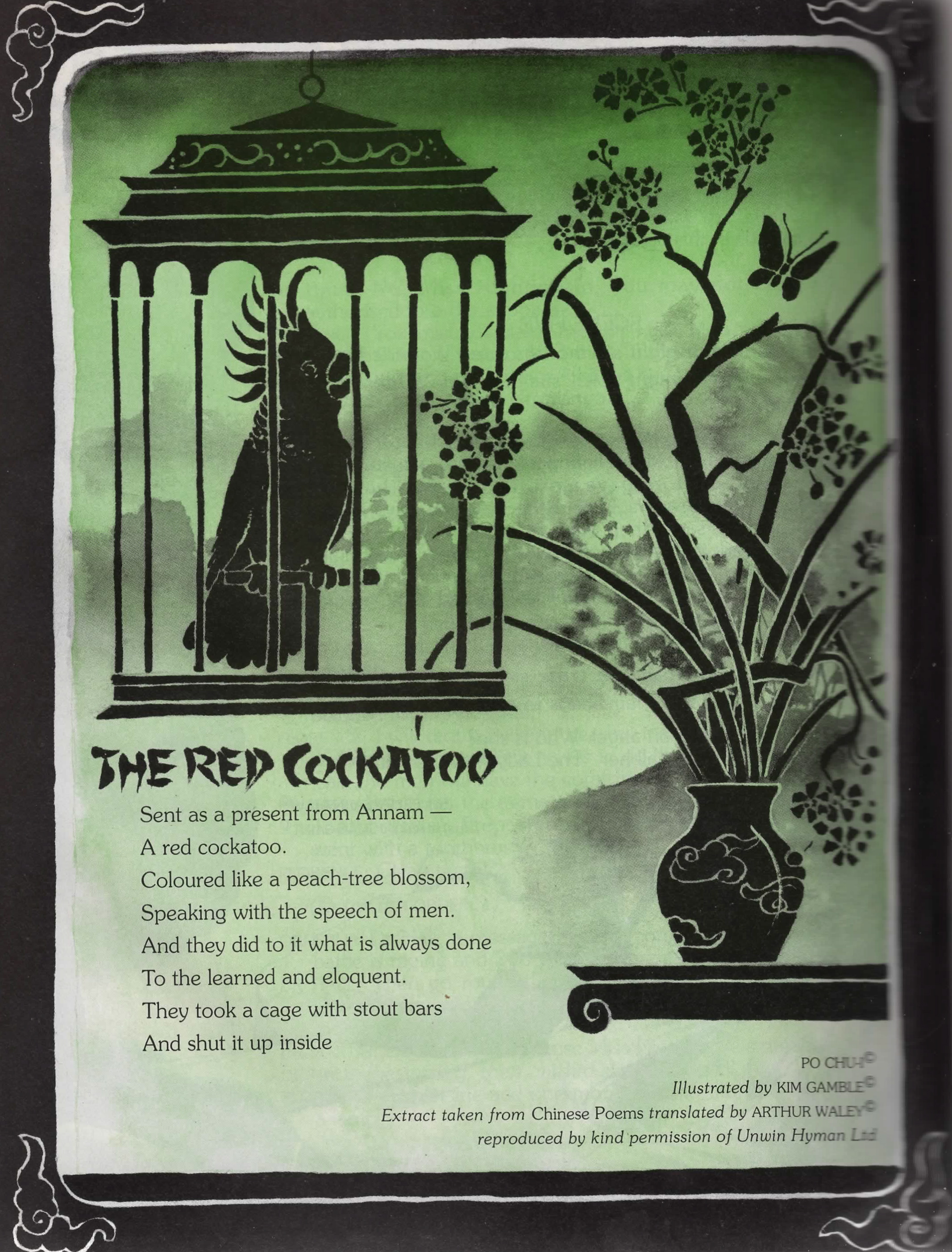
Patricia Wrightson was on the editorial staff of the School Magazine from the mid 1960s and was its editor for pretty much the whole 1970s. My acquaintance with Chinese poetry prior to reading J P Seaton’s anthology came largely from poems published in the magazine during those years. None of the poems I could lay hands on were published in the anthology. I think they are all translated by Arthur Waley. They all stand on their own merits, not sending the reader off in search of that which they have translated (not, as I was saying when blogging about the anthology, that there would be anything wrong with that – in fact, from some points of view, a translation should make a reader go searching for the original).

Click on the thumbnails to read the poems and see a little of their contexts in the magazine: Robert Louis Stevenson, Pixie O’Harris, a story about a dog, a Pauline Clarke serialisation, a historical article. The illustration of Li Po’ s ‘In the Mountains on a Summer’s Day’ is by the great Astra Lãcis. The last one, illustrated by Kim Gamble, was published in my day, but I found the poem in back copies from Patricia’s era.