Monthly Archives: Apr 2010

Les Murray, Prone to be Tall

Les Murray, Taller When Prone (Black Inc 2010)

A new book by Les Murray is an event, and I didn’t hesitate to use my birthday voucher to buy this. And I wasn’t disappointed. The book has already been reviewed well by people more articulate and perceptive than I am. Clive James in The Monthly, for instance, may be a little OTT in suggesting the Nobel for Literature and characterising the intemperate and possibly libellous ‘The 41st Year of 1968’ as ‘a sharp rebuke to ageing hippies who imagine themselves to be in sympathy with Gaia’, but he generally does a nice job of illuminating the poetry.

I was struck many years ago by something Francis Webb – who like Les Murray experienced severe depression – wrote about poetry:

I do value in poetry that heightening or ameliorating sense of companionship in human experience. What do we seek of the trusted companion? His honesty, and that half-loaf of comfort. Poetry, as in Dante, can teach; but that is not its primary function. And pure, honest companionship may implicitly carry  comfort within itself, neutralising the often frightening sense of solitude in our affairs.

Much as I admire and enjoy Murray’s poetry, I don’t get much sense of companionship from it.  I don’t have anything against the man – after all he published a poem of mine in Quadrant. And I’m a fan – I’ve been buying his books for decades. I’ve just seen a copy of The Weatherboard Cathedral going for more than $500 at Biblioz.com, but I’m not even slightly tempted to part with mine. But I do have a creeping sense that his poetry doesn’t much like me. I don’t mean just the splenetic outbursts like ‘The 41st Year’ (which, though its explicit targets are amalgamated Hippies and Greenies and New-Classies, none of which I quite am, I manage to take personally). Nor do I mean only the obscure pieces – Robert Gray says in The Australian that about a third of this book leaves him not having the faintest idea what it is about, and not ‘cajoled by the expression into wanting to find out’. I have a sense that the poetry generally doesn’t seem to want to communicate, to expect a relationship with the reader: it’s as if it’s reporting brilliantly on the world sharply seen and heard and thought about, on understandings (and positions and judgements) reached, even on emotions felt, and all it expects of me is that I look on,  admiring its brilliance. To vary the metaphor, the poems are like grenades lobbed over a wall – they may explode in verbal fireworks, release lyrical aromas, or scatter the shrapnel of opinion, but the wall stays there, solid and opaque between us and the thrower.

Or maybe that’s all rubbish. One of the many poems I liked here is ‘The Filo Soles’:

When tar roads came
in the barefoot age
crossing them was hell
with the sun at full rage.
Kids learned to dip
their feet in the black
and quench with dust,
dip again, and back
in the dust, to form
a dark layered crust
and carry quick soles
over the worst
annealing their leather
though many splash scornfully
across, to flayed ground.

When I wrote just now that I liked this poem, I thought of writing instead that the poem ‘spoke to me’, but actually it didn’t, even though I lived in the barefoot age in the tropics, and know about crossing a bitumen road in the summer heat. The poem doesn’t work on me by reminding me of that experience. What I like about it is the way the title adds a clever visual element, the way the disintegration of the rhyme and metre towards the end  mimics the desperate, unprotected run as opposed to the methodical application of protection, and the way ‘flayed’ unexpectedly describes the ground rather than the young feet in the last line. There’s a lot to like. Maybe my grumbling about lack of communication is just lack of sleep. I’d be interested to hear other people’s thoughts.

Asia Literary Review 14 and 15

Chris Wood (ed), Asia Literary Review, Nº 14 and Nº 15

I subscribed to the Asia Literary Review as an act of avuncular solidarity – I wanted a hard copy of issue 14, (northern) Winter 2009, which features ‘Broken’, a story by my niece Edwina Shaw. Having now read two issues, I’m a fan.

Asia, of course, covers a vast proportion of the Earth, from the Philippines in the east to the Arabian Peninsula in the west. The Asia (not ‘Asian’) Literary Review is a vast tent open to contributions from all of it and beyond. It’s an English-language journal, founded by Nury Vittachi in 1999, and currently edited by Chris Wood. It publishes work by writers and visual artists from Asian cultures in translation and originally in English, work by expat and former expat Westerners (like my niece), not all from English-speaking countries, work by Westerners who have engaged with Asia in other ways (there’s an extract from Henning Mankell’s The Man from Beijing in Nº 14), contributions from various Asian diasporas. There are interviews, both original and transcribed from The Book Show, and a wealth of illustration.

In Issue 15, just arrived in my letterbox this week, Hanif Kureishi (one of the interviewees) is quoted on racism:

It really is about language. It’s very traumatic to exist in a world of other people’s descriptions. Your own words have no force.

If he’s right, then the sheer multiplicity of voices here must be profoundly anti-racist. In Issue 14, ‘Noe’s Jiuta-mai’, a photo-essay by Bangkok based Xavier Comas on a traditional Japanese dance form, is followed by  ‘Nova Initia’, Thomas Lee’s first person narrative about a Korean man in the US learning about his father’s past, which in turn is followed by ‘Phallacy’, a laddish sonnet by England born Daljit Nagra (How oft do mates bang on at length about / how well they’re hung …). Issue 14 interviews Gao Xingjian, three times exiled from China for his writing and now living in France:

The writer is a weak individual and cannot overcome political oppression; he can only flee, or he has to write for the government. […] Dante fled Florence because he couldn’t write. Ibsen fled Norway; it wasn’t until Norway began to recognise him that he went back.

In Issue 15, dissident writer Liao Yiwu’s memoir ‘Go South, Go Further South’ concludes:

I had survived prison, while others had died within its walls. And I had survived a devastating earthquake while so many others perished. And hundreds of people are arrested or shot crossing the border. I don’t have a single reason to complain.
I accept my fate, which is to stay, and write.

Heroism has many faces. So does Asia. You get to meet a lot of them in this journal.

And in case I haven’t said it before, Edwina’s story can hold its head up in that multifaceted and exalted company.

Pirate Jenny Maiden

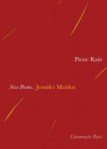
Jennifer Maiden, Pirate Rain (Giramondo 2010)

Jennifer Maiden’s poetry never fails to delight me, so a new book is a thrill. I don’t understand why she doesn’t get rockstar treatment.

Her last book, Friendly Fire, included a ‘cluster’ of poems featuring George Jeffreys and Clare Collins, characters from two of her novels (one of them ‘notoriously unpublished’). Clare had killed her two younger siblings when she was nine years old. George has been her probation officer and is now her mentor, friend and lover. As Jennifer Maiden explained in an introduction to the poems, through these characters ‘the horror-inhibited portions of [her] brain might speak’. First, in a prose piece, they were in the New York of 9/11. Then came the six poems, each of them beginning:

George Jeffreys woke up in [Kabul/Kandahar/London/ Berlin/the White House/Baghdad].
George Bush Junior was on the TV, obsessed
as usual with Baghdad.

and then going to unexpected places. In the five years since then, as seen in Pirate Rain, she has written four more ‘George Jeffreys woke up’  poems (in New Orleans, Rio, Beirut, and a Pirates’ Ship), which are collected here along with one in which ‘Clare Collins woke up in the Paris Hilton’, eight in which Eleanor Roosevelt or Hilary Clinton wakes up somewhere, and one each for Florence Nightingale’s pet owl Athena, Mother Teresa and Grahame Greene, who wake up respectively ‘on the wild cliffs of Crimea’, ‘in London, at /The Inquest for Princess Diana’ and ‘in the Saigon Caravelle/ Hotel in 2006’.

That might sound like a bit of a bore, but it’s actually quite the contrary. Those first-line awakenings are launching pads for a wide range  of poems: a couple come close to being straight action-adventure, others enter strange supernatural fantasy worlds, and always there’s a serious play with the big news of the day. (I would have liked the poems to be dated, which would have made it possible to find out easily at what stage of George W Bush’s foreign adventures the conversations in the poems were taking place. For instance, I seem to remember that the bit where George talks about torture in the Abu Ghraib prison was written before those sensational photographs were made public – and this surely affects how the poem is read.)

Maybe one day I’ll write something in which I figure out why I love Maiden’s poetry so much. Penny says it’s because her mind is like mine. I wish it were so! One thing that I can tell is that she writes about the public world, the world we see on the television, and makes sharp observations and judgements about it. Her portraits of George W Bush and Condoleezza Rice are wonderful. In this volume, there are Jim Cairns, Hillary Clinton and, most touchingly, Don Dunstan. (I want her to do Rudd, Abbott, Gillard, Obama, Kristina Keneally, … … … ) She argues about the nature of poetry, and fame, without every disappearing up her own kazoo. She reports conversations with her daughter without going cute – in fact, the poems involving those conversations generally astonish in the way they bring disparate elements together. ‘Night on water’ does this superbly. I hope it’s fair dealing to quote the whole poem:

night on water
Seeing him was like reading Shakespeare by flashes of lightning – Coleridge on Edmund Kean’s acting.

‘Mum, are you famous?’
______ with insouciant irony asks
my daughter, when one of her friends
says, ‘Is your mum famous?’
on the phone. That flirty incorruptible
compassionate eyebrow arches
at me and I answer, ‘No, just
an ageing hippie who’s had
a few books published,’ wishing that
either this or the fame thing were true,
momentarily, as she repeats my reply.
Later, she comforts as usual,
‘Don’t worry – you’ve got me,’ and I agree
‘Yes,’ as usual, feeling the old nervous
delight at that, think that if she has
as I once wrote, ‘eyes like night on water’,
there is also there the rapid glow
of fireworks on the harbour, remember
how once in a storm season when
the fences were blowing away, she
illuminated me from the bathroom window,
held onto its hinges to stop
it leaving as I gripped the fence sheets
together in the blinding, deafening rain.
Her torchlight and the lightning swung
wildly on my face and she called down,
sincerely and suddenly. ‘Mum, you
look beautiful.’______I’ve thought
ever since, this the most powerful
thing that the concept of beauty can do:
glance into the heart of you, like her,
and keep you going. __I’ve thought the
concept of fame somewhat like that, sometimes:
without too much charm,
money or position, it seems to me
a vague modicum of fame, however
mysterious it may seem to others, gives
one enough currency to survive. But
there’s still no real security, except
_____in some stunning
moment in practical tempestry when
one is seen as one would see, is read
like Shakespeare by flashes of lightning.

I didn’t fold any page-corners down in this book, because I’ll want to reread the whole thing, many time I’m sure.

Bête/beast du/of the marais/Camargue

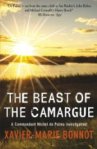
Xavier-Marie Bonnot, The Beast of the Camargue (translation Ian Monk, Maclehose Press 2009)

Maybe I’m turning into a horrible person, because here’s yet another book I’ve laid aside, this time just before page 100. It was a big hit in France, so it might be that I’ve lost all sense of what makes a good read. But it’s a murder mystery, and very little had happened by the time I parted company from it – the body of an extremely rich man who has been missing for a fortnight or so has finally been found in a swamp, so it feels as if the story might be about to start. An unnamed man who is probably a psychopathic serial killer has made a couple of lacklustre appearances. There’s a cop with enough idiosyncrasies to make him interesting, a romance that will probably stay unconsummated, and a beautiful, rich widow with something she’s not telling. There are English-speaking tourists, wandering with their cameras through places where evil lurks. Oh, and there are hints that the evil might be in some way occult. In other words, it’s familiar territory, and there evidently wasn’t enough in it to engage this reader.

Two things kept me reading even this long: the setting and the translation. The action takes place in parts of France I visited last year (as one of those gormless tourists), and I was hoping there would be pleasure in revisiting them – but the sense of place, it turns out, isn’t very strong. I was fascinated by the translation. When Gregory Rabassa was working on his translation of A Hundred Years of Solitude, an interviewer asked him if he knew enough Spanish for the task. He answered, ‘The question isn’t whether I know enough Spanish, the question is do I know enough English.’ I have no doubt that Ian Monk’s French was well up to the challenge of translating this book, much much better than mine I expect, but his English is disconcertingly uncomfortable in its own skin. A quick google just now turned up this sentence from the original:

‘Sortez du problème, les gars. Allez fourrer votre nez là où personne n’irait jamais le fourrer.’

As luck would have it, I knew where to find the English version (on page 83):

‘Move outside the problem, lads. Go and stick your nose where no one else would stick it.’

The French, advice that a wise old cop once gave our hero, looks to be casual speech, but the English is oddly stilted. Sortir is ordinary language for leaving or going out (of something), but who says, Move outside (something)? And how could anyone else stick the lads’ nose anywhere? How about:

Step outside of the problem, lads. Stick your nose in places where no one else would think of sticking theirs.

That’s just nit-picking, of course. My eye glided over that sentence when I read it in context. I noticed its awkwardness now because it’s the only sentence from the book I’ve seen the French for, so it’s the one I was stuck with to consider here. But the cumulative effect of such small misfires is both fascinating (as in, I’d love to study this closely because it shows a lot about language) and unpleasant (as in, I keep being jolted ever so slightly out of the world of the story).

Actually, I think Ian Monk is probably a very good translator. I spent maybe ten minutes playing around with that one sentence. He had to earn a living. Translators aren’t exactly paid at merchant banker rates, and you do what you can in the time you’ve got.

Anyhow, Commandant Michel de Palma may be the French reading public’s equivalent of John Rebus, but he couldn’t keep me reading past page 98.

NSWPLA shortlist

Last Tuesday the Children’s Book Council of Australia announced the short list for their Books of the Year Awards. I’ve only read one of the titles (Ursula Dubosarsky and Andrew Joyner’s lovely The Terrible Plop), but I applauded a couple of inclusions in their Notables Books list that didn’t get shortlisted (mainly Cassandra Golds’s The Museum of Mary Child and the latest of Jackie French and Peter Sheehan’s Australian history titles, Weevils, War and Wallabies: 1920–1945).

Today I turned up at the Mint in Macquarie Street for the announcement of the short list for the NSW Premier’s Literary Awards, hoping I’d have read more of the books and be able to applaud more of the nominees. I was also looking forward to clapping eyes on our newish premier in person. I did see the premier, but it turns out I haven’t read many of the books. It was a pleasant event all the same.

The short lists are already up on the PLA website, and the announcement was being tweeted by my friend misrule and the person next to her (who is paid to tweet), so I’m not exactly breaking news here.

Kristina Keneally was taller than I expected, and not so different in person from her on-screen appearance: poised, slightly awkward, with a sweet smile and a lively manner. She announced the short list with a PowerPoint  presentation, which I’ve just realised is a way of making a personal appearance approximate to television. There was none of Frank Sartor’s teasing of authors for being too shy to put their hands up – that may have been embarrassing, even painful, but it was personal. None of Nathan Rees fanboy enthusiasm about ‘talking to David [Malouf]’ or phoning Christos Tsiolkas. No devil-may-care quoting from Stalin, in the Carr tradition. CK made jokes (‘bribing the judges is not allowed’) and personal comments  about not being the most literate person in the Keneally family (her uncle by marriage is Tom Keneally), but it was all from the script. It was a good script, mind you, and included an honorable mention of Patricia Wrightson. The one moment of clear humanity was when Kristina stumbled over Justine Larbalestier’s surname, and apologised to Justine (who I believe is in New York just now). We all sat in the Mint theatrette and applauded quietly at the end – the shortlisted authors didn’t get to stand and be recognised, there was no partisan applause for individuals.

The food was good, and the mood was light and friendly.

The short list itself?

I haven’t read any of the books on the Patricia Wrightson (for children’s literature), Ethel Turner (for young people’s literature), Douglas Stewart (for non-fiction), Glenda Adams (for new writing), Kenneth Slessor (for poetry) or Literary Scholarship (no famous name yet attached) prizes, though there are books on all those lists I’d love to read, and some are already on my shelves waiting for their time to come.

The Script Writing Award list is stunning. I’ve seen four of the six. Misrule took a break from tweeting to tell me Tangle is on Foxtel and that I’d hate it. I missed Fairweather Man, but it sounds great. I haven’t blogged about East West 101, but I love it. I’ve added links to my offhand blogged remarks on the others:

Jane Campion, Bright Star
Kristen Dunphy and Michael Miller, East West 101: Episode 13
Adam Elliot, Mary and Max
Fiona Seres, Tangle: Episode 1, Yellow Amendments
Aviva Ziegler and Veronica Fury, Fairweather Man
Warwick Thornton, Samson and Delilah (also here)

Of the two works listed for the Community Relations Commission Award, I’ve read and loved the first, and look longingly at the second:

Dr Abbas El Zein – Leave to Remain: A Memoir
Dr Tim Soutphommasane – Reclaiming Patriotism: Nation-Building for Australian Progressives

I’d done OK on the Christina Stead Prize too, with three books read, two on the to-be-read list and strong opinions on all five:

J.M. Coetzee, Summertime
Richard Flanagan, Wanting
Cate Kennedy, The World Beneath
Steven Lang, 88 Lines about 44 Women
David Malouf, Ransom
Craig Silvey, Jasper Jones

Now I’m wondering if I can manage to read Cate Kennedy’s, David Malouf’s and Steven Lang’s books in time to cast a vote in the People’s Choice Award.

Adamson’s best of 2009

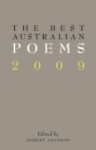
Robert Adamson, The Best Australian Poems 2009 (Black Inc 2009)

This is an excellent anthology. In fact, in the context of previous years’ round-ups, both from Black Inc and UQP, it’s a strong contender for Best of the Best. It includes a wonderful range of poetic styles and modes and subjects – incomprehensible post-modern stuff, impassioned story-telling, linguistic virtuosity, delicate lyric. There’s Clive James‘s assured iambic pentameter, Pam Brown‘s asthmatically short lines, Ali Cobby Eckermann‘s lines you might need to know didgeridoo breathing to recite adequately. In the introduction, Robert Adamson talks about his solution to the difficulty of reducing his short list to fit the space available – he persuaded Black Inc to give him more space. I’m glad he did, and that he kept commentary, analysis and explanation to a bare minimum. He does offer this gem of commentary:

People ask me, why are so many bird poems being written and published? I have a theory: we miss having poets among us who can imagine that a soul can ‘clap its hands and sing, and louder sing’, that we need to acknowledge visitations by intense psychological presences, and that birds are the closes things we have, more or less, to angels.

Perhaps that’s mainly a clue as to how to read his own poems, but it’s an interesting general thought as well.

I’m not going to try to name the poems I liked best.  My copy has far too many page-corners turned down for that.

As I was reading this anthology, my Art-Student Companion, as part of her preparation for an assignment on Australian Federation, was reading The Sentimental Nation by John Hirst, and kept regaling me with interesting bits about the major role poetry played – poetry, he says, is ‘the best guide to the ideas and ideals that inspired the movement’ for Federation, and again: ‘The nation was born in a festival of poetry.’ Well, even though poetry festivals rarely make the news pages these days, to judge by this book poems are still looking for words for what inspires and ails us as a nation and a species. But now, instead of writing bush ballads or ponderous and forgettable sonnets, they tell about Iraq, global warming, the ills of capitalism, but they tell it slant. There are any number of examples, but I’ll just mention Luke Davies’ ‘Maldon, 991 AD’ which ends:

oooooooooooo I felt an outsider
to laughter. Out there the Vikings sang,
that was more like it, something eerie
to get spooked about, distracted by:
and the world so tenderly
unveiling its final unveiling.

I was also struck by the sense of community among the poets, particularly as shown in the number of poems honouring those who have died: Dorothy Porter (‘Word‘ by Martin Harrison), but also John Forbes (‘Letter to John Forbes‘ by Laurie Duggan, Jan McKemmish (Pam Brown’s ‘Blue Glow‘), Francis Webb (‘Reading Francis Webb‘, by Philip Salom [the link is to a PDF]) and Bruce Beaver (a couple of mentions, but mainly Peter Rose’s beautiful imitation, ‘Morbid Transfers‘).

Buying this book in March felt a little bit silly, like buying hot cross buns in July, but it turns out it’s not a seasonal thing at all. It’s an anthology that I’m sure I’ll go back to.

Footnote: One of my wise younger relatives recently chided me for reading while walking: ‘It’s as bad as walking around with those things in your ears, Jonathan,’ she said (by which you can she’s not so very young). ‘You have to let the world in.’ She may be right in general. But sometimes reading while walking is a way of letting in both world and poetry. The other morning I was throwing the ball for Nessie at the bottom of the hill and noticed that the longish grass was pearled with dew so that previous walkers both human and canine had left tracks of darker green, and the rosellas wouldn’t shut about something. I realised it must have rained quietly in the night. The next words I read were these, from Sarah Day’s ‘A Dry Winter: Some Observations About Rain‘:

… an elemental transition from dry to damp.
Listen, you can hardly hear its outward breath

on the tin roof. In the morning,
grass and earth are wet and everything

but the mercuric globe in the nasturtium leaf
is translucent.

I don’t know anything about nasturtiums, but the rest could have been a condensation from my surroundings. (The whole poem is lovely, by the way.)

Added later: Tara Mokhtari on the Overland blog has a completely different view. She does identify herself as a ‘shunned poet’.

Fun with the Crowds

We went this morning to what we’re told these days is even more popular with Australians than the beach or the footie – the art gallery. Specifically, we went to the Art Gallery of New South Wales for the equivalent of a Grand Final, The Archibald Prize. We bought our concession tickets (I’m a senior, my companion a student) and joined the milling crowd. I liked the winning portrait of Tim Minchin (Penny didn’t). I lay on the floor to get a proper look at the distorted figure in The Alternative Ambassadors (which really ought to have been hung at the top of a staircase, or at least had a comfortable cloth on the floor beside it): ‘It’s a baby,’ I said to those who were too restrained to emulate me, ‘or perhaps a foetus.’ ‘A foetus, definitely,’ said a young woman who was flexible enough to have had a proper look without actually lying down.

In the People’s Choice I voted for Apple Yin’s ‘Previous Life‘, a portrait of a Melbourne personality as a beggar on the Silk Road in a past life. I wondered how Robert Hannaford’s magisterial portrait of Malcolm Fraser would have turned out if give a past life treatment? A Renaissance cardinal, perhaps, or a noble prisoner in the Tower of London?

There were lots of lovely things in the Wynne, including some austere Aboriginal works. I liked the winner, and was glad that among all those huge canvases it was the three smallest works that won the Archibald, the Wynne and the watercolour prizes. The Sulman mostly left me bemused, as it often does. If a work of art is supposed to be something you can look at for a long time and over a long period and still find fresh (and I know that’s a big ‘if’), how come a one-note joke won the Sulman? (You understand I speak as one who knows very little about art, and would generally recommend you listen to the brilliant Imants Tillers, this year’s Sulman judge, rather than me, on such matters, but I really don’t get it.)

We walked the length of the city, chatting happily, arguing with John McDonald in his absence, to Haymarket where we had a most satisfactory yum cha in the vast Marigold, apparently in the company of everyone who wasn’t actually at an art gallery.

Easter, the festival of the changing season, and this year also of putting the clocks back, draws to a close. I hope you’ve had a good one too.