
Ashley Kalagian Bunt, My Name is Revenge: A novella and collected essays (Spineless Wonders 2019)
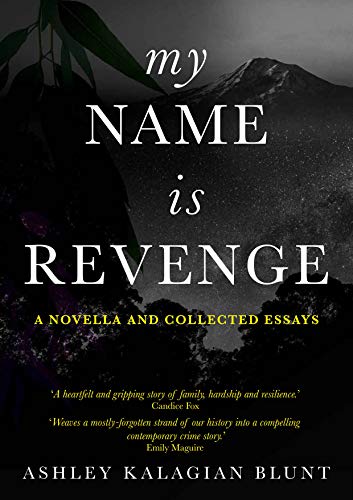
On 17 December 1980, at 9.47 am, two men shot the Turkish consul-general to Sydney and his bodyguard near the consul’s home in Vaucluse. The assassins aimed, fired and vanished.
That’s the opening paragraph of the novella that gives this slim book its title. I had to check in Wikipedia: it turns out that that assassination is not something invented by Ashley Kalagian Blunt. Like the Armenian genocide that inspired it, it is simply not remembered by most of us. What follows that paragraph – a young man whose name, Vrezh, is Armenian for ‘revenge’ feels empowered by news of the assassination and gets involved in a further terrorist plot – is fiction, but fiction fuelled by the historical genocide, and the Turkish government’s century-long insistence that the genocide never happened.
It’s a daring choice in the current climate to write about terrorism from the point of view of a potential terrorist, who has an assassin – Soghomon Tehlirian – as a hero. It’s daring, and stunningly successful: we care about that young man and his family.
The three essays accompanying the novella address aspects of the issues it raises: ‘Writing Violence, Arousing Curiosity’ deals with the genesis of the novella itself; ‘The Crime of Crimes’ sketches the history of genocide, from well before the term was coined in the 20th century; ‘Life After Genocide’ focuses on Kalagian Blunt’s reconnection with her Armenian heritage as a young adult, and how survivors of the genocide have dealt with the history – in particular her great grandfather who as a child witnessed monstrous deeds. The grim subject matter is leavened by a selection of the author’s photographs of Armenian buildings, landscapes and people, including a stunning double spread featuring herself as a baby with her great-grandparents. It’s to the credit of Spineless Wonders that these black and white photos are reproduced with great clarity.
It’s November, and this month I tend to keep reviews to a minimum and write a stanza inspired by the book in question (I have to produce 14 14-line poems this month). But I need to say a little more before breaking into rhyme.
As a settler Australian and a gentile, I’ve felt an obligatory interest in the history of genocide. I have a number of fat books on my To Be Read shelf with titles like Blood and Soil: A World History of Genocide and Extermination from Sparta to Darfur (that one’s by Ben Kiernan 2007). I haven’t even started reading any of them. My Name is Revenge got me through the opening gate, and I recommend it to anyone who feels a similar responsibility to be informed. (It has added several new books to my virtual TBR shelf, including the discouragingly titled Genocide: A World History (Norman M Naimark 2017). Actually, I recommend the book to anyone who appreciates fine writing that comes from a passionately felt source.
Now for my little verse, which opens with Exodus 15:3:
November Verse 4:
Kill man and woman, babe and suckling,
ox and sheep, camel, ass.
That's God to Saul. Since, we've been buckling
up for slaughter, sword to gas,
musket, spear, scimitar, machete;
harrying, dispersal, cleansing, deadly
soft words for the blood-soaked facts:
whole peoples falling to the axe.
And what comes next? Post-devastation
do gentlefolk take up the land,
priests take survivors by the hand,
declare it's all a fabrication?
The story of the human race
is sometimes awful hard to face.

My Name Is Revenge is the thirty-seventh book I’ve read as part of the 2019 Australian Women Writers Challenge. My copy is a gift from Ashley Galagian Blunt.


 Me fail? I fly!