Monthly Archives: Nov 2021

November verse 2.5: Homophones

There may be a better word for this kind of poem, and it may be much more widespread than I know about. I’ve met it in Toby Fitch’s poetry, and I’ve read one poem by Jaya Savige (‘Coonoowrin (Crookneck)’ in Southerly: 80!). It’s a lot harder than it looks.

My version of the idea is to take an existing text and rewrite it so that the words sound the same, or can be made to sound the same with a bit of distortion, but have completely different meaning, or even perhaps no meaning at all. Please don’t take the quality of my offering as representing the best the form can offer.

I’ve given the original text for this at the bottom in smaller type. I didn’t want to deprive you of the dubious pleasure of trying to spot the original.

Disingenuous
I forgot, brought showdirts,
I conned eel with hat.
Bit though's loose.
Eye m'nut, gunner.
Cop's legend hit a stray Lear.
Eye m'nut, gunner:
cope Thetan bee,
have a fast stray lens.

I’ve got broad shoulders. I can deal with that. But those slurs, I’m not going to cop sledging of Australia. I’m not going to cop that on behalf of Australians.
Prime Minister Scott Morrison, responding disingenuously to President Macron’s accusation that he lied

November verse 2

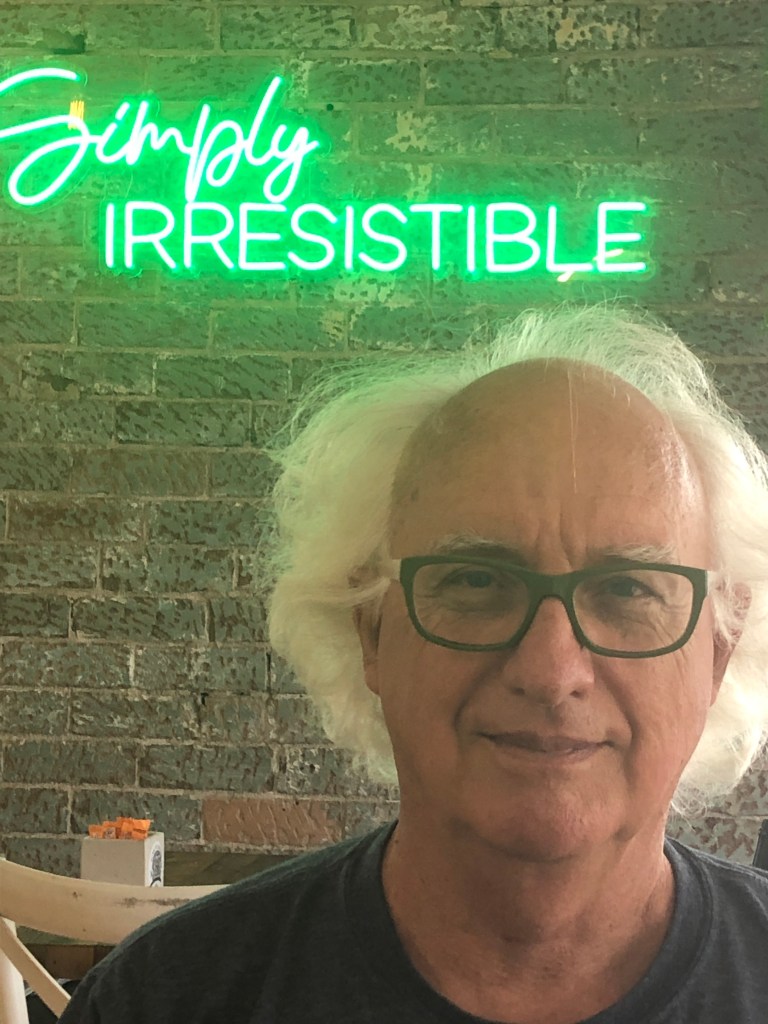
No subject having presented itself to me for today’s stanza, I’ve fallen back on Shakespeare. This stanza uses the rhyme words from his Sonnet 37 (chosen at random), modified to meet the Onegin stanza’s requirements. After reading the Shakespeare, I had to go for a walk around the block before I could begin to find my own much more frivolous thoughts, but here goes, with illustrations.

November verse 2: Post-lockdown hair

You wouldn't say it's as delightful
as my unkempt mane in youth,
but call it straggly straw? Just spiteful.
Mynas like it, that's the truth,
and swooping magpies. And the witty
check-out girl at Supa City
called me Einstein. (We get more
than what we pay for at that store.)
Thanks to Covid I've been given
time to think. I once despised
unbarbered hair. Four months sufficed
to help me understand men who were living
back when they were thou and thee,
balding, crested white, like me.
2021. Photo by Penny Ryan
1971

November verse 1.5: Erasure

This year I plan to add to my November exercises some excursions into poetic forms like erasure, cento, n+7, homophony (if that’s a good word for what Toby Fitch does), and others as I think of them. My idea is to make something from the day’s newspaper as source text.

I’m kicking off today with an erasure poem. Here’s one description of erasure poetry, from the poets.org website.

Erasure poetry, also known as blackout poetry, is a form of found poetry wherein a poet takes an existing text and erases, blacks out, or otherwise obscures a large portion of the text, creating a wholly new work from what remains.

You can read more about it, with links to ‘seminal’ works, here. Andy Jackson”s ‘borne away by distance’ is a fine example I have encountered recently (online here).

Here’s my offering, from page 1, column 5 of today’s Sydney Morning Herald.

Or, to type it out and give it a title:

Virtue
________++++++_________Glad
____________________secret
______++_________grace
___________duties, 
________+++++__honest
________+++++__dog.

The  _dependent ____mission
 gains
________++++++____trust or
 courage
________+__Wag   Wag .

Make of it what you will. I love it.

November verse 1

Since 2010, inspired by National Novel Writing Month (NaNoWriMo), I’ve had a project of writing fourteen 14-line stanzas each November. Even though my favourite stanza form is an Onegin stanza and not a sonnet, I called this project LoSoRhyMo – Local Sonnet Rhyming Month.

If you want to read past Novembers’ verses you can click on the LoSoRhyMo tag at the bottom of this blog post. Or you could go to my Publications page and buy one of the six little books made up from these and others of my adventures in verse. All but one of these excellent volumes are self-published. The exception, None of Us Alone, is a kind of Best Of published by Ginninderra Press, and I have to thank Tricia Dearborn for her help in selecting the poems for inclusion in it.

Here goes for 2021

November verse 1: The swimming pools have re-opened

So good to be back in the water.
I like to see it lap the Tiles
as I swim laps or when granddaughter
clamps her lips around her smiles
to keep it out. First thing this morning
in the slow lane, I'm relearning
other bodies aren't a threat,
even unmasked, bare and wet.
After bushfires, epicormic
shoots adorn the trunks of gums
like bloomers on their legs and bums.
Post-lockdown, thanks to hypodermic
double vaccination rates,
we put on hope. We tempt our fates.

A note for readers who noticed the Emily Dickinson reference: for no reason I can think of, the actual Emily Dickinson line (with ‘Miles’ instead of ‘Tiles’) often hounds me like a non-musical ear-worm while I’m swimming laps, so I had to include it here, however awkwardly.

Starting the Iliad

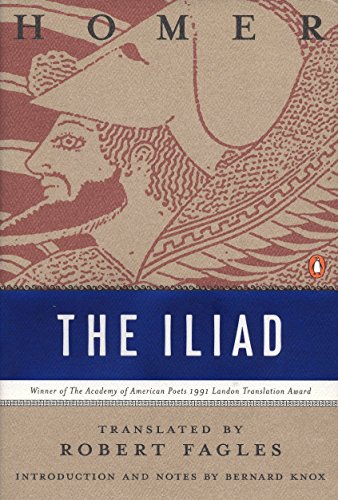
Homer, The Iliad (Translated by Robert Fagles, with notes and an introduction by Bernard Knox, ©1990, Penguin 1998)

It’s more than a week since I finished reading The Prelude, and I’m already missing reading a couple of pages from a classic text first thing every morning. I’ve decided to take on Homer’s Iliad, which definitely fits the definition of a classic as a book that you can’t read for the first time. My copy of Robert Fagles’s translation was a Christmas gift a while back and has been begging for attention from my sagging To Be Read shelf ever since.

This is my first crack at the actual Iliad, but I have read many fragments, versions and variations of it. Here’s a list of the ones I remember:

  • Kingsley’s Heroes, the Argonauts Club and the Queensland School Readers – from my parents, the ABC and primary school respectively – all told stories of Achilles, and almost certainly some parts of the Iliad
  • The Classics Illustrated comic some time in the 1950s
  • Book 2 of The Aeneid, Virgil’s account of the fall of Troy, which I studied in high school
  • Alice Oswald’s Memorial, subtitled ‘an excavation of The Iliad‘, which presents only the deaths from Homer’s poem (here’s a link to my blog post)
  • The 28 minute version in Natalie Haynes Stands Up for the Classics (link to the podcast)
  • Pat Barker’s Silence of the Girls, which tells the story from the point of view of a captured woman (link to my blog post)
  • David Malouf’s Ransom, which I’m pretty sure I haven’t read, but I feel as if I know it intimately from reading and hearing about it.

I made a start on it this morning. So far I’ve read the translator’s note and I’m part way through the learned Introduction by Bernard Knox. Getting excited already. I’ll report back in a month.