Yearly Archives: 2021

November verse 3.5: Cento

According to poets.org:

the cento (or collage poem) is a poetic form composed entirely of lines from poems by other poets.

You might think the name has something to do with the Latin for 100, and maybe it does, remotely, but it is actually a Latin word in its own right. According to my trusty Gepp & Haigh Latin dictionary, its first meaning is ‘a piece of patchwork, used for clothing, or as a fireproof curtain or blanket, or as a quilt, etc’.

Here’s a cento made, not from other poems, but from the program description of films I’ve got tickets for in this year’s Sydney Film Festival:

At the movies: a cento
Impressed by Einstein, 
a Swiss businessman and a Russian oligarch
are compelled to
violence, incompetence and oppression.
There are death threats,
more direct and more stridently critical,
a timely reminder of 
the role of individuals in an autocratic state.
An uncommunicative young woman
becomes increasingly desperate as she manoeuvres to keep
slapstick humour and deep emotion
with integrity and grit.
They begin to make sense of
life and death in the nuclear age.

November verse 3

I did go to the dentist on Friday, but was reduced to writing this between movies at the Sydney Festival.

November verse 3: Dentist
I used to focus on my breathing,
hoping not to feel the pain.
I’d concentrate on muscles, easing
tightness to relax my brain. 
I used to chant a homemade mantra:
Om madur,I give up Fanta, 
or words to that effect. The drill
and picks would terrify me still.
But these days if I pay attention
closely to what’s going on –
each nerve impulse, each tiny prick, 
each jolt – I find it does the trick:
my mind’s too busy keeping track
to let the panic goons attack. 

500 people: Weeks 35 to 38

See this post for a brief description of my 500 People challenge.

In the four weeks after lockdown eased, I didn’t manage to be any more gregarious with new people.

1 & 2. Wednesday 13 October. Masked and flashing my vaccination certificate, I stepped into a non-essential retail shop for the first time in many weeks. My mission was to buy new shoes to replace my much loved, double patched and disintegrating old pair. I’d tried to buy a pair online, but had to return them because they just didn’t work. The two people working in the shop were fabulous: they were helpful and informative, and we also got to chat about the state of things. They don’t expect retail in the city to be back to the old normal any time this year; they too have suffered from the lack of barbers/hairdressers – the man removed his mask briefly to reveal a splendid beard which is due for the chop and which, he said, he has to shampoo daily so as not to make his mask smell vile.

3. Monday 18 October. In another post-lockdown first, I went to a movie in an actual cinema. Just a few days after I’d told someone I wasn’t interested in Marvel movies, I went to see Shang-Chi and the Legend of the Ten Rings, which actually doesn’t look like a Marvel movie, at least for the first two thirds. It was wonderful to be in a temporary community watching a film for the first time in months. There was a silent moment of mutual recognition when no one moved at the start of the credits – a sign that we all knew what to expect from a Marvel movie. Maybe a quarter of the audience left after a brief postscript that came on a couple of minutes into the credits, but most of us stayed to the bitter end. As the final logos rolled up the screen, I said to the woman nearest me (a Covid-safe distance away and masked), ‘They sure make you wait!’ Just as the final scene was firing up, she said, ‘Every time!’

4. Sunday 24 October. On our morning walk by the Cooks river, we passed a young man, possibly Aboriginal, fishing with a rod and line. I seized the moment: ‘Had any luck?’ Yes, he had caught five flathead, and two had got away. I asked if he ate them. ‘No,’ he said, ‘not from here. I just do catch-and-release, strictly for fun.’ I expressed a hope that the river would be clean enough one day for fish to be edible again. He agreed, but said that would mean the river would be fished out, like a couple of less polluted places nearby.

5. Saturday night, the Emerging Artist and I broke out, walked to town, had our first meal out in a very long time, and went to the theatre. Not only the theatre, but a musical in a big theatre – Come From Away at the Capitol in Sydney’s Haymarket, where I hadn’t been since I saw Hair there in the 1970s. It was wonderful to be with a big crowd, feeling things together. I attempted to start a conversation with the man I was sitting next to, and although he wasn’t having any of it, I’m counting this failed attempt as one of my 500 conversations.

6. Sunday 31 October. In another reopening adventure, I was drawn to a display of hats at the Addison Road markets. The object on my head was unpleasantly sweat-stained, ragged-rimmed and badly misshapen. As I entered the booth, the merchant said, ‘I’m sorry, sir, but I don’t offer trade-ins.’ This got us off to a good start, and we had a pleasant chat about hats, specifically the kind I like to wear. I left with a new one.

7. Near our flat a little later on Sunday, we passed a man with a little boy, possibly 18 months old. The man was barefoot, so probably lives nearby. From a reasonable distance, we saw the man, almost certainly the boy’s father, rub his hand affectionately over the boy’s head as he spoke to him from his great height. As we got close, we realised that the little boy was tearful. The man picked him up, carried him pietà-style for a little, then put him back down on his feet. By this time we were within talking distance. I said something, or maybe I just smiled, and the man responded, ‘He’s unhappy today. Something is going on.’ There was a tiny bit more to the conversation, but I was struck once again by the changes that have happened in parenting in the last hallf century: that man spoke to a neighbour-stranger like an engaged parent as if fatherly engagement was completely normal. When I was a father of infants, I was asked more than once if I was babysitting – unthinkable that the father would be simply being a parent.

8 & 9. I wouldn’t include these encounters, but since there were two of them I’m telling you about them. Within days of each other, a passing man has commented on my T-shirt. The first time was on our usual walk at the Cooks river, and I was wearing a T-shirt with semi-abstract images of bright birds. The second time, I had just walked past a couple of Council vehicles. A man in yellow jacket came up behind me from one of them and as he passed, said, ‘I like your T-shirt.’ To save me the trouble of looking down, he added, ‘The periodic table.’ And so it was.

10. On Wednesday morning 3 November, a little after 9 o’clock, we passed a young man sitting under a tree near Enmore TAFE with a baby standing in his lap, gripping his fingers and pulling themselves upright. We made smiling contact with the man and locked eyes briefly with the baby. ‘Nearly standing up,’ I said inanely. ‘Getting dangerous,’ the man said.

11. Thursday morning, we passed a woman who was grooming her dog. By grooming, I mean she was rubbing her hand over the dog’s back and releasing astonishing cascades of fur. I stopped to comment, admiringly, that she was removing so much fur with her bare hand. She said he produced huge amounts. He was a cross beagle and cattle dog, with the double coat (I didn’t understand that term but didn’t pursue it). I chatted a little about cattle dogs from my childhood that were outside dogs, then we all commiserated about how much work these shedding creatures make. Luckily, our interlocutor’s floors are all polished wood.

12. Thursday, on the same walk, we passed a group of old men teeing off at the point where the riverside walk climbs to the teeing ground. One of them said to a man who was about to swing, ‘Patience is a virtue. Wait for these good people to pass.’ We thanked them, and once we were safely behind them, I said, ‘My mother used to say, “Patience is a virtue, possess it if you can, found seldom in a woman and never in a man.”‘ Surprisingly, the little verse wasn’t familiar to any of the men, nor to the Emerging Artist. Maybe those old men weren’t as old as me.

13. The Sydney Film Festival is on! On Thursday evening, I chatted in a celebratory kind of way with the woman sitting a Covid-safe two seats from me.

14. Saturday morning, before Quo Vadis, Aida, I struck up a conversation with man seated right next to me. We exchanged news and views abut the movies each of us had seen – there were no overlaps. It turns out that we lived a couple of blocks apart a couple of decades ago. he now lives near Wollongong and makes a pilgrimage with his wife each year for the Festival. In the movie, there’s a horrific moment when people are ordered to leave a place of refuge quietly, five at a time, and we’r pretty sure they’re going to their death. As the credits rolled we were asked to bear Covid restrictions in mind and to leave in a =n orderly manner. My new acquaintance and I said, in unison, ‘Five at a time.’

Running total is 242.

November verse 2.5: Homophones

There may be a better word for this kind of poem, and it may be much more widespread than I know about. I’ve met it in Toby Fitch’s poetry, and I’ve read one poem by Jaya Savige (‘Coonoowrin (Crookneck)’ in Southerly: 80!). It’s a lot harder than it looks.

My version of the idea is to take an existing text and rewrite it so that the words sound the same, or can be made to sound the same with a bit of distortion, but have completely different meaning, or even perhaps no meaning at all. Please don’t take the quality of my offering as representing the best the form can offer.

I’ve given the original text for this at the bottom in smaller type. I didn’t want to deprive you of the dubious pleasure of trying to spot the original.

Disingenuous
I forgot, brought showdirts,
I conned eel with hat.
Bit though's loose.
Eye m'nut, gunner.
Cop's legend hit a stray Lear.
Eye m'nut, gunner:
cope Thetan bee,
have a fast stray lens.

I’ve got broad shoulders. I can deal with that. But those slurs, I’m not going to cop sledging of Australia. I’m not going to cop that on behalf of Australians.
Prime Minister Scott Morrison, responding disingenuously to President Macron’s accusation that he lied

November verse 2

No subject having presented itself to me for today’s stanza, I’ve fallen back on Shakespeare. This stanza uses the rhyme words from his Sonnet 37 (chosen at random), modified to meet the Onegin stanza’s requirements. After reading the Shakespeare, I had to go for a walk around the block before I could begin to find my own much more frivolous thoughts, but here goes, with illustrations.

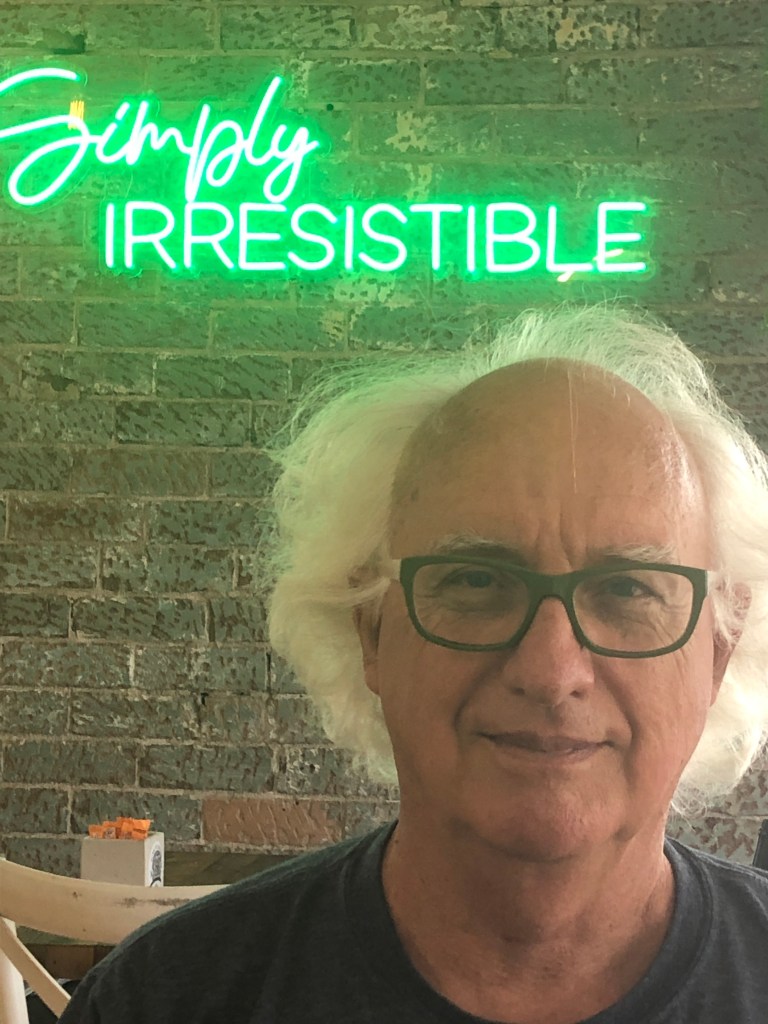
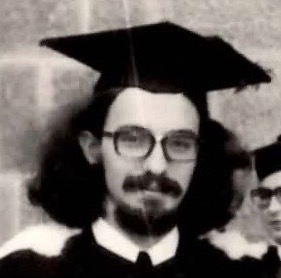
November verse 2: Post-lockdown hair

You wouldn't say it's as delightful
as my unkempt mane in youth,
but call it straggly straw? Just spiteful.
Mynas like it, that's the truth,
and swooping magpies. And the witty
check-out girl at Supa City
called me Einstein. (We get more
than what we pay for at that store.)
Thanks to Covid I've been given
time to think. I once despised
unbarbered hair. Four months sufficed
to help me understand men who were living
back when they were thou and thee,
balding, crested white, like me.
2021. Photo by Penny Ryan
1971

November verse 1.5: Erasure

This year I plan to add to my November exercises some excursions into poetic forms like erasure, cento, n+7, homophony (if that’s a good word for what Toby Fitch does), and others as I think of them. My idea is to make something from the day’s newspaper as source text.

I’m kicking off today with an erasure poem. Here’s one description of erasure poetry, from the poets.org website.

Erasure poetry, also known as blackout poetry, is a form of found poetry wherein a poet takes an existing text and erases, blacks out, or otherwise obscures a large portion of the text, creating a wholly new work from what remains.

You can read more about it, with links to ‘seminal’ works, here. Andy Jackson”s ‘borne away by distance’ is a fine example I have encountered recently (online here).

Here’s my offering, from page 1, column 5 of today’s Sydney Morning Herald.

Or, to type it out and give it a title:

Virtue
________++++++_________Glad
____________________secret
______++_________grace
___________duties, 
________+++++__honest
________+++++__dog.

The  _dependent ____mission
 gains
________++++++____trust or
 courage
________+__Wag   Wag .

Make of it what you will. I love it.

November verse 1

Since 2010, inspired by National Novel Writing Month (NaNoWriMo), I’ve had a project of writing fourteen 14-line stanzas each November. Even though my favourite stanza form is an Onegin stanza and not a sonnet, I called this project LoSoRhyMo – Local Sonnet Rhyming Month.

If you want to read past Novembers’ verses you can click on the LoSoRhyMo tag at the bottom of this blog post. Or you could go to my Publications page and buy one of the six little books made up from these and others of my adventures in verse. All but one of these excellent volumes are self-published. The exception, None of Us Alone, is a kind of Best Of published by Ginninderra Press, and I have to thank Tricia Dearborn for her help in selecting the poems for inclusion in it.

Here goes for 2021

November verse 1: The swimming pools have re-opened

So good to be back in the water.
I like to see it lap the Tiles
as I swim laps or when granddaughter
clamps her lips around her smiles
to keep it out. First thing this morning
in the slow lane, I'm relearning
other bodies aren't a threat,
even unmasked, bare and wet.
After bushfires, epicormic
shoots adorn the trunks of gums
like bloomers on their legs and bums.
Post-lockdown, thanks to hypodermic
double vaccination rates,
we put on hope. We tempt our fates.

A note for readers who noticed the Emily Dickinson reference: for no reason I can think of, the actual Emily Dickinson line (with ‘Miles’ instead of ‘Tiles’) often hounds me like a non-musical ear-worm while I’m swimming laps, so I had to include it here, however awkwardly.

Starting the Iliad

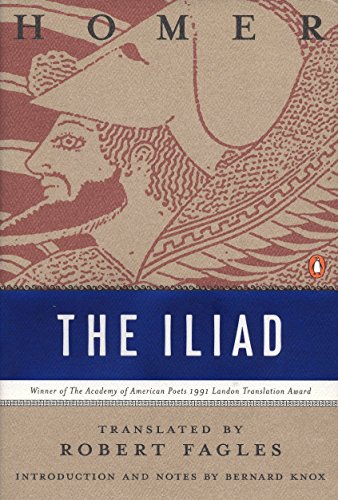
Homer, The Iliad (Translated by Robert Fagles, with notes and an introduction by Bernard Knox, ©1990, Penguin 1998)

It’s more than a week since I finished reading The Prelude, and I’m already missing reading a couple of pages from a classic text first thing every morning. I’ve decided to take on Homer’s Iliad, which definitely fits the definition of a classic as a book that you can’t read for the first time. My copy of Robert Fagles’s translation was a Christmas gift a while back and has been begging for attention from my sagging To Be Read shelf ever since.

This is my first crack at the actual Iliad, but I have read many fragments, versions and variations of it. Here’s a list of the ones I remember:

  • Kingsley’s Heroes, the Argonauts Club and the Queensland School Readers – from my parents, the ABC and primary school respectively – all told stories of Achilles, and almost certainly some parts of the Iliad
  • The Classics Illustrated comic some time in the 1950s
  • Book 2 of The Aeneid, Virgil’s account of the fall of Troy, which I studied in high school
  • Alice Oswald’s Memorial, subtitled ‘an excavation of The Iliad‘, which presents only the deaths from Homer’s poem (here’s a link to my blog post)
  • The 28 minute version in Natalie Haynes Stands Up for the Classics (link to the podcast)
  • Pat Barker’s Silence of the Girls, which tells the story from the point of view of a captured woman (link to my blog post)
  • David Malouf’s Ransom, which I’m pretty sure I haven’t read, but I feel as if I know it intimately from reading and hearing about it.

I made a start on it this morning. So far I’ve read the translator’s note and I’m part way through the learned Introduction by Bernard Knox. Getting excited already. I’ll report back in a month.

Ruby Reads 28: Mostly William Steig

A good friend who has a vast library of children’s books decided it might be time for Ruby to meet William Steig, one of the greats of US children’s literature. Shrek is his best known book, but wasn’t among the swag she lent us. The four books in our swag have been read many times by many children over the decades, and needed to be treated with great care. After we read them to Ruby, we decided to get hold of copies we could keep and manhandle. It turned out that none of the three public libraries I belong to have copies; I’ve ordered them from bookshops, but it will take months for them to arrive from ‘suppliers’.


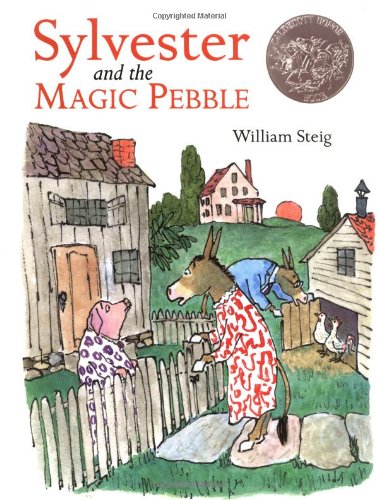
William Steig, Sylvester and the Magic Pebble (©1969, Simon & Schuster 2005)

Sylvester is a donkey who finds a pebble that grants his wishes. As you’d expect, one of his wishes goes terribly wrong. The wonder of this book is that the wrongness isn’t Sylvester’s fault: his wish is a clever response to a real threat, so the pickle it lands him in isn’t a punishment. All the same, the bulk of the book has poor Sylvester trapped and immobile, while his parents search for him desperately.

The suspense is terrible. All the more, because z– not to give anything away – the reader can see just how close Sylvester is to a solution to his problem. Yet the happy end, when it comes, is a huge relief.

We’ve only read this once, but it feels as if it will be part of Ruby’s repertoire for a while. We had to play a game based on it, but Ruby instructed us to make up our own wishes. So the appeal of th story so far seems to be in the idea of a tiny red stone with magic powers.


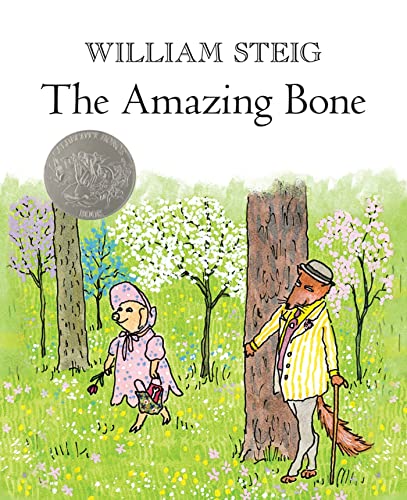
William Steig, The Amazing Bone (©1976, Puffin 1981)

Pearl is a pig who dresses in pink (always a winner with Ruby: ‘Did you know my favourite colour is pink, Poppa?’ ‘Yes, I had gathered that somehow’). One day, relaxing in the woods, she discovers and befriends a magical talking bone.

The bone is much more active than the pebble in the earlier book, and the dangers that Pearl faces are more dramatic: first some masked bandits, and then a suave and hungry fox. The bone scares the bandits off without breaking a sweat, but the fox is another matter.

Needless to say, Pearl and the bone escape the fox and, like Sylvester, Pearl returns to her parents. But whereas the pebble was locked in a safe out of harm’s way, the bone lives on in pride of place in Perl’s household.

I’d hesitated to read this to Ruby because she tends not to like scary stories. But she loved it


William Steig, Doctor De Soto (Farrar Straus & Giroux 1982)

Doctor De Soto is a mouse who is also an excellent dentist. For work health and safety reasons, dangerous animals such as cats are banned from his practice. One day, however, a dapper fox who is in extreme pain from toothache pleads for his help. Doctor De Soto and his wife, who is also his able assistant, reluctantly take pity on the wretched creature and remove the troublesome tooth. But they know, and we know, that the fox is still a fox and will eat them both once he is relieved of his pain. (Spoiler alert: Doctor de Soto and his wife outsmart the fox and stay safe.)

There are comic-terrifying images of the mouse-dentist actually going inside the fox’s mouth, with its huge sharp teeth. Ruby kept her hands at the ready to clamp over her ears each time this happened, but decided over and over to let the story continue: ‘I think they’ll escape,’ she said. I think she had the crocodile’s jaws in Jonny Lambert’s Let’s All Creep Through Crocodile Creek (see below) as a reference point, and so was prepared to trust the story teller not to hand her a steaming pile of tragedy.

As for me, I love Doctor and Mrs De Soto for their courage, compassion, and quick-wittedness. I also love the dapper and unscrupulous fox, who may actually be the same fox who troubled Pearl and the bone, now recovered from what they did to him.


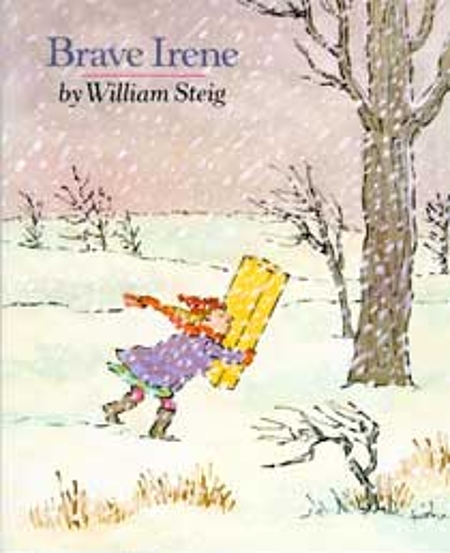
William Steig, Brave Irene (©1986, Victor Gollancz Ltd 1987)

Irene is a young human. Her mother has made a dress for the Duchess, but is taken ill and can’t deliver it in time for the ball. When Irene offers to deliver it for her, the mother can see no other option and reluctantly agrees. So brave Irene struggles on through page after page of blizzard. She rides on the dress’s package like a sled, and when the wind snatches the beautiful dress from her, she struggles on anyway because it would be even harder to return home.

It all turns out well in the end.

I’m not sure Ruby quite got this book, but I’m hoping it will grow on her. Irene is no Disney princess, which is a plus from my point of view, but not so much from Ruby’s.


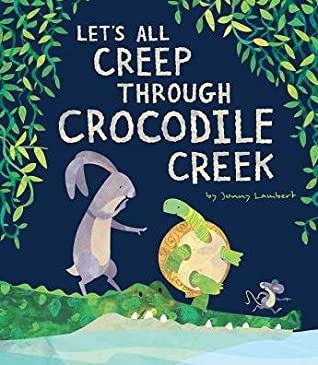
Jonny Lambert, Let’s All Creep Through Crocodile Creek (Little Tiger Press 2019)

I had to read this book to myself in order to understand what I had to do when Ruby said, ‘I’m the mouse, you’re the rabbit and Nanna is the turtle.’

Three animals take a short cut across a creek. The mouse is the leader who knows it’s safe because they have never seen a crocodile in this creek. The turtle is a little bit thick and has to have everything explained to her/him: ‘What does a crocodile look like?’ and so on. The rabbit is all too aware of the dangers and preaches caution.

As they cross the creek, the three adventurers keep seeing things that match up to the mouse’s description of crocodiles: from bumpy, scaly backs to big eyes and very sharp teeth. The mouse pooh poohs the similarities, the turtle asks more questions, and the rabbit understands the danger they are in all too well but her/his cries fall on deaf ears.

It’s a lot of fun. Thanks to the interplay of text and image, we understand what is going on so much better than the characters, so the pleasures of the unreliable narrator can begin at an early age. And in our case, the book is perfect for re-enactments if you have two willing collaborators. It may seem odd to write about this in the same blog post as the William Steig books, but the link is there in the scary teeth.

Brendan Ryan on the Lowlands of Moyne

Brendan Ryan, The Lowlands of Moyne (Walleah Press 2019)

I just read on Twitter that Brendan Ryan has been called ‘a poet of the cow pats’. The poems in this book may not celebrate cow manure as much as Ryan’s earlier ones, but they return to the apparently inexhaustible well of his childhood and adolescence in a large Catholic family on a dairy farm in rural Victoria.

I’ve just reread my three earlier blog posts about Brendan Ryan’s poetry, and it seems that anything I say about this book will be repeating myself. It’s not the poems: they’re fresh and full of discoveries, hugely satisfying. I have trouble finding fresh ways to express my love for them. So here are some samples from previous blog posts.

On Why I Am Not a Farmer:

Brendan Ryan’s poetry in this book is spattered with the shit and blood of work on a dairy farm … My high school Latin teacher said you could tell Virgil was a city man because in the Georgics he speaks of cow manure as disgusting. Brendan Ryan may well be citified, but he doesn’t shrink fastidiously from the details of labour on the family farm. He’s not whingeing. He has no obvious chip on his shoulder. And there’s no self-pity … There is nostalgia perhaps, but it’s not so much a vague yearning for a lost home, as an ache to integrate, to come to terms with experience.

On Paddock in his Head:

Most of the poems here are shot through with … Catholic sensibility: a sense of the holy unceremoniously embedded in the mundane, messy, painful, occasionally joyful, often strenuous, mostly inarticulate everyday life on a small dairy farm in rural Victoria – and in the farm escaped from, remembered, missed, revisited. It’s sacramental but not at all solemn, in fact not at all pious. There are hints of the Benedictine motto laborare est orare, but without religion.

On Travelling through the Family:

Brendan Ryan’s poetry is deeply rooted in place, specifically in what this book calls blister country, in western Victoria. The three books of his that I’ve read return again and again to his early life on a dairy farm, and to what it means to live away from it as an adult. Or they revisit it, even if only to drive through. It’s a rich vein that yields poetry about natural and human landscapes, about cattle and working with cattle, about living in a big Catholic family in a rural community, about masculinity as a son, a brother and a father, about memory and meaning, the powerful interplay of place and identity.

Some poems in The Lowlands of Moyne move away from the farm district. ‘Lajamanu’, ‘Ampilatwatja’ and ‘Home’ go to remote communities in the Northern Territory. ‘The things they carry’, ‘Coconut workers’ and ‘Brick kiln workers’ go to south-east Asia. There are elegies for friends who have died. There are poems that deal obliquely with the headlines: George Pell (‘of a time that haunts / like a rash, of looking the other way’) is on the car radio in ‘Driving to Debating’; ‘Comfort’ has fun with the coincidence that the main detective and his wife in Midsomer Murders are named Barnaby and Joyce (‘Barnaby will be my moral guide’); ‘Intentionality’ celebrates tiny moments of suburban life while Scott Morrison replaces Malcolm Turnbull as Prime Minister.

But the subjects of most of the poems are vivid memories of life and work on the farm, of family and community past and present. Where they are not the direct subject, they provide a vantage point from which to understand and respond to the world. Nothing feels arbitrary or ‘Literary’, everything seems to come from a deeply felt, deeply integrated place.

For example, from page 55:

 When she lowers her nuzzle to the clover / the post chafes her neck, swings against her shoulder./ No more than a wooden spacer tied to a loop /of cyclone wire strung around her neck. /She wears her post as a cross, bears its weight /its annoying shape for the days needed /to corral wayward heifer. /Aversion therapy, designed to stop her twisting /through fences, the lone heifer who discards /the herd to freely wander. The same process /we use to justify drowning kittens in a hessian bag, /whacking crippled calves on the head with an axe /watching the cattle buyer jab an electric prodder /into cows reluctant to climb into the darkness /of a cattle truck. In moments such as these /we separate ourselves from the animals, /realise who we are to detach ourselves /from the fear of the cow we are selling. /Like chaining a dog or dehorning a bull /our aim is to contain something wild, /rebellious, a heifer who will twist her neck /to pull at rye grass on the neighbour's boundary, /her fence post bowing the barbed wire /before she pulls back, snickets of orange fur snagging. /She learns to wear her post /as a sailor wears an albatross. /Other heifers /keep their distance, shun her affliction. /Eeach time she shakes her head at flies /the post knocks against her side like a voice /reminding her to pause before fences.

The word ‘wearing’ in the title sets up a kind of riddle, which is soon resolved, as we are told that the fence post is a kind of neckwear. The first seven lines focus on the young cow’s discomfort and annoyance. The tone is sympathetic, even affectionate. ‘She bears its weight like a cross’ beautifully clarifies the visual image and invokes religious iconography of Jesus on the road to Calvary. But before the reader can leap to an animal-liberationist sense of outrage, the fence post is described as an ‘annoying shape’: the heifer isn’t so much a sacrificial victim as a thwarted rebel, or even a free spirit lumbered with an irritating impediment.

Lines seven to 10 explain the rationale for the fence post: it stops her from wandering away from the herd by making it impossible to go ‘twisting / through fences’.

In a surprising shift in tone, lines 10 to 20 invoke many other ways that humans (‘we’) treat animals in utilitarian ways. The actions listed are harsh, but not wantonly cruel. Interestingly enough, the list starts with the most shocking: the killing of kittens and crippled calves, both of which are arguably horrible necessities. The electric prodder here is used to direct the cows, like a hi-tech whip. Bulls are dehorned to prevent damage in the herd. These actions are dictated by the logic of farming: using the animals for human purposes. We aren’t taken to the hideous, late-capitalism end of the spectrum: no animals dying of heat exhaustion on ships, no featherless cage chickens who never see daylight, not even the actual slaughter of beef cattle with a different kind of electric ‘prodder’.

As I may have mentioned once or twice on this blog, I grew up on a sugar farm in North Queensland. We had a small herd of cattle, which I had a fair bit to do with until I went off to boarding school at 13. I don’t remember us ever doing this to a heifer, or whacking a crippled calf on the head, or even dehorning a bull. But I have certainly chained a dog, I remember vividly the sound of kittens purring in a hessian bag as it was dropped into the river, and I helped in some gruesome births and deaths. So I easily find myself included in the ‘we’ at line 11, which is probably not the case for some readers. These lines aren’t a call to arms against animal cruelty so much as a reflection on the mental ‘process’ (line 10) that has us as farmers (and others) imposing our will on animals. The heart of the poem lies in the lines:

_______-______In moments such as these 
we separate ourselves from the animals, 
realise who we are to detach ourselves 

Many of us are thinking a lot these days about the disastrous results of humans, specifically humans of colonising and capitalist societies, believing we are separate from the rest of nature, seeing it as there simply to be exploited. Here in this gently comic image of an irritated heifer, Brendan Ryan asks us to notice it again with him, and asks if at some level it’s a matter of realising ‘who we are’ – what it means to be human.

In the remaining lines, we are back wth the heifer. The thing is, after centuries of breeding to fit human purposes, domesticated animals still have wills of their own. Our aim is still ‘to contain something wild, / rebellious’. Far from being a passive object of the farmers’ treatment, the heifer still twists through the fence, resists, and finally submits. The fence post, earlier compared to a cross, is now compared to an albatross, which sends me off to Coleridge’s Rime of the Ancient Mariner, especially this:

Instead of the cross, the Albatross
About my neck was hung. 

It’s kind of pretty that the heifer and the Ancient Mariner both progress from wearing a cross to wearing an albatross, from a symbol of supreme sacrifice to a punishment for wrongdoing. But even though the other heifers shun her, our sympathies are definitely with the rebel – it’s hard to think of her as an actual wrongdoer. (I’m reminded of the mixture of sympathy and ruthlessness I used to feel when we put a ‘cone of shame’ on our dog to stop her from biting a sore patch on her rump.)

The last three lines are interestingly anticlimactic. Having delved a little into the deeper implications of the heifer’s treatment, the poem comes back to the observable reality. The heifer carries on, just a little more thoughtful than before. This is ordinary, the poem seems to say; if there’s something amiss here, it’s deeply ingrained in a way of doing things, and we may just have to live with moral complexity.

You might like to find a metaphorical resonance in the poem. Is it perhaps talking about the way we are all constrained by the profit-orientated society we live in. Do we accept with an irritated shrug the limits imposed our wild natures? My two bob’s worth: sometimes a heifer is just a heifer, and that’s enough for me.