Monthly Archives: May 2023

Middlemarch: Final progress report

George Eliot, Middlemarch: A study of provincial life (George Eliot, 1871–1872; Könemann 1997), chapter 73 to end
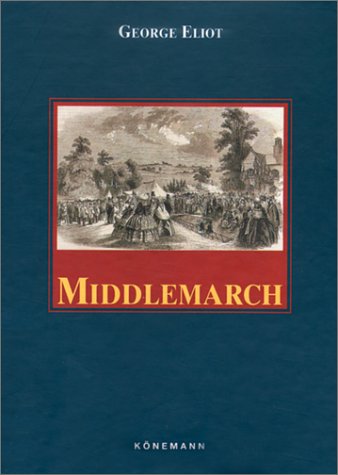
I had lunch last week with a friend from university days, who remembered me going on about Middlemarch back then. Apparently I was very keen on Casaubon’s doomed project, the Key to All Mythologies. My friend assured me that my keenness was ironic, but maybe in his heart of hearts the young me feared he had a lot in common with Casaubon.

As I read the book this time, two things stood out for me that I’m pretty sure I took for granted in 1968 (yes, it’s been that long!).

First, the main characters are very young, and the narrator speaks with the gravity of experience. In 1968 I read a contemporary review that, from memory, began by saying that reading George Eliot’s prose was like lifting the heavy lid of a sarcophagus. I was at a loss to understand what the reviewer meant, but this time around the narrator’s world-weariness is clear as a bell, along with her deep affection for, and possibly even envy of, the young characters.

Second, there’s a serious concern with money. Dorothea can be virtuous because she inherited a small fortune from her mother, and she inherits a further substantial fortune when Casaubon dies. Part of her virtue for most of the novel consists of a commitment to use her wealth well: she sets out to be a decent landlord, but never considers that her wealth is created by the labour of the people she means to be kind to. (Marx was still working on Das Kapital when Middlemarch was published, but George Eliot had almost certainly read Les misérables.) Lydgate comes from gentry, but is determined to make his own way as a doctor and scientist. Rosamond is all about wanting affluence without worrying where it comes from. Fred gets into serious trouble by gambling, and finds his way to responsible work.

These two strands come together brilliantly in the climactic scene at the end of Chapter 83. Dorothea and Will have just declared their love for each other, all doubts as to the other’s integrity dissolved, and they have faced the apparent impossibility of marriage because of the terms of Casaubon’s will:

‘Oh, I cannot bear it – my heart will break,’ said Dorothea, starting from her seat, the flood of her young passion bearing down all the obstructions which had kept her silent – the great tears rising and falling in an instant: ‘I don’t mind about poverty – I hate my wealth.’

(Page 923)

It’s been stated explicitly much earlier that Dorothea could renounce what she has inherited from Casaubon, but only now does she see that as a real option. ‘I hate my wealth’ – the wealth is a kind of prison from which she can escape.

But the word ‘young’ is crucial here. The narrator and the reader know not to take her outburst literally. Will takes her in his arms and, looking into his eyes, she says ‘in a sobbing childlike way’:

‘We could live quite well on my own fortune – it is too much – seven hundred a-year – I want so little – no new clothes – and I will learn what everything costs.’

(Page 924)

So, she doesn’t really hate her wealth as such, only the part of it that constrains her. She’s hardly opting for poverty. The narrator sees that, and so do we, but we can still appreciate the moral leap she is making. And that wonderful final clause, so clearly the cry of a young person – ‘I will learn what everything costs’ – sends echoes back through the whole book. Fred has had to learn the cost of his gambling; Lydgate the cost of marrying unwisely; Rosamond, however briefly, the cost of dalliance. Even some of the older generations learn what things cost – notably Mr Bulstrode whose sins find him out.

I’l miss the world of Middlemarch. I’ll wait a couple of weeks before I plunge into my next slow-read project, in no hurry to have George Eliot’s voice fade from the front of my mind. I’ll give her the last word, from the beginning of the ‘Finale’:

Marriage, which has been the bourne of so many narratives, is still a great beginning, as it was to Adam and Eve, who kept their honeymoon in Eden, but had their first little one among the thorns and thistles of the wilderness. It is still the beginning of the home epic – the gradual conquest or irremediable loss of that complete union which makes the advancing years a climax, and age the harvest of sweet memories in common.

(Page 945)

That’s from Mary Ann Evans, towards the end of a book dedicated ‘To my dear husband’, to whom – scandalously – she was happily not married.
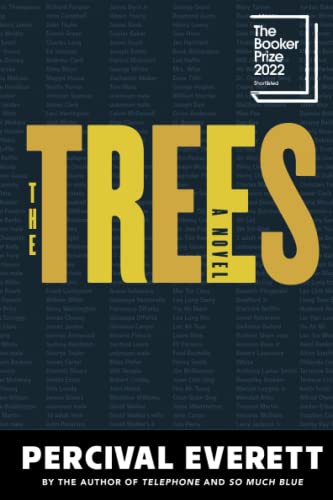
The Book Group and Percival Everett’s Trees

Percival Everett, The Trees: A novel (Graywolf Press 2021)

Before the meeting: This is another excellent book I wouldn’t have read but for my wonderful book group.

The book moves disconcertingly from genre to genre. After a bit of hayseed comedy, it develops into one of those murder mysteries where wisecracking out-of-town detectives arrive to help resentful local cops with an apparently insoluble case. Then there’s some social satire as the detectives, who are both African-American, make fun of the racism endemic in the small town. It’s all good TV detective show fun with an anti-racist bent.

Then the corpses multiply, each murder scene featuring a dead and mutilated White person paired with a long-dead Black person whose clenched fist holds the other’s severed testicles. It could be a highly implausible serial-killer yarn, or a revenge ghost story about racist violence in the USA (against Chinese people as well as African Americans, as the narrative makes unnervingly clear). A magic realist parable, perhaps, in which the murder scenes eerily evoke, and partly reverse, iconic images of lynchings? Or a tale of witchcraft? Certainly one key character identifies as a witch, but then she is also an amateur archivist who has accumulated records of thousands of lynchings from 1913 to the present. Or maybe, as the plot widens, it’s a zombie apocalypse, one whose allegorical meaning lies right on the surface. And Donald Trump makes an appearance. In the end, it’s a genre mash-up that manages – perilously – to stay coherent.

It’s all – to quote Quentin Tarantino from another context – ‘so much fun’. But it doesn’t lose sight of the monstrous historical reality. For example, one chapter consists of a ten-page list of names, in the manner of a spread in Claudia Rankine’s brilliant book, Citizen (my blog post here), and reminding me of Nana Kwama Adjei-Brenyah’s short story ‘The Finkelstein 5’, in which Black vigilantes kill random white people while shouting the names of Black people who have been murdered (my blog post about Friday Black, the book the story appears in, here).

A book that plays around like this with form and genre, that preaches a little, chills a lot and leaves a lot of questions unanswered, has to work brilliantly at the scene level and even the sentence level. This one does. I could give lots of examples, but take the moment at about the one-quarter mark, when the detectives, Ed and Jim, visit the juke joint on the edge of town.

The narrator doesn’t say so, but everyone in the joint is Black. Apart from one character who passes for White and another who is revealed to be Black late in the book, this is Ed and Jim’s first encounter with the town’s Black people. (In classic movie structure the one-quarter mark is the second turning point, often involving a change of location.) When they walk in, everything stops:

Jim and Ed stared back at the staring faces.
‘Yes, we’re cops,’ Jim said loudly. ‘And we don’t like it either. Everybody carry on. Have fun. Break the law, if you like.’
A couple of people laughed, then others. There was the sound of someone breaking a rack at the pool table in back. The dancing and chatting started up again.

(Page 75)

Maybe you have to enjoy writers like Elmore Leonard to be tickled by moments like this. I do and I am. You almost don’t notice that what is being described is a tacit alliance, or at least deep mutual understanding, among the Black characters, whether they’re cops, people relaxing at a bar, or possibly murderers.

What happens as Ed and Jim question the bartenders continues on that note. The bartenders express no sorrow for the racist White men who have been killed, but it’s different with the photograph of the Black corpse whose face has been beaten in. This corpse has appeared at the first murder scene, disappeared, turned up at the second murder scene, and disappeared again. Soon after this scene he will be identified [rest of this sentence whited out, but you can select it with your cursor if you don’t mind spoilers], mistakenly but with great thematic impact, with Emmett Till, whose murder sparked outrage in 1955. At this stage, most of the townspeople, Black and White, believe that this ancient corpse is somehow the murderer.

Jim pulled the picture from his pocket. ‘This is kind of hard to look at, but tell me if you recognise this man.’
The man cringed at the sight. ‘Ain’t nobody gonna recognise him. What the fuck happened?’
Jim shrugged. ‘If this man is alive, we want to find him before that cracker sheriff and his deputies do.’
‘How can that man be alive?’ the bartender asked.
Jim shrugged again.
‘Franklin, come here and look at this.’
The other bartender came over. Jim held up the photo for him to see. ‘Lord, have mercy. What’s that?’
‘That’s a human being,’ Ed said. ‘Somebody did that to another human being. Do you recognise him?’
The second man shook his head. ‘He must be dead. Is he dead?’
‘On and off,’ Jim said.
The man offered a puzzled look.
‘We don’t know,’ Ed said.

(Page 76)

‘Somebody did that to another human being’ lands like a well placed rock in the middle of the hard-boiled humour. It’s a sentence that is to gather force like a snowball in an avalanche. An awful lot of the writing in this book is as impeccable as that.

Why The Trees? Trees don’t feature in the book much at all. But a character sings the Billie Holiday classic (written by Abel Meeropol / Lewis Allan):

Southern trees bear strange fruit
Blood on the leaves and blood at the root
Black bodies swinging in the southern breeze
Strange fruit hanging from the poplar trees

Pastoral scene of the gallant south
The bulging eyes and the twisted mouth
Scent of magnolias, sweet and fresh
Then the sudden smell of burning flesh

Here is fruit for the crows to pluck
For the rain to gather, for the wind to suck
For the sun to rot, for the trees to drop
Here is a strange and bitter crop

Nearer to the meeting (spoiler): On Friday 28 April news broke that Carolyn Bryant Donham, the woman whose accusation led to a notorious racist murder, had died. Percival Everett got there just before Real Life: in the novel Carolyn Bryant, aka Granny C, is the third person to die in the presence of the small Black corpse. It’s unlikely that the Real Life Carolyn Bryant even heard of this book, but the timing!

After the meeting: Tragically I came down with a heavy cold (not Covid) on the morning of the meeting, and spared them all the risk of infection. It’s now a couple of days later and the customary brief account of the evening hasn’t materialised, so all I can say in this section of my blog post is: a) one chap beforehand said he could barely read for tears of laughter, until the book went dark and the laughter dried up; b) on the night itself, the conversation turned – as it does – to identity politics, including pronouns (several of us have gender non-conforming family members or friends); and c) they all had a good time while I stayed home nursing a stuffy nose.

Philip K Dick, Flow My Tears, the Policeman Said

Philip K Dick, Flow My Tears, the Policeman Said (1974, Gollancz SF Masterworks edition 2001)

I have a shelf full of science fiction and fantasy books that I acquired through BookMooch after finding a list of titles recommended as essential reading in the genre. Every now and then I actually read one of those books.

Flow My Tears, the Policeman Said was on that shelf.

I had previously read just one Philip K Dick novel, Do Androids Dream of Electric Sheep? (my blog post here), which was the basis of the movie Blade Runner; and I’d seen at least two other brilliant movies based on his work: Total Recall and Minority Report. So I was expecting a dystopian future, a surveillance state, psychological dislocation and the kind of philosophical rumination that can be hard to tell apart from quasi-psychotic, drug-induced meandering. My expectations were filled to overflowing. The book is like a weird waking dream, put together without much care for logical coherence, and at the same time it feels somehow deeply personal. It’s also masterly story-telling.

Jason Taverner is the phenomenally successful host of a weekly TV show. He’s a six, a genetically engineered superior human, handsome, charismatic and super-smart. Without warning he finds himself in a seedy hotel room, stripped of his identity – all records of him have disappeared from the data banks, there’s no trace of his TV show, and none of his associates recognise him or have any memory of him. Somehow he has to somehow acquire forged ID papers to avoid being picked up by the pols or nats and sent to an FLC (forced labour camp).

The story progresses through a series of encounters with women: his long-term partner in the TV show who is also a six; a woman he has seduced and dumped who unleashes an alien creature on him that (we believe) precipitates his crisis; a disturbed teenaged girl who forges his documents and tries to blackmail him into having sex with her; a spectacular, drugged out dominating woman who lures him into her mansion with disastrous results; a quiet ceramicist who is impressed to be meeting a celebrity. There’s a lot of drugs, a weird death, plenty of sexual titillation (see below), and a final bonkers explanation of what has been happening that an early reviewer described as ‘a major flaw in an otherwise superb novel’, but which I loved. Take your pick.

The book was published in 1974 and set in 1988, so the book’s near future is our fairly remote past, and readers in 2023 have the extra pleasure of clocking how wrong Dick’s predictions were. People fly around the city in self-flying quibbles and flipflaps but have to find a public phone to make a call. They read the news on foldable newspapers. The 70s protest movements have led to the Second Civil War in the USA; the surviving students now live underground beneath the ruins of universities and risk being captured and sent to forced labour camps if caught outside looking for food. The USA is a police state, and everyone is apparently on drugs of one kind or another.

Also dated is a creepy sexual element that seems to function mainly to assert Dick’s status as a pulp writer. Police surprise a middle-aged man in bed with a boy who has a blank expression, and though they are disgusted by the evidence of child sexual assault it is revealed to us that the age of consent has been lowered to 13. There are regular references to pornography and phone network orgies (as close as the book comes to predicting the internet). Two of the main characters are brother and sister who live in an incestuous love-hate relationship and have a son who is away in boarding school. And so on.

While the sexy stuff might assert the book’s pulp status, there’s also a strand of references to ‘high culture’. The book’s title, as the main example, comes from the 16th century lute song ‘Flow My Tears’:

Each chapter begins with a couple of lines from the song, so that it becomes in effect a sound track, a melancholy, orderly counterpoint to the characters’ panic and disorder. Sadly I didn’t look it up until I started writing this blog post, so it didn’t work that way for me.

Taverner’s progress is marked by his encounters with women. Meanwhile he is pursued by men, chief among them Police General Felix Buckman, who listens to classical music, and whose tears flow when he decides to seal Taverner’s fate. He has one of the weirdest scenes in the book, when he stops his quibble at a refuelling station and, out of the blue, has an intimate (but not sexual) moment with a Black stranger, which Dick later said was a mystical reference to a scene from the Christian Bible (Acts 4:27–38) – which he hadn’t read.

Having said that the book seems not to care for logical coherence, I should give you an example of the writing, which is always measured, even flat. Here is the moment, about a third of the way into the book, when Buckman makes his first appearance. His personality is revealed to us deftly – his easy authority, his cultural sophistication, his kindness. At the same time, details of the book’s world are filled in effortlessly, including the presumably intentionally comic bodily reference in ‘sphincter’ and the unintentionally jarring distinction between an ‘officer’ and a ‘female officer’:

Early in the grey of evening, before the cement sidewalks bloomed with nighttime activity, Police General Felix Buckman landed his opulent official quibble on the roof of the Los Angeles Police Academy building. He sat for a time, reading page-one articles on the sole evening newspaper, then, folding the paper up carefully, he placed it on the back seat of the quibble, opened the locked door, and stepped out.
No activity below him. One shift had begun to trail off; the next had not quite begun to arrive.
He liked this time: the great building, in these moments, seemed to belong to him. ‘And leaves the world to darkness and to me,’ he thought, recalling a line from Thomas Gray’s ‘Elegy’. A longcherished favourite of his, in fact from boyhood.
With his rank key he opened the building’s express descent sphincter, dropped rapidly by chute to his own level, fourteen. Where he had worked most of his adult life.
Desks without people, rows of them. Except that at the far end of the major room one officer still sat painstakingly writing a report. And, at the coffee machine, a female officer drinking from a Dixie cup.
‘Good evening,’ Buckman said to her. He did not know her, but it did not matter: she – and everyone else in the building – knew him.
‘Good evening, Mr. Buckman.’ She drew herself upright, as if at attention.
‘Be tired,’ Buckman said.
‘Pardon, sir?’
‘Go home.’

(Page 77)