Monthly Archives: Jan 2025

Philippe Jaccottet’s Pilgrim’s Bowl

Philippe Jaccottet. The Pilgrim’s Bowl (2001, translated by John Taylor 2015, Seagull Books 2022)
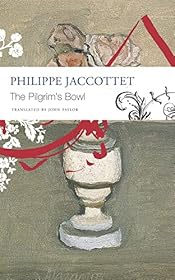
This is a short book by a poet who is completely new to me about an artist whose work I have never seen. It was a Christmas present, a book I wouldn’t have dreamed of buying for myself. I enjoyed it a lot.

Philipe Jaccottet (1925–2021) was a Swiss poet who wrote in French, one of only fifteen writers to be included in the canon-defining Bibliothèque de la Pléiade while still alive. His English-language Wikipedia page is extremely sparse, but French-language Wikipedia is a different thing altogether. His expansive page there includes this (as rendered by Google Translate):

Jaccottet writes that the poet is no longer ‘the Sun […] nor a son of the Sun; nor even a Torchbearer or a Lighthouse’ (he therefore rejects the image of the ‘poet-prophet’): the task of this ‘anonymous one […] dressed like any other anxious man’ is to try to ‘paint’ the world ‘so wonderfully’ that his work would be able to distract Man from his fear of death.

In The Pilgrim’s Bowl, Jaccottet turns his attention to the work of Italian painter and printmaker, Giorgio Morandi.
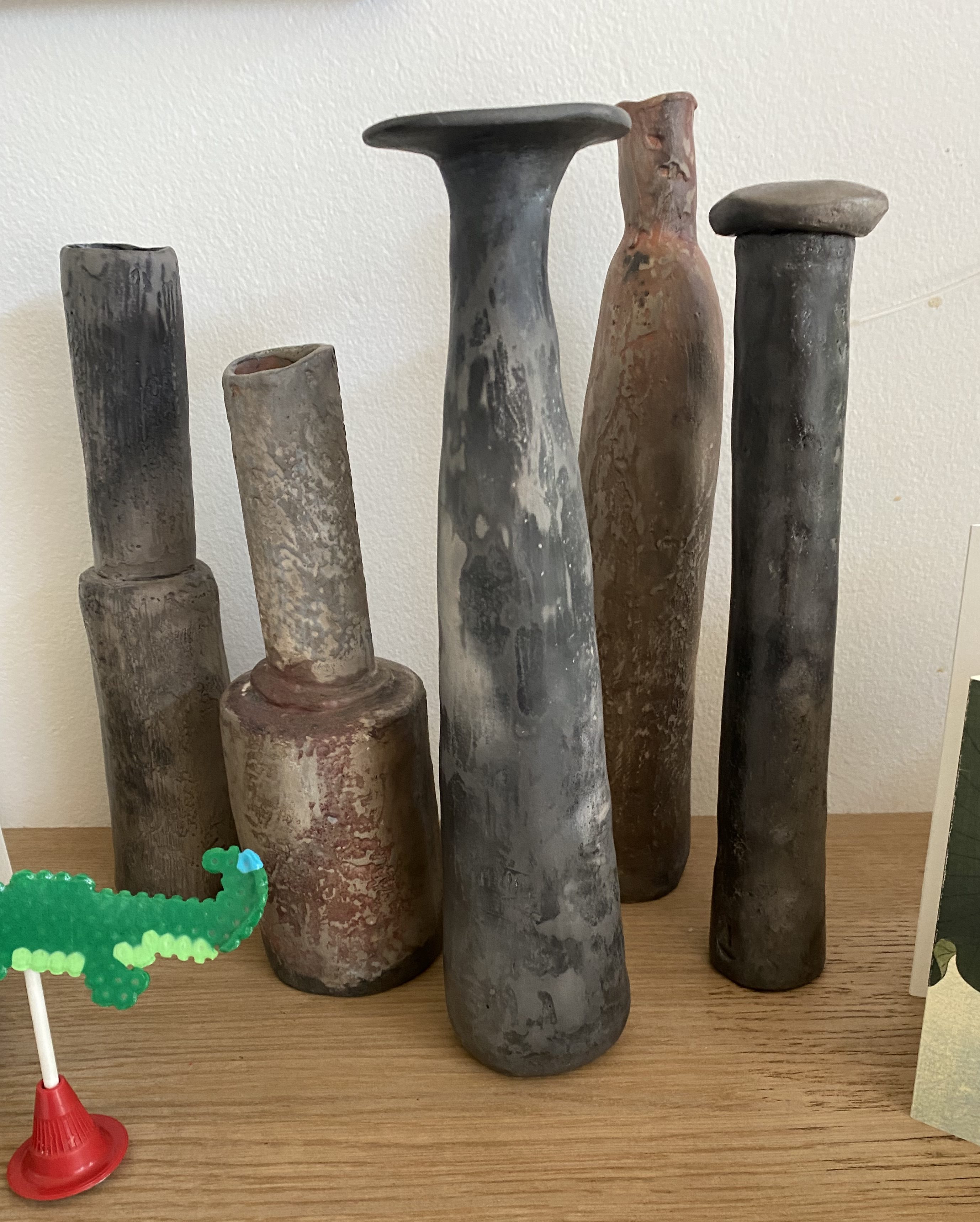
Though I’ve never seen an original work by Morandi (1890–1964, Wikipedia page here), I know a little more about him than about Jaccottet. The Emerging Artist did a beautiful drawing when at Art School that was copied, she told me, from one of his paintings, and the great cartoonist Jenny Coopes, taking up ceramics late in life, created a set of Morandesque objects which we now own. (For the benefit of readers who don’t know Morandi’s work: this photo does not capture anything of its austere, dreamlike simplicity.)

After reading this 66-page book with its dozen images, I feel that I know – and like, and admire – both these people much better. Jaccottet does not present as an art critic. He is not out to describe Morandi’s paintings, but to explore what he calls the enigma of the powerful emotion they create in him. This is from page 3:

It is not surprising to be stirred by the view of a mountain, the ocean, a sunset, a big city; or by the imminence of a war, the nearness of a face, the death of a close friend. And therefore, consequently, by their representation in a painting, poem or narrative. But with this artist: those inevitable three or four bottles, vases, boxes and bowls – what apparent insignificance, what ludicrousness or nearly so (and all the more so when the world seems about to collapse or explode)! And how can you dare claim that such a painting speaks a more convincing language to you than most contemporary works of art?

He approaches the enigma from different angles, ‘as naively as possible’. Which means he goes down tangent after tangent, and somehow enriches our sense of Morandi’s work.

Noting that Pascal and Leopardi were Morandi’s favourite authors, he spends fascinating pages discussing them. He riffs on snippets of Morandi’s biography. He catches fleeting associations – remembering that Morandi would let dust settle on his paintings, he thinks of the ‘sandman’ and then of the Sleeping Beauty, which gives him a way of talking about ‘the unchanging light bathing Morandi’s paintings’:

It never sparkles or glares, never flashes or breaks through clouds, even if it is clear as the dawn, with subtle rose and grey hues, this light is always strangely tranquil.

There is much more about that light.

He quotes from Dante and Plato. Acknowledging that he may be a little over the top, he compares Morandi’s still lifes with Vermeer’s paintings of young women and even with classic Madonnas.

Page 47* is the first half of the book’s most tangential tangent. Page 46 ends with this beautifully distilled paragraph:

The more Morandi’s art progresses in terms of deprivation and concentration, the more the objects in his still lifes take on, against a background of dust, ash or sand, the appearance and the dignity of monuments.

Then, abruptly, a parenthesis takes up the next two pages, beginning:

One night not long ago, I remembered a stopover in Ouazazarte, Morocco – rose-coloured sands and yellow sands, windy gusts blowing distant sand up into flags, and those fortress-like buildings shimmering in the excessive light without being mirages, yet barely distinct from the ground on which they had been built – why was this brief glimpse-like vision one morning so poignant?

I don’t know how to summarise this work. You have to be there. Let me just say that when I do get to see a painting by Morandi, I will come to it with eyes, heart and mind prepared.


I wrote this blog post on Wadawurrung land, overlooking the Painkalac River. I acknowledge their Elders past and present.


My blogging practice is to focus on the page of a book that coincides with my age, currently. As The Pilgrim’s Bowl has fewer than 77 pages, I’m focusing instead on my birth year, ’47.
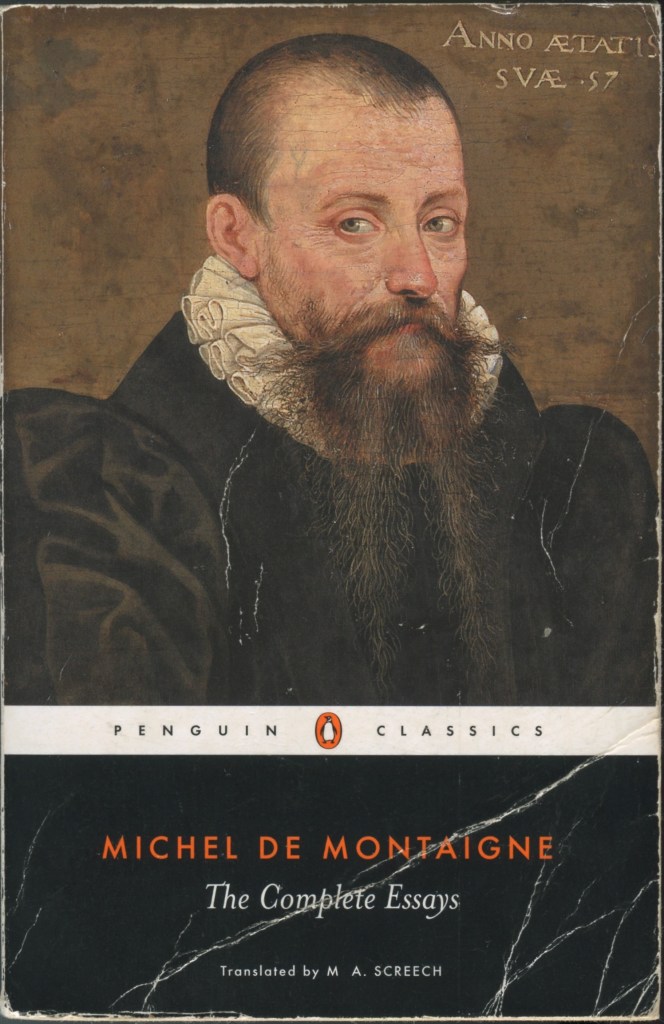
Montaigne final progress report

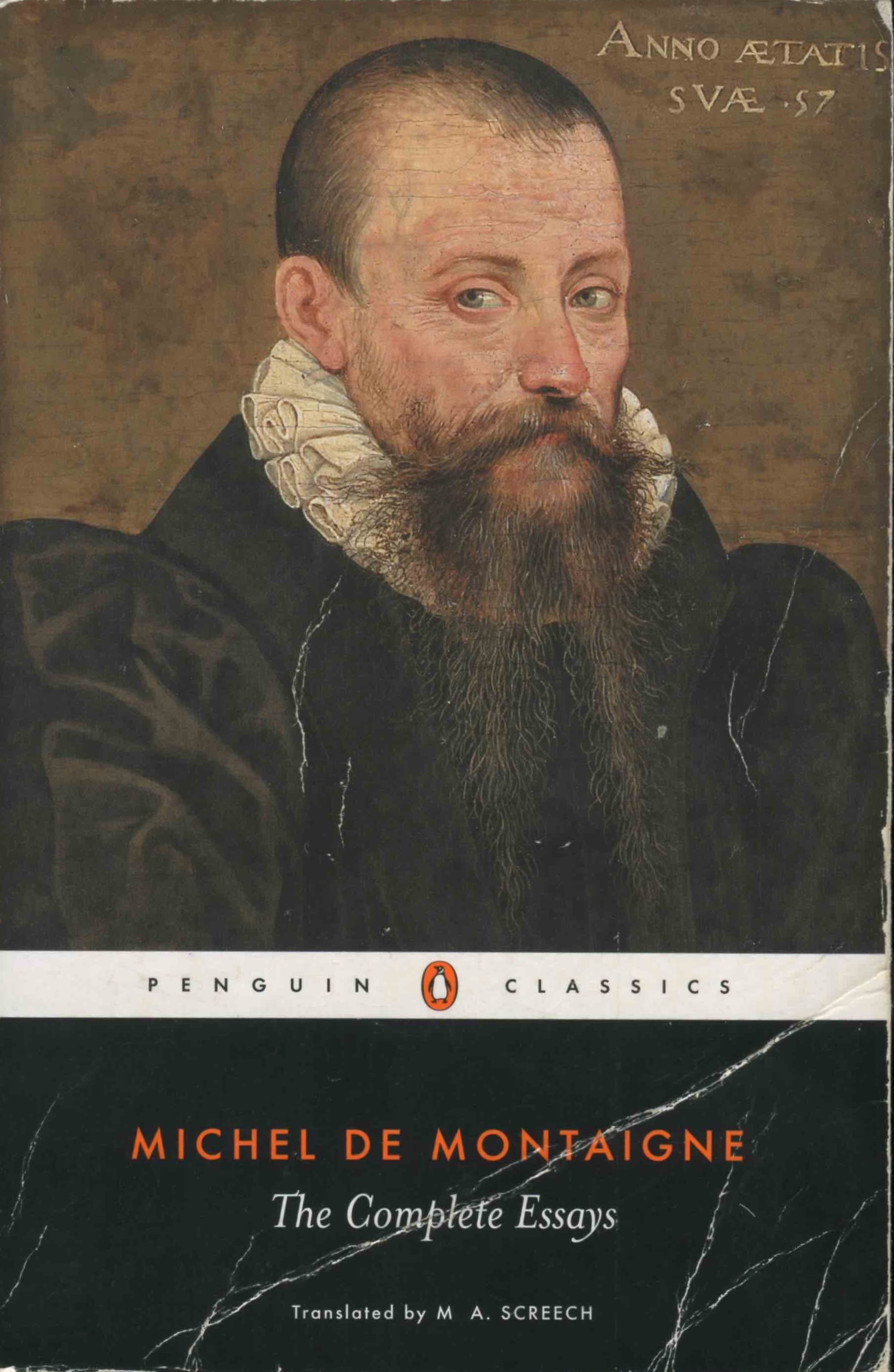
Michel de Montaigne, The Complete Essays (Penguin Classics 1991, translated by M. A. Screech)
– part way through Book 3, essay 10, ‘On restraining your will’ to end Book 3, essay 13, ‘On experience’

M A Creech, whose translation and edition of Montaigne’s essays I’ve been reading, a few pages a day, since March last year, says that it’s a mistake to read the Essais simply as a collection of separate pieces of varying lengths. There is a shape, he argues in his introduction, and in the final essay, ‘On experience’, Montaigne arrives at the place to which all the preceding essays have been heading.

Given the immersive task he has undertaken – not just finding English equivalents for Montaigne’s French, but also translating and identifying the sprinkling of quotes from Latin (and the few from Greek and more recent languages) – I’m not going to say he’s wrong, but I can’t see that he’s right.

But the final essay does read as a culmination, and a farewell. Its central argument is about the relationship between reason and experience, more specifically the limits of reason and the importance of giving full value to experience. There’s a long section in which he describes the mental process by which he comes to think of his extremely painful kidney stones as a good thing: the pain is intermittent so he has time to digest the experience; when the pain goes, its absence is delightful; unlike other diseases, this one doesn’t interfere with his normal life – he can spend up to ten hours in the saddle at the height of an attack; it’s an illness ‘which does not leave us guessing’ – that is, we know what it is, there’s no need to hunt for diagnoses; etc. At the end of the section, just as one is admiring his brilliant feat of mind over matter, he acknowledges that at least in part he has been whistling in the wind (page 1243):

With such arguments, both strong and feeble, I try … to benumb and delude my power of thought and to put ointment on its wounds. And tomorrow, if they grow worse, we will provide other escape-routes for them.

And then, in a twist that makes his writing as fresh now as it must have been nearly 500 years ago:

Since I wrote that, the slightest movements which I make have begun to squeeze pure blood from my kidneys again. Yet because of that I do not stop moving about exactly as I did before and spurring after my hounds with a youthful and immoderate zeal. And I find that I have got much the better of so important a development, which costs me no more than a dull ache and heaviness in the region of those organs. Some great stone is compressing the substance of my kidneys and eating into it: what I am voiding drop by drop – and not without some natural pleasure – is my life blood, which has become from now on some noxious and superfluous discharge.
Can I feel something disintegrating? Do not expect me to waste time having my pulse and urine checked so that anxious prognostics can be drawn from them: I will be in plenty of time to feel the anguish without prolonging things by anguished fear.

This last essay goes for more than 60 pages. It’s intensely personal: Montaigne describes his not entirely admirable table manners. He goes into some detail about his habits around eating, sleeping, excreting, walking, dressing, a little about sex (which at the ripe old age of fifty-something is largely in his past). He argues that what is customary for any individual or community should be maintained – it would be as wrong for a Frenchman to drink his wine undiluted as for a German to dilute his! And when he hits full stride he argues brilliantly that pleasure is a good thing, that life itself is a good thing. This is from page 1258:

When I dance, I dance. When I sleep, I sleep; and when I am strolling alone through a beautiful orchard, although part of the time my thoughts are occupied by other things, for part of the time too I bring them back to the walk, to the orchard, to the delight in being alone there, and to me. Mother-like, Nature has provided that such actions as she has imposed on us as necessities should also be pleasurable, urging us towards them not only by reason but by desire. To corrupt her laws is wrong.

And a little later:

What great fools we are! ‘He has spent his life in idleness,’ we say. ‘I haven’t done a thing today.’ – ‘Why! Have you not lived? That is not only the most basic of your employments, it is the most glorious.’ – ‘I would have shown them what I can do, if they had set me to manage some great affair.’ – If you have been able to examine and manage your own life you have achieved the greatest task of all. Nature, to display and show her powers, needs no great destiny … Our most great and glorious achievement is to live our life fittingly. Everything else – reigning, building, lying up treasure – are at most tiny props and small accessories.

How can I not love this man? All of this, of course, is interwoven with quotations from the ancients, with whom he sometimes argues robustly, even his beloved Socrates. Wonderfully, he ends with four lines from Horace:

Frui paratis et valido mihi,
Latoe, dones, et, precor, integra
Cum mentis, nec turpem senectam
Degene, nec Cythara carentem.

Which, drawing on M. A. Screech’s translation and explanatory footnote, I can paraphrase as: ‘Grant me, O Apollo god of healing, that I may enjoy the things I have prepared and, with my mind intact, I pray that I may not degenerate into a squalid old age, in which the lyre is wanting.’

It’s not age or death he feared, but the prospect of an old age when he was incapable of singing.


This blog post was written on Gadigal-Wangal land, on a fully hot, humid day when even the birds are silent. I acknowledge the Elders past, present and emerging of Gadigal and Wangal of the Eora Nation.

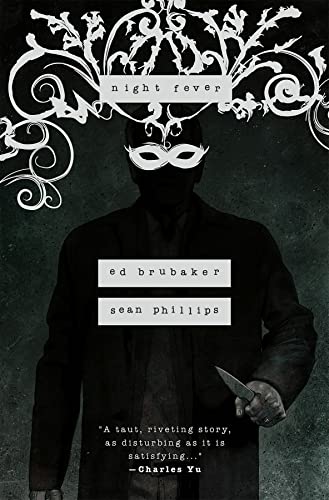
Brubaker and Phillips’s Night Fever

Ed Brubaker, Night Fever (art by Sean Phillips, colors by Jacob Phillips, Image 2023)

I’m steadily making my way through the pile of books I was given as Christmas presents. As always the pile includes some excellent comics. We Are Not Strangers is one (blog post here). Night Fever, which could hardly be more different, is another.

Ed Brubaker and Sean Phillips are a prolific team of comics makers. I’ve read their work in a number of genres – Hollywood noir, fantasy spy stories, and horror, though none of them is necessarily constrained to just one genre. Unlike most of their comics, Night Fever is a stand-alone story rather than part of a series. It shares the physical and moral darkness of their other work.

The narrator-protagonist, Jonathan Webb, is a sales rep for a US publishing company who once dreamed of being a writer. In Europe for a book fair, filled with a sense of failure, he crashes a decadent upper-class party, an orgy like the one in Stanley Kubrick’s Eyes Wide Shut, by pretending to be someone whose name he spotted on the guest list.

As every genre reader knows, it’s dangerous to borrow someone else’s identity, especially if they have access to a boundary-pushing party attended by the super rich. Sure enough, Jonathan is caught up in all manner of terrible things: alcohol, drugs and debauchery as you’d expect, but then there’s larceny, murder and an exploding police car. As one caption puts it, ‘Crime is the biggest high in the world.’

But crime doesn’t pay. Or does it? Will he ever find his way back to mundane life, his loving wife and their two sons? And if he does, will he be content? Or will he be haunted by this week when he threw off the shackles of decency? And who is the stranger Rainer who leads him deeper and deeper into the darkness?

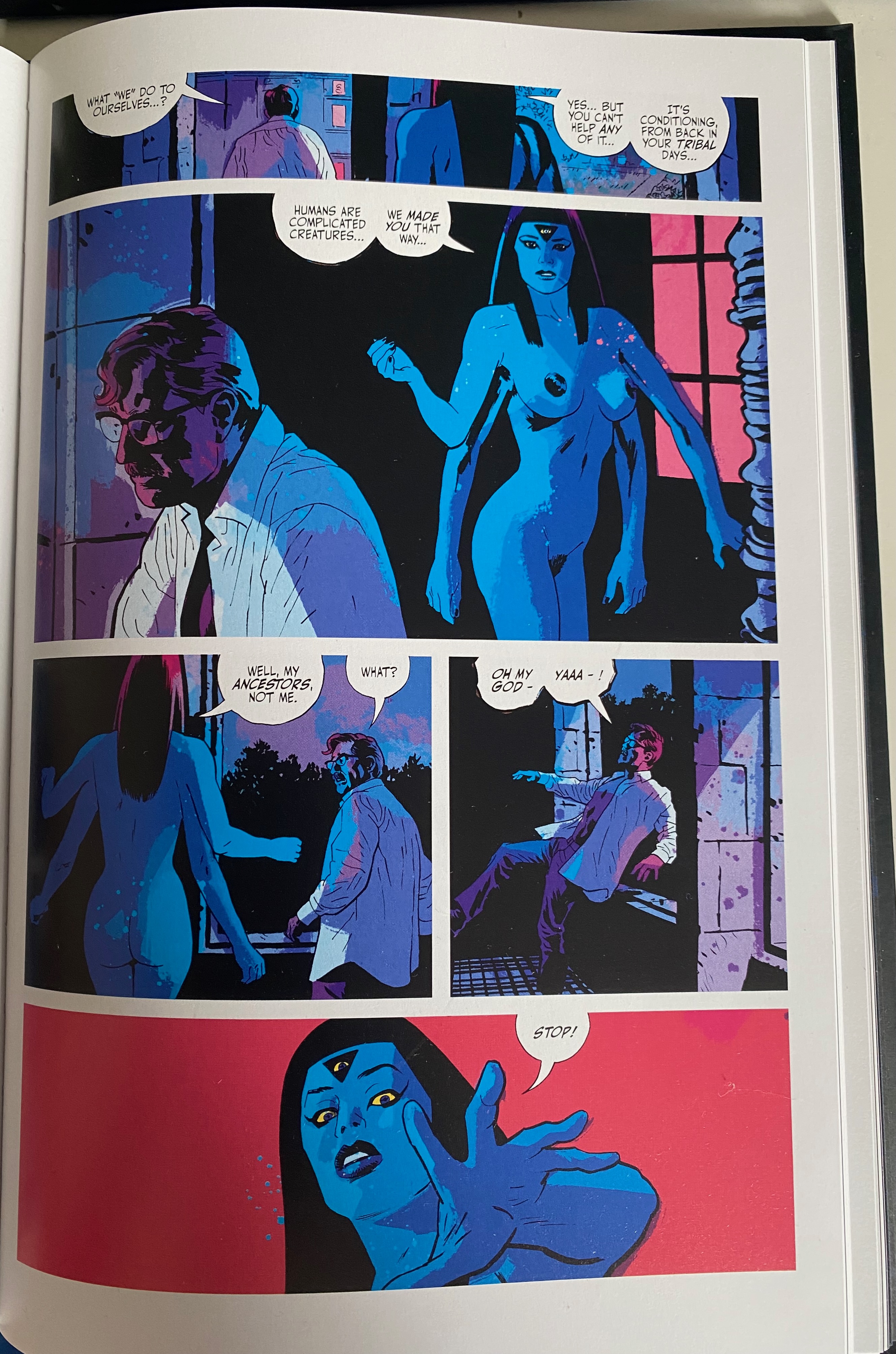
Page 77* give you a taste of the art work, including the dark palette. It’s also an example of the genre-blending quality of Brubaker and Phillips’s work. Jonathan has visited a bar where he’s been warned, too late, not to drink anything because, ‘They put a lot of stuff in the cocktails here.’ There follow a number of pages where black space represents things he doesn’t remember of the night, and the rest is full of jumbled images of debauchery and violence. This page is a moment of calm, in which the owner of a voice that has been speaking to him from the shadows is revealed:

Ah, you might think, this is where the story gets really weird. The next thing Jonathan remembers is being back at a party. Maybe she saved him, maybe he landed on something soft, maybe it was a drugged hallucination. It wouldn’t surprise me to learn that at this stage, Dave Brubaker himself wasn’t sure which way the story was heading. Another blue, four-armed person turns up a couple of pages later, and someone tells Jonathan that the aliens ‘have been coming more often lately … getting ready for the end’.

This page is also a good example of the objectifying treatment of women’s bodies that is my main dislike of comics like this. Thankfully this is the only naked woman in the book. I guess if you have scruples about pervy comic-book misogyny, you can always slip in a naked woman by giving her a second pair of arms and making her a godlike alien. (A full-frontal naked man turns up later, but he’s dead and not the least bit sexy.)

To quote my gift-giving son about another Brubaker-Phillips book, ‘It’s popcorn.’ It’s quality popcorn.


The first horror story I ever heard was told me by a Bundjalung woman – and it was much scarier than anything in Night Fever. I wrote this blog post on land of the Gadigal and Wangal people. I acknowledge their Elders past and present who have told stories here and cared for this land for millennia.

Michael Crane’s Urban / Landscape / Ordinary Lives

Michael Crane, Urban & Landscape / Ordinary Lives (Flying Island Books 2024)

Michael Crane organised Australia’s first poetry slam in 1991, and has been a significant figure in Melbourne’s spoken word scene ever since – or at least until his Wikipedia entry was updated, which may have been more than a decade ago until I added this book.

So this is a book of poems by a spoken word practitioner. That is, they are mainly poems for the stage rather than the page.

There are three sections: ‘Urban’, ‘Landscape’ and ‘Ordinary People’.

The first is mostly snapshots of life in inner-city Melbourne, with a couple of Brisbane scenes thrown in. The ones I like best are list poems. Take ‘The Emerald Hill Library Story Time’, for example, which lists many aspects of Clarendon Street that make it a tough place to live, and ends with the tenderness of storytime for children at the library; or ‘Hi Rise’, made up of fifteen couplets, each describingsomeone we take to be a resident of the building:

Marlene ran a tight ship
as her cat, Teddy, rubbed its tail between her legs.

Many visitors arrive unannounced,
cheating the security system.

Harry lives with his father
who he must treat like his child to manage him.

‘Landscape’ mostly moves out to the country, though in its final poem, ‘Life in the Big Smoke’, a poet from the country (a version of Michael Crane in his post-Wikipedia days?) visits the city, has a number of (non-)encounters and goes back ‘to where he came from’. This poem is enriched by being read in this context: its string of encounters echo similar ones on the first section, but the emotional impact is the opposite. In particular, it pairs nicely with ‘White noise of an urban landscape’, which begins, ‘The country life was not for him.’

The third section, ‘Ordinary Lives’ begins with ‘Introduction’, which lays out the section’s rationale, including this:

I find most people more interesting than me, but my job
is to document their success and failures, the moment of glory or
the times when they are alone without love.

The poems in this, as in all three sections, are mostly direct, straightforward, unassuming. They tend to name things without analysis or commentary. On the page they tend to be flat, but my sense is that they would come alive with the gesture, tone of voice and facial expression of spoken-word performance. They’re also mostly on the depressive side – fewer moments of glory, more times alone without love.

My arbitrary blogging practice, especially with books of poetry, is to focus on the page that corresponds to my age, which is currently 77. Page 77 of this book features one of the ‘Ordinary People’ poems, ‘On a plane to Cuba’:

This seems straightforward on a quick read, but there’s something unsettlingly off kilter about it – which may be another way of saying it couldn’t have been written by AI.

After I wrote that last sentence, I decided to test my assertion, and asked Chat GPT to write a poem about a woman who is about to leave her sleeping husband and go to Cuba. I’ve given the result at the bottom of this post, so as not to confuse it with real poetry*.

ChatGPT was worryingly proficient. But what it produced demonstrates that a mechanical aggregator just can’t do what a human poet can. The AI product has sharp images of the room, gives reasons for the woman’s choice of Cuba, and even has a last line that works, but none of it is surprising.

Michael Crane’s poem, on the other hand, pretends to be offering us clichés, but undermines them all the way. In the first ten lines, even as the poem evokes the woman’s yearning for elsewhere, it subtly, almost invisibly, distances itself from her. Does anyone in touch with reality think of Paris, City of Lights, as dimly lit? And though I’ve been in London when it snowed, surely ‘snow-covered footpaths’ is an idiosyncratic way of evoking that city. Her version of Cuba is similarly idiosyncratic. The ‘almost naked dancing women’ are a cliche from Rio rather than Havana. She seems to be vague about Cuban history. What is the ‘long war’? Maybe she’s thinking of Fidel wearing military fatigues? And, in the most telling split between the woman’s perspective and the poem’s, why does she find memories of war attractive?

In lines 13 to 15, the woman’s situation becomes clear:

She is going to catch a flight to Cuba 
as soon as she leaves the snoring man
who kidnapped her youth, ransomed her beauty.

Perhaps the woman’s idea of a ‘long war’ has come from the implied long time that she has been unhappily married. The definitive final line is hinted at here.

The poem continues to tread a fine balance between sympathy and – what is it? – scepticism. She takes no responsibility for whatever has one wrong with the relationship: there’s no indication that the man has been abusive – just that she took up with him when young and beautiful, and now feels the loss of those qualities (and we understand that she means he held her beauty to ransom rather than, what the words literally mean, that he paid a price to set it free). The feeling of loss is real, but we (or is it just me?) can’t help suspecting that she lacks insight.

Crucially, it’s her dreams that she packs along with supremely impractical clothing, and the last line strikes a superbly ambivalent note: all through the poem she has been dreaming of Cuba, and she heads off to ‘the songs of endless summer nights’, but really it might as well be dim Paris or snowy London, because what matters is

days filled with the absence of him.

It’s not ‘She’s Leaving Home‘, with it’s brilliant empathy for both sides of the departure, but then what is?


I finished writing this blog post on land of Gadigal and Wangal of the Eora Nation, as the sun was breaking through clouds after a day of heavy rain. I acknowledge the Elders past and present who have cared for this land for millennia.


*ChatGPT’s poem:

She watches him sleep, his chest rising and falling,
the steady rhythm of a man who never saw her breaking.
The sheets tangled around him,
a quiet fortress she once called home.
But now it feels like a cage.

Her bags are packed, a quiet rebellion in the corner.
Cuba waits—its colors, its heat,
its freedom, a place where she can feel her pulse again.
She runs her fingers over the window sill,
tracing the outlines of a life she no longer wants.

She should wake him, say goodbye,
but the words are too heavy,
the goodbyes too worn.
Instead, she steps lightly,
a ghost slipping past the threshold.

She breathes in the cool air of the morning,
the world opening wide in front of her.
And with every step,
she leaves behind the woman she used to be.

Josh Tuininga’s We Are Not Strangers

Josh Tuininga, We Are Not Strangers (Abrams Comicarts 2023)

In December 1941, about 127,000 Japanese Americans lived in the continental USA. After the attack on Pearl Harbor and the declaration of war on Japan, about 120,000 of them, of whom about two-thirds were U.S. citizens,  were forcibly relocated and incarcerated in concentration camps.

This is not a secret history. In The Karate Kid, the young boy comes across references to the deaths of Mr Miyagi’s wife and child in a camp. Star Trek actor George Takei famously spent a number of years in one of the camps as a child, as told in the documentary To Be Takei (2014) and in They Called Us Enemy, a comic he co-wrote that was published in 2019. David Guterson’s novel Snow Falling on Cedars (1994) and the Scott Hicks film made from it refer to the incarcerations. (There are more examples on Wikipedia – I’ve just mentioned the ones that ring a bell for me.) Various presidents have expressed regret over the episode.

Josh Tuiininga’s comic comes at the subject as it played out in Seattle, from the point of view of Sephardic Jews. It begins in December 1987, with the funeral of Marco, the narrator’s grandfather. The funeral proceeds according to Sephardic tradition, but a lot of people turn up that the narrator has never seen before. Curious, he asks them how they knew his grandfather so well, and the story emerges.

During World War Two, as the Sephardic Jews of Seattle were watching the horrific events unfolding in Germany, they were suddenly confronted by a terrible injustice closer to home, as Japanese friends and neighbours were rounded up, their businesses forcibly closed, and their lives disrupted.

Page 77* marks a turning point. Marco and his family have just heard a radio announcement that ‘the Japanese population in America are potentially dangerous’ and are to be relocated or suffer criminal penalties:

In the first image on this spread, the woman walking away with a dismissive gesture is Marco’s mother, who has successfully escaped Germany and been smuggled into the USA by way of Canada. Her gesture signifies contempt for the edict, which she has just said is like what happened to Jews under the Nazis (not a view the comic necessarily endorses, but it shows the basis for solidarity between Jews and Japanese).

The left-hand page appears to portray Marco and his family as helpless bystanders. Evidently the Japanese American Citizens League recommended compliance for pretty much the reasons that Marco gives here: to resist would be to undermine the war effort. But the wordless right-hand page suggests something else. It is followed by two more wordless pages, a full page drawing of Marco at his desk beneath a clock showing one-thirty, and then a single drawing of a lit window in a dark suburban scape. We don’t now what these images mean precisely, but they remain as a question as the rest of the story unfolds: there’s a Passover sermon at the Synagogue; one of the Japanese children has her white friends turn against her; the Central District of Seattle is filled with remnants of Japanese presence; there are glimpses of life in the camps, and on their closure signs of persistent anti-Japanese sentiment are everywhere.

But it turns out that what Marco was doing in his study that night was working out how he could safeguard his friends’ homes and businesses. When they return home, he gives them envelopes full of rent money, deeds and all that is needed to help restore their lives. And he has done it for as many families as he could manage. Only at his funeral do his own family find out what he has done.

‘Why did he keep it a secret?’ the narrator asks, and over a series of images that show Marco with family and his Japanese fishing friend in 1945, 1953, 1968, 1979 and then (his empty chair at the family table) 1987, the captions read:

Maybe he thought he would get into trouble.
Perhaps he wished he could have done more.
Or, maybe …
… he just wanted to forget all about it …
… and spend his time on more important things.

That last line is a caption between two images, one of Marco as an old man at a family meal, the other (echoing images from early in the book) of him and his Japanese friend fishing together and laughing.

It’s a powerful story, elegantly told in a palettte of mainly warm browns and pale blues. Though a note at the beginning assures us that this is a work of fiction, it also says the story is based on ‘the oral histories of many’.

It’s pure coincidence that I have read this so soon after Yael van der Wouden’s novel The Safekeep. That novel hinges on the loss of property and livelihood by Jews in the Netherlands under the Nazis – so that those who did return from camps found their houses occupied and their personal items now used by strangers. That almost certainly happened to many Japanese-Americans, but this story demonstrates how it could have been different, and that in at least some cases it was different.


It would have been impossible for me to read this book without thinking of North Queensland. My grandfather was a police magistrate. The family story is that because he had learned Italian he was brought back from his posting in Brisbane to supervise the internment of Italians during World War Two. That internment was on a smaller scale – 5000 men were taken from their families to internment camps in New South Wales and South Australia, and at least twice as many were put to work in remote areas building roads and rail, and working in mines. Many were naturalised Australian citizens.For the most part, only the adult men were taken away: the results were devastating for Italian farmers, and families were disrupted.

The ABC ran a story in 2020 marking the 75th anniversary of the end of the War (link here). The excellent Babinda museum tells one man’s story – a man who, characteristically, downplays the difficulties he faced. The official archival records of the internments have been made public for some decades now, but as far as I have been able to tell the many stories – from Innisfail, Ingham, Garradunga, Daradgee, Boogan – have yet to be told.


I wrote this blog post on land of Gadigal and Wangal of the Eora Nation, peoples whose own stories of mistreatment in times of war have yet to be fully told. I acknowledge the Elders past and present who have cared for this land for millennia.

Yael van der Wouden’s Safekeep at the book club

Yael van der Wouden, The Safekeep (Viking 2024)

Before the meeting: As I mentioned in my post about Lai Wen’s Tiananmen Square, this book has a general strategy in common with a number of other books I’ve read recently – a personal relationship as way of drawing the reader into a big public event.

In this case the personal relationship is sexual. At times I felt like averting my eyes, as if I was intruding on intensely intimate moments.

The book is told from the point of view of a woman who lives alone in the house she has kind-of inherited from her parents in postwar Netherlands. Her brother actually owns of the house but lets her live in it. The story kicks off when he pressures her to allow his girlfriend to stay with her while he goes away for work. The two women are very prickly with each other at first: the owner is prim and obsessive about neatness, and her begrudged guest is an apparently easygoing woman of the world. Bit by bit we realise that the narrator is constantly aware of the other woman’s bodily presence, and eventually the dam breaks and there are many pages of enthusiastic sex.

There are hints along the way that something else is going on. In the book’s very first paragraph, for instance, the uptight host finds a ceramic shard buried in the cottage garden. She recognises a piece from her mother’s precious dinner set, but has no memory of any of those plates ever having been broken. This is the first of a number of hints that there is something about the house that has never been acknowledged. More telling perhaps are childhood memories of strangers knocking at the door and her mother ignoring them.

I guess I knew from the beginning roughty where things were going, and even during the scenes of passion I kept waiting for the other shoe to drop. It does drop, most satisfactorily.

I loved this book.

After the meeting: I wasn’t alone in loving it.

This book group, the majority of whose members are Lesbian, has long had a rule that no Lesbian books were allowed unless the Lesbianism was incidental to the plot. Well, this book smashed that rule to bits, but it did it with such grace and integrity and good writing that not even the Chief Rulemaker minded.

Though we all loved the book, we spent some time discussing the ending. Was it too neat, too quickly achieved, too much out of character? It’s hard to blog about endings but I don’t think I’m giving too much away if I say that two possibilities were raised in defence: first, it’s like the endings to Shakespeare’s comedies – you’re not meant to think this could really have happened but it’s satisfying to imagine it as a kind of justice; second, the apparent change of personality involved could be accounted for by the transformative power of the passionate sexual experience – certainly it was transformative, and maybe even more so than obvious. If you’ve read the book, you’ll have opinions of your own.


The Book Club met on Gadigal land, and I wrote the blog post on land of Gadigal and Wangal of the Eora Nation, land that has never been ceded. I acknowledge the Elders past and present who have cared for this land for millennia.

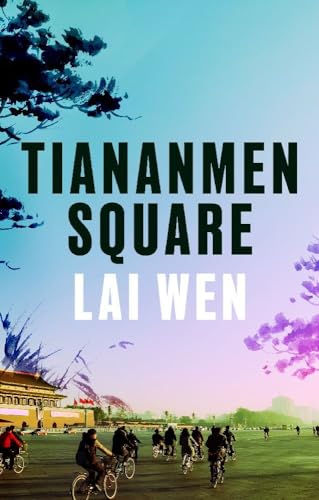
Lai Wen’s Tiananmen Square at the book club

Lai Wen, Tiananmen Square (Swift Press 2024)

Before the meeting: On page 411 of this novel, the narrator-protagonist, a student at Beijing University, posts an application for an exchange program at a Canadian university. She goes to one of the bars on campus, and then:

The enormity of what I had done began to sink in.

A few pages later, sensations flash across her mind ‘like lightening’, and a few pages further on there is a lake, where a turquoise glow

expanded outward as far as the eye could see, and beyond, the tawny ridges of ochre mountains were flushed at their foothills with dark streaks of wild grass and moss.

The fact that I am brought up short by such moments (enormity is something big and horrible, not something like a major life decision; lightning is what flashes; if the water goes as far as the eye can see, how can you describe what can be seen beyond it?) may say more about me than about the book, but I’m pretty sure if I’d been gripped by the narrative I wouldn’t have noticed them.

If the pseudonymous author is who she says she is, this is an autobiographically inflected story of a young woman caught up in the student uprising in China in 1989. As such, it commands respect.

By coincidence, it shares something of a strategy with three other books I have read recently, telling a story with a tight focus on relationships and then widening out into a huge public event or issue. Kairos by Jenny Erpenbeck is a tales of a toxic relationship between an older man and a young woman that culminates in the fall of the Berlin Wall. The Song of Achilles by Madeline Miller is an adolescent boy-boy love story that becomes a retelling of The Iliad. The Safekeep by Yael van der Wouden (blog post coming soon) is a steamy Lesbian romance that turns out to be about what happens to property confiscated from Jews in the Netherlands under Nazi occupation.

In this book, the personal story lacks a clear or interesting focus. The death of a beloved grandmother, an embittered mother, a pallid teenage sex life (though the first unsatisfactory moment of sexual intimacy is vividly realised), and quirky university encounters all compete for attention. And the otherwise powerful Tiananmen Square narrative is undermined by giving the final moment to a twist that’s silly, and not in a good way.

I am glad I’ve read the book. It’s an important story. It’s just that at the sentence level, which is where I mostly live in books, it trudges.

After the meeting: We discussed this book along with The Safekeep. It was the Book Club’s celebratory end-of-year meeting with exchange of gifts in a restaurant, so discussion of the books was perhaps less extensive than usual.

All but one of us had read the whole book, and given that our meeting had been postponed twice because of illnesses, it was clear that it was lack of interest rather than lack of time that had led to the one non-completion. Generally, the completers all agreed that it was too long – it would have been a better book without a lot of the earlier family stories. Not everyone was convinced by the implied eye-witness status of the author – that claim is undermined by what looks like an arbitrary and ahistorical invention at the very end (and who knows, but we might yet be proved wrong in judging the final moment that way).

The book’s strongest advocate felt (if I remember correctly) that the complex mundaneness of the family story and the story of teenage emotional entanglements was the book’s strength: it took the events of Tiananmen Square in 1989 away from the abstract an showed them irrupting onto the lives of otherwise ordinary people. While others agreed that that’s how the book works, they (we!) felt that the narrator was peripheral to those big events, so her account of them doesn’t add substantially to what we already know from other sources.

We enjoyed The Safekeep a lot more.

2024 End of year list 5: Blog traffic

In case you’ve had just about enough of my end of year lists, be reassured: This is the last one, and I don’t expect you to read it – it’s mainly so I’ll have a record.

Here are the posts that attracted most clicks on my blog in 2024:

  1. Claire Keegan’s Small Things Like These (October 2023, 1618 clicks)
  2. The Book Club and Paul Murray’s Bee Sting (April 2024, 775 clicks)
  3. Ocean Vuong’s Time is a Mother (March 2023, 744 clicks)
  4. Ellen van Neerven’s Throat (July 2020, 625 clicks)
  5. Mary Oliver’s Twelve Moons (January 2019, 597 clicks)
  6. Anne Enright, The Wren, the Wren, the book club, page 77 (March 2024, 533 clicks)
  7. Trent Dalton’s Boy Swallows Universe (July 2019, 412 clicks)
  8. Robert Alter’s Psalms (September 2020, 365 clicks)
  9. Jenny Erpenbeck’s Kairos and the Book Club (April 2024, 364 clicks)
  10. Rebecca Huntley’s Italian Girl (April 2022, 357 clicks)

Ocean Vuong’s book was at the top of the list for most of the year, and then news of the movie of Small Thiings Like These sent a lot of clicks to that post. Shirley Hazzard’s The Transit of Venus dominated the list for years, but has now dropped off altogether. Mary Oliver, Ellen van Neerven and Robert Alter are the stayers.

One more bit of nerdiness. Here’s WordPress’s list of my all-time top ten posts. Apart from changing positions, the main change from last year is that Philip Larkin got bumped by Claire Keegan:

  1. Travelling with the Art Student (November 2014, 3558 hits)
  2. The Book Group and Shirley Hazzard’s Transit of Venus (June 2018, 2721 hits)
  3. (Re-)reading Kevin Gilbert’s poetry (April 2012, 2430 hits)
  4. Mary Oliver’s Twelve Moons (April 2020, 1841 hits)
  5. Bran Nue Dae (January 2010, 1805 hits)
  6. Mary Oliver’s House of Light (April 2020, 1784 hits)
  7. Claire Keegan’s Small Things Like These (October 2023, 1676 hits)
  8. The book group’s Harp in the South (February 2011, 1431 hits)
  9. Jasper Jones at the Book Group (May 2010, 1352 hits)
  10. Contemporary Asian Australian Poets (June 2013, 1236 hits)

That’s it. Thanks to everyone who has contributed to those statistics. Some of you I know IRL, some I’ve met through email etc, some only in the comments section, some I know only as anonymous clickers. I’m happy that you’ve visited the blog. Come again.

2024 End of Year List 4: Books

The Emerging Artist now keeps a record of the books she reads so she can easily whip up a list for me at this time of year. Here are her favourite reads from 2024 in her own words (links to LibraryThing pages or, at her request, to my blog post when there is one):

Fiction

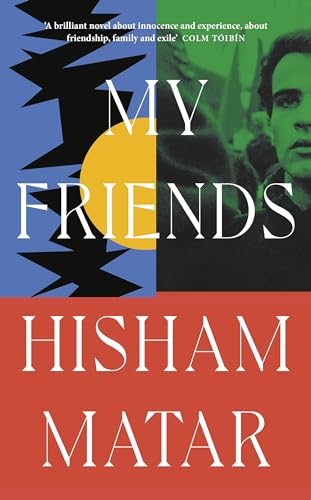
Hisham Matar, My Friends (Viking 2024)
I enjoyed Hisham Matar’s previous books, though I wasn’t enthusiastic about them as they often felt repetitive, and more like unreliable memoir than fiction. My Friends continues to draw on his life, but it feels more like a story that examines what it is to be an exile in a time of radical upheaval.

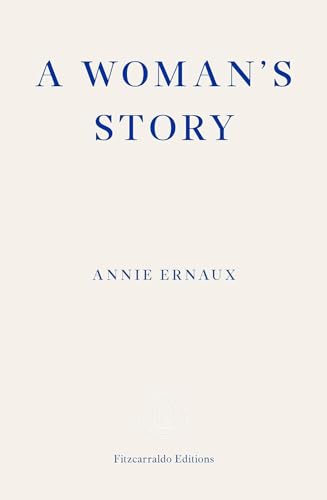
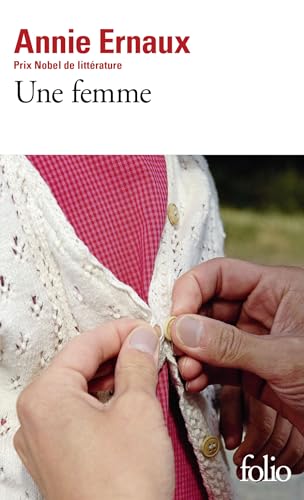
Annie Ernaux, A Woman’s Story (translated by Tanya Leslie 1991, Fitzcarraldo Editions 2024)
I read Annie Ernaux’s The Years before I got to this very slim volume, so I came to it with high expectations. I wasn’t disappointed. In such concise prose Ernaux describes the details of one woman’s life, and iin doing so conjures up a broader world.

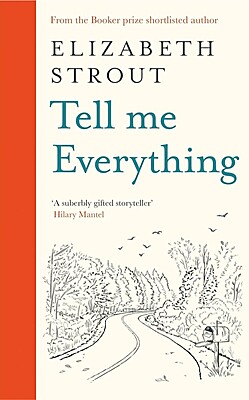
Elizabeth Strout, Tell Me Everything (Viking 2024)
This continues the stories of a number of Elizabeth Strout’s characters, bringing them together as they deal with death, ageing, love and lust. She writes with wit and kindness.

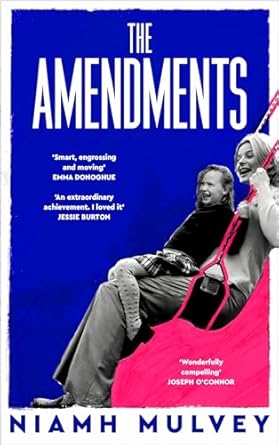
Niamh Mulvey, The Amendments (Picador 2024)
A new Irish writer for me. I hope she writes a lot more. This is a generational feminist tale about a family of women, dealing with the way issues of reproductive rights governed women’s lives before Ireland shifted from Catholic dominance – a shift made because of women demanding change.

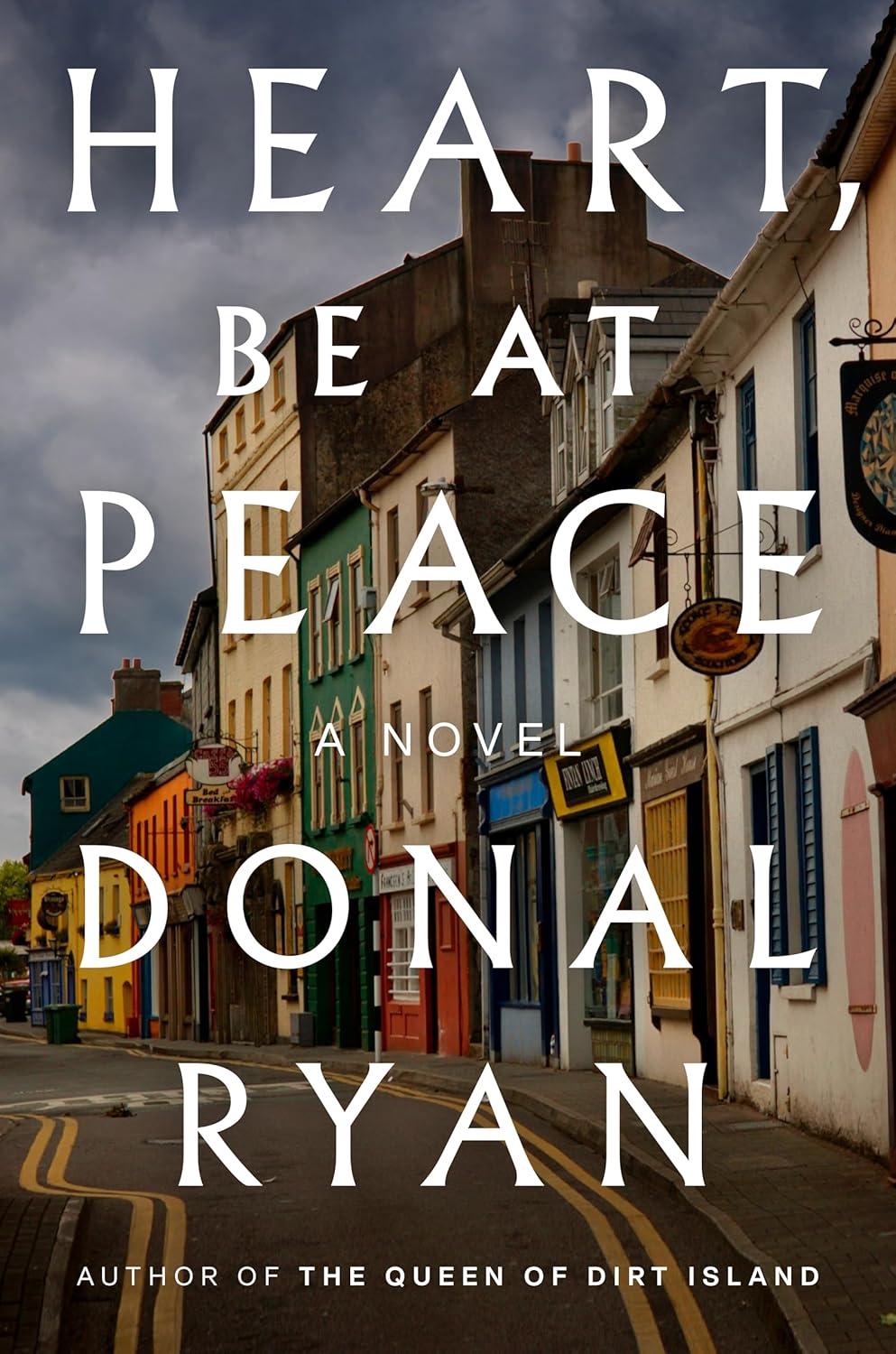
Donal Ryan, Heart, Be at Peace (Doubleday 2024)
I had read two previous Donal Ryan novels, both of which I loved. In this one he continues to create the sense of Irish village community and disunity in the context of the Celtic Tiger and its collapse. Told from multiple perspectives, it builds a picture of complex relationships.

Non fiction

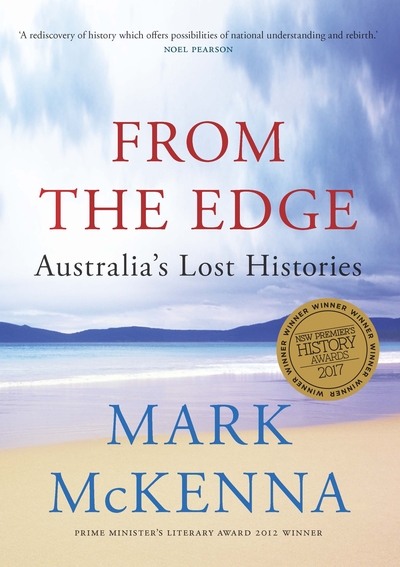
Mark McKenna, From the Edge: Australia’s Lost Histories (Melbourne University Publishing 2016)
Published in 2016, this is still a wonderful way to learn about First Nations and settler interactions. McKenna writes compelling history. These relatively short pieces include the pearl industry in Western Australia, the Barrup Peninsula petroglyphs and mining, early failed attempts to establish a colony in northern Australia, and the brutality of the Palmerston goldfields in north Queensland. They are written with a focus on First Nations agency, and they attempt to understand how colonisation played out in each specific time and place.

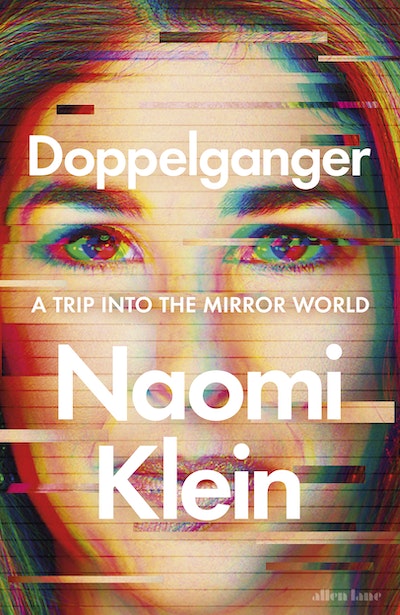
Naomi Klein, Doppelganger: A Trip into the Mirror World (Penguin 2023)
I’m still reading this, having put it down during the US elections as much of what Naomi Klein describes was playing out in the headlines. It’s a fascinating enquiry into the nature of truth, and the way fakery has become entrenched in political discourse.

From me

I can never pick a favourite or best book. My favourite is always the one I’m reading right now, unless the one I’m reading is the book I hate most in the world. Some highlights of 2024 were:

  • Montaigne’s Essays: I have read four or five pages most mornings since the beginning of March, and will have finished the book in a couple of weeks. He has been a great person to start the day with (apart from the Emerging Artist, of course)
  • Blue Mars, the final book in Kim Stanley Robinson’s Mars trilogy has finally made it from my TBR shelf, and it was a most satisfactory experience
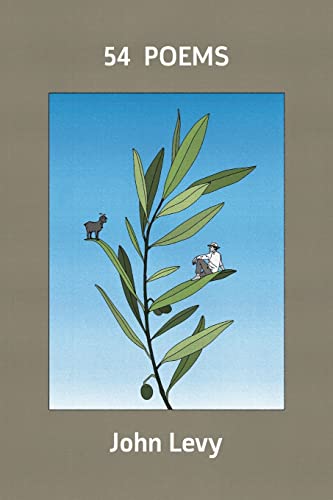
  • the poetry of John Levy, who showed up in my comments to share his enthusiasm for Ken Bolton’s poetry, and offered to send me a copy of his own book. I’m so glad I accepted the offer
  • I read more of Annie Ernaux: if ever I write a memoir, I hope I can manage to be at least slightly Ernauxian

To get all nerdy, I read:

  • roughly 83 books altogether (counting journals but only some children’s books)
  • 34 novels
  • 21 books of poetry
  • 5 comics
  • 6 books in translation – 3 from French (counting Montaigne’s Essays), 1 each from German, Japanese and Chinese
  • 7 books for the Book Group, whose members are all men
  • 12 books for the Book Club, where I’m the only man (two of them to be reviewed after tomorrow night’s meeting)
  • counting editors and comics artists, 45 books by women, 46 by men
  • 3 books by First Nations writers, and
  • 11 books by other writers who don’t belong to the White global minority.

And the TBR shelf is just as crowded as it was 12 months ago.


Happy New Year to all. May 2025 turn out to be a lot less dire than it’s looking at the moment, and (to repeat my wish from last year) may fossil fuels at last be left in the ground. May we all keep our hearts open, our minds engaged, and may we all talk to strangers.

2024 End of Year list 3: Theatre

I went to the theatre just nine times this year, and it wasn’t hard to choose the three I enjoyed most. Leaving aside the splendid Flying Fruit Fly Circus, I pass over in silence what children’s theatre I saw, and I won’t name the play that turned out to have been written by a HSC student who had watched a lot of Derry Girls.

So here they are: Jodie Comer in the National Theatre Live production of a play that had its premiere years ago at Sydney’s minute Stables Theatre; a new production of an epic play about Sri Lanka, just as alive and engrossing in the Carriageworks as it was in the Sydney Town Hall; and a stunning one-woman piece in which Vaishnavi Suryaprakash tells a story in Bharatanatyam dance.

  • Prima Facie (Suzie Miller 2019, seen in the National Theatre Live production)
  • Counting and Cracking (S. Shakthidharan and Eamon Flack 2019, seen in Belvoir’s production at the Carriageworks)
  • Nayika a Dancing Girl (Nithis Nagarajan and Liv Satchell 2023, at Belvoir Street Theatre)

Next: books!