Monthly Archives: Feb 2025

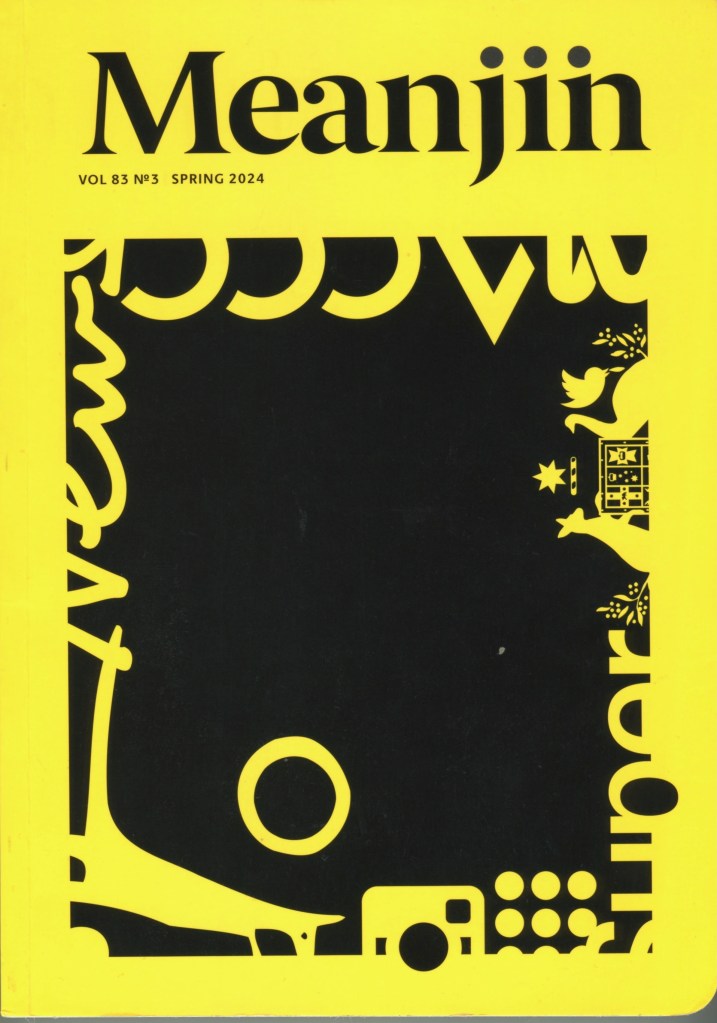
Journal Catch-up 28: Meanjin Spring 2024

Esther Anatolitis (ediitor), Meanjin Vol 83 Nº 3 (Spring 2024)
(links are to the Meanjin website: some but not all of them are available to non-subscribers)

This Meanjin was published before King Charles visited Australia last year. This means Jenny Hocking’s blistering essay, ‘Remnants of Empire: Racism, Power and Royal Privilege‘, appeared well before Lidia Thorpe’s headline-grabbing outburst. The article, which amply fulfils the promise of its title, made me feel much more sympathy for the outburst.

There’s a lot else in this issue to delight and enlighten. Some pieces that I think of as necessary. Apart from Jenny Hocking’s, three that stand out are:

  • Well, It’s Beautiful Country, Really –‘ by Mike Ross. Each issue of Meanjin these days begins with a ‘Meanjin Paper’ – an essay by a First Nations person. In this one Mike Ross, an Olkola man who has been at the vanguard of land rights for the people of Cape York for three decades, talks about finding meaning in Country, about constantly learning
  • Lucky for Some‘ by Frank Bongiorno on the 60th anniversary of publication of Donald Horne’s The Lucky Country, which I read in tandem with Nick Bryant’s recent piece on the same subject in the Guardian
  • Jews, Antisemitism and Power in Australia‘ by Max Kaiser, which parses the way accusations of antisemitism have been used to silence important points of view. This article may have been published six months ago, but it feels hyper-relevant today as actual vicious antisemitism and and dubious accusations of antisemitism are ramping up.

There are pirces that may not be necessary, but they’re fun and educative all the same:

  • an interview with poet Ellen van Neerven (which I enjoyed even though it focuses on a book of theirs I haven’t read)
  • a scathing annotation of the Australian Constitution from First Nations writer Claire G. Coleman

There is some excellent fiction, including these two:

  • The Feeling Bones‘ by Lucy Nelson, which tells a family’s story in terms of their bone ailments; and incidentally informs me that ‘sits bones’, a term for the backside I had only heard used by my Pilates instructor, actually comes from the world of dance.
  • The Other Doctor‘, in which James Salvius Cheng finds a way to talk about the exhausting business of being a medical practitioner without coming across as a whinger.

A trio of memoirs call out to each other about disability, religion and sexuality:

  • Love Is Worship by Adrian Mouhajer, about finding peace in a Muslim family as a queer person
  • Dirty Things, Precious Things by Anna Hickey-Moody, about Catholicism, disability, family violence
  • Crocodile by Ella Ferris, brilliant, complex piece of writing which includes experiences of Aboriginality and disability

There are some excellent poems. The ones I warm to most (not necessarily the ‘best’) are:

  • ‘Mothertongues’ by Grace Chan, which begins ‘My son is starting to speak / in English’ and later, as she tries to teach him some Chinese, ‘our tongues stumble / in synchrony’
  • ‘The Women’s Shelter’, a rhyming sonnet by Claire Watson, in which a woman creates a knotted rag rug from strips of old bedsheets

There are things that aren’t my cup of tea: a smart-alecky essay on satire, an incomprehensible poem, some ‘experiments’, a review or two that convinced me not to read the books under consideration. But I can imagine each of those finding readers who will delight in them


I wrote this blog post on the land of Gadigal and Wangal of the Eora nation. I acknowledge their Elders past present and emerging, and gratefully acknowledge their care for this land for millennia, as once agin the sun is rising later in the mornings, and spiders are making their presence known in the bushes.

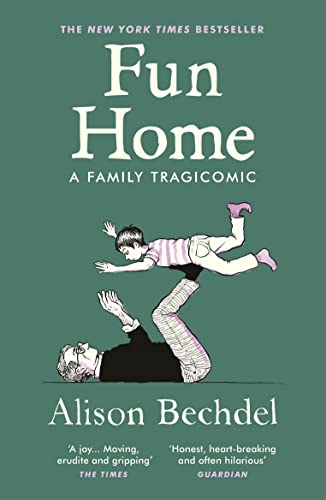
Alison Bechdel’s Fun Home

Alison Bechdel, Fun Home: A Family Tragicomic (©2006, Vintage 2022)

A Lesbian friend of mine was surprised, even shocked, when I told her I hadn’t read Alison Bechdel’s Fun Home. I got the impression that she revised her opinion of my literacy on the spot.

Well, now I’ve read it and can hold my head high again.

Alison Bechdel is probably best known for the Bechdel test, which serves as a rough guide to a movie’s level of misogyny or otherwise: does it have more than one named female character? do they have a conversation about something other than a man? According to Wikipedia, Bechdel modestly attributes the invention of the test to a friend and ultimately to Virginia Woolf. But it still bears her name.

She is also celebrated as a creator of comics, in particular her long-running series Dykes to Watch Out for. The strip ran for 25 years, from 1983 to 2008, with a brief revival on Trump’s first election. Fun Home, published in 2006, brought her a wider readership. The book was a New York Times bestseller. It has been adapted into an audio-book and an award-winning stage musical, with a movie reportedly on the way. It has been included on college reading lists and Wikipedia currently lists eight attempts at having it banned in the USA. When I bought my copy the shop assistant enthused that she had studied it at university, but then read it again later for pleasure.

It’s a memoir. At first, it seems like a familiar tale of living with a tyrannical father who is emotionally distant and given to violent rages. But it develops into something much more complex and interesting. Towards the end of the first chapter, Alison and her brother are at Sunday Mass with their parents, and a caption reads: ‘He appeared to be an ideal husband and father.’ This is an ordinary observation about middle class families putting on a front for public display, but then there’s a second caption: ‘But would an ideal husband and father have sex with teenage boys?’ And that question hangs there unexplained for many pages, as the narrative takes us back to the family’s early life, the father’s part-time work as a mortician (which is where the book’s title comes from – it was the Bechdel children’s nickname for the undertaker’s business), and Alison’s own portrait of the artist as a young woman.

So the narrative moves back and forth, entwining the narrator’s own story as a nerdy young person with OCD who comes out as a Lesbian, with the unfolding story of her father’s sexuality, and the way it all plays out in the family. Key moments are hinted at, passed over as offstage events, and then revisited in detail much later, so that there’s a constant sense of something not yet revealed.

It’s a bookish family, and a bookish book, shot though with literary references. The story of Daedalus and Icarus forms a major thread, beginning with a father-and-daughter game of ‘airplane’ as seen on the cover – ‘In the circus acrobatics where one person lies on the floor balancing another are called ‘Icarian games’.– and leading in the final pages to a revisionist interpretation of the myth, applied to this story. Camus gets a look-in, and so do Proust, Oscar Wilde, F. Scott Fitzgerald, Wallace Stevens, J. D. Salinger, A Chorus Line, Henry James, Shakespeare of course, and more – none of them incidental to the plot.

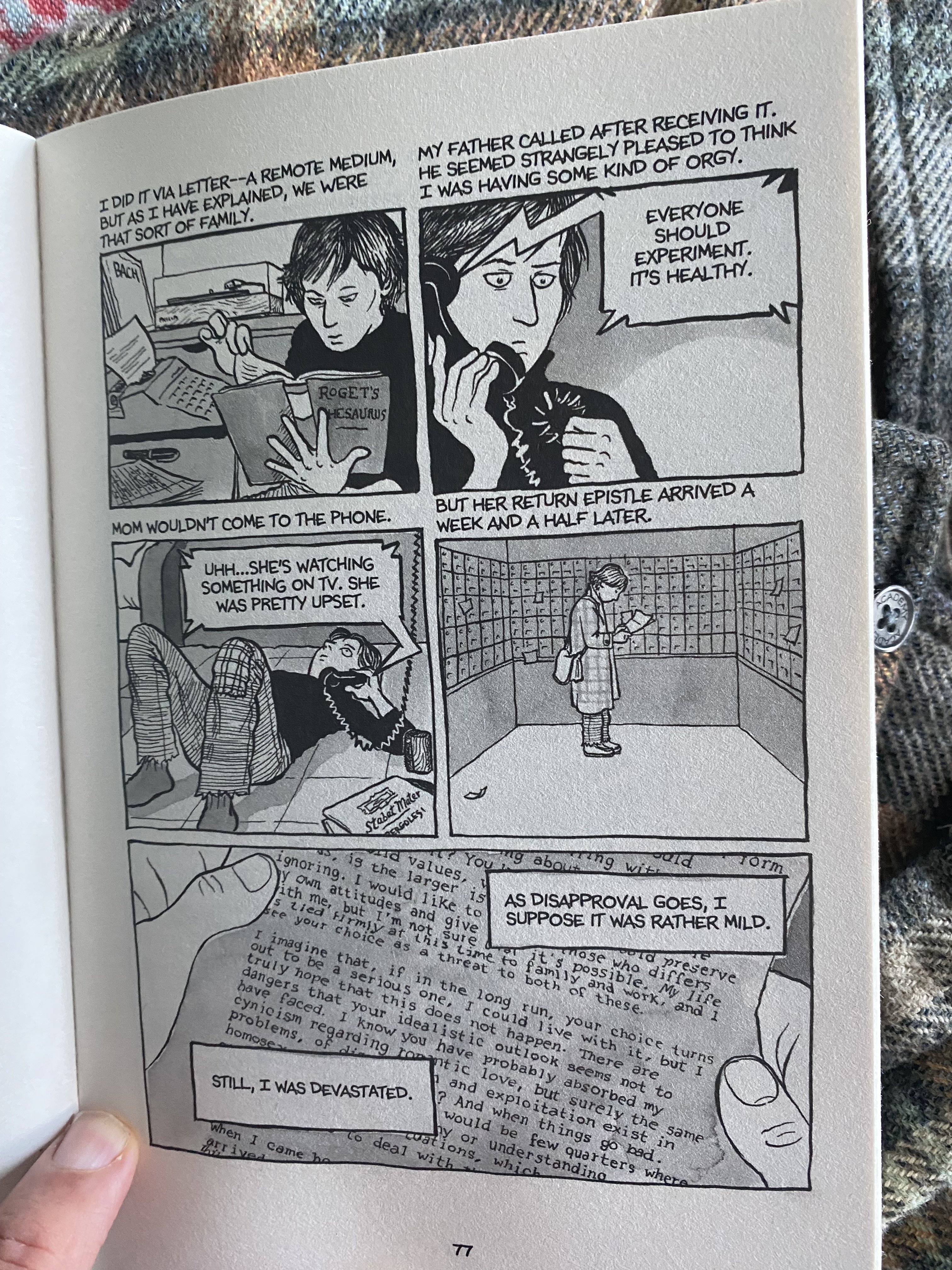
Page 77* may give you an idea of the art and the narrative style. Alison is nineteen, at college, and has just realised she is a Lesbian. The realisation has come about ‘in a manner consistent with [her] bookish upbringing. A revelation not of the flesh, but of the mind.’ There are a couple of pages that could be used as a reading list for a young person making a similar realisation; she attends a meeting of a Gay Union ‘in petrified silence’, and in the resulting exhilaration decides to come out to her parents:

If you enlarge this image you see how beautifully words and images are integrated. The captions offer a commentary on the action: ‘We were that sort of family,’ ‘He seemed strangely pleased,’ ‘I was devastated’. The page is a good example of Bechdel’s skill with dialogue: the father’s words on the phone convey his awkwardness quite independently of the caption’s commentary. The images are more than illustration – the technical term for this kind of story telling is ‘sequential art’, a different beast from ‘illustrated story’. We see how 19-year-old Alison lives: her clothes, the music she listens to, that she has to go to a post office box to receive mail, that her coming-out letter is typed, and composed with the assistance of a thesaurus. As often in this book, the images themselves include text: not just the names of books and records, but a glimpse of the mother’s letter, implying a documentary dimension to the narrative.

On the next page, there’s a fine example of the way the story is given to us bit by bit, layer by layer. We see Alison’s diary entry about her mother’s letter, which quotes part of the letter we are not shown here, hinting at the revelations yet to come about the father’s sexuality.

Like Art Spigelman’s Maus, Joe Sacco’s Palestine or Marjane Satrapi’s Persepolis, this is a comic that people who don’t read comics would do well to spend a little time with. It might not make comic-readers out of them, but it may give them the same kind of pleasure as a good movie or novel.


I wrote this blog post on land of the Gadigal and Wangal clans of the Eora Nation, where a flock of corellas, which I think are visiting from inland country, have been making a lot of noise. I pay my respects to Elders past and present, and to any First Nations readers of this blog.


My blogging practice is focus arbitrarily on the page of a book that coincides with my age, currently page 77.

The Book Club, Alan Hollinghurst and Our Evenings

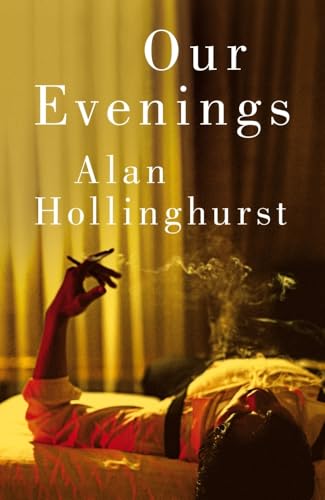
Alan Hollinghurst, Our Evenings (Picador 2024)

Before the meeting: About five decades ago I had to write an Eng Lit essay on Gerard Manly Hopkins’s sonnet ‘Spelt from Sybil’s Leaves’. It’s a poem that cries out to be read aloud, and on a weekend away at a beach house with friends, I found an out-of-the-way spot where I could perform the poem over and over for my own ears. It turned out that my secluded corner was actually an amplifying booth, and my sonorous renditions were heard by everyone in the house. Someone finally came and pleaded with me to stop. Embarrassment aside, I still love the poem.

So I took it as a personal gift to me when the poem is being recited, unannounced and unexplained, at the start of Chapter 15 of Our Evenings:

‘Earnest,’ I said, ‘earthless … equal … attuneable …’ Stella peered at me, tongue on lip, daring me.
‘… vaulty …’ she said.
… vaulty, voluminous … stupendous Evening strains to be time’s vast –’ (now we chanted it together) ‘womb-of-all – home-of-all – hearse-of-all NIGHT!’
‘I bet you can’t go on.’

If I hadn’t been loving the book before then, I would have been hooked.

As it happens, I was enjoying the book. The hero-narrator David Win, son of an English mother and a Burmese father he has never known, was given a scholarship to attend a prestigious boarding school, and at the start of Chapter 15 he’s studying at Oxford. The novel traces his development into a successful actor, his crushes, affairs and finally marriage with men, and his arrival at a reasonably contented late middle age (as we in our late 70s refer to the 60s).

The phrase that gives the novel its title occurs when David is in his last year at the boarding school. He is taken under the wing of Mr Hudson, his English teacher. They listen to classical music together late in the evening. These quiet times have an intimate, erotic charge, but though other boys leap to crude conclusions, ‘nothing ever “happened”, as they say’. Among the pieces they listen to is the first movement of Janáček’s ‘On an Overgrown Path’, which has its own title, ‘Our Evenings’. (You can hear it played by Rudolf Firkusny in 1986 at this link.)

The piece seemed simple and songlike, but the modulations in it made you wonder, and an agitated figure broke in higher up and then, like the scratch on the record, disappeared and left you with the song in a further change of mood, which didn’t quite replace the first one but seemed to cast the shadow of experience over it – what, I couldn’t say, but I felt it. I had no idea what we were listening to or how long it was going on – there was a very quiet passage when the agitated figure came back, but subdued and dreamlike, a trance of sadness and beauty, and soon after that the piece ended without any fuss. I glanced at Mr Hudson, but he was staring at the fire too, and then he jumped up and said, ‘Shall we hear it again?’

Apart from being an instance of the way other works – plays, poems, pieces of music – move the narrative along, this passage is a nice example of the way David as narrator shows rather than tells. ‘I couldn’t say, but I felt it.’ He never says in so many words that he has a crush on Mr Hudson, or that he believes it to be reciprocated, but in little moments like this – in Mr Hudson jumping up and suggesting a replay – readers can draw their own conclusions.

The description of Janáček’s music could be applied to the novel itself: ‘subdued and dreamlike, a trance of sadness and beauty’ occasionally interrupted by an ‘agitated figure’. The prose is elegant and unruffled, and most of the terrible things that happen – AIDS, Brexit, Covid – are offstage. David as boy, adolescent and man is unfailingly polite and helpful – we are usually left to imagine what feelings he is covering up, even perhaps from himself. He regularly encounters ‘agitated figures’ in the form of racism, but mostly it’s of the raised eyebrow or muttered phrase, micro-aggressive variety. An African-heritage lover says, ‘You’re not even Black!’ Likewise the homophobia he encounters is subtle – when he comes out to his mother and her female friend, their response is more or less, ‘Well, that’s been obvious for a long time!’ Class plays a role –  David’s patrons, whom he loves to the end – are like Proust’s aristocrats in their unfailing graciousness and generosity, and the sense that nothing really touches them. The mystery of his father remains a mystery, though late in life he receives some vague information. As in real life, many mysteries remain mysterious.

I suppose sex itself might count as an ‘agitated figure’. There’s quite a lot of it but, though it’s not coy, very little is explicit. I remember only two moments when sexual body parts are named, one involving a kind rejection, the other the beginning of a solid relationship. Neither is the slightest bit prurient.

The last 10 pages depart from the mainly ‘subdued and dreamlike’ narrative in a way that came as a surprise to me, and casts a brilliant light back over the preceding pages.

After the meeting: At the Book Club, we usually have two books under discussion at each meeting. This time, there was just the one, but everyone had to report on the book they’d scored in our Kris Kringle at last meeting. So our discussion, which followed and preceded convivial conversation about other things, began with enticing rundowns of books by Bernhard Schlink, Jock Serong, Robbie Arnott and Niamh Mulvey, and an unenticing rundown of one other.

Of Our Evenings, we had a very interesting discussion. I probably liked the book most, but no one hated it. The only strong difference was about the last ten pages, which I felt gave shape and significance to the whole thing and most others experienced as a lame and unnecessary framing device. It would be too spoilerish to present the arguments here. I’ll just state the obvious: they’re entitled to their opinions, but they’re wrong.

One person had an interesting take on the title. It captured the way the book, for her, is like a series of conversations you might have in a quiet evening at home: meandering, pleasant, amiable recollections and reflections, without drama or much significance. (If that’s so, I hope I said at the time, there’s always an awareness of terrible things happening in the outside world, of which many of the tiny things that come up in those conversations are micro-effects.)

David Win as narrator and hero provoked interesting conversation, which I’ll try to summarise. He is an outsider because of racism, class and sexuality, not necessarily in that order. As an outsider, his main way of being in the world is to aim to fill other people’s expectations – to act out the scripts he is given. It’s not insignificant that he’s an actor. He rarely takes the initiative, and there’s a way he doesn’t seem to know who he is. Not just as narrator, but also as character, he doesn’t have access to his own inner life. The narrative restraint about sex, which is not so in Hollinghurst’s other books that people had read, may be part of this. I read out the only passage in the book that mentions hard-ons, and people laughed (but not at all derisively). It’s as if in this book explicit sex is a relief from always having to decode what is being communicated in tight-lipped upper-class British dialogue (see Mr Hudson’s ‘Shall we hear it again?’ above).

We discussed other characters that I didn’t mention in the first part of this blog, especially a Boris Johnsonesque blustering bully, .

Less centrally, some took an almost anthropological interest in the portrayal of Gay male relationships – and it’s true that Hollinghurst gives meticulous detail on how people make their desires known. One person felt that (minor spoiler alert) having the David’s mother become a Lesbian was just laying on the Gayness too thick. Another, on the contrary, was impressed and delighted by the nuanced portrayal of middle-class, middle-aged, post-heterosexual-marriage Lesbianism.

We didn’t discuss the Hopkins poem, the Janáček music, or the plays – notably by Racine and Ben Jonson – that turn up in the narration.

Mint-flavoured Turkish delight was on offer. Only two of us tried it. I was the only one to finish my piece. I don’t recommend it. I do recommend the book.


Our Book Club met on unceded land of the Gadigal and Wangal clans of the Eora Nation. I acknowledge the Elders past and present. I hope that our conversation was in some way in continuity with yarns that have been happening on this land for tens of thousands of years.

Niall Williams’s Time of the Child and the book group

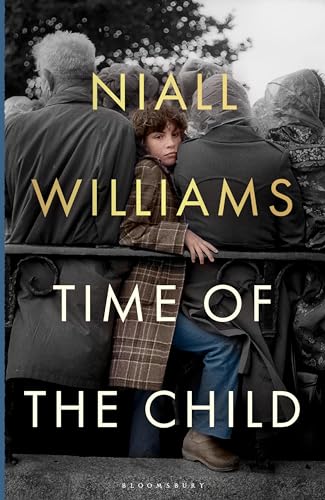
Niall Williams, Time of the Child (Bloomsbury 2024)

Before the meeting: As I was reading the first couple of chapters of this book, I had ringing in my ears something that a Book Group member had said about a different book, perhaps one of Niall Williams’s earlier novels, A History of the Rain or This Is Happiness: ‘It’s a beautifully written Irish novel, but I’m not sure the world needs yet another beautifully written Irish novel.’

The first chapters, in fact almost the first half of the book, are brilliant descriptions of life in 1962 in the fictional West Ireland village of Faha, the village we know from those previous books. The rain is still incessant and the village still slowly sinking into the river. The heart broken in This Is Happiness is still broken. Life is still dominated by the Catholic Church. Gossip is still the lifeblood of the community. Most houses now have electricity.

The first chapter begins with a wonderful setpiece, a parish Mass where the beloved parish priest stalls mid-sermon in the first major sign of dementia. Things are seen from the point of view of Jack Troy, the village’s general practitioner whose face and manner give away nothing of his inner feelings as his role in the community means he must always be available, including to people who will never ask for a doctor’s attention on their own behalf. After Sunday Mass he is regularly approached by people who indicate with a nod and a wink that his services are needed at such and such a house.

The second chapter revolves around another magnificent setpiece: the Christmas fair in which farmers bring their cattle to town to sell, and hawkers and traders come from elsewhere. Here, twelve-year-old Jude Quinlan, son of a drunkard farmer, carries the narrative burden.

Through both of these chapters, we are teased by hints that something big is going to happen. It’s as if the narrator is saying to his readers, ‘Yes yes, I know you’re here for a story, but first let me tell you about the place it happened in and the people who live there.’ At the end of the second chapter, more than a third of the way into the narrative, there’s this:

But it was here, at the back wall of the church in the village of Faha, on the night of the Christmas Fair 1962, that Jude Quinlan found the child.

Ah! The titular child has arrived! Then the third chapter continues to tease us. It takes us back a couple of days in the life of Ronnie Troy, Jack’s long-suffering dutiful daughter. After 16 pages in which we come to know and (speaking at least for myself) love her, she responds to a late-night knock on the door and at last the story begins.

Given that it happens so late in the book, I’m reluctant to say much more about it, except that though my Group member may be right that the world doesn’t need another book like this, I certainly do. Maybe it’s because I spent my 1950s childhood as part of the Irish diaspora in north Queensland, and I respond with little gasps of recognition to little throwaway lines about the Sacred Heart, the ‘Hail Holy Queen’, the smiling pope, or to the way the priest says Mass with his back to the church while the congregation’s more or less devout members goes about their own business. That is to say, maybe there’s a hefty dose of nostalgia in my response to the book. But if so, that nostalgia serves a serious purpose.

This is a time and place when the Church dominated Irish society. It was the time of the Magdalen laundries, covered-up clerical sexual abuse of children, pitiless laws against abortion and condemnation of most forms of birth control. None of this is foregrounded in the book, but oppressive Church–State authority looms large, mostly unspoken, over the second half of the book. On the one hand, a handful of people sinking to their knees to say the Rosary can be an exhilarating manifestation of something fine beyond words (though Niall Williams finds the words); on the other a priest with a form letter mouths deadly phrases like ‘For his own good’ and ‘Preserving his dignity’.

Just as much as, say, Sebastian Barry’s Old God’s Time or Claire Keegan’s Small Things Like These, this book is about decent humanity – individuals and communities – resisting the monolithic, repressive authority of Church and State. Like them, it revels in musical language. More than them it’s funny. I did cry, twice, but I laughed a lot.

Page 77* includes a micro example of the resistance. In the absence of a fairground, Faha’s monthly fair is a chaotic mess, and the church gates, ‘with their splayed look of welcome in the centre of the village’, are a main centre of trade. The curate, Father Coffey, representing the Church’s authority, asks the farmers not to stand their cattle there:

As it happened, the curate’s appeal fell on deaf ears, but he took some satisfaction when he was able to negotiate a treaty whereby Mick Lynch promised a rope corridor to let the daily Mass-goers through. As a goodwill gesture, Lynch said, the farmers would take their dung with them when they left, which Father Coffey reported back to the Canon, unaware it was a joke until the older priest put the hand across his laugh to stop his teeth flying.

With such jokes, in which the older priest colludes, the people of Faha keep the authority of the Church in its place.

Most of page 77 is taken up wth one of Niall Williams’s bravura character sketches:

Mick Lynch had the walk of a man who owned his own bull. Short and broad, he carried a blackthorn, wore a frieze coat and low hat with red feather in the band. That hat never came off his head outside of church. He wore it at the counter in Ryan’s, in the spartan confines of his iron bed, and when he went to wring the necks of geese. From victories in cards or trade, Lynch took a deal of pleasure. With a contrary nature, his cheeks were where the most of his hair grew, furred sideburns made key-shaped by the shaving of his chin which gave him a jailor’s look. Lynch had the reputation of being what Faha called a right cool man, a designation that pre-dated refrigeration, meant he could not be hurried or ruffled, and once, when asked by a dealer, ‘What are you looking for in a horse, boss?’ had delivered the incontestable answer, ‘Leg in each corner.’ He had not married. For women he hadn’t the handbook, he said, and children nothing but hosts to headlice and worms.

Remember, nothing has really happened in this book so far. That is, we’re a quarter of the way into it but we haven’t yet had what the movies call the inciting incident. But the narrator refuses to be hurried. There is too much to enjoy at any moment in the life of Faha, so though this is Mick Lynch’s only appearance, we’re going to take a moment, just for the fun of it, to savour him. I especially like that ‘outside of church’: whatever else he may be or do, it wouldn’t occur to Mick Lynch to defy the custom of men going bare-headed in church.


After the meeting: Unusually, this book was the subject of quite a lot of WhatsApp discussion before the meeting, mainly from people who couldn’t make it on the night. A number of us had wept, prompting one to ask whether we were ‘silly old men getting emotional about a baby and family relationships’. He who had made the remark about beautifully written Irish novels confounded my expectations by loving tis one, and wrote a thoughtful email on the theme of ‘the soul’. Another sounded a mildly dissenting note, having read only 80 percent and found it slow going; he reacted against the religion’s hold on people, and used the word ‘silly’ about a main character’s attempt to take charge of the situation (all of which are completely reasonable responses). Yet another quoted a number of favourite passages, and said he loved the way Catholicism co-existed with pishogues, which he noted was an excellent new word to him (as it is to me – definition at this link if you’re interested).

On the night there were just five of us. Among other things, we ate baked potatoes. Almost as soon as we arrived, those of us with Catholic backgrounds – a slim majority – were reminiscing about, of all things, our Confirmations. Not directly on topic, but certainly book-adjacent. We had an animated discussion. More than one said that the book took its own sweet time to get to the point – one said he almost stopped reading, but others (me included) thought it was a feature rather than a bug. Someone quoted a passage to the effect that Irish story-telling never goes in a straight line.

Someone said, on WhatsApp and then again on the night, that the book was an Irish Catholic equivalent to Marilynne Robinson’s Home. I don’t quite see that, though it’s an interesting thought. I had a go at articulating some of what I see the book as saying about Catholicism in Ireland then and now – which I won’t go into here because it would be spoilerish.

Interestingly, no one thought to say out loud that this is a Christmas story, even a kind of second-coming story. And, though someone had looked up Niall Williams on the internet, no one wondered aloud if he became a grandfather somewhere on the way to writing this book.

As for the rest of the conversation, I can’t do better than quote (with permission) from one chap’s report on WhatsApp. Conversation ranged, he wrote:

from John Cage and the Necks to motor bike accidents, playing golf, Parkinson’s disease and then the realities of being Bilbo Baggins.


I wrote this blog post on land of the Gadigal and Wangal clans of the Eora Nation. I was born in MaMu country, though as a small child I was confused about whether I lived there or in ‘Erin’s green valleys’. I acknowledge the Elders past and present of both countries, never ceded.


My blogging practice is focus arbitrarily on the page of a book that coincides with my age, currently page 77.
Isabella Tree’s Wilding

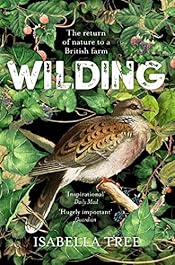
Isabella Tree, Wilding: The return of nature to a British farm (Picador 2018)

The environmental-activist friend who gave me this book for Christmas says he gives it to everyone. Having read it, I can see why. Apart from its fascinating subject matter, it’s very engagingly written. My friend wrote on the title page, ‘A taste of what the future holds (if there is one)’.

Isabella Tree (her real name) and her husband Charlie (Sir Charles Burrell) were dairy farmers in Sussex. They were also the lord and lady of Knepp Castle, Charlie’s ancestral home. In the 1990s, in spite of following all the best practice recommendations of the time, their dairies were operating at an unredeemable loss, so they decided to put their 3,500 acres (1,400 hectares) to different use. First they sought and received funding to make part of the land into a park, and eventually the whole property became what is now the Knepp Wildland rewilding project.

The book ia an exhilarating account of the process of bringing that change about – or to a great extent allowing it to happen, as a lot of what was needed, it turned out, was for well-meaning humans to get out of the way of natural regeneration. I won’t try to summarise the process. Enough to say that the experience of Knepp has challenged many received ideas about what the English countryside was like before large-scale human intervention. It seems unlikely, for example, that the country was covered in closed-canopy forest – grazing and browsing animals would have kept a lot of the land relatively open, and the much treaured English oaks don’t grow well in a closed-canopy environment.

That orthodoxy isn’t the only one to be challenged. Isabella Tree writes persuasively about the phenomenon of the shifting baseline: people think back with nostalgia to the land as they knew it in their childhoods, thinking of that as its natural state – whereas in fact that state was already deeply affecred by industrialisation. Animals and birds who are regarded by the scientific community as belonging to a particular habitat turn out, once destructive processes have been reversed, to prefer quite a different one – the one we have seen them in all our lives is just the best they could manage given that their preferred homes had been destroyed.

Film critic Mark Kermode is fond of saying that a good documentary can make you interested in a subject you didn’t think you cared about. That’s true of this book. It’s not that I don’t care about environmental issues, but I thought I knew enough about rewilding when I knew that wolves had been restored to Yosemite in the USA with extraordinarily beneficial effects. This book discusses that and laments the unlikelihood of wolves being allowed onto the Sussex estate, but it also makes me care about nightingales, turtle doves, butterflies (there’s a brilliant description of butterflies kelling), oaks and water violets.

Isabella Tree even makes compelling reading from the business of forming committees, consulting experts (including a brilliant forerunner of Knepp in the Netherlands), dealing with grumpy neighbours and dealing with government bureaucracies.

Because one of my regular readers loves them, I can’t resist quoting this lovely passage about pigs from Chapter 6, in which old English longhorns, Exmoor ponies and Tamworth pigs (approximations of the animals that were on the land before human activities wiped them out) are introduced to the estate (page 109-110):

Intelligent, inquisitive, imperious, myopic, sociable, gluttonous, grunting, ungainly, it is easy to recognize ourselves in them … Which is why, perhaps, the Tamworths are constantly forgiven their antics at Knepp. The instant they were let out of the acclimatisation area in the Rookery, they applied themselves to destroying Charlie’s manicured verges along the drives with the unstoppable momentum of forklift trucks. Then, two abreast, they unzipped the turf down the public footpaths, following the exact routes on the Ordnance Survey map, heading diagonally across the fields. We realised that what they were doing, with the undeviating propulsion of slow-motion torpedoes, was zeroing in on slivers of the park that had never been ploughed – margins rich in invertebrates, rhizomes and flora. In the first few days of their release the pigs drew an accurate blueprint of what modern farming had done to our soil.

The ornamental grass circle in front of the house, another patch of pristine turf, proved to have a magnetic attraction, too, and Charlie was compelled to take to his bicycle, jackeroo stock-whip in hand, to impress upon them that this area was sacred ground …

As Winston Churchill once observed, ‘A cat looks down on you. A dog looks up to you. A pig looks you straight in the eye.’

As a relatively ill-informed Australian, I read the book with a double mind: on the one hand learning so much about what remediation looks like in England, and on the other wondering what would have to be done to reverse the relatively more recent but possibly more radical damage done to Australian environments by, for example, hard-hoofed grazing animals, artificial fertilizers, and crops like sugar cane or wheat. Bruce Pascoe and Lyn Pascoe’s work at Yumburra might be a partial answer. I’d love to see them in conversation with Tree and Burrell.

Jeff Lemire and others’ Black Hammer vols 5 & 7

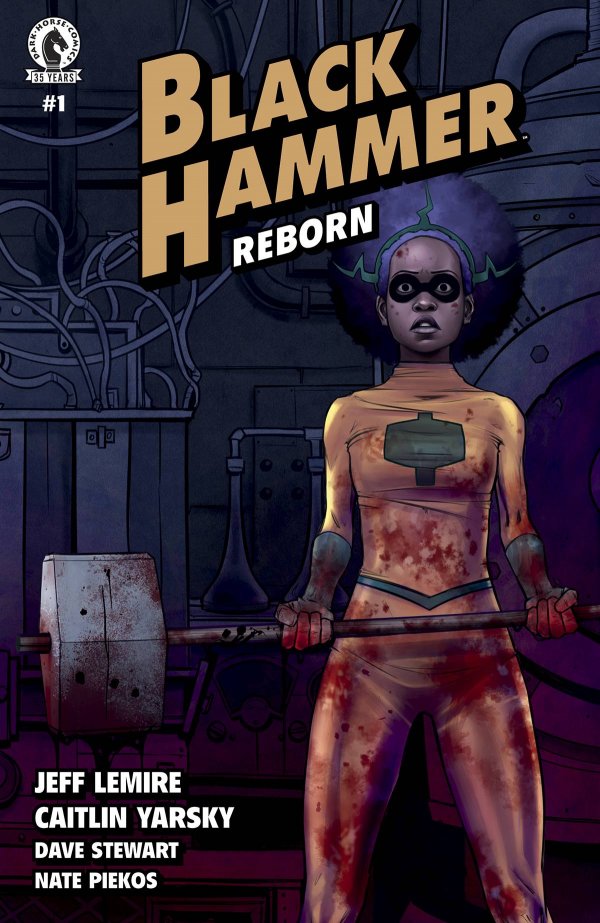
Jeff Lemire (writer), Caitlin Yarsky (art), Dave Stewart (colorist) and Nate Piekos (letterer), Black Hammer Volume 5: Reborn Part I (Dark Horse Books 2022)
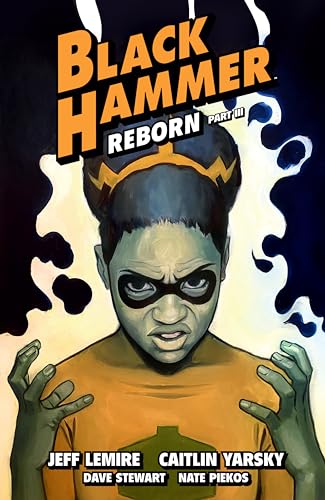
Jeff Lemire (writer), Caitlin Yarsky (art), Dave Stewart (colorist) and Nate Piekos (letterer), Black Hammer Volume 7: Reborn Part III (Dark Horse Books 2022)

When I wrote about Black Hammer Volume 4 (at this link) I thought it was the end of the story, but no, two year later in real life and TWENTY YEARS LATER in comics caption, along comes Volume 5, or Reborn Part I (monthly comics #1-4), closely followed by Volume 6 and 7, Reborn Parts II and III (monthly comics #5–8 and #9–12 respectively). Not only is superhero Black Hammer reborn, as his daughter Lucy reluctantly resumes the identity, but there is a new, female artist. Caitlin Yarsky’s distinctive artwork is every bit as dramatic as Dean Ormston’s in the earlier volumes, though I think the domestic elements of the story have taken on more weight

I was given Volume 7 as a Christmas gift. I hunted for the two earlier ones, but found only Volume 5. I’m resigned to never reading the middle of this trilogy, but I did enjoy the parts of the ride that I took part in, and Volume 7 does start with a recap of sorts.

Anti-God was defeated in the earlier books, and now he’s coming back, and multiple universes are about to be collide and be destroyed. In earlier books, the superannuated superheroes were put out to pasture in a kind of simulacrum of rustic bliss. Many of them turn up in this one, older, possibly wiser, or maybe something else. In the dizzying interplay of universes, the dead live again, the good become evil, the evil good – and some heartbreaking decisions have to be made. There are plenty of what you expect from a superhero comic: THWAKs, SHRIPs and THOOMs and svelte female bodies (always, mercifully, clothed), there’s also a lot of complex, even bewildering time shifts. The emotional heart of the story is Lucy having to choose between being a good mother and saving the universe. (A bit like E. M. Foster’s famous line in ‘Two Cheers for Democracy’: ‘If I had to choose between betraying my country and betraying my friend I hope I should have the guts to betray my country.’) Oh, she also has to resolve her daddy issues in a multiverse kind of way.

This is probably not the end of this Black Hammer series. The caption on the last page of Volume 7 reads, ‘The cataclysm has begun.’

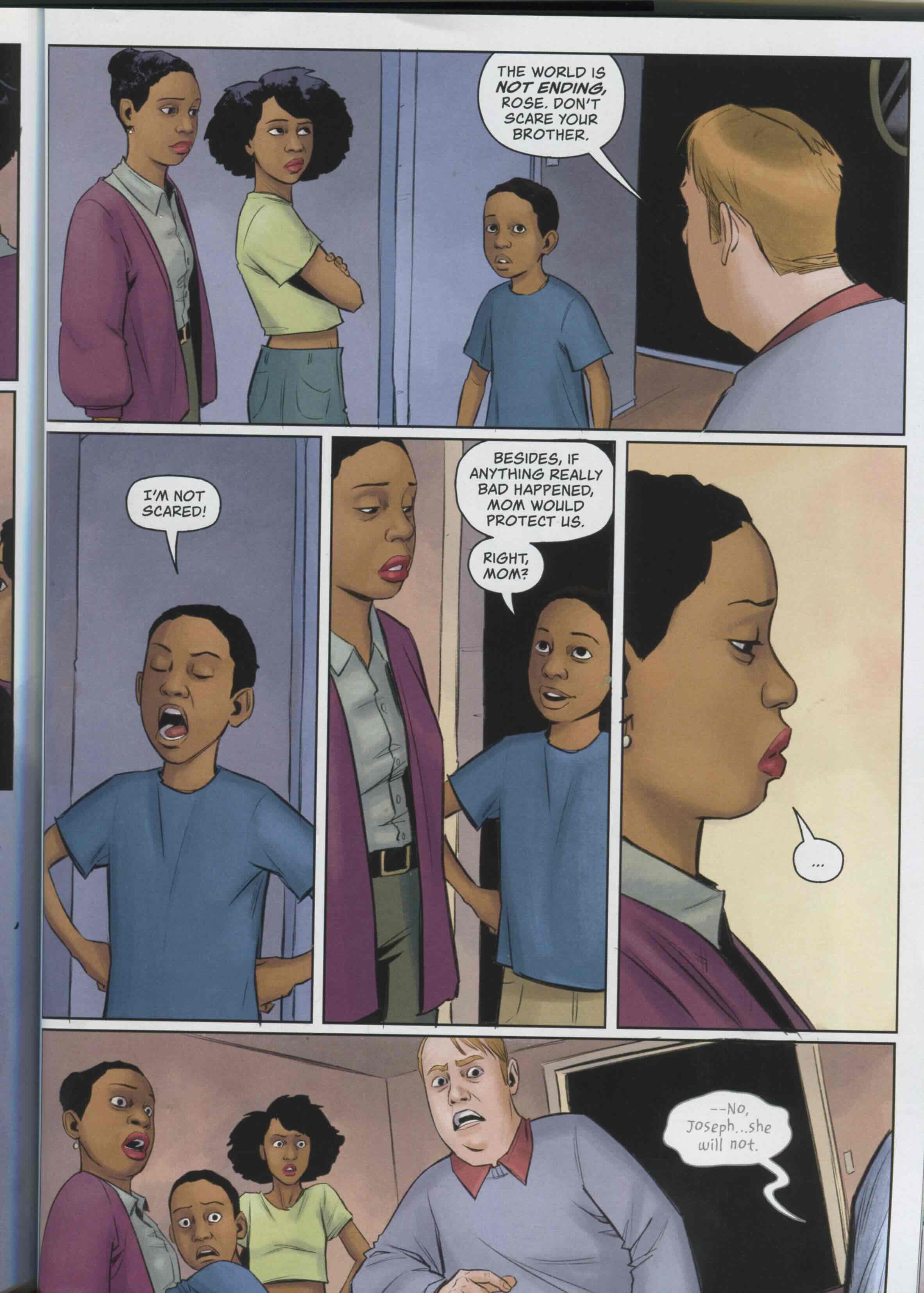
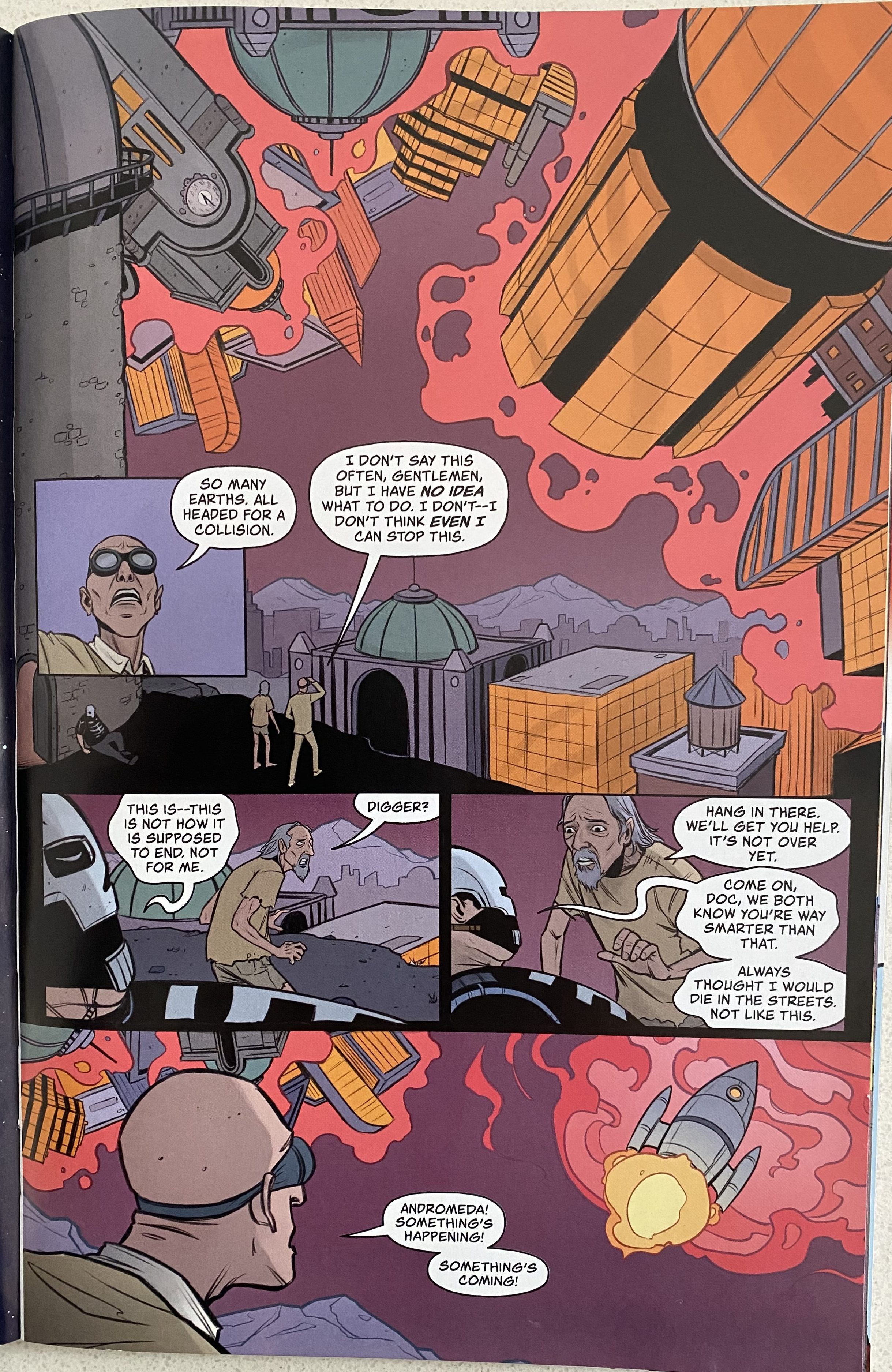
The two pages 77* illustrate the books’ range of art and narrative style.

In Volume 5, there’s a more or less domestic scene, in characteristic muted tones.

‘Mom’ here is Black Hammer in her mundane identity. The pudgy middle-aged man, the children’s father, was once an aspiring super-villain. His superpower was pretty pathetic and when Black Hammer vanquished him she also won his heart. In a note, Caitlin Yarsky says his his ‘suburban dad look’ was partly inspired by the late Philip Seymour Hoffman. Lucy’s reluctance to rise to her son’s challenge is a micro version of her central dilemma.

Readers of previous volumes immediately recognise the quavery font in the final panel’s speech bubble: it’s the voice of Colonel Weird, whose entanglement in a time warp means that he lives in the ‘Para-Zone’ were he experiences all times at once. When he says something about the future, we know it’s true. This little speech bubble carries a huge narrative force, as the other characters’ response indicates.

Volume 7’s page 77 may not feature any SCRACKs or KRA-KoooOOMs (these come a couple of pages later), but it’s part of the luridly coloured epic story.

Yes, it’s lurid, but it is crystal clear.

Those upside-down buildings in the top part of the page are parts of other universes heading for this one. A convergence will spell major disaster. Digger is another former supervillain, now Black Hammer’s major ally. He is wounded and probably dying. The Doc is one of the completely good guys – at least this version of him is. The man with the goggles … no, it’s all too complex for a quick summary. And that approaching rocket ship is about to introduce a whole new level of complexity, as Colonel Weird makes another appearance, this time accompanied by multiple even weirder versions of himself.

I guess I’ll keep an eye out for Volume 8 – maybe it will hit the shops in time for my March birthday.


I wrote this blog post on land of the Gadigal and Wangal clans of the Eora Nation. I pay my respects to Elders past and present. After days of heavy rain, the heat is beating down, and the lizards are loving it.


My blogging practice is focus arbitrarily on the page of a book that coincides with my age, which is currently 77.

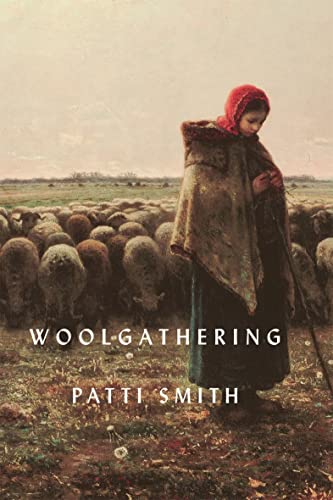
Patti Smith’s Woolgathering

Patti Smith, Woolgathering (©1992, Bloomsbury 2012)

I’m coming late to Patti Smith. I know that her memoir Just Kids is much loved, and I know she partnered with Robert Mapplethorpe. (I have seen a major exhibition of his photos, including a curtained space with an explicit content warning in which nevertheless punters were vocally shocked). Wikipedia informs me that she is a singer-songwriter, poet, painter and photographer. I believe she was big in punk. Her only performance I have seen is her brilliant rendition of ‘A Hard Rain’ at Bob Dylan’s Nobel Prize ceremony. (If you haven’t seen that, do watch it on YouTube, especially the absolutely disarming moment at about the 2 minute mark.)

This huge absence from my inner cultural landscape has now been slightly remedied, thanks to a well-judged Christmas gift.

Woolgathering was first published in 1992 as number 45 in a series of tiny books – 3 by 4 inches (roughly 7.6 by 10 centimetres). That’s even smaller than the Flying Island Pocket Poets books, and only slightly bigger than the titles in Maurice Sendak’s Nutshell Library. It contained 15 prose poems and a healthy scattering of photographs, mostly taken by the author or featuring her or her family. It was reissued in 2011, expanded to 5 by 7 inches (12 by 19 centimetres), with a new introduction and four extra poems.

In her introductory note to the 2011 edition (which is what I have in my hand), Patti Smith says that the book was commissioned when she was living with her husband and two school-age children on the outskirts of Detroit, and experiencing ‘a terrible and inexpressible melancholy’:

Everything contained in this little book is true, and written just like it was. The writing of it drew me from my strange torpor, and I hope that in some measure it will fill the reader with a vague and curious joy.

I don’t know that it does that for me, but it’s a lovely book – to look at, to hold, to read and to reread. There are glimpses of her childhood, including the story of her marble collection, her caring for her often ill little sister, her relationships with parents and grandparents, and wonderful lines like this from ‘Barndance’:

The mind of a child is like a kiss on the forehead – open and disinterested. It turns as the ballerina turns, atop a party cake with frosted tiers, poisonous and sweet.

I read it as elliptical, discontinuous, even cryptic story of how she came to be a writer and artist. The first poem. ‘A Bidding’, begins, ‘I always imagined I would write a book, if only a small one’. And the next to last poem, having described a dream in which, while her siblings ‘sat watching in wordless admiration’, she ‘lay suspended a few feet from the ground’. She is almost tempted to try the feat in real life:

But my writing desk awaits , my open journal, my quills, inks, and here are precious words to grind. So I leave myself to wonder and begin, for I always imagined I would one day write a book.

Writing is a realistic alternative to flying.

Page 47* occurs in the middle of ‘Two Worlds’, one of the poems added in 2011. At first glance, it makes Patti Smith’s claim that everything in the book is true look a bit, um, disingenuous. It starts out like a realistic narrative with the poet watching scenes from Jean Cocteau’s Orphée (in which the main characters move through mirrors from the ordinary world to Hades), and morphs into a dream narrative. If it’s true, it’s in the way that dreams are true (as in Bob Dylan’s ‘The Gates of Eden’, ‘Sometimes I think there are no words but these to say what’s true.’) She is dressed like a poet from the movie, except that his shirt is spattered with blood – then she realises that her shirt is also stained, with ‘the deep red juice of kidney beans’, and soon she is actually bleeding. She wanders from the movie’s Café des Poètes to a series of other cafes that I’m guessing would be recognisable to US readers in the 1990s.

Here’s most of page 47:

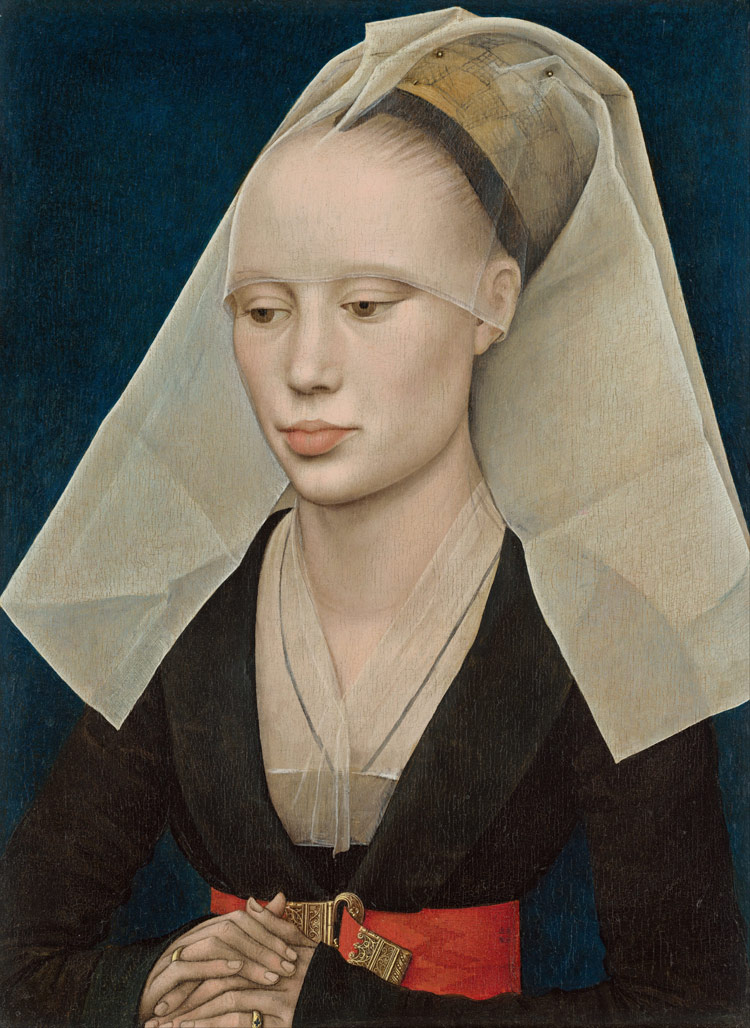
I ordered another Pernod and water, but what I really wanted was to lie down. I lost a lot of blood and some had dripped on the page of my journal. The tears of Pollock, I explained to the waiter. The tears of Pollock I scrawled across the page. The drips multiplied forming a fence of slim jagged poles. The lines I had written multiplied as well. I could not tame them and my entire station was noticeably vibrating, as if teeming with newborn caterpillars. Quickly I drained my glass and motioned for another. I tried to focus on a portrait behind the brass cash register. Flemish fifteenth-century. I had seen it somewhere before, perhaps in the hall of a local guild. The sight of it produced a shudder and then a curious rush of warmth. It was her head covering. A fragile habit framing her face like the folding wings of a large diaphanous moth.

This makes me think that the whole poem is a kind of surreal ars poetica: an account of how she sees her own writing. I read ‘Pollock’ as referring to Jackson Pollock: where he dripped paint onto the canvas (and when I first typed that there was a typo, so he dripped pain), she lets her blood drip onto the page, and then scrawls over it. You probably don’t have to be an Australian of a certain age to have ‘fence of slim jagged poles’ bring to mind Pollock’s Blue Poles, whose purchase once outraged our philistine newspapers. But the dripping of raw pain onto the page isn’t enough: beyond the effects of alcohol and the brass cash register (am I over-reading to see this as a dream symbol of the commodification of art?), she struggles to focus on the stillness of a fifteenth century painting in which the other-worldliness of a moth embraces a woman’s face.

That image turns up again in a later poem, ‘Flying’, in a non-dream context but in almost exactly the same words:

Above my desk is a small portrait – Flemish, fifteenth century. It never fails, when I gaze upon it, to produce a shudder, followed by a ciurious rush of warmth, recognition. Perhaps it is the serenity of the expression or perhaps the head-covering – a fragile habit framing the face like the folding wings of a large, diaphanous moth.

And facing page features a photo of that face and its ‘fragile habit’ on her wall. (A quick web search identifies it as Rogier van der Weyden’s Portrait_of_a_Lady.)

But ‘Two Worlds’ moves on – the Flemish portrait has been just a glimpse of quietness, perhaps something to aspire to. ‘I dreamed of being a painter,’ she writes, ‘but I let the image slide … while I bounded from temple to junkyard in pursuit of the word.’

This was Patti Smith in the years between punk stardom and her current status as grande icon, delving into memories, dreams and other people’s art to find her bearings, and rekindle in herself ‘a vague and curious joy’. Not bad!


I wrote this blog post on land of the Gadigal and Wangal clans of the Eora Nation. The heat is beating down, and the lizards are loving it.


My blogging practice is focus arbitrarily on the page of a book that coincides with my age. A focus on just one page seems to work well with books of poetry, where the parts are so often greater than the whole. As Woolgatherers has fewer than 77 pages, I’ve focused instead on my birth year, ’47.

Happy birthday, Francis Webb

Today would have been Francis Webb’s hundredth birthday.

Toby Davidson, the brilliantly enthusiastic Webb fan and scholar, is ensuring that the centenary year is well celebrated. He has already published an essay in the ABR (which sadly we can’t read without a subscription) and appeared on two podcasts.

Toby organises the annual Francis Webb poetry readings, and he promises that this year’s will be an All Star Event.

You can read some of my own effusions about this wonderful poet and events inspired by him: here, here, here, here, here and here.

Maybe the two excellent episodes of the ABC’s now defunct Poetica on the subject of Webb’s poetry and lertters will be resurrected. Their tombstones are here and here

UWAP has a page dedicated to the centenary, at this link. It includes a brief introduction by Toby Davidson and links to his essays and podcast appearances. Other links will be added as the year progresses

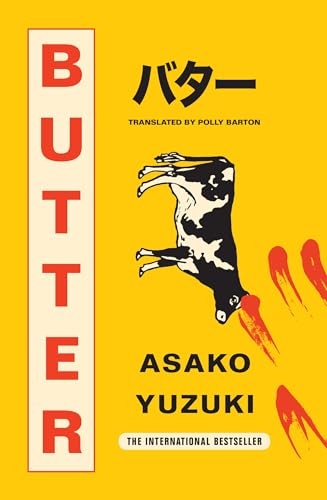
Asako Yuzuki’s Butter

Asako Yuzuki, Butter (2018, translation by Polly Barton, 4th Estate 2024)

This was my end-of-year gift from the Book Club. It is probably an excellent book about misogyny in Japanese culture, with sharp satiric assaults on attitudes to food, with extra piquancy derived from its claim to be based on a true-crime story. It was evidently a huge success in Japanese and this English translation by Polly Barton has been reviewed enthusiastically.

The protagonist, Kira, is an ambitious young woman journalist working on a sensationalist magazine. In searching for a career-defining scoop she becomes enthralled by Manako Kajii, a woman who defies the social norms of slender femininity and is currently in prison for having killed a number of elderly men, after winning their hearts by cooking luxurious food for them. Manako introduces Kira, who until now has survived on a spartan, negligent diet, to the joy of butter – cooking with it and eating the results.

My guess is that the key to enjoying the book is to read it fast, and I’m a slow reader. The themes are real and interesting: feminism versus feminine wiles; social norms versus desire; career ambition versus enjoyment of life. But I struggled with it, and gave up soon after my obligatory 77 pages.

It may well be that Polly Barton has reproduced the feel of the original Japanese, but the best way I can describe my response to the book’s language is to say that it reads like the kind of English you find in school students’ translations. The information is all there, but in the process of capturing it, the student forgets to pay attention to the natural rhythms and sequencing of English prose. That’s fine if you’re a teacher correcting someone’s homework, but if you’re reading a novel, it keeps yanking you out of the story.

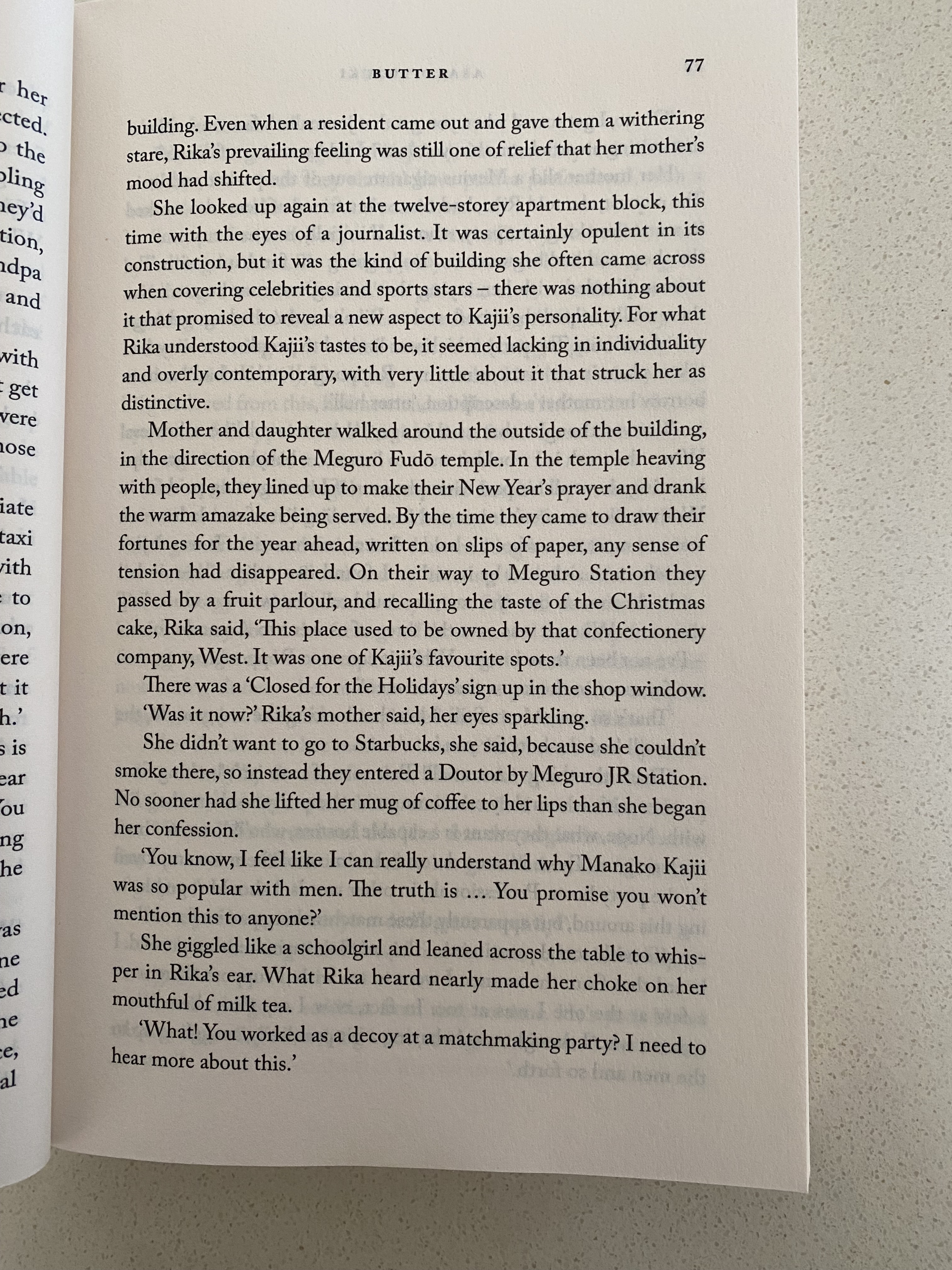
I don’t want to spoil anyone’s enjoyment, but I’ll try to articulate why I find the book such a slog. Page 77* isn’t particularly egregious, but it offers a number of examples. Rika is on an outing with her mother, partly to cheer her up, and partly with the undeclared intention of having a look at Kajii’s apartment. Rika’s mother becomes high-spirited as they inspect the building that has been ‘making a splash in the news’.

I’ll just talk about the beginning and ending of the page, but you can enlarge the image to read it in full:

The first sentence:

Even when a resident came out and gave them a withering stare, Rika’s prevailing feeling was still one of relief that her mother’s mood had shifted.

There’s nothing glaringly wrong with that, but a close look reveals a number of tiny problems contributing to the cumulative awkwardness.

To my ear, the phrase ‘even when’ suggests an extreme event of some kind, and it takes a microsecond to realise that this is something quite undramatic: a resident comes out of the building and gives the pair a withering look. For another microsecond, I wonder why the resident would pay them any attention at all. They’re just two women in a public street. And it’s not just a look, but a stare! How does Rika know that this more or less abstract person is a resident? Moving on, the awkward phrase ‘prevailing feeling’ suggests, if anything, that Rika is experiencing complex emotions, but that suggestion goes nowhere. ‘One of relief’ is clutter – why not just ‘relief’?

One last thing: the word ‘still’, which if you read this sentence without context is completely innocuous. But it’s another example of a micro-interruption to the narrative flow. This is the first time we’ve been told that Rika is feeling relieved. The reader (or at least this one) has to do a quick calculation: oh yes, Rika’s mother’s mood has lifted so of course it was implied that Rika felt relief, so now we’re being told that that relief has survived. This is a recurrent quirk: we’re told that something has happened, rather than seeing it happen.

I can enjoy a text that demands work of me, but these extra little bits of readerly labour bring no joy.

I won’t take you laboriously through the whole page, though I can’t resist mentioning the phrase, ‘In the temple heaving with people’. The meaning is clear, but it doesn’t quite feel like English.

At the end of the page, Rika and her mother are having a coffee (in a Doutor, which Rika’s mother prefers to Starbucks because Starbucks doesn’t allow smoking – in the kind of culture-specific moment that I confess to enjoying).

No sooner had she lifted her mug of coffee to her lips than she began her confession.
‘You know, I feel like I can really understand why Manako Kajii was so popular with men. The truth is … You promise you won’t mention this to anyone?’
She giggled like a schoolgirl and leaned across the table to whisper in Rika’s ear. What Rika heard nearly made her choke on her mouthful of milk tea.
‘What! You worked as a decoy at a matchmaking party? I need to hear more about this.’

Again, these are tiny things, but they accumulate. ‘No sooner than’ is just slightly wrong: can you begin to talk at the moment you lift a mug of coffee to your lips? Specifying a mouthful of tea is unnecessary and creates another of those micro-pauses: I suppose it’s technically possible to choke on a mouthful of liquid, but the term ‘mouthful’ suggests that it’s still in the mouth and more likely to cause spluttering. Having the reader learn what the mother says only when Rika repeats it is an unnecessary and (to me) annoying complication.

Your mileage may vary, and I hope it does. If you want a completely different take on the book, I recommend Theresa Smith Writes.


I wrote this blog post on land of the Gadigal and Wangal clans of the Eora Nation. I happily acknowledge their Elders past and present for caring for this land for many thousands of years.


My blogging practice is to focus arbitrarily on the page of a book that coincides with my age, currently 77.