Monthly Archives: Aug 2025

Yao Feng’s Great Wall Capriccio

Yao Feng, Great Wall Capriccio and Other Poems, translated by Kit Kelen, Karen Kun and Penny Fang Xia (Flying Island Books 2014)
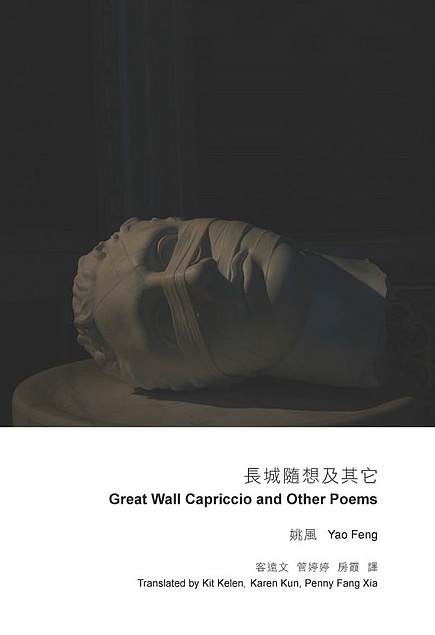
Beijing born Yao Feng is a much awarded poet, translator, artist and prose writer. In 2014 when this small book was published he was Associate Professor in the Portuguese Department at the University of Macau, where Kit Kelen, one of the translators of this book and series editor of Flying Island Books, was also a professor.

One of the lovely things about Flying Island Books is that they have two publishers, one in the cosmopolitan city of Macao (which seems to be the accepted spelling in English) and the other in Markwell, a tiny village 16 kilometres from Bulahdelah in New South Wales. The Macao partner is ASM (the Association of Stories in Macao), which has been described as ‘the most devoted publisher of translated literature in Macao’. As far as I can tell ASM was originally Kit Kelen’s baby, and is now under the directorship of Karen Kun, another of this book’s translators.

The book’s title poem is a series of eight dramatic monologues by characters who have stood on the Great Wall over centuries, from lonely soldiers to graffiiti-ing tourists. There are other poems that deal with Chinese history, including ‘memories yet to be disarmed’, a reflection on a painting in memory of the Cultural Revolution. But not all the poems are about China – and not all of them are on serious subjects. The poet sits in the sun and watches jacaranda blooms at the summer solstice, he looks in the mirror and sees that his ears have mysteriously disappeared, he imagines in what circumstances he might renounce his atheism and ‘approach God on all fours’. Poems are set in various parts of China, but also in Portugal, the Netherlands, the USA, Japan … the list goes on. There are poems about Pushkin, Ceaușescu, Aung San Suu Kyi and Marilyn Monroe. In other words, these 130 pages contain multitudes, and are a terrific introduction to this poet.

The poem on page 78, which I’m focusing on because of my arbitrary blogging rule*, has personal resonance for me.
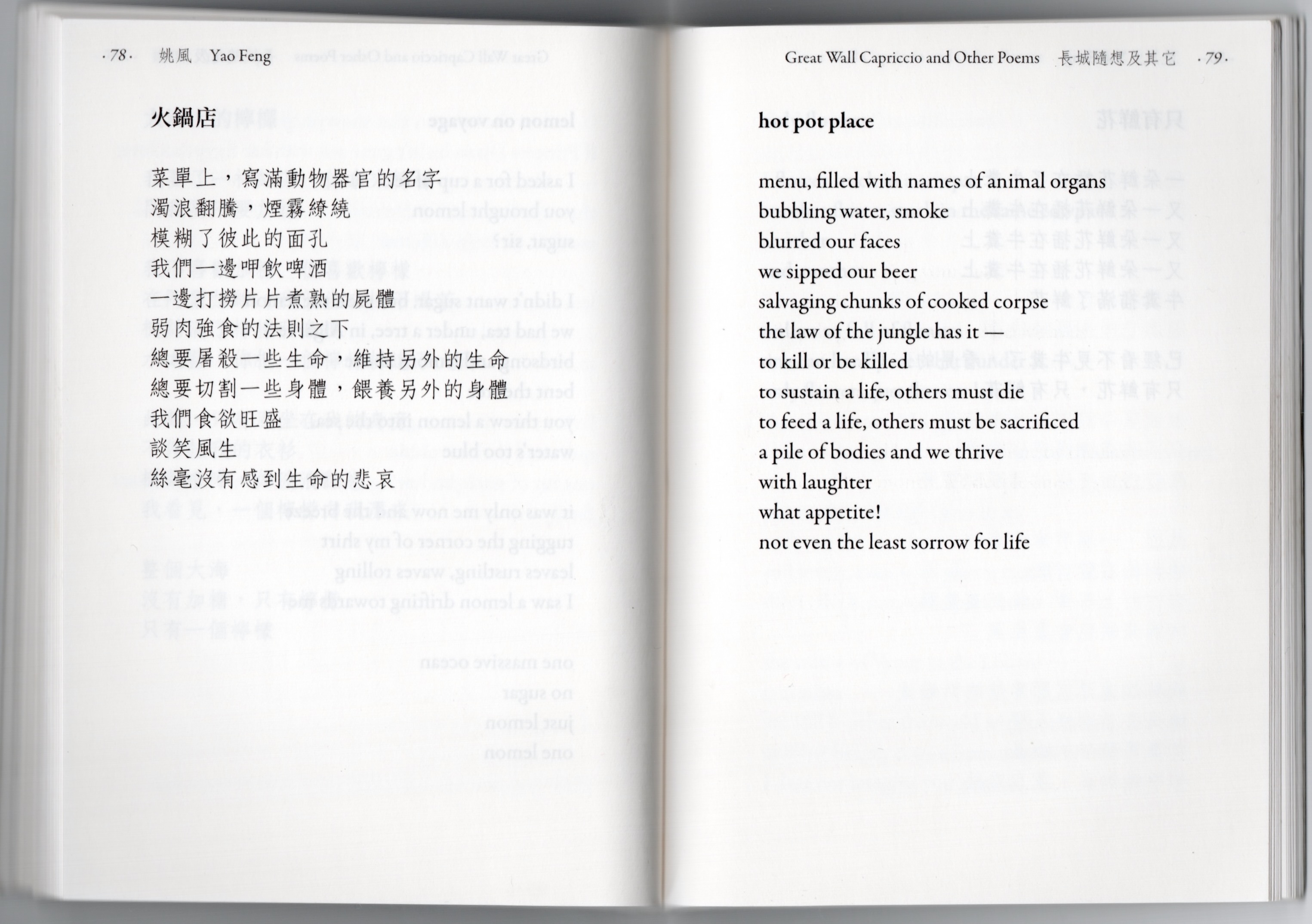
hot pot place

menu, filled with names of animal organs
bubbling water, smoke
blurred our faces
we sipped our beer
salvaging chunks of cooked corpse
the law of the jungle has it —
to kill or be killed
to sustain a life, others must die
to feed a life, others must be sacrificed
a pile of bodies and we thrive
with laughter
what appetite!
not even the least sorrow for life

Let me start with my grandson.

My four-year-old grandson is uncompromisingly vegetarian. He likes lambs or pigs to pat in a petting zoo, not to eat. When he overheard a WhatsApp message from someone saying they’d bring a chook to the Book Group, he asked if the chook would be alive, and I felt like a criminal when I told him it would be cooked and ready to eat. There was horror in his voice when he told me one afternoon that the lunch at daycare had been spaghetti bolognese.(He went hungry that day.)

‘Hot Pot Place’ lobs neatly right there. In case you need reminding, in such restaurants a variety of uncooked food is placed on the table, and the diners drop their chosen morsels into a communal pot of boiling stock. The first four lines conjure a cheerfully exuberant social occasion in one: the smells, the sounds the tastes are effectively implied.

The tone changes in the fifth line. The diners aren’t just fishing pieces of meat from the pot, but ‘salvaging chunks of cooked corpse’. The harshness of the language is completely in tune with my grandson’s horror at bolognese sauce, and the next four lines, with their change from past to present tense, can be read as a defensive response from a meat-eater. Everywhere in nature animals eat the corpses of other animals. So it makes sense to enjoy this meal.

But this is a poem, not an argument. The lines about the law of the jungle can also be read as affirming: in eating meat we are playing our part in the natural order of things.

I remember the particular joy I had as a child – quite a bit older than four, I think – when a bullock I’d known from when he was a calf was cooked on a spit at a party to celebrate a family member’s major birthday. Terry, the bullock, even had a nickname. We children called him Pookie because his head was often adorned by a little cap of cow poo from approaching his adopted mother’s udder from behind. I don’t remember feeling any horror, more a kind of comfort that I was eating an animal I knew, not one that had been turned into a commodity.

Then the last four lines. Are they the words of someone recoiling from the carnivorous spectacle? Or are they celebrating the event? Or even somehow both?

It’s not possible to read the phrase ‘a pile of bodies’ without thinking of horrendous events of the last hundred years, including some events where the bodies have been those of animals – I’m thinking of beached whales and recent massive fish kills in New South Wales. So the line ‘a pile of bodies and we thrive’ holds an almost impossible tension. It doesn’t condemn, but it won’t look away.

The last line, I think, does make a judgement. The poem’s speaker isn’t arguing for vegetarianism. It’s ‘sorrow for life’ that is absent, not guilt. He is noticing a callousness in himself and his companions. My mind goes back to Terry/Pookie: along with the joy of eating him, there was something that you might call reverence. The poem doesn’t ask, but it opens out towards asking: is it possible to thrive with laughter and appetite and at the same time honour the lives of the beings we eat, to feel the sadness of the dispensation in which ‘to feed a life, others must be sacrificed’?

My grandson would probably read the poem differently from me. It’s a bit beyond his capacity right now, but if he ever does get to read it, I hope he finds as much joy in it as I have.

This is my sixth post for National Poetry Month, and the fourth bilingual book from the Flying Island Books.


I first read Great Wall Capriccio while flying between Djaubay land and Gadigal Wangal land. I wrote the blog post on the land of Gadigal and Wangal of the Eora Nation. I acknowledge Elders past and present of all those Nations, and welcome any First Nations readers.


My blogging practice is to focus on the page that coincides with my age, currently 78.
Beginning Albert Camus’ L’étranger

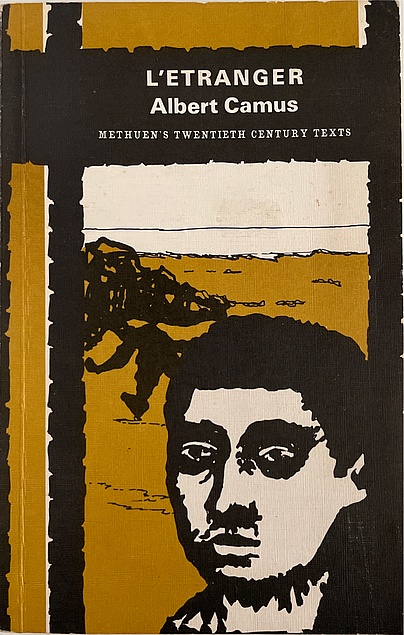
Albert Camus, L’étranger (1942, Methuen Educational 1970)

My practice of reading a couple of pages from a classic book every morning has been in abeyance since I finished reading Montaigne’s essays in January (final report at this link).

When a copy of L’Étranger turned up in a street library after Camus had cropped up in other reading – The Incorrigible Optimists Club and The Visionaries – I took it as a sign from the universe. I’ve read quite a lot about Camus, but not anything by him, except in excerpts and perhaps a play whose name I don’t remember. [Added later: I did read The Plague when I was 19, at my older brother’s bidding. I think I failed to think of it because I read it before I knew anything about Camus or existentialism, so it’s stored in a different file in my memory.]

My copy of the book has a protective plastic cover and the pencilled name of a former 6th form owner. There are pencilled notes on translation, but only on the first four pages (either her French got a lot better or she decided it wasn’t worth the effort to write). It also has some pedagogical apparatus – an introduction, a vocabulary, and a bibliography of critical studies, all of which I intend to ignore as far as possible.

I’ve just read Camus’ short avant-propos from 1955 in which he says that his protagonist, Meursault, becomes an outsider because, unlike the rest of us, he does not lie by exaggerating his feelings (‘majorer ses sentiments‘). Tomorrow morning I’ll start the text itself, and will report back in a month’s time.

Patricia Sykes Among the Gone of It

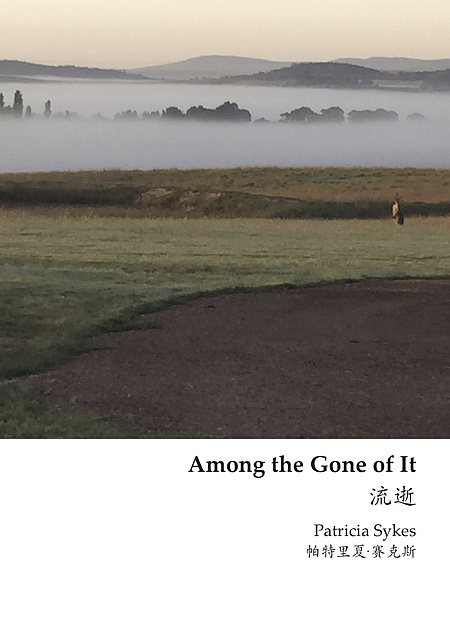
Patricia Sykes, Among the Gone of It, with Chinese translation by Xu Daozhi and Wu Xi (Flying Island Books 2017)

This is my fifth post for National Poetry Month, and my third bilingual book this month from the Flying Island Poets series.

A web search for “Patricia Sykes poet” produces a large number of hits that begin, ‘Patricia Sykes is a poet and librettist.’ She has collaborated with composer Liza Lim to create The Navigator, a chamber opera, and a number of her poems have been set to music. As a child she was a resident in the Abbotsford Convent orphanage in Melbourne (now an arts precinct), and as an adult she was a member of the Women’s Circus, both of which have been subjects of her poetry – in The Abbotsford Mysteries (2011) and Wire Dancing (1999) respectively, both published by Spinifex Press.

Of the translators, Xu Daozhi has a PhD in English literature studies from the University of Hong Kong and Wu Xi is a poet and scholar who was also stationed in Hong Kong at the time of translation. Again, I can’t comment on their work except to admire its visual beauty.

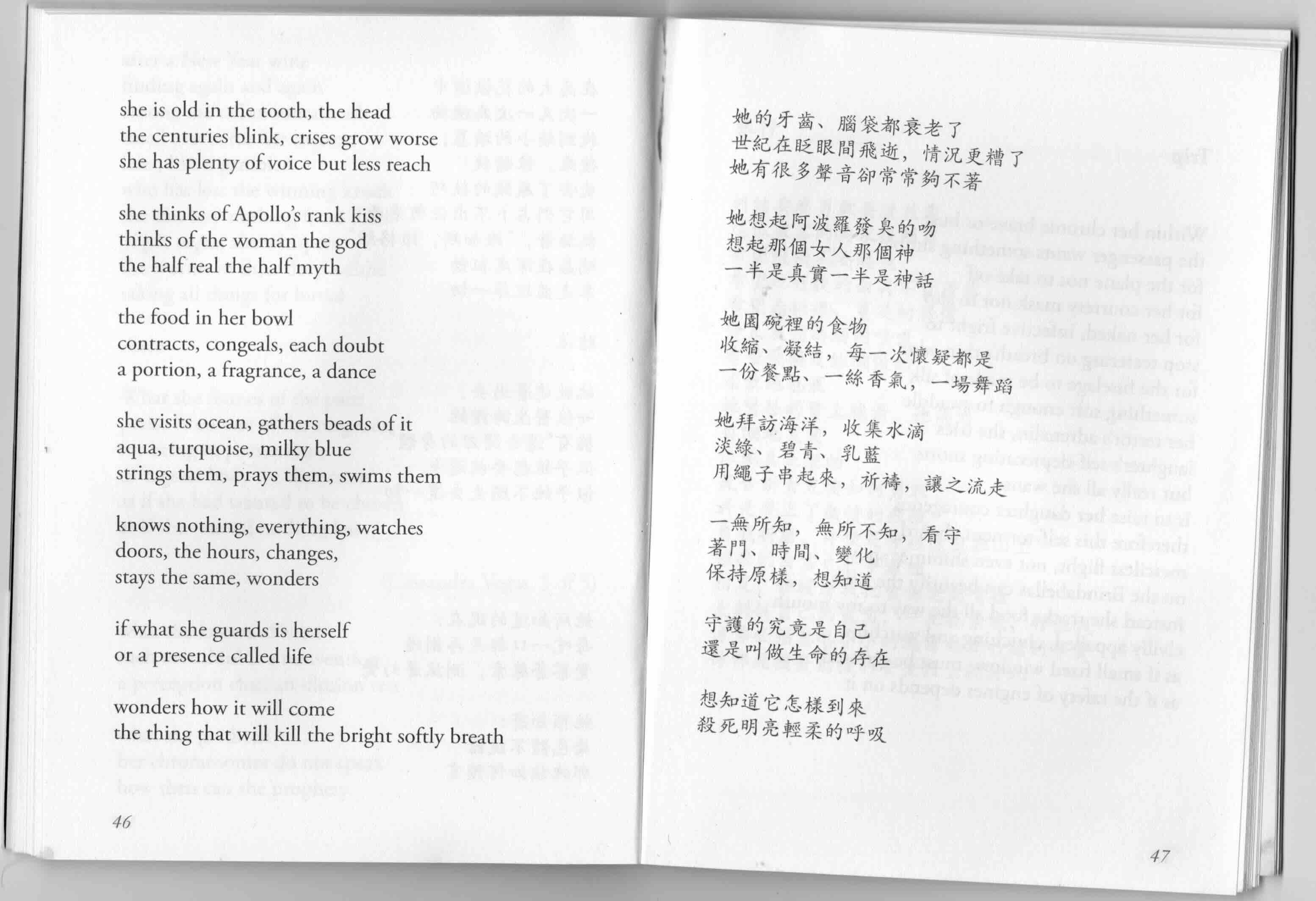
The poems in Among the Gone of It that spoke to me most strongly were those dealing with illness and ageing. By happy coincidence, one of these poems falls partly on page 47*.

‘Cassandra Vegas’ is a sequence of six poems in which the title character undergoes major surgery for cancer. Her name signals the poems’ concerns. In Greek myth, Cassandra had the gift of seeing the future, and Vegas is a synonym for gambling: so much language around illness and surgery is about prognosis (prophecy) and percentages (gambling odds). The sequence begins with ‘Casino’, in which Cassandra contemplates the risks of surgery or not-surgery:

to operate will swell the death odds
not to operate makes death certain

This is followed by ‘Theatre’ and ‘Anaesthesia’, whose titles give you their place in the narrative, though not their poetry. In ‘Angel Switch’ she is in intensive care after the operation. In ‘Vegas, Vagus’ she leaves hospital,

the craved bliss of silken air
a leaf's kiss on her bald head
like welcome to a newborn

and learns how to deal with the changes in her body.

The final poem is ‘Ante’, of which all but the first three stanzas are on pages 46–47.

The title, meaning ‘before’, at first seems ironic, as the poem is in the position where you might expect one titled ‘Aftermath’. But it also sits in anticipation of whatever is to come next – an ante is a bet placed on the table before the next hand is dealt.

The first three stanzas have dealt methodically with the immediate past (‘praise from one of the surgeons’), the present (‘each mouthful is a reinvention’) and the unknowable future (‘her chromosomes do not speak / how then can she prophesy?’). The poem now opens out:

she is old in the tooth, the head 
the centuries blink, crises grow worse
she has plenty of voice but less reach

she thinks of Apollo's rank kiss
thinks of the woman the god
the half real the half myth

Not that the preceding poems in the sequence have been straightforward narrative, but this marks a shift. ‘She is old in the tooth, the head’ is a simple literal statement, but with ‘the centuries blink’ it takes on a grander meaning. As in Walter Pater’s famous description of the Mona Lisa, ‘She is older than the rocks among which she sits’, the woman in this poem has become archetypal. The crises that grow worse refer both to her individual worsening health crises and to the deepening crises of the society and world around her. In another context, ‘plenty of voice but less reach’ could be a lament about contemporary poetry in general – there’s a lot of it out there, but the readership is small. (I’ve just been listening to a lecture by Sarah Holland-Batt on the Fully Lit podcast, in which she says, ‘Australia has never been short of poets, it’s short only of poetry readers.’)

In the next stanza the archetype is further identified. Cassandra in Greek myth was given the gift of prophecy by the god Apollo, but when she didn’t reciprocate his desire (his ‘rank kiss’), he added the curse that no one would believe her prophecies.

The remaining stanzas enlarge on that last line: what does ‘the half real the half myth’ mean?

The next stanza is a kind of bridge. It first evokes her post-surgery difficulty eating, as described earlier, and then goes to a new place:

the food in her bowl
contracts, congeals, each doubt
a portion, a fragrance, a dance

The unpleasant image of food contracting and congealing becomes a metaphor for doubt – the uncertainty, tentativeness, anxiety that can follow major surgery. Somehow these doubts, this unpleasant food, are transformed, in three steps. The food is a portion – it is what has been allotted to her, what has landed on her plate. Unpleasant as it looks, it has a fragrance – let’s attend to qualities other than its visual qualities. But there’s a subtle shift. Food has a fragrance, but here each doubt is a fragrance. The poem is leaving the literal food behind and talking now about what it represents metaphorically. In the final word of the stanza, the food has gone completely, the doubts are transformed into a dance.

The next three stanzas spell out the nature of that dance:

she visits ocean, gathers beads of it 
aqua, turquoise, milky blue
strings them, prays them, swims them

knows nothing, everything, watches
doors, the hours, changes,
stays the same, wonders

Crude paraphrase: ‘She is fully alive to the world.’ I love the idea of gathering beads of ocean – to wear, to pray like a rosary, to immerse herself in them. And I love the line break at the end of this stanza. If the poem finished here, we’d be left with Cassandra filled with wonder. That meaning lingers for a moment, but at the start of the next line the meaning of ‘wonders’ morphs from ‘has a sense of awe’ to ‘asks the following questions’.

stays the same, wonders

if what she guards is herself
or a presence called life

The play with myth is resolved. Like all of us, this woman is an embodiment of something sacred, ‘a presence called life’. ‘Guards’ is an interesting word. Unlike words like ‘battle’ or ‘struggle’ commonly used in this context, it implied strength but also tenderness and caring: she is not defensive, but protective, of the ‘presence’.

And the poem ends with an acknowledgement that survival is inevitably temporary. A harsh paraphrase of the final stanza might be, ‘Wonders how she will die.’ But it’s interesting to notice what that paraphrase leaves out (and I so wish I could read the Chinese translation). In this phrasing she won’t die – she will be killed. The ‘thing’ could be a car, a cancer, a virus, a lightning strike. And what it will kill is this precious, tender thing. It’s not fear of death being expressed, but a cherishing of life, knowing that death will come. The pedant in me would insist that ‘softly’ is an adverb, that it should be ‘bright, soft breath’. I can’t justify it, but the pedant is just wrong this time.

And I’m so glad there’s no full stop at the end. Even punctuation can carry metaphorical meaning.

wonders how it will come
the thing that will kill the bright softly breath

I first read Among the Gone of It while flying between Djagubay land and air and Gadigal Wangal land and air. I wrote the blog post on the Country of Gadigal and Wangal of the Eora Nation. I acknowledge Elders past and present of all those Nations, and welcome any First Nations readers.


My blogging practice is to focus on the page that coincides with my age, currently 78. The last poem in Among the Gone of It finishes on page 77, so my personal algorithm sends me to page 47 (I was born in 1947).
Judy Johnson’s Exhibit

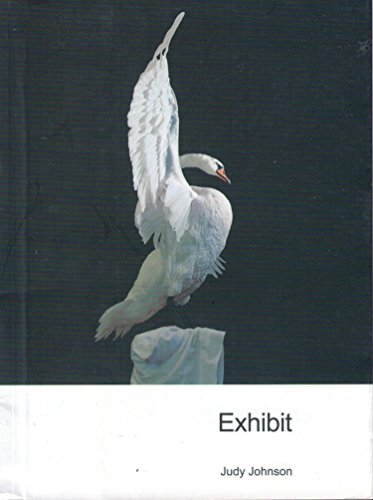
Judy Johnson, Exhibit, translated into Chinese by Iris Fan Xing (Flying Island Books & ASM 2013)

This is my fourth post for National Poetry Month.

Like Geoff Page’s Codicil, Exhibit is a bilingual book, aiming to bring an Australian poet to a Chinese readership.

According to the book’s dust-flap, Judy Johnson has been writing and publishing poetry for 20 years, and has won a number of prizes. She was editor of Picaro Press’s Wagtails series of chapbooks for some years. In 2021 she appeared with David Ades on his Poet’s Corner video show (link here), where among other things she spoke interestingly about her African-American convict ancestors and her book Dark Convicts, which I now have on order from Gleebooks.

Iris Fan Xing, the translator, was a PhD student at the University of Western Australia when the book was published in 2013. An interview with Robert Wood in Liminal Review of Books in 2021 (at this link) makes lovely reading for anyone who’s interested in translators, wonder-workers who are usually pretty much invisible. Sadly, my only response to her work in this book is to enjoy its visual beauty.

The book’s verso pages – that is to say, the English text – are terrific. To attempt the impossible and generalise: the poems tend to focus on small things (‘Three Tools’ fulfils the promise of its title), specific places (‘Walking Nobby’s Breakwall’ is almost a poetic manifesto for focusing on the small and partial), small interactions (‘Words, after an Absence’), without ever being trivial. Again and again in this book I was struck by a brilliant metaphor.

A poem that could provide a fun exercise for students, one of several set in Ireland, is ‘Saint Kevin and the Blackbird’ (which you can read as first published in Westerly in 2012 at this link – it’s a PDF, and you need to scroll quite a lot). The late great Seamus Heaney wrote a poem of the same name (which you can read at this link). Both poems tell the legend of a bird building a nest in the saint’s hand outstretched in prayer. One imagines what is happening in the saint’s mind and body; the other makes acerbic feminist comment on his broader life. Judy Johnson isn’t afraid to take on the big names.

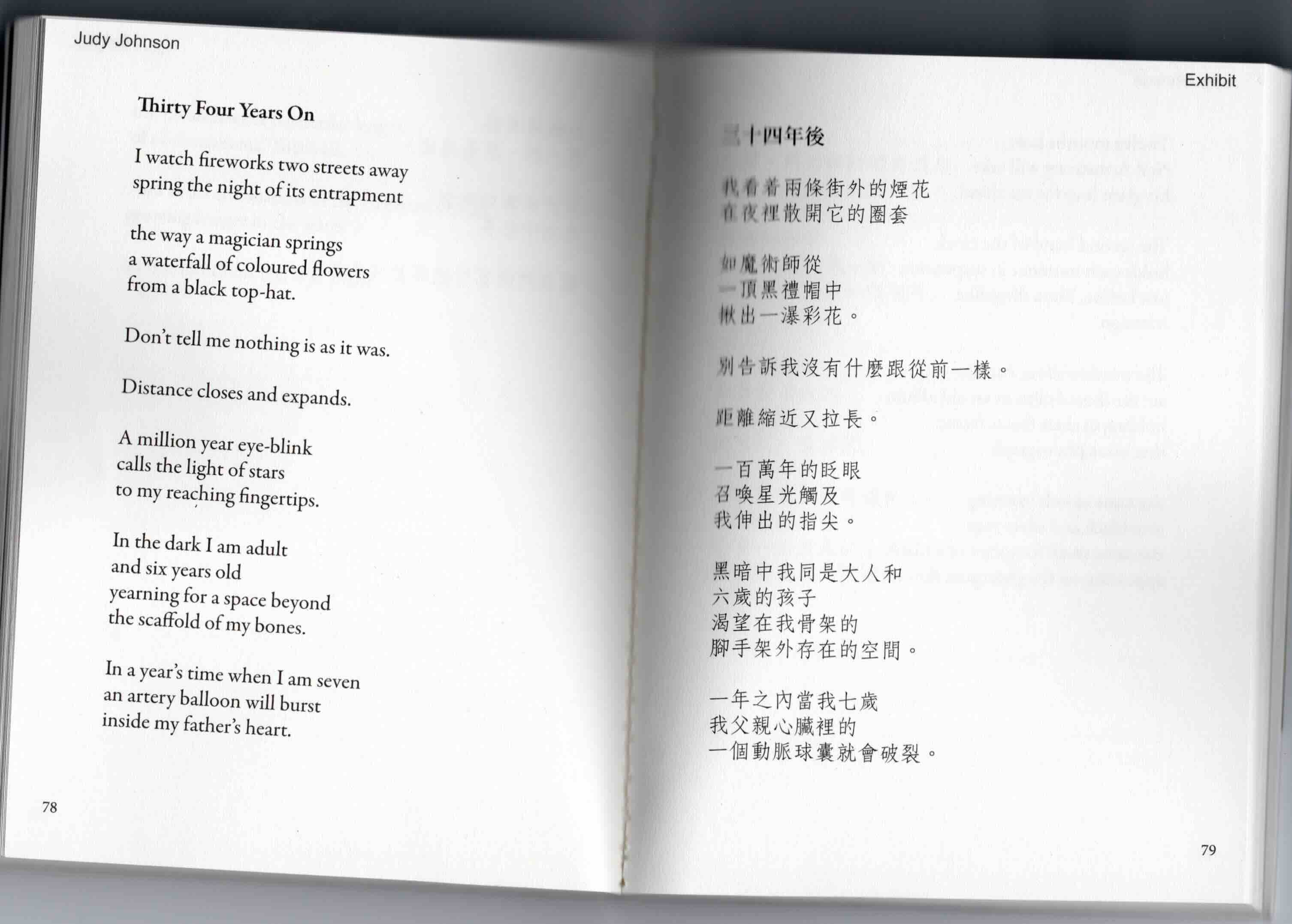
If you were browsing in a bookshop and flipped to page 78* of Exhibit, you’d be looking at the first of two pages of the poem ‘Thirty-Four Years On’. Here it is, with the Chinese translation opposite:

The title is a bit of a tease: thirty-four years on from what? My guess, based on the numbers given in the poem, is that its present moment is the year 2001, and the immediate prompt of the poem is a fireworks display, probably as part of Australia’s centennial celebrations. The fireworks remind the poem’s speaker of a similar display from her childhood, which she calculates to have been 34 years earlier. (It’s not that 34 is a significant anniversary, as in the episode of the Seth Hogan show Platonic when a character celebrates her ‘big two-six’.)

Thirty Four Years On
I watch fireworks two streets away
spring the night of its entrapment

I’m used to thinking of fireworks as embodying ephemerality: now they’re here, and beautiful, now they’re gone leaving nothing but the smell of cordite. In this poem they have a different effect. The night is normally trapped in just one time, but the fireworks explosion frees the speaker’s mind to be in more than one time at once, like magic:

the way a magician springs 
a waterfall of coloured flowers
from a black top-hat.

This is the kind of thing I mean about Judy Johnson’s use of metaphor. The firework’s time-freeing effect is magic, and the fireworks share other elements with a magician’s act – the cascading colours produced from a hat, which further bolsters the metaphor by being black like the night.

The next three stanzas play with time and space in more or less abstract ways. How this relates to the opening image won’t become clear until the following stanza.

Don't tell me nothing is as it was.

A possible paraphrase of this is, ‘I don’t want you to remind me of the obvious fact that that things are always changing.’ The poem’s speaker is experiencing the present moment as identical to some other moment.

Distance closes and expands.

She is also experiencing physical space as relative. In her mind, she is living in two times and places at once.

A million year eye-blink 
calls the light of stars
to my reaching fingertips.

Isn’t that beautifully put? We know how long it takes light to reach us from the stars, but that’s not how we experience it. It’s both a million years and an eye-blink. At the same time, the stars remind us that the poem started with a fireworks display two streets away – and also 34 years ago.

The next stanza brings us back to the present moment:

In the dark I am adult 
and six years old
yearning for a space beyond
the scaffold of my bones.

At a literal level, then, the fireworks remind the speaker of a similar display when she was six years old. The ‘scaffold of my bones’ echoes the ‘entrapment’ of the night. She remembers as a child longing for transcendence.

Because I’m looking at the poem closely, I’ve done my sums. Judy Johnson was born in 1961. She was six in 1967, and 34 years after that, she is 40 and Australia is celebrating its Centenary. The poem is prompted by a fireworks display in 2001.

Having been taken back to that moment, she then moves forward in time:

In a year's time when I am seven 
an artery balloon will burst
inside my father's heart.

If the poem ended here, it would be a bit of a downer: ‘Ah, these magical fireworks remind me of a similar display when I was six. Oh, then my father died.’ But that’s not the tone. The next stanza, over the page, also a three-liner, moves forward to the next year, 1969, with an abrupt change of register from intensely personal to public. 1969 is the year when ‘Neil Armstrong will take / his giant leap for mankind’.

This progression changes the way her father’s sudden death is presented: not so much a personal trauma as simply the next major event after the fireworks, with the moon landing the one after that. It’s not that the pain of her father’s death is minimised – it’s just not indulged, and it’s not mentioned again in the four remaining stanzas of the poem. In my reading, that silence is the heart of the poem.

I want to quote one more stanza:

The second hand of the clock
holds each moment in suspension
just before, like a slingshot
it lets go.

The observable way a second hand moves jerkily becomes a metaphor for the way we remember moments, almost like still photographs, but that time moves on inexorably.

The final paragraphs return to the fireworks, seen through a window, whose ‘four corners / are cardboard clips in an old album / holding in their freeze frame / that same photograph’. Time moves on, things change constantly, but this moment make those past moments present: the fireworks, the clouds of smoke (‘black an silver rags’), and

the same small footprint of a man
appearing on the ghostgum moon.

I’ve heard Evelyn Araluen speak derisively about how settler Australians love to write about ghost gums. At the risk of incurring her mockery, I think ‘ghostgum moon’ is perfect here – as an Australian reference that contains the word ‘ghost’ it does a lot of subliminal work. The poem focuses closely on that ‘same small footprint of a man’, leaving the bursting artery balloon in the realm of the unspoken, almost unspeakable, but with just the wisp of a reference to it in those final two words of the poem.

(For reasons that are probably peculiar to me, I find myself remembering Biblical quotes and theological concepts from my youth: ‘The seven years seemed to him to be just seven days, so great was his love’; the sacrifice of the Mass doesn’t just commemorate Jesus’ sacrifice on the cross, it is that sacrifice, happening in the present moment, not repeated but the same.)

Not that I saw all that on first reading, but I felt some of it, which is what poetry can make happen.


I first read Exhibit while flying over countries between Djabugay land and Gadigal Wangal land. I wrote the blog post on the land of Gadigal and Wangal of the Eora Nation. I acknowledge Elders past and present of all those Nations, and welcome any First Nations readers.


My blogging practice is to focus on the page that coincides with my age, currently 78.
Geoff Page’s Codicil

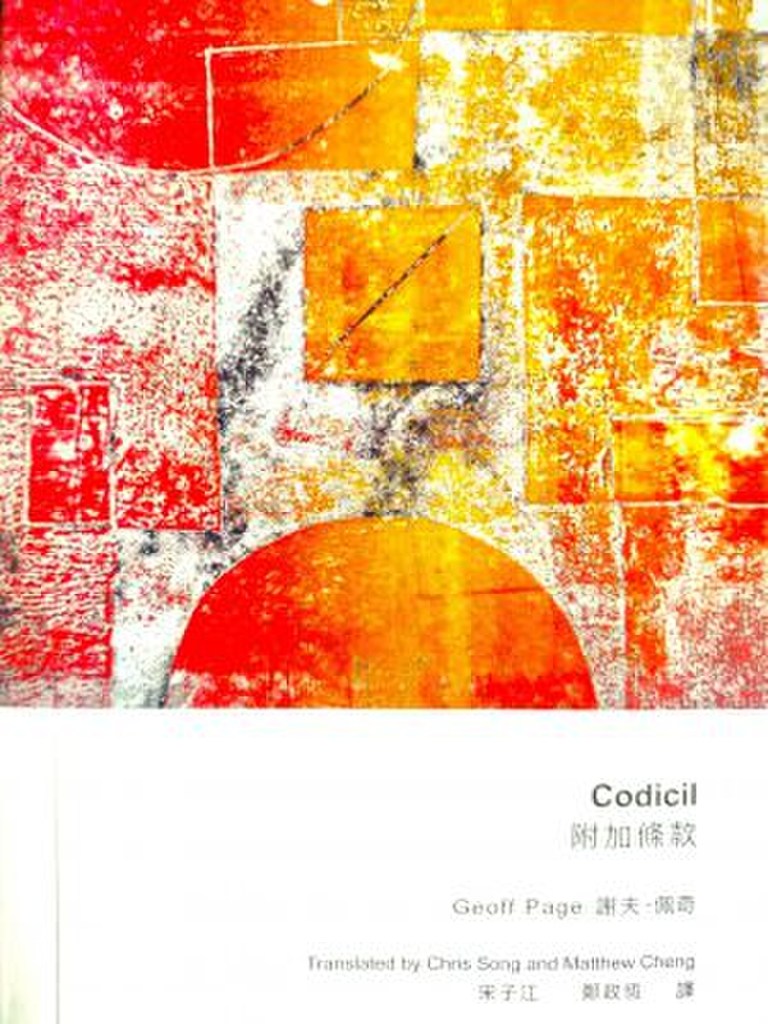
Geoff Page, Codicil, tanslated into Chinese by Chris Song and Matthew Cheng (Flying Island Books 2019)

It’s National Poetry Month in Australia. The Red Room Poetry site lists a plethora of events, workshops and competitions, promoted by ambassadors ranging from journalist Stan Grant to comedian Suren Jayemanne.

Codicil is the third book of poetry I’ve read so far in Poetry Month. I plan to read and blog about three more.

Geoff Page’s poetry has been around for a long time. I have an alarming number of anthologies of Australian poetry on my bookshelves, and his work appears in most of them, from Poet’s Choice (Island Press 1971, a limited, hand-set and -printed edition of 500 copies) to Contemporary Australian Poetry (Puncher & Wattmann 2016). His work is wonderfully accessible, using traditional forms without being trite or hidebound. For an intelligent discussion of his poetry, you’d find it hard to go past Martin Duwell’s review of his New Selected Poems (Puncher & Wattmann 2013). The whole review is worth reading, but I’ll just quote his description of Page as ‘a public poet who reflects the social concerns of the time of the Bicentennial and into the first decade of the twenty-first century’, and as a writer of personal poems with the ‘dominant image of himself as an outsider in a family he loves’.

Duwell’s description fits Codicil, which includes some new poems and at least three of his most anthologised poems, ‘Smalltown Memorials‘ (1975), ‘Grit’ (1979) and ‘My Mother’s God‘ (1988) – the links are to recordings of Page reading the poems on the Poetry Archive website. What I take to be the most recent poems here deal with ageing and the approach of death – the title poem is instructions for the disposal of the poet’s ashes on the Clarence River, where he spent his childhood.

I imagine that the poems were selected by the translators, themselves accomplished poets in Hong Kong, with the intention of introducing Page’s work to Chinese readers. I wish I could read Chinese, because I’d love to know how they have dealt with the frequent Australian idioms and throwaway references. Like this from ‘Three Akubras’:

Three Akubras in a row
my brothers underneath them
standing at the saleyards there

Or this, from ‘Severance’, an imagined speech to an employee being sacked:

User Pays and 
Market Forces
are all the rhet-
oric you'll get.

(And what have they done with that weird hyphen that’s there for the sake of metre and rhyme?)

And I’d love to know what a Chinese reader might make of his occasional professions of allegiance to iambics, as in ‘I Think I Could Turn Awhile’, in which he imagines writing ‘like the Americans’, an heir to Whitman. But then:

I'd hear the clipped
iambics calling,
my template just
beneath the line

For me, alas, the bilingual aspect of the book amounts to a purely visual effect – and it is fascinating to see what these very Australian poems look like in Chinese characters.

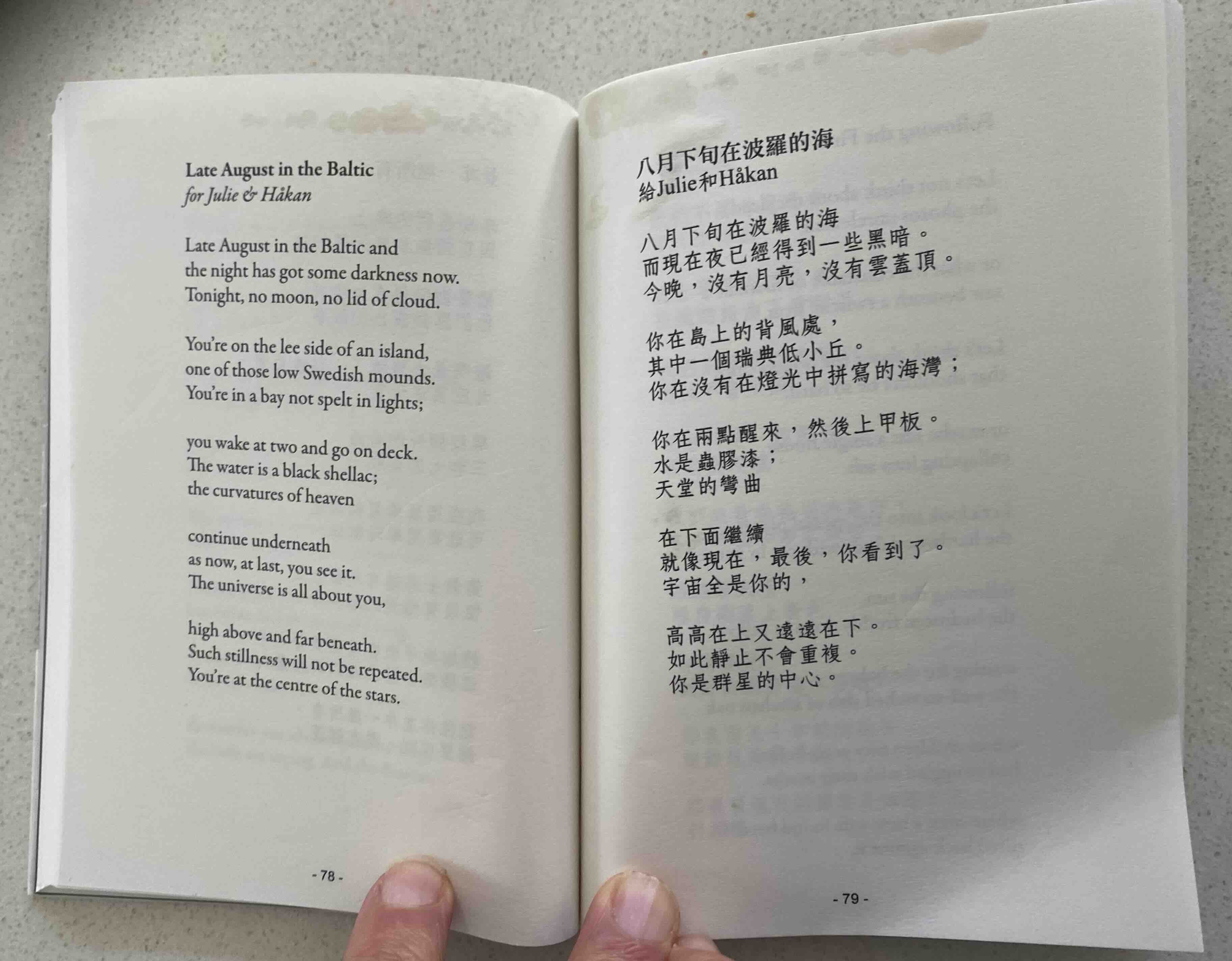
Here’s an image of pages 77 & 78*:

The poem, first published in Island magazine in September 2009, is neither a public poem dealing with issues of the day, nor a personal poem dealing directly with family or mortality. I read it as a letter to friends who are on a boat somewhere on the Baltic Sea, perhaps in response to a photo they have sent. Whatever, it’s a wonderful evocation of a still, moonless night on the water.

It’s almost a sonnet. The first eight lines paint the scene, and the almost perfectly regular iambic pentameters (de-dum de-dum de-dum de-dum) enact the calm of the night.

Late August in the Baltic 
for Julie & Håkan

Late August in the Baltic and
the night has got some darkness now.
Tonight, no moon, no lid of cloud.

You're on the lee side of an island,
one of those low Swedish mounds.
You're in a bay not spelt in lights;

you wake at two and go on deck.
The water is a black shellac;

Then there’s a turn, so gentle, in mid stanza with just a semicolon to mark it. The lines get shorter, and the literal elements of the poem – the island, the time of year, the deck, the absence of lights on shore – give way to more fanciful language:

the curvatures of heaven

continue underneath
as now, at last, you see it.

Then the regular iambics re-establish themselves – as if a small wave of metaphor has momentarily disrupted the stillness of the poem, and it can now continue, but with a broader view:

The universe is all about you,

high above and far beneath.
Such stillness will not be repeated.
You’re at the centre of the stars.

Pause for a moment to look at the second last line. Without it, the poem would have been a sonnet, and the bunching up of sibilants in ‘Such stillness’ strikes a dissonant note. I don’t think this is a flaw. What the line says – a warning not to expect life always to be like this – is unobtrusively reinforced by its comparative harshness and a faint sense that it disrupts the form. Whatever, it makes sure that what is to come in the last line is read as humbling rather than grandiose.

The last line gies us the word that has been implied but conspicuously missing from the first part of the poem: ‘stars’. It’s not completely irrelevant that this is the word that comes at the end of each book of Dante’s Divine Comedy.

We are at the centre of myriad points of light – not a narcissistic centre, but one who for this unrepeatable moment has a glimpse of the immensity and splendour of the cosmos. I’m reminded of Yayoi Kazuma’s infinity mirror rooms.

I’m in awe of Chris Song and Matthew Cheng for taking on the task of translating a poem that works so much through the rhythms and traditions of its native language.


I read Codicil on Wulgurukaba land, beautiful Yunbenun. I wrote the blog post on the land of Gadigal and Wangal of the Eora Nation. I acknowledge Elders past and present of all those Nations, and welcome any First Nations readers.


My blogging practice is to focus on the page that coincides with my age, currently 78.
Anything Can Happen with Susan Hampton at the Book Club

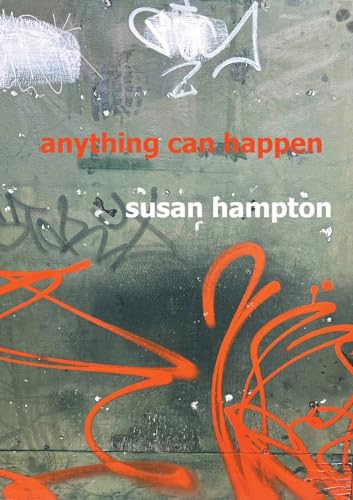
Susan Hampton, Anything Can Happen (Puncher and Wattmann 2024)

We decided on this book before checking on availability. All was good for the Kindle readers, but there was a long queue at the library and it was out of stock in Sydney bookshops, pending reprint. Nor did we have any luck at Avid Reader in Brisbane on our travels. In the end, the Emerging Artist bought it for the Kindle app and we read the book to each other.

So that is how I experienced Anything Can Happen: being read to or reading it aloud on beaches, in cafes, under the benign tropical winter sun. I recommend it.

Before the meeting: Susan Hampton is a poet. She has ghost written a celebrated memoir with a First Nations person, and The Kindly Ones, a novel in verse, but this book is the first long prose work of her own making. It’s not an autobiography, but memoir. She makes that distinction in the first pages:

Whereas in autobiography ‘everything’ is told, often in chronological order, the memoir is partial, with the capacity for time loops … The scenes of your childhood, the river, the back lane, the silo, rise up to replace your mother’s arm. That dissolves and you find you’re hearing or in fact making up a conversation.

Anything Can Happen isn’t in chronological order, and it doesn’t attempt to tell everything. It gives us accounts of key relationships: Hampton’s Slovenian husband, Joe, whom she left after a very few years but who was an important part of her life until his death in Slovenia decades later; her mother and grandmother; her son Ben; Tommy, a woman in her thirties on whom she had a crush when she was a teenager and who stayed in her life until Tommy died in her 80s, by then a close friend of the Susan’s mother; a number of romantic and/or toxic entanglements and other friendships with women.

There are glimpses of a working-class childhood in the Hunter region; of life as an academic single mother in the Inner West of Sydney (she and I had children at different schools in the same suburb in the 1980s); of a number of years living in a rural area and becoming a kind of hub for a Lesbian community; of later married life in the beautiful mid-north coast of New South Wales (she married her partner Charlotte in the British embassy in Canberra before same-sex marriage became legal in Australia).

And there’s an impressionistic account of her development as a writer. A main thread of this account is a novel project, which remains on the go for decades and still exists only as a series of unsatisfactory drafts and many books full of notes. One of the many pleasures of this book is the dawning realisation that it is an extended piece of prose from a writer who says she is incapable of writing such a thing.

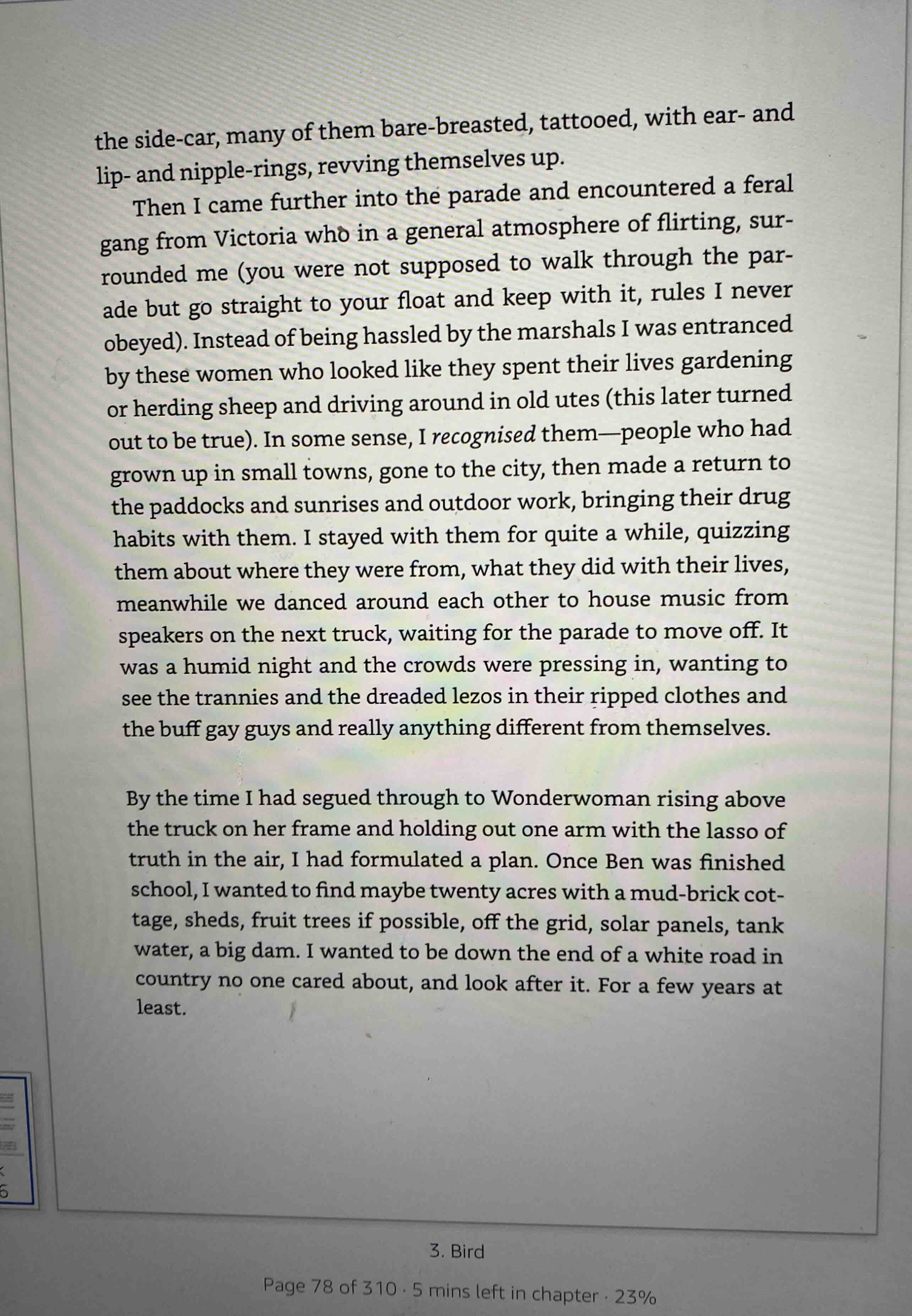
In a memoir of a life that has seen so many wildly different phases, you could open up any page and get a different sense of what kind of book it is. At page 78, Susan joins the Gay and Lesbian Mardi Gras. She walks alone among the Dykes on Bikes. One or two women sat on each bike, and often one of the side-car:

Then I came further into the parade and encountered a feral gang from Victoria who in a general atmosphere of flirting, surrounded me (you were not supposed to walk through the parade but go straight to your float and keep with it, rules I never obeyed). Instead of being hassled by the marshals I was entranced by these women who looked like they spent their lives gardening or herding sheep and driving around in old utes (this later turned out to be true). In some sense, I recognised them – people who had grown up in small towns, gone to the city, then made a return to the paddocks and sunrises and outdoor work, bringing their drug habits with them. I stayed with them for quite a while, quizzing them about where they were from, what they did with their lives, meanwhile we danced around each other to house music from speakers on the next truck, waiting for the parade to move off.

Just a few pages earlier, Hampton has reflected that her autobiographical writing is ‘partially confected, altered, made more symbolic, exaggerated, even invented’ because after all, ‘you wanted the reader to be swept along in the story, to turn the page’. I don’t at all doubt the truthfulness of this paragraph, but it’s also a nice example of detail being selected in order to serve the longer story. The Dykes on Bikes are colourful context, but the ‘feral gang from Victoria’ are there to foreshadow the years in which Hampton was to own a small property in rural Victoria and, even while she did scholarly and poetic work indoors, became one of just such a feral gang. And there’s recurring motif of Hampton ignoring rules – here she disobeys the Mardi Gras rule; elsewhere she climbs fences into private property, snoops in people’s bedrooms, even pilfers personal items. These details may be ‘partially confected’, or they may be part of a ruthless honesty about her own failings – either way they do keep us turning the pages (or swiping the screen).

Then there’s this sentence, easy to miss among all the colour and movement:

It was a humid night and the crowds were pressing in, wanting to see the trannies and the dreaded lezos in their ripped clothes and the buff gay guys and really anything different from themselves.

There’s a gentle challenge to the reader here. The Gay and Lesbian Mardi Gras parade is an event primarily for the LGBTQI+ community (a term Hampton doesn’t use) but it’s also a spectacle enjoyed by the mainstream, possibly voyeuristically she suggests. Could something similar happen with this book? Unlike, say, Kerryn Higgs’s excellent novel All That False Instruction, this book doesn’t set out to ‘explain’ Lesbian experience to mainstream readers. If anything, the author is seeking to understand her own story, of which Lesnianism is a major part but not the whole. But, she suggests indirectly here, some readers may be here for the inside story on ‘the dreaded lezos’ – as at the Mardi Gras, they may not be unwelcome, but they are on the outside pressing in.

By the time I had segued through to Wonderwoman rising above the truck on her frame and holding out one arm with the lasso of truth in the air, I had formulated a plan. Once Ben was finished school, I wanted to find maybe twenty acres with a mud-brick cottage, sheds, fruit trees if possible, off the grid, solar panels, tank water, a big dam. I wanted to be down the end of a white road in country no one cared about, and look after it. For a few years at least.

And that is more or less where the story soon goes.

We read this book along with Debra Oswald’s 100 Years of Betty. Where that book feels as if it grew from a treatment for a TV series, and never quite shook off its origins, this one may well have started out as a collection of prose poems, and has kept some of the compressed, elliptical, elements of that beginning.

After the meeting: We met in a pub, and had a lot of catching up to do. Two of the five of us had met Susan Hampton, one just briefly, and one for some time when they both lived in Canberra (where in the book she says she made a number of good friends). So our book conversation was a little more gossipy than usual – though not at all nasty or juicy. I had hoped someone would know the identities of the women known as the Gardener and the Radiographer with whom Hampton had an unsettling relationship, but that wasn’t to be.

We all enjoyed the book, partly because so many of its places were familiar to at least some of us, and it was pleasurable to have them described from a different point of view. One person felt that there was an almost sociological tone to the chapters about Hampton’s family background, and that seemed to spread in some way to a kind of distance or detachment in the telling as a whole. (I don’t know what I think about that.It didn’t strike me that way, but I don’t think it’s wrong.) We noted that there are gaps in the story, but realise they may have been necessary to protect other people’s privacy.

One of the many rules of the Book Club has been ‘No Lesbian novels unless the Lesbianism is incidental to the plot.’ The club’s membership is majority Lesbian, and the rule was there because (I’m told) novels about Lesbianism tend to be badly written. With The Safekeep and Anything Can Happen, the prohibition has gone the way of Mardi Gras rules on page 78.


We read Anything Can Happen to each other on Wulgurukaba land, beneath an intense blue sky on the island of Yunbenun. The Book Club met on Gadigal Wangal country, which is where I have written the blog post. I acknowledge the Elders past and present of those Nations, and welcome any First Nations readers of this blog.


My blogging practice is to focus on the page that coincides with my age, currently 78.
Debra Oswald’s 100 Years of Betty and the Book Club

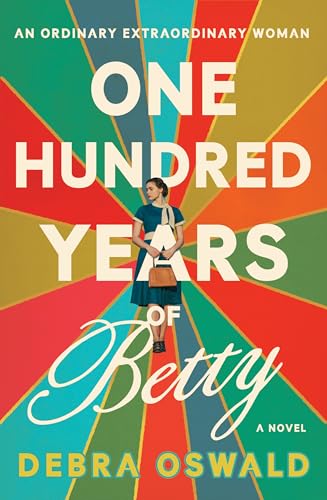
Debra Oswald, One Hundred Years of Betty (Allen & Unwin 2025)

Long before the meeting: If not for the Book Club, I would have put this book aside at page 14. Betty is the seventh child in a desperately poor family in South London. Her Catholic mother dies soon after giving birth to a tenth live child. As Betty and her Protestant father emerge from church they pass the two priests who have said the funeral Mass, one ‘in a creamy chasuble with scarlet embellishments, the other sporting a gold-embroidered number’. Betty’s father delivers a tirade:

Tell my daughter Betty the truth on this day we’re burying her poor Catholic mother. Tell her that it’s all a lie and that you two – with your fancy clothes and your Latin gibberish and your snouts in the trough – you know it’s a lie. Your religion is a pack of fairy stories to bamboozle poor people and keep us in line. Tell her.

I don’t mind a bit of anti-Catholic vitriol. In my devout childhood I was intrigued by mockery of the saints in a Walter Scott novel, and as a 17-year old trainee religious I was thrilled by Dostoevsky’s Grand Inquisitor. BUT this just gets too much wrong. Two priests saying Mass for a poor person’s funeral? Not likely! Even one priest standing at the door of the church still wearing his vestments? Also not likely! And even a quick google would have told the author (or certainly her editors) that priests wore black chasubles at funerals – never cream or (gasp!) scarlet.

But what the Book Club wants …


Before the meeting: I did persevere. It’s not a terrible book, and there were no other moments that felt so wrong.

Betty works in a factory, emigrates to Australia, falls in love and makes two lasting friendships on the ship, marries a rich man who becomes abusive then kills himself leaving her destitute. She has two children each of whom is problematic, protests against the Vietnam War, joins Women’s Liberation, spends some time living in Mexico where she loves swimming in cenotes, comes back to Australia for her daughter’s wedding, works in television where she eventually becomes a writer, has her heart broken a number of times, helps out in an AIDS ward, has a severe depressive episode, develops breast cancer, finds happiness when reunited with her first love, sees friends die. Oh, and there’s a daughter she gave out for adoption before leaving England. As she moves through the phases of her life her name changes: Betty, Beth, Elizabeth, Lizzie, Liz, and finally back to Betty. Sometimes I cared and was engaged, sometimes not so much. I did laugh a number of times.

I never got a feel for the narrative voice – the voice of 100-year-old Betty. There are self-conscious moments when Betty warns us (mostly disingenuously) that things won’t turn out as they do in novels, or expects us to be surprised at her earthiness, but these don’t create the sense of an actual person telling the story.

The penny dropped for me in Chapter 16, when a friend urges 63-year-old Betty to pitch a long-held idea for a show to a TV channel. Betty realises she no longer has ‘the stamina to deal with the machinery of TV drama, the muscle spasms of hope and dejection, the delicate calculations of conciliation and obstinacy required of you’. That night in bed, her husband suggests that she could put the idea into novel form, and Betty’s career as a novelist is launched.

Ah! I thought. One Hundred Years of Betty is really the treatment for a TV show. When it makes it to the screen, which is very likely, I’ll be happy to watch it.

I’m sorry to be so negative. I may have come to the book with inappropriate expectations. Maybe I was wanting the story of an individual life told in the context of world events in the manner of Annie Ernaux’s The Years, Alan Hollinghead’s Our Evenings, or Ian McEwan’s The Lesson. Maybe I expected a fictionalised treatment of Debra Oswald’s mother’s generation, something probing and compassionate. This isn’t one of those books, and nor does it need to be.

After the meeting: Unusually, we met in a pub. As always with the Book Club, we had two books on our agenda. The other one, Susan Hampton’s Anything Can Happen, took up most of the discussion.

One of the other Catholics said she registered the problems with the post-funeral scene that so irritated me, but it hadn’t disturbed her. One of the non-Catholics said the scene felt very Anglican to her rather than Catholic.

A couple of people felt there was a box-ticking element: the songs, devices, events more or listed as a way of marking the different eras. Others felt that was a feature rather than a bug. Betty’s life touches on major events of her times, is sometimes significantly changed by them, without their ever becoming her central passionate concerns.

Someone described the book as an excellent summer beach read, engaging enough to keep you entertained without making big demands. She said it a lot better than that, and I think we all agreed.


The Book Club met, and I wrote this blog post, on land of Gadigal and Wangal of the Eora nation. I acknowledge their Elders past present and emerging, and gratefully acknowledge their care for this land for millennia. I welcome any First Nations readers of this blog.

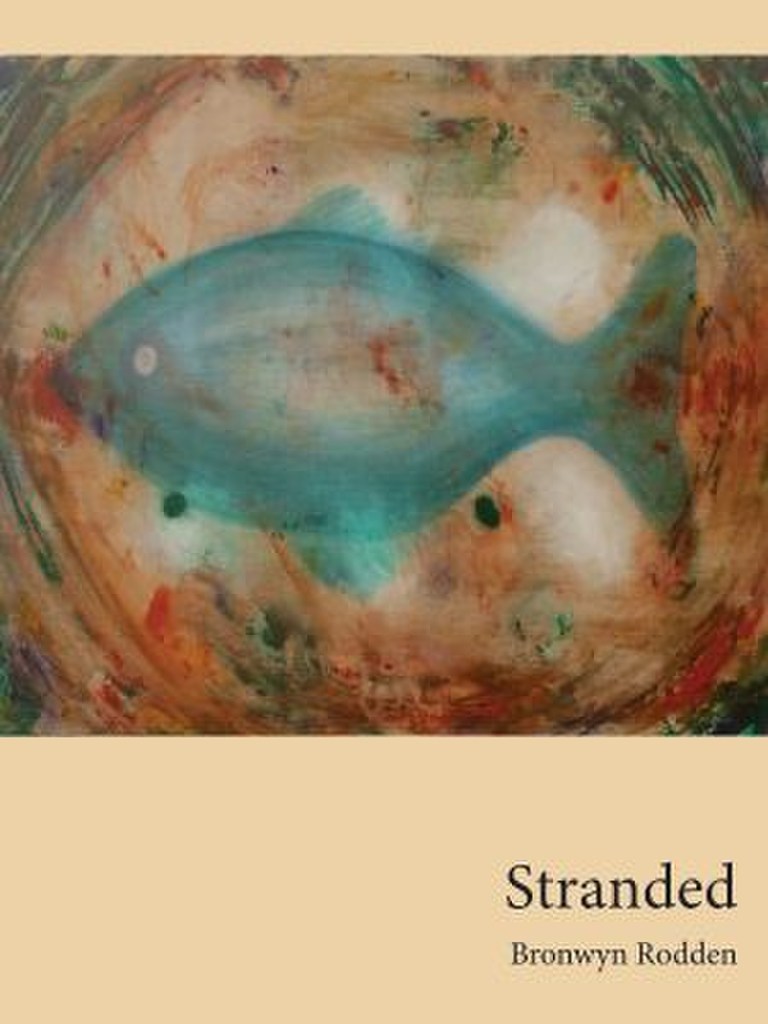
Bronwyn Rodden’s Stranded

Bronwyn Rodden, Stranded (Flying Island Pocket Poets Series 2024)

I have brought a stack of books from the Flying Island Pocket Poets series on a winter holiday. They’re perfect travel companions – physically light and small in size, but with engrossing content.

In the title poem of Stranded, an animal

It sticks its fine-pointed 
head into our picnic,
our anger doesn't move it,
its hunger ties it to us

It strikes me that Bronwyn’s poetry is a bit like that: the poems’ speaker sticks her fine-pointed head into all manner of subjects – places, people, animals, plants, paintings – with a hunger to observe and record. She travels to Ireland, Madagascar and Western Australia, stays in hotels in Adelaide and the Blue Mountains, and writes verse about what she sees.

Many of the poems are a very high-order version of the creative-writing exercise where you go for a walk around the block and then write a poem about what you have seen. It’s as if the reader is looking over the speaker’s shoulder on her travels and encounters. There’s an austere restraint about the poems: not the restraint of imagist poetry that aims to let the things speak for themselves, but a deliberate flatness of affect, an absence of reflexivity.

Because I’m short of time – so much walking and lying in the sun to do – I’ll limit myself to page 78. It’s a long way from being my favourite poem in the book, but a close-ish reading offers rewards:

Unusually, ‘Panda’ is a character sketch, but its unemotive language is characteristic.

Panda

Toenails round as fingernails,
vermillion ovals pretty as cellophane
bows tying up the beautiful,
lacquered package that was her.

The stanza begins with the word ‘toenails’ and only arrives at the person belonging to them, ‘her’, at the last word. I imagine the poem’s speaker sitting in an airport or a cafe when her attention is caught by the carefully-tended toenails of a woman sitting nearby. Her first observation is that they are ’round as fingernails’. I have never thought of fingernails as round, but I can tell that there’s something singular about these. Then, improbably, they are likened to cellophane, which is justified after the beautifully placed line break: like cellophane bows wrapping a parcel, they are the final touch to the woman’s beauty regime.

In this stanza, the speaker portrays the other woman pretty much as an extension of the beautifully tended toenails. She is objectified – the speaker sees her as having objectified herself, made herself into a ‘beautiful, lacquered package’. But there’s something unsettling about the speaker’s relationship to her: she’s just an observer, free to describe the other woman without engaging with her as another fully human person, unaware that she is doing the objectifying.

The point of view shifts in the second stanza.

It all went well till they moved 
from Manila and the price of pedicures
zoomed from fifty cents to twenty-five
dollars. And she fell pregnant.

The woman is no longer an object but a person with a history. She has a nationality. She is in a relationship and has emigrated (‘they moved’). Her beauty regime has financial practicalities. She is a parent. The speaker is no longer summing her up on the basis of her toenails, but has engaged with her, imagining a life story for her. Or perhaps there’s a new speaker in this stanza, an omniscient narrator, or a friend who actually knows the woman and is tacitly reprimanding the speaker of the first stanza for her objectifying gaze. (Incidentally, notice the break at the end of the third line, which give the word ‘dollars’ a shocking emphasis.)

Then there’s another shift.

She’s still round as a panda,
and her toenails are in-grown
and her husband looks at her in
old photographs in bathing suits.

The first stanza may have been patronising, but it sketched a beautifully turned-out woman. Now it seems that her self-packaging is an attempt to keep the ageing process at bay. The pretty toenails of the first stanza are now in-grown. Perhaps time has passed. Or perhaps the speaker has taken a closer look and seen past the toenails’ prettiness to their painful condition. Their roundness has become a feature of the woman herself.

Why ‘still round’? Is roundness an attractive quality? If so, what’s going on with the husband? There’s a terrific line break: ‘and her husband looks at her in’ … Is it going to be pity, disgust, or even – as that ‘and’ allows to be possible – desire? She may still have the qualities her husband found attractive (‘She’s still round’), but it turns out he prefers images of her younger self.

The third stanza is elusive. The image of the woman as a panda sets her up to be a comic figure – round, cuddly, likeable, but not an equal to the observer. There’s pathos in the way she tries, and fails, to keep her youthful beauty. And something is not being said: we are left wondering what is happening for the speaker. Has she maintained her mildly satirical, racism-tinted distance? Has the poem tipped over into pity, even contempt? Or is there an unstated undercurrent of solidarity, fellow-feeling – one woman of a certain age to another?

On first reading, I would have gone with the second option – pity, even contempt. I was dismayed that my page 78 rule meant I had to write about this poem and might have to invoke ‘own voices‘ rhetoric. But as I’ve sat with it, let it unfold in my mind, noticed in particular the litany effect of the ands in the third stanza, I’ve come to read it as essentially comradely. The question, ‘I’ve called her ‘Panda’, what would she call me?’ lurks just benerath the surface.

To speak pedantically for a moment, there are no giant pandas on the Philippines.


I wrote this blog post on Wulgurukaba land, beautiful Yunbenun, where yesterday I saw an echidna going about its business in the late afternoon. I acknowledge the Elders past and present, and welcome any First Nations readers.


My blogging practice is to focus on the page that coincides with my age, currently 78.
Books I read in April [2007]

[7 August 2025: I’ve retrieved this post from my old blog because I’m currently reading a book by Geoff Page, and Lawrie & Shirley, reviewed here, is the only other book by him I’ve read since I started blogging]

Clive Hamilton & Sarah Maddison, Silencing Dissent (Allen & Unwin 2007)
Flannery O’Connor, Wise Blood (1949)
Tim Baker (editor), Waves: great stories from the surf (HarperCollins 2005)
Geoff Page, Lawrie & Shirley: the final cadenza (Pandanus Poetry 2006)
Markus Zusak, The Book Thief (Pan Macmillan Australia 2006)
Leonard Cohen, Book of Longing (Viking 2006)
Heat 13: Harper’s Gold (starting)
Harold Bloom’s Best Poems (continuing)

dissent

Gillian Leahy’s movie Our Park has a special place in my heart because the park in question is my local park. But it’s got an even stronger hold on my affections because of its uncomfortable, even gruelling depiction of democracy in action. As they struggle over what use should be made of a little patch of semi-derelict land, people disagree passionately, at times (off camera) come to blows, and (on camera) declare intense animosity for each other. But things are thrashed out. Many points of view are heard. Everyone owns the final result.

That’s not how democracy works in Prime Minister John w Howard’s Australia. People do get beaten up, of course, mostly off camera and with a legal requirement not to talk about it. But disagreement with the government’s policies doesn’t get much of a look-in. Silencing Dissent is a chilling look at the way dissenting voices have been systematically intimidated, bribed, excluded, marginalised or drowned out over the last decade or so. It lists the democratic institutions that have been undermined: the media, the senate, non-government organisations, intelligence and defence services, the public service, universities. Because it’s a book of essays all making the same point, there’s quite a bit of overlap and repetition, but for slow learners like me that’s all to the good. A young friend of mine is fond of saying that the Coalition are Fascists (he intends the term precisely) and that only cowardice stops people from saying so; the detail accumulated in this book makes him seem less hyperbolic.


wblood

To cheer myself up I moved on to a bit of fiction by Flannery O’Connor. I hope that sentence doesn’t make her turn in her grave, but paradoxically there is something cheering about Wise Blood. It reads to me as if it was written in a trance – as if some twisted angel had dictated it and the young Ms O’Connor just wrote it down, trusting it would amount to something. Most of its characters are all ‘a little bit off their heads’ and some are a big bit off the rails. Hazel Motes, played by Brad Dourif in the John Huston movie which I plan to watch again on DVD soon, is in obsessive revolt against the punitive and repressive Christianity of his childhood, and burns with an evangelical imperative to preach a Church of Christ without Christ (I would have said cacangelical but the word doesn’t seem to exist).

I remember reading a review of the movie that compared Hazel to the Monty Python character who was trying to train ravens to fly underwater. That comparison captures the bleak comedy of the book, but leaves out the appalling sense of waste and, in the end, awe that Hazel inspires. Flannery O’Connor was a Catholic living in the southern US. The characters in this book are all Protestant. Maybe she’s observing them from the other side of a sectarian fence and seeing them as wildly deluded, but the pervasive sense of intractable mystery, of not-knowing, and the lack of overt authorial commentary, makes a sectarian reading seem wide of the mark. I finished the last page with a sense that I’d been taken somewhere dark, weird and scarily believable.


waves

I read Waves as research for work. It reminded me in a roundabout way of an early review of David Williamson’s play The Removalists. As you probably know, in the course of that play, a man – Kenny – is terrorised and beaten up by two policemen. The review I’m thinking of by the late, magisterial H. G. Kippax, found fault with many aspects of the play, including the victimised man being described as a typesetter: according to Kippax, typesetters were not working-class yobbos like Kenny, but quirky individuals who were forever surprising their acquaintances with odd snippets of information. It came with the territory, you see: according to Harry, typesetters read much more widely, if also more shallowly, than normal people who weren’t handling other people’s words for their entire working lives. Like those possibly mythical beings, I often find myself acquiring information about the most unlikely subjects. Waves introduced me to a new world of specialised language: technical language for describing waves and related phenomena (lefties, beachbreaks, righties, peaks and barrels); jargon associated with surfing equipment and practice (coaming, mals, floaters, nosedives, guns); and the argot of the surfing culture, which includes but is not limited to the other two (groms, kahunas, charging and stoked).

The bit I enjoyed most was grand old champion surfer Nat Young’s 1974 encounter with Patrick White (whom Tim Baker describes disarmingly as a ‘gay literary luminary’). After Young is quoted as saying how important The Tree of Man had been to him, we are given this glimpse of Patrick White as filtered through a surfer sensibility:

This unlikely pair discovered they had a connection that went back twenty-five years. ‘He was living down at Werri at that stage, him and his boyfriend, and they were very much in love and they used to spend a lot of time walking on the beach. He said he used to watch surfing and watch waves. Werri, from my childhood, was very important because there was a golf club and it was abandoned and we used to go in and just stay there. And Patrick understood. He said, “Oh, we used to laugh about the way the golf club had turned into a derelict place and the surfers were squatting there on the weekends.” So he knew exactly where my head was at.’


lawrie

Lawrie & Shirley was a birthday present from my niece Paula.

Somewhere along the line I’ve absorbed, without really noticing it, the notion that poetry should be difficult – if it’s not difficult it’s doggerel; almost: if it rhymes and has a sense of humour, it must be bad. Not that I hold these assertions to be true, but they have insinuated themselves into my brain. But hell, if Lawrie and Shirley is doggerel, then let’s have lots more.

It’s a rhyming narrative, ‘A Movie in Verse’, about a relationship between a man in his early eighties and a woman who’s not a lot younger. Each of its 47 ‘scenes’ opens with screenplay-style directions of the ‘INTERIOR. DAY’ variety, and the story progresses mainly through visuals and dialogue. It’s light, funny, has an unsurprising range of characters (middle-aged children who see their inheritances threatened, disapproving former friends, etc), and manages to feel like an enjoyable romantic comedy, albeit a geriatric one. The great fear that hangs over the characters isn’t death – everyone knows that death isn’t far off – but disability, and more specifically dementia. I wouldn’t say it’s a major focus, but it crops up from time to time. Like this, where Shirley takes Lawrie to visit her aunt Ida in a nursing home – also a nice example of how the jolly dump-de-dum of the tetrameters can tilt over into genuine pathos:

Shirley looks around the room,
trying to locate the smile

she'll recognise as Auntie Ida's.
And finds her after quite a while

away off in a distant corner,
wasting quietly in a chair,

doing absolutely nothing,
no recognition in her stare;

no smile, no words like 'Hello, Shirley';
no formula like 'Hello, dear'.

Shirley stoops to take her hand
and, fighting back a hidden tear,

sighs to Lawrie, close beside her,
'There's no one in there any more.'

Eventually, they turn about
and walk back down the corridor.

Cross-fade to a final shot
of Ida's vacant, lunar face,

a kind of undiscovered planet
staring coldly into space.

thief

The Book Thief, another birthday present, is a terrific read. I guess it’s a YA title, though some of those famously nervous school libraries might have trouble with the swearing – even though it’s in German, it’s all meticulously translated. The action of the story takes place in a small community near Munich during the Second World War, and is narrated by Death, who doesn’t enjoy his work, is deeply curious about human beings and charmed by them even in the middle of the immense overwork of that period.

Such dark material, but delivered with delicacy, affection and even lightness. Some elements of the presentation might seem irritatingly tricksy to some readers, but they worked fine for me as something like aeration. There are two or three short books, lyrical graphic novels you might call them, within the book, and every now and then a short piece of text is separated from the body and printed in bold type with its own little heading: a key piece of dialogue, some background information on a character, statistics on parts of the war. I read a review somewhere online taking the book to task for trying to exculpate the German people over the murder of the Jews: that’s absolutely not how I read it. These are recognisably human people. They love their children; some take actions, small or huge, against the prevailing Nazis; all of them, willingly or by cruel force of circumstance, are complicit; and all of them suffer. The book has won awards, and it deserved them.


longing

Leonard Cohen’s book is a weirdly mixed bag. There are some memorable serious poems, introspective and embarrassingly honest; and one or two witty throwaways. There are the lyrics of songs, several of which are on his 2004 album, Dear Heather (I’ve just listened to them, and they’re fabulous as songs). But too much of it reads like excerpts from his notebooks – whingeing effusions about being fat, old, failing in love and as a monk, past his prime as poet and singer if he ever had a prime – adorned by innumerable variations on the same gloomy charcoal self-portrait, most of them accompanied by gnomic handwritten annotation. My sense is that if Leonard Cohen wasn’t a celebrity this book wouldn’t have seen the light of day, or at least would have been a much slimmer volume. I suppose we should be grateful that his celebrity status derives largely from his writing! The longing of the book’s title is everywhere, shot through with despair. Frankly, as a preacher in a Peter Cook sketch once said about sex and violence in the movies, we get enough of that at home. When the poem ‘Titles’ asked me:

and now Gentle Reader
in what name
in whose name
do you come
to idle with me
in these luxurious
and dwindling realms
of Aimless Privacy?

I was tempted to reply, ‘G-d alone knows.’ It’s a beautifully produced book, feels good in the hand, and there are some very good things in it. Deeply committed fans will almost certainly love it. I think his editor has let him – and us – down.


bloom

Sporadically I continue my way through the Bloom book: Edward Lear and Lewis Carroll made the cut, and make strange bedfellows indeed with Yeats, Hardy and the guy who wrote ‘Et in Arcadia Ego’ (‘I have been faithful to you, Cynara, in my fashion’). In his commentary, Harold does seem to like letting us know about intimate or passionate relationships poets have with people of the same gender.

heat13

I’ve just started the Heat. Gillian Mears has multiple sclerosis, and some years ago had an unrelated, horrific medical crisis that brought her close to death. When she was securely back from the brink, she bought an old ambulance and set off on a solitary adventure, driving and camping solo for many months. Her account of it is the first article in this issue, and it makes me hope that she has a book in mind: there are Walden-ish moments in the New South Wales bush, House MD-ish urgencies, a beautiful rendering of the way a mind does unexpected things in crisis …


Lizz Murphy’s Bitumen Psalms

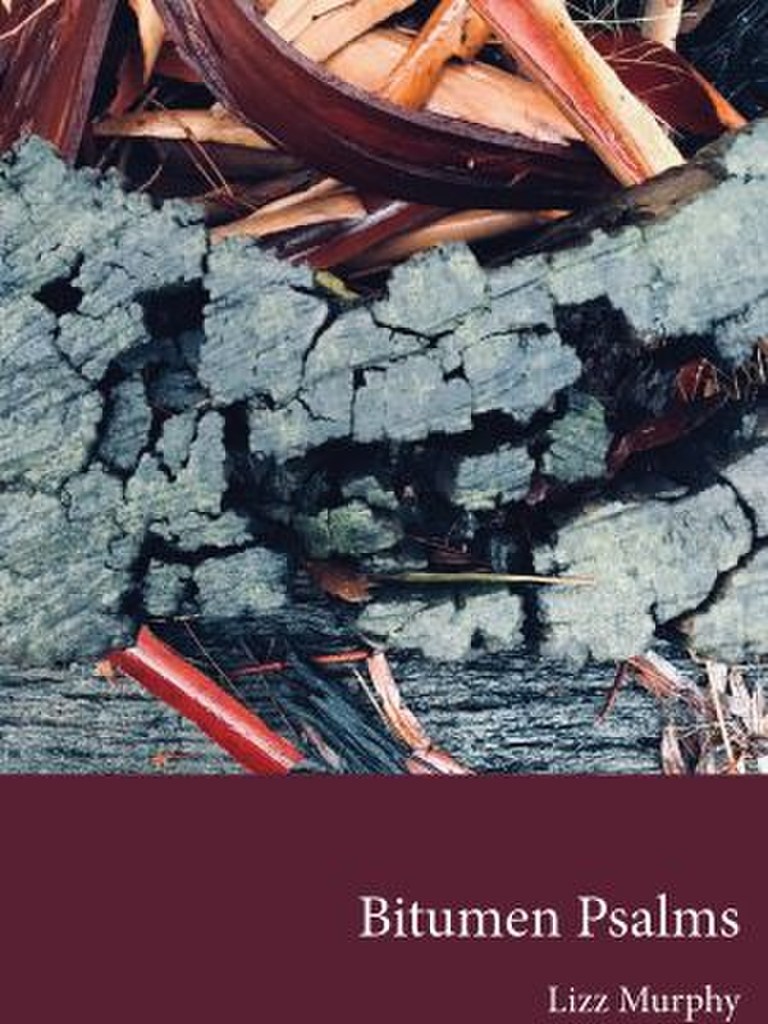
Lizz Murphy, Bitumen Psalms (Flying Island 2024)

This book is another jewel in the Flying Island Pocket Poets series, more than 100 pocket-sized books (14 x 11 cm) so far, published under the stewardship of Kit Kelen. It’s a wonderful series, in which well-established poets appear cheek by jowl with brand new talents. You can subscribe here to receive 10 books at the start of each year.

The poems in Bitumen Psalms are mostly short, or sequences of short stanzas that might be stand-alone poems. I had to consult the table of contents a number of times to check whether what I was seeing on a page was a number of separate poems or the stanzas of a single poem. Mostly they weren’t, but publishing the poems without titles leaves open the possibility of reading them all as one continuous mega-poem.

The book is in seven sections. The first, ‘Bitumen Psalms’, is a long poem made up of short stanzas, each a glimpse seen from a car travelling from inland New South Wales to the sea. A recurring line, ‘I forbid the camera’ spells it out: these are word snapshots – similes and haiku-like compression in place of shutter-clicks.

‘All Weathers’ is seven pages of glimpses of people. ‘Marking Time’ is spent in hospital, whether as visitor or as patient is not clear, and doesn’t need to be. ‘Cast Your Wing’, the section I enjoyed most, begins with the poem ‘I don’t go outside often enough’, and takes the reader out into a world of birds, animals, clouds and light. ‘Things’ takes us back inside again, mostly, for three pages of, mostly, domestic objects wittily observed. ‘Shudders’ is three pages of computer-related joke-poems. ‘Breath and Air’, the final section, has four longer poems in which birds feature. It includes the killer lines (in ‘Under the filling moon’):

A hundred thousand
children at risk
and I am writing about birds

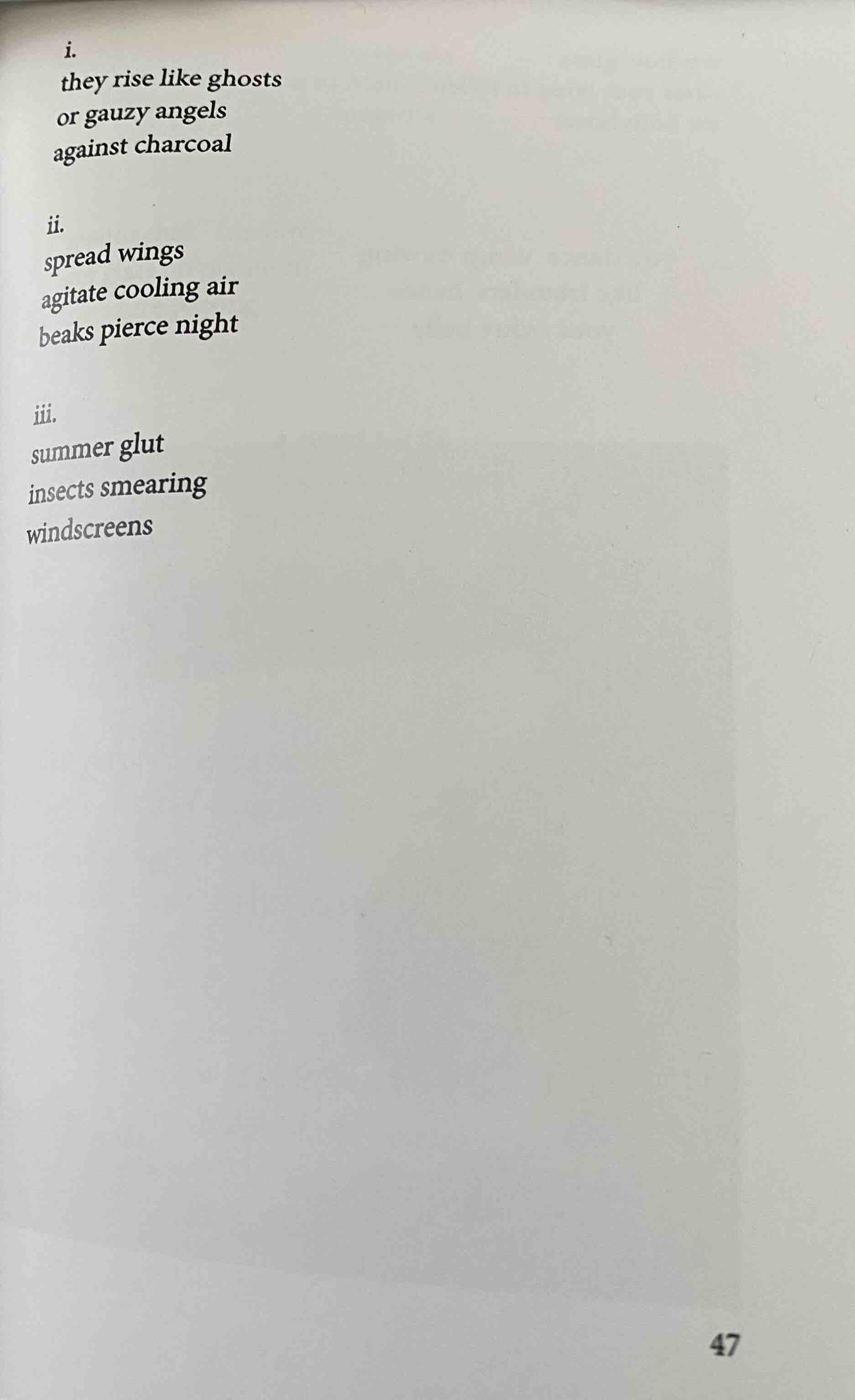
Like most of those in the book, the one on page 47* is untitled. It differs by giving clear indications that the three blocks of print are to be read as a single poem in three parts.

Exactly how they constitute a single poem isn’t straightforward.

On first reading section i, I expected to following sections to clarify who they are who ‘rise like ghosts’ – birds, perhaps, or moths? And section ii seemed to be heading that way with its wings and beaks – ah, it’s birds. But section iii puts the kibosh on that, being definitely about insects.

My initial expectation having been thwarted, I take a pleasurable moment to sit with the poem, to simply enjoy its three images and let any connections arise. I have to suppress the impulse to figure out, even nail down, what the poet had in mind, but I’m gradually learning what critics of contemporary poetry mean when they say that it’s the reader’s job to create meaning in a poem as much as it is the poet’s. (Or sometimes, they say, the job of a number of readers collaborating: so feel free to say something in the comments section.)

i.
they rise like ghosts
or gauzy angels
against charcoal

This vividly evokes white and fluttering things taking to the air at night. (I get the whiteness from ‘like ghosts’, and the fluttering from the sound of ‘ghosts / or gauzy’, and of course they have the wings of angels.) It doesn’t identify them. While that creates a kind of puzzle for the reader, it’s not the main effect. It’s more like an invitation to reflect on the image, to bring your own experience to bear on it, or to let it do the work, calling up images from your mind. It gives the reader room to reflect.

I saw moths, but then:

ii.
spread wings
agitate cooling air
beaks pierce night

The strong sound of ‘spread wings’ contrasts with the flutteriness of the first section, and the night-piercing beaks make it clear that these are not the same creatures. Perhaps the poem is simply turning its attention to a new subject, a new image, something else the poet sees as night falls. But there’s something purposeful about these birds, their wings and beaks. I catch a hint that they are swooping to prey on the moths, swallows perhaps, and now I can’t read the lines any other way.

The third section, at first a jarring contrast to the observations of nature that precede it, now fits.

iii.
summer glut
insects smearing
windscreens

The subject is still the death of insects, but the language of economics (‘glut’) and technology (‘windscreens’) intrudes. It’s a very different death from the targeted killing by hungry birds – it’s now happening on an industrial scale, and it’s soulless, collateral damage. And is it just me, or is there an edge of nostalgia here? Having insects smeared on a windscreens used to be a feature of long-distance drives in the country. In my experience this is no longer so. The summer glut is a thing of the past. This is not just death of individual insects, but the wiping out of populations. The poem has moved from a gentle observation of insect and bird life to a deep sorrow about the state of the world. Or at least it has moved me in that way.

I love this book. You can flip it open at any page and find something to smile at or mull on.


I wrote this blog post on unceded Wulgurukaba land, Yunbenun, where yesterday I met a family of five red-tailed black cockatoos, gorgeous and unafraid. I acknowledge Elders past and present who have cared for this country for millennia, and welcome any First Nations readers.


My blogging practice is to focus on the page that coincides with my age, currently 78. The last poem in Bitumen Psalms finishes on page 75, so my personal algorithm sends me to page 47 (I was born in 1947).