
Ian McEwan, What We Can Know (Jonathan Cape 2025)
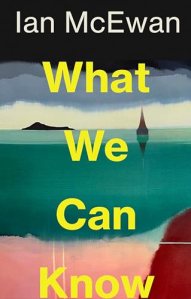
Before the meeting: I heard Ian McEwan talking about this novel on David Runciman’s Past Present Future podcast a while back (at this link). Well, not so much about this novel as about what it’s like to be contemplating one’s own death at a time when the future of the world as we know it is in doubt. How will the people of the future regard us who were alive at this critical moment in human history? That question, he said, was the genesis of the novel.
What We Can Know is set in Britain long after our time, which is known in that future as the Derangement. In 2042 there has been an Inundation caused by the melting ice caps, and a nuclear winter created by international war has put an end to global warming. Britain is now an archipelago. North America is the domain of lawless warlords. Nigeria has become the preserver of electronic connectivity. Life is simpler and more difficult, but there are still academics, and there is a vast trove of records preserved from our time.
The central characters of the novel specialise in the literature of a period that overlaps our present moment. Their students revolt, seeing such studies as irrelevant to the needs of the times, and regarding literature produced by the generations who allowed such catastrophic events as beneath contempt.
That all works well. The physical environment is always interesting, even for a reader like me who has little knowledge of British geography, and so can’t appreciate the specifics of boat trips from island to island. However, I was far from engrossed by the central narrative thread, which concerns the main character’s search for a long lost poem, written in 2014 but never published. He hunts through the vast reservoir of data, and pieces together a picture of the dinner party when a distinguished poet read the poem aloud and presented it to his wife on a vellum scroll tied up with a bow. The story is told and retold from many points of view, becoming in my experience increasingly tedious, until there is a final telling that may amount to a revelation, but by that time I was well beyond caring.
Page 79*, taken in isolation, isn’t much to write home about, though it’s a nice example of the novel’s intertextuality. It’s a summary of part of an actual book published in 1985, Footsteps: Adventures of a Romantic Biographer by Richard Holmes, which has a minimalist Wikipedia page at this link.
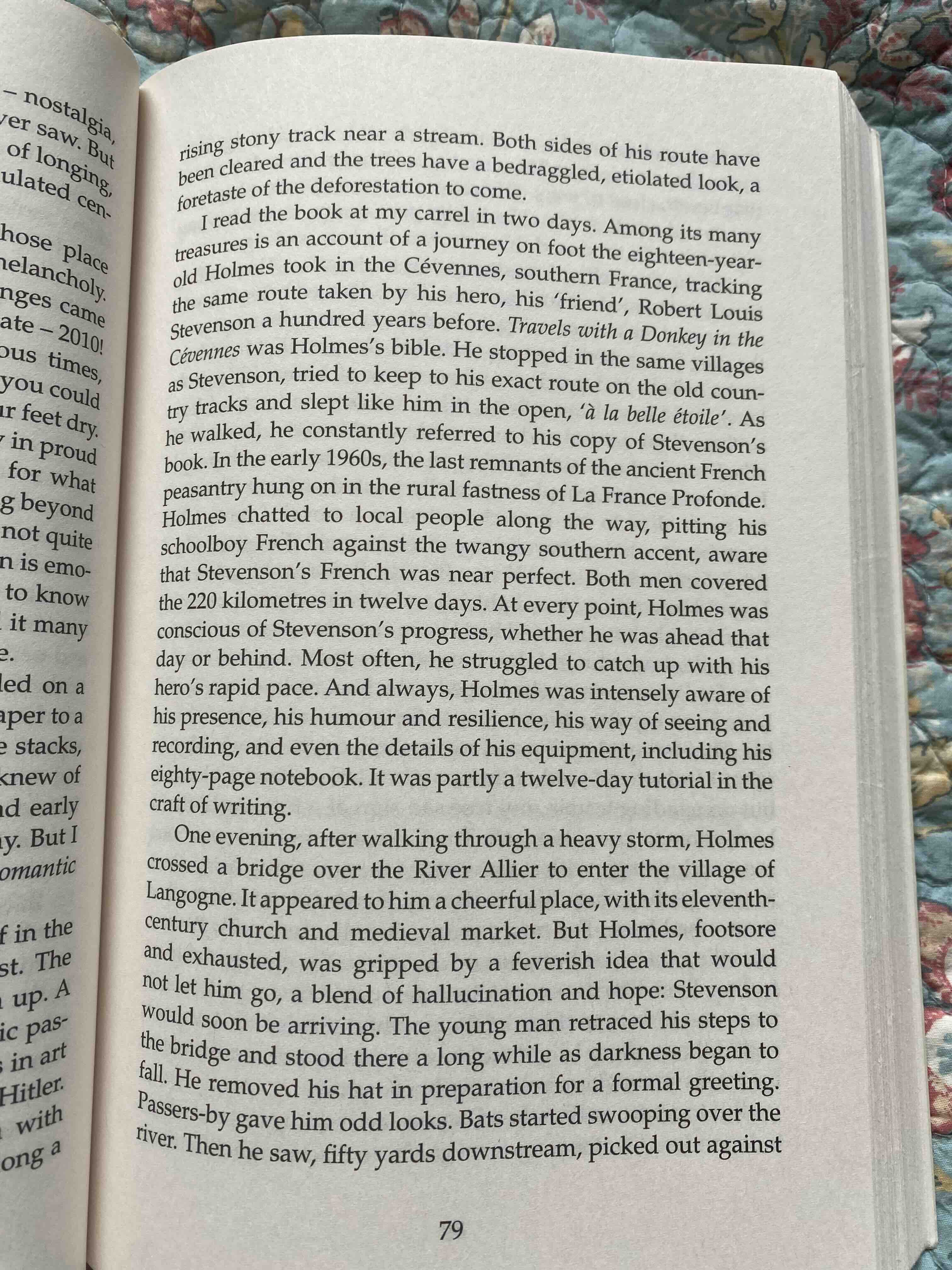
Among its many treasures is an account of a journey on foot the eighteen-year-old Holmes took in the Cévennes, southern France, tracking the same route taken by his hero, his ‘friend’, Robert Louis Stevenson a hundred years before. Travels with a Donkey in the Cévennes was Holmes’s bible. He stopped in the same villages as Stevenson, tried to keep to his exact route on the old country tracks and slept like him in the open, ‘à la belle étoile‘. As he walked, he constantly referred to his copy of Stevenson’s book. In the early 1960s, the last remnants of the ancient French peasantry hung on in the rural fastness of La France Profonde.
And so on. I was interested enough in the description of Holmes’s book because I’d enjoyed the 2020 film Antoinette dans les Cévennes, which also traces the route taken by the young Robert Louis Stevenson in the 1870s.
You won’t be surprised to learn that the passage’s context makes it something more than a schoolboy summary. The narrator had come across Holmes’s book when he was a 22 year old student who hadn’t yet settled on a subject for his doctorate. He had ‘eased the hundred-year-old hardback from its shelf’ as a delicate remnant from a past era, and tells us about it now because it contains one of the ‘most exquisitely evoked descriptions’ of a longing for ‘what was never known and is lost’ – the emotion that is the central driver of his academic research and of his quest as narrated in the first half of this book. The world before one was born in what was never known, and its loss is intensified for those who live after the Inundation
Most of page 79 leads up to that ‘exquisitely evoked description’. Then, at the bottom of the page, Holmes is standing at a bridge in the village of Langogne in a semi-hallucinatory state hoping that Stevenson, long dead, would soon be arriving:
Then he saw, fifty yards downstream, picked out against the fading gleam of the western sky, the old ruined bridge into town, the one his dear Stevenson would have crossed. Holmes was bereft, close to tears. ‘There was no way of following him, no way of meeting him. His bridge was down. It was beyond my reach over time, and this ruin was the true, sad sign.’
The narrator draws out the meaning of this:
The collapsed bridge downstream and the man crossing it a hundred years before represent the past from which I too am excluded, the past that from here seems whole and precious, when many of humanity’s problems could have been solved.
But, though Stevenson’s bridge was down, the country he had walked was substantially unchanged in Holmes’s time. In the narrator’s present time, all that land is lost, under water.
And that is the chord that vibrates through the novel. I the reader am living in the time that the character sees as ‘whole and precious’. Logically I can see that the book should have me on an edge – a prolonged moment of appreciating the world I live in, preemptively mourning its loss, and resolving to do what I can to protect and defend it. Whether the failure is mine or the novel’s, it didn’t have that effect on me.
When – spoiler alert – the second half of the novel has a different narrator, in a different time period, that driving emotion fades into a distant background, and the book, in my opinion, becomes a much more commonplace affair.
The meeting: We read What We Can Know in tandem with Carys Davies’s Clear. Like that book, it evoked widely divergent responses. In this case I was the Most Negative, and she who had been Most Negative for Clear enjoyed this one as a satisfying holiday read.
For some the world-building amounted to thinly disguised lecturing about climate change. Others felt there wasn’t enough of it – and I guess I’m in that camp: I would happily have stayed in that future, wandering beyond the confines of university scholarly life. Where my engagement as a reader was fading by the end of the first part and died irretrievably when the narrator and time frame changed, that was where others felt the book finally came alive. I think there were two people (out of five) who were there for both parts. (My interest had died to such an extent that I had to be reminded of the key revelation in the second part.)
I think the key thing that worked for others and not for me is announced in the book’s title. Appropriately enough, the title is hard to remember: I keep misremembering it as ‘All We Can Know’ or ‘All That You Know’ and I keep thinking of Keats – ‘That is all / Ye know on earth and all ye need to know.’ So What We Can Know: the book is about knowledge, specifically historical knowledge. The academics of the future can sift through the mountains of detailed electronic and other documentation of our times but what goes unrecorded will remain unknown, and if the records of significant truth aren’t found then that truth remains unknown.
I’m sailing very close to spoilerish now, but the book’s central search for a lost poem, reputedly a masterpiece, turns out to be wrong-headed. A different document, found thanks to ingenious deciphering of clues in the archive, transforms the meaning of events as they were known up to that point. For some readers, perhaps for most, this is deeply satisfying. It might, I concede ruefully, be a matter of attention span.
The Book Club’s five members are all of settler heritage. Our combined ages add up to many more years than have passed since Arthur Phillip claimed this continent for the British Crown. We met on Gadigal land, and I wrote this blog post on the land of Gadigal and Wangal of the Eora Nationa. I wrote the blog post on Wangal and Gadigal land. I gratefully acknowledge the Elders past and present who have cared for this beautiful country for millennia, and welcome any First Nations readers of this blog.
* My blogging practice is to focus on the page that coincides with my age, currently 79.


 Me fail? I fly!
Good night
Get Outlook for Androidhttps://aka.ms/AAb9ysg ________________________________
LikeLike