Tag Archives: Ian McEwan

Ian McEwan’s What We Can Know at the Book Club

Ian McEwan, What We Can Know (Jonathan Cape 2025)
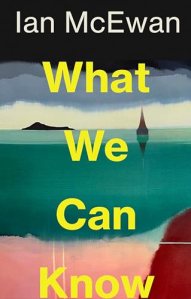
Before the meeting: I heard Ian McEwan talking about this novel on David Runciman’s Past Present Future podcast a while back (at this link). Well, not so much about this novel as about what it’s like to be contemplating one’s own death at a time when the future of the world as we know it is in doubt. How will the people of the future regard us who were alive at this critical moment in human history? That question, he said, was the genesis of the novel.

What We Can Know is set in Britain long after our time, which is known in that future as the Derangement. In 2042 there has been an Inundation caused by the melting ice caps, and a nuclear winter created by international war has put an end to global warming. Britain is now an archipelago. North America is the domain of lawless warlords. Nigeria has become the preserver of electronic connectivity. Life is simpler and more difficult, but there are still academics, and there is a vast trove of records preserved from our time.

The central characters of the novel specialise in the literature of a period that overlaps our present moment. Their students revolt, seeing such studies as irrelevant to the needs of the times, and regarding literature produced by the generations who allowed such catastrophic events as beneath contempt.

That all works well. The physical environment is always interesting, even for a reader like me who has little knowledge of British geography, and so can’t appreciate the specifics of boat trips from island to island. However, I was far from engrossed by the central narrative thread, which concerns the main character’s search for a long lost poem, written in 2014 but never published. He hunts through the vast reservoir of data, and pieces together a picture of the dinner party when a distinguished poet read the poem aloud and presented it to his wife on a vellum scroll tied up with a bow. The story is told and retold from many points of view, becoming in my experience increasingly tedious, until there is a final telling that may amount to a revelation, but by that time I was well beyond caring.

Page 79*, taken in isolation, isn’t much to write home about, though it’s a nice example of the novel’s intertextuality. It’s a summary of part of an actual book published in 1985, Footsteps: Adventures of a Romantic Biographer by Richard Holmes, which has a minimalist Wikipedia page at this link.
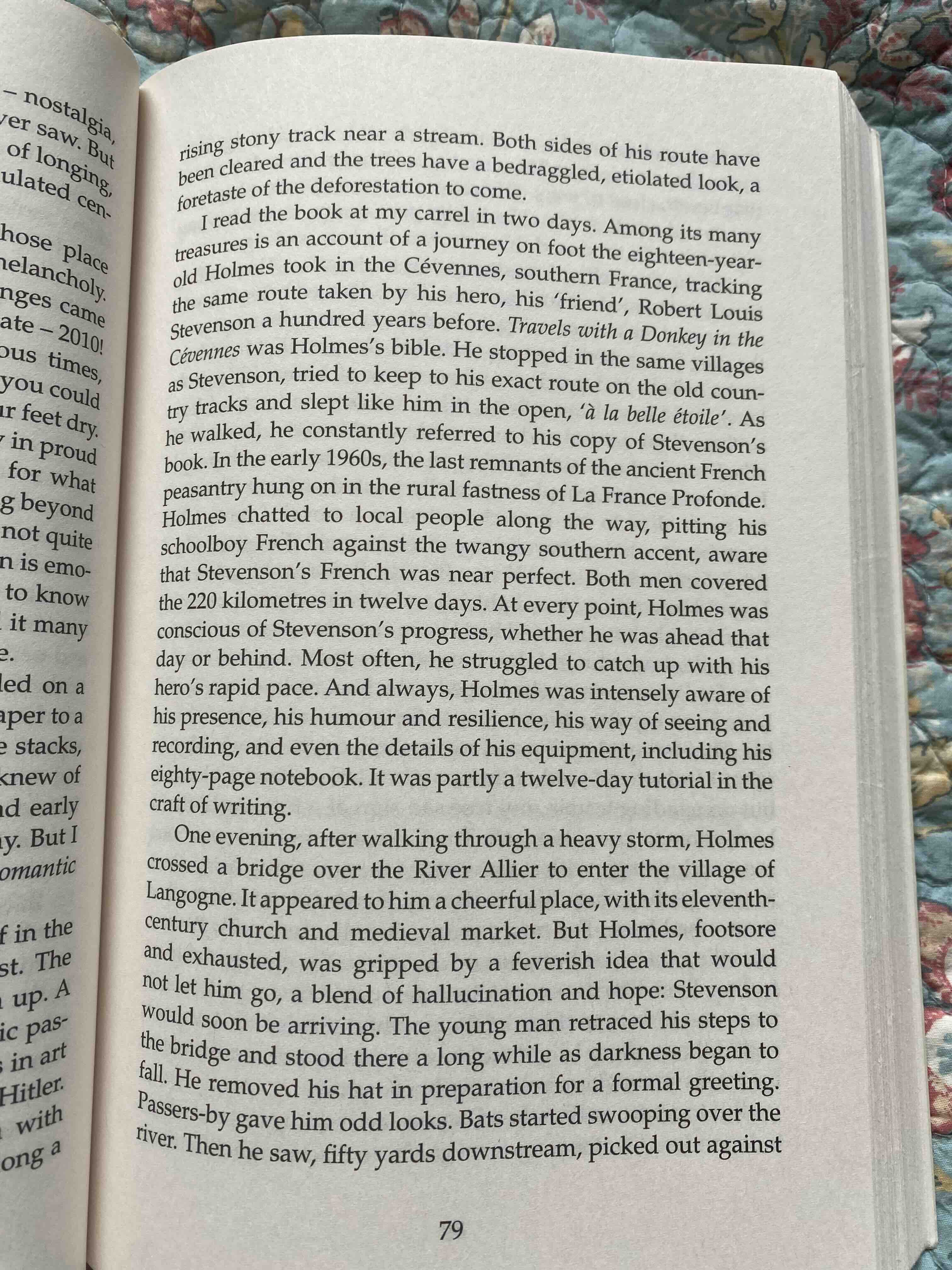
Among its many treasures is an account of a journey on foot the eighteen-year-old Holmes took in the Cévennes, southern France, tracking the same route taken by his hero, his ‘friend’, Robert Louis Stevenson a hundred years before. Travels with a Donkey in the Cévennes was Holmes’s bible. He stopped in the same villages as Stevenson, tried to keep to his exact route on the old country tracks and slept like him in the open, ‘à la belle étoile‘. As he walked, he constantly referred to his copy of Stevenson’s book. In the early 1960s, the last remnants of the ancient French peasantry hung on in the rural fastness of La France Profonde.

And so on. I was interested enough in the description of Holmes’s book because I’d enjoyed the 2020 film Antoinette dans les Cévennes, which also traces the route taken by the young Robert Louis Stevenson in the 1870s.

You won’t be surprised to learn that the passage’s context makes it something more than a schoolboy summary. The narrator had come across Holmes’s book when he was a 22 year old student who hadn’t yet settled on a subject for his doctorate. He had ‘eased the hundred-year-old hardback from its shelf’ as a delicate remnant from a past era, and tells us about it now because it contains one of the ‘most exquisitely evoked descriptions’ of a longing for ‘what was never known and is lost’ – the emotion that is the central driver of his academic research and of his quest as narrated in the first half of this book. The world before one was born in what was never known, and its loss is intensified for those who live after the Inundation

Most of page 79 leads up to that ‘exquisitely evoked description’. Then, at the bottom of the page, Holmes is standing at a bridge in the village of Langogne in a semi-hallucinatory state hoping that Stevenson, long dead, would soon be arriving:

Then he saw, fifty yards downstream, picked out against the fading gleam of the western sky, the old ruined bridge into town, the one his dear Stevenson would have crossed. Holmes was bereft, close to tears. ‘There was no way of following him, no way of meeting him. His bridge was down. It was beyond my reach over time, and this ruin was the true, sad sign.’

The narrator draws out the meaning of this:

The collapsed bridge downstream and the man crossing it a hundred years before represent the past from which I too am excluded, the past that from here seems whole and precious, when many of humanity’s problems could have been solved.

But, though Stevenson’s bridge was down, the country he had walked was substantially unchanged in Holmes’s time. In the narrator’s present time, all that land is lost, under water.

And that is the chord that vibrates through the novel. I the reader am living in the time that the character sees as ‘whole and precious’. Logically I can see that the book should have me on an edge – a prolonged moment of appreciating the world I live in, preemptively mourning its loss, and resolving to do what I can to protect and defend it. Whether the failure is mine or the novel’s, it didn’t have that effect on me.

When – spoiler alert – the second half of the novel has a different narrator, in a different time period, that driving emotion fades into a distant background, and the book, in my opinion, becomes a much more commonplace affair.

The meeting: We read What We Can Know in tandem with Carys Davies’s Clear. Like that book, it evoked widely divergent responses. In this case I was the Most Negative, and she who had been Most Negative for Clear enjoyed this one as a satisfying holiday read.

For some the world-building amounted to thinly disguised lecturing about climate change. Others felt there wasn’t enough of it – and I guess I’m in that camp: I would happily have stayed in that future, wandering beyond the confines of university scholarly life. Where my engagement as a reader was fading by the end of the first part and died irretrievably when the narrator and time frame changed, that was where others felt the book finally came alive. I think there were two people (out of five) who were there for both parts. (My interest had died to such an extent that I had to be reminded of the key revelation in the second part.)

I think the key thing that worked for others and not for me is announced in the book’s title. Appropriately enough, the title is hard to remember: I keep misremembering it as ‘All We Can Know’ or ‘All That You Know’ and I keep thinking of Keats – ‘That is all / Ye know on earth and all ye need to know.’ So What We Can Know: the book is about knowledge, specifically historical knowledge. The academics of the future can sift through the mountains of detailed electronic and other documentation of our times but what goes unrecorded will remain unknown, and if the records of significant truth aren’t found then that truth remains unknown.

I’m sailing very close to spoilerish now, but the book’s central search for a lost poem, reputedly a masterpiece, turns out to be wrong-headed. A different document, found thanks to ingenious deciphering of clues in the archive, transforms the meaning of events as they were known up to that point. For some readers, perhaps for most, this is deeply satisfying. It might, I concede ruefully, be a matter of attention span.


The Book Club’s five members are all of settler heritage. Our combined ages add up to many more years than have passed since Arthur Phillip claimed this continent for the British Crown. We met on Gadigal land, and I wrote this blog post on the land of Gadigal and Wangal of the Eora Nationa. I wrote the blog post on Wangal and Gadigal land. I gratefully acknowledge the Elders past and present who have cared for this beautiful country for millennia, and welcome any First Nations readers of this blog.


My blogging practice is to focus on the page that coincides with my age, currently 79.
Middlemarch: Progress report 1

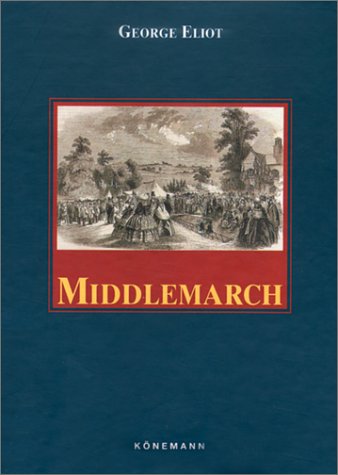
George Eliot, Middlemarch: A study of provincial life (George Eliot, 1871–1872; Könemann 1997), pages 1–162

I had read just eight pages of Middlemarch, two mornings’ worth, squinting through sleep bleared eyes, when a kind friend lent me her copy, a beautiful two-volume edition from a German publishing house that is set in type that will demand less effort than the on I picked up from Gould’s bookshop.

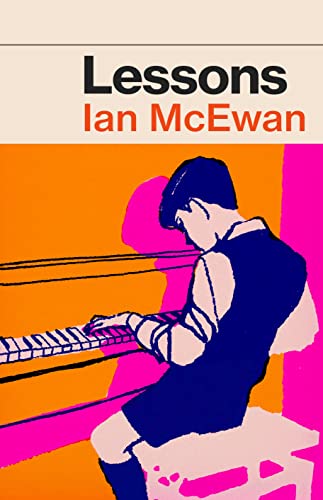
In other reading this month, when the protagonist of Ian McEwan’s Lessons reads the novel written by his estranged wife, he finds to his chagrin that it is brilliant, and includes ‘high-flying digressions offered up to the ghost of George Eliot’ (page 243).

So far, it’s not so much high-flying digressions as sharp authorial observations on the side that are delighting me. For instance, in the first scene where the gorgeous, privileged Rosamond Price and plain, less privileged Mary Garth have a scene together, there’s this brief excursion into the abstract:

Plainness has peculiar temptations and vices quite as much as beauty; it is apt either to feign amiability, or, not feigning it, to show all the repulsiveness of discontent: at any rate, to be called an ugly thing in contrast with that lovely creature your companion, is apt to produce some effect beyond a sense of fine veracity and fitness in the phrase.

(Page 130)

Part of the pleasure of this kind of thing is that it’s ironic. The narrator goes on to attribute to Mary the ‘vice’ of speaking with a satiric edge, a quality the narrator herself has in spades. There’s always a sense of the narrator as a character here, one who has a lot in common with George Eliot herself. In this example, it’s hard not to read the comment as springing in part from Eliot’s own experience of being seen as plain (‘horse-faced’, I dimly remember). The novel’s opening words, ‘To my dear husband’, affirm that George Eliot is a woman, and I guess she could assume that the English reading public knew who she was.

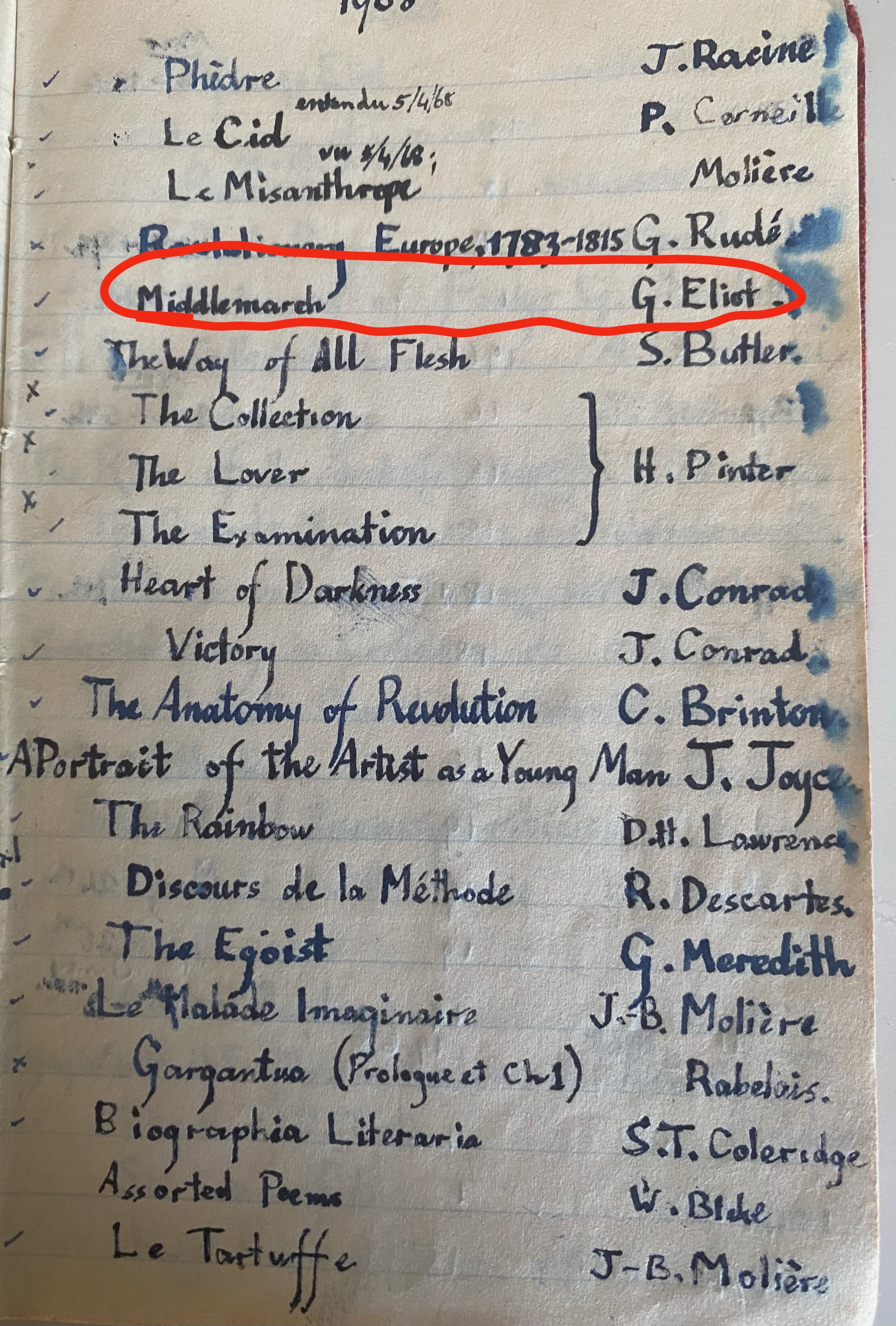
When I read Middlemarch in 1968, it was as part of an exhilarating immersion in literary classics. In the little notebook where I listed the books I read, it appears on the same page Racine’s Phèdre, Samuel Butler’s The Way of All Flesh, and books by Pinter, Conrad, Joyce, Lawrence, Descartes and Rabelais. So reading it now, with that tsunami well in the past and without my 20-year-old predisposition to awe, is like meeting it for the first time.

I’m pretty sure I picked up on the ironic tone back then, but I doubt if I understood that the affectionate mockery of the idealistic heroine Dorothea and her pragmatic sister Celia, of gorgeous Rosamond and her flibbertigibbet brother Fred, and of ‘plain’, sarcastic Mary all has to do with their youth. The narrator is in love with their lack of world-weariness, and I’m in love with them too, as I doubt I was the first time around, however much I loved the book.

Mind you, I’ve read to the Emerging Artist a couple of passages that gave me joy. She responded to the first with a noncommittal noise, and to the second, ‘Now I know I was right not to read past the first page.’ So it’s not a book for all tastes.

So far, Dorothea has committed herself to marry the dried up old stick, Mr Casaubon. Youngish Dr Lydgate has arrived in the area full of reforming zeal. Rosamond, whose beauty no man could resist, is determined to marry someone from outsides Middlemarch and Lydgate is a likely prospect. Fred is in love with Mary, who has been his friend since childhood. The older generation is rife with intrigue to do with religious intolerance, political ambition, greed, and owning-class pretensions. So far, it’s a frothy comedy of manners as told by an immensely erudite and morally serious narrator.

This morning, there was some dialogue worthy of Oscar Wilde. Mary is responding to Fred’s proposal of marriage, which we understand has been made many times before::

‘If l did love you, I would not marry you: I would certainly not promise ever to marry you.’
‘I think that is quite wicked, Mary. If you love me, you ought to promise to marry me.’
‘On the contrary, I think it would be wicked in me to marry you even if I did love you.’
‘You mean, just as I am, without any means of maintaining a wife. Of course: I am but three-and-twenty.’
‘In that last point you will alter. But I am not so sure of any other alteration. My father says an idle man ought not to exist, much less, be married.’
‘Then I am to blow my brains out?’
‘No; on the whole I should think you would do better to pass your examination.’

(Page 162)

I hope they end up living happily together, rich or poor. I know their love’s path will not be smooth, any more than that of any of the other potential love matches.

Ian McEwan’s Lessons: page 75

Ian McEwan, Lessons (Jonathan Cape 2022)

This is a tentative experiment in a different way (for me) of blogging about books: take page 75 and write whatever comes to mind about it. After my next birthday, if I keep this up, I’ll take page 76.

Page 75 of Lessons would probably have a red line drawn through it by someone writing a film script. It’s mainly a minor character’s backstory.

By this stage of the novel, the main character, Roland Baines, has been abandoned by his wife, Alissa, with no warning and no real word of explanation, leaving him to care for their infant son. He has received a couple of postcards from European addresses, the most recent saying she is about to visit her parents in Germany. Page 75 begins with his wondering why she is visiting her parents and imagining that if she tells them what she has done, ‘the row would be like no other’. McEwan delivers on this tease later when Roland hears the mother’s account of that row, which is quite different from what he imagines. Later still, that account is confirmed by Alissa herself.

The rest of the page begins the back story of Alissa’s mother, Jane: born in 1920, educated in a grammar school, and by the end of the page nursing literary ambitions working as a part-time typist at Cyril Connolly’s prestigious literary magazine Horizon (a real magazine):

She later told her son-in-law that she was seated in an invisible corner and given the dullest correspondence. She wasn’t beautiful or well connected and socially adroit like many of the young women who passed through the office. Reasonably enough, Connolly barely noticed her but occasionally she was in the presence of literary gods. She saw, or thought she saw, George Orwell, Aldous Huxley and a woman who may well have been Virginia Woolf. But, as Roland knew, Woolf had been dead for two years and Huxley was living in California.

There are many passages like this in the book: passages that fill us in on someone’s background, or summarise a novel or (in one case) a children’s picture book. As here, the writing keeps the main narrative in sight: we’re getting Jane’s story, but it’s as told to Roland, and commented on by him. There are plenty of dramatic scenes in the novel – Roland visits Berlin as the wall is coming down; he has a weird physical struggle with a conservative politician in the wilds of Scotland; in his 70s, he confronts a woman who sexually abused him as a 14 year old – but even in undramatic passages like this, there’s plenty of complexity to hold a reader’s interest. There’s also a version of one of the novel’s recurring motifs: a life lived in the shadow of fame.

The novel tells the story of Roland’s life, from early childhood in Libya, his time at boarding school where he has a deeply troubling sexual experience with his piano teacher, through years of drifting, his shortlived marriage to Alissa, single parenthood, some years of happiness in a new relationship, to old age. His early promise as a pianist is blighted by the early quasi-consensual sexual abuse: that and his abandonment by Alissa are the two intimate experiences that shape his life. The Suez crisis, the Cuban crisis, the building and fall of the Berlin wall, Brexit and Covid 19: each of these also has a direct impact. The novel is immensely satisfying as the story of an ordinary life that covers, as it happens, almost exactly the same period as my own. I feel as if I know Roland.

Rereading page 75 makes me realise that his story also functions as a conduit for other stories, mostly stories of women: his mother, the piano teacher, Alissa, Alissa’s mother Jane, Daphne who is a good friend and confidante in the early chapters and later become much more, and finally, briefly, his granddaughter Stefanie. Each of these stories can be seen as holding lessons for Roland, and for us, or at least they can be seen as posing questions: about adults’ responsibility to young people in their care, about complex issues of consent, about how to face death, about the competing demands of art and personal relationships, about ways to assess success and failure. Not that it’s didactic. When Roland reads Tomi Ungerer’s Flix to his granddaughter, he tries to make it a teaching moment by asking her if the story ‘is trying to tell us something about people’:

She looked at him blankly. ‘Don’t be silly, Opa. It’s about cats and dogs.’
He saw her point. A shame to ruin a good tale by turning it into a lesson. That could be for later.

(Page 481-482)

Lessons is a good tale, or a whole entwined mass of good tales. One of them is the tale of a man who is offered many lessons and learns some of them. If there is one overarching lesson, it’s that the more you know about someone’s life, the less easy it is to make a sharp moral judgement.

The Book Group in an Ian McEwan Nutshell

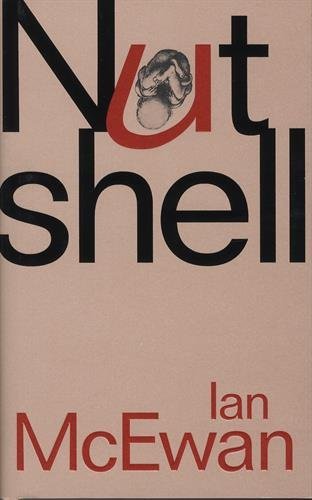
Ian McEwan, Nutshell (Jonathan Cape 2016)

1911214330.jpgThe Meeting: This is the first time I’ve been to a Book group meeting without having read even one page of the book that’s up for discussion. The Emerging Artist asked me what excuse I was going to give. I replied haughtily, and a little disingenuously, that I didn’t need an excuse, because the group is about much more than discussing a book.

There’s food, which this time was excellent: our host had taken a day off work to buy ingredients and cook a fabulous Malaysian meal. (He joked that he had thought of making smoothies but decided against it – a joke which I only got a week later when half way through the book.) And there’s bonhomie: we caught up with each other’s lives, relationships, illnesses and other milestones.

We eventually did discuss the book. I gleaned that it is beautifully written, with many sentences that at least one person was compelled to read more than once. A couple of people laughed so hard at some parts they had to put the book down. The plot had to do with Hamlet, but not obviously. The central conceit, that the narrator is a foetus in the last weeks of gestation who knows an awful lot about the world from listening to podcasts, was either amusing (most of the group), richly metaphorical (one person), or one-joke tedious (the main dissenter who, incidentally, says he is an Ian McEwan fan).

I snuck a quick look at a page close to the end, and was enthralled. Here’s the paragraph I read, without spoiler anxiety, because after all it would have been odd for the narrator not to be born at the book’s end:

A slithering moment of waxy, creaking emergence, and here I am, set naked on the kingdom. Like stout Cortez (I remember a poem my father once recited), I’m amazed. I’m looking down, with what wonder and surmise, at the napped surface of the blue bath towel. Blue. I’ve always known, verbally at least, I’ve always been able to infer what’s blue – sea, sky, lapis lazuli, gentians – mere abstractions. Now I have it at last, I own it, and it possesses me. More gorgeous than I dared  believe. That’s just a beginning, at the indigo end of the spectrum.

In the course of the evening someone read a passage that he particularly enjoyed. To my uninformed ear it was a dry if elegantly constructed list of items such as one hears on the news every night, with nothing particularly clever, pleasant or moving about it.

The discussion must have been enticing enough because when the library emailed that a copy had finally become available, I borrowed it.

After the meeting: It turned out that the main challenge for me as a reader was the requirement that I willingly suspend, not so much disbelief, as my sense of late prenatal awareness as an actual thing, one that bears little or no resemblance to the sophisticated rumination, moral discrimination, wine connoisseurship and intense visualisation that characterise the narration here.

Once you are reconciled to the fact that there’s no attempt to imagine an actual foetus’s mental processes, and have set aside any anxiety about the potential damage from the mother’s copious alcohol consumption or vigorously receptive sexual activity, you can pay attention to the story, in which the narrator listens and feels helplessly while his mother (Trudy/Gertrude) and her lover/brother-in-law (Claude/Claudius) plot the death of his father.

Like a number of recent and forthcoming books, though not part of the Hogarth Shakespeare Project (Gillian (Gone Girl) Flynn will be doing Hamlet for that project), this is a novelistic riff on a Shakespeare play. The names and the incest–murder scenario aren’t all that links it to Hamlet. There are plenty of verbal echoes  – ‘To be’, though not ‘not to be’; ‘Seems, nay tis’, and so on. And Hamlet’s indecisiveness is parallelled in the narrator’s vacillations as he is influenced by his mother’s hormonal fluctuations and his own divided loyalties. The narrator toys with the idea of killing himself, with a literal ‘mortal coil’. There’s even a Shakespearean ghost.

The narrative swings along, and the remarkably well-informed foetus’s reflections are engaging, but I kept wondering if the central conceit was really any more interesting than the one in the movie Look Who’s Talking. In an odd way, it was this rather than the narrative question – would the plotters get away with murder? – that kept me in suspense. In the end, it was a passage very like the one that had so failed to impress me at the meeting that brought the narrative’s metaphorical power home for me. The narrator is well informed, like so many of us in the age of social media, about things he is all but powerless to influence. This helplessly informed state is the novel’s equivalent to Hamlet’s indecisiveness. ‘And always, there are problems closer to hand.’ That sentence, banal as it may seem out of context, is actually a call to action, and it’s what in the end made me love the book, though I still could have done without all the alcohol during pregnancy.