
Pam Brown, text thing (Little Esther Books 2002)
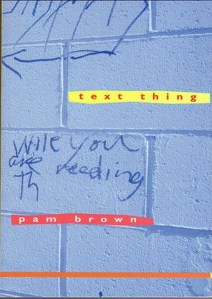
Since 1972, Pam Brown has published 23 books of poetry and almost as many chapbooks (chapbooks are tiny books of poetry, mostly too small to be given an ISBN). She has won major prizes, been an editor including for Jacket and Overland, and is a generous reader of other people’s books.
I enjoy her poetry, but I’m perplexed when it comes to writing about it. Before sitting down to write about Text Thing, approximately her eighteenth book, I looked back over my blog to see what I’d already written. It turns out there’s quite a lot, much revealing the extent of my ignorance about contemporary poetry. If the spirit moves you to read them, here are links to my encounters with Selected Poems 1972–1981, True Thoughts (2008), Home by Dark (2013), Missing Up (2016) and Stasis Shuffle (2021).
There are plenty of places you can go for illuminating accounts of Brown’s poetry. I especially like her 2003 interview with John Kinsella in Jacket2 where he memorably suggests that she has created her own subculture. Among many interesting things in that interview, she says something that’s relevant to page 79* of this book. Referring to the way her poems often include the names of friends without explanation, Brown says:
The … thing is that they’re signifiers. And somehow it’s also a call for community. That sounds corny and old-fashioned but poetry is a marginal art and we’re like the black market of culture — it lends a freedom to do that… include real people, names…
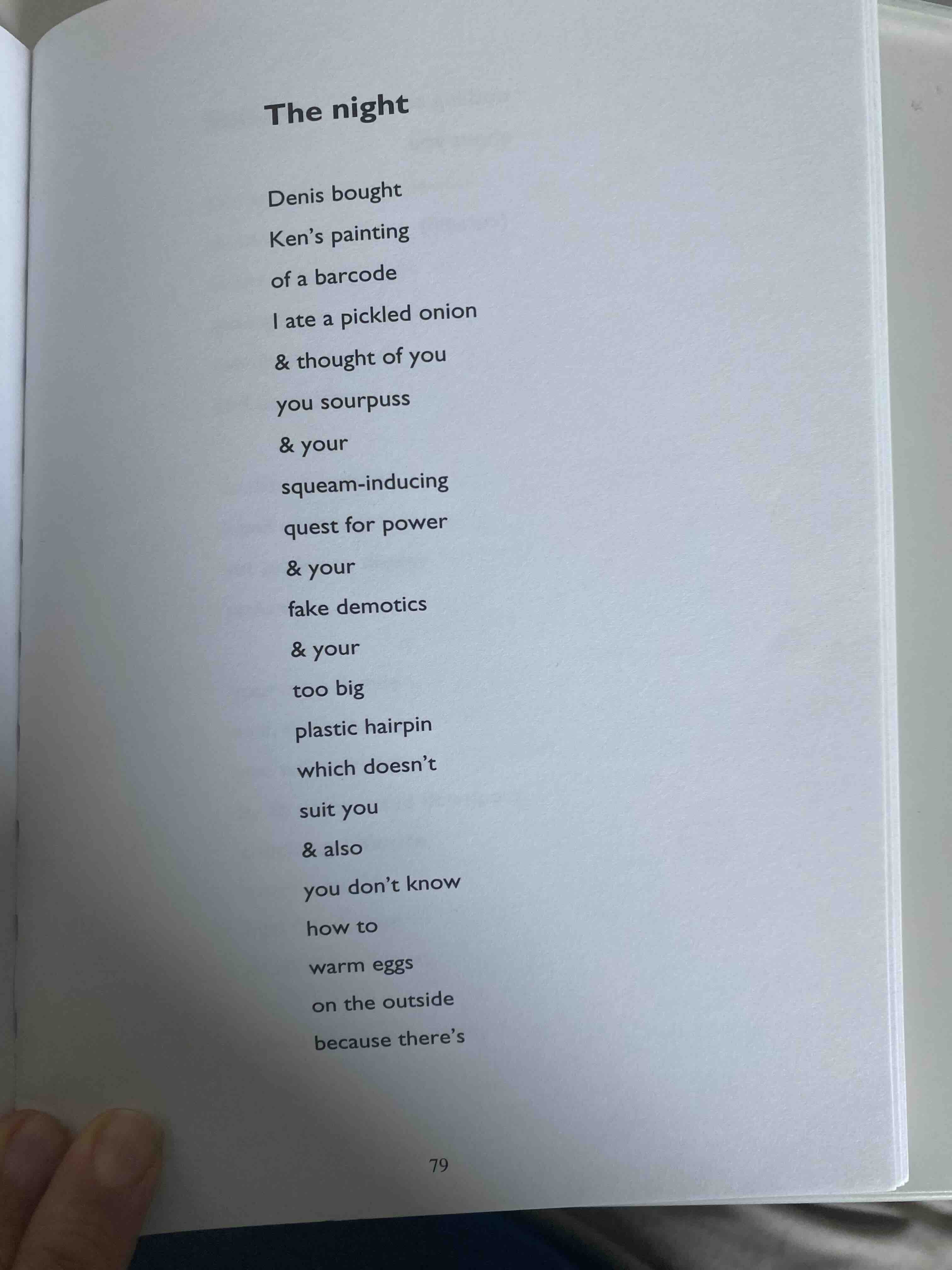
The poem that begins on page 79 is ‘The Night’:
And there are three lines over the page:
nothing cosy
about you.

(curses!)
This poem is uncharacteristically straightforward. Including the title, it consists of a single sentence whose syntax is almost simple enough to meet a primary schoolteacher’s specifications, followed by a one word exclamation. The poem’s speaker eats a pickled onion and is reminded of a friend (or perhaps a frenemy or a former lover?). She indulges in a little rant addressed to that person.
It makes me laugh and I’m not exactly sure how.
Maybe the poem invites me to imagine it being read by the person it’s addressed to. Would she/they (I’m assuming it’s not a man) be amused? Defensive? Dismissive? Retaliate in a poem of her own?
Having now read it a number of times, I realise that there’s quite a lot going on.
The night

Denis bought
Ken's painting
of a barcode
I ate a pickled onion
This opening clause sets the scene. I imagine the opening night of an art exhibition in a small gallery. Art is on sale and there are snacks, including pickled onions. ‘Ken’ is almost certainly Ken Bolton, poet and painter, named on the imprint page as the publisher of this book . ‘Denis’ is probably a real person too, but his identity doesn’t matter, any more than that of the poem’s ‘you’ does. What does matter is that all four people in the poem – ‘I’, ‘you’, Ken and Denis – are on first-name terms, and seem to belong to some kind of creative community – perhaps Brown’s ‘black market of culture’. Only when I read the poem out loud (to the long-suffering Emerging Artist) did I realise that there’s a lovely contrast between the briefly mentioned masculine, transactional world of buying and selling where even the artwork is an emblem of commerce, and the feminine, relational world of the rest of the poem.
I ate a pickled onion
& thought of you
you sourpuss
Is it ridiculous of me to compare Brown’s pickled onion to Proust’s madeleine? Probably. But the taste of this pickled onion, like the smell of the madeleine, transports the poem’s speaker from the external world to the internal one of emotion-charged memory. The word ‘sourpuss’ explains the connection. Then there’s something disarming in the string of qualities, each introduced by an ampersand, with the attention-grabbing words ‘squeam’ (which Merriam-Webster says is a back formation from ‘squeamish’) and ‘demotics’ (which in this context I take to mean the adoption of working-class manners and language, like a recent Australian Prime Minister giving himself an Aussie-sounding nickname). There’s a nice comedy in the transition from criticising an off-putting quest for power and calculated manner to a silly schoolyard insult:
& your
squeam-inducing
quest for power
& your
fake demotics
& your
too big
plastic hairpin
which doesn't
suit you
You almost expect that to go ‘which doesn’t / suit you / anyway‘ with a teenage emphasis. The first two insults carry the ring of truth. The third reflects back on the speaker.
Learned people refer to Pam Brown’s gift for sprezzatura, a casual appearance that conceals the work that went into it. The veering off in the next line – the fifth to start with an ampersand – is a nice example. I can’t read the opening ‘& also’ without thinking of an angry teenager. Brown’s world of allusion is almost certainly more sophisticated than mine – but I think of Mary-Anne Fahy’s gum-chewing Kylie Mole from the 1990s. (Come to think of it, this book was published in 2002, so Kylie Mole may well have been in Brown’s mind.) So it feels like an easy, natural follow-on from the big plastic hairpin. Then, as if it’s a perfectly natural next step, the poem turns into an intimate attack:
& also
you don't know
how to
warm eggs
on the outside
Well, maybe it’s not explicitly intimate, but the lines do suggest a shared domesticity in the past. I’m not sure what it means to ‘warm eggs / on the outside’. This conjured in my mind in image of hands holding eggs gently, imparting body heat to them. Why anyone would want to do that, or why not knowing how to do it was a moral failure wasn’t immediately clear. Then I reflected that if you’re baking a cake, a pavlova, or even an omelette, it’s a good idea to let the eggs warm up for a while ‘on the outside’ of the fridge: so there’s a practical meaning. But – for me at least – the image of motherly, protective, feminine warmth persists. And that justifies the final twist of the knife:
because there's
nothing cosy
about you.
I’m not usually one to notice perfectly conventional punctuation, but I love that full stop at the end. Back in 2002, Millennials probably weren’t yet expressing horror at Boomers’ ending text messages with a full stop, which they saw as unreasonably aggressive. This one fits their reading perfectly.
The full stop may the end of the rant, but it’s not the end of the poem:
(curses!)
The exclamation is a response to everything that has gone before. I love how many ways it can be read: ‘(Did I really just say that?)’, ‘(Do I still have all these feelings about her?)’, ‘(I was having such a nice time before I bit that pickled onion!)’, ‘Why did I ever let her into my life?)’. Or: ‘(And now I hurl curses in your direction!)’, ‘(I’ll sum it all up in the one word!)’. Given that Pam Brown often quotes from other poets and popular culture, or even odd bits of graffiti or commercial copy, it doesn’t seem wrong to hear an echo of comics like Popeye here. No time at all on Google gave me an example.
That’s just one poem. If I were to find a way that it’s representative of the whole book, I’d say it’s something about interruption. The cover illustration, attributed to Kurt Brereton, is of graffiti that reads ‘wile you are reeding th’. The book is full of interruptions, asides, distractions. ‘The Night’ can be read as being about one more distraction. But such a rich one!
I am a man of settler heritage who has been alive for almost a third of the time elapsed since Arthur Phillip claimed this continent for the British crown. I wrote this blog post on the land of Gadigal and Wangal of the Eora Nation. I acknowledge their Elders past and present and welcome any First Nations readers of the blog.
* My blogging practice is to focus on the page that coincides with my age, currently 79.


 Me fail? I fly!
Thanks for this! Good discussion of the poem and Pam Brown is a marvelous poet!
John Levy
LikeLiked by 1 person
Hullo Me Fail!
If you feel like making corrections: the ‘Ken’ referred to in Pam’s poem, or your commentary on it, is not me (KB) butthe artist Ken Searle.
I enjoyed your unpacking of Pam’s poem.
Ken Bolton
LikeLiked by 1 person
Thanks, Ken. I’ll change the text.
LikeLike